Preparation is the key to success in any interview. In this post, we’ll explore crucial Hydrographics interview questions and equip you with strategies to craft impactful answers. Whether you’re a beginner or a pro, these tips will elevate your preparation.
Questions Asked in Hydrographics Interview
Q 1. Explain the difference between single-beam and multi-beam echo sounders.
The key difference between single-beam and multi-beam echo sounders lies in the amount of data they collect. Think of it like taking a picture: a single-beam echo sounder is like taking a single vertical photograph of the seabed at a point, while a multi-beam system is like taking a wide panoramic photograph, capturing a swath of the seabed.
A single-beam echo sounder emits a single, narrow acoustic pulse straight down towards the seabed. It measures the time it takes for the sound to travel down and back up, calculating the water depth at that specific point. This is simpler and cheaper but provides only a single depth measurement for each pulse, making it inefficient for large-scale surveys.
A multi-beam echo sounder, on the other hand, transmits multiple acoustic pulses simultaneously in a fan-shaped pattern across the seabed. It receives the reflected signals from each pulse, allowing it to create a high-resolution three-dimensional image of the seafloor. This provides far more detailed information on bathymetry (water depth), seabed features, and bottom type. It’s more complex and expensive, but vastly superior for detailed mapping projects.
In short: Single-beam is simple, cheap, and provides limited data. Multi-beam is complex, expensive, and offers high-resolution data across a wide swath.
Q 2. Describe the process of hydrographic data acquisition.
Hydrographic data acquisition is a multi-stage process that involves careful planning, precise measurement, and meticulous recording. Imagine it like creating a detailed map of an underwater landscape.
- Planning and Pre-Survey Activities: This includes defining the survey area, understanding the anticipated water depths and seabed characteristics, obtaining necessary permits, and selecting appropriate equipment based on the survey objectives.
- Mobilization: Getting the survey vessel and equipment ready, calibrating sensors, and confirming communication systems. This is akin to getting all your tools and materials ready for the job.
- Data Acquisition: This is where the actual surveying happens. The vessel navigates the survey area according to a predetermined plan, using multi-beam echo sounders, single-beam echo sounders (often for deeper water areas or to supplement multi-beam), side-scan sonar, sub-bottom profilers, and other sensors to gather bathymetric, acoustic, and sometimes even underwater video data.
- Positioning: Precise positioning is crucial. This typically utilizes GPS, GLONASS, or other satellite navigation systems, often augmented by other positioning technologies like DGPS (Differential GPS) or inertial navigation systems to ensure accuracy. Imagine making sure your measurements are located exactly where they’re supposed to be on the map.
- Post-Survey Activities: Once data acquisition is complete, the equipment is demobilized and the data is prepared for further processing and analysis.
Q 3. What are the common sources of error in hydrographic surveys?
Hydrographic surveys are susceptible to various sources of error, impacting the accuracy and reliability of the data. These errors can be classified as systematic or random.
- Sound Velocity Variations: Changes in water temperature, salinity, and pressure affect the speed of sound, leading to errors in depth calculations. This is like using a ruler that’s slightly longer or shorter depending on the environment.
- Positioning Errors: Inaccuracies in the vessel’s position can significantly impact the accuracy of depth measurements. This is like marking a point on a map incorrectly.
- Instrument Errors: Malfunctions or calibration issues with the echo sounders or other sensors introduce errors. This is akin to using a faulty tool.
- Tidal Effects: Changes in water level due to tides can affect the accuracy of depth measurements if not properly accounted for. Imagine measuring the height of something while the ground is rising and falling.
- Seabed Characteristics: The nature of the seabed (e.g., soft mud versus hard rock) can affect the reflection of sound waves, leading to inaccurate depth readings.
- Environmental Conditions: Weather conditions, such as strong currents or waves, can affect data acquisition and quality. A storm makes it harder to get a clear picture.
Q 4. How do you ensure the accuracy and precision of hydrographic data?
Ensuring the accuracy and precision of hydrographic data requires a rigorous approach encompassing various techniques and best practices.
- Calibration and Maintenance: Regular calibration and maintenance of all equipment are vital. Just as you would maintain your car regularly to keep it running smoothly.
- Quality Control (QC): This involves meticulous checks and analysis of the raw data during and after acquisition. This is like proofreading a document to identify and correct mistakes.
- Tide Prediction and Correction: Accurate tide predictions are critical for reducing tidal-related errors. This is essential to ensure consistent depth measurements.
- Sound Velocity Profiling: Measuring sound velocity profiles helps correct for variations in sound speed in the water column.
- Data Validation: This involves using different techniques and data sources to verify the accuracy of the acquired data. This is like having multiple witnesses to ensure the accuracy of a statement.
- Use of Appropriate Standards: Adhering to international hydrographic standards (e.g., IHO standards) ensures consistency and quality. This is like following a standardized recipe to guarantee a consistent result.
Q 5. Explain the role of GPS in hydrographic surveying.
GPS (Global Positioning System) plays a pivotal role in hydrographic surveying, providing the crucial element of positioning. Without precise positioning, depth measurements are meaningless.
GPS receivers on the survey vessel provide real-time location data, enabling the accurate georeferencing of depth soundings. This means associating each depth measurement with its precise geographic coordinates (latitude and longitude). Imagine trying to draw a map without knowing the exact location of each point.
While standard GPS is useful, hydrographic surveys often require higher accuracy. Therefore, techniques such as DGPS (Differential GPS), which uses a network of base stations to correct for GPS errors, are commonly used. RTK (Real-Time Kinematic) GPS provides even more precise positioning, achieving centimeter-level accuracy. These enhanced techniques help reduce positioning errors that can significantly affect the accuracy of the final hydrographic survey.
Q 6. What are the different types of hydrographic charts?
Hydrographic charts serve as vital navigational tools, guiding mariners safely through waterways. There are several types, each serving specific purposes.
- Enroute Charts: These are large-scale charts designed for general navigation, providing comprehensive information on water depths, hazards, and navigational aids. These are the equivalent of a general road map.
- Approach Charts: These charts cover coastal areas and approaches to ports, providing detailed information for safe navigation into harbors and ports. This would be similar to a detailed map of the city you’re visiting.
- Harbor Charts: These are detailed charts of individual ports and harbors, offering high-resolution depictions of navigational features, alongside mooring areas and other critical information. Think of these as very detailed street maps of a specific neighborhood.
- Special-purpose Charts: These charts are designed for specific purposes, such as fishing, dredging, or underwater pipelines, offering specialized information tailored to the intended use.
- Electronic Navigational Charts (ENCs): Digital charts used by electronic charting systems (ECS) offering various layers of data and dynamic capabilities that adapt in real-time. This represents the modern navigational equivalent, updated and easily adaptable.
Q 7. Describe the process of data processing and analysis in hydrographics.
Data processing and analysis in hydrographics is a critical step transforming raw data into usable information. It’s like taking a pile of building blocks and transforming them into a magnificent castle.
- Data Cleaning: This initial step involves identifying and removing or correcting errors and inconsistencies in the raw data. It’s the equivalent of clearing away debris before building.
- Georeferencing: This is the process of assigning geographic coordinates (latitude and longitude) to each depth measurement. This is like ensuring each block is placed in the correct position.
- Tide Correction: Applying tidal corrections to the depth measurements to account for the change in water level. This is like leveling the ground before building the castle.
- Sound Velocity Correction: This process adjusts the depth measurements to account for variations in the speed of sound in water. It’s like calibrating your tools to ensure precision.
- Bathymetric Modelling: This involves creating a digital elevation model (DEM) of the seafloor, showing the shape and contours of the seabed. This is the actual construction of the castle.
- Data Visualization: This involves creating charts, maps, and other visual representations of the processed data. This is presenting the finished castle to the world.
- Quality Assurance (QA): This involves verifying the accuracy and reliability of the processed data. It’s the final inspection of the completed castle to check its integrity and design.
Q 8. What software packages are you familiar with for hydrographic data processing?
I’m proficient in several software packages crucial for hydrographic data processing. My experience includes using Hypack, a widely used industry-standard software for planning, acquisition, and processing of hydrographic survey data. It allows for real-time data visualization, quality control checks, and the generation of various nautical charts and reports. I’m also familiar with QINSy, renowned for its advanced processing capabilities, particularly useful for handling large datasets and complex survey geometries. Furthermore, I have experience with CARIS HIPS and SIPS, a powerful suite of software for processing, analyzing, and visualizing hydrographic data, including bathymetric data, sound velocity profiles, and tidal corrections. Finally, I utilize ArcGIS for spatial data management and visualization, integrating hydrographic data with other geospatial datasets for comprehensive analysis and presentation.
Q 9. Explain the concept of tidal correction in hydrographic surveys.
Tidal correction is absolutely vital in hydrographic surveys because water levels constantly change due to the gravitational forces of the sun and moon. Without correcting for these variations, depth measurements would be inaccurate and unreliable. The process involves determining the water level at the precise time each depth measurement was taken and adjusting the measured depth accordingly. This is usually achieved using a tide gauge which records water level fluctuations continuously. We use predicted tide data, often obtained from tidal prediction models or harmonic analysis of past tide gauge data. The difference between the actual water level at the time of measurement and a reference datum (e.g., Chart Datum) is then applied to the measured depth. Imagine trying to build a house on a beach without accounting for the tide – the foundation would be constantly shifting! Similarly, inaccurate depth measurements due to neglecting tidal corrections can lead to navigation hazards and project failures.
Q 10. How do you deal with outliers in hydrographic data?
Outliers in hydrographic data can stem from various sources – faulty sensors, errors in positioning, or even unusual seabed features. Ignoring them can significantly skew the results. My approach involves a multi-step process. Firstly, visual inspection of the data is crucial. We plot the data and look for points that deviate significantly from the surrounding data. Secondly, statistical methods are employed. We calculate the mean and standard deviation, identifying points that fall outside a certain number of standard deviations from the mean. Common methods include using box plots to visualize outliers. Thirdly, we investigate the cause of the outliers. Was there a problem with the sensor at that time? Was there a known obstacle or unusual seabed feature? If the outlier is due to a genuine error, it’s removed. If it’s due to a valid feature, it’s reviewed and documented. For instance, if a sonar returns a false reading due to a fish school, it would be an outlier to be treated and not a feature. Ultimately, documentation and justification are key aspects of handling outliers.
Q 11. Describe your experience with different types of positioning systems used in hydrographic surveys.
I have extensive experience with various positioning systems, each offering different levels of accuracy and capabilities. GNSS (Global Navigation Satellite Systems), including GPS, GLONASS, and Galileo, are fundamental for providing horizontal positioning. We often use differential GNSS (DGPS) or Real-Time Kinematic (RTK) GNSS to improve accuracy. In challenging environments with poor satellite visibility, I’ve used acoustic positioning systems such as Ultra-Short Baseline (USBL) and Long Baseline (LBL). USBL systems are particularly useful for positioning underwater vehicles, while LBL offers high accuracy for precise positioning in confined areas. For shallow water surveys, we utilize single beam echo sounders which require less sophisticated positioning system but have limitation in data collection and processing. Furthermore, the use of Inertial Measurement Units (IMUs) along with GPS and other systems are increasingly common to improve accuracy and data integrity in dynamic positioning during the survey.
Q 12. What are the safety procedures you follow during hydrographic surveys?
Safety is paramount in hydrographic surveys. Before any operation, a thorough risk assessment is conducted, identifying potential hazards like vessel traffic, weather conditions, and equipment malfunctions. We adhere strictly to the International Maritime Organization (IMO) guidelines and all relevant local regulations. This involves maintaining a safe distance from other vessels and adhering to traffic separation schemes. Regular communication with vessel traffic services (VTS) is essential, especially in busy waterways. All crew members receive appropriate safety training, including personal protective equipment (PPE) use and emergency procedures. Pre-survey planning is crucial; we always check weather forecasts and adjust operations accordingly. Furthermore, routine equipment checks and maintenance are performed to prevent failures and potential accidents, and emergency drills are conducted on a regular basis.
Q 13. Explain the concept of sound velocity profiles (SVPs).
Sound velocity profiles (SVPs) are crucial for accurate depth measurements in hydrographic surveys. Sound travels at varying speeds through water, depending on temperature, salinity, and pressure. These variations can cause significant errors in depth measurements if not accounted for. An SVP is a vertical profile of the speed of sound at different depths in the water column. It’s typically measured using a sound velocity profiler (SVP sensor). This data is then used to correct the travel time of sound waves emitted by the echo sounder, ensuring accurate depth calculations. Imagine throwing a stone into a lake – if the water density changed rapidly with depth, the path the stone takes would be unpredictable. Similarly, SVPs allow us to account for the variations in sound speed, allowing for precise depth calculations.
Q 14. How do you handle data from different sensors in a hydrographic survey?
Modern hydrographic surveys often involve data from multiple sensors – echo sounders, side-scan sonars, sub-bottom profilers, and positioning systems. Data integration is crucial for a comprehensive understanding of the seabed. This is achieved using specialized hydrographic software like Hypack or QINSy. These programs have the capability to import, process, and display data from different sensor formats. The software allows for time synchronization of data from different sources, a critical step to ensure that data points are correctly linked in space and time. Spatial referencing and datum transformations ensure all data is in a consistent coordinate system. Moreover, quality control measures are applied to each dataset before integration, ensuring consistency and reliability throughout the process. Think of it like assembling a puzzle – each piece (sensor data) is important, and the software provides the framework (processing) to bring them together accurately.
Q 15. What are the common standards and specifications followed in hydrographic surveying?
Hydrographic surveying follows several international and national standards to ensure data consistency, accuracy, and interoperability. The most prominent is the International Hydrographic Organization (IHO) standards, particularly the IHO Standards for Hydrographic Surveys (S-44). This document details specifications for various aspects of the survey, from planning and data acquisition to processing and presentation. Specific standards address aspects like positional accuracy, depth accuracy, and the reporting of uncertainties. National authorities often build upon these IHO standards, adding specific requirements relevant to their geographic locations and regulatory contexts. For instance, a coastal nation might have stricter guidelines regarding the survey of shallow waters for navigation safety. These standards ensure that hydrographic data is reliable and can be used consistently across different projects and organizations.
For example, S-44 specifies different orders of accuracy, depending on the intended use of the survey. A high-order survey for critical navigation channels requires significantly higher accuracy than a lower-order survey for general charting purposes. Understanding and adhering to these standards is vital for producing high-quality hydrographic data.
Career Expert Tips:
- Ace those interviews! Prepare effectively by reviewing the Top 50 Most Common Interview Questions on ResumeGemini.
- Navigate your job search with confidence! Explore a wide range of Career Tips on ResumeGemini. Learn about common challenges and recommendations to overcome them.
- Craft the perfect resume! Master the Art of Resume Writing with ResumeGemini’s guide. Showcase your unique qualifications and achievements effectively.
- Don’t miss out on holiday savings! Build your dream resume with ResumeGemini’s ATS optimized templates.
Q 16. Explain your experience with hydrographic project planning and management.
My experience in hydrographic project planning and management encompasses all phases, from initial concept to final report delivery. I’ve successfully led multiple projects, ranging from small-scale harbour surveys to large-scale offshore wind farm site assessments. My approach is systematic, involving a detailed planning phase. This includes defining clear objectives, identifying the required data products, selecting appropriate survey methodologies and equipment, developing a rigorous quality control plan, and allocating resources effectively. Risk assessment is crucial, anticipating potential challenges like weather conditions, equipment malfunctions, or unexpected site conditions. I use project management software to track progress, manage budgets, and ensure timely completion. Regular communication with clients and team members is paramount. During a recent project mapping a new shipping lane, careful planning prevented delays by anticipating potential logistical hurdles and proactively obtaining necessary permits.
For example, I created a detailed work breakdown structure for a recent project, dividing it into manageable tasks with assigned responsibilities and timelines. This ensured that the project remained on schedule and within budget. I also developed contingency plans to mitigate risks such as equipment failure and adverse weather conditions.
Q 17. Describe your experience with quality control procedures in hydrographics.
Quality control (QC) is integral to hydrographic surveying. It’s not a single procedure but a continuous process throughout the project lifecycle. My experience involves implementing comprehensive QC checks at each stage. This begins with pre-survey calibration of equipment and verification of positioning systems, extending to real-time checks during data acquisition and rigorous post-processing procedures. We use both automated QC techniques, such as outlier detection algorithms, and manual visual checks to identify and address anomalies. In the post-processing phase, we meticulously examine sound velocity profiles, tide gauge data, and positioning data for inconsistencies. Regular calibration and maintenance of equipment are non-negotiable. Our procedures are documented in accordance with the relevant IHO standards, ensuring traceability and accountability.
For instance, in one project, a systematic error was detected during post-processing. It was identified through careful analysis of sound velocity data that had not been properly corrected. Without our rigorous QC procedures, this error could have significantly affected the accuracy of the final bathymetric data.
Q 18. How do you ensure the quality of your hydrographic data reports?
The quality of hydrographic data reports is paramount. We follow a structured approach to ensure clarity, accuracy, and completeness. The reports are designed to be user-friendly, presenting data in clear, concise formats that are easily understandable by both technical and non-technical audiences. We adhere to IHO standards for data presentation, including the use of standardized formats and metadata. We use clear illustrations, maps, and diagrams to support the data analysis. Prior to finalization, a rigorous internal review process is undertaken, involving independent verification of the results and a thorough check of the report’s overall quality. Client feedback is actively sought and incorporated before final submission. We prioritize data integrity by utilizing digital data formats that allow for easy sharing, archival, and analysis.
For example, for a recent port development project, we provided multiple data presentations, including 3D models and interactive maps tailored to the specific needs of different stakeholders, such as engineers, environmental consultants, and port authorities.
Q 19. What are the legal and regulatory frameworks governing hydrographic surveys?
Hydrographic surveys are subject to a complex interplay of legal and regulatory frameworks. International regulations, such as those set by the IHO, provide general guidelines and standards, while national legislation provides specific regulations tailored to each country’s maritime boundaries and legal systems. These regulations often address issues of data ownership, access, and confidentiality. Permitting processes are common, particularly for surveys in sensitive areas, such as protected marine environments or military zones. Environmental regulations are also crucial, and surveys must often comply with guidelines on minimizing impact on marine ecosystems. Navigational safety regulations influence the accuracy and standards required for hydrographic surveys used in creating nautical charts. The United Nations Convention on the Law of the Sea (UNCLOS) plays a significant role in the legal framework governing maritime boundaries and the rights and obligations of coastal states regarding hydrographic data.
For instance, a project close to a marine protected area required environmental impact assessment approval in addition to the standard hydrographic survey permits.
Q 20. Explain the different types of hydrographic survey vessel and equipment.
A wide variety of vessels and equipment are used in hydrographic surveys, depending on the scale and complexity of the project. Vessels range from small, shallow-draft boats suitable for coastal and inland surveys to large, ocean-going research vessels capable of operating in deep waters. The choice of vessel depends on factors such as water depth, weather conditions, and access to the survey area. Equipment includes:
- Positioning Systems: GPS, GNSS, and inertial navigation systems are used to determine the precise location of the survey vessel.
- Sounding Systems: Single-beam and multibeam echo sounders are used to measure water depth. Multibeam systems provide a higher resolution and wider swath coverage than single-beam systems.
- Side-Scan Sonar: This is used to image the seabed and detect objects on the seafloor.
- Sub-bottom Profilers: These systems are used to image the subsurface layers of the seafloor.
- Current Meters: Used to measure the speed and direction of water currents.
- Tide Gauges: These instruments measure the height of the water level, essential for correcting depth measurements.
Q 21. What experience do you have with different types of sonar systems?
My experience includes working with a variety of sonar systems, encompassing both single-beam and multibeam technologies. Single-beam echosounders are suitable for simpler surveys requiring less detail, while multibeam systems are preferred when high-resolution bathymetry is required. I’m proficient in operating and processing data from various manufacturers, including Kongsberg, Teledyne Reson, and R2Sonic. My experience extends to understanding the different operational parameters of each system and optimizing their performance for various environmental conditions. This includes considerations such as water depth, water column characteristics (e.g., turbidity), and seabed characteristics. I have worked with systems using different frequencies and beam configurations, adapting my approach to achieve the optimal balance between data resolution and survey efficiency. Furthermore, I understand the limitations of each sonar type and the importance of selecting the appropriate system for the specific project objectives.
For example, when working on a shallow-water harbour survey, we selected a multibeam system with a high-frequency transducer for optimal resolution in resolving detailed features on the harbour floor. For a deep-water survey, a low-frequency multibeam was more appropriate, given the greater penetration depth needed.
Q 22. How do you manage and interpret hydrographic data in GIS software?
Managing and interpreting hydrographic data in GIS software involves a multi-step process. First, the data – typically in formats like XYZ point clouds, soundings, or gridded bathymetry – needs to be imported. This often requires careful consideration of coordinate systems and datum transformations to ensure accurate spatial referencing. Popular software packages like ArcGIS, QGIS, and CARIS HIPS are commonly used. Once imported, data quality control is crucial. This involves identifying and correcting outliers, inconsistencies, and errors. We employ various techniques including visual inspection, statistical analysis, and comparison with existing datasets. Next, the data is analyzed and interpreted. This could involve creating depth contours (isobaths), calculating water volumes, identifying seabed features (e.g., wrecks, pipelines), or modeling the seafloor for navigation or engineering projects. Visualization is key here; we use different symbology, 3D representations, and surface shading to effectively communicate the spatial characteristics of the seabed. For example, I recently used ArcGIS to analyze a multibeam echosounder dataset, correcting for tidal effects before creating a detailed 3D model of a harbor for dredging planning. The resulting visualizations clearly showed areas requiring dredging and helped optimize the project’s efficiency.
Q 23. Describe your experience with bathymetric data visualization and presentation.
Bathymetric data visualization and presentation is a critical component of hydrographic surveying. My experience spans various methods, ranging from simple contour maps to sophisticated 3D models. The choice of visualization technique depends largely on the intended audience and the specific information to be conveyed. For instance, a simple contour map with depth shading might suffice for a general overview, while a 3D model with textures and annotations is better suited for detailed analysis or presentations to stakeholders. I’ve used several software packages including ArcGIS Pro, QGIS, and CARIS HIPS to generate a wide array of visuals, from shaded relief maps highlighting seabed topography to cross-sections illustrating changes in depth along specific transects. Interactive 3D visualizations are particularly powerful for engaging audiences and enabling exploration of the data. For example, during a project assessing the impact of coastal erosion, I created an interactive 3D model showing seabed changes over time, effectively communicating the erosion rate and potential risks to coastal infrastructure to the local council. The use of color ramps, transparency, and annotations is vital to effectively conveying depth, seafloor features, and uncertainties.
Q 24. What are the challenges in conducting hydrographic surveys in shallow water?
Shallow water hydrographic surveys present unique challenges compared to deeper water surveys. The primary challenges stem from the increased influence of factors like water column variability, bottom scattering, and the presence of surface waves and currents. These factors can significantly affect the accuracy and reliability of the acquired data. Water column variability can be caused by suspended sediments, which can scatter the acoustic signal and lead to inaccurate depth measurements. Bottom scattering, caused by the seafloor’s roughness, can also hinder accurate depth readings. Surface waves and currents affect the positioning of the survey vessel and the accuracy of the sound velocity profile, which is critical for depth calculations. Furthermore, shallow water often necessitates the use of specialized equipment and techniques, such as higher-frequency sounders and careful positioning strategies, to mitigate these issues. I recall a project where we were surveying a shallow, highly turbid estuary. We had to carefully select the appropriate frequency of the sounder to penetrate the sediments effectively whilst minimizing the impact of water column scatter. Careful planning and real-time quality control were essential to ensure the accuracy of the data collected.
Q 25. How do you address environmental considerations during hydrographic surveys?
Environmental considerations are paramount in hydrographic surveys. We must carefully plan and execute surveys to minimize any potential impacts on the marine environment. This includes adherence to all relevant environmental regulations and permits, careful consideration of sensitive habitats (e.g., seagrass beds, coral reefs), and implementation of measures to reduce noise pollution. For example, we might adjust survey speeds to minimize the potential disturbance to marine mammals, or employ noise reduction techniques. We also implement robust safety protocols to ensure that survey operations do not pose risks to personnel or equipment. Before undertaking a survey, we conduct a thorough environmental impact assessment to identify potential risks and implement mitigation strategies. This often involves consultation with environmental agencies and stakeholders. Furthermore, we prioritize the use of environmentally friendly equipment and practices, such as using bio-degradable cleaning agents for equipment and selecting survey lines to avoid sensitive areas. During a recent survey in a designated marine protected area, we worked closely with marine biologists to optimize the survey plan and minimize any disruption to the local ecosystem. The survey was successfully completed with minimal environmental impact.
Q 26. Explain your experience with the use of unmanned surface vehicles (USVs) in hydrographic surveys.
My experience with unmanned surface vehicles (USVs) in hydrographic surveys has been increasingly positive. USVs offer significant advantages over traditional survey vessels, including cost-effectiveness, improved safety, and increased accessibility to challenging environments. Their autonomous operation allows for extended survey durations and reduced operational costs. The smaller size and maneuverability of USVs enable surveys in shallow and confined areas where larger vessels might struggle. We utilize USVs equipped with multibeam echosounders and other sensors to collect high-resolution bathymetric and other data, like water quality parameters. The data collected by the USV is then processed and analyzed using standard hydrographic software. For example, in a recent project mapping a complex river system, a USV was deployed due to its ability to navigate the shallow and winding channels. The speed and efficiency were significantly improved compared to traditional survey methods. The data collected was high quality and provided a comprehensive map of the riverbed.
Q 27. Describe your experience with the use of autonomous underwater vehicles (AUVs) in hydrographic surveys.
Autonomous underwater vehicles (AUVs) are becoming increasingly important for hydrographic surveys, particularly in challenging environments such as deep water or areas with limited accessibility. AUVs are capable of operating autonomously for extended periods, covering large areas and collecting high-resolution data. They can be equipped with various sensors, including multibeam echosounders, side-scan sonars, and sub-bottom profilers, enabling the collection of a wide range of data. Data processing for AUV data is slightly more complex compared to USVs, usually involving advanced post-processing techniques to account for the vehicle’s motion and environmental factors. The benefits of AUVs are significant for deeper water surveys and complex underwater environments. I participated in a deep-water survey where an AUV was deployed to collect detailed bathymetric data in an area inaccessible to traditional survey vessels. This successfully mapped a significant underwater geological feature to an unprecedented level of detail. The mission planning and data post-processing required specialized software and expertise, but the results were well worth the effort.
Q 28. What are your future goals and aspirations in the field of hydrographics?
My future goals in hydrographics center around advancing the integration of autonomous systems, improving data processing techniques, and furthering the application of hydrographic data in addressing societal challenges. I aim to deepen my expertise in the use of AI and machine learning to automate data processing workflows and improve the accuracy and efficiency of hydrographic surveys. I also see significant potential in leveraging hydrographic data for applications beyond traditional navigation, including coastal zone management, environmental monitoring, and offshore renewable energy development. Specifically, I’m keen to explore the use of advanced sensor integration on autonomous platforms to simultaneously collect bathymetric data, water quality parameters, and biological data to provide a more holistic understanding of marine ecosystems. Ultimately, I hope to contribute to the development of more sustainable and efficient methods for understanding and managing our oceans.
Key Topics to Learn for Hydrographics Interview
- Hydrographic Surveying Principles: Understanding fundamental concepts like datum, chart projections, and sound velocity profiles. Practical application involves interpreting survey data to create accurate maps.
- Hydrographic Data Acquisition: Familiarize yourself with various techniques like single-beam, multi-beam echo sounders, and side-scan sonar. Practical application includes understanding the limitations and strengths of each method and selecting the appropriate technology for a given task.
- Data Processing and Analysis: Learn about post-processing techniques, including sound velocity corrections, tide reduction, and feature extraction. Practical application involves using specialized software to create clean and accurate hydrographic datasets.
- Cartography and Chart Production: Understand the principles of nautical cartography and the creation of nautical charts. Practical application includes complying with international standards (like IHO standards) in producing charts.
- Hydrographic Instrumentation: Gain familiarity with various sensors and equipment used in hydrographic surveys. Practical application includes troubleshooting common issues and understanding the maintenance requirements of this equipment.
- Quality Assurance and Quality Control (QA/QC): Learn about the importance of QA/QC processes in hydrographic surveying. Practical application involves implementing robust procedures to ensure the accuracy and reliability of survey data.
- Legal and Regulatory Frameworks: Understanding the legal and regulatory aspects of hydrographic surveying, including international regulations and national standards. Practical application involves ensuring compliance with all relevant regulations.
- Geographic Information Systems (GIS): Learn how to integrate hydrographic data into GIS for analysis and visualization. Practical application involves utilizing GIS software to create thematic maps and models.
Next Steps
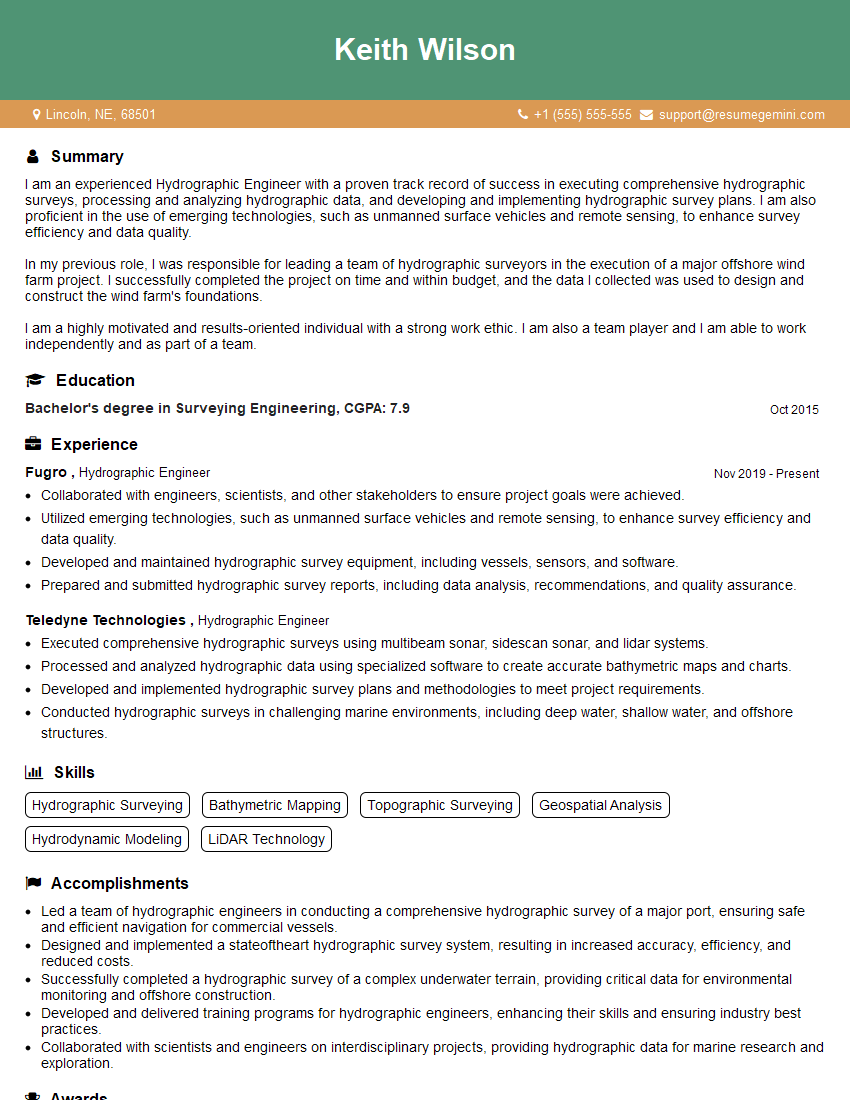
Mastering hydrographics opens doors to exciting and rewarding careers in maritime industries, environmental management, and coastal engineering. To maximize your job prospects, creating an ATS-friendly resume is crucial. ResumeGemini is a trusted resource that can help you build a professional resume that highlights your skills and experience effectively. Examples of resumes tailored to the Hydrographics field are available to guide you.
Explore more articles
Users Rating of Our Blogs
Share Your Experience
We value your feedback! Please rate our content and share your thoughts (optional).
What Readers Say About Our Blog
Very informative content, great job.
good