The right preparation can turn an interview into an opportunity to showcase your expertise. This guide to Hymnology and Liturgical Music interview questions is your ultimate resource, providing key insights and tips to help you ace your responses and stand out as a top candidate.
Questions Asked in Hymnology and Liturgical Music Interview
Q 1. Define the difference between a hymn and a psalm.
While both hymns and psalms are forms of liturgical song praising God, they differ significantly in origin and structure. Psalms are the collection of 150 sacred poems found in the Hebrew Bible, expressing a wide range of emotions from praise and thanksgiving to lament and penitence. They’ve been set to music throughout history, often in diverse styles reflecting the cultural context. Think of Psalm 23, ‘The Lord is my shepherd,’ which has countless musical arrangements. Hymns, on the other hand, are generally more recent compositions, written specifically for congregational singing in Christian worship. They often reflect theological doctrines or narratives and typically follow a structured verse-chorus pattern. ‘Amazing Grace’ is a prime example; it’s a hymn, not a psalm, though its themes resonate with many biblical psalms.
Q 2. Explain the historical development of Anglican chant.
Anglican chant’s development is deeply intertwined with the history of the Church of England. It emerged from the Gregorian chant tradition, but with distinctive English characteristics. Early forms, influenced by medieval plainsong, were relatively simple, focusing on syllabic settings of the text. The Reformation in the 16th century saw a period of experimentation, with some composers seeking to create more elaborate settings. However, the emphasis remained on clarity and congregational participation. The 19th and 20th centuries saw a revival of interest in Anglican chant, with composers like Ralph Vaughan Williams contributing significantly. His arrangements emphasized the beauty of the English language and the musical richness of the tradition, leading to more melodic and harmonically complex settings while retaining a sense of simplicity appropriate for congregational use.
Q 3. Describe the role of the organ in liturgical music.
The organ holds a central position in many liturgical traditions, particularly in Western Christianity. Its role is multifaceted: it provides harmonic support for congregational singing, enhancing the emotional impact of the hymns. It accompanies other instrumental music and vocal solos. It introduces and concludes services, creating an atmosphere of reverence or joy depending on the context. In more elaborate settings, the organ may be used for improvisational pieces, providing interludes that reflect the liturgical season or the overall tone of the service. The versatility of the organ allows it to adapt to various musical styles, from the relatively simple accompaniments of traditional hymns to complex and dramatic interludes that complement more elaborate settings.
Consider the powerful effect of an organ prelude setting the mood before a solemn service, or its uplifting accompaniment during a celebratory Eucharist.
Q 4. What are the key elements of a successful choral arrangement for liturgical use?
A successful choral arrangement for liturgical use must balance several key elements. Firstly, text clarity is paramount. The arrangement must ensure that every word of the text is easily understood by the congregation. Secondly, musical appropriateness is vital; the style should reflect the liturgical season and the overall tone of the service. A joyful anthem is unsuitable for a penitential season. Vocal accessibility is also crucial; the arrangement should be within the capabilities of the choir and should not overwhelm the congregational participation. Finally, the arrangement should be theologically sound, reflecting the spiritual message of the text. It should be moving and inspiring, creating an atmosphere of worship and reverence.
Q 5. Discuss the various musical styles used in different liturgical traditions.
Liturgical music spans an incredibly diverse range of styles, varying considerably across different traditions and historical periods. Gregorian chant, the foundation of much Western liturgical music, utilizes monophonic melodies, characterized by its modal scales and austere beauty. Eastern Orthodox traditions feature rich polyphony, often incorporating Byzantine modes and intricate melodic lines. Protestant traditions exhibit a greater variety, including the metrical hymns characteristic of many denominations, and the more elaborate choral settings found in Anglican or Lutheran services. Pentecostal and Charismatic traditions often feature more contemporary styles, reflecting gospel music or other popular genres. The choice of musical style reflects the theological and cultural context of each tradition.
Q 6. How would you select appropriate hymns for a specific liturgical season?
Selecting appropriate hymns for a specific liturgical season involves careful consideration of several factors. Firstly, the theological themes of the season should be reflected in the lyrics of the chosen hymns. For example, hymns about resurrection are suitable for Easter, while hymns focusing on repentance and forgiveness are more fitting for Lent. Secondly, the emotional tone of the hymns should align with the season’s character. Joyful and celebratory hymns are suitable for Christmas and Easter, while hymns of penitence and reflection are appropriate for Lent. Finally, the musical style should be considered, ensuring that the chosen hymns are suitable for the congregational and musical resources available. Consultation of hymnals with seasonal indexes and familiarity with the liturgical calendar are essential for this process.
Q 7. Explain the principles of musical setting of scripture readings.
Setting scripture readings musically involves a delicate balance between enhancing the text’s meaning and avoiding overshadowing it. The musical setting should complement and emphasize the liturgical text, highlighting key phrases or ideas without distracting from the message. Vocal styles should be chosen carefully, and they could range from simple unison chant to more elaborate choral settings, depending on the context and the reading’s nature. The musical style should be appropriate for the liturgical context, reflecting the overall tone and character of the service. It is vital that the musical setting serves the liturgical purpose of proclaiming the Word of God in a meaningful and accessible way to the congregation. Excessive ornamentation or overly complex harmonies could detract from the clarity of the scripture.
Q 8. What are some common challenges in leading congregational singing?
Leading congregational singing presents unique challenges. It’s not just about musical skill; it’s about fostering a sense of shared worship. One major hurdle is varying levels of musical ability within a congregation. Some may be accomplished singers, while others may be hesitant or have limited musical experience. This necessitates choosing accessible hymns and employing techniques that accommodate this range. Another challenge is maintaining a good balance between the congregation’s vocal power and instrumental accompaniment. Too much accompaniment can drown out the congregation, while too little can leave them feeling unsupported. Finally, creating a welcoming and inclusive atmosphere where everyone feels comfortable participating is crucial. Shyness, lack of confidence, or unfamiliarity with the hymn can all contribute to hesitant participation.
- Solution: Choose well-known hymns with simple melodies initially. Gradually introduce more challenging pieces. Offer clear visual aids like projected lyrics or hymn books. Provide a strong, but not overpowering, instrumental foundation. Build a supportive atmosphere by encouraging participation subtly and praising effort over perfect execution.
Q 9. How do you manage rehearsal time effectively for a church choir?
Effective choir rehearsal management hinges on planning and clear communication. Before each rehearsal, I create a detailed agenda specifying the hymns, sections, and the rehearsal objectives for each. This ensures we remain focused and avoid wasting time. I start by reviewing previously learned material, addressing any difficulties, before moving on to new material. I segment the rehearsal into focused segments—perhaps one section for vocal technique, another for musical interpretation, and a final one for overall polish. This structured approach maximizes time. Active listening and providing constructive feedback are essential. Instead of simply pointing out mistakes, I explain the desired effect and guide the choir through correcting it. Finally, recording rehearsal sessions can be invaluable for later review by choir members and for tracking progress over time.
- Example: For a complex piece, I might break down each voice part individually, then bring them together progressively.
Q 10. Describe your experience with music software for composition and arrangement.
I’m proficient in several music software applications, including Sibelius and Finale for notation, and Logic Pro X and Ableton Live for arrangement and audio production. These tools are invaluable for composing, arranging, and refining musical pieces for liturgical settings. For example, Sibelius allows me to meticulously notate complex harmonies and ensure accurate voicing for the choir, while Logic Pro X allows me to create accompaniment tracks with different instrumental timbres and textures. I leverage the software’s capabilities to explore various arrangements, adjusting dynamics, tempo, and instrumentation to find the most effective and worshipful outcome. I also use these tools to create custom hymn arrangements specifically tailored to my congregation’s capabilities and the style of the service.
- Example: Using Logic Pro X, I might create a contemporary arrangement of a traditional hymn by adding layered synths and a driving drum beat, yet maintaining the integrity of the original melody.
Q 11. How would you handle a situation where a hymn is too difficult for the congregation?
If a hymn proves too difficult for the congregation, the key is adaptation, not abandonment. Instead of discarding it entirely, I explore various solutions. One approach is to simplify the melody. This might involve omitting some less crucial sections or altering the range to make it more comfortable for the congregation. Another strategy is to offer a simplified accompaniment track. Reducing the complexity of instrumental parts can make it easier for the congregation to follow the melody. Finally, I might choose an alternative arrangement, perhaps a more accessible version of the same hymn available in other hymnals. Openly discussing the challenge with the congregation, emphasizing participation over perfection, can also ease concerns and encourage a more relaxed singing environment. The goal is to make the experience inclusive and enjoyable for all.
Q 12. Explain your familiarity with different hymnals and their theological perspectives.
My familiarity with hymnals spans a wide range, including the widely used Hymnal 1982 (Episcopal), The United Methodist Hymnal, and Glory and Praise. Each hymnal carries a unique theological slant reflecting the denomination’s beliefs and traditions. For instance, Hymnal 1982 leans towards a high church tradition, featuring many hymns emphasizing the liturgical year and sacramental theology. The United Methodist Hymnal showcases a broader selection, incorporating both traditional and contemporary hymns, reflecting the denomination’s diverse theological perspectives. Glory and Praise often exhibits a contemporary emphasis, with a blend of traditional and contemporary styles and a focus on themes of social justice and inclusivity. Understanding these nuances allows me to select hymns that best resonate with the specific theological context of the service and the congregation’s preferences.
Q 13. Discuss the importance of musical balance in a liturgical setting.
Musical balance in a liturgical setting is paramount. It’s about creating a harmonious blend of congregational singing, choral anthems, instrumental music, and silence, so that each element supports the overall worship experience. An imbalance, whether an overpowering choir drowning out the congregation or a weak instrumental accompaniment failing to support the singing, can disrupt the flow and diminish the spiritual impact. Achieving balance requires careful consideration of volume, instrumentation, and the relative prominence of different musical parts. This requires a nuanced understanding of the acoustic properties of the space and the ability to adjust the mix dynamically throughout the service. Ultimately, the goal is a cohesive, unified sound that enhances the spiritual atmosphere.
Q 14. How do you incorporate diverse musical styles within a worship service?
Incorporating diverse musical styles requires sensitivity and planning. I start by understanding the congregation’s preferences and the overall ethos of the worship community. I usually begin with well-known traditional hymns as a foundation, creating a sense of familiarity and unity. Then, I might introduce contemporary Gospel music, reflecting its vibrant energy and spiritual fervor. Perhaps a Taizé chant can provide moments of quiet contemplation. Or, I might incorporate a piece of world music reflecting the diverse backgrounds within the congregation. The key is to create a cohesive and meaningful sequence of musical styles, making sure each selection serves a specific purpose within the service and enhances the overall worship experience. Transitions between styles should be carefully planned to avoid jarring contrasts.
Q 15. What is your experience with leading instrumental ensembles in a liturgical context?
My experience leading instrumental ensembles in liturgical settings spans over fifteen years. I’ve directed groups ranging from small chamber ensembles accompanying congregational singing to larger orchestras for major liturgical celebrations. This includes experience with a variety of instruments and musical styles, adapting arrangements to suit the specific needs of the liturgy and the architectural acoustics of the space. For example, in a small, intimate chapel setting, a string quartet might be ideal, while a large cathedral might necessitate a full orchestra or a choir with organ accompaniment. A key aspect of my approach is careful rehearsal and attention to detail, ensuring both musical excellence and a reverent atmosphere. I prioritize collaborative musicianship, fostering a spirit of mutual respect and artistic growth within the ensemble.
I’ve successfully prepared and led instrumental ensembles for various services, including Holy Week observances, Christmas Eve masses, and Pentecost celebrations. My focus is always on enhancing the spiritual experience of the congregation through well-executed and theologically appropriate music.
Career Expert Tips:
- Ace those interviews! Prepare effectively by reviewing the Top 50 Most Common Interview Questions on ResumeGemini.
- Navigate your job search with confidence! Explore a wide range of Career Tips on ResumeGemini. Learn about common challenges and recommendations to overcome them.
- Craft the perfect resume! Master the Art of Resume Writing with ResumeGemini’s guide. Showcase your unique qualifications and achievements effectively.
- Don’t miss out on holiday savings! Build your dream resume with ResumeGemini’s ATS optimized templates.
Q 16. Describe your approach to teaching musical skills to non-musicians.
Teaching musical skills to non-musicians requires patience, creativity, and a strong understanding of basic musical concepts. My approach is highly experiential and focuses on building confidence. I start with simple rhythmic exercises and melodic patterns, gradually introducing more complex elements. Instead of focusing solely on theoretical knowledge, I emphasize practical application through group singing, simple instrumental pieces, and improvisation exercises.
For instance, I might begin a session by having the group clap simple rhythms together before introducing basic notation. Later, we’d explore simple melodies using handbells or recorders before moving to more complex harmonies. My goal is to foster a love for music and a sense of accomplishment, regardless of prior musical training. I regularly assess their progress and tailor my teaching methods to accommodate diverse learning styles. Positive reinforcement and creating a supportive learning environment are crucial aspects of my teaching philosophy.
Q 17. How do you incorporate contemporary music into a traditional liturgical setting?
Incorporating contemporary music into a traditional liturgical setting requires careful consideration of theological appropriateness and stylistic coherence. The key is finding pieces that resonate with the liturgical message while maintaining respect for the tradition. This can involve selecting contemporary hymns with strong theological themes or commissioning new compositions that reflect both traditional and modern musical idioms. I carefully consider the overall context – the specific service, the congregation’s preferences, and the overall aesthetic of the worship space.
For example, a contemporary gospel-style arrangement of a well-known hymn can add vibrancy without detracting from its spiritual message. However, a jarringly discordant piece might be inappropriate. It’s a balance between innovation and reverence. The goal is not simply to add contemporary elements, but to enhance the liturgical experience through music that is both meaningful and engaging to the modern worshipper. Careful consideration of instrumentation and arrangement is essential to ensure the new piece fits seamlessly into the traditional musical landscape.
Q 18. Explain your understanding of copyright regulations regarding liturgical music.
Copyright regulations regarding liturgical music are complex and require careful attention. Generally, performing a copyrighted musical work requires obtaining permission from the copyright holder, usually through a licensing agency like OneLicense or CCLI. This is particularly crucial for commercially published works, including hymnals and contemporary worship songs. Public domain works are usually freely available, but confirming their status is important.
Improper use of copyrighted material can lead to legal consequences and financial penalties. Therefore, it is essential to always check the copyright status of any musical piece before incorporating it into a liturgical service. I meticulously maintain records of all the music used, ensuring that necessary licenses are obtained and properly documented. Understanding and adhering to copyright law is not only ethically responsible but also protects the church and its musicians from potential legal issues.
Q 19. Describe your experience with preparing and leading music for special services (e.g., weddings, funerals).
Preparing and leading music for special services like weddings and funerals requires sensitivity, empathy, and a nuanced understanding of the occasion. For weddings, I work closely with the couple to select music that reflects their personal preferences and the overall tone of the ceremony. This might involve a mix of traditional hymns, classical pieces, and contemporary songs.
Funerals, on the other hand, call for a more somber and reflective approach. Music selection should provide comfort and solace to the bereaved. I usually discuss the deceased’s musical tastes and preferences with the family to create a program that is both appropriate and meaningful. In both instances, careful consideration of the instrumentation and the overall flow of the musical selections are crucial to the success of the event. I ensure the music seamlessly integrates with the liturgical rites and the emotional arc of the ceremony.
Q 20. How do you work collaboratively with other members of the worship team?
Collaborative teamwork is crucial for successful liturgical music. I work closely with the pastor, the worship team leader, and other musicians to create a unified and cohesive musical experience. Open communication, mutual respect, and a shared vision are vital for achieving this. We engage in regular meetings to plan the music for upcoming services, discuss the theological themes, and coordinate the various elements of the worship service. This collaborative approach allows us to create a worship experience that is both spiritually enriching and musically satisfying for the congregation.
For example, I often consult with the pastor about the sermon’s theme to select hymns and other musical pieces that complement the message. I also work closely with the sound technician to ensure optimal audio quality. Through this collaborative effort, we create a synergistic whole greater than the sum of its parts.
Q 21. Discuss your understanding of the theological implications of liturgical music.
Liturgical music holds profound theological implications. It’s not merely background music but a crucial element of worship, shaping the spiritual experience of the congregation. The music chosen should reflect the theological message of the liturgy, enhancing the meaning and impact of the words and actions. It can evoke specific emotions, encourage reflection, and create a sense of awe and reverence. Furthermore, the style and quality of the music can influence the overall tone and atmosphere of the worship service.
For example, a joyful hymn can express thanksgiving, while a somber piece might reflect sorrow or penitence. The use of traditional melodies and hymns can connect worshippers to their heritage and theological tradition, while contemporary music can reflect the church’s engagement with the modern world. The thoughtful selection and arrangement of liturgical music, therefore, is an act of theological articulation, shaping the community’s faith and spiritual life.
Q 22. What are your strengths and weaknesses as a liturgical musician?
My strengths as a liturgical musician lie in my deep understanding of hymnology’s historical context and theological implications, coupled with a versatile skillset encompassing organ, piano, and vocal accompaniment. I excel at crafting musically engaging services that enhance congregational participation and foster a reverent atmosphere. I’m also proficient in various musical styles, ranging from Gregorian chant to contemporary gospel, allowing me to cater to diverse liturgical preferences. However, a weakness I acknowledge is occasionally over-preparing, potentially leading to a less spontaneous and flexible response during unexpected circumstances. I’m actively working on cultivating greater adaptability and embracing the unexpected moments inherent in live liturgical music.
Q 23. How do you adapt your musical choices to different congregations?
Adapting musical choices to different congregations requires careful consideration of several factors. Firstly, I assess the age range and demographic makeup of the congregation. A younger congregation might appreciate more contemporary hymns and praise songs, while an older congregation may prefer traditional hymns and chants. Secondly, I consider the liturgical calendar and the specific occasion. A joyous occasion like a wedding might warrant more celebratory music, while a penitential season like Lent calls for more reflective and subdued pieces. Thirdly, I listen attentively to the congregation’s responses during the service itself. Observing their engagement levels helps me tailor the music accordingly – if a particular hymn doesn’t resonate, I’ll make a mental note for future services. For example, in one parish with a largely Hispanic congregation, I incorporated more Spanish hymns and adapted my accompaniment style to reflect their musical heritage. In another, a predominantly young adult congregation responded well to modern praise choruses with stronger rhythmic elements.
Q 24. Describe your experience with improvising musical accompaniment.
Improvisation is an essential skill for a liturgical musician. It allows for spontaneous musical responses that enhance the worship experience. My approach involves a deep understanding of harmony, counterpoint, and chord progressions. I can improvise organ preludes and postludes that set the tone for the service, or accompany congregational singing in a way that enhances their voices and creates a unified musical experience. I often draw inspiration from the liturgical texts and the overall mood of the service. For instance, during a solemn service, I might choose a more subdued and reflective improvisational style, while during a celebratory service, my improvisation might be more joyful and exuberant. One memorable occasion was during a spontaneous moment of prayer where I was able to seamlessly transition the organ accompaniment to provide a powerful and supportive musical backdrop.
Q 25. What resources do you utilize to enhance your knowledge of hymnology and liturgical music?
To enhance my knowledge of hymnology and liturgical music, I utilize a variety of resources. These include scholarly books and journals on liturgical music history and theory, comprehensive hymnals and their accompanying resources that provide historical and theological background on each hymn, online databases of hymn texts and tunes, recordings of historically significant performances of liturgical music and websites and forums dedicated to liturgical music discussion and sharing. I also attend workshops and conferences related to liturgical music and engage in mentorship with experienced liturgical musicians. Continuous learning is crucial in this field, as both musical styles and theological perspectives evolve over time.
Q 26. How do you ensure accessibility for individuals with disabilities in your musical leadership?
Ensuring accessibility for individuals with disabilities is paramount. I make sure that hymn texts are displayed in large, clear fonts, preferably using digital projection systems that allow for font size adjustments. For visually impaired individuals, I ensure Braille hymnals or audio recordings are available. I also consider individuals with hearing impairments by providing clear and well-projected musical accompaniment, sometimes incorporating sign language interpreters where appropriate. When selecting hymns, I prioritize lyrics that are easy to understand and sing, avoiding complex or overly poetic language that might be difficult for some to grasp. Creating an inclusive space means proactively anticipating and addressing accessibility needs, making the worship experience genuinely welcoming for everyone.
Q 27. Explain your understanding of different musical notations and their application in liturgical settings.
My understanding of musical notations encompasses various forms used in liturgical settings. These include Gregorian chant notation (neumes), which uses symbols to indicate melodic contours rather than precise pitches, modern staff notation, which provides a precise representation of pitch and rhythm, and chord symbols, which are used extensively in accompanying congregational singing and contemporary liturgical music. The choice of notation depends on the specific musical piece and its intended purpose. For instance, Gregorian chant is typically represented using neumes, whereas contemporary hymns and songs are usually notated using modern staff notation with chord symbols for accompaniment. My experience with diverse notation systems enables me to interpret and perform a wide range of liturgical music accurately and effectively.
Q 28. Describe your approach to creating a welcoming and inclusive musical environment for all participants.
Creating a welcoming and inclusive musical environment involves several key strategies. Firstly, I prioritize diverse musical styles to cater to the broad range of preferences within the congregation. Secondly, I ensure that musical leadership reflects the diversity of the community, fostering a sense of belonging and representation. Thirdly, I encourage congregational participation, creating a space where all voices are valued and heard, regardless of skill level. I also pay close attention to the language used in announcements and the overall tone of the music, making sure it is accessible and non-exclusive. Finally, I actively solicit feedback from the congregation, seeking to understand their experiences and preferences to better serve their spiritual needs. By fostering a sense of community and mutual respect, I strive to create an inclusive musical environment where everyone feels welcome to participate fully in the worship experience.
Key Topics to Learn for Hymnology and Liturgical Music Interview
- Historical Development of Hymns and Liturgical Music: Understanding the evolution of hymnody and its connection to various historical periods and musical styles. Consider exploring Gregorian chant, the Reformation’s impact, and the development of congregational singing.
- Hymnody and Theology: Analyzing the theological content and expression within hymns. Be prepared to discuss how hymns reflect and shape theological understanding and beliefs.
- Liturgical Structures and Musical Settings: Familiarity with the structure of various liturgical services (e.g., Mass, Eucharist, Evensong) and how music integrates into each part. This includes understanding the function of different musical genres within the service.
- Musical Analysis of Hymns and Liturgical Music: Ability to analyze musical elements such as melody, harmony, rhythm, and form in hymns and liturgical pieces. Practical application includes discussing the effectiveness of musical choices in conveying theological meaning.
- Practical Skills and Application: Demonstrate understanding of practical skills such as hymn accompaniment, score reading, leading congregational singing, or arranging music for liturgical settings.
- Contemporary Issues in Hymnology and Liturgical Music: Discuss current trends, challenges, and debates within the field. This may include inclusivity, cultural sensitivity, and the use of modern musical styles in worship.
- Copyright and Licensing in Church Music: Understanding the legal aspects of using copyrighted liturgical music and hymns.
Next Steps
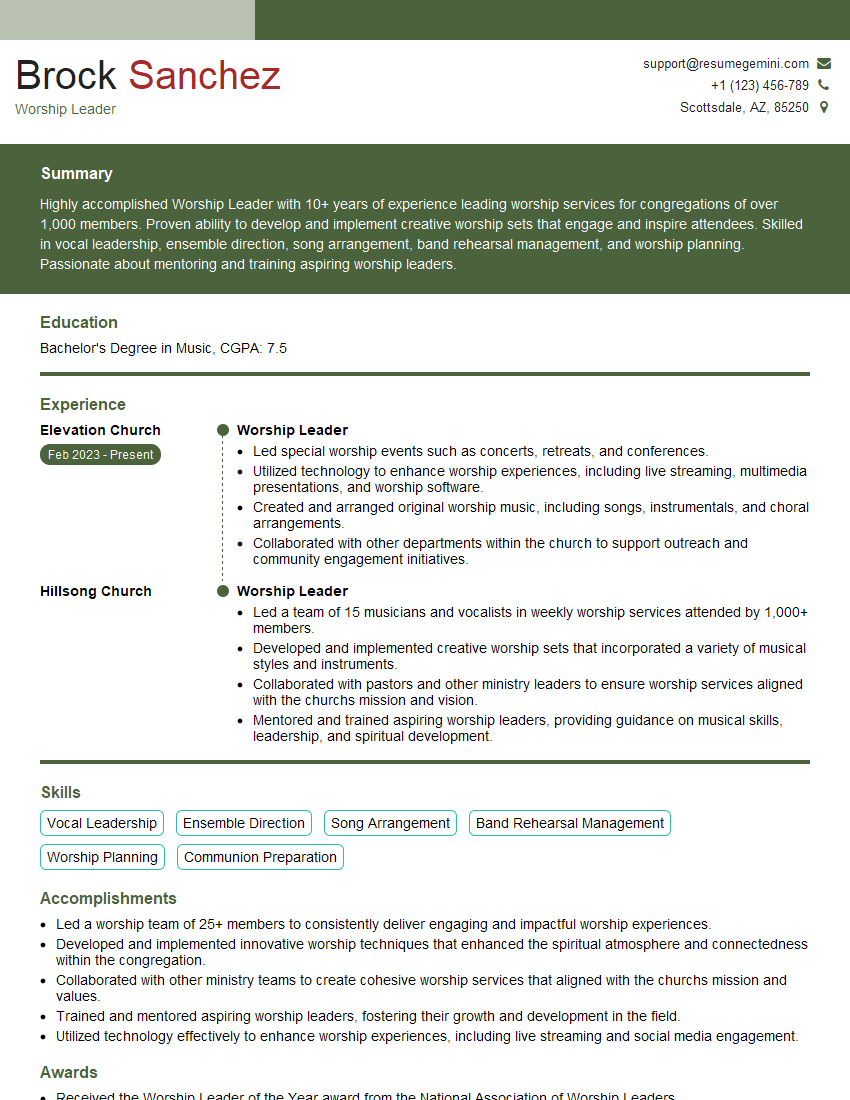
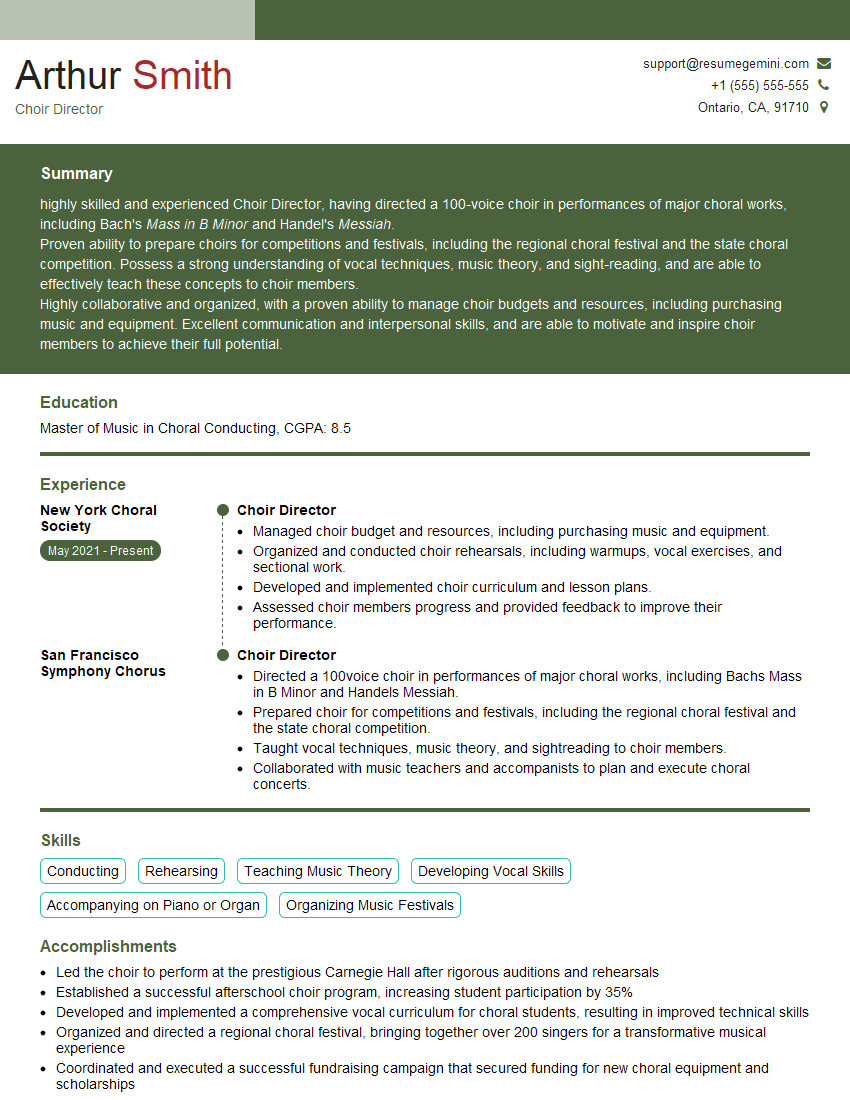
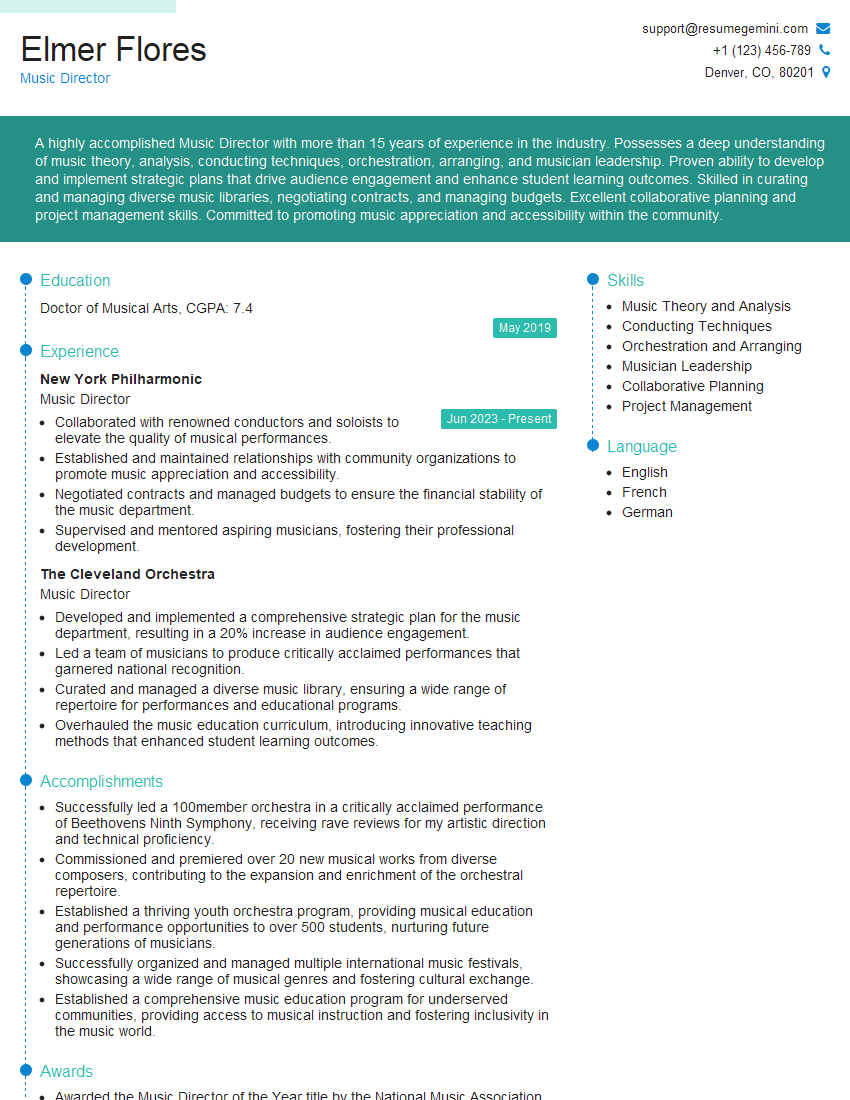
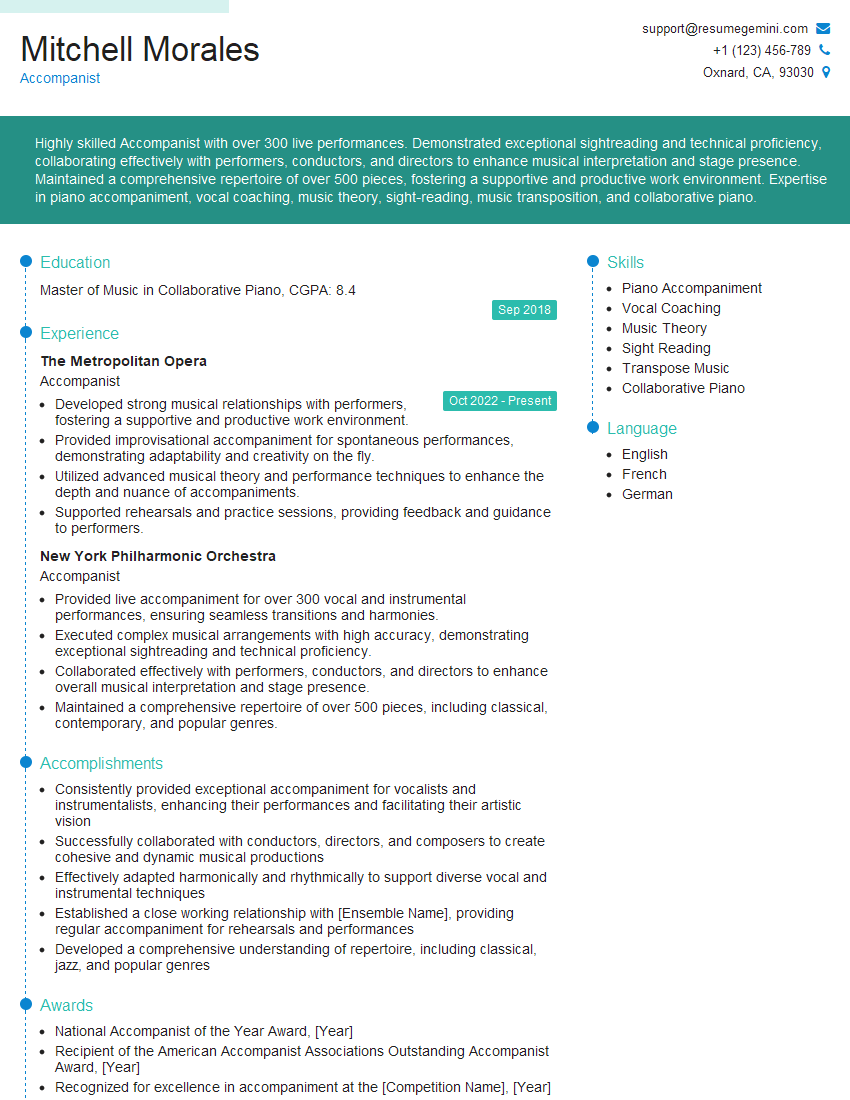
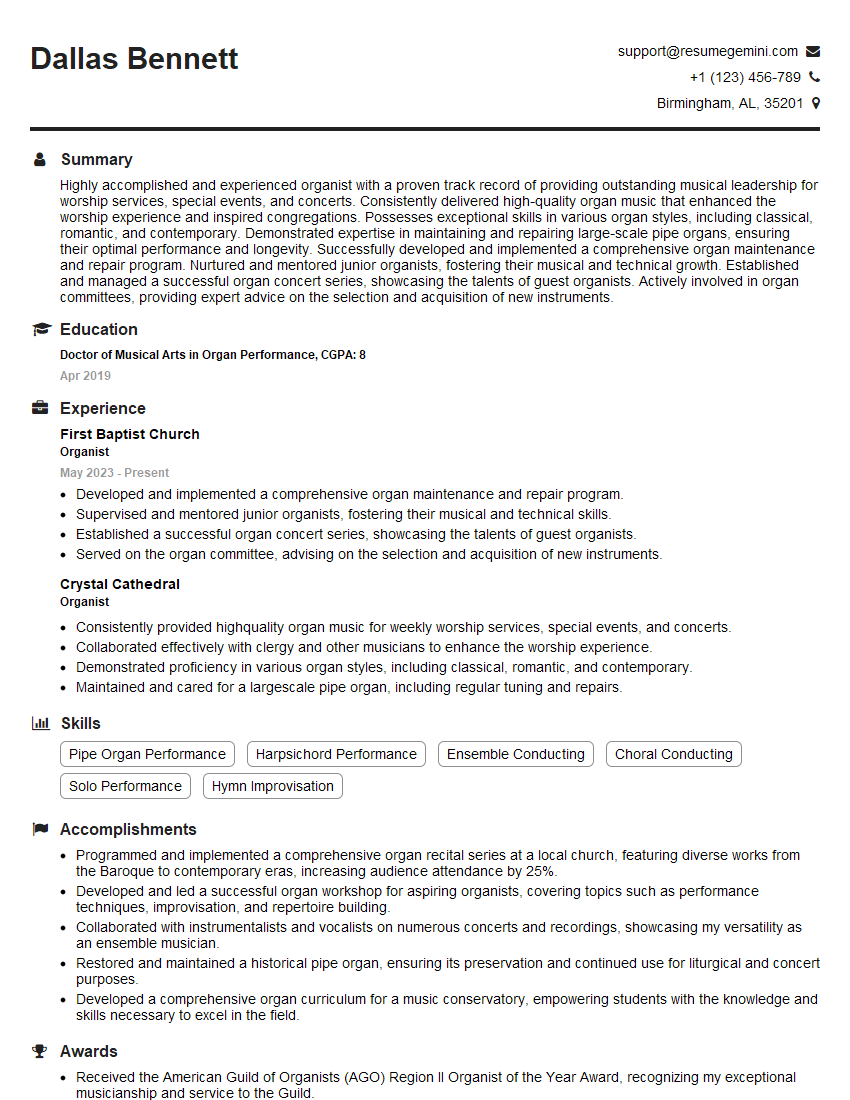
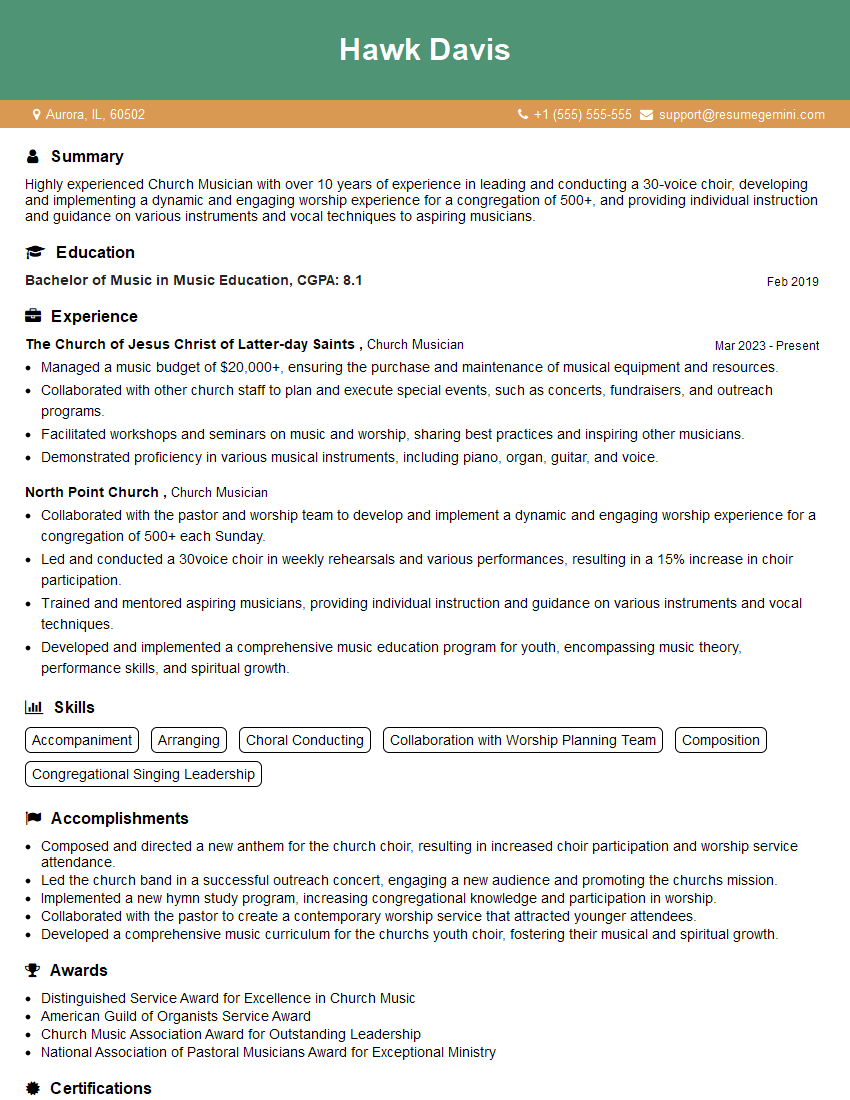
Mastering Hymnology and Liturgical Music opens doors to fulfilling careers in church music, academia, and liturgical planning. A strong understanding of these areas showcases your dedication and expertise, making you a highly desirable candidate. To maximize your job prospects, it’s crucial to present your qualifications effectively. Creating an ATS-friendly resume is essential for getting your application noticed. We highly recommend using ResumeGemini to build a professional and impactful resume that highlights your skills and experience in this specialized field. ResumeGemini provides examples of resumes tailored to Hymnology and Liturgical Music to guide you in creating a winning application.
Explore more articles
Users Rating of Our Blogs
Share Your Experience
We value your feedback! Please rate our content and share your thoughts (optional).
What Readers Say About Our Blog
Very informative content, great job.
good