Interviews are more than just a Q&A session—they’re a chance to prove your worth. This blog dives into essential Indium Plating interview questions and expert tips to help you align your answers with what hiring managers are looking for. Start preparing to shine!
Questions Asked in Indium Plating Interview
Q 1. Explain the process of Indium plating.
Indium plating is an electroplating process where a thin layer of indium metal is deposited onto a substrate material, typically a metal or a conductive polymer. Think of it like painting a metal object with a very thin layer of indium, but instead of paint, we use electricity to deposit the indium atoms onto the surface. This process enhances the substrate’s properties, making it more resistant to corrosion, improving its solderability, and increasing its conductivity. The process involves several key steps: cleaning the substrate to ensure a clean surface, preparing the plating bath with indium salts and other additives, then applying a direct current to deposit the indium onto the substrate. The thickness of the indium layer is precisely controlled to meet the specific application requirements.
Imagine you’re making a circuit board. Indium plating on the connectors ensures a reliable solder joint each time, preventing failures and ensuring the longevity of your device.
Q 2. What are the different types of Indium plating methods?
Several methods are used for indium plating, each with its advantages and disadvantages. The most common methods include:
- Electroplating: This is the most widely used method, involving the deposition of indium from an electrolyte bath using an electric current. It’s versatile and allows for precise control over the plating thickness.
- Electroless Plating: This method doesn’t require an external electric current. Instead, a chemical reducing agent is used to deposit indium onto the substrate. It offers better coverage on complex shapes but generally provides less precise control over the plating thickness.
- Immersion Plating: A simpler method where the substrate is immersed in a solution containing indium ions. Indium is deposited by a displacement reaction. This method is less common for thicker layers due to limited control and potential for inferior adhesion.
- Vacuum Deposition (sputtering or evaporation): These techniques are employed for extremely thin and uniform indium coatings, often used in specialized applications where high purity and precision are critical. They are typically more expensive than electroplating.
The choice of method depends heavily on factors such as desired thickness, substrate material, required quality, and cost considerations.
Q 3. Describe the advantages of using Indium plating.
Indium plating offers several significant advantages, making it a valuable surface treatment in various industries:
- Excellent Solderability: Indium’s low melting point and excellent wetting properties make it ideal for creating strong and reliable solder joints. This is crucial in electronics manufacturing.
- Corrosion Resistance: Indium forms a protective oxide layer, enhancing the corrosion resistance of the underlying substrate, particularly in humid environments.
- High Conductivity: Indium’s high electrical conductivity makes it suitable for applications requiring efficient current flow, like electrical contacts.
- Low Contact Resistance: This property contributes to improved electrical conductivity and reliability in connectors and switches.
- Biocompatibility: Indium’s biocompatibility makes it suitable for use in medical devices.
For instance, indium plating is essential for ensuring reliable connections in high-reliability applications such as aerospace components and medical implants.
Q 4. What are the limitations of Indium plating?
Despite its advantages, indium plating also has some limitations:
- High Cost: Indium is a relatively expensive metal, making indium plating more costly compared to other plating methods like nickel or zinc.
- Softness: Indium is a soft metal, making the plating susceptible to scratching and abrasion. This limits its use in applications requiring high wear resistance.
- Limited Hardness: The soft nature of indium also affects its wear resistance.
- Potential for Hydrogen Embrittlement: In some cases, the plating process can introduce hydrogen into the substrate, leading to hydrogen embrittlement and reducing the mechanical strength.
- Oxidation: Though the oxide layer is protective, indium can still oxidize, especially at elevated temperatures.
These limitations need careful consideration during the design and manufacturing process to mitigate potential problems.
Q 5. How does Indium plating affect surface properties?
Indium plating significantly alters the surface properties of the substrate. The most noticeable changes include:
- Increased Surface Smoothness: A properly applied indium layer can improve the smoothness of the surface, enhancing its aesthetic appeal and improving its wettability.
- Improved Solderability: This is a key advantage, ensuring strong and reliable solder joints.
- Enhanced Corrosion Resistance: The protective oxide layer prevents corrosion, extending the lifespan of the plated component.
- Increased Electrical Conductivity: The high conductivity of indium improves the electrical performance of the substrate.
- Altered Reflectivity: Depending on the thickness and surface finish, indium plating can affect the reflectivity of the substrate.
For example, indium plating on a copper connector improves its solderability, ensuring a strong and reliable connection, while also offering superior corrosion protection in a humid environment.
Q 6. What are the key quality control parameters for Indium plating?
Maintaining consistent quality in indium plating requires meticulous control over several parameters:
- Plating Thickness: Precise control is essential using techniques like coulomb counting or measuring thickness using non-destructive methods like X-ray fluorescence.
- Plating Uniformity: Variations in thickness can lead to inconsistent performance. This is monitored visually and using profilometry.
- Adhesion Strength: The indium layer must adhere strongly to the substrate. Pull-off tests or peel tests assess this strength.
- Surface Finish: A smooth and even surface is generally desired. Surface roughness is measured using profilometry or microscopy.
- Purity of Indium: Impurities can significantly affect the plating’s properties. Regular analysis of the plating bath and indium source material is crucial.
- pH and Temperature of the Plating Bath: These factors greatly influence the plating process and need to be precisely controlled.
Regular quality control checks and adjustments are essential to ensure consistent performance and reliability of the plated components.
Q 7. How do you ensure the adhesion of Indium plating?
Ensuring good adhesion of indium plating is critical for its performance and longevity. Several factors contribute to strong adhesion:
- Proper Substrate Preparation: This is paramount. The substrate surface must be thoroughly cleaned and pre-treated to remove any oxides, contaminants, or other impurities that could hinder adhesion. This often involves chemical cleaning and mechanical treatments.
- Optimized Plating Parameters: Careful control of the plating bath’s pH, temperature, current density, and agitation is essential for optimal indium deposition and adhesion. Improper parameters can lead to poor adhesion.
- Use of Adhesion Promoters: In some cases, specific adhesion promoters can be added to the plating bath to enhance the bond between the indium layer and the substrate.
- Proper Pre-Plating Treatments: Pre-plating treatments like activating the surface or using a thin underlayer of a different metal can improve adhesion.
- Post-Plating Treatments: Sometimes, a post-plating treatment, such as baking, helps improve the bond between the indium and the substrate by promoting further diffusion and interaction.
Think of it like gluing two surfaces together – the cleaner and better-prepared the surfaces, the stronger the bond. The same principle applies to indium plating.
Q 8. Explain the role of pre-treatment in Indium plating.
Pre-treatment in indium plating is crucial for ensuring a strong, adherent, and defect-free coating. Think of it like preparing a wall before painting – you wouldn’t paint directly onto rough, dirty plaster, would you? Similarly, the substrate’s surface needs to be properly cleaned and prepared to achieve optimal adhesion.
The process typically involves several steps:
- Cleaning: This removes oils, grease, and other contaminants from the substrate’s surface using solvents, alkaline cleaners, or ultrasonic cleaning. The choice depends on the substrate material and the level of contamination.
- Etching (optional): This step uses acids (like nitric acid or hydrochloric acid) to slightly roughen the substrate surface, promoting better mechanical bonding of the indium layer. This is especially important for smoother surfaces where the adhesion may otherwise be weak.
- Activation (optional): This step may involve a brief immersion in a dilute acid solution to activate the substrate surface and enhance its receptivity to the indium plating bath. This is frequently used for certain metals to enhance adhesion.
- Rinsing: Thorough rinsing with deionized water between each step is essential to remove residual chemicals and prevent contamination of the plating bath. Improper rinsing can lead to plating defects.
For example, when plating indium onto copper, a typical pre-treatment might involve an alkaline cleaning step followed by a brief etch in nitric acid, before a final rinse before the plating process.
Q 9. What are the common defects found in Indium plating and their causes?
Several defects can occur in indium plating, often caused by issues within the plating process. Understanding these defects is key to improving plating quality.
- Poor Adhesion: This is often caused by inadequate pre-treatment, leaving contaminants on the substrate surface or a poorly prepared surface. Think of trying to stick a sticker to a dusty surface – it won’t adhere well.
- Rough or Pitted Surface: This can be caused by high current densities, impurities in the plating bath, or inadequate agitation of the solution. It’s similar to using a paint roller with too much paint – the texture becomes uneven.
- Nodules or Dendrites: These are tree-like growths that form due to high current densities or localized concentration differences in the plating bath. They’re like unwanted clumps forming on a painted surface.
- Burning: This occurs when excessive current density leads to localized overheating, causing the indium to become burnt or discolored. It’s akin to melting the paint onto the surface.
- Porosity: This refers to tiny holes or imperfections in the coating, which can lead to corrosion. Imagine tiny holes letting water get through a coat of paint.
Identifying the root cause of the defect requires careful observation and systematic troubleshooting, as detailed in the next answer.
Q 10. How do you troubleshoot problems encountered during Indium plating?
Troubleshooting indium plating problems is a systematic process. It requires a keen eye for detail and a methodical approach.
- Visual Inspection: Carefully examine the plated parts for defects. Note the type, location, and severity of any defects.
- Analyze Plating Bath Chemistry: Check the concentrations of indium ions, additives, and other components in the bath. Deviation from the optimal parameters can significantly impact the plating quality.
- Current Density Adjustment: Too high a current density can lead to burning, nodules, or poor adhesion. Adjust it downwards if these are observed. Similarly, lower the current density if you notice slow plating speeds or thin coatings.
- Pre-treatment Evaluation: Re-evaluate the effectiveness of the pre-treatment process. Look for incomplete cleaning, inadequate etching, or issues with rinsing.
- Agitation Check: Poor agitation can lead to non-uniform plating. Ensure adequate agitation is provided to the plating bath.
- Temperature Control: Check the bath temperature; fluctuations can affect plating quality. Maintain the ideal temperature as recommended for your bath chemistry.
- Additive Analysis: If additives are used, check their concentration and functionality. Insufficient or degraded additives can affect plating properties.
For instance, if you observe burning, reducing the current density and checking the bath temperature would be the initial steps. If you observe poor adhesion, it would be necessary to review the cleaning and etching stages of pre-treatment.
Q 11. Describe the different types of Indium used in plating.
Indium used in plating typically comes in two main forms:
- Indium metal: High-purity indium metal is dissolved in an electrolyte solution to create the plating bath. The purity of the indium is crucial for obtaining a high-quality, defect-free plating.
- Indium salts: These are often used as a source of indium ions in the plating bath. Common indium salts include indium sulfate and indium chloride. The choice of salt can impact the bath’s properties and the quality of the resulting deposit.
In some cases, indium alloys might also be used in specific applications where unique properties are needed. The selection of indium type will be largely influenced by the application’s requirements and the type of plating bath used.
Q 12. What is the role of additives in Indium plating baths?
Additives play a vital role in optimizing the indium plating process. They’re like secret ingredients that enhance the final product’s properties.
- Brighteners: These additives produce a bright, shiny finish on the plated surface. They control the crystal growth in the plating process, leading to a smoother, more aesthetically pleasing coating.
- Levelers: These help to create a more uniform thickness of the indium layer across the substrate surface, particularly in areas with complex shapes. This ensures consistency in the plating.
- Stress reducers: These additives help to minimize internal stresses in the indium deposit, thus reducing the risk of cracking or peeling of the coating.
- Grain refiners: These promote a finer grain structure in the indium layer, which can lead to improved mechanical properties and corrosion resistance.
The specific additives used will depend on the desired properties of the indium plating and the type of plating bath employed. The precise concentration of each additive must be carefully controlled to achieve the optimal results.
Q 13. How do you control the thickness of the Indium plating layer?
Controlling the thickness of the indium plating layer is critical for ensuring the coating meets the required specifications. Several methods are used:
- Time Control: Plating time is directly related to the coating thickness. A longer plating time will result in a thicker coating. However, this is a less accurate method for precise control.
- Current Density Control: Increasing the current density increases the deposition rate and results in a thicker coating. Precise control over current density is essential to achieve consistent thickness.
- Measurement Techniques: Measuring the thickness of the indium layer during or after the plating process is essential. This is done using methods such as beta backscattering, X-ray fluorescence, or cross-sectional microscopy. The measurement data will help determine the precise plating time or current density required for the desired thickness.
Think of it like baking a cake – you need to control the baking time to achieve the desired thickness of the cake layers. Similarly, controlling the plating parameters helps us achieve consistent indium coating thickness.
Q 14. Explain the importance of bath chemistry control in Indium plating.
Maintaining the correct bath chemistry is paramount for consistent and high-quality indium plating. It’s like maintaining the right recipe in cooking – slight changes can drastically impact the final result.
Regular monitoring and adjustments are necessary to ensure optimal performance and prevent defects. Key parameters to monitor include:
- Indium ion concentration: This needs to be maintained within a specific range to ensure a constant plating rate and coating quality. Depletion of indium ions can lead to thinner coatings or uneven plating.
- pH: The pH of the plating bath significantly affects the plating efficiency and the properties of the deposited indium. Changes in pH can alter the chemical reactions and lead to defects.
- Additive concentrations: The concentration of additives must be carefully monitored and adjusted regularly to maintain the desired plating properties such as brightness, leveling, and stress.
- Impurities: The buildup of impurities in the bath can negatively impact the plating quality. Regular filtration and bath purification are important to maintain the purity and consistency of the bath.
Regular analysis of the bath chemistry, along with periodic adjustments, will ensure consistency in the plating process and prevent unforeseen problems. Failing to maintain bath chemistry can lead to a range of defects, from poor adhesion to rough surfaces and inconsistent coating thickness.
Q 15. What safety precautions are necessary when working with Indium plating?
Indium plating, while offering excellent properties, requires careful handling due to potential health hazards. The primary concern is indium’s low toxicity; however, prolonged or repeated exposure can lead to respiratory irritation and potential long-term health effects. Therefore, a robust safety protocol is crucial.
- Proper Ventilation: Always work in a well-ventilated area or under a fume hood to minimize inhalation of indium fumes or dust generated during the plating process.
- Personal Protective Equipment (PPE): This is paramount. It includes gloves (nitrile or neoprene are recommended), eye protection (safety goggles or face shields), and respiratory protection (a respirator rated for particulate matter). Lab coats are also advisable.
- Skin Contact Prevention: Immediate and thorough washing with soap and water is essential if skin contact occurs. Avoid touching your face or eyes while working with indium solutions.
- Emergency Procedures: Have readily available eyewash stations and safety showers in case of accidental splashes or spills. A clearly defined spill response plan is crucial, outlining procedures for containing and cleaning up spills safely.
- Training and Awareness: All personnel involved should receive thorough training on handling indium and the associated risks. Regular refresher courses are beneficial.
For instance, I once worked on a project where a technician inadvertently spilled some indium plating solution. Because we had a well-defined spill protocol and immediate access to safety equipment, we were able to neutralize the solution and clean up the area effectively, avoiding any injuries.
Career Expert Tips:
- Ace those interviews! Prepare effectively by reviewing the Top 50 Most Common Interview Questions on ResumeGemini.
- Navigate your job search with confidence! Explore a wide range of Career Tips on ResumeGemini. Learn about common challenges and recommendations to overcome them.
- Craft the perfect resume! Master the Art of Resume Writing with ResumeGemini’s guide. Showcase your unique qualifications and achievements effectively.
- Don’t miss out on holiday savings! Build your dream resume with ResumeGemini’s ATS optimized templates.
Q 16. How do you maintain the Indium plating bath?
Maintaining the indium plating bath is crucial for consistent and high-quality plating. It involves regular monitoring and adjustments to ensure its optimal performance and lifespan. This includes:
- Regular Analysis: Periodically analyze the bath’s composition for indium concentration, pH, and the presence of impurities. This analysis guides the appropriate adjustments.
- pH Control: The pH of the bath is critically important. It’s usually maintained within a specific range (often slightly acidic) using acids or bases as needed. Deviations can affect plating quality and efficiency.
- Indium Replenishment: As indium is deposited onto the workpieces, its concentration in the bath decreases. Regular additions of indium salts are necessary to maintain the desired concentration.
- Filtration: Regular filtration is crucial to remove particulate matter and other impurities that can accumulate in the bath, affecting the quality and consistency of the plating. This is frequently done using filter cartridges or other appropriate filtration systems.
- Temperature Control: Maintaining a stable bath temperature is important as it significantly impacts the plating rate and quality. This often necessitates using a thermostatically controlled heater.
- Periodic Cleaning: Occasionally, a more thorough cleaning of the plating bath is needed to remove accumulated residues and maintain its long-term efficiency. This might involve filtering and the addition of cleaning agents.
Think of it like maintaining a car engine. Regular checks, fluid top-ups, and periodic servicing (cleaning) ensure the engine runs smoothly and efficiently. Similarly, meticulous bath maintenance ensures consistent and high-quality indium plating.
Q 17. Describe the environmental impact of Indium plating.
The environmental impact of indium plating is a growing concern due to indium’s limited abundance and toxicity. The primary environmental challenges include:
- Indium Waste: The disposal of spent plating solutions and residues containing indium presents a significant challenge. Improper disposal can lead to soil and water contamination.
- Resource Depletion: Indium is not widely available and is considered a critical raw material. The increasing demand for indium plating raises concerns about its sustainable use.
- Toxicity: While indium’s toxicity is relatively low compared to other heavy metals, it’s still essential to prevent its release into the environment. Bioaccumulation in aquatic ecosystems is a potential concern.
Minimizing the environmental impact involves employing responsible waste management practices, including recycling or proper treatment of spent solutions, exploring alternative plating materials wherever feasible, and optimizing plating processes to reduce indium consumption.
Q 18. What are the disposal procedures for Indium plating waste?
Disposal of indium plating waste requires adherence to strict regulations and best practices. It should never be disposed of in regular trash or down the drain. The procedures typically involve:
- Waste Segregation: Separate indium-containing waste streams (spent solutions, sludge, rinse water) from other waste materials.
- Treatment: Depending on local regulations and the nature of the waste, treatment might involve chemical precipitation, ion exchange, or other methods to remove or reduce indium concentration before disposal.
- Recycling: Whenever possible, recycle the indium content from spent solutions. Several companies specialize in indium recovery from industrial waste streams.
- Licensed Disposal: Dispose of the treated waste through a licensed hazardous waste disposal facility. This ensures compliance with environmental regulations and minimizes environmental risk.
- Documentation: Maintain meticulous records of waste generation, treatment, and disposal to ensure traceability and compliance with regulatory requirements.
Failure to follow proper procedures can result in significant environmental damage and legal penalties. Working with a licensed hazardous waste management company is always advisable.
Q 19. What are the common applications of Indium plating?
Indium plating finds applications in various industries due to its unique properties, primarily its excellent solderability and corrosion resistance. Some common applications include:
- Electronics: Indium plating is widely used in electronic components for improved solderability of connectors, contacts, and other surfaces. This is crucial for reliable circuit connections. Think of the contacts on circuit boards in your phone or computer.
- Aerospace: Indium’s corrosion resistance makes it suitable for aerospace applications, particularly where high reliability and protection against harsh environmental conditions are paramount.
- Medical Devices: The biocompatibility of indium makes it suitable for certain medical devices requiring surface treatments to enhance biocompatibility.
- Automotive: Indium plating can be used in automotive components where improved conductivity and corrosion resistance are required.
- Semiconductors: Used in semiconductor manufacturing, often to facilitate bonding of chips.
Q 20. How does Indium plating compare to other plating methods?
Compared to other plating methods, indium plating stands out due to its specific characteristics. Here’s a comparison:
- Compared to Tin Plating: Indium offers better corrosion resistance than tin, especially in harsh environments. However, tin plating is often preferred for cost effectiveness.
- Compared to Nickel Plating: Indium has better solderability than nickel but offers less corrosion and wear resistance. Nickel is typically chosen for its hardness and durability.
- Compared to Gold Plating: While gold plating offers superior conductivity and corrosion resistance, indium is significantly more cost-effective. Gold is typically reserved for high-reliability applications.
The choice of plating method ultimately depends on the specific application requirements, balancing factors like cost, performance, and environmental considerations. Each plating type offers a unique set of advantages and disadvantages.
Q 21. Explain the concept of solderability and its relevance to Indium plating.
Solderability refers to the ease with which a metal can be soldered – the ability to form a strong, reliable metallurgical bond with a solder. It’s a crucial property in electronic assembly and various other applications.
Indium’s excellent solderability is due to its low melting point and tendency to readily wet and alloy with common solders (like tin-lead or lead-free solders). This makes indium plating highly desirable for applications requiring reliable and robust solder joints, such as in the electronics industry where millions of solder joints must be created and maintained for devices to operate correctly.
For example, in the production of circuit boards, components with indium plating are easier to solder, leading to faster and more efficient assembly processes and a lower rate of failed joints compared to parts with other surface finishes. A poorly soldered joint can lead to intermittent connections and ultimately product failure. The high solderability of indium minimizes this risk.
Q 22. How do you measure the thickness of the Indium plating layer?
Measuring the thickness of an indium plating layer is crucial for ensuring quality and performance. We primarily use two methods: destructive and non-destructive testing.
Destructive Testing: This involves cross-sectioning a sample of the plated component and then using microscopy (often coupled with image analysis software) to measure the thickness of the indium layer directly. This is considered the gold standard for accuracy but requires sacrificing a part.
Non-Destructive Testing: This is preferred for mass production because it doesn’t damage the component. Common non-destructive methods include:
Electrochemical methods: These methods, like the coulometric method, measure the amount of charge required to dissolve the indium layer, allowing us to calculate its thickness.
X-ray fluorescence (XRF) spectroscopy: XRF uses X-rays to excite the indium atoms, causing them to emit characteristic X-rays. The intensity of these X-rays is proportional to the indium layer thickness. It’s a fast and relatively easy technique.
The choice of method depends on factors such as required accuracy, the number of samples, and the importance of preserving the components. For example, in a high-volume manufacturing environment, XRF is preferred due to its speed and non-destructive nature, while destructive testing might be necessary for critical applications requiring extremely precise thickness measurements.
Q 23. What are the different types of testing performed on Indium plated components?
Indium-plated components undergo several tests to ensure their quality and functionality. These tests can be broadly categorized as follows:
Thickness Measurement: As discussed earlier, this is vital to ensure the plating meets the required specifications and provides adequate protection or functionality.
Adhesion Testing: This evaluates how well the indium layer adheres to the substrate. Common tests include peel tests, scratch tests, and tape tests. Poor adhesion can lead to premature failure.
Corrosion Resistance Testing: Indium’s corrosion resistance is a key property, so we assess this through methods like salt spray testing (ASTM B117) or electrochemical impedance spectroscopy (EIS). This helps determine the longevity of the plating in various environments.
Solderability Testing: In many applications, indium plating enhances solderability. We conduct solderability tests to ensure the plated components create reliable solder joints.
Surface Finish Inspection: Visual inspection and microscopy are used to assess the surface finish for any defects like pits, cracks, or nodules that might compromise the plating’s integrity.
Electrical Conductivity Testing: For applications where electrical conductivity is crucial, we measure the conductivity of the plated component to verify its electrical performance.
The specific tests performed depend on the application and the requirements of the end-user. For instance, a high-reliability application may need a more extensive test regimen compared to a less demanding application.
Q 24. Describe your experience with different Indium plating processes.
My experience encompasses several indium plating processes, each with its own advantages and limitations:
Electroplating: This is the most common method, involving the deposition of indium from an electrolyte solution onto the substrate using an electric current. I’ve worked extensively with various electrolyte compositions, including those based on indium sulfate and indium methanesulfonate, optimizing parameters like current density, temperature, and pH to achieve the desired plating thickness and properties. For example, I successfully optimized an indium sulfate bath to significantly improve the uniformity of plating on complex geometries.
Electroless Plating: This is a chemical reduction process that doesn’t require an external electric current. While less common for indium, I have experience using it for specific applications where electroplating may be challenging, such as plating non-conductive substrates. Controlling the chemical reducing agent and its concentration is key to achieving the desired thickness and quality.
Vacuum Deposition: I’ve also worked with vacuum deposition techniques, such as sputtering or evaporation, for very thin, highly uniform indium films. This is particularly useful for applications requiring precise control of thickness and excellent adhesion, especially for microelectronic components.
My expertise extends to optimizing these processes for specific materials, ensuring compatibility and minimizing defects. Understanding the interaction between the plating process, the substrate material, and the desired properties of the final product is essential.
Q 25. How would you improve the efficiency of an Indium plating process?
Improving the efficiency of an indium plating process requires a multifaceted approach focusing on several key areas:
Process Optimization: Through experimentation and statistical analysis (e.g., Design of Experiments or DOE), I’d refine parameters such as current density, bath composition, temperature, and agitation to reduce plating time and improve the uniformity of the deposit. This can significantly increase throughput.
Waste Minimization: Implementing strategies to reduce the consumption of chemicals and water, along with developing effective waste treatment procedures are crucial for environmental responsibility and cost-effectiveness. For example, I’ve implemented closed-loop systems to recycle plating solutions and reduce wastewater.
Automation: Automating aspects of the plating process, such as loading and unloading components, can increase throughput and reduce labor costs. Implementing automated monitoring and control systems further minimizes human error and enhances consistency.
Improved Rack Design: Careful design of plating racks can ensure uniform current distribution and improve the quality and speed of plating, especially for complex parts.
Predictive Maintenance: Implementing a predictive maintenance program for plating equipment can prevent downtime and improve overall efficiency by identifying potential issues before they escalate.
A holistic approach integrating these strategies can lead to substantial improvements in efficiency and cost-effectiveness without compromising the quality of the indium plating.
Q 26. What challenges have you faced in Indium plating, and how did you overcome them?
One significant challenge I faced involved achieving uniform indium plating on complex, high-aspect-ratio parts. The non-uniform current distribution resulted in uneven plating thickness and defects. To overcome this, I implemented several strategies:
Optimized Rack Design: We redesigned the plating racks to improve current distribution using different materials and configurations, focusing on minimizing shadowing effects on the recessed areas of the component.
Pulse Plating: Implementing a pulse plating technique helped reduce the formation of hydrogen bubbles, which often interfered with uniform deposition. The carefully timed pulses optimized the deposition process.
Electrolyte Optimization: We modified the electrolyte composition to improve its throwing power (ability to deposit uniformly on complex shapes). This included adjusting additives to improve conductivity and reduce the concentration gradients within the plating solution.
Through a systematic approach combining these improvements, we successfully achieved consistently uniform indium plating across the entire surface area of the complex components.
Q 27. How do you stay updated on the latest advancements in Indium plating technology?
Staying updated in the field of indium plating requires a multi-pronged strategy. I actively participate in:
Professional Organizations: I am a member of relevant professional organizations, like the Surface Engineering Society, that provide access to conferences, workshops, and publications focusing on the latest advancements in plating technologies.
Industry Publications and Journals: I regularly read specialized journals and industry publications such as the Journal of The Electrochemical Society and other relevant publications, staying informed about new research and developments.
Conferences and Workshops: Attending conferences and workshops allows me to network with other professionals and learn directly from leading experts in the field.
Vendor Collaboration: Maintaining close contact with suppliers of plating equipment and chemicals keeps me abreast of new technologies and innovations.
This multifaceted approach ensures I remain at the forefront of advancements in indium plating technologies and best practices.
Q 28. Describe your experience with different types of plating equipment.
My experience includes working with various types of indium plating equipment:
Barrel Plating Systems: These are highly efficient for plating small, similar-shaped parts. I’ve worked with automated barrel plating systems that significantly improved throughput and consistency.
Rack Plating Systems: These are more flexible for plating larger or irregularly shaped components. I have experience with both manual and automated rack plating systems. Precise control of current density and temperature is vital with this type of system.
Spray Plating Systems: These are useful for applying indium coatings to large surface areas or complex parts. I’ve used spray plating systems for a variety of applications, carefully controlling the spray parameters to ensure quality and uniformity.
Electroplating Power Supplies: I’m proficient in using different types of power supplies, including DC and pulse power supplies, and understand their effects on plating quality.
Automated Plating Lines: Experience with fully automated plating lines has provided me with valuable insights into optimizing throughput and ensuring consistency in large-scale production settings.
My understanding of different equipment allows me to choose the most appropriate system for a specific application and optimize its performance for best results.
Key Topics to Learn for Your Indium Plating Interview
- Indium Properties and Characteristics: Understand indium’s unique physical and chemical properties, including its low melting point, high ductility, and excellent conductivity. Consider its advantages over other plating materials.
- Indium Plating Processes: Familiarize yourself with various plating techniques, such as electroless plating, electroplating, and sputtering. Understand the differences in their applications and limitations.
- Surface Preparation and Pretreatments: Master the importance of proper surface preparation before plating, including cleaning, etching, and activation processes. Know the impact of surface imperfections on plating quality.
- Plating Bath Chemistry and Control: Gain a working knowledge of the chemical composition and parameters crucial for maintaining a stable and effective plating bath. This includes pH, temperature, and concentration control.
- Thickness Measurement and Quality Control: Understand the methods used to measure the thickness of indium plating and the importance of quality control procedures to ensure consistent results and adherence to specifications.
- Applications of Indium Plating: Explore the diverse applications of indium plating, including its use in electronics, semiconductors, and medical devices. Be prepared to discuss specific examples and their associated challenges.
- Troubleshooting and Problem Solving: Develop your ability to identify and troubleshoot common issues encountered during the indium plating process, such as poor adhesion, pitting, and uneven coating. Consider preventative measures.
- Safety Procedures and Regulations: Understand the safety regulations and precautions associated with handling indium and the chemicals used in the plating process. This demonstrates responsible and professional conduct.
Next Steps
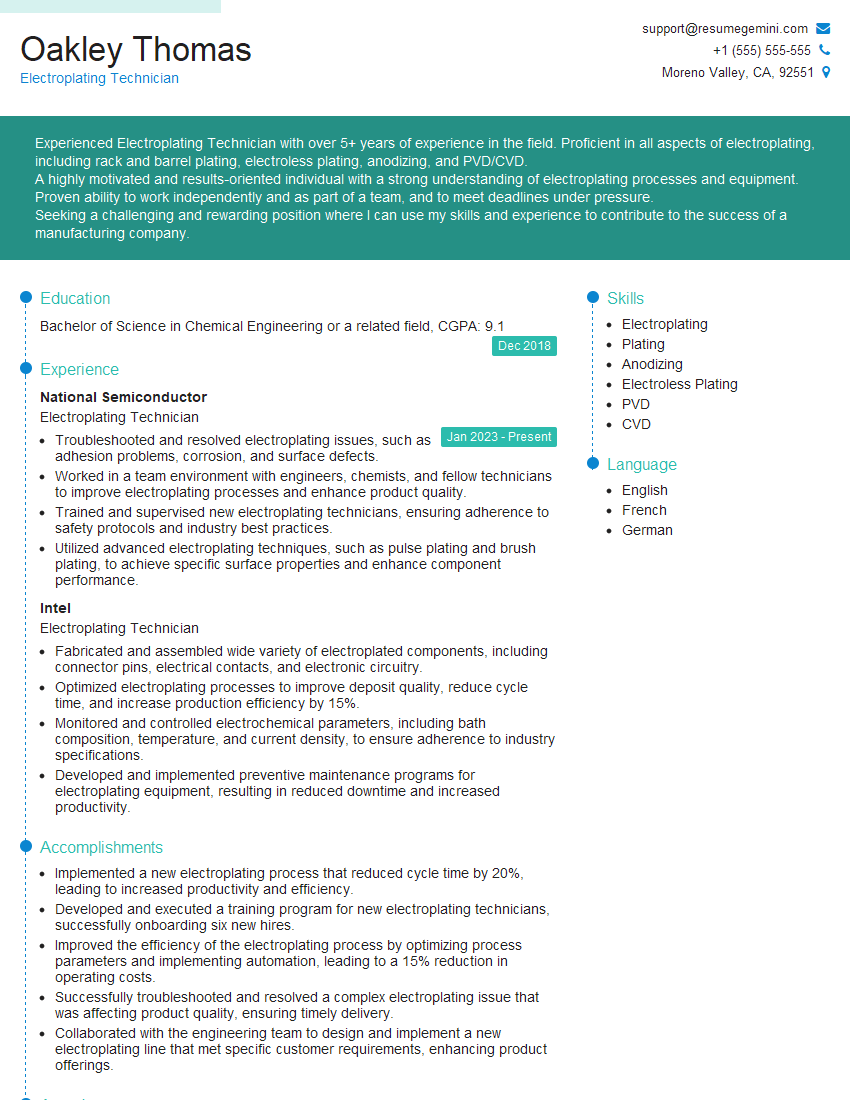
Mastering Indium Plating opens doors to exciting career opportunities in advanced manufacturing and technology. To maximize your job prospects, it’s crucial to present yourself effectively. An ATS-friendly resume is essential for getting noticed by recruiters. Use ResumeGemini to build a professional resume that highlights your skills and experience. ResumeGemini offers examples of resumes tailored to Indium Plating to guide you in creating a compelling application. Take the next step towards your dream job today!

Explore more articles
Users Rating of Our Blogs
Share Your Experience
We value your feedback! Please rate our content and share your thoughts (optional).
What Readers Say About Our Blog
good