Are you ready to stand out in your next interview? Understanding and preparing for Industrial Overlock Machine Operation interview questions is a game-changer. In this blog, we’ve compiled key questions and expert advice to help you showcase your skills with confidence and precision. Let’s get started on your journey to acing the interview.
Questions Asked in Industrial Overlock Machine Operation Interview
Q 1. What types of fabrics are best suited for overlocking?
Overlock machines excel at finishing seams on a wide variety of fabrics, but some are better suited than others. Generally, fabrics with some give or stretch work best, as the overlock stitch itself is designed to stretch and recover.
- Knit fabrics: Jersey, rib knit, interlock – these are ideal because their elasticity complements the overlock’s flexibility. Think t-shirts, leggings, or athletic wear.
- Woven fabrics with some drape: Lightweight cottons, rayons, and linens often work well, though you might need to adjust your settings depending on the weave’s tightness. Imagine a flowing summer dress or a lightweight blouse.
- Less suitable fabrics: Very stiff or heavy fabrics like heavy canvas, denim (though possible with modifications), or tightly woven materials can be more challenging to overlock smoothly. The machine might struggle to feed the fabric evenly.
The key is to consider the fabric’s weight and drape. Too much resistance, and you risk skipped stitches or broken needles. Too little, and the stitch might look loose and uneven.
Q 2. Explain the difference between a 3-thread and a 5-thread overlock stitch.
The difference between a 3-thread and a 5-thread overlock stitch lies primarily in the number of threads used and the resulting seam finish.
- 3-thread overlock: This uses two needles and one looper thread. It creates a neat, clean, and narrow seam finish. It’s suitable for quick finishing where maximum durability isn’t paramount. Think of a simple seam on a lightweight garment.
- 5-thread overlock: This utilizes two needles and three looper threads. The addition of two looper threads creates a wider, more durable seam finish, often with a rolled edge for added strength and professional look. This is great for heavier fabrics or garments requiring added reinforcement, such as active wear or work clothing.
Imagine the 3-thread stitch as a simple bandage – neat and effective, but not overly robust. The 5-thread stitch, on the other hand, is like a reinforced surgical stitch – strong and designed for lasting wear.
Q 3. How do you adjust the stitch length and width on an industrial overlock machine?
Adjusting stitch length and width on an industrial overlock machine usually involves dials or levers located on the machine’s body, often near the tension knobs.
- Stitch length: This is typically controlled by a dial marked with numbers or markings representing stitches per inch (spi). A lower number indicates longer stitches, while a higher number means shorter stitches. Experimentation is key to find the optimal stitch length for different fabrics.
- Stitch width: This setting determines how wide the overlocked seam will be. It’s often controlled by a separate dial or lever, sometimes marked with width measurements in millimeters. Adjusting this changes the distance between the needles and the loopers, affecting the overall width of the finished seam.
Remember always to consult your machine’s manual for specific instructions, as the location and operation of these controls can vary slightly across models. Always make small adjustments and test on a scrap fabric before working on your main project.
Q 4. Describe the process of threading an industrial overlock machine.
Threading an industrial overlock machine is a multi-step process that requires careful attention to detail. It’s best to follow the manufacturer’s instructions for your specific machine model, as there can be slight variations.
The general steps usually involve:
- Upper loopers: Threading the upper looper(s) usually involves guiding the thread through various guides and tension discs. This often involves pulling the thread from the spool and carefully leading it through the correct path.
- Needles: Threading the needles is usually straightforward, involving inserting the thread into the needle bar and making sure it’s secure. Always use the correct needle type and size for the fabric.
- Lower looper: Threading the lower looper(s) often involves opening a small access panel or door on the machine, carefully guiding the thread through a series of internal guides. This step requires patience and careful observation of the path the thread should take.
- Tension adjustment: Once the machine is threaded, adjusting the tension on the upper and lower loopers is crucial to achieve a balanced stitch.
Each step is important, and a single missed step can lead to skipped stitches, broken threads, or other operational issues. Always refer to your machine’s manual for the precise threading sequence.
Q 5. How do you troubleshoot a broken needle on an overlock machine?
A broken needle is a common occurrence on overlock machines, often caused by hitting a hard object in the fabric or using the wrong type of needle for the fabric being used.
- Safety First: Always unplug the machine before attempting any repairs.
- Remove the broken needle: Use the appropriate needle removal tool (usually included with the machine) to carefully remove the broken needle. Never use your fingers or pliers, as you could injure yourself or damage the needle bar.
- Insert a new needle: Carefully insert a new needle of the correct type and size (check your manual for the correct size and type). Make sure it’s securely seated in the needle clamp.
- Retest: Run a test seam on a scrap piece of fabric to make sure the new needle is functioning correctly and the machine is threaded properly.
Preventing broken needles involves using the correct needle type for the fabric weight and using a fabric suitable for the overlocker. Always check the fabric for any hard objects that may damage the needle before you start.
Q 6. What are the common causes of skipped stitches on an overlock machine?
Skipped stitches are a frequent frustration with overlock machines, often indicating a problem with tension, threading, or the machine’s condition.
- Incorrect tension: Improperly adjusted tension (either too tight or too loose) is a primary culprit. This leads to uneven thread feed and skipped stitches. Carefully readjust the tension dials, checking your manual for optimal settings for your fabric.
- Threading issues: A broken thread, a misthreaded looper, or a thread caught in the machine can lead to skips. Check your threading carefully, ensuring all threads are correctly in place and free of tangles.
- Dull needles: A dull needle can’t penetrate the fabric effectively, resulting in skipped stitches. Replace the needle with a sharp one of the appropriate size for your fabric.
- Dirty machine: Lint and dust buildup can interfere with the machine’s mechanisms. Regular cleaning and lubrication are crucial for optimal performance.
Troubleshooting often involves a methodical process of elimination, starting with the most common causes. Always begin by checking the simplest issues such as the tension before investigating more complex internal problems.
Q 7. How do you maintain the tension on an overlock machine?
Maintaining consistent tension is essential for achieving a high-quality overlock stitch. Different fabrics require different tension settings, so understanding how to adjust and maintain the tension is crucial.
The tension system typically involves adjusting dials or screws for each thread (needles and loopers). Each dial is usually numbered, although the numbers do not always correlate perfectly across machines.
- Start with recommended settings: Begin by setting the tensions to the manufacturer’s recommended settings for your fabric type.
- Test seam: Stitch a test seam on a scrap piece of fabric and inspect the result. Look for even stitch formation, and the tightness of the stitches.
- Adjust based on observation: If the stitches look uneven, adjust the tension dials incrementally. Too loose, and the stitch might be loose and open. Too tight, and you may break threads or have difficulty sewing. Generally, it’s easier to loosen the tension rather than tightening it.
- Regular cleaning: Lint and dust accumulation can affect tension, so regular cleaning and oiling (according to the machine’s maintenance schedule) are essential.
Tension adjustments are an iterative process. Don’t expect perfection on your first try. Experience and practice allow you to quickly assess and adjust the tension to get consistent results. Often adjusting one tension dial will require an adjustment to another dial to maintain balance.
Q 8. How do you clean and lubricate an industrial overlock machine?
Cleaning and lubricating your industrial overlock machine is crucial for its longevity and efficient operation. Think of it like changing the oil in your car – regular maintenance prevents major problems down the line. The process involves several steps:
Power Down and Disconnect: Always begin by turning off the machine and unplugging it from the power source. Safety first!
Remove Lint and Debris: Use a soft brush, compressed air, or a vacuum cleaner with a brush attachment to remove lint, thread scraps, and dust from all accessible areas, including the bobbin case, feed dogs, and around the needle plate. Pay special attention to areas where thread often accumulates.
Lubrication: Apply a high-quality sewing machine oil to designated lubrication points. Your machine’s manual will specify these points; generally, they include moving parts like the hook assembly, tension discs, and needle bar. A small drop is usually sufficient; avoid over-lubrication, which can attract more lint.
Clean the Bobbin Case: Remove the bobbin case and carefully clean any lint or debris using a small brush. Make sure the bobbin case is correctly reinstalled.
Clean the Needle Plate: Remove the needle plate (if removable) and clean any built-up lint from beneath it. This is often a major source of skipped stitches.
Check and Clean the Feed Dogs: Inspect the feed dogs for any bent or damaged parts. If any exist, you may require professional repair. Wipe them clean with a soft cloth.
Test Run: After cleaning and lubricating, run a test seam to check for smooth operation. Listen for any unusual sounds, which could indicate a problem needing attention.
Remember, consistency is key. Regular cleaning and lubrication, ideally after each shift or at least daily, will significantly extend the life of your machine and improve its performance. Neglecting maintenance leads to breakdowns and costly repairs.
Q 9. What safety precautions should be followed when operating an industrial overlock machine?
Safety is paramount when operating an industrial overlock machine. Here are some crucial precautions:
Proper Training: Always receive adequate training before operating the machine. This will cover all safety procedures.
Machine Guarding: Ensure all guarding devices are in place and functioning correctly. These guards protect your hands and fingers from the moving parts of the machine.
Personal Protective Equipment (PPE): Wear appropriate PPE, including safety glasses to protect your eyes from flying debris and possibly hearing protection, especially with older models.
Loose Clothing and Jewelry: Avoid loose clothing, jewelry, or long hair that could get caught in the moving parts. Tie back long hair securely.
Proper Posture: Maintain a comfortable and ergonomically correct posture to prevent fatigue and injuries.
Emergency Stop: Familiarize yourself with the location and operation of the emergency stop button. This should be easy to reach at all times.
Never Reach into Moving Parts: Never reach into moving parts of the machine while it is in operation. Always turn off and unplug the machine before cleaning or making adjustments.
Regular Maintenance: Regular cleaning and lubrication will keep your machine in top condition, reducing the risk of malfunctions.
Following these safety precautions not only protects you from injury but also contributes to a productive and efficient work environment. Safety should always be the top priority.
Q 10. How do you identify and correct different types of stitch faults?
Diagnosing and correcting stitch faults requires a systematic approach. Let’s consider some common issues and their solutions:
Skipped Stitches: This often indicates a dull needle, improper needle threading, incorrect tension, or a dirty needle plate. Check the needle for damage, rethread correctly, adjust the tension settings, and clean the needle plate thoroughly.
Broken Stitches: Broken threads point to incorrect tension (too tight or too loose), a damaged needle, or a faulty bobbin. Adjust the tension, replace a damaged needle, or check the bobbin for damage or improper winding.
Uneven Stitches: Inconsistent stitch length often signals problems with the feed dogs (e.g., a buildup of lint or a bent feed dog), differential feed settings (requiring adjustment), or needle timing issues (requiring professional attention).
Looping on the Wrong Side: This commonly arises from incorrect differential feed settings or incorrect tension settings. Adjust these until loops are formed evenly on the correct side of the fabric.
Loose Stitches: Loose stitches often result from incorrect tension, a worn needle, or problems with the bobbin tension. Check all tension settings, change the needle, and check the bobbin.
Troubleshooting stitch faults involves careful observation and a methodical approach. Start with the simplest checks (needle, thread, and tension) before moving to more complex mechanical issues. If you’re consistently encountering problems, consult your machine’s manual or seek assistance from a qualified technician.
Q 11. What is the importance of proper differential feed in overlocking?
Proper differential feed is essential for producing high-quality overlock seams, especially on stretchy or uneven fabrics. The differential feed mechanism controls the speed at which the fabric feeds through the machine, allowing one side to feed faster than the other. This prevents fabric stretching or gathering, resulting in a flat, even seam.
Think of it like this: imagine trying to sew a curve with two pieces of fabric moving at the same speed. The fabric would bunch up. With differential feed, you can control how the fabric feeds, creating a smooth, neat curve. For example, a higher differential setting allows for a smoother seam on curved edges or stretchy fabrics, preventing puckering. Lower settings, conversely, offer less stretch and are useful for less stretchy fabrics.
In essence, the differential feed provides control and precision, making it possible to produce professional-quality seams consistently across a range of fabrics.
Q 12. Explain the function of the knife on an overlock machine.
The knife on an overlock machine serves a crucial purpose: trimming the raw edges of the fabric as it is sewn. This creates a clean, finished edge that prevents fraying and unraveling, leading to a more durable and professional-looking seam.
The knives are usually positioned close to the needles, and they cut the excess fabric as it is fed through the machine. Depending on the model, they can be either one or two knives. The number of knives will impact the width of the trimming and therefore influences the finished look of the seam. Without the knives, the edges of the fabric would remain raw and susceptible to fraying.
Q 13. How do you adjust the knife position on an overlock machine?
Adjusting the knife position is a critical aspect of overlock machine operation. The adjustment allows you to control the width of the trimmed edge and to prevent the knives from cutting too deeply into the seam, potentially damaging the stitches. The process varies slightly depending on the machine’s model, but generally involves:
Locating the Adjustment Screws: Consult your machine’s manual to identify the specific screws or levers used to adjust the knife position. These screws are usually found near the knife assembly. Usually there are screws for each knife.
Making Adjustments: Small adjustments are typically all that are needed. Use a screwdriver (often a small flat-head) to turn the screws. Turning them clockwise will usually move the knife closer to the seam, while counter-clockwise moves the knife away.
Test the Adjustment: After making an adjustment, always run a test seam on a scrap piece of fabric to assess if it needs further adjustment. Too much trimming could result in unwanted cutting of the stitch.
Precision is key when adjusting the knife position. It’s better to make small adjustments and test repeatedly than to make large changes that could damage the fabric or the machine.
Q 14. What are the different types of overlock machine needles?
Overlock machines typically use specialized needles designed to handle the high speeds and the specific types of fabrics they work with. There are primarily two main types:
Overlock Needles (System 134/705H-SS): These needles have a slightly stronger construction to withstand the added stress of the overlocking process. The ‘705H’ signifies a high-shank needle (used in most industrial overlockers), and ‘SS’ refers to a system, though it’s often omitted. They come in various sizes, determined by a number (e.g., 14, 16). Larger numbers mean a thicker needle.
Specialized Needles for Specific Fabric Types: While the standard 134/705H-SS is versatile, some fabrics require more specialized needles, such as needles specifically made for stretchy fabrics or delicate materials. For example, microtex needles are frequently used for fine knits, improving stitch quality and reducing fabric damage.
Selecting the correct needle size is crucial for optimal stitch quality. Using the wrong needle can lead to skipped stitches, broken threads, or damage to the fabric. Always refer to the manufacturer’s recommendations for the appropriate needle size based on fabric type and weight.
Q 15. How do you choose the appropriate needle for a particular fabric?
Choosing the right needle for your fabric is crucial for achieving a clean, consistent stitch and preventing needle breakage. The needle’s size and type must match the fabric’s weight and structure. Think of it like choosing the right tool for a job – a tiny needle for delicate silk, a sturdy one for heavy denim.
- Fabric Weight: Lighter fabrics (silk, chiffon) require finer needles (sizes 60/8, 70/10), while heavier fabrics (denim, canvas) need heavier needles (sizes 100/16, 110/18). The needle size is indicated by two numbers; the first is the metric size, the second the American size.
- Fabric Type: Different fabrics have different structures. Knit fabrics are stretchy, so you’d typically select a ballpoint needle to avoid snagging. Woven fabrics, like cotton or linen, can usually use a sharp needle. Special needles exist for delicate fabrics like jersey (ballpoint), leather (leather needles), or stretch fabrics (stretch needles).
- Needle System: Ensure the needle system (e.g., 134-35, 135×5) matches your overlock machine’s specifications. Using the wrong system can lead to misalignment and damage.
Example: When sewing a silk scarf, I would use a size 70/10 ballpoint needle because of the fabric’s delicate nature and stretch.
Career Expert Tips:
- Ace those interviews! Prepare effectively by reviewing the Top 50 Most Common Interview Questions on ResumeGemini.
- Navigate your job search with confidence! Explore a wide range of Career Tips on ResumeGemini. Learn about common challenges and recommendations to overcome them.
- Craft the perfect resume! Master the Art of Resume Writing with ResumeGemini’s guide. Showcase your unique qualifications and achievements effectively.
- Don’t miss out on holiday savings! Build your dream resume with ResumeGemini’s ATS optimized templates.
Q 16. Describe your experience with different types of overlock machine models.
My experience encompasses a range of overlock machine models, from basic single-needle machines to advanced industrial models with multiple needles and differential feed. I’ve worked extensively with brands like Juki, Brother, and Singer, each with its own unique features and functionalities. For instance, Juki machines are known for their robust build and precise stitching, while Brother offers a good balance of features and affordability. I’m adept at working with both electronically controlled and mechanically operated machines, and I understand the nuances of adjusting tension, stitch length, and differential feed on each model.
My experience also extends to troubleshooting various models. I’ve diagnosed and repaired issues ranging from simple thread tension adjustments to more complex mechanical problems like faulty looper timing or differential feed malfunctions.
Q 17. How do you handle fabric jams on an overlock machine?
Fabric jams are a common occurrence on overlock machines, often caused by improper threading, incorrect tension, or feeding issues. Addressing them effectively requires a methodical approach. My first step is always to power off the machine for safety.
- Identify the Jam: Carefully examine where the fabric is jammed. Is it caught in the loopers, the knife, or the feed dogs?
- Remove the Fabric: Gently remove the jammed fabric, working from the back of the machine towards the front. Avoid yanking, as this can damage the machine.
- Check Threading and Tension: Once the jam is cleared, re-thread the machine carefully and ensure the tension discs are correctly adjusted. Incorrect tension is a major cause of jams.
- Clean the Machine: Clean any lint or debris that might be contributing to the problem. Lint can build up around the loopers and cause binding.
- Inspect Feed Dogs: Check to see that the feed dogs are moving smoothly and that nothing is obstructing their movement.
Example: Recently, I encountered a jam caused by a build-up of lint near the loopers on a Juki machine. After carefully cleaning this area, the machine ran smoothly again.
Q 18. What is your experience with troubleshooting electrical issues on an overlock machine?
Troubleshooting electrical issues requires caution and a basic understanding of electrical safety. I’ve encountered various problems, such as blown fuses, malfunctioning motors, and faulty switches. I will always prioritize safety and will disconnect the power before attempting any repairs.
- Safety First: Always disconnect the power before undertaking any electrical troubleshooting.
- Check Power Supply: Ensure the power cord is properly connected and the outlet is working.
- Fuse Check: Check and replace blown fuses if necessary. Ensure you’re replacing them with the correct amperage rating.
- Motor Inspection: If the motor is not running, listen for any unusual noises. A humming sound may indicate a bearing issue. A grinding sound could indicate more severe damage.
- Professional Assistance: For complex electrical problems, I always recommend seeking the help of a qualified technician.
Example: A sudden power outage resulted in a blown fuse on a Brother overlock machine. After replacing the fuse with the correct amperage, the machine operated normally again.
Q 19. How do you ensure consistent stitch quality throughout a production run?
Maintaining consistent stitch quality throughout a production run requires attention to detail and proactive monitoring. It’s a bit like baking a cake – you need the right ingredients and the right process for consistent results.
- Regular Maintenance: Regular cleaning, lubrication, and inspection of the machine are essential. This prevents build-up and ensures smooth operation.
- Consistent Threading and Tension: Consistent threading and tension are paramount. Properly threading the machine and making subtle tension adjustments as needed are essential.
- Needle and Looper Check: Regularly inspect the needles and loopers for wear and tear. Replace them as needed to prevent skipped stitches or poor stitch quality.
- Differential Feed Adjustment: Adjust the differential feed to match the stretch of the fabric. Proper settings are crucial for consistent stitching on stretch fabrics.
- Regular Calibration: If the stitch quality fluctuates despite your efforts, professional calibration might be necessary to ensure optimal machine performance.
Example: During a large production run, I noticed a slight inconsistency in stitch tension on a particular seam. By subtly adjusting the tension on one of the threads, I quickly restored consistent stitch quality.
Q 20. What is your experience with different types of overlock machine thread?
My experience includes working with a variety of overlock machine threads, each suited for different applications and fabric types. The choice of thread is as important as choosing the correct needle.
- Polyester Thread: A versatile option with good strength and durability, ideal for most fabrics.
- Cotton Thread: Suitable for natural fabrics but may be less durable than polyester.
- Serger Thread: Specifically designed for overlock machines, it often has a slightly stronger core and smoother surface for better performance.
- Stretch Thread: Essential for working with stretchy fabrics, providing excellent elasticity and preventing the stitches from breaking.
- Thread Weight: The weight (denier or tex) of the thread also needs to be considered, aligning with both the machine’s recommendation and the fabric type. Too thick a thread can cause jams and poor stitch quality; too thin can result in weak stitching.
Example: When sewing a high-stretch garment, I would always use stretch thread to ensure that the seams stretch and move with the fabric.
Q 21. How do you manage multiple overlock machines simultaneously?
Managing multiple overlock machines simultaneously requires efficient organization, multitasking skills, and a proactive approach to problem-solving. It’s like conducting an orchestra – each machine needs attention, and you need to ensure everything works in harmony.
- Organized Workflows: Having a clear workflow and prioritization is essential to keep things organized.
- Proactive Monitoring: I regularly monitor each machine for any issues, such as thread breakage or stitch inconsistencies, addressing them promptly.
- Preventative Maintenance: Regular cleaning and lubrication of multiple machines will minimize downtime.
- Efficient Threading: Having a system to quickly and accurately thread multiple machines helps to minimize set-up time.
- Delegation (If Applicable): In larger production settings, delegating tasks effectively to other operators can significantly increase efficiency.
Example: In my previous role, I routinely managed four overlock machines concurrently. I developed a system for pre-threading bobbins and cones to optimize threading time and minimize downtime.
Q 22. How do you handle a situation where the machine is producing faulty stitches?
Faulty stitches on an overlock machine usually stem from a few key areas: incorrect tension, improper needle selection, or problems with the looper system. My first step is a methodical check, starting with the most common culprits.
Tension: I’d carefully examine the stitch quality. Loose stitches often indicate low tension, while tight, puckered stitches point to excessive tension. I’d adjust the differential feed and individual tension dials, testing small samples between adjustments until the stitch is even and secure. Think of it like finding the ‘sweet spot’ – the perfect balance between tension on all threads.
Needles: Bent, dull, or incorrectly sized needles are a frequent cause of skipped stitches or broken threads. I’d inspect the needles closely; even a tiny bend can create major problems. Replacement is often the quickest solution. The needle size must match the thread type and fabric for optimal performance.
Loopers: The loopers are responsible for creating the overlock stitch’s characteristic serged edge. Problems like incorrectly positioned loopers, damaged loopers, or improper looper thread tension can result in dropped stitches or uneven stitching. I’d check for proper alignment and look for any wear or damage, replacing parts as needed. This part requires a good eye and understanding of the machine’s mechanics.
Other Considerations: Sometimes, the problem isn’t with the machine itself, but rather the fabric being sewn. Extremely stretchy or delicate fabrics can create difficulties. Adjusting the differential feed can sometimes compensate, or a different stitch setting may be necessary.
By systematically checking these areas and making adjustments, I can efficiently identify and resolve most faulty stitching issues. My experience allows me to diagnose the problem quickly, minimizing downtime.
Q 23. Describe your experience working in a fast-paced manufacturing environment.
I thrive in fast-paced manufacturing environments. During my time at [Previous Company Name], we consistently met demanding production quotas, often under tight deadlines. We were producing [Number] units daily, requiring efficient workflow and constant attention to detail. My ability to maintain speed and accuracy under pressure contributed significantly to our team’s success. For example, during a particularly busy period where we had a large order of [Product Type] with a short turnaround time, I was able to maintain a consistent output exceeding expectations, even while assisting colleagues with minor machine adjustments. Efficient time management and a proactive approach to potential problems are key skills I developed in such environments.
Q 24. What is your experience with different sewing machine maintenance procedures?
My maintenance experience encompasses a range of procedures, all crucial for keeping overlock machines running smoothly. This includes regular cleaning and lubrication; I’m familiar with cleaning lint and debris from the feed dogs, bobbin case, and around the needle. I’ve also handled needle and looper replacements, and I know the importance of using the correct type and size. Furthermore, I’m experienced in tension adjustments and understanding the relationship between tension and stitch quality. Finally, I have experience with basic troubleshooting of common mechanical issues, and know when to escalate to a qualified technician for repairs beyond my expertise.
Q 25. How do you ensure quality control while operating an overlock machine?
Quality control is paramount in my work. Before starting a large production run, I always run a test piece to check the stitch quality, tension, and overall aesthetics. Throughout the process, I regularly inspect the finished work for consistency in stitching, seam strength, and evenness of the overlock edge. If I notice any deviations from the standards, I immediately investigate the cause (e.g., tension issues, needle damage) and take corrective action. I also regularly check the bobbin thread to ensure proper winding. Think of it like a baker constantly tasting the dough; consistent checks ensure a perfect final product.
Q 26. What are the common problems encountered with overlock machines?
Common problems with overlock machines can be broadly categorized into threading issues, tension problems, and mechanical issues. Threading difficulties are often related to incorrect threading of the needles, loopers, or the bobbin. Tension problems manifest as loose, puckered, or uneven stitches, and these can usually be corrected by adjusting the tension dials. Mechanical problems, which are more serious and often require professional assistance, can include broken needles, damaged loopers, or malfunctioning feed dogs.
Q 27. How do you prioritize tasks when working with multiple overlock machines?
When managing multiple machines, I prioritize tasks based on urgency and complexity. High-priority tasks, like urgent orders with tight deadlines or critical machine malfunctions, take precedence. I use a system that combines a visual checklist with timed production goals. This helps me maintain an overview of tasks and distribute my time effectively. For instance, if I have one machine needing a minor repair and another ready for a large order, I’ll prioritize the large order first, addressing the minor repair during a downtime period, thus maximizing overall productivity.
Q 28. Describe a time you had to solve a complex problem related to an overlock machine.
Once, I encountered a persistent problem with an overlock machine producing inconsistent stitches. Initial checks of tension and needles revealed no obvious issues. After systematic troubleshooting, I discovered a tiny piece of lint lodged within the timing mechanism of the machine, slightly impeding its smooth operation. The lint was almost invisible, but after carefully removing it, the machine worked flawlessly. This experience taught me the importance of thorough inspections and not to overlook seemingly insignificant details. Just like a doctor needing to find a small obstruction to solve a larger health issue, careful and patient examination of seemingly insignificant details often reveals the root cause of machine problems.
Key Topics to Learn for Industrial Overlock Machine Operation Interview
- Machine Setup and Maintenance: Understanding the different components of the overlock machine, proper threading procedures, tension adjustments, and routine maintenance tasks like oiling and cleaning.
- Stitch Types and Applications: Knowing the various stitch types achievable with an industrial overlock machine (e.g., flatlock, rolled hem, narrow hem) and their appropriate applications in different fabrics and garment types. Be prepared to discuss the advantages and disadvantages of each stitch type for specific projects.
- Fabric Handling and Feeding: Mastering the techniques for efficiently and smoothly feeding various fabrics through the machine, minimizing tension issues and maintaining consistent stitch quality. This includes understanding how different fabric weights and types affect machine settings.
- Troubleshooting Common Issues: Familiarize yourself with common problems encountered during overlock operation (e.g., broken threads, skipped stitches, uneven seams) and the systematic troubleshooting steps to identify and resolve these issues quickly and effectively.
- Safety Procedures and Regulations: Demonstrating a strong understanding of workplace safety protocols related to industrial sewing machinery, including proper machine operation, needle handling, and emergency procedures.
- Production Efficiency and Speed: Be ready to discuss strategies for maximizing production efficiency while maintaining high-quality stitching. This could involve techniques for optimizing workflow and minimizing downtime.
- Understanding Different Overlock Machine Models: While in-depth knowledge of every model isn’t necessary, having a basic understanding of the variations between different manufacturers and models will showcase your adaptability and breadth of knowledge.
Next Steps
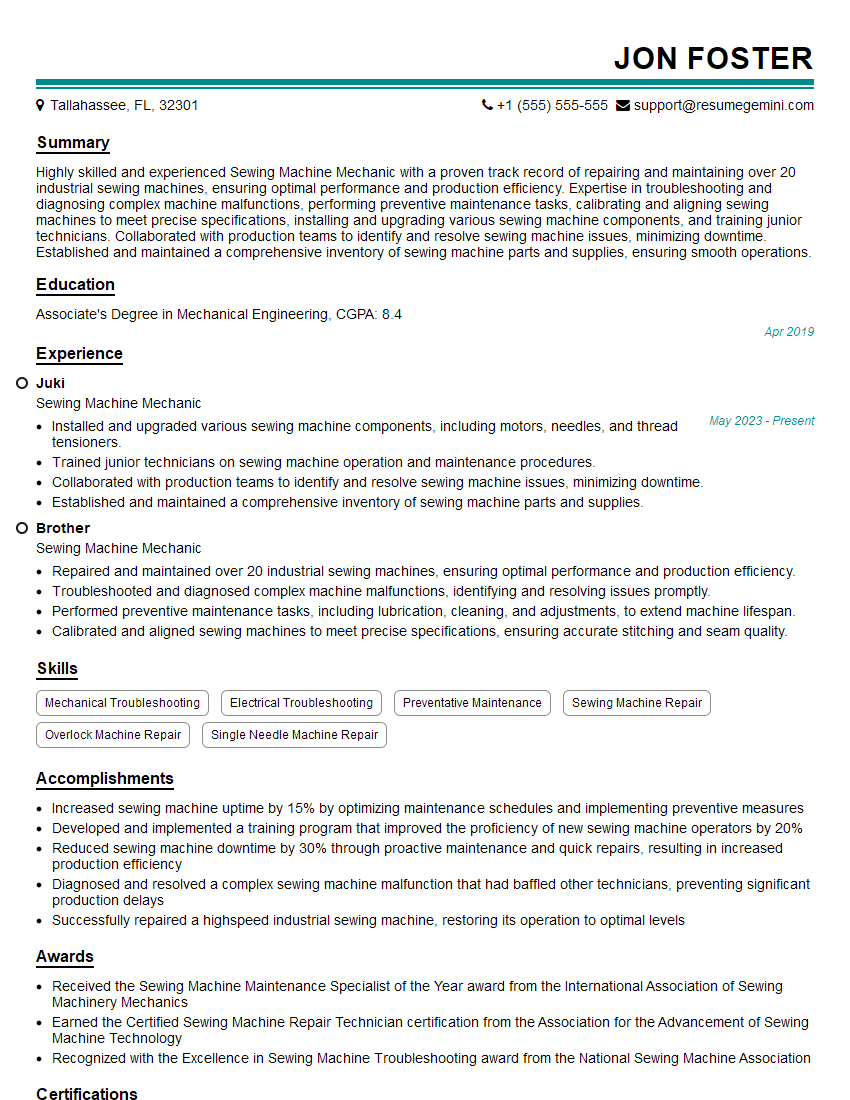
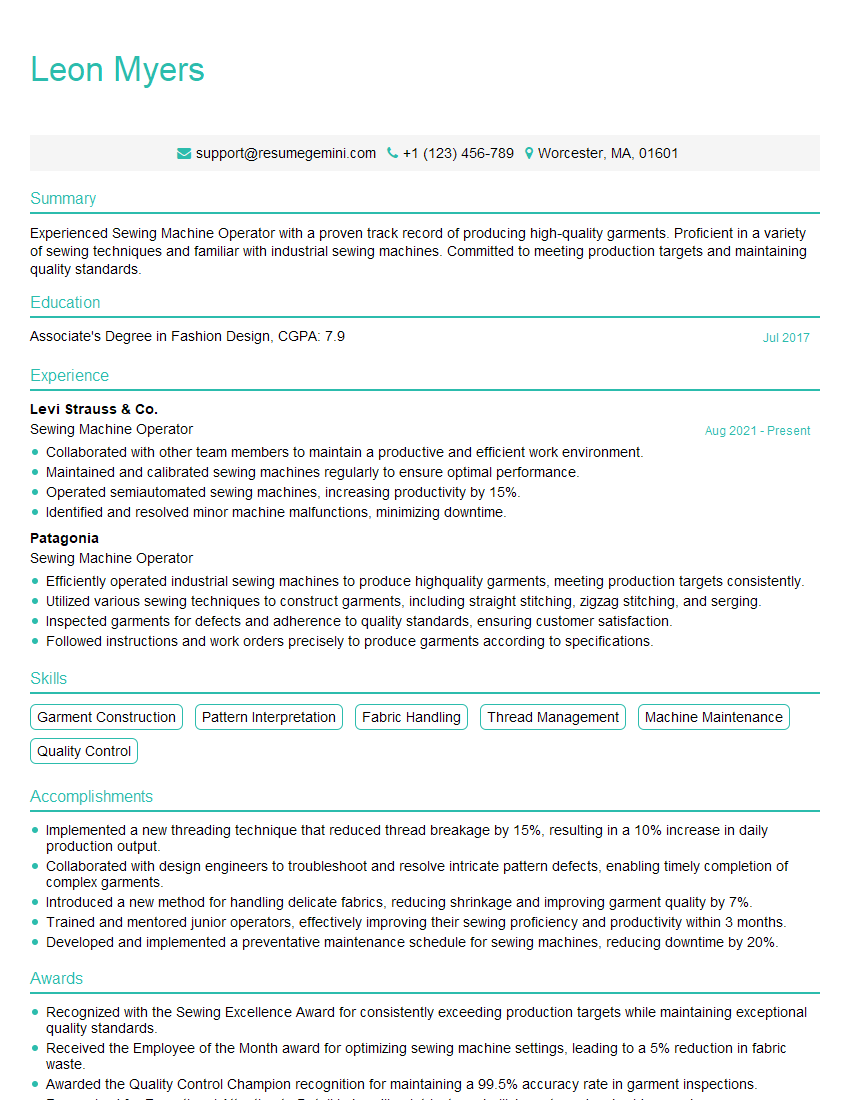
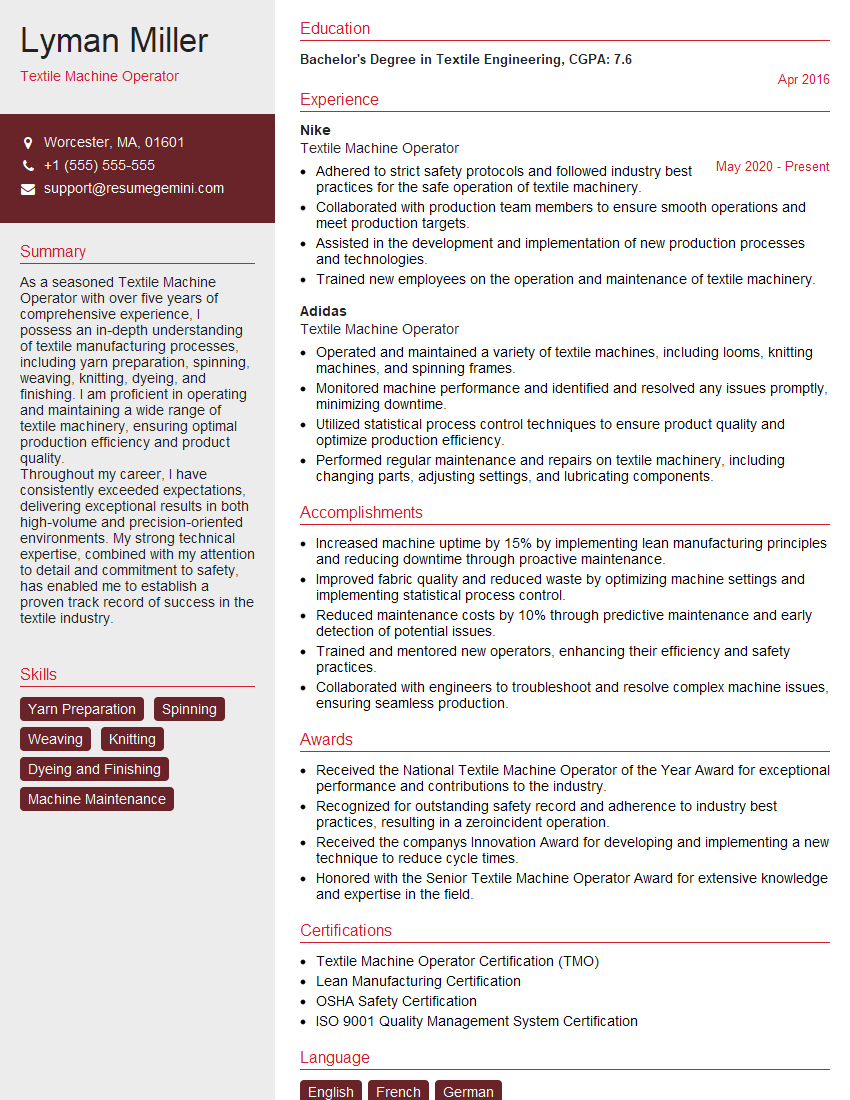
Mastering industrial overlock machine operation opens doors to exciting career opportunities in the garment manufacturing and textile industries, offering potential for advancement and higher earning potential. To maximize your job prospects, creating a strong, ATS-friendly resume is crucial. ResumeGemini is a trusted resource that can help you build a professional resume that showcases your skills and experience effectively. ResumeGemini provides examples of resumes tailored to Industrial Overlock Machine Operation to help you craft a compelling application.

Explore more articles
Users Rating of Our Blogs
Share Your Experience
We value your feedback! Please rate our content and share your thoughts (optional).
What Readers Say About Our Blog
Very informative content, great job.
good