Interviews are opportunities to demonstrate your expertise, and this guide is here to help you shine. Explore the essential Industrial Piping interview questions that employers frequently ask, paired with strategies for crafting responses that set you apart from the competition.
Questions Asked in Industrial Piping Interview
Q 1. Explain the different types of pipe fittings and their applications.
Pipe fittings are essential components connecting pipes, changing direction, or altering flow characteristics. They come in various types, each suited for specific applications.
- Elbows: Change the direction of flow. 90-degree elbows are common, but 45-degree elbows reduce pressure drop. Types include long-radius and short-radius elbows. Example: A 90-degree elbow is used to connect a vertical pipe to a horizontal one in a water distribution system.
- Tees: Allow for branch connections, diverting flow in three directions. Example: A tee is used to connect a sprinkler head to a main water supply line.
- Reducers/Enlargers (Concentric & Eccentric): Gradually change pipe diameter. Eccentric reducers maintain a consistent centerline for gravity flow. Example: A reducer connects a larger diameter main line to a smaller diameter branch line.
- Couplings: Join two pipes of the same diameter. Example: Used to connect lengths of pipe during installation.
- Caps: Close the end of a pipe. Example: Used to seal off the end of a pipe that’s not in active use.
- Flanges: Used for joining pipes with bolts. Allows for easy disassembly and maintenance. Example: Commonly used in large-diameter pipelines and process piping systems requiring frequent maintenance access.
- Unions: Allow for easy disconnection of pipes without needing to disconnect the entire line. Example: Used in areas where regular maintenance or equipment changes are anticipated.
Material selection for fittings is crucial and depends on factors like the fluid handled, pressure, and temperature. Common materials include carbon steel, stainless steel, and PVC, each offering different corrosion resistance and pressure ratings.
Q 2. Describe the process of creating an isometric drawing for piping systems.
Creating an isometric drawing for piping systems involves a systematic approach to ensure accurate representation and efficient installation. It’s a 3D representation shown in a 2D view, with all three axes displayed at 120-degree angles.
- Gather Data: Collect piping specifications including pipe sizes, materials, components (valves, fittings), equipment connections, and elevation data.
- Develop a Piping and Instrumentation Diagram (P&ID): This diagram provides a schematic overview of the system.
- Establish a Reference Point: Choose a convenient location as the origin for coordinates.
- Layout the Piping: Start drawing pipe runs systematically, using standard isometric symbols for fittings and valves. Maintain consistent scaling and orientation.
- Add Details: Include pipe sizes, specifications, valve types, equipment connections, support locations, and other relevant information. Use consistent labeling and notation.
- Check for Conflicts and Errors: Carefully review the drawing for potential clashes between pipes, equipment, or supports. Verify compliance with piping standards.
- Revision and Approval: Finalize the drawing and obtain approval from relevant stakeholders before construction.
Software like AutoCAD or dedicated piping design software significantly aids in this process by providing automated features, ensuring accuracy and efficiency. Thinking of it as building a 3D model on a flat surface helps visualize the process.
Q 3. What are the common pipe materials used in industrial applications and their suitability?
The choice of pipe material in industrial applications is critical and depends on factors like operating temperature, pressure, fluid compatibility, and cost. Here are some common materials:
- Carbon Steel: Widely used due to its strength, weldability, and relatively low cost. Suitable for many applications but susceptible to corrosion.
- Stainless Steel: Offers excellent corrosion resistance, making it ideal for handling aggressive chemicals or high-purity fluids. More expensive than carbon steel.
- Cast Iron: Durable and resistant to corrosion, often used for underground water pipes, but brittle and susceptible to cracking under stress.
- Ductile Iron: Improves on cast iron’s brittleness, providing better impact resistance. Often used in water and wastewater systems.
- Plastic Pipes (PVC, CPVC, HDPE): Lightweight, corrosion-resistant, and suitable for low-pressure applications. Less resistant to high temperatures than metallic options. PVC and CPVC are more common in chemical and water industries, while HDPE is used for gas and water.
- Copper: Excellent corrosion resistance and high thermal conductivity, typically used in plumbing and specialized applications.
Selecting the right material involves a thorough risk assessment considering the process conditions, environmental factors and potential risks. A wrong choice can lead to failure and significant financial losses.
Q 4. How do you perform a pressure drop calculation for a piping system?
Pressure drop calculation in a piping system is crucial for determining pump requirements and ensuring efficient fluid flow. Several methods exist, often involving iterative calculations and specialized software.
The most common approach uses the Darcy-Weisbach equation:
ΔP = f * (L/D) * (ρV²/2)Where:
ΔPis the pressure dropfis the Darcy friction factor (dependent on Reynolds number and pipe roughness)Lis the pipe lengthDis the pipe diameterρis the fluid densityVis the fluid velocity
Calculating the friction factor f often involves the Moody chart or correlations like the Colebrook-White equation. Additional pressure drops are considered for fittings (using equivalent length method or K-factors) and valves. Software like AFT Fathom or similar packages automate this process significantly.
Simplified Example: For a short pipe with minimal fittings, a simplified approach using an approximated friction factor can be used, but for complex systems, dedicated software is recommended for accurate results.
Q 5. Explain the importance of pipe supports and their design considerations.
Pipe supports are vital for preventing excessive stress, vibration, and sagging in piping systems, ensuring operational safety and longevity. Proper design considers several factors.
- Load Calculation: Determine the weight of the pipe, fluid, and insulation. Consider dynamic loads from pressure surges, thermal expansion, and vibrations.
- Support Spacing: Ensure sufficient spacing between supports to prevent excessive sagging or deflection, based on pipe material, diameter, and operating conditions. Too close together is wasteful, while too far apart risks failures.
- Support Type Selection: Choose appropriate support types considering factors like pipe size, weight, temperature, and location. Types include anchors, guides, hangers, and restraints.
- Material Selection: Select support materials compatible with the pipe material and environment, considering corrosion resistance and temperature limitations.
- Code Compliance: Design pipe supports in accordance with relevant codes and standards (e.g., ASME B31.1, B31.3) to ensure system integrity.
Improper pipe support can lead to pipe failure, leaks, and safety hazards. A well-designed support system guarantees that the piping system performs as intended while accommodating for movement and stress. Imagine a clothesline – without adequate supports, the line sags, potentially leading to snapping. Piping systems function similarly.
Q 6. Describe your experience with various piping codes and standards (e.g., ASME B31.1, B31.3).
I have extensive experience with various piping codes and standards, primarily ASME B31.1 (Power Piping) and ASME B31.3 (Process Piping). My experience includes:
- ASME B31.1: Applied this code extensively in power generation projects, ensuring compliance with pressure vessel requirements, material selection, and stress analysis. This involves understanding the specific requirements for high-pressure, high-temperature piping systems in power plants, ensuring compliance with safety regulations.
- ASME B31.3: Used this code in chemical processing plants and refinery projects. The focus here is on handling a wider variety of fluids and ensuring compliance for different process conditions, taking into account potential hazards associated with chemical processing.
- Other relevant codes: I’m also familiar with API standards for pipeline construction and operation, including aspects related to leak detection and pipeline integrity management.
Understanding these codes is essential for ensuring safe and reliable piping systems. Each code provides specific requirements and guidelines for material selection, design, fabrication, testing, and inspection. Ignoring or misinterpreting these standards can lead to catastrophic failures.
Q 7. How do you handle pipe stress analysis using CAESAR II or similar software?
I’m proficient in using CAESAR II for pipe stress analysis, a crucial step in ensuring the structural integrity of piping systems. The process generally involves:
- Model Creation: Develop a 3D model of the piping system within CAESAR II, accurately representing pipe sizes, materials, supports, and equipment connections.
- Input Data: Define operating conditions such as pressure, temperature, fluid properties, and support characteristics (stiffness, movement restrictions).
- Analysis Run: Perform the stress analysis considering static and dynamic loads (dead weight, thermal expansion, pressure, wind, seismic). CAESAR II calculates stresses, displacements, and reactions.
- Result Interpretation: Carefully review the results, checking for stress levels exceeding allowable limits. Identify critical areas needing design modifications, such as additional supports or changes in pipe routing.
- Report Generation: Generate reports documenting the analysis results, including stress reports, displacement reports, and support reaction reports. These reports are critical for compliance and demonstration of system integrity.
CAESAR II provides valuable insights into potential failure points, ensuring safe and efficient piping systems. It’s not just about running the software; it’s about correctly interpreting the results and making sound engineering decisions based on the analysis findings.
Q 8. Explain the concept of pipe flexibility and its impact on system design.
Pipe flexibility refers to a pipe’s ability to withstand thermal expansion, contraction, and other stresses without causing excessive strain or failure on the system. Think of it like a garden hose: a stiff hose is more likely to crack under pressure or if you try to bend it sharply, while a more flexible one can adapt. In industrial piping, this is critical because temperature changes can cause significant expansion and contraction, particularly in long pipelines. Insufficient flexibility leads to pipe stresses, potentially causing leaks, ruptures, and costly downtime.
In system design, flexibility is achieved through several methods. These include using flexible pipe materials (like certain plastics or specially designed alloys), incorporating expansion loops (U-shaped bends that allow for expansion without stressing straight sections), installing expansion joints (devices that allow for axial, lateral, or angular movement), and employing flexible connectors. The selection of the best approach depends on factors like the fluid being transported, the operating temperature range, the pipe material, and the overall system layout. For example, in a high-pressure steam line, expansion loops might be impractical due to space constraints, and we might opt for expansion joints instead.
Q 9. What are the different types of pipe insulation and their applications?
Pipe insulation serves to prevent heat loss or gain, protecting personnel from burns or other hazards, preventing condensation, and maintaining the process fluid at the desired temperature. Different types cater to various needs and applications.
- Fiberglass Insulation: Commonly used due to its cost-effectiveness and good insulation properties. It’s often used in applications with moderate temperatures and is available in various thicknesses. However, it’s not suitable for high-temperature applications or those where moisture is a concern.
- Calcium Silicate Insulation: Offers excellent fire resistance and high-temperature capabilities, often used in high-temperature processes such as power plants. It’s durable and can withstand harsh conditions but is more expensive than fiberglass.
- Polyurethane Foam Insulation: Known for its superior insulating value and moisture resistance. It’s commonly used in refrigeration systems, cryogenic applications, and where minimizing heat transfer is crucial. However, it’s sensitive to UV degradation and requires protective jacketing.
- Mineral Wool Insulation: Provides good thermal and acoustic insulation and is fire-resistant. It’s often used in industrial settings, particularly where fire safety is paramount. Its fibrous nature makes it slightly more difficult to handle than other types.
The choice of insulation depends on factors like operating temperature, the fluid being transported, environmental conditions, and budget constraints. A proper insulation selection is critical for efficiency and safety.
Q 10. Describe your experience with piping material specifications and procurement.
My experience encompasses the entire lifecycle of piping material specifications and procurement. This includes collaborating with engineering teams to define material requirements based on project specifications, industry standards (like ASME B31.1 or B31.3), and client needs. We carefully consider factors like pressure rating, temperature limits, corrosion resistance, and material compatibility with the process fluid. This often involves reviewing material datasheets, consulting with material suppliers, and ensuring compliance with relevant codes and standards.
The procurement process involves creating detailed purchase orders, managing supplier relationships, tracking deliveries, and ensuring quality control. I have experience with various procurement methods, from competitive bidding to negotiated contracts, and I’m familiar with managing inventory and maintaining accurate records. I’ve worked with a range of materials, including carbon steel, stainless steel, ductile iron, and various plastics, each requiring specific handling and quality checks to ensure compliance and prevent costly mistakes in the field.
For example, in one project involving a highly corrosive process fluid, we carefully selected a super duplex stainless steel, which was more expensive but significantly increased the system’s lifespan compared to a cheaper, less resistant material, ultimately saving the client money in the long run.
Q 11. How do you ensure the proper installation and testing of industrial piping systems?
Ensuring proper installation and testing of industrial piping systems involves a meticulous, multi-step process. It starts with a thorough review of the design drawings and specifications to understand the system’s layout, component requirements, and testing criteria. On-site, we verify that the materials are as specified, that welds are performed according to code, and that proper supports and hangers are installed to prevent sagging or stress buildup. Each step is documented, and any deviations are reported and addressed promptly.
Testing is crucial. This typically involves pressure testing to verify the integrity of the system, and this procedure is carried out in accordance with ASME Section VIII, Div. 1 or other relevant codes. We also perform leak checks, visual inspections, and hydro-testing, depending on the system’s design and the fluid being transported. Documentation of all testing procedures and results is crucial for quality control and future maintenance. Failure to properly install and test systems can lead to leaks, failures, and, in extreme cases, catastrophic events. A thorough and documented process is paramount for safety and reliability.
Q 12. Explain the importance of proper pipe sizing and its impact on system efficiency.
Proper pipe sizing is critical for efficient and reliable system operation. Undersized pipes lead to increased pressure drops, higher energy consumption, and potential flow limitations, reducing overall system efficiency. Conversely, oversized pipes are wasteful, representing unnecessary capital expenditure and potentially leading to unwanted pressure surges. Pipe sizing calculations take into account factors such as flow rate, fluid properties (viscosity, density), pressure drop, and allowable velocity. We use established engineering equations and software to determine the appropriate pipe diameter for each section of the system.
For example, imagine a water supply line for a large building. If the pipes are undersized, the pressure will be inadequate on upper floors, and pumps may need to work harder (increasing energy costs). Oversizing would be wasteful and unnecessary, increasing the initial project investment. Accurate sizing ensures the system operates efficiently at the design pressure and flow rate, optimizing performance and minimizing operational costs.
Q 13. Describe your experience with different types of pipe joints and their applications.
Various pipe joints are employed in industrial piping, each offering advantages and disadvantages depending on the application. Common types include:
- Welding: Provides a strong, permanent joint suitable for high-pressure applications, but requires skilled welders and post-weld inspection.
- Flanged Joints: Allow for easy disassembly and maintenance, commonly used in locations where frequent access is needed. They can handle higher pressures compared to threaded joints but are more expensive and require more space.
- Threaded Joints: Relatively inexpensive and easy to install for smaller pipes and lower pressures, but are less suitable for high-pressure or high-temperature applications.
- Compression Fittings: Quick and easy to install, commonly used for smaller pipes and less critical applications. Not suitable for high-pressure or high-temperature systems.
- Couplings: Used to join pipes of the same diameter; they are available in various styles, such as grooved couplings or mechanical couplings, offering different levels of pressure capacity and ease of installation.
Selecting the appropriate joint type involves considering factors such as pressure rating, temperature, required strength, ease of installation and maintenance, and cost. A detailed engineering assessment is crucial for choosing the optimum solution, ensuring both safety and project success.
Q 14. How do you manage potential hazards and safety concerns during piping installation?
Managing potential hazards and safety concerns during piping installation is paramount. This begins with a thorough risk assessment that identifies potential hazards such as working at heights, confined space entry, exposure to hazardous materials, and the risk of injury from heavy equipment or hot surfaces. Based on this assessment, we develop a comprehensive safety plan which outlines procedures, safety measures, and emergency protocols.
Throughout the installation, we enforce strict adherence to safety regulations, including the use of personal protective equipment (PPE) like hard hats, safety glasses, and safety harnesses. We implement lockout/tagout procedures to prevent accidental releases of energy during maintenance or repairs. We use proper lifting techniques and equipment to avoid injuries from handling heavy pipes and components. Regular safety meetings and toolbox talks are conducted to ensure that the workforce is aware of the potential hazards and is trained in safe work practices.
Thorough documentation of safety procedures, incident reporting, and corrective actions ensures a proactive approach to safety management. Prioritizing safety not only protects the workforce but also prevents costly delays and potential legal liabilities. A safe work environment translates to a productive and efficient project.
Q 15. What is your experience with hydraulic calculations for piping systems?
Hydraulic calculations are fundamental to designing safe and efficient piping systems. They ensure the system can handle the pressure, flow rate, and fluid properties involved. My experience encompasses a wide range of calculations, from simple pressure drop calculations using Darcy-Weisbach or Hazen-Williams equations to more complex analyses involving fluid transients and surge pressures. For example, in a recent project involving a high-pressure oil pipeline, I used specialized software to model the entire system, predicting pressure drops across various components like valves, fittings, and pipe sections. This allowed us to accurately size the pumps and select appropriate pipe materials to prevent failures.
I’m proficient in using both manual calculation methods and specialized software like AFT Fathom and PIPE-FLO to perform detailed hydraulic analyses. This includes considering factors such as fluid viscosity, temperature, pipe roughness, and the presence of bends and fittings, which all affect pressure drop. I also have experience with analyzing pump curves to ensure adequate flow and pressure are maintained throughout the system’s operating range. I can identify potential issues such as cavitation or excessive pressure drops, and propose design modifications or operational strategies to mitigate these issues. The end result is a system that operates safely and efficiently while minimizing energy costs.
Career Expert Tips:
- Ace those interviews! Prepare effectively by reviewing the Top 50 Most Common Interview Questions on ResumeGemini.
- Navigate your job search with confidence! Explore a wide range of Career Tips on ResumeGemini. Learn about common challenges and recommendations to overcome them.
- Craft the perfect resume! Master the Art of Resume Writing with ResumeGemini’s guide. Showcase your unique qualifications and achievements effectively.
- Don’t miss out on holiday savings! Build your dream resume with ResumeGemini’s ATS optimized templates.
Q 16. Explain the process of performing a piping system hydrotest.
A piping system hydrotest, also known as a pressure test, is a crucial step in verifying the integrity of a new or repaired piping system before it goes into operation. The process involves pressurizing the system with water or another suitable test fluid to a pressure significantly higher than the system’s operating pressure. This reveals any leaks or weaknesses in welds, joints, or the pipes themselves. Think of it as a thorough stress test for your plumbing.
The process typically involves these steps:
- Preparation: Isolate the piping system, thoroughly flush it to remove debris, and inspect for any visible defects.
- Pressurization: Slowly fill the system with the test fluid, typically water, until the designated test pressure is reached. This pressure is usually a factor, often 1.5 times, higher than the maximum operating pressure.
- Holding Time: Maintain the test pressure for a specific duration, typically several hours, to allow for any potential leaks to manifest themselves.
- Leak Detection: Carefully inspect all joints, welds, and pipe sections for any signs of leakage. Specialized leak detection equipment, such as soap solution or electronic leak detectors, can be used for improved sensitivity.
- Documentation: All observations, including pressure readings and leak locations, are meticulously documented.
- Pressure Reduction: After the holding time and inspection, slowly depressurize the system.
If leaks are detected, they must be repaired before the system is retested. The hydrotest ensures the system is ready to handle the expected operational pressure safely and reliably.
Q 17. Describe your experience working with P&ID (Piping and Instrumentation Diagrams).
P&IDs, or Piping and Instrumentation Diagrams, are the blueprints for industrial piping systems. My experience with P&IDs goes beyond simply reading them; I actively use them throughout the entire project lifecycle. I’m proficient in interpreting them to understand the system’s layout, component specifications, and process flow. I use them to develop detailed piping isometrics (3D drawings), generate material take-offs, and coordinate with other disciplines such as instrumentation and electrical engineering. For example, I’ve used P&IDs to identify potential conflicts between pipe routes and other equipment, and to propose design changes to improve accessibility for maintenance.
Furthermore, I’m familiar with various P&ID symbology standards, including ISA standards, and I can create or modify P&IDs using software like AutoCAD Plant 3D or SmartPlant P&ID. My experience ensures that the final design accurately reflects the project requirements and industry best practices.
Q 18. What software are you proficient in for piping design and analysis?
Proficiency in piping design and analysis software is crucial for efficient and accurate project delivery. I’m highly proficient in several industry-leading software packages. This includes AutoCAD Plant 3D for 3D modeling and design, SmartPlant 3D for similar functionality, and specialized analysis software like AFT Fathom and PIPE-FLO for hydraulic and thermal calculations. I also have experience with Caesar II for stress analysis. My skills extend beyond basic modeling; I can create detailed piping layouts, perform simulations under various operating conditions, generate reports, and manage design changes efficiently within these platforms. I can adapt to various software depending on the specific project requirements and client preferences.
Q 19. How do you identify and mitigate potential sources of piping system leaks?
Identifying and mitigating potential sources of leaks is critical for safety and efficiency. My approach involves a multi-faceted strategy that begins with careful design and extends through construction and operation. During design, we carefully select appropriate pipe materials, specify proper welding techniques, and ensure correct sizing and installation of components like flanges, valves, and fittings. We carefully consider the operating conditions and potential stresses the system will undergo.
During construction, regular inspections and quality control measures are essential. This includes verifying weld integrity through non-destructive testing (NDT) methods such as radiography or ultrasonic testing. Proper installation of gaskets and bolting is equally critical. After commissioning, regular inspection and preventive maintenance play a vital role. We use leak detection technologies to identify potential leaks early on, and we implement corrosion protection strategies to extend the lifespan of the piping system. Common leak sources I address include corrosion, erosion, improper installation, and fatigue. For example, identifying a high-vibration area may necessitate the use of flexible connectors to mitigate fatigue.
Q 20. Explain your experience with different types of valves and their applications.
Valves are essential components in controlling flow and pressure within piping systems. My experience encompasses a wide array of valve types, each with its own unique applications. For instance, gate valves are typically used for on/off service, while globe valves are better suited for throttling applications due to their superior controllability. Ball valves are favored for their quick on/off action and compact size. Butterfly valves are often chosen for their low cost and compact design, particularly in larger diameter lines. Check valves prevent backflow, and safety relief valves protect the system from overpressure. I’m also familiar with specialized valves like control valves, which are used to automate flow control, and specialized valves for specific fluid services such as cryogenic valves.
The selection of a specific valve depends on factors like pressure, temperature, fluid type, flow rate, and the required level of control. For example, in a high-pressure, high-temperature steam system, a specialized valve with robust materials and high-pressure ratings would be required. Incorrect valve selection can lead to failures, leaks, and inefficiencies; therefore, careful consideration is crucial. I have practical experience specifying, selecting and troubleshooting a variety of valves, and this knowledge allows me to design reliable and efficient systems.
Q 21. How do you address pipe corrosion and erosion in industrial settings?
Corrosion and erosion are significant challenges in industrial piping systems, leading to leaks, failures, and costly downtime. My approach to addressing these issues is proactive and multifaceted. It starts with material selection; choosing corrosion-resistant materials like stainless steel or specialized alloys tailored to the specific fluid and environmental conditions is crucial. For example, in a highly corrosive environment such as a chemical processing plant, using materials like Hastelloy or Monel may be necessary.
Beyond material selection, implementing effective corrosion and erosion control methods is equally important. These include:
- Coatings: Applying protective coatings like epoxy or polyurethane to the pipe’s internal or external surfaces creates a barrier against corrosive agents.
- Cathodic Protection: This electrochemical technique protects the pipe from corrosion by introducing a sacrificial anode. This method is frequently used in underground or submerged pipelines.
- Inhibitors: Adding chemical inhibitors to the fluid can slow down corrosion rates. This is commonly used in water systems.
- Flow Optimization: Designing the system to minimize fluid velocity and turbulence can reduce erosion. The use of flow straighteners or optimizing pipe bends can be helpful.
Regular inspections and monitoring are key to detecting and addressing corrosion and erosion issues promptly before they escalate into major problems. This might involve visual inspections, ultrasonic testing, or other NDT methods. Addressing corrosion and erosion effectively is critical for ensuring the long-term reliability and safety of the piping system.
Q 22. Describe your experience with piping system layout optimization.
Piping system layout optimization is crucial for maximizing efficiency, minimizing costs, and ensuring safe operation. It involves strategically arranging piping components to reduce pipe length, minimize the number of fittings, and optimize flow dynamics. My experience includes using various software like AutoCAD Plant 3D and other specialized piping design tools to create and refine layouts. For example, in a recent project involving a chemical processing plant, I was able to reduce the overall piping length by 15% by carefully considering pump placement and rerouting several pipe runs. This resulted in significant savings in material costs and reduced installation time. Another example involved optimizing the layout of a refinery’s cooling water system, leading to improved heat transfer efficiency and a reduction in energy consumption. I leverage techniques such as isometric drawings and 3D modeling to visually analyze and improve the layout before finalizing the design. This iterative process ensures that the final design is both efficient and compliant with industry standards.
Q 23. What are the key considerations for designing piping systems in hazardous environments?
Designing piping systems for hazardous environments demands meticulous attention to detail and adherence to stringent safety regulations. Key considerations include material selection, suitable pipe and fitting specifications (e.g., those rated for higher pressure and temperature), corrosion protection, and leak detection systems. For flammable or explosive materials, special attention is paid to preventing static electricity build-up (e.g., using grounding and bonding techniques) and ensuring adequate ventilation to avoid the accumulation of hazardous gases. For example, in a project involving the transportation of highly corrosive chemicals, we employed specialized corrosion-resistant alloys and implemented a comprehensive cathodic protection system to prevent pipe degradation. Furthermore, we incorporated double-walled piping with leak detection capabilities to mitigate the risk of spills or leaks. Regular inspections and maintenance are also vital to ensuring continued safe operation in these environments. Safety valves, pressure relief devices and fire suppression systems are all key components of a robust design.
Q 24. How do you ensure compliance with relevant environmental regulations for piping systems?
Compliance with environmental regulations is paramount in piping system design and operation. This involves understanding and adhering to local, national, and international standards, such as those related to emissions, waste disposal, and water discharge. My approach involves thorough research of the applicable regulations relevant to the project location and the nature of the fluids being handled. This ensures that the chosen materials are environmentally safe, and that the system design minimizes potential environmental impacts. For instance, we might select pipes made from recycled materials or those with low VOC (Volatile Organic Compound) emissions to reduce the environmental footprint. We also consider the implementation of leak detection and prevention systems to minimize the possibility of spills. Detailed documentation, including material safety data sheets (MSDS) and operational procedures, is crucial for demonstrating regulatory compliance. Moreover, we collaborate closely with environmental agencies and consultants to ensure full compliance throughout the project lifecycle.
Q 25. Explain your experience with piping system maintenance and repair.
My experience in piping system maintenance and repair spans various industries and includes both preventative and corrective measures. Preventative maintenance involves regular inspections, leak checks, and cleaning to identify potential problems before they escalate. This includes tasks like lubrication of valves and checking for corrosion. Corrective maintenance addresses issues that arise during operation, such as leaks, cracks, or component failures. I have extensive experience in diagnosing the root cause of failures and implementing effective repair strategies. For example, I once successfully repaired a major leak in a high-pressure steam line by utilizing advanced welding techniques and employing a rigorous testing procedure to ensure the repair’s integrity. We also use condition monitoring techniques like vibration analysis to detect early signs of wear and tear, allowing for timely repairs and reducing the risk of catastrophic failures. A comprehensive CMMS (Computerized Maintenance Management System) is utilized to track maintenance activities and optimize schedules.
Q 26. Describe your problem-solving approach when encountering unexpected issues during a piping project.
When confronted with unexpected issues, my approach is systematic and data-driven. First, I thoroughly assess the situation, gathering all available information, including relevant data logs, site observations, and input from the on-site team. Then, I perform a root cause analysis using techniques such as the ‘5 Whys’ method to identify the underlying cause of the problem, not just the surface-level symptom. For example, when we experienced unexpected pressure fluctuations in a process line, instead of simply adjusting valves, we investigated the system thoroughly. The root cause turned out to be a malfunctioning control valve, which was then replaced. Once the root cause is identified, I develop and implement a solution, ensuring it is both safe and effective. The final step is thorough documentation of the issue, the corrective actions, and lessons learned, to prevent similar problems from occurring in the future. This data contributes to continuous improvement of our processes and systems.
Q 27. How do you effectively communicate technical information related to piping systems?
Effective communication is crucial in industrial piping. My approach focuses on clarity, accuracy, and audience consideration. I use a variety of methods, including clear written reports, detailed diagrams, and visual aids like isometric drawings and 3D models to convey technical information effectively. I also leverage presentations and site meetings for direct communication with stakeholders, ensuring that technical jargon is explained clearly and simply. For example, when explaining a complex piping modification to a non-technical audience, I use analogies and visuals to ensure understanding. I ensure that all communication channels—emails, reports, drawings—are consistent and well-documented, leaving an auditable trail of all decisions and changes. Clear and concise communication avoids misunderstandings and contributes to project success.
Q 28. What are your career aspirations related to industrial piping?
My career aspirations involve furthering my expertise in industrial piping and contributing to innovative solutions in this field. I aim to take on increasing responsibility in project management and leadership roles, mentoring junior engineers and fostering a culture of safety and efficiency. I’m particularly interested in exploring the application of advanced technologies such as digital twinning and predictive maintenance in piping systems. I see a future where predictive analytics helps us anticipate and prevent problems before they occur, minimizing downtime and maximizing safety. My long-term goal is to become a recognized expert in my field, contributing to advancements in piping design and maintenance practices through research and industry contributions.
Key Topics to Learn for Your Industrial Piping Interview
- Piping Design and Codes: Understanding industry standards (ASME B31.1, B31.3, etc.), pressure vessel design, and material selection criteria. Practical application includes interpreting piping and instrumentation diagrams (P&IDs) and specifying appropriate pipe materials for different applications.
- Piping Fabrication and Installation: Knowledge of welding techniques (e.g., different types of welds, their strengths and weaknesses), bending, cutting, and joining methods. Practical application involves understanding field installation practices, quality control procedures, and safety regulations.
- Piping Systems and Components: Familiarity with various valves (gate, globe, ball, check), pumps, compressors, and other components within industrial piping systems. Practical application includes troubleshooting system malfunctions and understanding the function of each component within a larger system.
- Fluid Mechanics and Thermodynamics: Understanding concepts like pressure drop calculations, fluid flow characteristics, and heat transfer within piping systems. Practical application includes optimizing system design for efficiency and minimizing energy loss.
- Stress Analysis and Support Design: Knowledge of calculating stresses on piping systems due to pressure, weight, and thermal expansion. Practical application includes designing and selecting appropriate pipe supports to prevent failures.
- Instrumentation and Control: Understanding how instruments like pressure gauges, flow meters, and temperature sensors are integrated into piping systems for monitoring and control. Practical application includes interpreting sensor readings and troubleshooting control system issues.
- Safety and Regulations: Deep understanding of relevant safety regulations and procedures (OSHA, etc.) related to industrial piping. Practical application involves identifying and mitigating potential hazards in piping systems.
Next Steps: Unlock Your Industrial Piping Career
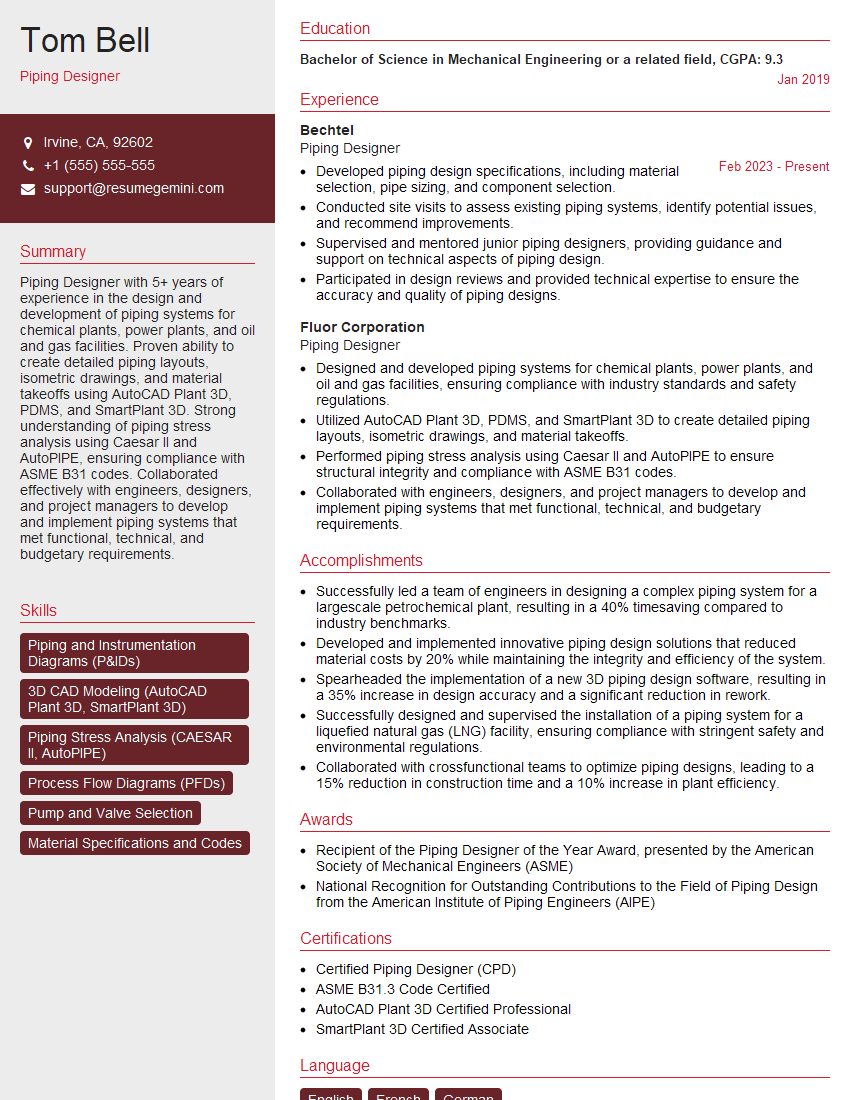
Mastering industrial piping principles is crucial for a successful and rewarding career in this vital field. A strong foundation in these concepts opens doors to diverse and challenging opportunities, leading to professional growth and advancement. To maximize your job prospects, it’s essential to present your skills effectively. Create an ATS-friendly resume that highlights your expertise and experience. ResumeGemini is a trusted resource to help you build a compelling and professional resume that stands out from the competition. We offer examples of resumes tailored specifically to the industrial piping industry to guide you in creating your own.
Explore more articles
Users Rating of Our Blogs
Share Your Experience
We value your feedback! Please rate our content and share your thoughts (optional).
What Readers Say About Our Blog
Very informative content, great job.
good