Feeling uncertain about what to expect in your upcoming interview? We’ve got you covered! This blog highlights the most important Infrared Missile Guidance interview questions and provides actionable advice to help you stand out as the ideal candidate. Let’s pave the way for your success.
Questions Asked in Infrared Missile Guidance Interview
Q 1. Explain the principles of infrared homing guidance.
Infrared homing guidance relies on the detection of infrared (IR) radiation emitted by a target. Essentially, missiles using this technology ‘see’ the heat signature of their target. The seeker head in the missile contains an IR sensor that detects the target’s heat. This sensor measures the intensity and location of the IR radiation, providing information on the target’s position. The missile’s guidance system then uses this information to calculate the necessary corrections to its flight path, enabling it to intercept the target. Think of it like a heat-seeking snake – it follows the warmest trail.
The process involves several key steps: detection of the target’s IR signature, tracking the target’s position relative to the missile, and continuous calculation of flight path corrections to maintain the interception course. The accuracy of this system depends on factors like the target’s IR signature strength, atmospheric conditions, and the sophistication of the seeker’s signal processing capabilities.
Q 2. Describe different types of infrared seekers (e.g., imaging, point-source).
Infrared seekers are broadly categorized into two main types: point-source seekers and imaging seekers.
- Point-source seekers are simpler and less computationally expensive. They focus on detecting a single, intense source of infrared radiation, such as the exhaust plume of a jet engine. These are highly effective against targets with a prominent heat signature, but can be easily confused by multiple heat sources or flares.
- Imaging seekers, on the other hand, create a complete thermal image of the target and its surroundings. This allows for more sophisticated target recognition and tracking capabilities, making them less susceptible to countermeasures like flares. They can distinguish a target from the background clutter even if the target has a relatively weak signature. They are, however, computationally more complex and require more sophisticated processing algorithms.
Within these categories, there are further variations depending on the specific sensor technology used (e.g., photodetectors, microbolometers) and signal processing techniques employed. Some advanced seekers might even combine both point-source and imaging capabilities for enhanced performance.
Q 3. What are the advantages and disadvantages of infrared guidance compared to other guidance methods?
Infrared guidance offers several advantages over other guidance methods, such as radar or laser guidance.
- Passive operation: IR guidance systems do not emit energy, making them difficult to detect and less susceptible to jamming. This provides a degree of stealth.
- All-weather capability: While atmospheric conditions affect performance, IR seekers can still function in adverse weather conditions like rain, fog, and dust that would impair radar.
- Relatively low cost: Compared to active radar systems, IR guidance tends to be less expensive to produce and maintain.
However, IR guidance also has limitations:
- Susceptibility to countermeasures: Flares and other IR countermeasures can easily deceive point-source seekers.
- Atmospheric effects: Rain, fog, and smoke can significantly attenuate IR signals, reducing seeker performance.
- Limited range: Compared to radar, the effective range of IR guidance is typically shorter, especially in poor atmospheric conditions.
- Target signature variability: The effectiveness of IR guidance depends heavily on the target’s IR signature, which can vary depending on factors like altitude, speed, and engine characteristics.
Q 4. How does atmospheric attenuation affect infrared missile guidance?
Atmospheric attenuation refers to the reduction in the intensity of the IR radiation as it travels through the atmosphere. Various atmospheric constituents, such as water vapor, carbon dioxide, and aerosols (like dust and smoke), absorb and scatter IR radiation. This leads to a weaker signal reaching the missile’s seeker, potentially making it difficult to accurately track the target. The amount of attenuation depends on the wavelength of the IR radiation, the atmospheric conditions (temperature, humidity, visibility), and the distance between the target and the missile. This means that during adverse weather conditions, the signal from a target can be significantly weakened, causing the missile to lose lock or follow the wrong target.
Mitigation strategies involve using seeker wavelengths less susceptible to attenuation, employing signal processing techniques to compensate for the reduced signal strength, and predicting atmospheric attenuation using meteorological data.
Q 5. Explain the concept of target acquisition in infrared missile systems.
Target acquisition in infrared missile systems is the process of detecting, identifying, and acquiring a lock onto the target. This involves several crucial stages:
- Search: The seeker scans a wide field of view to locate potential targets based on their IR signature.
- Detection: Once a potential target is detected, the seeker determines whether it meets the criteria for a valid target (e.g., sufficient IR intensity, appropriate spatial characteristics).
- Track initiation: Once a target is identified, the seeker begins to track it, continuously measuring its position and velocity.
- Lock-on: Once a stable track is established, the missile is said to have achieved ‘lock-on.’ The seeker is then able to provide continuous tracking data to the guidance system.
The sophistication of the target acquisition process varies significantly based on the type of seeker and the complexity of the guidance system. Advanced systems may utilize sophisticated algorithms for clutter rejection, target recognition, and multi-target tracking to effectively acquire the intended target in challenging environments.
Q 6. Describe the role of signal processing in infrared seeker operation.
Signal processing plays a vital role in infrared seeker operation. The raw signal received by the seeker’s sensor is typically noisy and contains unwanted information from the background. Signal processing algorithms are essential to extract the target’s IR signature from this noise and clutter.
Key signal processing functions include:
- Noise reduction: Filtering techniques are employed to remove or reduce noise from the raw signal.
- Clutter rejection: Algorithms are used to differentiate the target from the background clutter based on factors like temperature contrast, size, and movement.
- Target tracking: Algorithms track the target’s position and velocity using data from successive scans of the sensor.
- Target recognition: In advanced seekers, signal processing algorithms can be used to identify the target based on its characteristic thermal signature.
The effectiveness of the seeker strongly depends on the performance of its signal processing algorithms. Advanced algorithms are crucial for ensuring accurate and reliable target tracking and recognition, even in challenging conditions.
Q 7. How do infrared countermeasures (IRCMs) work, and how can they be countered?
Infrared countermeasures (IRCMs) are designed to deceive or disrupt infrared guided missiles. Common IRCMs include flares, which release a burst of intense IR radiation to create a false target for the missile, and active decoys that mimic the target’s IR signature. These divert the missile from its intended course.
Countering IRCMs involves various techniques:
- Improved seeker technology: Advanced imaging seekers and sophisticated signal processing algorithms can help discriminate between the true target and the countermeasures.
- Multiple-target tracking: Tracking multiple sources of IR energy simultaneously can aid in identifying the real target.
- Sophisticated algorithms: AI-powered algorithms can learn to differentiate between the real target and countermeasures over time.
- Increased sensor sensitivity: Seekers with higher sensitivity to IR can better distinguish the weaker signal from a real target against a stronger flare.
The arms race between IRCMs and counter-countermeasures is a constant evolution, with each side developing new technologies to gain an advantage.
Q 8. What are the challenges of using infrared guidance in adverse weather conditions?
Adverse weather conditions, such as heavy rain, fog, snow, or dust storms, significantly impact infrared (IR) guidance by attenuating and scattering the infrared radiation emitted by the target. This reduces the signal-to-noise ratio (SNR), making target detection and tracking extremely difficult. Imagine trying to spot a campfire through a thick fog – the heat is still there, but the visibility is drastically reduced.
Specifically, atmospheric particles absorb and scatter IR radiation, leading to signal degradation. The amount of attenuation depends on the wavelength of the IR radiation, the type and density of the particles, and the distance to the target. For example, shorter wavelength IR is more susceptible to scattering by smaller particles like water droplets in fog, while longer wavelengths might be more affected by dust or smoke. This necessitates robust signal processing techniques and potentially different IR sensor designs for optimal performance in diverse weather conditions. Systems might employ algorithms to compensate for atmospheric attenuation or use multiple spectral bands to enhance target discrimination.
Q 9. Explain the concept of gimbaling in infrared seekers.
Gimbaling in infrared seekers refers to the mechanism that allows the seeker head to rotate and point in different directions, enabling it to track a moving target even when the missile itself is maneuvering. Think of it like your head moving independently of your body to follow a moving object. The seeker’s gimbal system consists of a platform with one or more axes of rotation, allowing for precise pointing of the IR sensor. These axes typically have high-precision motors and encoders for accurate position control.
A common configuration is a two-axis gimbal, providing pitch and yaw control. This allows the seeker to track targets moving in any direction within a certain field of view. More advanced systems may use three-axis gimbals, incorporating roll control for even greater maneuverability. Gimbaling is crucial for maintaining target lock during missile flight, as the missile’s trajectory may differ from the target’s movement.
Q 10. Describe the different types of infrared detectors and their characteristics.
Infrared detectors are the heart of an IR seeker, converting incoming IR radiation into electrical signals. Several types exist, each with unique characteristics:
- Photovoltaic detectors: These generate a current directly proportional to the incident IR radiation. They are known for their high responsivity and speed, making them suitable for high-speed tracking applications. A common example is the mercury cadmium telluride (MCT) detector.
- Photoconductive detectors: Their resistance changes with incident IR radiation. They generally have higher sensitivity than photovoltaic detectors but are slower. Lead sulfide (PbS) is a classic example.
- Photoelectromagnetic (PEM) detectors: These utilize the photoelectromagnetic effect to generate a voltage proportional to the incident radiation. They offer a good combination of responsivity, speed, and sensitivity.
The choice of detector depends on the specific requirements of the application, such as sensitivity, speed, operating temperature, and cost. For instance, MCT detectors are often preferred for their high performance but are more expensive and require cooling, while PbS detectors are less expensive but have lower performance.
Q 11. How is image processing used to enhance target detection and tracking in infrared guidance?
Image processing plays a vital role in enhancing target detection and tracking in infrared guidance. The raw signal from the IR detector is typically noisy and contains clutter from various sources such as background radiation, clouds, or other objects. Image processing techniques are employed to filter out noise, enhance the target signal, and isolate the target from the background.
Common techniques include:
- Noise reduction: Filters such as median filters or Wiener filters are used to remove noise from the IR image.
- Target enhancement: Techniques like edge detection, thresholding, and contrast enhancement help to highlight the target and make it easier to distinguish from the background.
- Clutter rejection: Algorithms designed to identify and eliminate clutter based on characteristics such as size, shape, and temperature are used. For example, a sophisticated algorithm might use a ‘moving target indicator’ to help identify a dynamic object against a more static background.
- Target tracking: Algorithms such as Kalman filters (discussed in the next question) use the processed IR image to accurately predict the target’s future location.
The selection of appropriate image processing techniques is crucial for accurate and robust target acquisition and tracking.
Q 12. Explain the importance of Kalman filtering in infrared tracking algorithms.
Kalman filtering is a powerful algorithm used in infrared tracking to estimate the state of a dynamic system – in this case, the target’s position, velocity, and acceleration – based on noisy measurements. Imagine trying to track a fast-moving bird through binoculars on a windy day. The bird’s motion is erratic, and your view is constantly disturbed by wind-blown leaves. Kalman filtering helps to smooth out the erratic measurements and provide a more accurate estimate of the bird’s trajectory.
The Kalman filter works by recursively combining predictions based on a dynamic model (e.g., constant velocity or constant acceleration model) with noisy measurements from the IR seeker. It uses the previous state estimate and the current measurement to improve the accuracy of the next estimate. This iterative process minimizes the effect of noise and provides a smoother, more reliable estimate of the target’s trajectory. This enables accurate prediction of the target’s future position, allowing for precise missile guidance even under noisy conditions.
Q 13. Describe the design and operation of an infrared focal plane array (FPA).
An infrared focal plane array (FPA) is a crucial component of modern IR seekers. Instead of a single detector element, an FPA is a two-dimensional array of many individual detector elements arranged in a grid pattern. Think of it as a digital camera sensor but for infrared radiation. Each detector element measures the IR radiation intensity at a specific location in the scene, creating a complete IR image of the field of view.
The design and operation involve:
- Detector material: Usually MCT, InSb, or other materials sensitive to specific IR wavelengths.
- Readout integrated circuit (ROIC): This circuit processes the signals from the individual detectors, amplifies them, and converts them into a digital format.
- Micro-machining and packaging: The detectors and ROIC are fabricated using micro-machining techniques, integrated into a single package, and then cooled to improve performance.
The FPA provides significant advantages over single-element detectors, including higher spatial resolution, wider field of view, and the ability to simultaneously acquire information about multiple targets within the field of view. This enhances both target detection and discrimination capabilities.
Q 14. How are false alarms and clutter mitigated in infrared guidance systems?
False alarms and clutter are significant challenges in infrared guidance. False alarms can be caused by objects other than the target emitting IR radiation, while clutter refers to unwanted background signals that can mask the target signal. Mitigation strategies include:
- Spatial filtering: Analyzing the spatial characteristics of the IR signal to discriminate between point targets (like missiles) and extended objects (like clouds or terrain features). This is often done using image processing techniques.
- Temporal filtering: Analyzing the temporal characteristics of the signal to differentiate between moving targets and stationary objects. This might involve techniques like using a moving target indicator (MTI).
- Spectral filtering: Utilizing multiple wavelengths to separate the target’s IR signature from background clutter. Different materials and objects have distinct spectral signatures.
- Multiple hypothesis tracking (MHT): An advanced tracking algorithm that considers multiple possible target trajectories to reduce the impact of false alarms and clutter.
- Intelligent algorithms: Using machine learning techniques to train models to identify and eliminate clutter based on vast amounts of training data.
A combination of these techniques is typically employed to create a robust and effective clutter rejection system. This ensures that the seeker focuses on the actual target and doesn’t get distracted by false positives.
Q 15. Discuss the role of target signature modeling in infrared missile design.
Target signature modeling is crucial in infrared (IR) missile design because it dictates how effectively the missile will find and track its target. It’s essentially creating a digital twin of the target’s heat signature, considering factors like its size, temperature, and the surrounding environment. This model allows engineers to design the seeker’s sensor to optimally detect and discriminate the target from background clutter. For example, a model might account for the heat signature of a tank engine, considering various engine types and operational conditions (idle vs. full power), and how that signature differs from the surrounding terrain.
This model isn’t static; it needs to account for various factors such as atmospheric conditions (humidity, fog, rain), aspect angle (the angle at which the missile views the target), and even the target’s maneuvers. A sophisticated model will incorporate probabilistic elements, simulating potential variations in the target’s signature to ensure the seeker’s robustness. Ultimately, a good target signature model is vital for optimizing the missile’s acquisition range, tracking accuracy, and overall effectiveness.
Career Expert Tips:
- Ace those interviews! Prepare effectively by reviewing the Top 50 Most Common Interview Questions on ResumeGemini.
- Navigate your job search with confidence! Explore a wide range of Career Tips on ResumeGemini. Learn about common challenges and recommendations to overcome them.
- Craft the perfect resume! Master the Art of Resume Writing with ResumeGemini’s guide. Showcase your unique qualifications and achievements effectively.
- Don’t miss out on holiday savings! Build your dream resume with ResumeGemini’s ATS optimized templates.
Q 16. Explain the process of calibrating and testing an infrared seeker.
Calibrating and testing an IR seeker is a multi-stage process involving sophisticated equipment and meticulous procedures. The process starts with characterization, where the seeker’s performance parameters, like sensitivity, noise levels, and linearity, are measured in a controlled environment. This often involves using a blackbody source, a device that emits a precisely controlled amount of infrared radiation, to simulate various target signatures.
Next comes the alignment process. This is where the seeker’s internal components, especially the optical elements and detectors, are precisely aligned to ensure that the image being formed is accurately centered and focused. This involves adjusting various mirrors and lenses using highly accurate micrometer adjustments.
After alignment, the seeker undergoes rigorous testing, often employing a combination of laboratory tests and field tests. Laboratory tests might involve simulations of various target scenarios, using blackbody sources and other target mimics, to evaluate the seeker’s ability to acquire, track, and discriminate targets. Field tests, however, are crucial for assessing the seeker’s real-world performance. This might involve mounting the seeker on a missile and performing test launches under various environmental conditions.
Throughout the entire process, data is meticulously collected and analyzed, providing insight into the seeker’s performance and allowing engineers to optimize its design. Data from field tests, specifically, can expose weaknesses that might not have been apparent in a lab setting, leading to crucial improvements.
Q 17. Describe the various error sources in an infrared guidance system.
Infrared guidance systems are susceptible to a variety of error sources, broadly classified into atmospheric, seeker-related, and target-related errors.
- Atmospheric Errors: These include attenuation (reduction in signal strength) and scattering of IR radiation due to atmospheric constituents like water vapor, dust, and smoke. These effects can severely degrade the seeker’s performance, especially at longer ranges.
- Seeker-Related Errors: These stem from imperfections within the seeker itself. Examples include detector noise, optical aberrations (distortions in the image), inaccuracies in the seeker’s pointing mechanism, and electronic noise in the signal processing chain.
- Target-Related Errors: These are related to the target’s signature. Variations in the target’s temperature, aspect angle, and the presence of countermeasures like flares can introduce errors. For example, a target’s engine might produce a different IR signature depending on its operational mode.
Minimizing these errors requires careful design and manufacturing of the seeker, sophisticated signal processing algorithms to filter out noise and compensate for atmospheric effects, and robust countermeasure rejection techniques. The overall system design also needs to account for these various error sources, ensuring robust performance under challenging conditions.
Q 18. How does seeker cooling affect performance?
Seeker cooling is essential for optimal performance, particularly in longer-wave infrared (LWIR) systems. Many IR detectors operate most effectively at cryogenic temperatures (significantly below room temperature). Cooling reduces thermal noise, a source of random fluctuations in the detector output, thereby enhancing the seeker’s sensitivity and ability to discriminate targets from the background. A less noisy signal means better target detection and tracking.
Different cooling mechanisms are employed, ranging from simple thermoelectric coolers (TECs) to more complex cryogenic coolers using liquid nitrogen or Stirling cycle refrigeration. The choice of cooling method depends on factors such as the desired operating temperature, size and weight constraints, and power consumption. Inadequate cooling leads to increased noise, reduced sensitivity, and ultimately, decreased performance. The seeker might struggle to detect targets, especially in cluttered backgrounds, or it might miss targets altogether.
Q 19. What are the implications of using different spectral bands in infrared guidance?
Different spectral bands in infrared guidance have distinct advantages and disadvantages. The most common bands are shortwave infrared (SWIR), midwave infrared (MWIR), and longwave infrared (LWIR). SWIR is less affected by atmospheric attenuation but offers lower contrast between targets and backgrounds. MWIR provides a good balance between atmospheric transmission and target contrast. LWIR is strongly affected by atmospheric conditions but has the advantage of good contrast against warm targets.
The choice of band influences the seeker’s design and overall performance. For example, a system operating in LWIR might require more sophisticated signal processing techniques to compensate for atmospheric effects. The selection of the band is often a trade-off, determined by the specific operational requirements, such as the range, expected weather conditions, and the type of targets to be engaged. A system designed for maritime applications, where atmospheric conditions can be variable, might favor MWIR for its balance between performance and robustness.
Q 20. Explain the concept of lock-on-before-launch (LOBL) and lock-on-after-launch (LOAL).
Lock-on-before-launch (LOBL) and lock-on-after-launch (LOAL) refer to different modes of target acquisition in missile guidance systems. In LOBL, the seeker acquires and locks onto the target *before* the missile is launched. This requires a separate targeting system, such as a laser designator or a tracking radar, to provide the missile with initial target information. LOBL typically allows for greater accuracy, as the seeker has time to adjust to target movements and compensate for potential errors before launch.
In contrast, LOAL involves the seeker acquiring and locking onto the target *after* the missile is launched. This is often used in scenarios where the target is rapidly moving or is not precisely known beforehand. LOAL systems must be designed for faster acquisition times and possess enhanced robustness to handle the complexities of rapidly identifying and locking onto a target mid-flight. The choice between LOBL and LOAL depends on various factors, including the specific application, the availability of a suitable targeting system, and the nature of the threat.
Q 21. Discuss the challenges of integrating infrared guidance with other systems.
Integrating infrared guidance with other systems presents several challenges. One major issue is the need for accurate and reliable data exchange between different systems. For example, the IR seeker might need to receive target location information from a radar or GPS system. Ensuring data compatibility and timely transmission is crucial for optimal performance.
Another challenge is managing the power budget. IR seekers, especially those requiring cooling, can have significant power demands. Careful power management is vital to prevent conflicts or degradation of performance in the overall system. Similarly, the weight and size constraints of the overall system can limit the choices for the IR seeker, often requiring trade-offs between performance and physical size.
Finally, ensuring electromagnetic compatibility (EMC) is essential. The various electronic systems within the missile need to coexist without causing interference. This often requires careful shielding and filtering to prevent spurious signals from disrupting the operation of the IR seeker or other critical components.
Q 22. How is the accuracy of an infrared missile affected by range?
The accuracy of an infrared (IR) missile is significantly impacted by range due to several factors. Think of it like trying to hit a target with a water pistol: the further away the target, the more difficult it becomes to accurately aim. At longer ranges:
- Atmospheric Attenuation: The IR signal weakens as it travels through the atmosphere, affected by factors like dust, fog, rain, and even the air itself. This reduces the signal-to-noise ratio, making it harder for the seeker to accurately track the target.
- Target Size in the Seeker’s Field of View: The target’s apparent size diminishes with distance. This smaller angular size makes it more challenging for the seeker to distinguish the target from the background clutter.
- Tracking Errors Accumulation: Small errors in the seeker’s measurements accumulate over time. At longer ranges, the missile spends more time in flight, allowing these small errors to compound into larger miss distances.
- Geometric Dilution of Precision (GDOP): This effect describes how slight errors in angle measurement translate to larger errors in position at greater ranges. Imagine trying to pinpoint a location on a map using two distant landmarks: a slight error in the angle measurement to each landmark causes a large error in the calculated location.
Therefore, designing an IR missile requires careful consideration of these factors. Techniques like advanced signal processing, larger aperture seekers (to collect more IR energy), and sophisticated control algorithms are employed to mitigate the accuracy degradation at longer ranges.
Q 23. Describe the design considerations for an infrared seeker’s field of view.
The field of view (FOV) of an IR seeker is a critical design parameter, balancing the need for a wide search area with the precision required for accurate tracking. A narrow FOV provides superior resolution and accuracy once the target is acquired, but it necessitates a wider initial search FOV to locate the target. The design considerations include:
- Target Acquisition: A wider FOV is needed initially to ensure the target can be located within the seeker’s view, especially for fast-moving or maneuvering targets.
- Tracking Accuracy: A narrower FOV is advantageous once the target is acquired, as it improves the precision of tracking and reduces the effects of background clutter.
- Seeker Size and Weight: A wider FOV often requires a larger and heavier seeker, which can impose constraints on the overall missile design.
- Signal-to-Noise Ratio: A wider FOV can reduce the signal-to-noise ratio, making it harder to distinguish the target from the background. Narrower fields of view concentrate more energy onto a smaller area increasing this ratio.
- Gimbal Design and Mechanism: The FOV is directly related to the physical capabilities of the seeker’s gimbal mechanism, the system used to move the seeker head and change its angle.
In practice, many seekers employ a dual-FOV approach: a wide FOV for initial acquisition and a narrow FOV for precision tracking, switching between the two as needed. This is analogous to using binoculars to initially spot a bird and then using a telescope for a detailed view.
Q 24. What are the reliability and maintainability concerns specific to infrared guidance systems?
IR guidance systems face unique reliability and maintainability challenges stemming from their sensitive components and operating environment. These include:
- Detector Degradation: IR detectors are prone to degradation over time due to factors such as radiation and thermal stress. This can affect the sensitivity and accuracy of the seeker.
- Optics Alignment: The precise alignment of the optical components in the seeker is crucial for optimal performance. Any misalignment can severely impact the accuracy of the system. Maintaining precision alignment is extremely challenging due to vibrations and thermal expansion.
- Cooling System Reliability: Many IR seekers require sophisticated cooling systems (cryocoolers) to maintain the operating temperature of the detector. The failure of these systems can render the seeker inoperable.
- Electronic Component Failure: Similar to other electronic systems, IR guidance systems are susceptible to failures in their electronic components. Robust design and redundancy are necessary to ensure reliability.
- Environmental Effects: IR seekers are sensitive to temperature variations, humidity, and vibration. Their design must account for these factors to maintain reliability in various environments.
To address these concerns, robust designs, thorough testing, and effective maintenance procedures are essential. Redundancy, self-diagnostics, and modular designs can improve both reliability and maintainability.
Q 25. Explain the principles of image stabilization in infrared seekers.
Image stabilization in IR seekers is crucial to maintain accurate tracking of a target, especially against a cluttered background. Even small movements of the missile can cause significant apparent motion of the target in the seeker’s field of view. Several techniques are used:
- Gimbal Stabilization: A sophisticated gimbal system with high-precision actuators and position sensors compensates for the missile’s movement, keeping the seeker pointing at the target. Think of it like a camera with image stabilization.
- Rate Gyroscopes: These sensors measure the angular rate of the missile’s motion, allowing the gimbal system to precisely counteract the motion. They measure how fast and in what direction the missile is rotating.
- Digital Signal Processing: Sophisticated algorithms process the IR image to identify and track the target, compensating for any remaining image motion. These algorithms can filter out motion that is not the target.
- Target Feature Tracking: Instead of just tracking the centroid of the target, advanced seekers track distinct features of the target’s IR signature. This provides greater robustness to image motion.
These methods are often combined to achieve excellent image stabilization. The level of stabilization is critical to successful missile guidance. A poorly stabilized image would be unable to lock onto the target.
Q 26. Discuss the impact of target maneuverability on infrared guidance performance.
Target maneuverability significantly impacts the performance of IR guidance systems. A highly maneuverable target is much harder to track and hit than a stationary or slowly moving one. The effects include:
- Increased Tracking Difficulty: Rapid maneuvers can cause the target to briefly disappear from the seeker’s FOV or introduce significant image motion, making tracking challenging.
- Loss of Lock: In extreme cases, the target’s maneuvers can lead to the seeker losing lock on the target entirely, resulting in a miss.
- Reduced Hit Probability: The probability of hitting a maneuverable target is significantly lower than that of a stationary target, necessitating more sophisticated guidance laws and faster response times.
- Propulsion System Requirements: Missile propulsion systems may need to be more capable to counteract target maneuvers or to allow for course corrections after a maneuver. This means that missiles designed for engagement of agile targets might need larger or more powerful rockets.
Sophisticated guidance laws, such as proportional navigation and advanced algorithms, are designed to compensate for target maneuvers. However, there is always a limit to how effectively these algorithms can cope with extremely agile targets. Countermeasures like flares further complicate the guidance task.
Q 27. How are infrared guidance systems tested and evaluated?
Testing and evaluation of IR guidance systems involve a multi-faceted approach combining simulation, laboratory testing, and field testing. This process is crucial for verifying performance and identifying potential weaknesses.
- Simulation: Computer simulations are used extensively to model the performance of the system under various conditions, including different target maneuvers, atmospheric effects, and countermeasures. This allows for cost-effective testing of many different scenarios without the need for expensive real-world launches.
- Laboratory Testing: Laboratory testing involves testing individual components and the complete system in controlled environments. This allows for precise measurements of performance parameters and identification of potential problems.
- Field Testing: Field tests involve launching missiles against real targets (or representative targets) in realistic scenarios. This testing evaluates the performance of the complete system in the intended operational environment, including real-world atmospheric conditions, and verifying the accuracy of simulations.
- Countermeasure Effectiveness: Testing against various countermeasures, such as flares and decoys, is critical to assess the robustness of the guidance system. Testing includes various types of decoys to determine how likely the missile is to lock on and track a decoy rather than the actual target.
The data gathered from these tests are analyzed to assess the performance of the IR guidance system, identify areas for improvement, and ensure it meets the specified requirements.
Q 28. Describe your experience with infrared missile guidance simulations and modeling.
Throughout my career, I’ve been extensively involved in the simulation and modeling of IR missile guidance systems. My experience encompasses the development and application of high-fidelity models to predict system performance, analyze design trade-offs, and evaluate the effectiveness of different guidance algorithms. I’ve utilized various simulation tools and techniques, including:
- Six-Degree-of-Freedom (6-DOF) simulations: These simulations model the full three-dimensional motion of both the missile and target.
- Monte Carlo simulations: These are statistical simulations that account for uncertainties in various parameters, such as atmospheric conditions and target maneuvers.
- High-fidelity seeker models: These models accurately simulate the performance of the IR seeker, including its response to target motion, background clutter, and countermeasures.
- Advanced guidance law algorithms: My experience encompasses the development and analysis of advanced guidance laws to enhance tracking performance and robustness.
For example, I was involved in a project where we used simulations to evaluate the impact of different seeker aperture sizes on missile accuracy. The results of this study directly informed design decisions, leading to an improvement in the overall performance of the system. Another project involved creating a simulation to test how effective countermeasures would be against our newly designed missiles. Using this model, we determined which countermeasures were more threatening and how best to mitigate their effectiveness.
Key Topics to Learn for Infrared Missile Guidance Interview
- Infrared Physics and Sensors: Understanding the principles of infrared radiation, detector technologies (e.g., photodiodes, thermopiles), and their limitations. Consider exploring different types of IR sensors and their applications in missile guidance.
- Target Acquisition and Tracking: Learn about algorithms and techniques used for detecting, identifying, and tracking targets in infrared imagery. Explore challenges such as clutter rejection, false alarms, and countermeasures.
- Signal Processing and Image Analysis: Mastering techniques for enhancing infrared images, reducing noise, and extracting relevant features for accurate target tracking. Familiarize yourself with image processing algorithms and their application in this context.
- Missile Dynamics and Control: Understand how the missile’s flight path is controlled based on the infrared sensor data. This includes concepts like proportional navigation, guidance laws, and control systems.
- Countermeasures and Electronic Warfare: Explore the various techniques used to deceive or disrupt infrared missile guidance systems. Understanding these countermeasures is crucial for designing robust and effective systems.
- System Integration and Testing: Gain knowledge on the overall system architecture and the process of integrating various components (sensor, processor, actuator). Understand different testing methodologies used to validate the performance of the system.
- Practical Applications: Research real-world examples of infrared missile guidance systems and their applications in different contexts (air-to-air, air-to-ground, etc.). Analyze case studies to understand practical challenges and solutions.
Next Steps
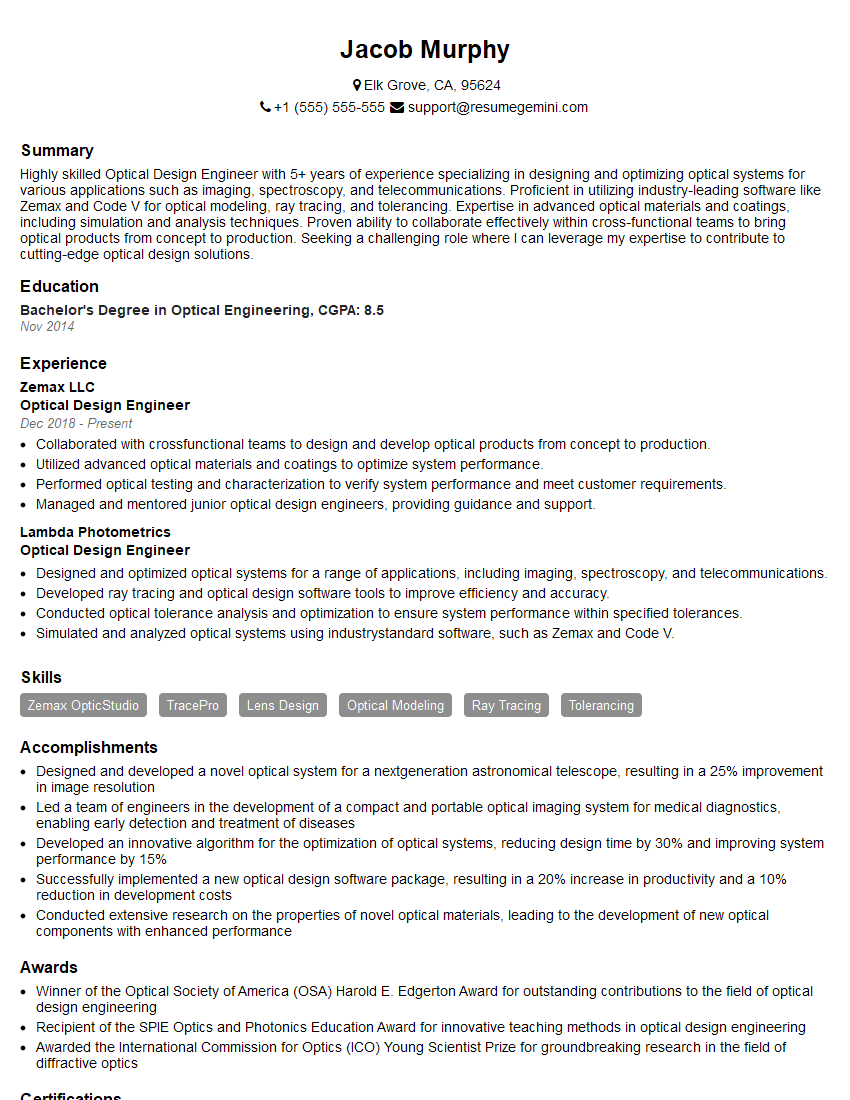
Mastering Infrared Missile Guidance opens doors to exciting and impactful careers in the aerospace and defense industries. Your expertise in this critical field will be highly sought after. To maximize your job prospects, invest in crafting a strong, ATS-friendly resume that showcases your skills and experience effectively. ResumeGemini is a trusted resource to help you build a professional and impactful resume tailored to the specific requirements of the job market. Examples of resumes specifically tailored to Infrared Missile Guidance are available to further guide you in this process. Take the next step towards your dream career today!
Explore more articles
Users Rating of Our Blogs
Share Your Experience
We value your feedback! Please rate our content and share your thoughts (optional).
What Readers Say About Our Blog
Very informative content, great job.
good