Every successful interview starts with knowing what to expect. In this blog, we’ll take you through the top Insulation Taping interview questions, breaking them down with expert tips to help you deliver impactful answers. Step into your next interview fully prepared and ready to succeed.
Questions Asked in Insulation Taping Interview
Q 1. What types of insulation tapes are you familiar with?
Insulation tapes come in a wide variety of types, each designed for specific applications and environmental conditions. The most common types I’m familiar with include:
- Cloth Tapes: These tapes use a cloth backing, often cotton or fiberglass, coated with an adhesive. They offer good conformability and are often used for bundling and general-purpose insulation.
- Film Tapes: These tapes use a thin plastic film backing, such as PVC, polyester, or polyimide, providing excellent dielectric strength and resistance to moisture and chemicals. They are widely used in electrical insulation.
- Silicone Rubber Tapes: These tapes are highly flexible and heat-resistant, making them ideal for applications with high temperatures or frequent flexing.
- Glass Cloth Tapes: Made with a fiberglass backing, these tapes offer superior tensile strength and are often used in high-temperature or high-voltage applications.
- Mylar Tapes: These tapes, with their polyester film backing, possess great dielectric strength, tear resistance and chemical resistance, making them ideal for demanding insulation needs.
- Heat-Shrinkable Tubing: While technically not a tape, it’s a crucial component in many insulation projects. It’s applied as a tube and then shrunk using heat to create a tight, conformal seal.
The choice of tape depends heavily on the application’s specific requirements, such as temperature range, voltage level, and environmental conditions.
Q 2. Explain the difference between cloth and film tapes.
The primary difference between cloth and film tapes lies in their backing material and resulting properties. Cloth tapes, with their woven fabric backing, offer excellent conformability – they can easily wrap around irregular shapes. Their flexibility also makes them good for applications where the insulation needs to withstand some flexing or movement. However, their dielectric strength (resistance to electrical breakdown) is generally lower than film tapes.
Film tapes, on the other hand, usually have a smoother, more rigid backing and superior dielectric strength, making them better suited for high-voltage applications. They often offer better resistance to moisture, chemicals, and abrasion. However, they might not conform as easily to irregular surfaces.
Think of it like this: cloth tape is like a flexible bandage – great for wrapping around a wound and conforming to its shape. Film tape is more like a strong, protective sheet – ideal for covering something completely and preventing damage.
Q 3. Describe the proper application techniques for various insulation tapes.
Proper application techniques are crucial for ensuring the effectiveness of insulation tape. Here’s a general guideline:
- Surface Preparation: Clean the surface thoroughly. Dirt, grease, or moisture can reduce the adhesive’s effectiveness.
- Tape Selection: Choose the appropriate type of tape based on the application requirements (temperature, voltage, etc.).
- Application: Apply the tape smoothly and evenly, overlapping each layer by at least 50% for optimal coverage and strength. Avoid stretching the tape excessively, as this can weaken it.
- Tension: Maintain consistent tension during application to prevent wrinkles or gaps.
- Multiple Layers: For high-voltage or critical applications, apply multiple layers of tape, ensuring each layer overlaps the previous one.
- Finishing: Smooth out the edges of the tape to ensure a neat and secure finish. A slight burnishing can improve adhesion.
For specific tapes, like heat-shrinkable tubing, follow the manufacturer’s instructions carefully, paying attention to temperature and shrinkage time.
Example: When insulating electrical wires, start at one end and wrap the tape tightly and evenly around the wire, creating a smooth, continuous layer. Ensure the entire wire is completely covered and the ends are well-sealed. Avoid loose ends or gaps in the tape.
Q 4. What safety precautions are necessary when working with insulation tapes?
Safety is paramount when working with insulation tapes, especially in electrical applications. Key precautions include:
- Always de-energize circuits: Before working on any live electrical components, ensure the power is completely switched off and locked out. Never assume a circuit is safe.
- Use appropriate Personal Protective Equipment (PPE): Wear gloves, safety glasses, and appropriate clothing to protect yourself from potential hazards.
- Ventilation: In confined spaces or when working with solvents, ensure adequate ventilation to avoid inhaling fumes.
- Fire Safety: Be mindful of fire hazards, especially when working with heat-shrinkable tubing or in environments with flammable materials.
- Proper Disposal: Dispose of used tape and other materials according to local regulations.
Remember, even seemingly simple tasks can be hazardous if safety precautions are neglected. Always prioritize your safety and follow established safety procedures.
Q 5. How do you determine the appropriate type of insulation tape for a specific application?
Selecting the right insulation tape hinges on understanding the specific demands of the application. Consider these key factors:
- Voltage: The tape’s dielectric strength must exceed the voltage it will be subjected to.
- Temperature: The operating temperature range should encompass the expected temperature fluctuations.
- Environmental Conditions: Exposure to moisture, chemicals, UV radiation, or other environmental factors will dictate the need for specific tape properties (e.g., UV resistance, chemical resistance).
- Mechanical Stress: If the insulation will experience flexing or vibration, choose a tape with good flexibility and tensile strength.
- Adhesion: Ensure that the tape’s adhesive will provide a secure bond to the surface being insulated.
Example: For high-voltage applications, a film tape with high dielectric strength would be necessary, while for applications involving high temperatures, a silicone rubber or glass cloth tape would be more suitable.
Referring to manufacturer’s specifications and data sheets is crucial to make an informed decision.
Q 6. What are the common causes of insulation tape failure?
Insulation tape failure can stem from several causes:
- Improper Application: Insufficient overlap, uneven application, or stretching the tape too much can lead to weak points and failure.
- Environmental Factors: Exposure to extreme temperatures, moisture, UV radiation, or chemicals can degrade the tape’s properties over time.
- Mechanical Stress: Excessive flexing, vibration, or abrasion can cause the tape to crack or peel.
- Incorrect Tape Selection: Using the wrong type of tape for the application (e.g., using a low-voltage tape in a high-voltage scenario) can result in failure.
- Age and Degradation: Even with proper application, tapes will eventually degrade with age and exposure to the elements.
Regular inspection is crucial for early detection of potential issues.
Q 7. How do you inspect and identify damaged insulation?
Inspecting insulation for damage requires a thorough visual examination. Look for:
- Cracks or Tears: These indicate structural damage and compromise the insulation’s effectiveness.
- Discoloration: Changes in color can indicate degradation due to age or environmental exposure.
- Loose or Lifting Edges: These signify poor adhesion and potential failure points.
- Gaps or Overlaps: Uneven application or inadequate overlap reduces the insulation’s effectiveness.
- Bulges or Wrinkles: These imperfections can compromise the insulation’s integrity.
In electrical applications, use a non-contact voltage tester to ensure the circuit is de-energized before inspecting the insulation. If there’s any doubt about the integrity of the insulation, it’s best to replace it to avoid potential hazards.
Example: If you find a crack in the insulation tape on a wire, that section should be carefully removed, the damaged area cleaned, and then re-wrapped with fresh insulation tape.
Q 8. Describe your experience with different types of insulation materials.
My experience encompasses a wide range of insulation materials, each with its own strengths and weaknesses. We frequently work with materials like fiberglass, which is common for its cost-effectiveness and thermal properties. However, it’s crucial to handle it carefully due to its potential for fiber release. I’ve also extensively used closed-cell foams like polyethylene or polyurethane, valued for their moisture resistance and superior insulating capabilities, especially in demanding environments. These are often preferred for applications requiring higher R-values (a measure of thermal resistance). Finally, I have experience with mineral wool insulation, known for its fire resistance and acoustic damping properties, making it ideal for applications where these factors are critical. The choice depends heavily on the specific application, environmental conditions, and budget constraints.
- Fiberglass: Cost-effective, readily available, good thermal insulation.
- Closed-cell foam (Polyethylene/Polyurethane): Excellent moisture resistance, high R-value, ideal for damp environments.
- Mineral wool: Superior fire resistance, good acoustic insulation.
Q 9. How do you ensure proper adhesion of insulation tape?
Proper adhesion is paramount for effective insulation. It begins with surface preparation (discussed later), ensuring a clean, dry, and suitably textured surface. The next step is selecting the right tape for the substrate. For instance, a high-tack tape is vital for rough surfaces, while a more flexible tape might be needed for intricate curves. Applying consistent pressure along the entire length of the tape, working from the center outwards to avoid air bubbles, is crucial. Overlap is also important, typically around 50%, to ensure complete coverage and prevent gaps. The tape needs to be appropriately stretched to allow for contraction and expansion with temperature changes, especially in outdoor applications. Finally, checking for any lift or gaps after application ensures a secure bond.
Think of it like putting up wallpaper; you wouldn’t expect it to stick if the wall was dusty or the paste wasn’t applied correctly. The same principle applies to insulation tape.
Q 10. What are the environmental considerations related to insulation tape selection and use?
Environmental considerations are increasingly important. We prioritize tapes with low VOC (volatile organic compound) emissions to minimize air pollution during application and throughout the product’s lifespan. Recycled content tapes are a growing focus, supporting sustainable practices. Biodegradable options are being explored for applications where disposal is a significant concern. Proper disposal of used tapes is also crucial, adhering to local regulations to prevent environmental contamination. Furthermore, the selection of insulation materials themselves influences the environmental impact – closed-cell foams, for example, can have higher embodied carbon than other options, so life-cycle assessments become necessary for large-scale projects.
Q 11. Explain the importance of proper surface preparation before applying insulation tape.
Surface preparation is non-negotiable for successful insulation taping. A clean surface ensures optimal adhesion. This typically involves removing any dirt, dust, grease, or debris using appropriate cleaning agents, such as isopropyl alcohol. For rusty or corroded surfaces, rust removal may be necessary before applying any tape. In some instances, surface abrasion or priming may enhance adhesion, especially on smooth surfaces like plastics. Imagine trying to stick a sticker to a dusty or greasy surface – it simply won’t adhere properly. The same principle applies to insulation tape. A well-prepared surface is the foundation of a long-lasting, effective insulation system.
Q 12. What are the limitations of different types of insulation tapes?
Different insulation tapes have limitations. For example, some tapes are not suitable for high-temperature applications, potentially failing at elevated temperatures. Others may not be resistant to UV degradation and lose their properties when exposed to sunlight for prolonged periods. Certain tapes may be less flexible, making them unsuitable for curved surfaces or intricate details. The adhesive strength can also vary significantly; some tapes might struggle with rough or porous substrates. Finally, moisture resistance is another key factor, with some tapes being more susceptible to water damage than others. Understanding these limitations is crucial for selecting the appropriate tape for each specific application to avoid failures.
Q 13. How do you handle challenging applications, such as curved surfaces or intricate details?
Challenging applications require specialized techniques and sometimes, specialized tapes. For curved surfaces, we might use flexible tapes designed for conformability. For intricate details, we might use narrow tapes or employ scissors to create precise cuts and shapes. In some cases, we might use a combination of tapes, with a high-tack tape for the primary adhesion and a flexible tape to cover seams or overlaps. Pre-cutting tapes into specific shapes beforehand can dramatically improve efficiency and accuracy. Think of it like sculpting with tape – patience and precision are key elements.
For example, when working on pipes, a flexible rubber-backed tape is often the best choice. When covering wires in a tight bundle, a thin, conformable tape is needed to avoid bulk.
Q 14. What tools and equipment are commonly used in insulation taping?
The tools and equipment used in insulation taping are relatively straightforward but essential for efficient and high-quality work. These typically include:
- Measuring tape: For accurate length measurement.
- Utility knife/scissors: For precise cutting of the tape.
- Tape dispensers: To facilitate easier and more controlled application.
- Cleaning materials: Such as isopropyl alcohol and lint-free cloths for surface preparation.
- Heat gun (optional): To activate certain heat-activated tapes or to provide additional adhesion.
- Gloves: To protect hands and maintain a clean working area.
The choice of tools can depend on the scale and complexity of the project.
Q 15. How do you measure and cut insulation tape accurately?
Accurately measuring and cutting insulation tape is crucial for effective insulation and a professional finish. It’s not just about getting the right length; it’s about ensuring proper overlap and a seamless application.
First, I carefully measure the area needing tape using a retractable tape measure. I always double-check my measurements, especially on complex curves or angles. Think of it like tailoring a suit – precise measurements are key to a perfect fit. For example, when taping around a pipe, I’ll measure the circumference to determine the length of tape needed, adding extra for overlap.
Next, I use sharp utility scissors or a specialized tape cutter to make clean, precise cuts. A jagged cut can compromise the seal and reduce the effectiveness of the insulation. A clean cut ensures a smooth, even application. I’ll often use a metal straight edge as a guide for particularly straight lines, like when taping along edges of insulation panels. Finally, I inspect the cut and make any minor adjustments as needed before applying the tape.
Career Expert Tips:
- Ace those interviews! Prepare effectively by reviewing the Top 50 Most Common Interview Questions on ResumeGemini.
- Navigate your job search with confidence! Explore a wide range of Career Tips on ResumeGemini. Learn about common challenges and recommendations to overcome them.
- Craft the perfect resume! Master the Art of Resume Writing with ResumeGemini’s guide. Showcase your unique qualifications and achievements effectively.
- Don’t miss out on holiday savings! Build your dream resume with ResumeGemini’s ATS optimized templates.
Q 16. What are the industry standards and codes related to insulation taping?
Industry standards and codes for insulation taping vary depending on the specific application and location. However, some common principles apply across the board. Safety regulations, for instance, always take precedence. This includes using appropriate personal protective equipment (PPE) like gloves and safety glasses.
Many building codes dictate the type and quality of insulation materials and the methods of application. For example, in fire-rated applications, specific fire-resistant tapes and installation techniques must be used, often specified in the building’s blueprints. There may be requirements for the overlap of the tape to ensure a consistent seal. Moreover, standards related to energy efficiency are often implemented, encouraging the use of high-performance tapes to minimize heat loss or gain.
Organizations like the International Code Council (ICC) and Underwriters Laboratories (UL) provide valuable resources and standards related to building construction and material specifications. Staying updated on these codes and standards is crucial for compliance and ensuring the quality of my work. Ignoring these standards could lead to faulty insulation, potentially affecting building efficiency and safety.
Q 17. Describe your experience with working at heights or in confined spaces related to insulation work.
I have extensive experience working at heights and in confined spaces, both integral aspects of insulation work. Safety is always my top priority. Before starting any work at height, I always conduct a thorough risk assessment, utilizing proper safety harnesses and fall protection equipment, as mandated by OSHA regulations. For example, when working on a high-rise building, I ensure that all safety lines are securely fastened and I have a spotter if necessary.
In confined spaces, the focus shifts to ventilation and air quality. I always utilize appropriate respiratory protection and ensure proper ventilation to avoid exposure to harmful airborne particles or gases that may be present. Before entering a confined space, I always check the oxygen levels and for the presence of any hazardous materials. I never work alone in a confined space and always have a partner for safety and assistance. In both situations, adhering to safety protocols is not just a guideline – it’s the only way to prevent accidents and ensure a safe work environment.
Q 18. How do you maintain a clean and organized workspace during insulation work?
Maintaining a clean and organized workspace is vital for efficiency and safety. It prevents accidents caused by tripping hazards and ensures that materials are easily accessible. My approach is systematic. Before starting a job, I plan the layout, organizing tools and materials in a logical manner. This prevents wasted time searching for items.
During the process, I regularly clear away debris such as scraps of tape or insulation material. This is not just about aesthetics; it prevents the build-up of waste and reduces the risk of accidental damage to the insulation. For example, I use designated bins for different types of waste and ensure proper disposal methods to comply with environmental regulations. At the end of each work day, I thoroughly clean the area, ensuring tools are stored correctly. This organized approach allows me to work more efficiently and safely, contributing to a superior end result.
Q 19. How do you manage your time and prioritize tasks in a fast-paced environment?
Time management in a fast-paced environment relies on planning and prioritization. I start by reviewing the project specifications and breaking down the tasks into smaller, manageable units. This provides a clear roadmap of what needs to be done and in what order. I prioritize tasks based on their urgency and importance. Critical tasks requiring specific tools or materials are completed first to avoid delays.
I utilize scheduling tools and checklists to track progress and ensure deadlines are met. For example, if I’m working on multiple projects simultaneously, I’ll create a schedule outlining the time allocated for each task, which helps in maintaining balance and completing all tasks efficiently. Regular communication with my team and supervisors helps to identify and resolve any potential bottlenecks early, preventing project delays.
Q 20. Explain your problem-solving skills in relation to insulation challenges.
Problem-solving is a core competency in insulation work. Challenges can range from unexpected material issues to difficult installation situations. My approach is methodical. When faced with a problem, I begin by identifying the root cause. For instance, if the tape isn’t adhering properly, I investigate factors such as surface cleanliness, temperature, or tape compatibility.
Next, I explore various solutions, weighing the pros and cons of each. If the issue is a difficult-to-reach area, I may need to use specialized tools or techniques to ensure complete coverage. If the issue is material-related, I might need to consult the manufacturer’s specifications or consider alternative materials. Throughout this process, I document my findings and solutions. This allows for efficient troubleshooting in similar situations in the future. This systematic approach ensures that I can find practical and effective solutions efficiently.
Q 21. What are your experience with different types of adhesives used in insulation taping?
My experience encompasses a wide range of adhesives used in insulation taping. The choice of adhesive is crucial, impacting the tape’s performance, durability, and suitability for the specific application. Common types include acrylic, rubber-based, and pressure-sensitive adhesives.
Acrylic adhesives are known for their versatility and strong bonding capabilities, especially on various surfaces. They provide good adhesion even in low-temperature conditions. Rubber-based adhesives offer high tack and excellent durability, suitable for demanding applications, and often work well on uneven surfaces. Pressure-sensitive adhesives are simple to use, requiring only hand pressure for application, but may be less durable in extreme conditions.
Selecting the right adhesive involves considering factors like the substrate material (metal, wood, plastic), temperature variations, and the level of stress the tape will endure. For instance, I’d use a high-temperature-resistant adhesive for ductwork in industrial settings to ensure that the bond remains strong in hot conditions. Each adhesive has its own characteristics, which I carefully consider when choosing the right tape for a project.
Q 22. How familiar are you with different types of splicing techniques?
Splicing techniques are crucial for ensuring the continuity and integrity of electrical insulation. My familiarity spans several methods, each chosen based on the specific application and the type of wire involved.
- Twist Splicing: A simple method suitable for low-voltage applications, but less robust for high-stress environments. It involves twisting the bare wire ends together and then insulating. I generally avoid this for anything beyond minimal applications.
- Western Union Splice: A more secure method than twisting, involving wrapping one wire around the other before insulation. It offers improved mechanical strength. I often use this for smaller gauge wires in relatively less demanding settings.
- Soldered Splice: This provides the most secure and reliable connection, ideal for high-voltage or high-current applications. After twisting, the splice is soldered for excellent conductivity and durability. It is a time consuming method that must be done carefully to avoid overheating.
- Crimp Splicing: Using specialized crimping tools, this method offers a fast and reliable connection, particularly for larger gauge wires. I utilize this for heavier applications and where speed and reliability are paramount.
The choice of splicing technique always considers factors like voltage, current, wire gauge, and the environmental conditions the splice will endure.
Q 23. Describe your experience with heat-shrinkable tubing and its applications.
Heat-shrinkable tubing is a vital component in my insulation toolkit. It’s essentially a tube of flexible polymer that shrinks tightly around a wire or component when heated, providing excellent insulation, strain relief, and environmental protection.
- Applications: I use heat-shrink tubing extensively for wire termination, protecting splices from moisture and abrasion, bundling wires for better organization and insulation, and insulating connectors from accidental shorts.
- Advantages: Its ease of use, reliable performance, and versatility make it a go-to solution. The shrink ratio allows for covering larger diameters with relatively smaller tubing.
- Types: I’ve worked with various types, including standard PVC, flame-retardant, and those with adhesive lining for added security. The choice depends on the specific needs of the project.
For instance, recently I used flame-retardant heat-shrink tubing to insulate wires near a motor in a high-temperature environment. This ensured not only electrical safety but also fire prevention.
Q 24. What are the common problems associated with improper insulation installation?
Improper insulation installation can lead to a cascade of problems, ranging from minor inconveniences to serious safety hazards. Common issues include:
- Electrical shorts: Inadequate insulation can lead to dangerous short circuits, potentially causing fires or equipment damage.
- Ground faults: Compromised insulation can lead to a ground fault, posing a shock risk to personnel.
- Moisture ingress: Poorly sealed insulation allows water to enter the system, causing corrosion, degradation of materials, and electrical malfunctions. I’ve personally seen equipment failure caused by this, leading to costly repairs.
- Mechanical damage: Improperly installed insulation can be easily damaged, making the underlying wires susceptible to abrasion and breakage.
- Reduced efficiency: In some systems, poor insulation can lead to energy loss due to heat dissipation.
These problems not only affect the functionality of the equipment but also present significant safety concerns. It’s crucial to follow best practices and use high-quality materials.
Q 25. How do you ensure compliance with relevant safety regulations during insulation application?
Safety is my top priority. I ensure compliance with all relevant safety regulations by following several key steps:
- Lockout/Tagout procedures: I always de-energize equipment before working on it, using proper lockout/tagout procedures to prevent accidental energization.
- Personal Protective Equipment (PPE): I consistently use appropriate PPE, such as insulated gloves, safety glasses, and sometimes even protective clothing depending on the project.
- Training and Certification: I maintain updated training and certifications relevant to electrical safety and insulation techniques. I’m up-to-date on all relevant safety codes.
- Regular Inspections: After completing work, I conduct thorough inspections to ensure the insulation is properly installed and meets safety standards.
- Proper documentation: I maintain complete documentation of the work performed, including materials used and safety precautions taken.
By adhering to these measures, I create a safer work environment for myself and others.
Q 26. Describe a time you had to troubleshoot a problem related to insulation tape failure. What was your solution?
I once encountered a situation where a motor’s insulation tape failed due to excessive heat and vibration. This resulted in intermittent operation and a potential fire hazard.
My troubleshooting involved:
- Visual inspection: I carefully examined the affected area, identifying the damaged insulation and the underlying cause.
- Testing: I used a multimeter to check the continuity and insulation resistance of the wiring, verifying the extent of the damage.
- Solution: I removed the damaged tape completely, cleaned the wires thoroughly, and applied a higher-temperature rated and more robust insulation tape with added reinforcement. I also addressed the root cause by ensuring better heat dissipation from the motor.
- Retesting: After completing the repairs, I repeated the continuity and insulation resistance tests to confirm the effectiveness of my solution.
This experience reinforced the importance of using the correct type of tape for specific applications and addressing root causes of failures to prevent recurrence.
Q 27. What is your experience with different types of fire-resistant insulation tapes?
My experience encompasses several types of fire-resistant insulation tapes, each with its own advantages and applications. These include:
- Silicone rubber tapes: Excellent for high-temperature applications, offering both electrical insulation and flame resistance.
- Fiberglass tapes: Provides good mechanical strength and insulation, with added fire-resistant properties. These often come with a silicone adhesive for enhanced performance.
- Ceramic fiber tapes: Suitable for extreme temperatures and harsh environments where superior fire protection is paramount.
- Kapton tapes: Known for their high-temperature resistance and excellent dielectric strength. They’re particularly useful in electronics.
The selection of the appropriate fire-resistant tape depends on factors like the operating temperature, the specific hazard, and the environmental conditions. Choosing the right type is critical for ensuring safety and preventing fire-related incidents.
Q 28. How do you handle working with different types of surfaces (metal, wood, plastic, etc.) when applying insulation tape?
Working with diverse surfaces requires adapting my techniques to ensure proper adhesion and insulation. The key is surface preparation and selection of the right tape.
- Metal: I typically clean the metal surface with a suitable solvent to remove any grease or debris before applying the tape. A slightly roughened surface can further enhance adhesion.
- Wood: Ensuring a clean and dry wooden surface is crucial. Sometimes a primer might be necessary for better adhesion, particularly on porous woods.
- Plastic: The type of plastic influences the adhesion. I select tapes specifically designed for plastic surfaces to ensure a strong bond and prevent peeling. Cleaning the surface is critical here as well.
In addition to surface preparation, tape selection is vital. I might opt for a higher-tack tape for difficult surfaces or those subject to vibration or movement. I always perform a small test application to ensure compatibility before proceeding.
Key Topics to Learn for Insulation Taping Interview
- Types of Insulation Tape: Understand the properties and applications of different insulation tapes (e.g., fiberglass, PVC, silicone, Kapton). Consider their thermal, electrical, and mechanical properties and when each is best suited.
- Taping Techniques and Best Practices: Master proper taping techniques for different applications, including surface preparation, tape application methods (e.g., hand wrapping, machine application), and achieving consistent overlap and tension. Explore techniques for minimizing air gaps and ensuring a strong, secure seal.
- Safety Procedures and Regulations: Familiarize yourself with relevant safety regulations and best practices related to insulation taping, including personal protective equipment (PPE) requirements and hazard identification.
- Troubleshooting Common Issues: Develop problem-solving skills to identify and address common issues encountered during insulation taping, such as tape adhesion problems, air bubbles, and inconsistencies in the tape layer. Be prepared to discuss how you approach troubleshooting in a systematic manner.
- Materials Compatibility: Understand the compatibility of different insulation tapes with various substrates and materials. Be able to discuss factors that might affect adhesion or performance.
- Industry Standards and Codes: Review relevant industry standards and codes of practice related to insulation taping in your specific field (e.g., electrical, HVAC, automotive). This demonstrates a commitment to quality and safety.
- Quality Control and Inspection: Learn about quality control methods used to ensure the integrity and effectiveness of insulation taping. Be prepared to discuss visual inspection techniques and other quality assurance measures.
Next Steps
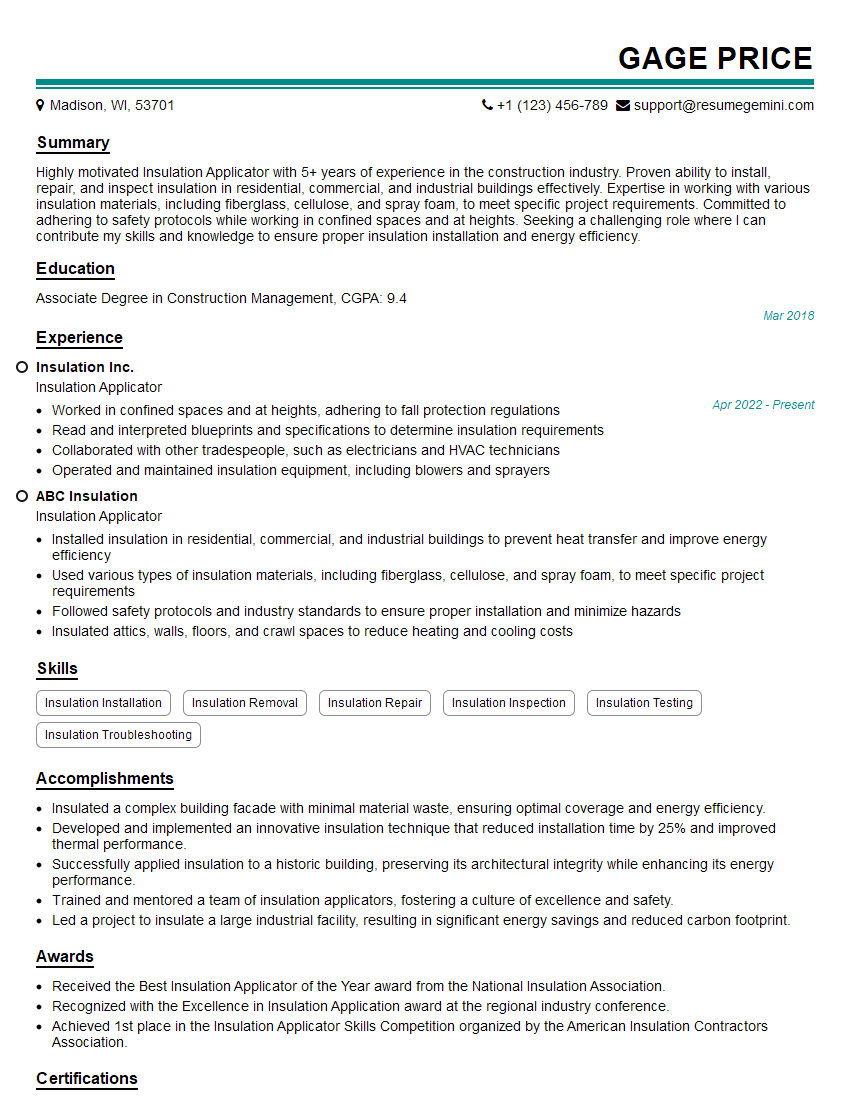
Mastering insulation taping techniques opens doors to diverse and rewarding career opportunities within various industries. To maximize your job prospects, create a professional and ATS-friendly resume that effectively highlights your skills and experience. ResumeGemini is a trusted resource that can help you build a compelling resume tailored to your specific qualifications. Examples of resumes tailored to the Insulation Taping field are available, allowing you to craft a document that stands out from the competition and showcases your expertise in the field. Take the initiative to build a strong resume; it’s a crucial step in securing your desired role.
Explore more articles
Users Rating of Our Blogs
Share Your Experience
We value your feedback! Please rate our content and share your thoughts (optional).
What Readers Say About Our Blog
Very informative content, great job.
good