Interviews are opportunities to demonstrate your expertise, and this guide is here to help you shine. Explore the essential Interference Mitigation Techniques interview questions that employers frequently ask, paired with strategies for crafting responses that set you apart from the competition.
Questions Asked in Interference Mitigation Techniques Interview
Q 1. Explain the difference between EMI and RFI.
While both EMI and RFI refer to unwanted electromagnetic energy interfering with a system’s operation, they differ slightly in their origin and frequency range. Electromagnetic Interference (EMI) is a broader term encompassing any unwanted electromagnetic energy, regardless of its source. This includes naturally occurring phenomena like lightning as well as man-made sources like electrical equipment. Radio Frequency Interference (RFI) is a subset of EMI, specifically referring to interference within the radio frequency spectrum (typically 3 kHz to 300 GHz). Think of EMI as the umbrella term, with RFI being one type of interference under that umbrella. For instance, a faulty spark plug in a car engine creates EMI, and some of that EMI, if it falls within the radio frequency range, is then also classified as RFI, possibly disrupting radio reception.
Q 2. Describe various techniques for mitigating electromagnetic interference.
Mitigating electromagnetic interference involves a multi-pronged approach, addressing both the source and the receiver of the interference. Common techniques include:
- Shielding: Enclosing sensitive components or circuits in conductive enclosures (like metal boxes or conductive coatings) to block electromagnetic fields. This is highly effective for preventing both EMI and RFI.
- Filtering: Using electronic filters to attenuate specific frequency ranges of interference. Low-pass, high-pass, band-pass, and notch filters are commonly employed depending on the nature of the interference.
- Grounding and Bonding: Establishing a low-impedance path to ground for all conductive components, minimizing voltage differences and preventing the formation of loops that can act as antennas. This is crucial in preventing ground loops that create significant EMI.
- Distance and Orientation: Increasing the physical separation between interfering sources and sensitive equipment reduces the intensity of the interference. Proper orientation can also minimize coupling between components.
- Signal Integrity Techniques: Implementing techniques like proper impedance matching, controlled rise/fall times, and the use of twisted-pair wiring in signal paths to minimize unwanted radiation and susceptibility to interference. These are especially vital in high-speed digital systems.
- Absorptive Materials: Using materials that absorb electromagnetic energy to reduce interference levels. These are frequently employed in anechoic chambers or as coatings on surfaces.
The best approach depends on the specific interference source, its frequency, and the sensitivity of the affected system. Often, a combination of these techniques is necessary for effective mitigation.
Q 3. How do you identify the source of electromagnetic interference?
Identifying the source of EMI requires a systematic approach. Here’s a typical process:
- Initial Observation and Documentation: Carefully note when the interference occurs, its characteristics (e.g., frequency, amplitude, waveform), and any related operational conditions. A thorough understanding of the system operation is vital here.
- Spectrum Analysis: Use a spectrum analyzer to pinpoint the frequency or frequencies of the interference. This provides crucial information on the nature of the interference.
- Near-Field Probing: Using a near-field probe, systematically scan the area around the affected equipment to locate the strongest interference sources. This is particularly useful for pinpointing EMI from poorly shielded or noisy components.
- Current Probes and Voltage Probes: Employ current probes and voltage probes to measure the current and voltage levels at various points in the system, helping to identify potential noise sources within the circuits.
- Controlled Experiments: Systematically disconnect components or modify operational parameters to isolate the source. A controlled process of elimination is crucial.
- Signal Tracing and Injection: If the source remains elusive, use signal tracing techniques and purposely inject known signals to observe their propagation and identify potential paths of interference.
Remember, patience and methodical investigation are key to successfully identifying the source of electromagnetic interference.
Q 4. What are the common causes of interference in wireless communication systems?
Several factors contribute to interference in wireless communication systems:
- Co-channel Interference: Signals from other devices operating on the same frequency band can overlap and cause interference. This is particularly problematic in crowded frequency bands like 2.4 GHz.
- Adjacent-channel Interference: Signals from devices operating on adjacent frequency channels can ‘bleed’ into the desired channel, causing interference. Good channel planning is crucial.
- Intermodulation Products: Non-linear mixing of signals from multiple sources can create new interference signals at frequencies that are sums or differences of the original signals.
- Multipath Propagation: Signals reflecting off various surfaces can arrive at the receiver with different delays, causing constructive and destructive interference and signal fading.
- Atmospheric Noise: Natural phenomena like lightning and solar activity can generate electromagnetic noise that affects wireless communication.
- Man-made Noise: Industrial equipment, power lines, and other electrical devices can create significant electromagnetic interference.
Effective mitigation often involves choosing optimal operating frequencies, implementing error correction codes, using directional antennas, and employing techniques to minimize multipath effects.
Q 5. Explain the concept of shielding effectiveness and how it’s measured.
Shielding effectiveness quantifies how well a shield attenuates electromagnetic fields. It represents the reduction in the electromagnetic field strength on the shielded side compared to the unshielded side. A higher shielding effectiveness indicates better protection. It’s typically expressed in decibels (dB) and calculated as:
Shielding Effectiveness (SE) = 20 * log10(E_unshielded / E_shielded)
where E_unshielded is the field strength without the shield and E_shielded is the field strength with the shield. Measurement involves using equipment like a near-field probe and a spectrum analyzer. A controlled environment with a known electromagnetic field source is crucial for accurate measurements. The measurement process also considers the frequency range of interest, as shielding effectiveness can vary significantly with frequency. For example, a shield might offer excellent SE at lower frequencies but less so at higher frequencies.
Q 6. Describe different types of filters used in interference mitigation.
Numerous filter types are used in interference mitigation, each tailored to specific frequency characteristics:
- Low-pass filters: Allow frequencies below a cutoff frequency to pass while attenuating higher frequencies.
- High-pass filters: Allow frequencies above a cutoff frequency to pass while attenuating lower frequencies.
- Band-pass filters: Allow frequencies within a specific band to pass while attenuating frequencies outside that band.
- Band-stop (notch) filters: Attenuate frequencies within a specific band while allowing frequencies outside that band to pass. These are excellent for rejecting specific interference signals.
- LC Filters (Inductor-Capacitor): Simple passive filters using inductors and capacitors. Their effectiveness varies with frequency.
- Pi Filters: Use multiple capacitors and inductors to enhance filtering capabilities compared to basic LC filters.
- Active Filters: Employ operational amplifiers to provide more precise frequency response and better attenuation, especially useful for more complex filtering needs.
The choice of filter depends on the specific interference and the desired filtering characteristics. Factors like the cutoff frequency, roll-off rate (how quickly attenuation increases), and impedance matching are critical design considerations.
Q 7. How do you design a PCB to minimize EMI?
Designing a PCB for minimal EMI requires careful consideration of various aspects:
- Component Placement: Strategically place sensitive components away from potential noise sources. Group components by function, and separate analog and digital circuits.
- Grounding: Create a single-point ground plane to minimize ground loops. Use multiple vias for effective grounding and minimize trace lengths.
- Power Supply Decoupling: Place capacitors close to the power pins of integrated circuits to suppress noise on the power supply lines. Use multiple capacitors of different values to cover a wide range of frequencies.
- Trace Routing: Keep signal traces short and direct. Use twisted-pair wiring for sensitive signals to minimize radiation. Avoid long parallel traces, as they can act as antennas.
- Shielding: Use a ground plane as a shield, and consider using metal enclosures or conductive coatings for extra shielding. Consider the use of ferrite beads to suppress high-frequency noise.
- Controlled Impedance: Maintain consistent impedance along signal traces to minimize reflections and signal degradation.
- Layout Symmetry: Symmetrical layouts can reduce unwanted radiation.
Use specialized PCB design software with EMI simulation capabilities to verify and optimize the design before fabrication. Often iterative design adjustments are needed to achieve optimal results.
Q 8. What are the key considerations for grounding and bonding in interference mitigation?
Grounding and bonding are fundamental in interference mitigation. Grounding connects a device or system to the earth, providing a low-impedance path for unwanted currents to flow safely away. Bonding connects multiple metallic parts within a system to ensure they’re at the same electrical potential, preventing voltage differences that could create interference. Think of it like plumbing – grounding is your main drain, and bonding ensures all your pipes are connected to prevent leaks.
- Key Considerations:
- Low Impedance Paths: Grounding and bonding wires must be thick enough and short enough to minimize resistance, ensuring effective current flow. High resistance pathways can actually worsen interference by creating voltage drops.
- Multiple Ground Points: In large systems, using multiple grounding points is crucial to avoid ground loops – situations where multiple grounding paths create circulating currents causing noise.
- Material Selection: Conductors should be chosen for their low resistance and corrosion resistance. Copper is a common choice.
- Shielding Effectiveness: Bonding plays a crucial role in the effectiveness of shielding. A properly bonded shield provides a continuous low-impedance path for conducted interference, preventing it from entering sensitive components.
- Safety: Grounding protects against electrical shocks and equipment damage. It’s a critical safety measure, not just an interference mitigation technique.
Example: Imagine a sensitive audio amplifier near a large motor. Proper grounding and bonding of both the amplifier and the motor’s chassis prevents the motor’s electromagnetic noise from being conducted through the ground into the amplifier and causing hum or distortion. Without this, the noise would couple into the audio signal.
Q 9. Explain the role of impedance matching in reducing reflections and interference.
Impedance matching ensures that the impedance of a source (e.g., a transmitter) is equal to the impedance of the load (e.g., a receiver) and the transmission line connecting them. This prevents reflections of signals at the source and load interfaces. Reflections cause signal distortion and can lead to interference by creating unwanted echoes.
Think of it like pushing a water balloon down a garden hose. If the hose is matched to the pressure of your push, all the water goes through smoothly. However, if there’s a sudden change in the hose’s diameter (mismatched impedance), some water will bounce back (reflection), causing a mess and potentially damaging the hose.
In electronics, reflected signals interfere with the original signals, resulting in signal degradation, reduced power transfer, and potentially increased interference. Matching impedance minimizes reflections, maximizing signal transfer efficiency and reducing interference.
Techniques for Impedance Matching:
- Matching Networks: Circuits employing inductors and capacitors to transform the impedance of one component to match another.
- Transmission Lines: Carefully selecting transmission lines (coaxial cables, for example) with a characteristic impedance that matches the source and load impedance.
- Impedance Transformers: Devices specifically designed to transform impedances.
Example: In RF communication systems, it’s crucial to have properly matched impedance between the antenna and the transmitter/receiver. Mismatched impedance can lead to signal reflections back towards the transmitter, potentially damaging the circuitry, reducing signal strength, and increasing interference. Using baluns or other impedance matching networks is standard practice.
Q 10. Describe your experience with different interference measurement techniques.
My experience encompasses a wide range of interference measurement techniques, both in the time and frequency domains. These techniques allow us to pinpoint the sources and characteristics of interference, guiding mitigation strategies.
- Spectrum Analyzers: Essential for analyzing the frequency content of signals and identifying interference sources. I’ve used them extensively to pinpoint interference peaks and harmonics in frequency domain.
- Network Analyzers: Used to characterize the impedance of circuits and transmission lines, identifying mismatches that could cause reflections and interference. I have used it to measure S-parameters and characterize impedance over a frequency range.
- EMI Receivers/Preamplifiers: To measure conducted or radiated emissions, I rely on calibrated receivers and preamplifiers to ensure accurate measurements across various frequency ranges.
- Near-field Probes: for detailed investigation of electromagnetic fields around electronic devices. These help identify precise locations of emissions.
- Current Probes: These are indispensable for measuring conducted currents on various lines. This is a direct way to pinpoint currents flowing in a system that contribute to interference.
- Time-domain reflectometers (TDRs): used to detect discontinuities or impedance mismatches on transmission lines that might cause reflections and interference.
Example: In one project involving a medical device, I used a combination of spectrum analyzer and near-field probes to identify a specific component causing unwanted high-frequency radiation. Pinpointing it, we were able to encapsulate it with shielding material, effectively mitigating the interference.
Q 11. How do you interpret EMI/EMC test results?
Interpreting EMI/EMC test results involves a systematic approach. The key is understanding the context of the measurements and comparing them to applicable standards.
- Limit Lines: The first step is comparing the measured emission or immunity levels to the relevant limit lines specified by standards like CISPR, FCC, or other regional regulations. Exceeding these limits indicates a potential compliance issue.
- Margin of Compliance: The difference between the measured values and the limit lines represents the margin of compliance. A larger margin is preferable for robustness and future design changes.
- Frequency Dependence: Emissions and immunity levels often vary significantly with frequency. Analyzing the frequency distribution of interference reveals crucial insights into the sources and characteristics of interference.
- Correlation with Design: The results should be correlated with the system’s design, pinpointing sources of interference based on their frequency components and location.
- Statistical Analysis: Test results often involve multiple measurements. A statistical analysis (like determining average, minimum, and maximum values and standard deviation) helps assess the consistency and reliability of the results.
Example: If the test shows that a device’s radiated emissions exceed the limits in a specific frequency band, this indicates that the device’s design needs modification to reduce those emissions. Analyzing the location and magnitude of the emission at different frequencies provides clues about the source, for instance a poor grounding of a high-speed clock, enabling a more effective modification.
Q 12. What are the relevant standards and regulations for electromagnetic compatibility?
Electromagnetic compatibility (EMC) standards and regulations vary depending on the region and the type of equipment. However, some key international standards provide a framework for many local regulations.
- CISPR (International Special Committee on Radio Interference): This organization establishes many widely adopted international standards for limits on electromagnetic emissions and immunity. CISPR standards are frequently referenced in local regulations.
- FCC (Federal Communications Commission): In the United States, the FCC sets regulations for electromagnetic emissions and has its own standards for various types of electronic devices.
- CE Marking (Conformité Européenne): This mark indicates that a product conforms to all relevant European Union directives, including those related to EMC. This requires testing to specific standards.
- IEC (International Electrotechnical Commission): IEC standards cover various aspects of electrical and electronic technologies, including many EMC-related standards, that are referenced globally.
- Other Regional Standards: Various countries and regions have their own specific standards and regulations that often align with or are based on international standards.
Example: A device intended to be sold in the European Union (EU) needs to comply with the EMC Directive, which usually implies meeting the requirements of CISPR standards through testing and certification. Similarly, a device for sale in the US would need to meet FCC regulations.
Q 13. Explain the concept of conducted and radiated emissions.
Conducted and radiated emissions are two primary ways electromagnetic interference (EMI) can propagate and affect other devices.
Conducted Emissions: These are electromagnetic disturbances that travel along conductive paths, such as power cords, signal cables, and ground connections. They are effectively ‘currents’ that flow along wires.
- Source: Can originate from switching power supplies, motors, or other circuits that generate high-frequency transients or harmonics.
- Propagation: These emissions travel through cables and can couple into other circuits, causing interference.
- Mitigation: Often addressed through filters on power lines and signal lines, proper grounding, and shielding of cables.
Radiated Emissions: These are electromagnetic disturbances that propagate through space as electromagnetic waves. They are similar to radio waves.
- Source: These originate from antennas or unintentional radiating structures on electronic devices, such as traces on printed circuit boards (PCBs).
- Propagation: They travel through the air and can induce currents and voltages in other nearby electronic equipment, causing interference.
- Mitigation: Usually involves using shielding to confine the emissions, using proper grounding techniques, and optimized PCB layout design.
Example: A switching power supply can generate both conducted emissions on its power cord (coupling interference through wires) and radiated emissions from its enclosure (radiated interference through the air). These need to be addressed through different mitigation techniques.
Q 14. How do you address interference issues in high-frequency circuits?
Addressing interference in high-frequency circuits requires specialized techniques, due to the increased susceptibility to electromagnetic effects. Higher frequencies mean shorter wavelengths, making signals more prone to radiation and coupling.
- Shielding: Employing effective shielding is paramount in high-frequency designs. The shield needs to be properly grounded and continuous, with minimal apertures.
- Careful PCB Layout: Placing sensitive components away from high-frequency signal paths is important. Using ground planes and proper grounding techniques to minimize unwanted loop antennas helps.
- Filtering: Using appropriate filters at both the input and output of high-frequency circuits can help to attenuate conducted interference.
- Impedance Matching: As mentioned previously, ensuring impedance matching at all points in the high-frequency signal path is critical to minimizing reflections and maximizing signal integrity.
- Differential Signaling: Using differential signaling pairs reduces susceptibility to common-mode interference, thus improving noise immunity.
- Specialized Components: Using specialized high-frequency components, such as surface mount technology (SMT) components and low-ESR capacitors, minimizes parasitic capacitance and inductance, improving signal integrity.
Example: In a high-speed digital design, using differential signaling, carefully controlling the impedance of traces on the PCB, and employing proper grounding techniques will be crucial for preventing signal integrity issues and reducing the chance of EMI.
Q 15. Describe your experience with software tools used for EMI/EMC analysis.
My experience with software tools for EMI/EMC analysis is extensive. I’ve worked extensively with industry-standard tools like ANSYS HFSS, CST Microwave Studio, and Keysight ADS. These tools allow for sophisticated simulations of electromagnetic fields, enabling the prediction and mitigation of interference before prototypes are even built. For example, using ANSYS HFSS, I once modeled a complex PCB layout to identify potential radiation hotspots, leading to design modifications that significantly reduced emissions and improved compliance with regulatory standards. I’m also proficient with tools like Keysight Advanced Design System (ADS) for circuit-level simulations, which helps pinpoint sources of interference within electronic circuits. Furthermore, I have experience using specialized EMI/EMC pre-compliance test software to analyze measurements taken from real-world systems, allowing for faster problem identification and resolution. This combination of simulation and measurement analysis gives me a holistic view of EMI/EMC challenges.
Career Expert Tips:
- Ace those interviews! Prepare effectively by reviewing the Top 50 Most Common Interview Questions on ResumeGemini.
- Navigate your job search with confidence! Explore a wide range of Career Tips on ResumeGemini. Learn about common challenges and recommendations to overcome them.
- Craft the perfect resume! Master the Art of Resume Writing with ResumeGemini’s guide. Showcase your unique qualifications and achievements effectively.
- Don’t miss out on holiday savings! Build your dream resume with ResumeGemini’s ATS optimized templates.
Q 16. How do you troubleshoot interference problems in a complex system?
Troubleshooting interference in a complex system requires a systematic approach. I typically start with a thorough understanding of the system architecture and signal paths. This involves reviewing schematics, PCB layouts, and system documentation. The next step is careful measurement using spectrum analyzers and oscilloscopes to identify the frequency and amplitude of the interference. This helps pinpoint the source of the problem. Then, I employ a combination of techniques such as signal tracing, near-field probing, and current probes to isolate the interference source. For instance, if the interference is a high-frequency signal, a near-field probe can help locate its origin more precisely than using just a spectrum analyzer. Once the source is identified, targeted mitigation strategies can be applied, like adding filters, shielding, or redesigning specific components. I often use a combination of hardware and software diagnostic tools, such as logic analyzers and software-defined radios, to understand the timing and nature of signals and interference. Documenting each step in detail is vital for both troubleshooting and future reference.
Q 17. What are the different types of antennas and their impact on interference?
Different antenna types have vastly different radiation patterns and sensitivities, directly impacting their contribution to and susceptibility to interference. Common types include dipole antennas, monopole antennas, patch antennas, and horn antennas. A dipole antenna, for instance, has a relatively omnidirectional pattern in the plane perpendicular to its axis, meaning it can receive or transmit signals from a wide range of angles, thus increasing the potential for interference. In contrast, a highly directional horn antenna has a narrow beamwidth, minimizing interference from sources outside this beam. The impact on interference also depends on factors such as antenna gain, frequency of operation, and polarization. A high-gain antenna, while providing better signal reception, is also more sensitive to interference, which might necessitate more robust interference mitigation techniques. Patch antennas, often used in mobile devices, can have significant interference issues from nearby metal objects which alter their radiation patterns. The careful selection of antenna type and its placement within the system are crucial factors in minimizing the impact of interference.
Q 18. Explain the concept of near-field and far-field interference.
Near-field and far-field interference describe how electromagnetic fields behave relative to the source and the distance. In the near field (typically less than λ/2π, where λ is the wavelength), the electromagnetic fields are complex and strongly coupled to the source. Interference in the near field is characterized by reactive fields, meaning energy is stored rather than radiated. This type of interference is often highly localized and can be influenced by the physical proximity and orientation of components. In contrast, the far field (distances significantly greater than λ/2π) is dominated by radiating electromagnetic waves. Far-field interference is characterized by propagating waves and exhibits a more predictable behavior, often following the inverse square law (intensity decreases proportionally to the square of the distance). An example of near-field interference would be crosstalk between closely spaced traces on a printed circuit board. An example of far-field interference would be interference from a nearby radio transmitter affecting the reception of a receiver. Understanding this distinction is crucial for selecting effective mitigation strategies. Near-field problems often require careful layout and shielding, whereas far-field interference may require directional antennas or changes to transmission power.
Q 19. How does cable shielding affect signal integrity and interference?
Cable shielding significantly impacts signal integrity and interference reduction. Shielding, typically a conductive metallic layer or braid wrapped around the cable, acts as a Faraday cage, blocking external electromagnetic fields from affecting the signal within the cable (reducing EMI). Simultaneously, it prevents the signal within the cable from radiating outwards (reducing EMC). The effectiveness of shielding depends on factors like the conductivity and permeability of the shielding material, the shielding’s continuity, and the frequency of the signals. Breaks or gaps in the shield can severely compromise its effectiveness, allowing interference to penetrate. Proper grounding of the shield at both ends is also essential to ensure a complete current path for any interfering signals. Without proper shielding, signals can be corrupted by external interference (noise pickup), leading to signal degradation and malfunctioning. Shielding also helps maintain signal integrity by reducing signal reflections and impedance mismatches, which can cause signal distortion. In high-speed digital systems, proper shielding is crucial for preventing signal degradation and ensuring data integrity.
Q 20. What is the role of common-mode and differential-mode interference?
Common-mode and differential-mode interference are two fundamental types of noise affecting signal transmission. Differential-mode interference is the difference in voltage between two signal lines. It’s the intended signal, but it can be corrupted by noise coupled equally to both lines. This can be mitigated by balanced transmission lines and differential amplifiers. Common-mode interference is a voltage that appears equally on both signal lines. This type of noise is typically induced through capacitive or inductive coupling, which can significantly impact the integrity of differential signals. For example, common-mode noise might be induced by a nearby power line. Common-mode chokes, which offer high impedance to common-mode currents while allowing differential-mode currents to pass relatively unaffected, can effectively suppress common-mode noise. Both need to be carefully considered during design and testing to achieve good signal integrity. Often a balanced system design with proper grounding is necessary to deal with both types effectively.
Q 21. Describe techniques for mitigating interference in power systems.
Mitigating interference in power systems is critical for ensuring reliable and safe operation. Techniques include using filters (such as LC filters) to attenuate specific frequencies of noise. These filters are often placed at the input and output of sensitive equipment. Shielding power cables and components can also reduce radiated emissions and susceptibility. Proper grounding techniques are crucial to prevent ground loops and common-mode currents. Using twisted-pair wiring for sensitive signals helps reduce crosstalk and improve noise immunity. In some cases, specialized techniques like active noise cancellation might be employed, where an opposing signal is generated to cancel out the noise. Furthermore, careful selection and placement of components, such as transformers and capacitors, can greatly improve the immunity to interference. In higher-power systems, techniques like surge suppression devices (such as MOVs and varistors) are crucial to protect against power surges and transients that can be significant sources of interference. Regular maintenance and testing are also vital to ensure the continued effectiveness of mitigation strategies.
Q 22. How do you perform a site survey to assess interference levels?
A site survey for interference assessment is crucial for understanding the electromagnetic environment. It’s like taking a detailed photograph of the radio frequency (RF) landscape. We start by identifying potential sources of interference, such as nearby radio transmitters, industrial equipment, or even other electronic devices. We then use specialized equipment, including spectrum analyzers and field strength meters, to measure the strength and frequency of these signals at various locations. This involves systematically scanning the frequency spectrum to identify any signals that might interfere with the intended operation of our system. We also map the strength of these signals, noting their spatial variation. For example, we might find that interference is particularly strong near a specific piece of equipment, but significantly weaker further away. This data allows us to pinpoint the sources of interference, characterize their strength, and determine the best mitigation strategies. The process typically involves detailed documentation, including photographs, maps, and tabulated data for later analysis and reporting.
Q 23. What is your experience with different types of filters (e.g., LC, Pi, T)?
I have extensive experience designing and implementing various filter types for interference mitigation. LC (Inductor-Capacitor) filters are the simplest, offering a cost-effective solution for attenuating specific frequencies. They are analogous to a simple sieve, letting certain frequencies pass while blocking others. Pi and T filters are more complex, typically using multiple LC sections for sharper attenuation characteristics and improved impedance matching. Think of them as more refined sieves with multiple layers to isolate specific frequencies. For example, a Pi filter might be preferred in situations needing a steeper roll-off, such as when dealing with narrowband interference very close to the desired operating frequency. The choice of filter topology depends critically on the specific application, the nature of the interference (narrowband or broadband), and the desired attenuation level. We also consider the impedance matching for optimal power transfer and to minimize reflections.
Q 24. Explain the concept of spectral masking and how it relates to interference.
Spectral masking describes a scenario where a strong interfering signal obscures or masks a weaker signal of interest. Imagine trying to hear a quiet conversation in a noisy room – the loud noises mask the quieter voice. In the RF world, a strong interference signal can overwhelm a weaker, desired signal, preventing its reception or proper processing. This is particularly problematic in congested frequency bands. To mitigate this, we often use techniques like frequency hopping, spread-spectrum modulation, or increased receiver sensitivity. We might also implement stronger filters to attenuate the interfering signal before it reaches the receiver. Successfully dealing with spectral masking requires careful analysis of the frequency spectrum to identify the interfering signal and design mitigation strategies that enhance the signal-to-interference-plus-noise ratio (SINR).
Q 25. How do you balance interference mitigation with system performance?
Balancing interference mitigation with system performance is a delicate act, often involving trade-offs. Excessive filtering or other mitigation techniques can degrade the desired signal’s quality or even cause signal loss. It’s like trying to remove weeds from a garden without damaging the plants. We need to carefully evaluate the impact of each mitigation technique on system performance parameters, such as signal-to-noise ratio (SNR), bit error rate (BER), and overall system throughput. The optimal solution usually involves a cost-benefit analysis. For instance, a more sophisticated filter might offer superior interference rejection but may introduce significant signal loss or increased cost. We often employ simulations and modeling to test various mitigation strategies before deploying them in a real-world system, ensuring the chosen approach meets the performance requirements while effectively minimizing interference.
Q 26. What is your experience with compliance testing for electromagnetic compatibility?
I have extensive experience in Electromagnetic Compatibility (EMC) compliance testing, having conducted numerous tests to ensure products meet regulatory standards such as FCC, CE, and CISPR. This involves testing for both conducted and radiated emissions and immunity to various interference sources. We use specialized equipment like anechoic chambers and conducted immunity test setups. These tests involve measuring the electromagnetic emissions from a device to verify they fall within the specified limits, as well as subjecting the device to various interference scenarios to assess its immunity. Understanding and adhering to these standards is crucial for ensuring the safe and reliable operation of electronic devices and preventing interference with other systems. A thorough understanding of the standards and the testing procedures is paramount for successful compliance.
Q 27. Describe a challenging interference problem you solved and your approach.
One challenging case involved a narrowband interference source disrupting a critical communication link. Initial spectrum analysis revealed a strong, intermittent signal very close to our operating frequency. The source was ultimately traced to a poorly shielded industrial machine operating nearby. Simple filtering wasn’t effective due to the interference’s proximity to our signal frequency. Our solution involved a multi-pronged approach. First, we implemented a sophisticated notch filter to selectively attenuate the interfering signal. Second, we coordinated with the facility to improve the shielding of the industrial machine, reducing its emissions significantly. Third, we implemented a frequency hopping spread spectrum (FHSS) technique in the communication system, making it less susceptible to the persistent narrowband interference. By combining these techniques, we effectively eliminated the interference while maintaining high communication reliability.
Q 28. How do you stay current with the latest advancements in interference mitigation techniques?
Staying current in this rapidly evolving field requires a multifaceted approach. I regularly attend industry conferences, such as IEEE EMC Society symposia and workshops, to learn about the latest research and technological advancements. I actively participate in professional organizations, maintaining memberships that provide access to publications, webinars, and online forums. I also regularly review technical journals and publications such as the IEEE Transactions on Electromagnetic Compatibility. Furthermore, I keep up-to-date with regulatory changes and evolving standards through online resources and participation in relevant working groups. Continuous learning is vital in this dynamic field to ensure I can apply the most effective and up-to-date techniques for interference mitigation.
Key Topics to Learn for Interference Mitigation Techniques Interview
- Types of Interference: Understand the different types of interference (e.g., narrowband, wideband, co-channel, adjacent channel) and their characteristics. Consider the impact of various signal propagation mechanisms.
- Mitigation Strategies: Explore various techniques, including filtering (digital and analog), equalization, spread spectrum techniques (e.g., frequency hopping, direct sequence), and coding schemes. Analyze the trade-offs between different approaches.
- Signal Processing Fundamentals: Review core concepts like Fourier transforms, signal-to-noise ratio (SNR), and spectral analysis. These are fundamental to understanding and addressing interference issues.
- Practical Applications: Familiarize yourself with real-world applications where interference mitigation is crucial, such as wireless communication systems (cellular, WiFi, satellite), radar systems, and medical imaging. Be prepared to discuss specific examples.
- System Design Considerations: Understand how interference mitigation techniques are integrated into the design of communication systems. This includes aspects like antenna placement, power control, and channel allocation.
- Performance Evaluation Metrics: Know how to evaluate the effectiveness of different interference mitigation techniques using metrics such as bit error rate (BER), signal-to-interference-plus-noise ratio (SINR), and spectral efficiency.
- Adaptive Techniques: Explore adaptive filtering and equalization methods, which allow for dynamic adjustment to changing interference conditions.
Next Steps
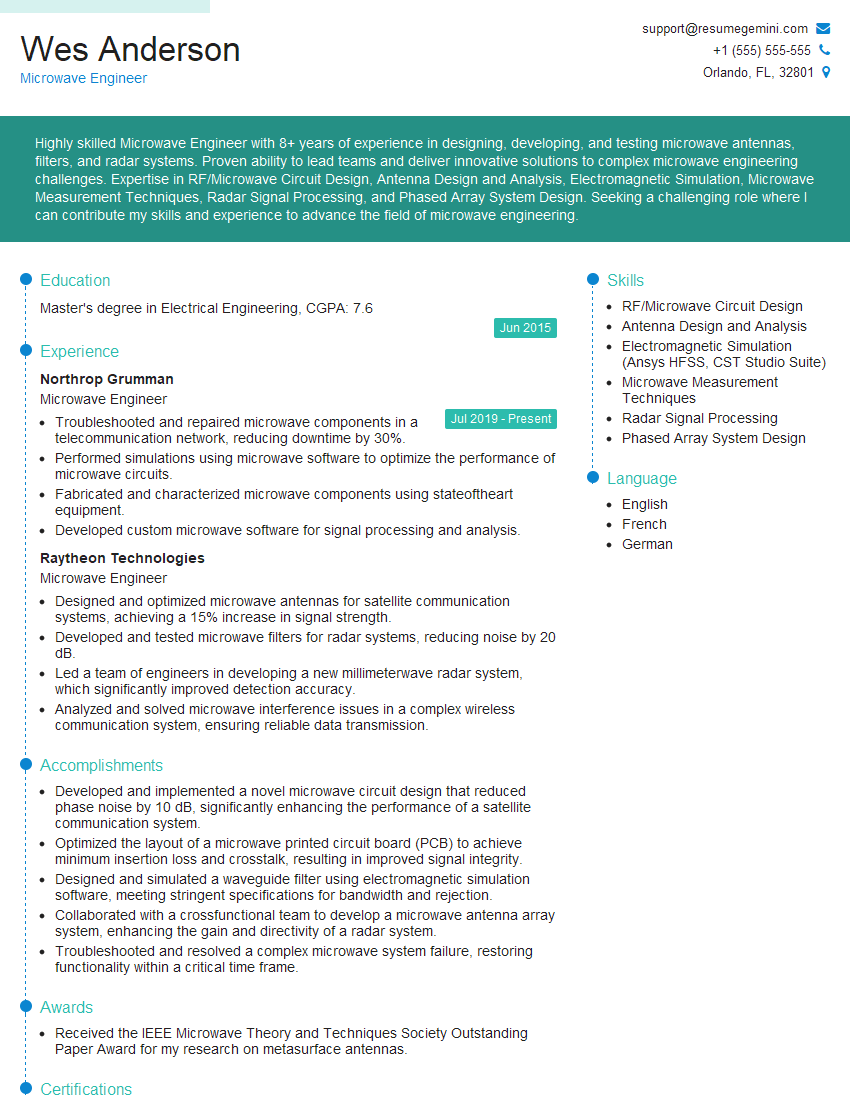
Mastering Interference Mitigation Techniques opens doors to exciting career opportunities in various high-tech sectors. A strong understanding of these techniques demonstrates valuable problem-solving skills and technical expertise highly sought after by employers. To maximize your job prospects, focus on creating a compelling and ATS-friendly resume that effectively highlights your skills and experience. ResumeGemini is a trusted resource that can help you build a professional resume tailored to your specific career goals. Examples of resumes tailored to showcasing expertise in Interference Mitigation Techniques are available, providing valuable templates and guidance to help you present your qualifications effectively.
Explore more articles
Users Rating of Our Blogs
Share Your Experience
We value your feedback! Please rate our content and share your thoughts (optional).
What Readers Say About Our Blog
Very informative content, great job.
good