Unlock your full potential by mastering the most common Intonation and Tuning Skills interview questions. This blog offers a deep dive into the critical topics, ensuring you’re not only prepared to answer but to excel. With these insights, you’ll approach your interview with clarity and confidence.
Questions Asked in Intonation and Tuning Skills Interview
Q 1. Explain the difference between equal temperament and just intonation.
The difference between equal temperament and just intonation lies in how intervals are tuned. Just intonation prioritizes pure, consonant intervals based on simple mathematical ratios. For example, a perfect fifth is tuned to a 3:2 ratio of frequencies. This creates incredibly pure harmonies within a limited key, but moving to different keys introduces significant intonation problems. Imagine a perfectly tuned C major chord – it sounds heavenly. However, if you modulate to G major, the intervals might sound slightly ‘off’ because the tuning was optimized for C.
Equal temperament, on the other hand, divides the octave into 12 equal semitones. This means every semitone has the same frequency ratio (the 12th root of 2, approximately 1.0595). While this compromises the purity of intervals in any given key (a perfect fifth isn’t exactly 3:2), it allows for seamless modulation between keys. Think of it as a compromise – we sacrifice some harmonic purity for the flexibility to change keys without retuning the entire instrument.
In essence, just intonation is like having a perfectly tailored suit, fitting beautifully in one specific situation, while equal temperament is like having a well-fitting, versatile outfit that suits various occasions, although perhaps not as exquisitely as the custom-tailored one.
Q 2. Describe the process of tuning a piano using a reference pitch.
Tuning a piano using a reference pitch, often A4 at 440 Hz, is a meticulous process usually done by a professional piano tuner. It involves adjusting the tension of the piano strings using tuning pins. The tuner begins by setting the reference pitch (A4) using a tuning fork or electronic tuner. This establishes a fundamental frequency. From there, they use various tuning techniques, often employing patterns based on the harmonic series and intervals. For example, they might tune the A4, then tune the E above it using a perfect fifth relationship. Then they might tune the other notes using a combination of perfect fifths, octaves, and other intervals relative to the A4 and other tuned notes. The process requires skill, patience, and a keen ear to fine-tune the piano to ensure that all intervals are accurately tuned within the equal temperament system.
The tuner will repeatedly check and adjust the pitches, listening for beats (oscillations in volume) to identify discrepancies. Reducing the number of beats until they are imperceptible signifies that the intervals are accurately tuned. The whole process is iterative, often involving multiple adjustments for each note to ensure accurate tuning across the entire piano’s range.
Q 3. How do you identify and correct intonation problems in a string instrument?
Identifying and correcting intonation problems on a string instrument like a violin, viola, or cello involves a combination of listening, visual inspection, and skillful adjustments. Poor intonation often manifests as notes being sharp or flat. You can identify the problem by playing single notes and comparing them to a reference pitch (a tuner, piano, or another instrument).
Corrections involve adjusting the string’s length by moving the fingers on the fingerboard (for fretless instruments) or adjusting the bridge position or nut (which determines string length). For a violin, for example, if a note is flat, you need to shorten the vibrating length of the string by moving your finger closer to the bridge. The opposite is true for a sharp note. It’s crucial to listen for the intonation change and the overall blend within a piece; you shouldn’t only focus on playing single notes in isolation.
Regular practice and a trained ear are essential for mastering intonation on string instruments. A teacher can provide invaluable feedback and guidance.
Q 4. What are the common causes of intonation issues in wind instruments?
Intonation issues in wind instruments can stem from several sources:
- Embouchure (mouth position): An incorrect embouchure can alter the airflow, affecting the pitch of the note. This is particularly crucial for brass and woodwind instruments.
- Air pressure and support: Insufficient or inconsistent air pressure can make notes flat or unstable.
- Fingerings and keywork: Incorrect fingerings or poorly maintained keywork can lead to inaccurate pitches. This is common on woodwind instruments.
- Instrument temperature and humidity: Changes in these conditions can affect the instrument’s material, leading to variations in pitch.
- Instrument damage or wear: Cracks or leaks in the instrument’s body affect its acoustics, potentially altering intonation.
Troubleshooting often involves checking each aspect meticulously. For instance, a flat note could be due to low air pressure, an incorrect fingering, or even a leak in the instrument. A skilled player can diagnose the problem by carefully checking and adjusting their technique, and a repair technician can inspect the instrument’s condition.
Q 5. Explain how temperature affects instrument tuning.
Temperature significantly affects instrument tuning, primarily due to the thermal expansion and contraction of materials. As temperature increases, most materials expand, making strings longer (on string instruments) or causing the instrument’s body to expand (on wind instruments), lowering the pitch. Conversely, decreasing temperature causes contraction and raises the pitch. The effect is particularly noticeable on string instruments where the string’s tension is crucial for accurate pitch.
This is why you’ll often find orchestral musicians making small tuning adjustments between movements of a symphony, compensating for changes in temperature in the concert hall. Similar effects apply to wind instruments, where the material of the instrument itself expands and contracts, changing the resonance frequencies of the instrument.
Understanding this phenomenon is crucial for maintaining consistent intonation during performances in varying temperature conditions.
Q 6. Describe different methods for tuning a guitar.
Several methods exist for tuning a guitar:
- Standard Tuning (EADGBe): This is the most common tuning, where each string is tuned to a specific note, forming the basis for most guitar music. Tuners (electronic or apps) are essential here.
- Alternate Tunings: Many guitarists use alternate tunings to explore different sounds and voicings. Open tunings, for instance, result in many open chords ringing when strummed without fretting. Tuning to these requires adjusting the strings to match the desired tuning. Examples include DADGAD or Drop D.
- Tuning Methods: Guitarists often use electronic tuners for accurate tuning. Alternatively, some use tuning pegs (mechanical) to fine tune after using a reference pitch from a piano or another instrument.
- By Ear: Experienced guitarists can tune by ear, using their knowledge of intervals and comparing their guitar’s notes to a reference pitch.
Regardless of the method, the goal is to ensure that the strings are accurately tuned in relation to each other, creating harmonious and accurate intervals.
Q 7. How do you troubleshoot a buzzing string on a guitar?
A buzzing string on a guitar is a common problem, and troubleshooting usually follows these steps:
- Identify the culprit: Determine which string is buzzing and where on the neck it’s happening. Play the string gently while fretting various positions to pinpoint the location of the buzz.
- Check the fret: If the buzz is localized to a specific fret, the fret might be too high or uneven. Use a straight edge (ruler) to check for any bumps or irregularities on the fret. A slight elevation can cause buzzing.
- Check string height (action): High action (the distance between strings and frets) can cause buzzing, especially on higher frets. If the action is too high, adjust it using the truss rod (for neck relief) and bridge saddle height.
- Examine the nut: If the buzz is at the nut (where the strings sit at the headstock), the nut slots might be too high, too narrow or uneven. This requires professional adjustment.
- Check for loose parts: Vibrating hardware or other parts can also cause buzzing sounds, examine all parts to check if anything is loose.
- String condition: If the string is old, worn, or corroded, replace it; a damaged string is more likely to buzz.
If you cannot identify and fix the problem yourself, take it to a professional luthier (guitar repair technician). They have the tools and expertise to diagnose and address more complex issues.
Q 8. What tools are essential for tuning and maintaining a piano?
Tuning and maintaining a piano requires specialized tools for precision and safety. The most essential tools include:
- Electronic tuner: Provides accurate frequency readings, crucial for precise tuning. A good tuner will offer various temperaments (like equal temperament) for different musical styles.
- Tuning hammer: Used to gently adjust the tension of piano strings. Different sizes and weights are available for various string thicknesses.
- Tuning wrench: Used to adjust the tuning pins, which control string tension. This requires a sensitive touch and understanding of how pin movement affects pitch.
- Mutes: Dampen strings during tuning to prevent unwanted sympathetic vibrations and improve accuracy.
- Felt hammer: A soft hammer used for voicing, discussed further in a later question.
- Tuning fork (optional, but helpful): A standard pitch reference, often A440Hz, useful for initial setting.
Regular maintenance, including dusting and climate control, is vital to prolong the instrument’s life and stability. Ignoring this can lead to rapid detuning and potential damage.
Q 9. How do you adjust the intonation of a violin?
Violin intonation is adjusted primarily using the fine tuners located on the tailpiece and, more subtly, by the player’s finger placement on the fingerboard.
Fine tuners: These small screws at the end of each string allow for minute pitch adjustments. They work by increasing or decreasing the string’s effective length. Over-tightening can damage the tailpiece or strings.
Finger placement: Precise intonation relies heavily on the violinist’s ear and skill in placing their fingers correctly on the fingerboard to produce the desired pitch. This requires years of practice and a keen sense of pitch.
Intonation is checked using a tuner or by playing intervals and chords with other instruments or recordings, listening for accurate intervals and consonance. Regular checks are essential; temperature and humidity can significantly affect intonation.
Q 10. Explain the concept of harmonic series and its relevance to tuning.
The harmonic series is a naturally occurring phenomenon where notes are multiples of a fundamental frequency. For example, if the fundamental frequency is ‘C’, the harmonic series would include ‘C’, ‘C’ an octave higher, ‘G’, ‘C’ two octaves higher, ‘E’, and so on.
Its relevance to tuning is profound: Many tuning systems, including just intonation, are based on the relationships found within the harmonic series. These relationships produce naturally consonant intervals, perceived as pleasing to the ear. Equal temperament, the standard tuning system for Western music, is a compromise; it’s designed to make all keys relatively usable, but slightly deviates from the perfect intervals found in the harmonic series. Understanding the harmonic series allows tuners to create more expressive and harmonious tunings, tailoring them to specific musical contexts.
Q 11. What are the challenges of tuning instruments in different climates?
Climate significantly affects instrument tuning. Changes in temperature and humidity cause wood to expand and contract, directly impacting string tension and thus pitch. In a dry climate, strings may loosen, leading to a drop in pitch; in humid climates, the opposite occurs.
Challenges: Frequent retuning is often necessary in climates with significant fluctuations. Instruments may also exhibit unstable intonation, making playing challenging. Extreme temperature changes can cause damage to instruments, particularly wooden ones. Using climate-controlled environments is ideal to minimize these effects. For instance, a professional musician may need to adjust the instrument’s tuning before each performance depending on the venue’s climate.
Q 12. How do you identify and fix fret buzzing on a guitar?
Fret buzzing on a guitar usually indicates a problem with string height, fret level, or neck relief. Let’s address each possibility:
- High action (string height): The strings are too far from the frets. Adjusting the bridge height can usually solve this. This is done via saddle adjustment or, for more significant changes, a professional setup might be required.
- High frets: Individual frets might be protruding, causing buzzing on certain strings. This requires leveling and crowning the frets; a skilled luthier can perform this.
- Neck relief: The neck might be too straight or have excessive bow (backwards curve). This affects overall string height and can be adjusted by adjusting the truss rod (a metal rod inside the neck). This procedure requires careful attention to detail to avoid damaging the neck.
To diagnose the problem, carefully observe which frets and strings are buzzing, and under what conditions (open strings, specific notes, etc.). This helps pinpoint the specific issue and guide the appropriate adjustment.
Q 13. Describe the process of voicing a piano.
Voicing a piano involves adjusting the tone of each note to create a balanced and pleasing overall sound. It’s a nuanced process that requires skilled touch and extensive experience.
The process involves: Using a felt hammer, the tuner carefully shapes the hammers to impact how they strike the strings. The goal is to achieve a consistent tone across all notes, with appropriate volume levels and harmonic richness. This includes regulating the hammer’s hardness (to control volume and tone), and ensuring a consistent hammer strike across the piano’s range. Each hammer is individually adjusted; the process requires both technical skill and an acute musical ear.
Voicing is far more than just tuning. It significantly impacts the piano’s tonal character and can be customized to produce different sounds, from bright and brilliant to warm and mellow. A well-voiced piano possesses a satisfying tone quality that greatly enhances the playing experience.
Q 14. What are the common problems encountered during the tuning of a keyboard?
Tuning keyboards, whether digital or traditional, presents some unique challenges:
- Drifting Pitch: Especially in older or cheaper digital keyboards, the pitch can drift over time, requiring frequent retuning. This is because of the inherent limitations of their digital oscillators.
- Inconsistent Key Response: Some digital keyboards exhibit inconsistencies in volume or tone across different keys. Fixing this often requires technical expertise and may be unfixable with older models.
- Temperature Sensitivity: While not as significant as with acoustic instruments, temperature and humidity can still impact tuning, albeit to a lesser extent.
- Calibration Issues: Digital pianos must be regularly calibrated to ensure accuracy. If the instrument’s internal calibration is off, it may require a specialist for adjustments or replacement of internal components.
Unlike acoustic pianos, many digital keyboard tuning issues may require replacement of parts or professional servicing.
Q 15. How do you adjust the bridge of a violin to improve intonation?
Adjusting a violin’s bridge is crucial for intonation. The bridge acts as a fulcrum, transferring string vibrations to the body. Slight adjustments to its position significantly impact the string length and, consequently, the pitch. Think of it like a seesaw: shifting the fulcrum changes the balance.
- Foot Placement: The feet of the bridge should be firmly planted on the violin’s f-holes. If the bridge is tilted, it will affect intonation, often causing one string to be sharper or flatter than the others. Gently adjust the feet to ensure they’re stable and parallel.
- Centering: The bridge must be perfectly centered between the f-holes. A slight offset will cause uneven string lengths and intonation issues. Use your eye and a ruler to check for this.
- Height: The bridge height influences the string’s vibration. Too high, and the strings will be too tight, producing a higher pitch; too low, and the strings will be too loose, producing a lower pitch. This adjustment is usually best done by a luthier, as it’s more precise.
- Forward/Backward Tilt: This is a subtle adjustment that professionals make to fine-tune intonation. It can affect individual string response, and it takes experience to correctly implement.
Making bridge adjustments requires care. Small changes can make a big difference, but overly aggressive adjustments can damage the violin. If unsure, consult a professional violin maker or repair person.
Career Expert Tips:
- Ace those interviews! Prepare effectively by reviewing the Top 50 Most Common Interview Questions on ResumeGemini.
- Navigate your job search with confidence! Explore a wide range of Career Tips on ResumeGemini. Learn about common challenges and recommendations to overcome them.
- Craft the perfect resume! Master the Art of Resume Writing with ResumeGemini’s guide. Showcase your unique qualifications and achievements effectively.
- Don’t miss out on holiday savings! Build your dream resume with ResumeGemini’s ATS optimized templates.
Q 16. Explain how humidity affects the tuning stability of a woodwind instrument.
Woodwind instruments are particularly susceptible to humidity changes because they are made of wood, a hygroscopic material (it absorbs and releases moisture from the air). This absorption and release changes the wood’s dimensions, directly impacting the instrument’s intonation and playing response. Imagine a wooden ruler – it gets slightly longer in high humidity and shorter in low humidity.
High humidity causes the wood to swell, lengthening the instrument’s bore. This effectively lengthens the vibrating air column, lowering the pitch of all notes. Conversely, low humidity causes the wood to shrink, shortening the bore and raising the pitch. The effect on tuning stability is very noticeable; the instrument might be in tune in one climate but significantly out of tune in another.
To mitigate this issue, musicians often store their woodwinds in cases with humidity control systems to maintain a consistent environment. Regular checking of tuning and adjustments are essential in changing climates.
Q 17. How do you diagnose and repair intonation problems in a brass instrument?
Diagnosing intonation problems in brass instruments is a systematic process. It often involves careful listening, visual inspection, and sometimes, the assistance of specialized tools.
- Listening for Intonation Issues: Play each note of the instrument’s range, listening for notes that are consistently sharp or flat in relation to a reference pitch (tuning device or piano).
- Visual Inspection: Examine the instrument for any dents, kinks, or irregularities in the tubing. These deformities can affect airflow and, thus, intonation. Also inspect the valves/slides for proper alignment and smooth operation.
- Testing Valve/Slide Alignment: If the instrument uses valves, ensure they are correctly aligned and not sticking or binding. If the instrument uses slides, check for proper alignment and smoothness of the movement.
- Airflow Issues: Inconsistent or restricted airflow can also contribute to intonation problems. Check for any obstructions or leaks in the tubing.
Repairing intonation issues involves different techniques depending on the problem. Minor dents might be able to be addressed by a skilled technician, while major damage may require more extensive repair or even replacement.
For example, if a slide is misaligned in a trombone, adjusting it will help correct intonation. If there’s a dent in the tubing, a skilled technician would use specialized tools to repair it. However, some issues might be beyond repair, requiring a replacement part or instrument.
Q 18. What is the role of the soundboard in the intonation of a piano?
The soundboard in a piano plays a crucial role in the instrument’s intonation and overall sound. It acts as a resonator, amplifying the vibrations of the strings and transmitting them to the instrument’s body. Its shape, material, and structural integrity directly affect the clarity, resonance, and intonation of the piano.
Intonation is affected by the soundboard’s ability to transfer the vibrations effectively. If the soundboard is damaged, cracked, or improperly constructed, its resonant frequencies will be altered, resulting in inconsistencies in the intonation across the keyboard. The soundboard’s interaction with the bridge, which is the connecting point between the strings and the soundboard, is also very important for efficient transfer of vibrations and correct intonation.
The subtle variations in tone across the piano’s range can be partly attributed to the soundboard’s resonance properties which vary across different frequencies. A well-crafted soundboard produces a balanced and consistent tone, whereas a compromised soundboard might produce inconsistent tuning and tonal quality across the register.
Q 19. Describe the difference between relative and absolute tuning.
The difference between relative and absolute tuning lies in the reference point used for tuning.
- Relative Tuning: This method tunes the instrument relative to a single reference note or pitch. For instance, a guitarist might tune the sixth string to a specific pitch and then tune the other strings relative to this reference note. This approach is common in smaller ensembles where absolute pitch perfection might not be critical. It’s sufficient to ensure that all instruments sound harmonious together.
- Absolute Tuning: This method tunes each note of an instrument to a precise frequency based on a standard tuning system (usually A4 = 440 Hz). A symphony orchestra, for example, must use absolute tuning for all instruments, ensuring that every note matches the established standard precisely. This approach is critical in larger ensembles and to ensure consistent pitch across different instruments and performances.
In essence, relative tuning establishes harmonious relationships within the instrument or ensemble, while absolute tuning aims for precise pitch accuracy relative to a fixed standard. The choice between them depends on the context and the desired level of accuracy.
Q 20. How do you use a strobe tuner to achieve precise tuning?
A strobe tuner is a highly accurate electronic tuning device that displays the pitch of a note using a visual strobe effect. It’s significantly more precise than many other tuners because it provides a continuous visual representation of the pitch and frequency, showing how far off the note is from the target frequency.
To use a strobe tuner for precise tuning, you need to follow these steps:
- Select the Reference Pitch: Most strobe tuners allow selecting the desired reference pitch (e.g., A4 = 440 Hz).
- Generate Sound: Play the note you want to tune.
- Observe the Strobe Effect: The tuner will display a strobe pattern. If the note is perfectly in tune, the pattern will appear to be stationary. If the note is sharp, the pattern will move in one direction; if flat, it will move in the other.
- Adjust the Pitch: Based on the strobe movement, adjust the tuning pegs or other mechanism until the pattern appears stationary, indicating precise tuning.
- Fine Tuning: Even when the pattern is seemingly still, you can get even better accuracy using a smaller movement.
The continuous visual feedback provided by a strobe tuner allows for exceptionally precise adjustments, making it an invaluable tool for professionals seeking impeccable tuning accuracy.
Q 21. What is the significance of the equal tempered scale in modern music?
The equal tempered scale is a system of tuning where the octave is divided into twelve equal semitones. This means the frequency ratio between any two adjacent notes is constant, regardless of the key. This contrasts with other tuning systems (like just intonation) where the frequency ratios between notes vary depending on the key.
The significance of the equal tempered scale in modern music is immense because it allows for seamless modulation between keys. With just intonation, modulating frequently would result in significant intonation discrepancies, making it impractical for most modern music, which frequently changes key. Equal temperament’s compromise on the perfect consonance of some intervals allows for the freedom of modulation and tonal variety that is a cornerstone of much modern music, particularly Western classical and popular music.
While not perfectly consonant in every key, the relative consistency across all keys makes it the most practical system for most music today. This is why most instruments are tuned according to the equal tempered scale.
Q 22. How do you measure the frequency response of an instrument?
Measuring the frequency response of an instrument involves determining how it responds to different frequencies of sound. This is crucial for understanding its tonal characteristics and identifying potential issues with intonation. We typically use specialized equipment like a microphone, a spectrum analyzer, and a sound card.
The process involves playing the instrument across its entire range, while the microphone captures the sound. The spectrum analyzer then displays the frequency response as a graph showing the amplitude (loudness) at each frequency. Peaks and dips in the graph indicate the instrument’s resonance frequencies and areas where it might be weak or uneven.
For example, a violin might show strong resonance peaks in its mid-range, while a bass guitar might have a powerful low-frequency response. Deviations from an expected flat response could suggest problems like a poorly constructed soundboard (in string instruments) or issues with the instrument’s bracing or construction. Professional luthiers use this data to fine-tune instrument design and repair.
Q 23. Describe the process of setting up a guitar for optimal intonation and playability.
Setting up a guitar for optimal intonation and playability is a multi-step process that involves adjusting several key elements. Think of it like fine-tuning a finely crafted machine for peak performance.
- Intonation Adjustment: This involves adjusting the bridge saddle position to ensure that notes played open and fretted are in tune. A skilled technician uses an electronic tuner and carefully adjusts the saddle to achieve accurate intonation across the entire fretboard. This often requires meticulous adjustments, and slight changes can make a significant difference.
- Neck Relief Adjustment: The neck’s curvature (relief) needs to be just right. Too much relief makes the strings buzz; too little causes fretting to become difficult. The truss rod is adjusted to achieve a slight concave curve, ensuring comfortable playability without buzzing.
- Action Adjustment: This refers to the height of the strings above the fretboard. Too high an action makes the guitar difficult to play, while too low an action leads to buzzing. The action is adjusted by modifying the saddle height and the neck relief.
- Nut Slot Filing: The nut slots guide the strings onto the tuning pegs, and poorly cut slots can affect intonation and tuning stability. A well-fitted nut ensures proper string break angle and reduces unwanted friction.
Once these steps are completed, the guitar is carefully checked and tweaked for overall playability and optimal tone. Each adjustment is iterative, meaning that adjusting one factor might necessitate readjusting another, resulting in a refined instrument ready for performance.
Q 24. What are the common materials used in making musical instrument parts and how do they affect tuning stability?
The choice of materials significantly impacts tuning stability and the overall tone of a musical instrument. For instance, the selection of wood for a violin’s body drastically affects its resonance and tuning. Let’s look at some common materials and their effects:
- Wood (Spruce, Maple, Rosewood, etc.): Different wood types offer varying degrees of stiffness, density, and resonant frequencies. Spruce, for its lightness and stiffness, is frequently used for instrument tops (e.g., violins, guitars), contributing to its bright tone and good response. Maple, known for its hardness and density, is often used for instrument backs and necks, providing strength and stability.
- Metals (Brass, Nickel, Steel, etc.): Commonly used in strings and other hardware, metals influence tuning stability and tonal character. Steel strings, for example, offer excellent tension and sustain, whereas nickel-wound strings provide a warmer tone. The type of metal, its thickness, and its alloys all contribute to the specific properties of the instrument.
- Plastics (ABS, Nylon, etc.): Plastics are used in some components, mainly for their durability and affordability. However, they might not offer the same level of resonance or tuning stability as natural materials.
- Bone/Synthetic Bone: Frequently used for nuts and saddles, bone offers excellent self-lubricating properties which leads to improved tuning stability and a smoother playing experience. Synthetic bone offers a more affordable alternative that maintains adequate performance.
The interaction of these materials within an instrument is critical in determining its overall acoustic properties. For example, a guitar’s top wood, bracing pattern, and string material all work together to create its characteristic sound and intonation. The skilled luthier understands these relationships and selects the optimal combination of materials for their desired sonic outcome.
Q 25. How do you determine the best string gauge for an instrument?
Choosing the right string gauge is crucial for optimal intonation and playability. The gauge refers to the diameter of the string, and different gauges produce different tensions and tonal characteristics. Too light a gauge might cause buzzing, while too heavy a gauge can make the instrument difficult to play and negatively impact intonation.
Factors to consider include:
- Instrument Type and Scale Length: Scale length (the distance between the nut and the bridge) determines the optimal string tension. Longer scale lengths generally require heavier gauge strings.
- Playing Style: Aggressive players might prefer heavier gauge strings for more sustain and resistance. Lighter gauge strings are easier on the fingers and better for more subtle playing techniques.
- Desired Tone: Heavier gauge strings tend to produce a fuller, warmer sound, while lighter gauge strings sound brighter and more articulate.
Experimentation and careful consideration of these factors often involves trying different gauges to find the ideal combination for your specific needs and playing style. Online resources and the advice of experienced players or technicians can also be immensely helpful in determining the best string gauge for your instrument.
Q 26. Explain the concept of pitch bending and its application in musical performance.
Pitch bending involves deliberately altering the pitch of a note during its sustained duration. It’s a common expressive technique in many genres, adding nuance and emotion to musical performances.
Techniques for pitch bending vary by instrument:
- Guitar: Guitarists bend strings using their fingers, increasing string tension and raising the pitch. The amount of bend and the speed of the return to the original pitch creates different expressive effects.
- Brass Instruments: Brass players alter their embouchure (mouth position) to change the pitch during a note.
- Vocals: Singers bend pitches by altering vocal cord tension and airflow.
- Synthesizers: Electronic instruments offer precise pitch bending through various controllers such as pitch wheels, modulation wheels, or MIDI controllers.
Pitch bending adds an expressive element, imitating the natural inflections of human speech or creating a sense of yearning, anticipation, or excitement. Think of a blues guitar solo, where skillful pitch bending adds deep emotion. It’s a technique that enhances phrasing and melodic interest. Professional musicians use pitch bending strategically to add color and feeling to their performance.
Q 27. How do you use a digital audio workstation (DAW) to correct intonation in a recording?
Correcting intonation in a recording using a DAW (Digital Audio Workstation) typically involves using pitch correction plugins, also known as auto-tune plugins. These plugins analyze the pitch of a recorded audio track and adjust it to match a specified scale or reference pitch. Professional audio engineers use this technology to fix pitch inconsistencies in vocals and other instruments. This can be beneficial in situations where a performer’s pitch is slightly off or if the instrument itself has tuning problems.
The process generally involves:
- Selecting the Plugin: Choose an appropriate pitch correction plugin within your DAW (e.g., Auto-Tune, Melodyne).
- Setting the Parameters: Adjust the plugin’s settings to achieve the desired level of correction, often including settings for pitch detection sensitivity, correction speed, and formant preservation (to avoid unnatural sounding vocals).
- Analyzing and Editing: The plugin visually displays the pitch of the input audio. You can then select specific regions to correct or automatically apply pitch correction across the entire track.
- Refinement: Fine-tune the corrected audio to avoid artifacts or a robotic sound, striving for natural sounding results.
While pitch correction plugins are powerful tools, they should be used judiciously. Overuse can make the audio sound unnatural or artificial. The goal is to subtly enhance the performance, not to mask poor intonation completely.
Q 28. What are some common pitfalls to avoid when tuning instruments?
Several common pitfalls can hinder accurate instrument tuning and should be avoided. These often stem from a lack of awareness, improper technique, or insufficient attention to detail:
- Ignoring Environmental Factors: Temperature and humidity significantly impact string tension and tuning stability. Changes in these factors can throw off tuning. It’s crucial to tune in a stable environment.
- Tuning to a Poor Reference Pitch: Using an inaccurate tuner or referencing a poorly tuned instrument will result in an incorrectly tuned instrument. Rely on reliable digital tuners to get accurate pitch.
- Uneven String Tension: Failure to stretch strings properly, especially new ones, before tuning can lead to inconsistencies. Strings must be properly stretched to avoid inconsistent tuning.
- Improper Stretching of Strings: New strings require time to settle to avoid repeatedly going out of tune. Stretching the strings slowly is crucial.
- Ignoring Instrument Setup Issues: Problems with the instrument’s setup, such as a warped neck or improperly fitted bridge, can lead to intonation issues that tuning alone cannot resolve.
- Over-tightening Tuning Pegs: Excessively tightening pegs can damage them and potentially cause other problems with the instrument.
By being attentive to these aspects and performing proper instrument maintenance, you can avoid common tuning issues and ensure your instrument stays in tune for longer periods.
Key Topics to Learn for Intonation and Tuning Skills Interview
- Understanding Pitch and Frequency: Grasping the fundamental relationship between pitch, frequency, and musical intervals is crucial. Consider exploring different tuning systems and their implications.
- Relative Pitch and Interval Recognition: Practice identifying intervals and chords aurally. Develop strategies for quickly and accurately determining pitch relationships in various musical contexts.
- Tuning Techniques and Methods: Familiarize yourself with various tuning methods (e.g., equal temperament, just intonation) and their practical applications in different musical settings. Be prepared to discuss the advantages and disadvantages of each.
- Aural Skills Development: Discuss your approach to developing your aural skills. Highlight any specific exercises or techniques you’ve used to improve your intonation and tuning abilities.
- Troubleshooting Intonation Issues: Be ready to discuss strategies for identifying and correcting intonation problems in different instruments or vocal performances. Consider approaches for both individual and ensemble settings.
- The Role of Technology in Tuning: Explore the use of electronic tuners and other technological tools for tuning and intonation. Understand their limitations and appropriate applications.
- Musical Context and Intonation: Discuss how stylistic considerations influence intonation choices in different genres and historical periods.
Next Steps
Mastering intonation and tuning skills is paramount for career advancement in music-related fields. These skills demonstrate a high level of musicality, precision, and technical proficiency, highly valued by employers. To significantly boost your job prospects, creating an ATS-friendly resume is essential. ResumeGemini is a trusted resource that can help you build a professional resume that highlights your unique skills and experience. We provide examples of resumes tailored to Intonation and Tuning Skills to help guide you. Invest time in crafting a compelling resume – it’s your first impression on potential employers.

Instrument Technician Resume Sample

Luthier Resume Sample

Music Producer Resume Sample

Broadcast Engineer Resume Sample

Audio Engineer Resume Sample

Acoustical Engineer Resume Sample

Recording Engineer Resume Sample
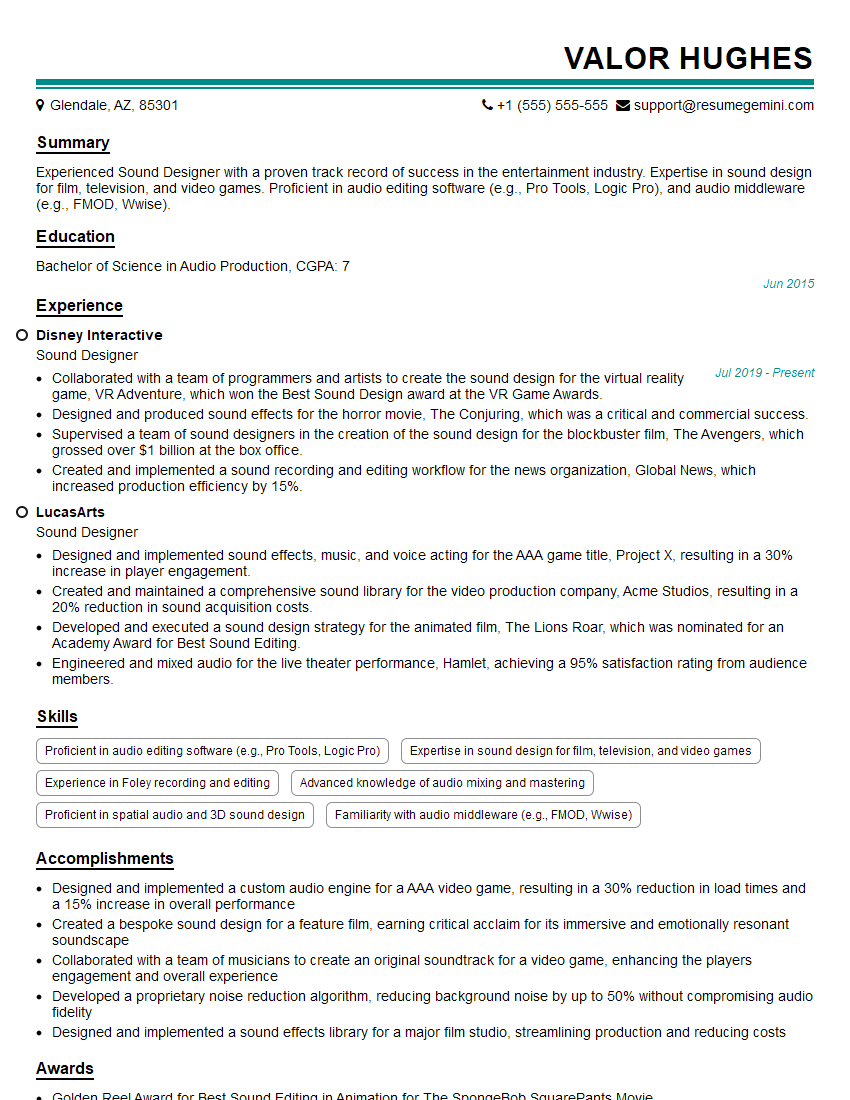
Sound Designer Resume Sample

Sound Engineer Resume Sample

Music Therapist Resume Sample

Guitar Technician Resume Sample

Piano Tuner Resume Sample
Explore more articles
Users Rating of Our Blogs
Share Your Experience
We value your feedback! Please rate our content and share your thoughts (optional).
What Readers Say About Our Blog
Very informative content, great job.
good