Interviews are opportunities to demonstrate your expertise, and this guide is here to help you shine. Explore the essential Inventory and Parts Control interview questions that employers frequently ask, paired with strategies for crafting responses that set you apart from the competition.
Questions Asked in Inventory and Parts Control Interview
Q 1. Explain the difference between FIFO and LIFO inventory methods.
FIFO (First-In, First-Out) and LIFO (Last-In, First-Out) are two common methods for valuing inventory. They impact how the cost of goods sold (COGS) and the value of ending inventory are calculated on your financial statements. The core difference lies in the order of cost assignment.
FIFO: Imagine a bakery. The first loaves of bread baked are the first ones sold. Similarly, with FIFO, the oldest inventory items are assumed to be sold first. This means the cost of goods sold reflects the cost of the oldest items, while the ending inventory value reflects the cost of the newest items. In times of inflation, FIFO results in a lower COGS and higher net income, because older, cheaper inventory is being sold first.
LIFO: Now imagine a stack of pancakes. You eat the top one first, right? LIFO works the same way; the most recently purchased items are assumed to be sold first. This leads to a higher COGS and lower net income during inflationary periods, as the more expensive, recently purchased items are being used to calculate COGS. LIFO is less commonly used due to tax implications and the fact that it doesn’t always reflect the actual flow of goods.
Example: Let’s say you bought 10 widgets at $1 each and later 10 more at $1.50 each. Using FIFO, the cost of goods sold for 15 widgets would be (10 * $1) + (5 * $1.50) = $17.50. With LIFO, it would be (10 * $1.50) + (5 * $1) = $20.00.
Q 2. Describe your experience with inventory tracking software.
I have extensive experience with various inventory tracking software, including ERP systems like SAP and Oracle, and cloud-based solutions such as NetSuite and Fishbowl Inventory. My experience encompasses implementing, configuring, and optimizing these systems to meet specific business needs. This includes data migration, user training, and report generation. For example, in my previous role at Acme Corp, I led the implementation of NetSuite, which resulted in a 15% reduction in inventory carrying costs through improved forecasting and reduced stockouts. I’m proficient in using these systems to track inventory levels, manage purchase orders, generate reports on inventory turnover, and analyze sales data to optimize inventory levels. I understand the importance of choosing the right system based on company size, industry, and specific requirements. My skills extend to integrating inventory management systems with other business systems, such as point-of-sale (POS) systems and customer relationship management (CRM) systems for a holistic view of the business.
Q 3. How do you identify and address inventory discrepancies?
Identifying and addressing inventory discrepancies is crucial for maintaining accurate inventory records and minimizing losses. My approach involves a multi-pronged strategy.
- Regular Cycle Counts: I advocate for frequent cycle counting, rather than relying solely on annual physical inventories. This allows for the timely identification and correction of minor discrepancies before they escalate.
- Variance Analysis: I meticulously analyze variances between physical counts and system records. Large discrepancies trigger immediate investigation. I utilize root cause analysis techniques to identify the source of the error—human error, system glitches, theft, or damage.
- Reconciliation Processes: I establish robust reconciliation processes between different inventory locations, ensuring consistency across the entire inventory system.
- Technology Utilization: I leverage barcode scanners and RFID technology to automate data collection and reduce manual errors during physical counts. Real-time inventory tracking software helps in maintaining accurate stock levels.
- Addressing Root Causes: Once the root cause of a discrepancy is identified, I implement corrective actions, which may include retraining staff, improving system processes, or enhancing security measures.
For instance, if a discrepancy reveals consistent shortages of a specific item, I would investigate potential issues such as theft, inaccurate picking processes, or damage during handling. I’d then implement solutions like improved security cameras, better training for warehouse staff, or improved packaging to minimize damage.
Q 4. What are the key performance indicators (KPIs) you track in inventory management?
Key Performance Indicators (KPIs) are vital for monitoring inventory health and efficiency. I track several crucial metrics:
- Inventory Turnover Rate: This measures how many times inventory is sold and replaced over a period. A high turnover rate indicates efficient inventory management, while a low rate suggests slow-moving inventory.
- Carrying Costs: This represents the expenses associated with storing and maintaining inventory, including warehousing, insurance, and taxes. Lower carrying costs are always desirable.
- Stockout Rate: This indicates the frequency of running out of stock for particular items. A high rate signifies potential lost sales and unhappy customers.
- Inventory Accuracy: This measures the difference between recorded inventory levels and the actual physical count. High accuracy is crucial for accurate financial reporting and efficient operations.
- Fill Rate: This metric shows the percentage of customer orders that are fulfilled completely and on time. It’s a good indicator of customer service levels, which are often directly impacted by inventory management.
By tracking these KPIs and analyzing trends, I can identify areas for improvement and make data-driven decisions to optimize inventory management strategies.
Q 5. How do you manage obsolete or slow-moving inventory?
Obsolete or slow-moving inventory ties up capital and occupies valuable storage space. Managing it effectively involves a strategic approach:
- Identification: I use ABC analysis to categorize inventory based on value and usage. This helps pinpoint items that are slow-moving or obsolete. Regular review of inventory reports, considering sales trends, helps flag such items early.
- Reduction Strategies: I explore several options including price reductions, promotional campaigns, or bundling them with other products to increase sales. Sometimes, donating or recycling obsolete items is a viable option.
- Process Improvement: Analyzing the reasons behind slow-moving items is crucial. This might reveal issues with forecasting, product quality, or marketing.
- Inventory write-offs: As a last resort, writing off completely obsolete items is necessary for accurate financial reporting. This requires proper authorization and documentation.
For example, if we have a surplus of outdated technology components, we might explore options like selling them to a surplus parts dealer, or even repurposing some components for other projects.
Q 6. Explain your experience with cycle counting.
Cycle counting is a crucial inventory control method that involves counting a small portion of inventory on a regular basis, rather than doing a full physical inventory annually. My experience with cycle counting includes designing and implementing effective cycle counting programs. I focus on:
- Developing a Schedule: I create a schedule that ensures all items are counted within a specified timeframe, prioritizing high-value or high-risk items. This schedule should be flexible and adaptable.
- Training Staff: Proper training is essential for accurate counting, ensuring consistency and minimizing errors. This includes training on proper scanning techniques and data entry procedures.
- Using Technology: Barcode scanners, RFID technology, and inventory management software significantly improve the efficiency and accuracy of cycle counting.
- Analyzing Results: Regular analysis of cycle counting results helps identify areas of weakness in inventory processes and helps pinpoint systemic issues.
In my past role, I implemented a cycle counting program that improved inventory accuracy from 90% to 98%, leading to better financial reporting and reduced stockouts.
Q 7. How do you handle inventory shrinkage?
Inventory shrinkage, the difference between recorded inventory and actual inventory, can result from various factors including theft, damage, obsolescence, and errors. Addressing shrinkage requires a multi-faceted approach:
- Strengthening Security: Implementing robust security measures like surveillance cameras, access control systems, and secure storage areas can deter theft.
- Improving Processes: Reviewing and improving receiving, storage, and picking processes can minimize errors and damage. Regular staff training and adherence to standard operating procedures are vital.
- Regular Cycle Counts: Frequent cycle counts quickly identify shrinkage and enable prompt corrective actions.
- Investigating Discrepancies: Thoroughly investigating the causes of shrinkage is crucial for preventing future losses. This may involve analyzing sales data, reviewing security footage, or interviewing staff.
- Technology Implementation: Using RFID technology or other advanced inventory management systems can improve inventory tracking and minimize errors.
For example, if shrinkage analysis reveals a pattern of missing high-value items, we might install additional security cameras in specific areas or implement stricter inventory access controls.
Q 8. Describe your experience with forecasting inventory needs.
Forecasting inventory needs is crucial for maintaining optimal stock levels, minimizing storage costs, and preventing stockouts or overstocking. It involves analyzing historical data, market trends, and sales projections to predict future demand. My approach is multifaceted.
- Time Series Analysis: I leverage statistical methods like moving averages, exponential smoothing, and ARIMA modeling to identify patterns and trends in past sales data. For example, I might use a 12-month moving average to smooth out seasonal fluctuations and predict demand for the next quarter.
- Causal Forecasting: I consider external factors like promotional campaigns, economic indicators, and competitor actions that could influence demand. For instance, if a competitor launches a new product, I would anticipate a potential decrease in demand for our similar product and adjust my forecast accordingly.
- Qualitative Forecasting: In situations with limited historical data or significant market changes, I incorporate expert opinions and market research to refine the forecast. This could involve consulting with sales teams or conducting surveys to gauge customer sentiment.
- Software Utilization: I’m proficient in using inventory management software with built-in forecasting tools. These tools often automate the process and provide valuable insights, including safety stock calculations and demand variability analysis. For instance, I have experience using software like SAP and Oracle to generate accurate and timely forecasts.
The accuracy of my forecasting is continuously monitored and refined through regular review and adjustment based on actual sales data and market feedback.
Q 9. How do you ensure the accuracy of inventory data?
Maintaining accurate inventory data is paramount for efficient operations. My strategy involves a combination of technological and procedural measures.
- Cycle Counting: Instead of a complete physical inventory count, I implement a cycle counting system where small sections of the warehouse are counted regularly. This minimizes disruption and improves accuracy over time. Imagine dividing the warehouse into zones and counting one zone each day; this allows for quicker identification and correction of discrepancies.
- Barcode/RFID Scanning: I utilize barcode or RFID scanning technology to track items throughout the inventory process, from receiving to shipping. This automation minimizes manual data entry errors significantly. For example, when receiving a shipment, each item is scanned, updating the inventory database in real-time.
- Regular Reconciliation: I perform regular reconciliation of inventory data between physical counts and the inventory management system. Any discrepancies are investigated and resolved promptly. This is like balancing your checkbook – regularly verifying that the numbers add up.
- Inventory Management System (IMS): The chosen IMS needs to be user-friendly, have strong data security features, and generate reports that track discrepancies. I ensure proper training for all personnel to maintain data integrity within the system.
- Vendor Managed Inventory (VMI): For specific high-volume items, exploring VMI options where the vendor manages inventory levels based on our sales data can improve accuracy and reduce workload.
By combining these methods, I ensure that inventory records reflect the actual stock levels, minimizing losses due to stockouts or write-offs.
Q 10. What is ABC analysis, and how have you applied it?
ABC analysis is an inventory management technique that categorizes items based on their consumption value. It helps prioritize inventory control efforts by focusing on the most valuable items.
- A-items: These represent a small percentage (e.g., 20%) of total inventory items but account for a significant portion (e.g., 80%) of the total value. These require tight control, frequent monitoring, and accurate forecasting.
- B-items: These are intermediate items with moderate value and consumption. They require less stringent control than A-items but still need regular monitoring.
- C-items: These comprise a large percentage of items but represent a small portion of the total value. Control is less critical, and simpler inventory methods may be sufficient.
In my previous role, we applied ABC analysis to optimize our warehousing strategy. We allocated more space and dedicated more resources to storing and managing A-items. We also implemented tighter controls on A-item ordering and tracking. This allowed us to maximize the efficiency of our inventory management and focus resources where they have the biggest impact. For C-items, we simplified ordering procedures and used a more streamlined inventory tracking system.
Q 11. Describe your experience with implementing an inventory management system.
Implementing an inventory management system (IMS) requires careful planning and execution. My experience includes the entire process, from selection and setup to training and ongoing maintenance.
- Needs Assessment: I started by identifying the organization’s specific needs and requirements. This involved assessing current processes, identifying pain points, and defining the desired outcomes of the new system.
- System Selection: I carefully evaluated various IMS options, considering factors such as functionality, cost, scalability, and integration capabilities with other systems. This might include comparing cloud-based solutions to on-premise systems.
- Implementation: The implementation phase involved configuring the system, migrating data from the old system (if applicable), testing the system thoroughly, and training personnel on how to use it effectively.
- Post-Implementation Support: After the initial launch, I ensured ongoing support and maintenance, including regular system updates, performance monitoring, and user support.
- Data Migration: Successfully migrating existing inventory data to the new system with minimal errors is critical. This often involves data cleaning and validation steps.
In one project, we implemented a cloud-based IMS that significantly improved inventory accuracy and reduced lead times. The new system also automated several manual processes, freeing up staff for more strategic tasks.
Q 12. How do you prioritize tasks when managing multiple inventory locations?
Managing multiple inventory locations requires a systematic approach to task prioritization. I utilize a combination of techniques to ensure efficient allocation of resources.
- Prioritization Matrix: I create a matrix prioritizing tasks based on urgency and importance. Urgent and important tasks receive immediate attention, while less critical tasks are scheduled accordingly.
- Inventory Turnover Rate: I prioritize locations with high inventory turnover rates, as these locations have a greater impact on profitability and require more frequent attention.
- Stock Levels: Locations with critically low stock levels of essential items receive immediate attention to prevent stockouts. This might involve expediting orders or adjusting forecasts.
- Centralized Control System: A centralized system allows for real-time visibility into the inventory levels of all locations, making it easier to identify and prioritize critical situations.
- Regular Communication: Effective communication among staff across all locations is essential. This helps ensure everyone is aware of priorities and can effectively manage their workload.
Think of it like a conductor of an orchestra – you need to coordinate the various sections (inventory locations) to create a harmonious and efficient operation.
Q 13. What methods do you use to optimize warehouse layout and efficiency?
Optimizing warehouse layout and efficiency is crucial for minimizing operational costs and maximizing throughput. My approach considers several key elements:
- Flow Optimization: The layout should facilitate a smooth flow of goods, from receiving to shipping. This minimizes travel time and reduces the risk of damage or loss.
- Zone Allocation: Items should be strategically placed in zones based on their frequency of use or demand. High-demand items should be easily accessible, while low-demand items can be stored in less accessible areas. This is like organizing your kitchen – frequently used items are within easy reach.
- Storage Density: Maximizing storage density while ensuring efficient access is crucial. This might involve utilizing vertical space with racking systems or implementing high-density storage solutions.
- Technology Integration: Integrating warehouse management systems (WMS) and automated guided vehicles (AGVs) can improve efficiency significantly. WMS helps optimize picking routes, while AGVs automate material handling.
- Safety Considerations: The layout must prioritize safety, ensuring sufficient space for movement and minimizing the risk of accidents.
For example, I’ve worked on projects where implementing a new slotting strategy, based on ABC analysis and picking frequency, resulted in a 20% reduction in picking time. This involved carefully studying picking patterns and optimizing the placement of high-demand items to minimize travel time.
Q 14. How do you manage relationships with vendors and suppliers?
Building and maintaining strong relationships with vendors and suppliers is essential for securing reliable supply chains and negotiating favorable terms.
- Strategic Partnerships: I foster long-term partnerships based on mutual trust and transparency. This involves open communication and collaborative problem-solving.
- Performance Evaluation: I regularly evaluate vendor performance based on metrics like on-time delivery, quality of goods, and responsiveness to inquiries. This helps identify areas for improvement and strengthens the relationship.
- Negotiation Skills: I actively negotiate contracts to secure competitive pricing and favorable terms, while ensuring a reliable supply of goods. This involves understanding market dynamics and effectively communicating our needs.
- Collaboration and Communication: Regular communication is key, keeping vendors informed of our needs and providing feedback on their performance. This fosters a sense of partnership.
- Supplier Diversification: To mitigate risk, I aim to diversify our supplier base to avoid dependence on a single vendor. This protects against supply disruptions and ensures competitive pricing.
Building strong relationships is like building a strong bridge – it requires consistent effort and mutual understanding to ensure reliability and stability over the long term.
Q 15. Describe your experience with just-in-time (JIT) inventory systems.
Just-in-Time (JIT) inventory is a management strategy that aims to minimize inventory holding costs by receiving materials only when they are needed for production. Instead of holding large quantities of stock, JIT relies on precise demand forecasting and efficient supply chains. It’s like ordering groceries just before you need them for dinner – no unnecessary storage space and minimal waste.
In my experience implementing JIT systems, I’ve found success depends critically on strong relationships with suppliers, highly accurate demand forecasting, and a flexible production process capable of adapting to minor supply chain disruptions. For instance, in a previous role at a manufacturing plant, we implemented JIT for a specific component. This required a thorough analysis of our production schedule, negotiating guaranteed delivery times with our supplier, and implementing a rigorous quality control system to prevent delays caused by defective parts. The result was a significant reduction in warehousing costs and improved cash flow.
However, JIT can be vulnerable to unforeseen events like supplier delays or spikes in demand. A robust contingency plan, including a small buffer stock of critical components, is essential to mitigate these risks.
Career Expert Tips:
- Ace those interviews! Prepare effectively by reviewing the Top 50 Most Common Interview Questions on ResumeGemini.
- Navigate your job search with confidence! Explore a wide range of Career Tips on ResumeGemini. Learn about common challenges and recommendations to overcome them.
- Craft the perfect resume! Master the Art of Resume Writing with ResumeGemini’s guide. Showcase your unique qualifications and achievements effectively.
- Don’t miss out on holiday savings! Build your dream resume with ResumeGemini’s ATS optimized templates.
Q 16. How do you handle emergency orders or unexpected demand?
Handling emergency orders or unexpected demand requires a swift and coordinated response. My approach involves several key steps:
- Immediate Assessment: First, I determine the urgency and scale of the demand increase. Is it a temporary spike or a shift in market conditions?
- Inventory Check: I check existing inventory levels to see if we can fulfill the order from existing stock. This includes considering potential substitutions if the exact item is unavailable.
- Prioritization: If existing stock is insufficient, I prioritize orders based on factors such as customer importance and delivery deadlines.
- Supplier Communication: I immediately contact suppliers to expedite delivery of the needed parts. This may involve negotiating expedited shipping costs or exploring alternative suppliers.
- Production Adjustment: If necessary, I work with the production team to adjust schedules to accommodate the emergency order. This might mean temporarily postponing less urgent tasks.
- Post-Incident Analysis: After the emergency is resolved, I conduct a thorough analysis to identify root causes and prevent similar situations in the future. This often leads to adjustments in safety stock levels or improved demand forecasting.
For example, during a sudden surge in demand for a particular product, we used a combination of expedited shipping from our primary supplier and a small allocation from a secondary supplier to meet customer orders within the required timeframe.
Q 17. Explain your understanding of safety stock and its importance.
Safety stock is the extra inventory held to buffer against unexpected fluctuations in demand or supply chain disruptions. It’s a crucial component of inventory management, acting as a safety net to prevent stockouts and maintain customer service levels. Think of it as having a spare tire in your car – you hope you never need it, but it’s essential to have when you do.
The importance of safety stock lies in its ability to mitigate risk. Insufficient safety stock can lead to lost sales, increased production downtime, and damaged customer relationships. Determining the appropriate safety stock level involves considering factors such as demand variability, lead times, service level targets, and the cost of stockouts. There are various statistical models, such as the Economic Order Quantity (EOQ) model with safety stock considerations, that can be employed to calculate the optimal level.
Q 18. What strategies do you employ to minimize inventory holding costs?
Minimizing inventory holding costs is a key objective in inventory management. These costs include warehousing expenses, insurance, obsolescence, and the opportunity cost of capital tied up in inventory. My strategies include:
- Demand Forecasting: Accurate demand forecasting is crucial. By accurately predicting demand, we can optimize ordering quantities and reduce excess inventory.
- Inventory Optimization Techniques: Employing techniques like ABC analysis (classifying inventory based on value and consumption) allows us to focus resources on managing high-value items more closely.
- Efficient Warehousing: Optimizing warehouse layout and utilizing technology like warehouse management systems (WMS) improve efficiency and reduce storage costs.
- Supplier Relationship Management: Strong supplier relationships can lead to more frequent and smaller deliveries, reducing the need for large buffer stocks.
- Vendor-Managed Inventory (VMI): In some cases, entrusting inventory management to a trusted supplier can streamline processes and reduce costs.
- Regular Inventory Reviews: Conducting regular cycle counts and inventory reviews helps identify slow-moving or obsolete items that should be disposed of.
Q 19. How do you ensure compliance with industry regulations in inventory management?
Ensuring compliance with industry regulations in inventory management is paramount. This involves adhering to various rules depending on the industry and the nature of the goods. For example, in the pharmaceutical industry, strict regulations govern the storage and handling of medications, including temperature control and expiry date tracking. In the food industry, food safety regulations dictate inventory storage and handling practices to prevent contamination.
My approach involves:
- Staying Updated: I keep abreast of all relevant regulations and updates through industry publications, regulatory agency websites, and professional development courses.
- Documentation: Maintaining meticulous records of inventory movements, expiry dates, and storage conditions is essential for demonstrating compliance during audits.
- Implementing Control Systems: We use inventory management software with features that support compliance, such as lot tracking and traceability, and maintain detailed documentation trails.
- Internal Audits: Regular internal audits help identify any potential compliance gaps and allow for corrective actions before external audits.
- Employee Training: Employees involved in inventory management receive regular training on relevant regulations and best practices.
Q 20. Describe a time you had to solve a significant inventory problem.
In a previous role, we faced a significant inventory problem due to a faulty barcode scanning system. This led to inaccurate inventory data, resulting in stockouts of popular items and an overstock of slow-moving items. The problem wasn’t immediately apparent; it gradually emerged as discrepancies between physical inventory counts and system records grew larger.
My approach to solving this was multi-pronged:
- Root Cause Analysis: First, we identified the faulty barcode scanner as the root cause of the problem. This involved meticulously tracing errors and comparing data from multiple sources.
- Data Reconciliation: We then performed a complete physical inventory count to reconcile discrepancies between the physical inventory and the system data. This was a time-consuming process but essential for establishing an accurate baseline.
- System Repair & Upgrade: The faulty barcode scanning system was repaired and upgraded with improved error-handling capabilities.
- Process Improvements: We implemented stricter quality control measures for inventory data entry and improved employee training on inventory management procedures. This included improving the process for reporting and resolving discrepancies.
- Improved Reporting: We established better reporting mechanisms to monitor inventory accuracy and promptly identify any new discrepancies.
The outcome was a much more accurate and reliable inventory system, improved customer service due to fewer stockouts, and reduced costs associated with excess inventory and lost sales.
Q 21. How familiar are you with different inventory valuation methods?
I am familiar with several inventory valuation methods, each with its own strengths and weaknesses. The choice of method depends on factors such as the industry, the nature of the inventory, and the company’s accounting practices.
- First-In, First-Out (FIFO): This method assumes that the oldest inventory items are sold first. It provides a more realistic picture of the cost of goods sold (COGS) and is often preferred when inventory is perishable.
- Last-In, First-Out (LIFO): This method assumes that the newest inventory items are sold first. It can be beneficial for tax purposes in periods of rising prices, as it leads to higher COGS and therefore lower taxable income. However, it can result in a less accurate reflection of the current cost of inventory.
- Weighted-Average Cost: This method calculates the average cost of all inventory items and assigns that cost to the goods sold. It’s a simpler method than FIFO or LIFO but may not reflect the true cost of goods sold as accurately.
- Specific Identification: This method tracks the cost of each individual inventory item. It’s the most accurate method but is only practical for businesses with a small number of high-value items.
Understanding the implications of each method is crucial for accurate financial reporting and effective inventory management. I’ve used all of these methods throughout my career, choosing the most appropriate one based on the specific context and requirements of each situation.
Q 22. What is your experience with using barcodes and RFID technology in inventory tracking?
Barcode and RFID technologies are crucial for efficient inventory tracking. Barcodes, using a system of lines and spaces, provide a simple and cost-effective method for identifying individual items. RFID (Radio-Frequency Identification), on the other hand, uses radio waves to identify and track tags attached to items. This allows for tracking multiple items simultaneously, even without line-of-sight.
In my previous role at Acme Manufacturing, we used barcodes for tracking individual components in our assembly process. This enabled us to quickly locate specific parts and manage our inventory levels accurately. We later integrated RFID technology for tracking pallets of finished goods, allowing for real-time visibility into warehouse inventory and streamlining the shipping process. The RFID system dramatically reduced stock discrepancies and improved overall efficiency.
Choosing between barcode and RFID depends on several factors. Barcodes are ideal for low-cost, high-volume tracking where individual item identification is paramount. RFID shines when tracking multiple items simultaneously, providing real-time location information and reducing manual scanning time. A hybrid approach, using both technologies, is often the most effective solution.
Q 23. How do you balance the need for sufficient inventory with minimizing storage costs?
Balancing sufficient inventory with minimal storage costs is a delicate act, akin to walking a tightrope. Too much inventory ties up capital and increases storage expenses, while too little leads to stockouts, lost sales, and dissatisfied customers. Effective inventory management hinges on accurate demand forecasting, efficient ordering processes, and careful analysis of carrying costs.
One effective approach is implementing the Economic Order Quantity (EOQ) model. This formula calculates the optimal order size that minimizes the total inventory costs, considering ordering costs and holding costs. Beyond EOQ, techniques like just-in-time (JIT) inventory management aim to minimize inventory levels by receiving materials only as they are needed for production. This reduces storage costs but requires precise demand forecasting and reliable supplier relationships. Regular inventory reviews and analysis of sales data are also key; slow-moving items, for instance, may necessitate a reduction in stock levels.
In my experience, successfully managing this balance involves a combination of data analysis, robust inventory management software, and a willingness to adjust strategies based on performance and market fluctuations. For example, during seasonal peaks, we might strategically increase inventory levels to meet anticipated demand while maintaining tighter control during slower periods.
Q 24. Explain your understanding of lead times and their impact on inventory planning.
Lead time refers to the time elapsed between placing an order and receiving the goods. Understanding lead times is absolutely critical in inventory planning; it directly impacts how much inventory you need to keep on hand to avoid stockouts. A long lead time necessitates holding a larger safety stock to cushion against potential delays or unexpected demand spikes.
Imagine you’re a bakery ordering flour. If your supplier delivers flour within a day (short lead time), you can order smaller amounts more frequently. However, if the delivery takes a week (long lead time), you’ll need to order a larger quantity upfront to ensure you don’t run out before the next shipment arrives. This is why accurately forecasting lead times is so vital. Factors like supplier reliability, transportation methods, and even unforeseen events (e.g., natural disasters) can influence lead times.
In practice, I always incorporate lead time into our inventory planning models. We use historical lead time data to create forecasts and build safety stock levels accordingly. Regular communication with suppliers is also crucial to identify and mitigate potential delays.
Q 25. How do you deal with damaged or defective inventory?
Dealing with damaged or defective inventory requires a structured approach to minimize losses and maintain inventory accuracy. The first step is identifying and segregating the affected items. A clear process for documenting the damage, including the cause and quantity, is essential for analysis and preventative measures.
Next, we determine the viability of repair or salvage. Minor defects might be repairable, potentially reducing losses. However, items beyond repair must be disposed of correctly, adhering to all relevant regulations. For instance, certain hazardous materials require specialized disposal methods. The disposal process itself needs thorough documentation.
Finally, we analyze the root cause of the damage. Was it a supplier issue, a storage problem, or a transportation mishap? Identifying the root cause helps implement preventative measures and avoid similar incidents in the future. In my experience, regularly auditing inventory and implementing robust quality control measures throughout the supply chain significantly minimizes the occurrence of damaged or defective inventory.
Q 26. What software or tools are you proficient in for inventory management?
My proficiency in inventory management software includes experience with SAP, Oracle, and NetSuite. I’m also comfortable with Microsoft Excel and its advanced features for inventory tracking and analysis, including pivot tables and macros for automating tasks. These tools enable efficient data management, real-time tracking, and advanced reporting functionalities.
For example, using SAP, I’ve managed inventory across multiple locations and warehouses, generating accurate reports on stock levels, reorder points, and sales forecasts. Excel has proven invaluable for creating custom reports and dashboards tailored to specific needs, offering greater visibility into key inventory metrics.
Beyond these, I’m adept at using data analytics tools to identify trends and patterns within inventory data, facilitating data-driven decision making for inventory optimization. The ability to effectively leverage these tools is crucial for streamlining operations and enhancing efficiency.
Q 27. Describe your experience working with different inventory control systems (e.g., perpetual vs. periodic).
Perpetual and periodic inventory systems represent two distinct approaches to tracking inventory. A perpetual system continuously updates inventory records each time an item is added or removed. This provides real-time visibility into stock levels. A periodic system, on the other hand, updates inventory records at fixed intervals (e.g., monthly) through physical counts or cycle counting.
A perpetual system is more accurate and provides greater control but requires significant investment in technology and resources. Think of a large supermarket using a scanner at each checkout – that’s essentially a perpetual system in action. A periodic system is simpler and less expensive but less accurate, potentially leading to discrepancies between physical stock and recorded levels. This is more common in smaller businesses with lower inventory turnover.
In my career, I’ve implemented and managed both systems. The choice depends heavily on the business’ size, complexity, and budget. In situations requiring precise real-time tracking, a perpetual system is preferred; otherwise, a well-managed periodic system can be efficient and cost-effective.
Key Topics to Learn for Your Inventory and Parts Control Interview
- Inventory Management Systems (IMS): Understanding various IMS software and their applications, including ERP integration and data analysis capabilities. Consider the strengths and weaknesses of different systems.
- Inventory Control Techniques: Explore methods like FIFO (First-In, First-Out), LIFO (Last-In, First-Out), and weighted average cost. Be prepared to discuss their practical implications and when each method is most appropriate.
- Demand Forecasting and Planning: Learn techniques for predicting future demand, considering seasonality, trends, and other factors. How do these forecasts impact inventory levels and ordering strategies?
- Cycle Counting and Stock Audits: Understand the importance of regular inventory checks, techniques for conducting accurate counts, and resolving discrepancies. Discuss best practices for minimizing stock losses.
- Parts Classification and Coding Systems: Familiarize yourself with different parts classification systems and their benefits. How do these systems aid in organization, tracking, and efficient retrieval?
- Supply Chain Management Principles: Grasp the broader context of inventory control within the supply chain. Discuss the relationship between inventory levels, supplier relationships, and customer satisfaction.
- Warehouse Management and Optimization: Explore strategies for efficient warehouse layout, storage methods, and order fulfillment processes. How does effective warehouse management impact inventory control?
- Inventory Cost Analysis: Understand the components of inventory costs (holding costs, ordering costs, shortage costs) and how to minimize them. Be ready to discuss cost-saving strategies.
- Problem-Solving and Troubleshooting: Practice identifying and resolving inventory discrepancies, shortages, and overstocking situations. Illustrate your analytical and problem-solving skills using real-world scenarios.
- Data Analysis and Reporting: Demonstrate your ability to analyze inventory data, identify trends, and create reports to inform decision-making. Familiarity with relevant software (e.g., Excel, data visualization tools) is beneficial.
Next Steps
Mastering Inventory and Parts Control opens doors to exciting career opportunities and advancement within logistics, operations, and supply chain management. To maximize your job prospects, invest time in creating a strong, ATS-friendly resume that highlights your skills and experience. ResumeGemini is a trusted resource that can help you build a professional and impactful resume. They offer examples of resumes tailored to Inventory and Parts Control professionals, giving you a head start in showcasing your qualifications effectively.

Operations Manager Resume Sample
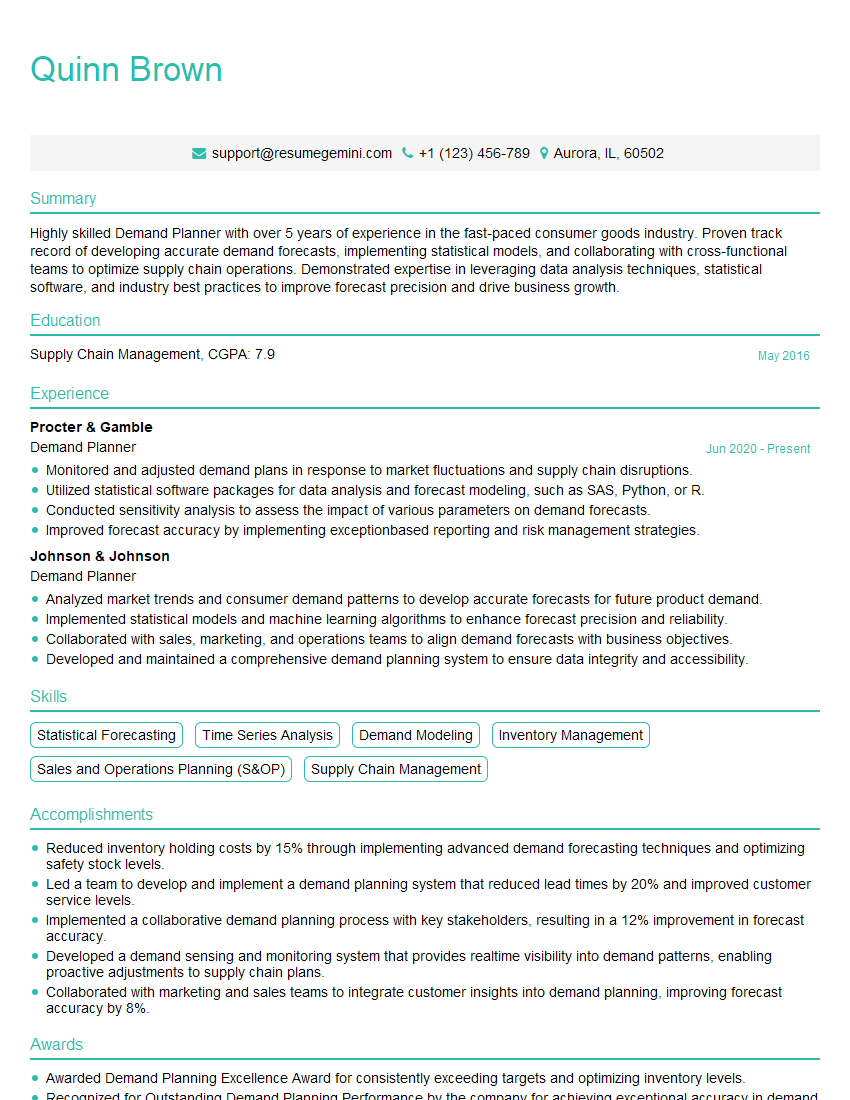
Demand Planner Resume Sample
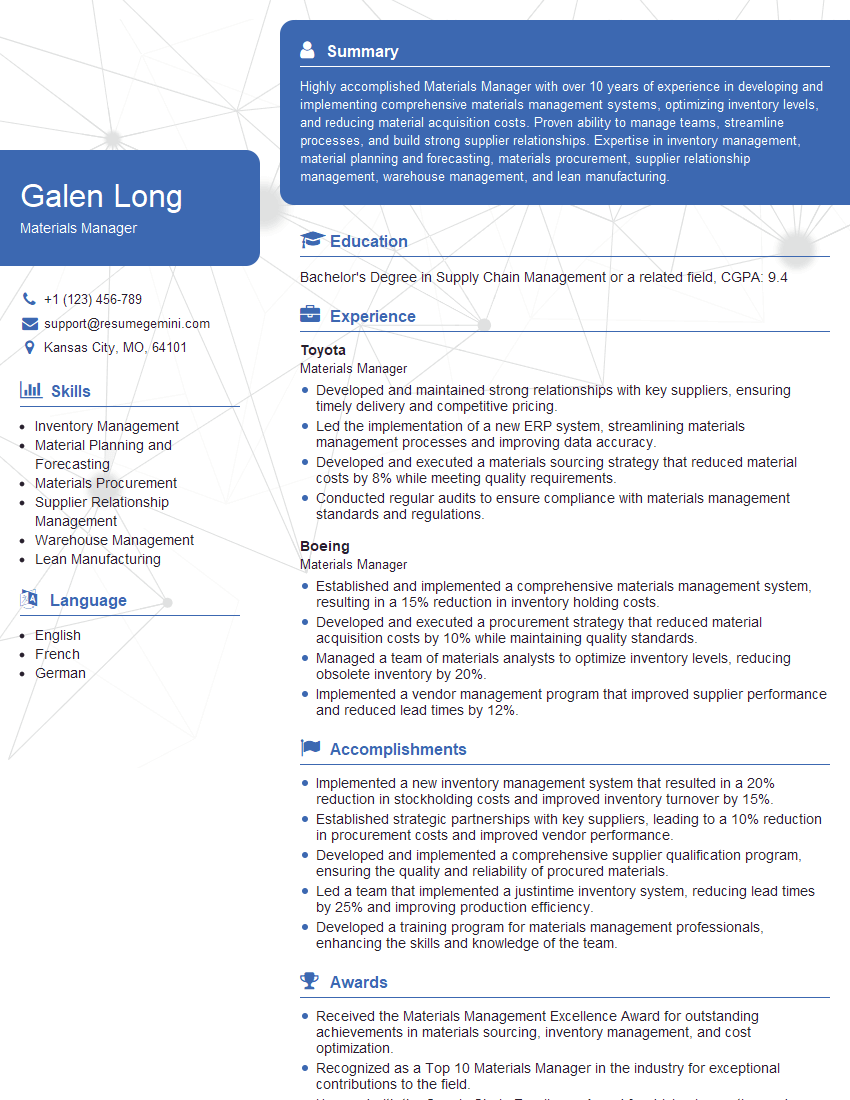
Materials Manager Resume Sample
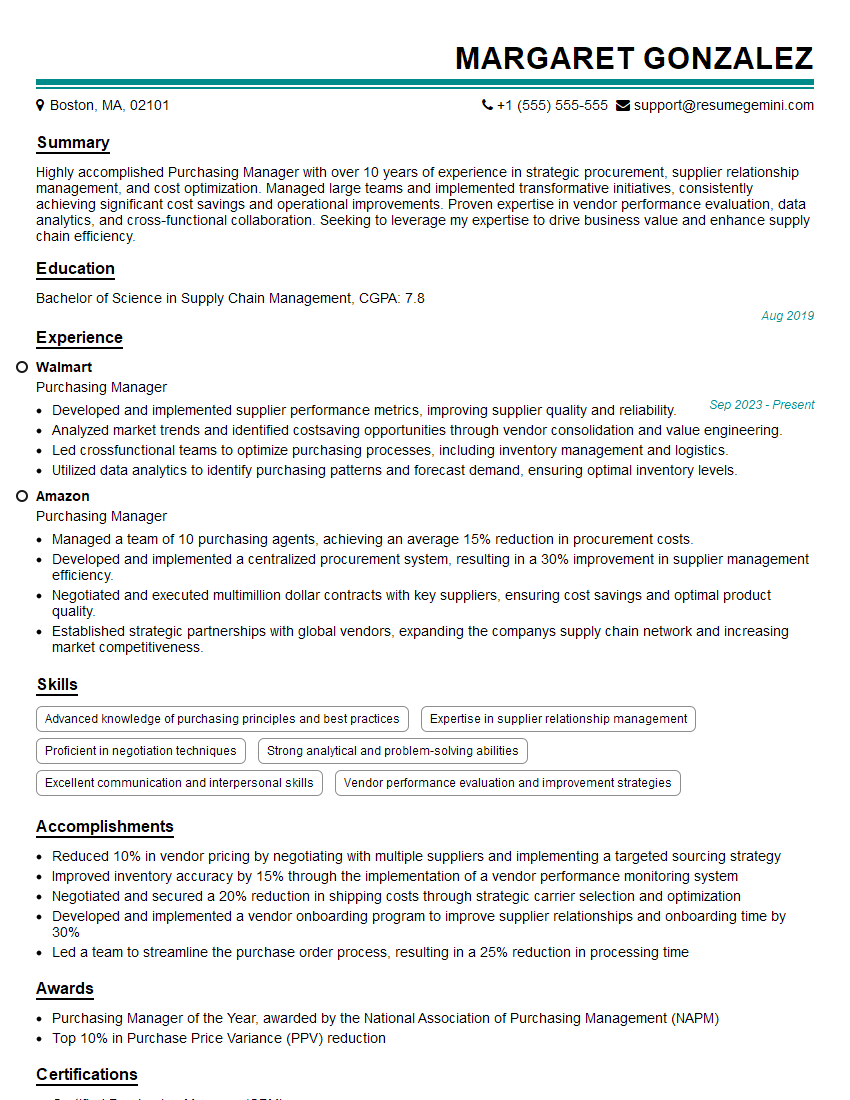
Purchasing Manager Resume Sample
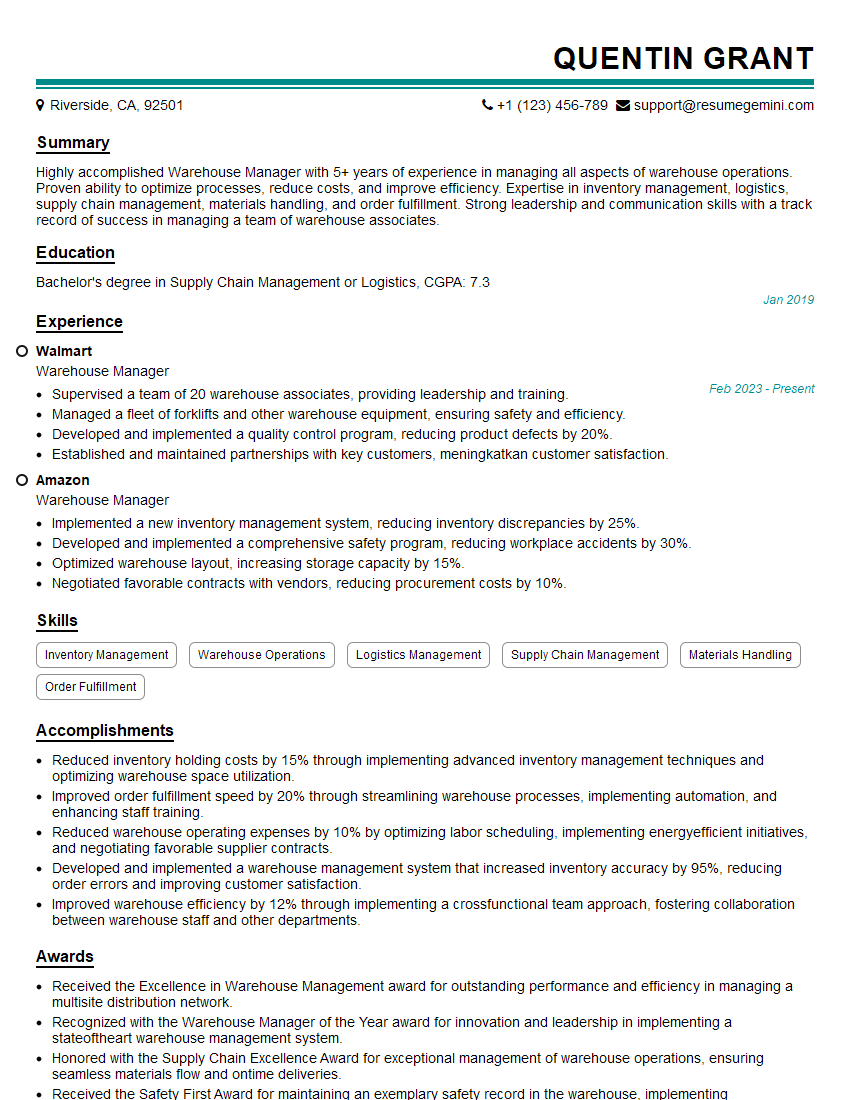
Warehouse Manager Resume Sample
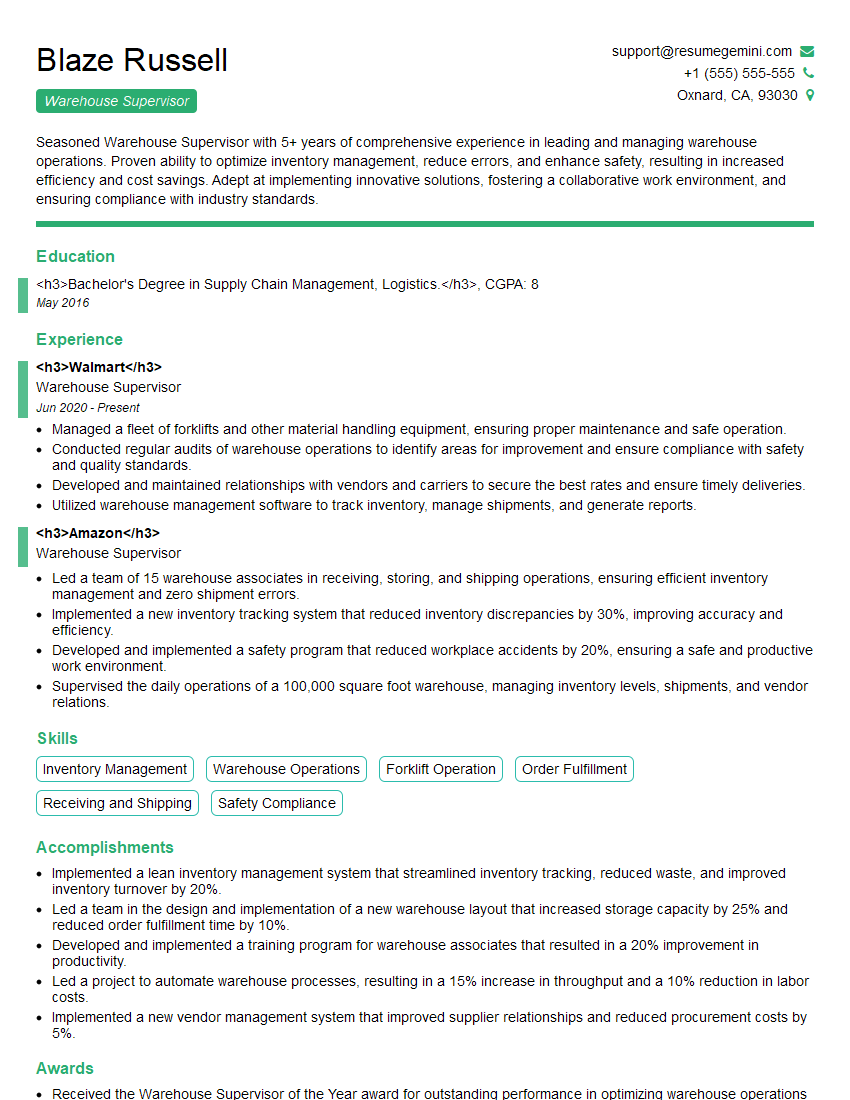
Warehouse Supervisor Resume Sample
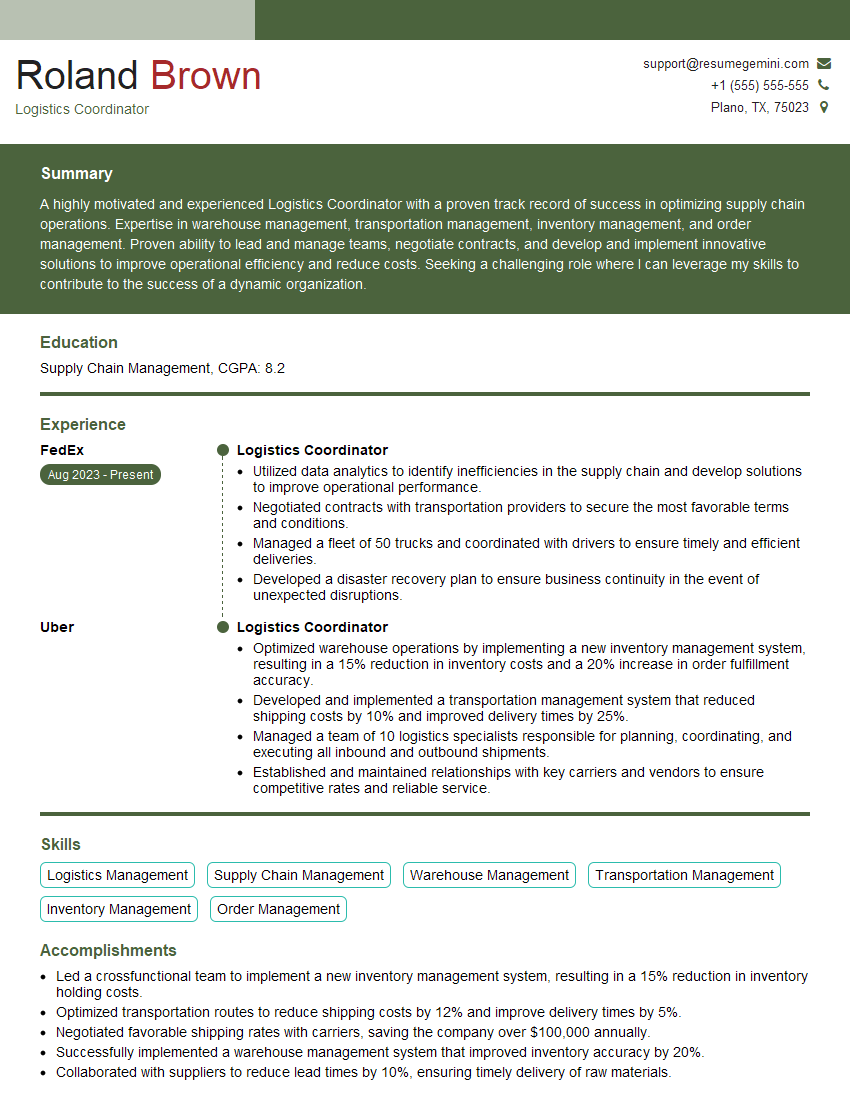
Logistics Coordinator Resume Sample
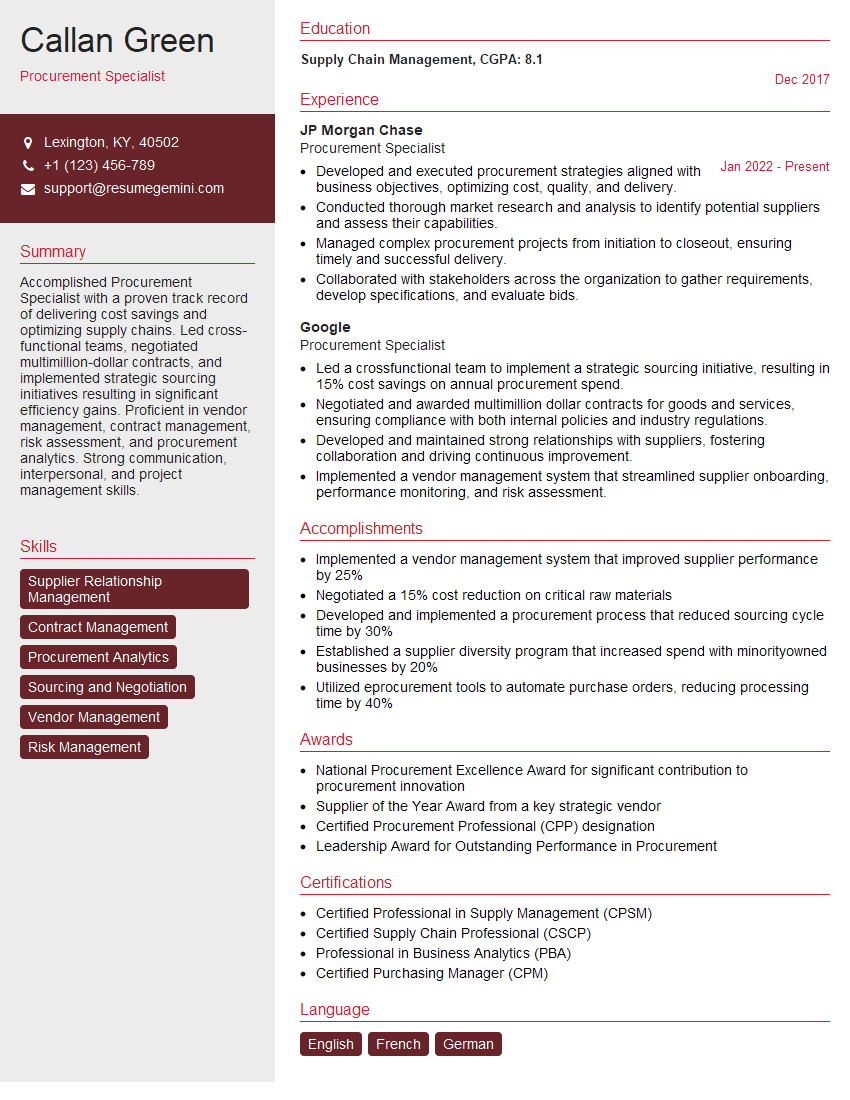
Procurement Specialist Resume Sample
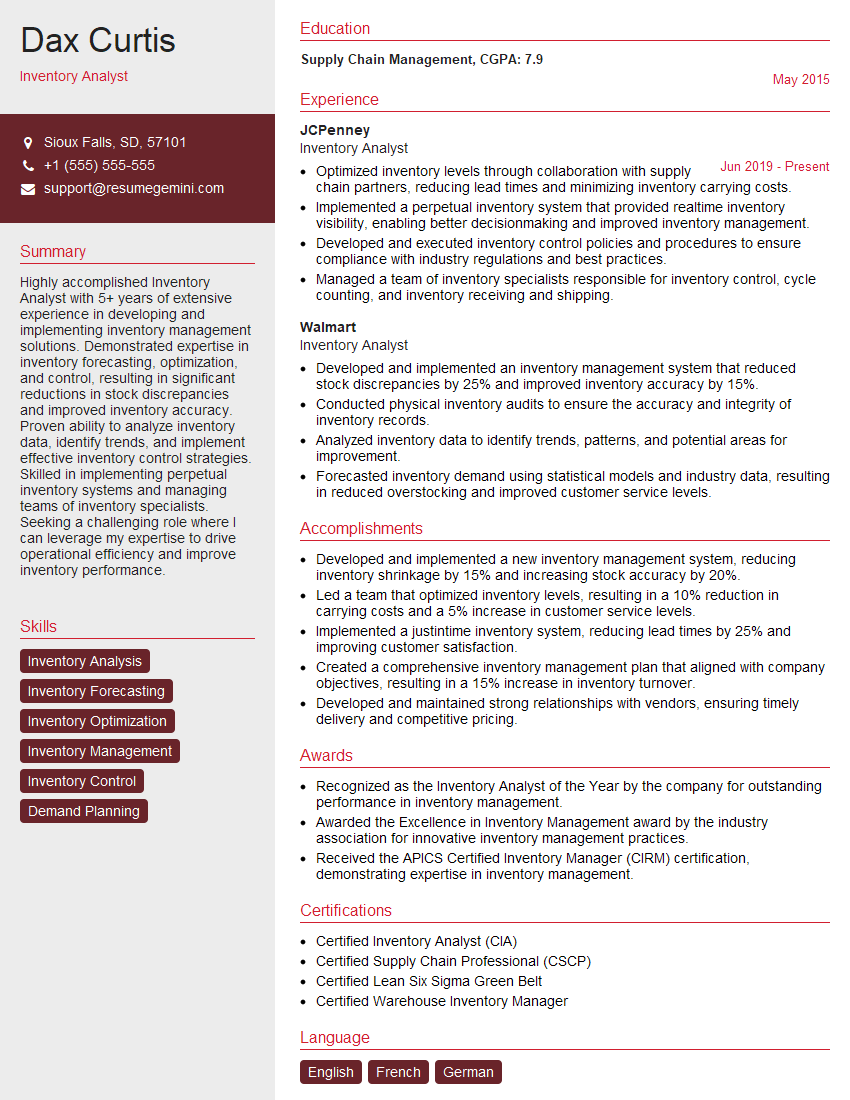
Inventory Analyst Resume Sample
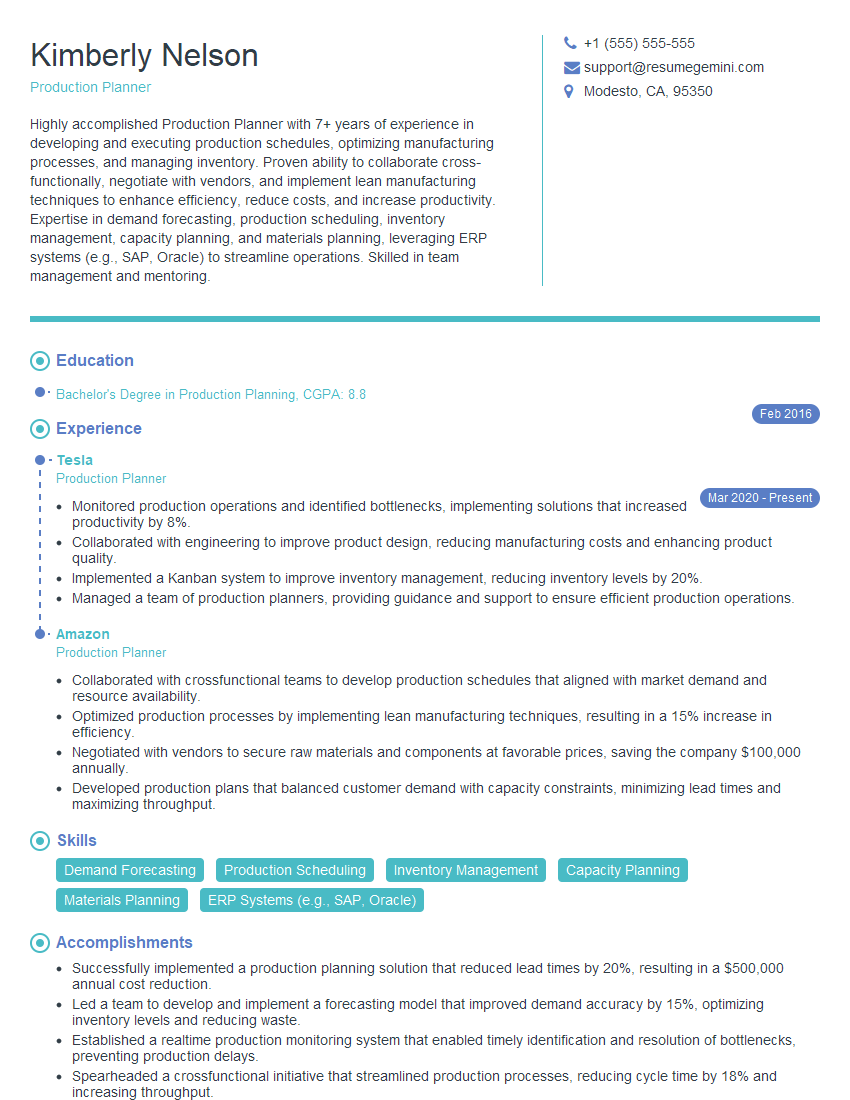
Production Planner Resume Sample
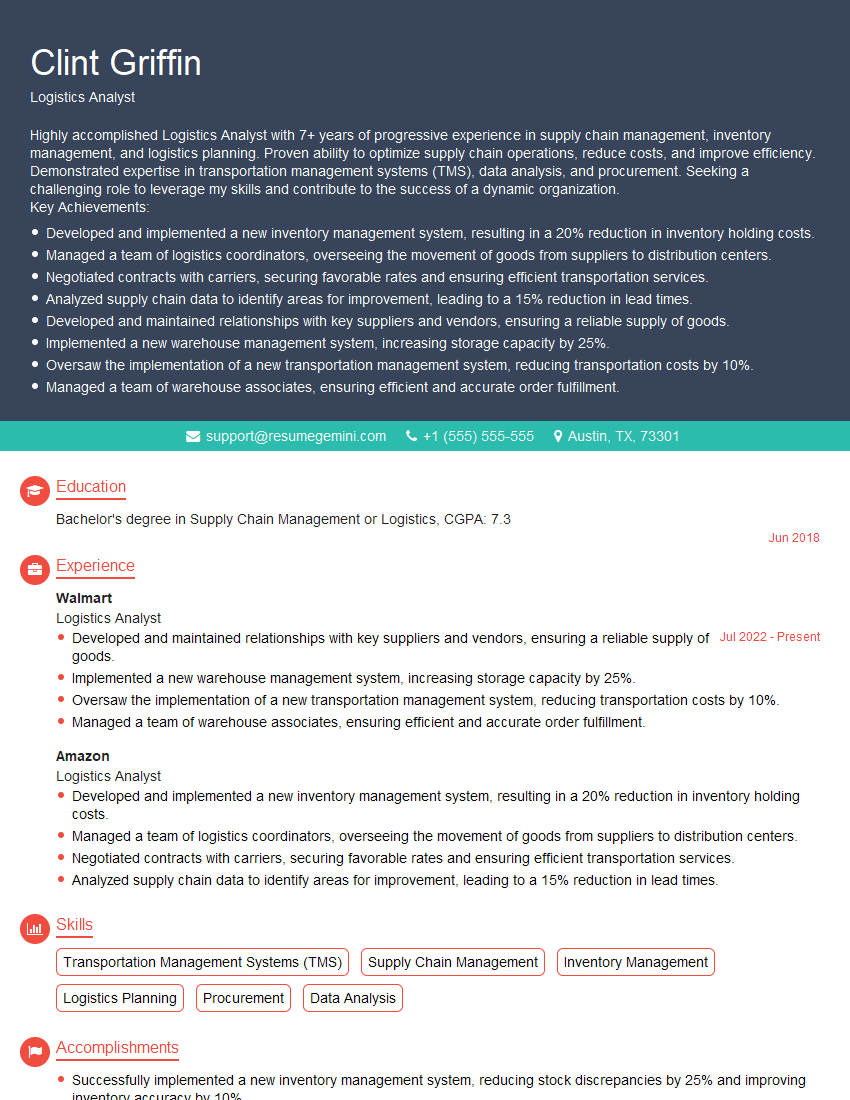
Logistics Analyst Resume Sample
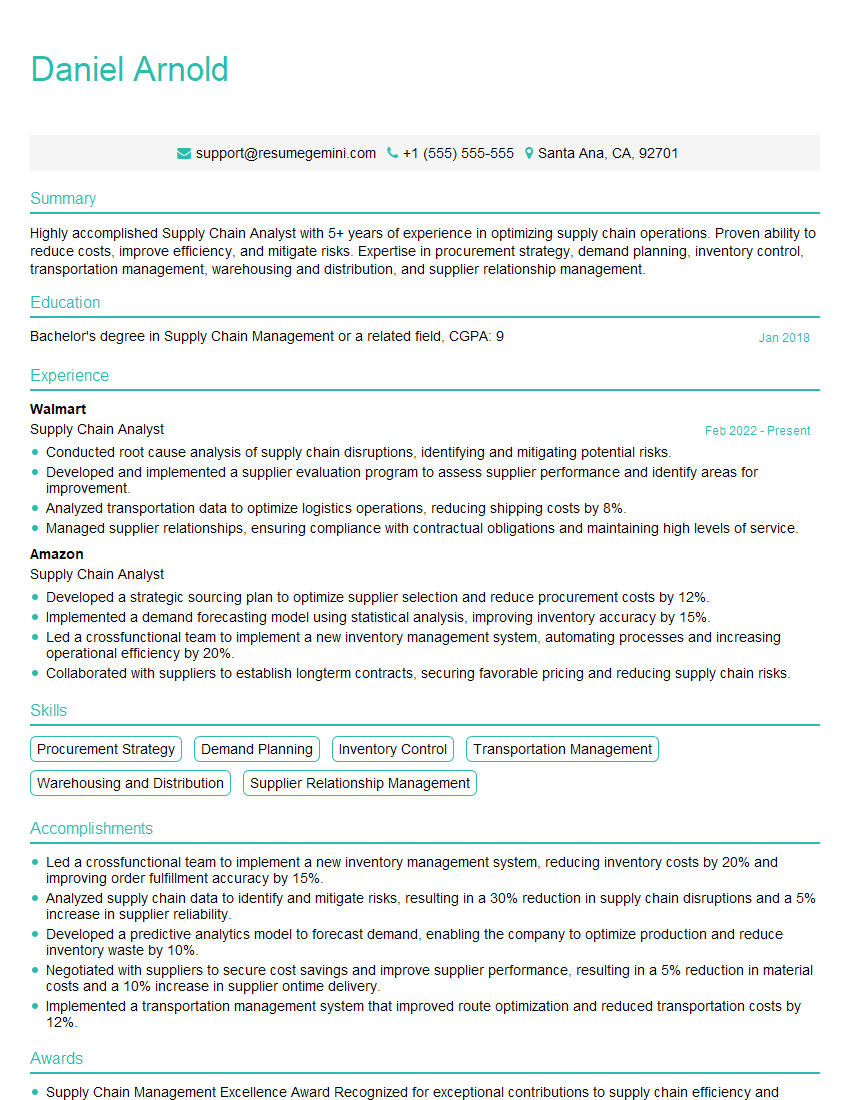
Supply Chain Analyst Resume Sample
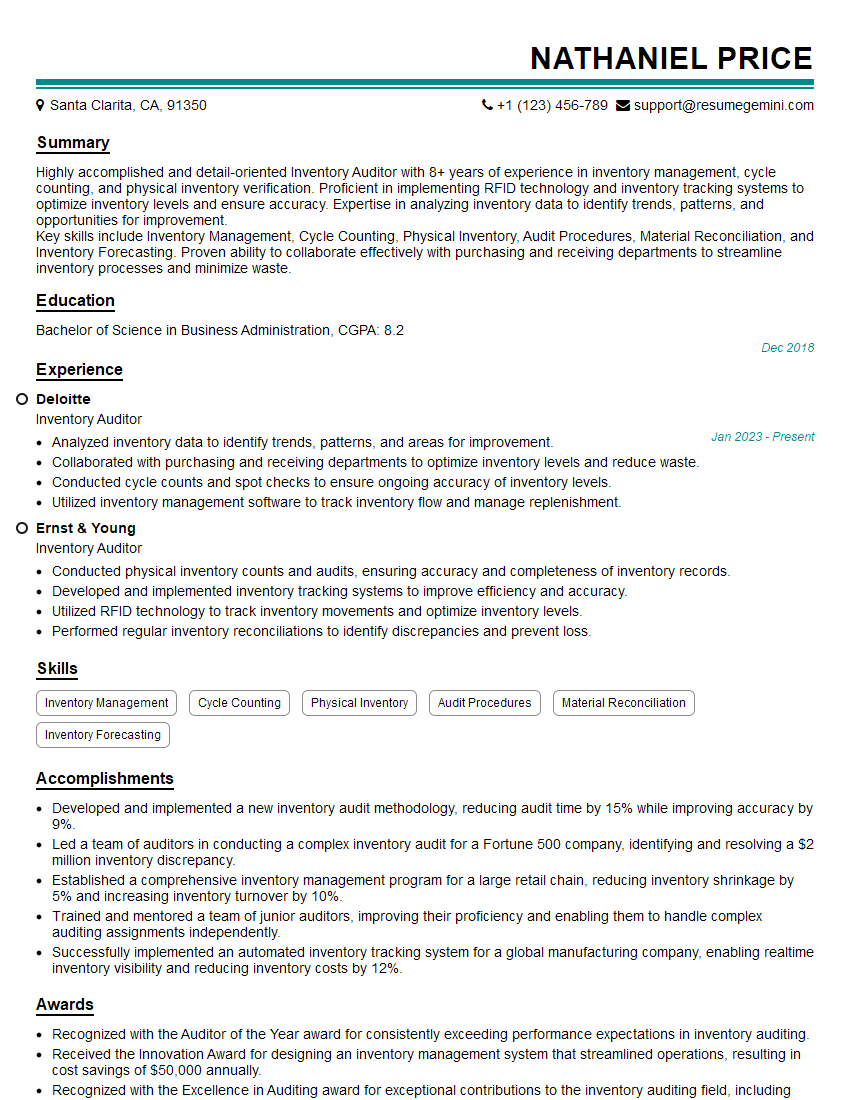
Inventory Auditor Resume Sample
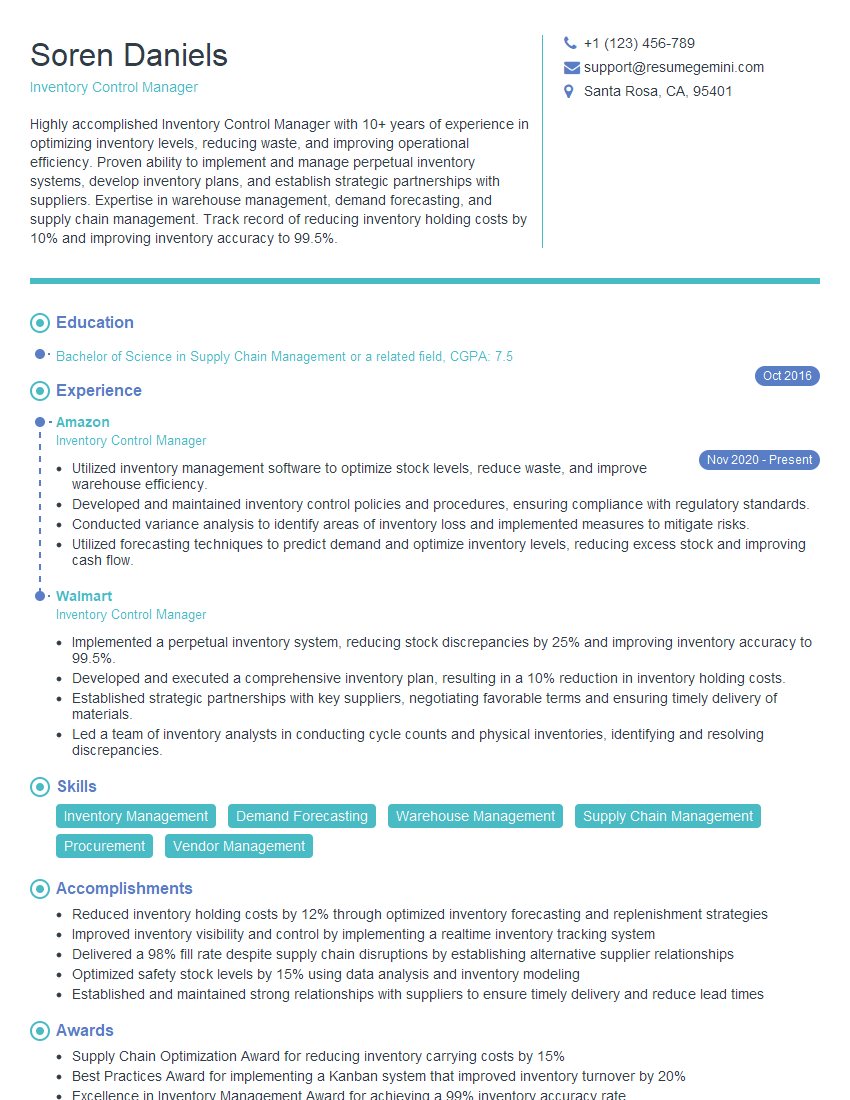
Inventory Control Manager Resume Sample
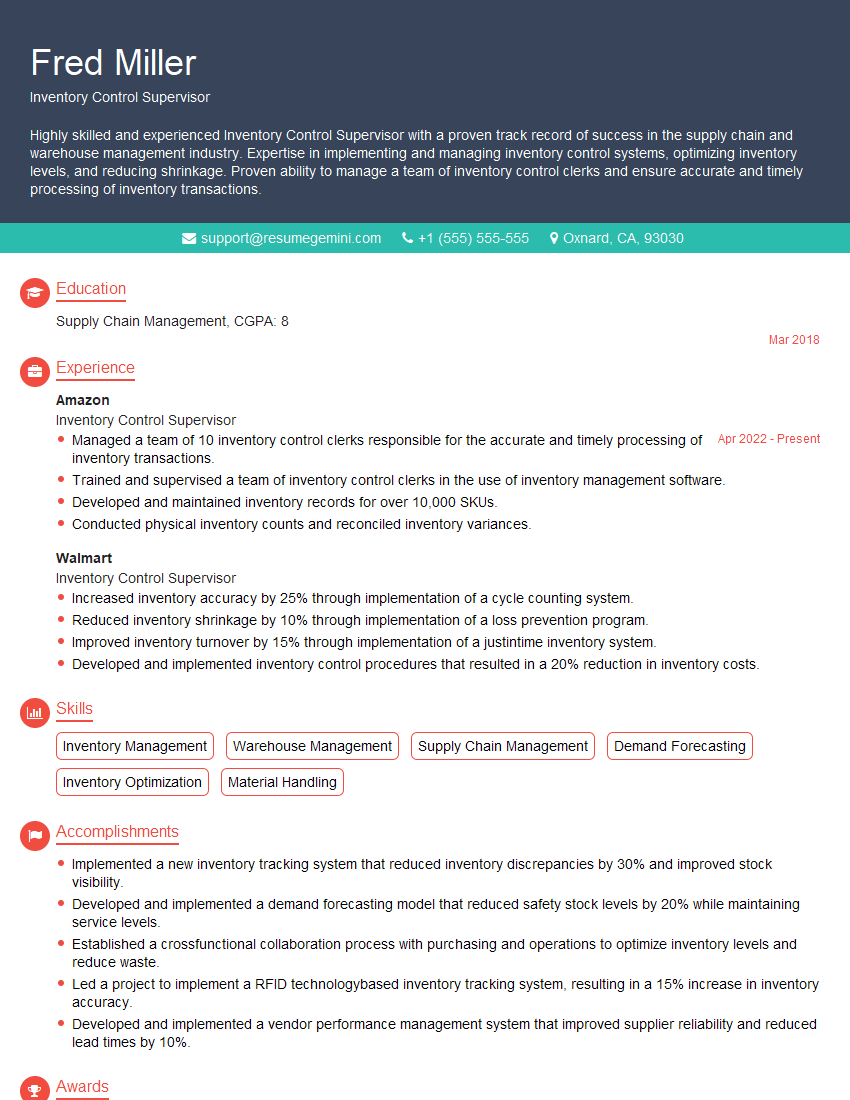
Inventory Control Supervisor Resume Sample
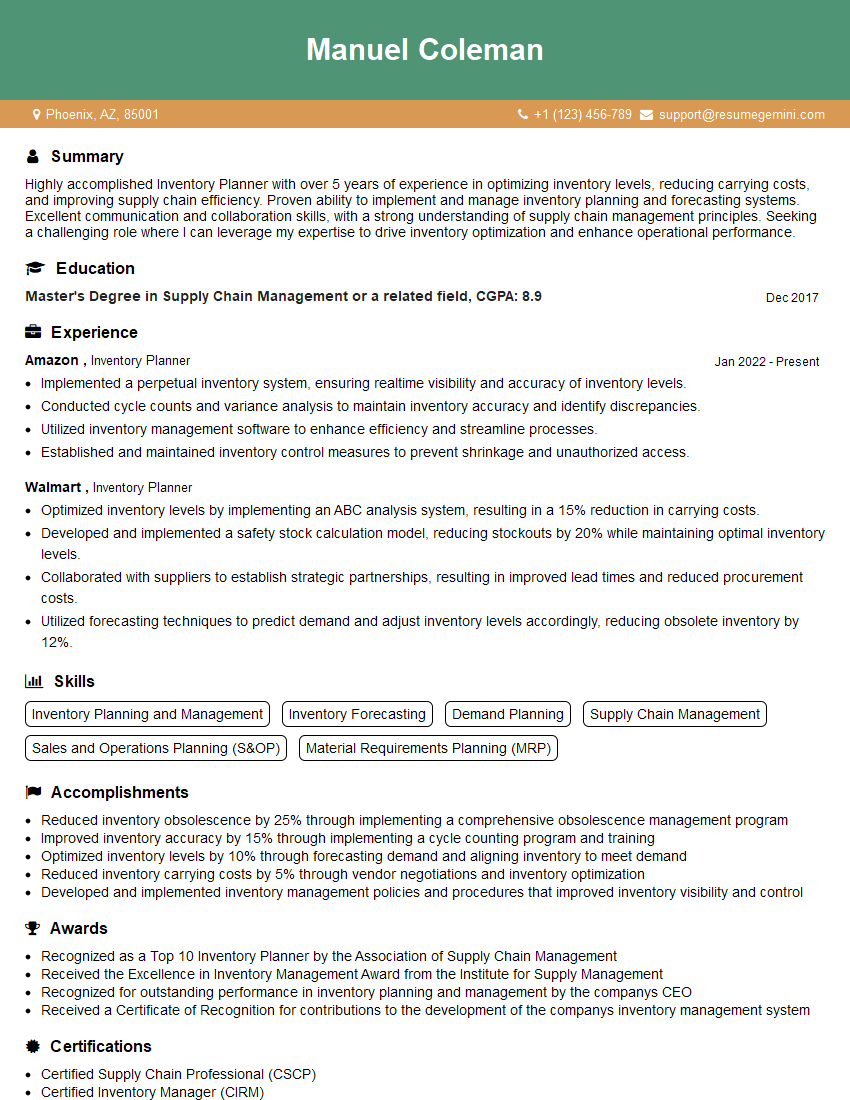
Inventory Planner Resume Sample
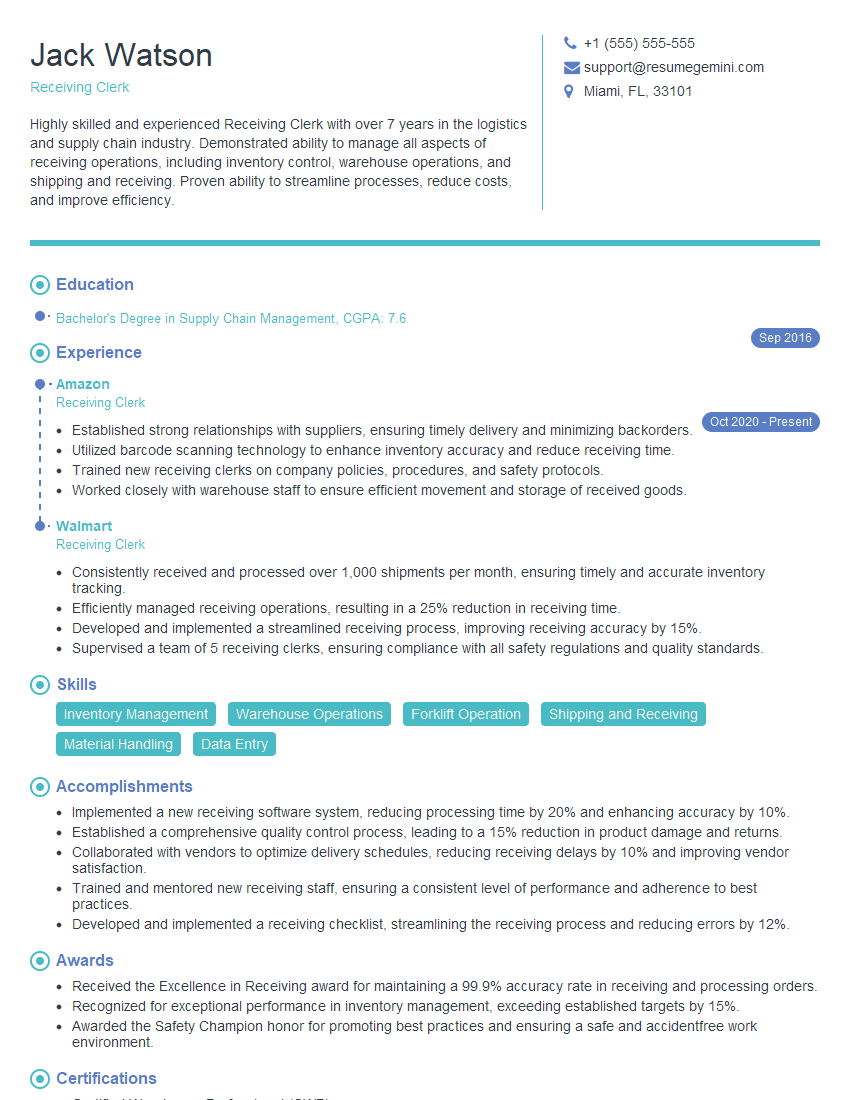
Receiving Clerk Resume Sample
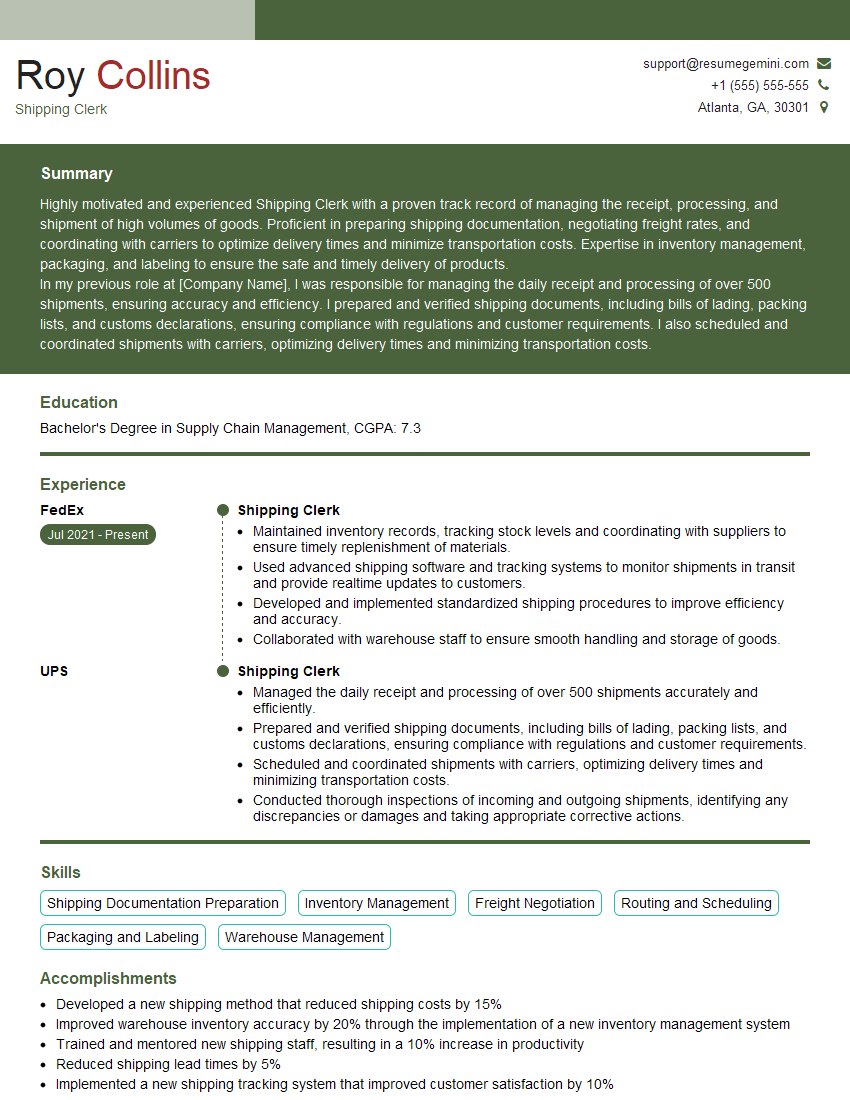
Shipping Clerk Resume Sample
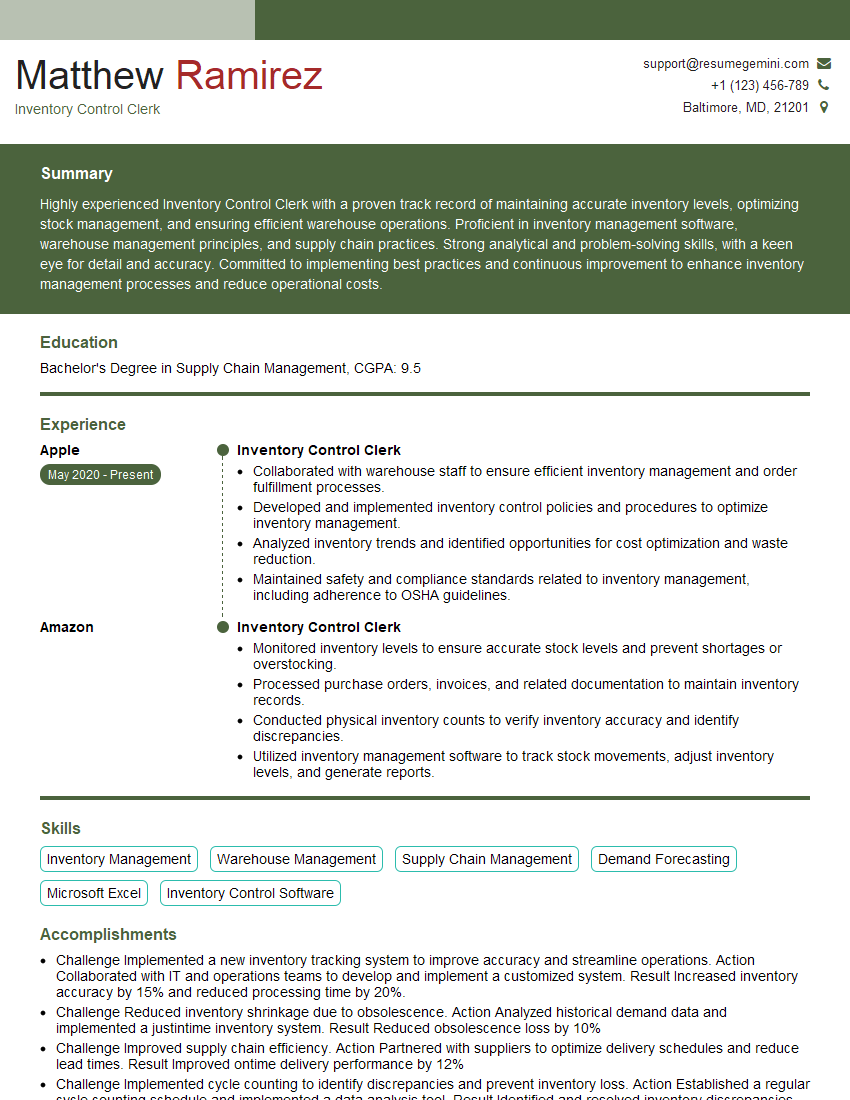
Inventory Control Clerk Resume Sample
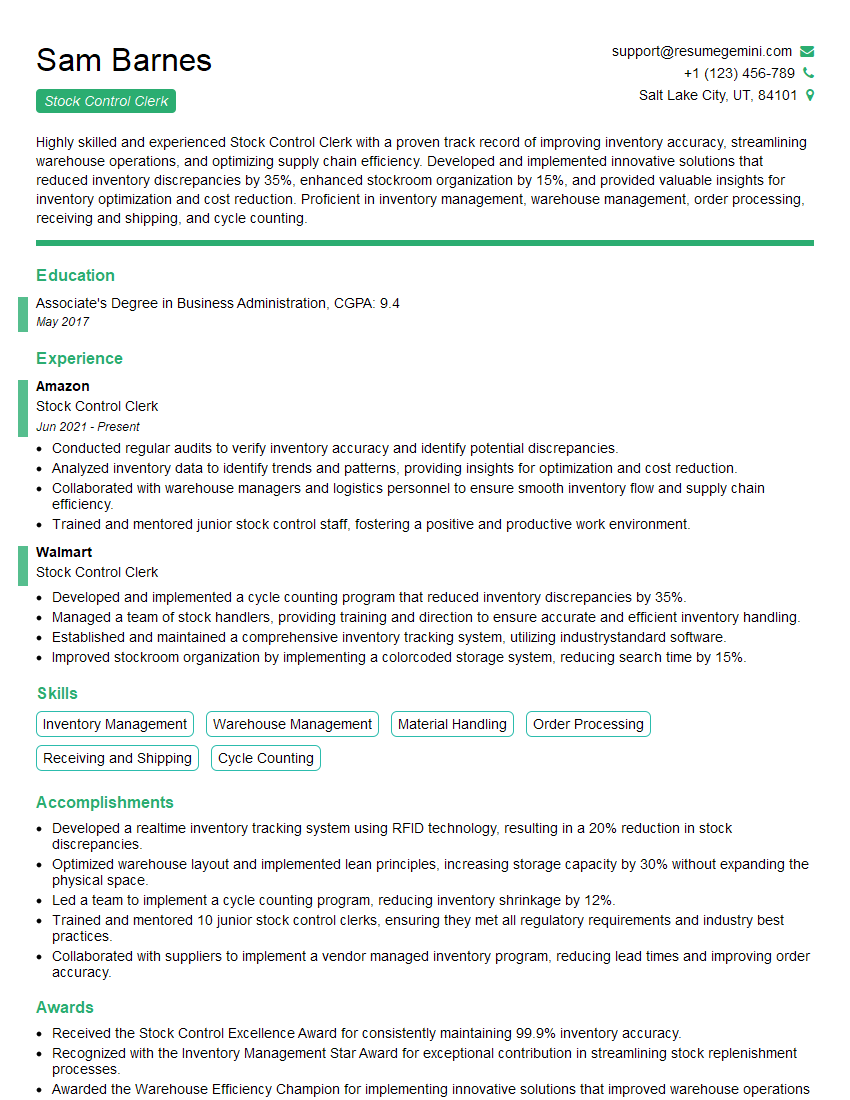
Stock Control Clerk Resume Sample
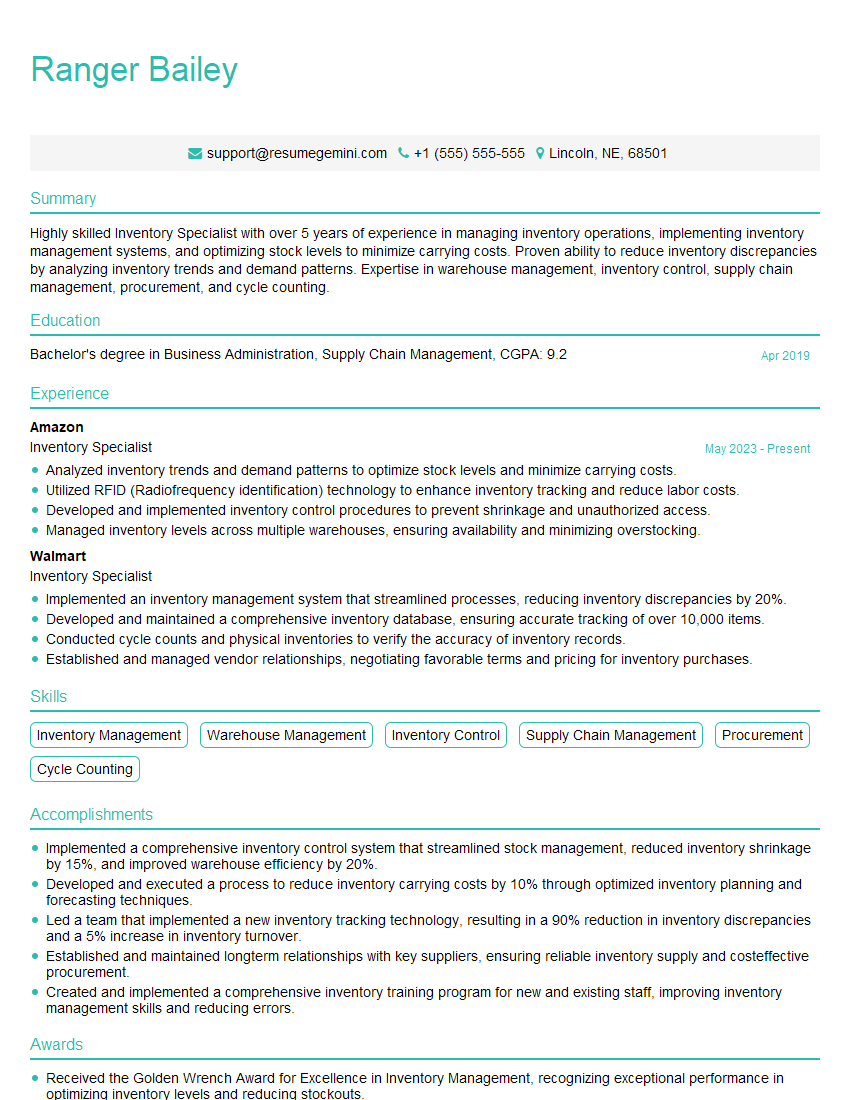
Inventory Specialist Resume Sample
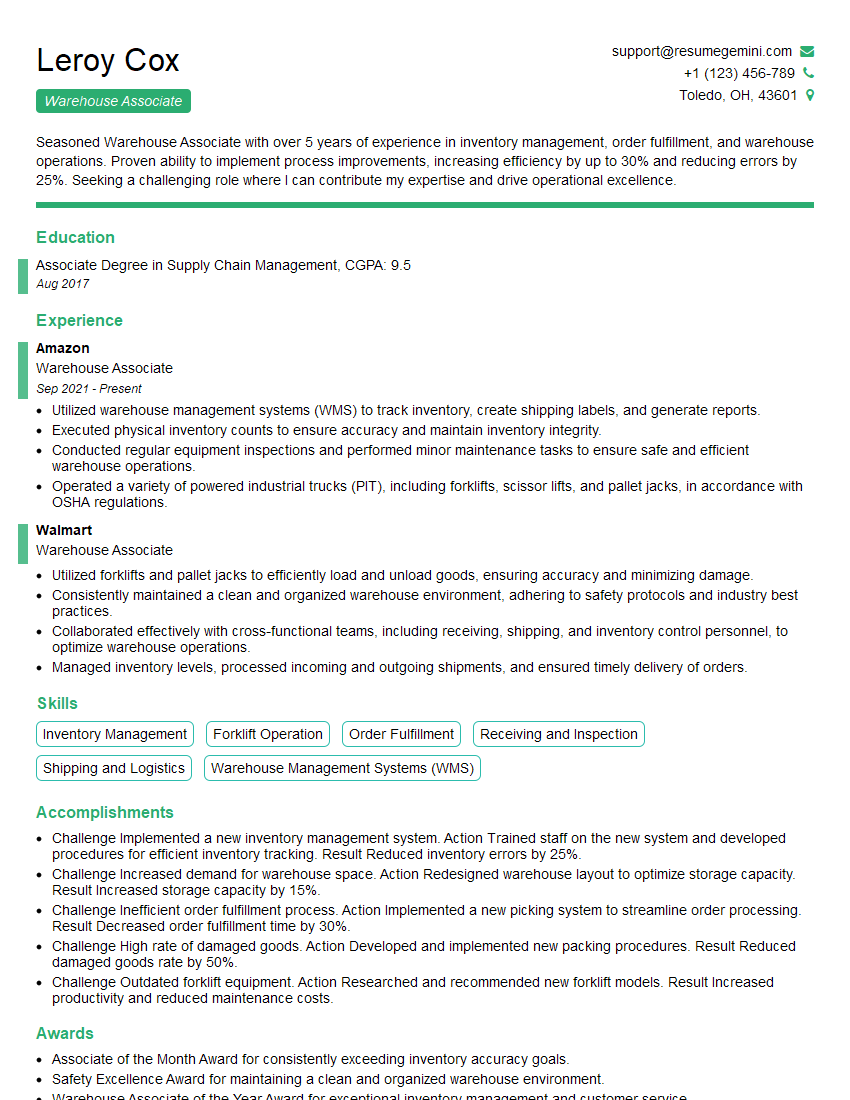
Warehouse Associate Resume Sample
- Operations Manager
- Demand Planner
- Materials Manager
- Purchasing Manager
- Warehouse Manager
- Warehouse Supervisor
- Logistics Coordinator
- Procurement Specialist
- Inventory Analyst
- Production Planner
- Logistics Analyst
- Supply Chain Analyst
- Inventory Auditor
- Inventory Control Manager
- Inventory Control Supervisor
- Inventory Planner
- Receiving Clerk
- Shipping Clerk
- Inventory Control Clerk
- Stock Control Clerk
- Inventory Specialist
- Warehouse Associate
Explore more articles
Users Rating of Our Blogs
Share Your Experience
We value your feedback! Please rate our content and share your thoughts (optional).
What Readers Say About Our Blog
Very informative content, great job.
good