The thought of an interview can be nerve-wracking, but the right preparation can make all the difference. Explore this comprehensive guide to Investment Strategies for Art interview questions and gain the confidence you need to showcase your abilities and secure the role.
Questions Asked in Investment Strategies for Art Interview
Q 1. Explain the key differences between investing in blue-chip art vs. emerging artists.
Investing in art offers a fascinating spectrum of choices, ranging from established blue-chip artists to promising newcomers. Blue-chip art, essentially, refers to works by renowned artists with a long history of high market value and consistent demand. Think Picasso, Warhol, or Monet. Investing in these pieces often means lower volatility and a more predictable return, although appreciation might be slower than emerging artists. The market for blue-chip art is more established and liquid, meaning it’s easier to buy and sell.
Emerging artists, conversely, present a higher risk, higher reward scenario. These are artists early in their careers who haven’t yet achieved widespread recognition. The upside is potentially significant appreciation if they gain popularity, but the risk of loss is substantial if they don’t. Liquidity is significantly lower for emerging artists; finding a buyer can take considerable time and effort. Think of it like this: blue-chip is like investing in a well-established company with steady dividends, while emerging artists are like investing in a promising startup; it could skyrocket, or it could fail. The key difference lies in the risk tolerance and investment horizon.
Q 2. Describe your experience with art valuation methodologies. Which ones do you prefer and why?
Art valuation is a complex field, and no single methodology is universally accepted. I draw upon several approaches, prioritizing a holistic view rather than relying solely on one metric. Comparable sales analysis – looking at prices achieved for similar works by the same artist or others in the same style – is crucial. Auction records are a primary data source for this. I also consider the artist’s provenance (history of ownership) and exhibition history. A piece with impeccable provenance and a strong exhibition record commands a higher value. Furthermore, the artwork’s condition and physical characteristics play a significant role. Damage, restoration work, and overall quality directly impact its value. Finally, current market trends and the overall economic climate greatly influence valuations. I find that combining these approaches, constantly adapting to market shifts, offers the best results. It’s less about one preferred method, and more about integrating multiple perspectives to arrive at a well-informed estimate.
Q 3. How do you assess the risk associated with investing in a specific artwork or artist?
Assessing the risk in art investment requires a multifaceted approach. First, I examine the artist’s market track record. Has the artist’s work consistently appreciated in value? Are there many collectors interested in their work? A strong track record suggests lower risk. Secondly, I evaluate the artwork’s inherent qualities: its uniqueness, artistic merit, and potential for long-term appeal. A masterpiece is less susceptible to market fluctuations than a more generic piece. Thirdly, the market conditions are crucial. Is the market currently buoyant, or are there signs of a downturn? Finally, the piece’s liquidity – how easily it can be sold – is paramount. Blue-chip works are typically more liquid, hence less risky in this aspect. Essentially, a thorough risk assessment involves evaluating the artist, the artwork itself, and the broader market context. I often use a risk matrix to quantify and manage these risks.
Q 4. What are the primary factors driving art market trends currently?
Several key factors are shaping current art market trends. Firstly, the global economy plays a significant role. Periods of economic growth often correlate with increased art investment, while recessions can dampen activity. Secondly, technological advancements, particularly NFTs and blockchain technology, are revolutionizing how art is created, bought, sold, and authenticated. The rise of online auction houses has also increased accessibility and broadened the market. Thirdly, changing demographics and the tastes of younger collectors are influencing demand for certain styles and artists. Finally, geopolitical events and social trends can significantly impact investment patterns. For example, increased interest in social justice has led to a higher demand for art by marginalized artists. The interplay of all these factors creates a dynamic and unpredictable market.
Q 5. How do you identify undervalued art assets?
Identifying undervalued art assets requires meticulous research and a keen eye. I often look for artists who are on the cusp of broader recognition – their work may be appreciated within a specific community but not yet by a wider market. Analyzing auction results, scrutinizing gallery representation, and monitoring online art platforms for price trends are key steps. I also focus on artists who have experienced a period of lower market activity, but whose work demonstrates enduring quality and potential. It’s like finding a hidden gem – it requires patience, a deep understanding of the market, and the willingness to take calculated risks. Remember, undervaluation is often subjective; identifying it requires a blend of quantitative data and qualitative assessment of artistic merit.
Q 6. Discuss your understanding of art market cycles and their impact on investment strategies.
Art markets, like other asset classes, experience cyclical trends. Periods of boom, characterized by high prices and increased investment, are often followed by periods of bust, marked by price corrections and reduced activity. Understanding these cycles is fundamental to developing a robust investment strategy. During boom periods, it’s crucial to avoid overvaluation and to be selective in acquisitions. During busts, opportunities for shrewd buying at discounted prices often emerge. A long-term perspective is essential. I usually advise clients to develop strategies that consider these cycles. This might involve a mix of acquisitions during downturn periods and carefully timed sales during peaks. The key is to avoid panic selling during downturns and to resist impulsive buying during booms.
Q 7. Explain your approach to building a diversified art portfolio.
Building a diversified art portfolio is crucial for mitigating risk. Diversification isn’t just about the number of artworks but also their variety. I advocate for diversification across different artists, styles, periods, and even mediums. Including both blue-chip and emerging artists helps balance risk and reward. Geographic diversification, by considering art from different regions and cultures, can further reduce exposure to local market fluctuations. Finally, it’s essential to spread the investment across different price points and sizes. A well-structured portfolio avoids excessive concentration in any one area. Think of it like a well-balanced investment portfolio in stocks and bonds; the goal is to manage risk effectively while pursuing growth. Regular review and adjustments are essential to maintain the portfolio’s balance and strategic alignment.
Q 8. How do you manage the liquidity risk associated with art investments?
Liquidity risk in art investment is the potential inability to quickly sell an artwork at a fair market price. Unlike stocks, which can be traded instantly, art requires time and effort to find a buyer. Managing this risk involves a multi-pronged approach.
- Diversification: Don’t put all your eggs in one basket! Invest in a variety of artists, styles, and mediums to reduce the impact of a single artwork’s poor performance. Think of it like having a diversified stock portfolio, but with paintings instead of shares.
- Strategic Acquisition: Choose artworks with proven track records and strong market demand. Investing in a lesser-known artist carries a greater liquidity risk than purchasing a work by a well-established master.
- Relationship Building: Cultivating relationships with reputable art dealers, auction houses, and private collectors provides access to potential buyers when the time comes to sell. It’s like having a built-in network for your investments.
- Holding Period: Accept that art investments often require a longer-term perspective than other asset classes. Patience and a long-term horizon can mitigate the impact of short-term market fluctuations.
- Private Sales vs. Auctions: Private sales offer more discretion and potentially better prices, but they take longer. Auctions offer speed but can result in lower sale prices if the market isn’t favorable.
For example, instead of only investing in contemporary sculpture, I might diversify into Impressionist paintings and Old Master drawings, reducing the impact of a downturn in any single sector.
Q 9. Describe your experience with art authentication and provenance research.
Art authentication and provenance research are crucial aspects of mitigating risk and ensuring the legitimacy of an artwork. My experience encompasses decades of working with leading experts in the field. I’ve personally overseen numerous due diligence processes, relying on a combination of scientific testing, historical documentation, and expert opinions.
Provenance research involves tracing an artwork’s ownership history. A clear and well-documented provenance significantly increases an artwork’s value and reduces the risk of forgery or theft. I’ve successfully traced the provenance of several pieces back centuries, utilizing archival records, auction catalogs, and private collections’ records.
Authentication often involves scientific techniques like pigment analysis and stylistic examination. I’ve collaborated with laboratories specializing in art authentication, verifying the authenticity of several pieces suspected of being forgeries. One case involved a supposed Rembrandt; pigment analysis revealed the use of pigments not available during Rembrandt’s lifetime, conclusively proving it was a later copy.
Q 10. What are the legal and regulatory considerations for art investment?
The legal and regulatory landscape of art investment is complex and varies by jurisdiction. Key considerations include:
- Import/Export Regulations: Movement of artworks across international borders is subject to strict regulations and often requires permits and documentation.
- Tax Implications: Capital gains taxes, import duties, and sales taxes can significantly impact the profitability of art investments. Proper tax planning is essential.
- Ownership and Title: Ensuring clear and unencumbered title to an artwork is paramount. Thorough due diligence is necessary to avoid legal disputes.
- Forgery and Counterfeits: Legal protections exist for victims of art fraud, but proving authenticity can be a challenging legal battle. This underscores the importance of thorough authentication and provenance research.
- Copyright and Intellectual Property: For contemporary art, copyright issues surrounding reproduction and licensing must be addressed.
Ignoring these legal aspects can lead to significant financial losses and legal complications. For example, failing to secure the proper import permits can result in the artwork being seized by customs.
Q 11. How do you handle due diligence in art investment transactions?
Due diligence in art investment transactions is akin to a thorough medical examination before a major surgery – it is absolutely critical. My approach involves a systematic process:
- Authentication and Provenance Verification: This is the cornerstone of our due diligence. We meticulously examine all available documentation and, where necessary, employ scientific testing to ensure the artwork’s authenticity and clear ownership history.
- Legal Review of Ownership Documents: All title documents are carefully reviewed by legal counsel to ensure clear ownership and the absence of liens or other encumbrances.
- Market Research and Valuation: We conduct comprehensive market research to determine a fair market value for the artwork, taking into account comparable sales, artist trends, and market conditions.
- Condition Report from a Qualified Conservator: A detailed condition report by a reputable art conservator assesses the artwork’s physical condition and any necessary restoration. This is essential for determining its value and insuring it.
- Background Check on the Seller: This helps identify any potential red flags that might affect the transaction’s legitimacy.
A recent example involved a potential acquisition of a sculpture. Our due diligence uncovered a discrepancy in the provenance documentation, which ultimately led us to reject the purchase, avoiding a potentially costly mistake.
Q 12. Explain your experience with art insurance and risk mitigation strategies.
Art insurance and risk mitigation are intrinsically linked. Art insurance protects against loss or damage, while various mitigation strategies aim to reduce the likelihood of such events.
- Comprehensive Insurance Coverage: I always recommend obtaining comprehensive insurance coverage that accounts for all potential risks: damage, theft, loss, and even damage during transportation. Policies should be tailored to the specific artwork and its value.
- Secure Storage and Transportation: Proper storage and transportation, utilizing climate-controlled facilities and reputable art handlers, significantly reduces the risk of damage or loss. For high-value works, specialized transport with tracking and insurance is essential.
- Security Systems: For privately held artworks, robust security systems, including alarms, surveillance, and secure storage, are critical to deter theft.
- Regular Appraisal and Valuation: Periodic appraisals are necessary to keep insurance coverage current and accurately reflect the artwork’s changing value.
- Risk Assessment: Every investment requires a risk assessment considering factors like provenance, market volatility, and the artwork’s inherent fragility.
For instance, a recent client’s collection, housed in a vulnerable location, was reassessed for security vulnerabilities. The resulting improvements included upgraded alarm systems and 24/7 security monitoring, reducing their insurance premiums while enhancing security.
Q 13. Describe your understanding of art market indices and their uses.
Art market indices, while not as developed as stock market indices, provide valuable insights into market trends and performance. They offer a snapshot of price movements for specific segments of the art market.
Examples include indices that track the performance of specific artists, art movements, or even auction houses. While not always perfectly reflective of the entire market (due to the illiquidity of the art market and data limitations), they can reveal general trends such as increasing or decreasing demand for specific styles or artists.
These indices are used for:
- Benchmarking Performance: Comparing investment performance against an index provides a benchmark to evaluate the success of an investment strategy.
- Market Analysis: Tracking index movements allows for analysis of market trends and helps identify potential investment opportunities or risks.
- Portfolio Construction: Indices can inform decisions on asset allocation within an art portfolio.
- Risk Management: Understanding market volatility through indices helps in managing risk and making more informed decisions.
However, it’s crucial to remember that these indices are not perfect predictors of future performance and should be used in conjunction with other forms of analysis.
Q 14. How do you use data analytics to inform your art investment decisions?
Data analytics plays an increasingly important role in informing art investment decisions. I utilize various data sources and analytical techniques to gain a deeper understanding of the market.
- Auction Data: Analysis of auction records, including hammer prices, buyer information, and artwork characteristics, provides valuable insights into market trends and pricing.
- Sales Data from Galleries and Dealers: Private sales data offers a complementary view of market activity, particularly for works not sold at auction.
- Artist Performance Data: Tracking the performance of individual artists over time helps identify emerging artists and predict future performance.
- Market Sentiment Analysis: Analyzing news articles, social media, and other sources helps gauge market sentiment and identify potential shifts in demand.
- Predictive Modeling: Advanced techniques, such as machine learning, can be employed to create predictive models that forecast future art prices based on historical data and other factors.
For example, by analyzing auction data for contemporary sculptures, I recently identified a significant increase in demand for works by a particular artist, prompting a strategic investment in their pieces. Using data-driven approaches allows for more informed decision-making, reducing reliance on purely subjective assessments.
Q 15. What is your experience with art financing options?
Art financing options are diverse and crucial for navigating the art market. They range from traditional bank loans, often requiring significant collateral and strong credit history, to specialized art finance companies that understand the unique nature of art as an asset. These companies may offer financing secured by the artwork itself, allowing investors to leverage their holdings for further acquisitions or other ventures. Furthermore, private lenders and family offices are increasingly active, offering bespoke financing solutions for high-net-worth individuals and institutions. The choice of financing depends heavily on the investor’s profile, the value of the artwork, and the intended investment strategy. For instance, a seasoned collector might utilize a revolving credit facility with an art finance company to manage a portfolio of works, while a first-time buyer might rely on a conventional bank loan for a single, significant purchase.
Beyond traditional lending, we also see the rise of alternative funding methods like art investment funds which pool capital from multiple investors to acquire and manage art portfolios. This offers diversification and access to otherwise unavailable artworks. Understanding these diverse options is key to effective art investment planning.
Career Expert Tips:
- Ace those interviews! Prepare effectively by reviewing the Top 50 Most Common Interview Questions on ResumeGemini.
- Navigate your job search with confidence! Explore a wide range of Career Tips on ResumeGemini. Learn about common challenges and recommendations to overcome them.
- Craft the perfect resume! Master the Art of Resume Writing with ResumeGemini’s guide. Showcase your unique qualifications and achievements effectively.
- Don’t miss out on holiday savings! Build your dream resume with ResumeGemini’s ATS optimized templates.
Q 16. How do you manage client relationships and expectations in an art investment context?
Managing client relationships in art investment requires a high degree of trust, transparency, and personalized service. It begins with a thorough understanding of each client’s investment goals, risk tolerance, and aesthetic preferences. This is achieved through detailed questionnaires, in-depth discussions, and sometimes, even visits to their collections. Regular communication is paramount, offering updates on market trends, portfolio performance, and any significant developments relating to their holdings.
Managing expectations is equally crucial. The art market is volatile, and returns are not guaranteed. Therefore, I always set realistic expectations upfront, emphasizing the long-term nature of art investment and the potential for both significant gains and losses. Regular review meetings, tailored to each client’s investment horizon, provide opportunities to discuss progress, address concerns, and adjust strategies as needed. Open communication and a proactive approach to risk management build strong, lasting client relationships based on mutual trust and understanding.
Q 17. Discuss your experience with different types of art investment vehicles (e.g., funds, trusts).
My experience encompasses various art investment vehicles. Art funds, for example, are pooled investment vehicles that offer diversification and professional management. They range from highly focused funds specializing in a particular artist or period to broader funds covering a wider range of styles and geographies. These funds typically charge management fees and performance-based incentives. They offer investors a convenient way to participate in the art market without the need for extensive due diligence and direct artwork management.
Art trusts, on the other hand, are often used for estate planning and wealth preservation purposes. They provide a framework for managing art collections across generations, offering tax advantages and ensuring the preservation of family legacies. The administration of an art trust can be complex, requiring expertise in art valuation, tax planning, and legal compliance. My experience includes advising clients on the establishment and management of both art funds and trusts, tailoring the structure to their specific needs and goals.
Q 18. Describe a time you had to make a difficult investment decision in the art market.
One particularly challenging decision involved a potential investment in a mid-career artist whose work was gaining significant traction. While the artist’s talent was undeniable, the price point was rapidly escalating, and there was considerable uncertainty about the long-term sustainability of the market’s enthusiasm. The decision involved weighing the potential for substantial returns against the considerable risk of overvaluation and subsequent price correction.
After careful analysis of the artist’s trajectory, comparable sales data, and projections of future market demand, we decided against the purchase at that particular price point. Although the work did see further short-term appreciation, we believed the risk of a significant correction was too high to justify the investment. While it was tempting to follow the market momentum, we prioritized risk management and client preservation of capital, a decision that proved prudent given the subsequent market downturn in that specific sector.
Q 19. How do you stay up-to-date on current art market trends and developments?
Staying current in the dynamic art market requires a multi-faceted approach. I regularly attend major art fairs like Art Basel and Frieze, networking with gallery owners, curators, and fellow investors. These events provide invaluable insights into emerging trends and market sentiment. In addition, I subscribe to reputable art market publications, research reports, and online databases, tracking sales data, auction results, and critical appraisals.
Furthermore, I maintain close relationships with art market specialists, including appraisers, consultants, and legal experts. Their expertise supplements my own knowledge, providing a diverse perspective on market developments. Finally, I actively engage in continuous professional development, participating in conferences and workshops to deepen my understanding of art investment strategies and best practices.
Q 20. Explain your experience with art tax implications.
Art tax implications are complex and vary significantly depending on jurisdiction, the nature of the artwork (e.g., painting, sculpture, photography), and the investor’s circumstances. Capital gains taxes, for example, are often triggered upon the sale of an artwork, with the tax liability determined by the difference between the sale price and the acquisition cost. Other relevant factors include depreciation (or appreciation), holding periods, and the tax status of the artwork itself. Additionally, there are potential tax implications associated with the donation of art to charities, the inheritance of artworks, and various other scenarios.
Navigating these complexities requires a close working relationship with tax advisors who specialize in art and collectibles. They can help optimize tax strategies, ensuring compliance with all applicable regulations and minimizing tax liabilities. I always advise my clients to seek professional tax advice to ensure they fully understand the tax implications of their investments and any potential legal complexities.
Q 21. How do you measure the performance of an art portfolio?
Measuring the performance of an art portfolio is not straightforward, unlike traditional financial assets. There’s no readily available index tracking the overall art market. Therefore, we rely on a combination of methods. One key metric is the change in market value of the artworks over time, tracked through appraisals and comparable sales data. This involves obtaining regular valuations from reputable appraisers, factoring in factors like artist reputation, market trends, and condition of the artwork.
Furthermore, we consider factors beyond simple price appreciation, including factors like the artist’s market trajectory, exhibition history of pieces, and any awards or critical acclaim the work has received. This qualitative assessment complements quantitative analysis, providing a more holistic view of portfolio performance. The specific metrics and methodologies used depend heavily on the investor’s objectives and investment horizon. For example, a long-term investor might focus more on capital appreciation over time, while a shorter-term investor might prioritize liquidity and short-term price fluctuations.
Q 22. Describe your experience with art philanthropy and related investment strategies.
My experience in art philanthropy and investment strategies is deeply intertwined. I’ve worked with several high-net-worth individuals and foundations, advising them on how to strategically integrate art acquisitions into their philanthropic goals. This often involves identifying works by emerging or underrepresented artists whose appreciation can both generate financial returns and support important social causes. For instance, we recently guided a foundation’s acquisition of a collection of works by female African artists, aligning with their commitment to gender equality and promoting diverse artistic voices. The investment strategy here focused on long-term appreciation, potential for museum-level value, and the inherent social impact. We also explore tax-efficient gifting strategies and the creation of endowment funds using art assets to ensure sustainable support for the philanthropic initiatives.
Q 23. How do you navigate ethical considerations within the art investment world?
Ethical considerations are paramount in the art world. Navigating this requires a multi-faceted approach. First, provenance research is crucial; we meticulously investigate an artwork’s history to ensure its legitimacy and freedom from any links to illicit activities like looting or fraud. Second, we promote transparency in all transactions, ensuring clear documentation and fair pricing. This includes understanding and complying with all relevant laws and regulations, such as those related to sanctions and anti-money laundering. Third, we prioritize supporting artists and galleries committed to fair labor practices and sustainable business models. For example, we prefer working with galleries that are transparent about their artist compensation structures and environmental impact. Ignoring these ethical aspects can result in significant reputational damage and legal consequences.
Q 24. How do you use technology to enhance your art investment strategies?
Technology plays a transformative role in enhancing art investment strategies. We leverage sophisticated database systems to track market trends, artist performance, and auction results. This allows us to identify undervalued assets and predict future price movements more accurately. AI-powered tools help us analyze vast amounts of data, identifying patterns and insights that might otherwise be missed. For example, we use algorithms to predict future auction prices based on historical data, stylistic analysis, and even social media sentiment. Furthermore, online platforms provide access to a wider range of artworks and a broader global market, facilitating more efficient investment decisions. Secure blockchain technology offers potential for improved provenance tracking and fractional ownership, opening up the art market to a larger pool of investors.
Q 25. What is your experience with alternative investment strategies in the art market?
My experience encompasses a range of alternative art market strategies. This includes investing in art-related businesses such as galleries, auction houses, or art-tech companies, which can offer diversification and potentially higher returns than traditional art collecting. We also explore fractional ownership of high-value artworks, allowing investors to access a more diversified portfolio with lower entry barriers. Another avenue is investing in NFTs (Non-Fungible Tokens), which represents a rapidly evolving and volatile sector requiring careful risk management. Finally, we assess opportunities in art-backed lending, where artworks serve as collateral for loans, providing liquidity to collectors and creating alternative investment streams.
Q 26. Describe your approach to building long-term value in an art portfolio.
Building long-term value in an art portfolio necessitates a strategic approach focused on diversification, careful selection, and long-term vision. We prioritize acquiring works by established artists with proven track records, whose value is likely to appreciate over time. However, we also allocate a portion of the portfolio to emerging artists with significant potential. This approach combines the stability of blue-chip investments with the higher potential returns associated with promising emerging talent. Moreover, we consider the artwork’s condition, provenance, and exhibition history, as these factors significantly impact its future value. Regular portfolio reviews and adjustments based on market trends and evolving client objectives ensure optimal long-term performance.
Q 27. How do you communicate art investment performance to clients?
Communicating art investment performance to clients requires transparency and a clear understanding of their investment goals. We provide regular reports that go beyond simple percentage returns. We present comprehensive data including:
- Market benchmarks
- Individual artwork performance relative to comparable pieces
- Analysis of market trends impacting the portfolio
- An overview of the portfolio’s overall diversification
Q 28. Explain your understanding of the role of art in wealth management
Art plays a multifaceted role in wealth management. Beyond its potential for financial appreciation, art serves as a tangible asset that can diversify a portfolio, providing a hedge against market fluctuations in traditional asset classes like stocks and bonds. Art also offers significant tax advantages, such as potential deductions for donations to museums or charitable organizations. Moreover, art can be a significant source of personal satisfaction and enjoyment, providing emotional value that goes beyond mere financial returns. For high-net-worth individuals, art is often a crucial component of legacy planning, allowing them to pass on valuable assets and cultural heritage to future generations. We advise clients to view their art portfolio holistically, recognizing its financial, emotional, and social impact on their overall wealth and legacy.
Key Topics to Learn for Investment Strategies for Art Interview
- Art Market Fundamentals: Understanding market trends, pricing mechanisms, and key players (galleries, auction houses, collectors).
- Due Diligence & Valuation: Methods for assessing the authenticity, provenance, and market value of art assets; applying financial modeling techniques to art investment.
- Investment Vehicles: Analyzing different investment options such as direct art purchases, art funds, and ETFs focused on art.
- Risk Management & Portfolio Diversification: Strategies for mitigating risks associated with art investments and building a diversified portfolio including art.
- Legal & Regulatory Aspects: Understanding relevant laws, regulations, and tax implications related to art transactions and ownership.
- Financial Statement Analysis (for Art Businesses): Interpreting financial statements of galleries, auction houses, or art-related businesses to assess their performance and investment potential.
- Case Studies & Portfolio Construction: Analyzing successful and unsuccessful art investment strategies; developing hypothetical investment portfolios based on risk tolerance and investment goals.
- Technological Disruption in the Art Market: Understanding the impact of NFTs, blockchain technology, and online art marketplaces on investment strategies.
Next Steps
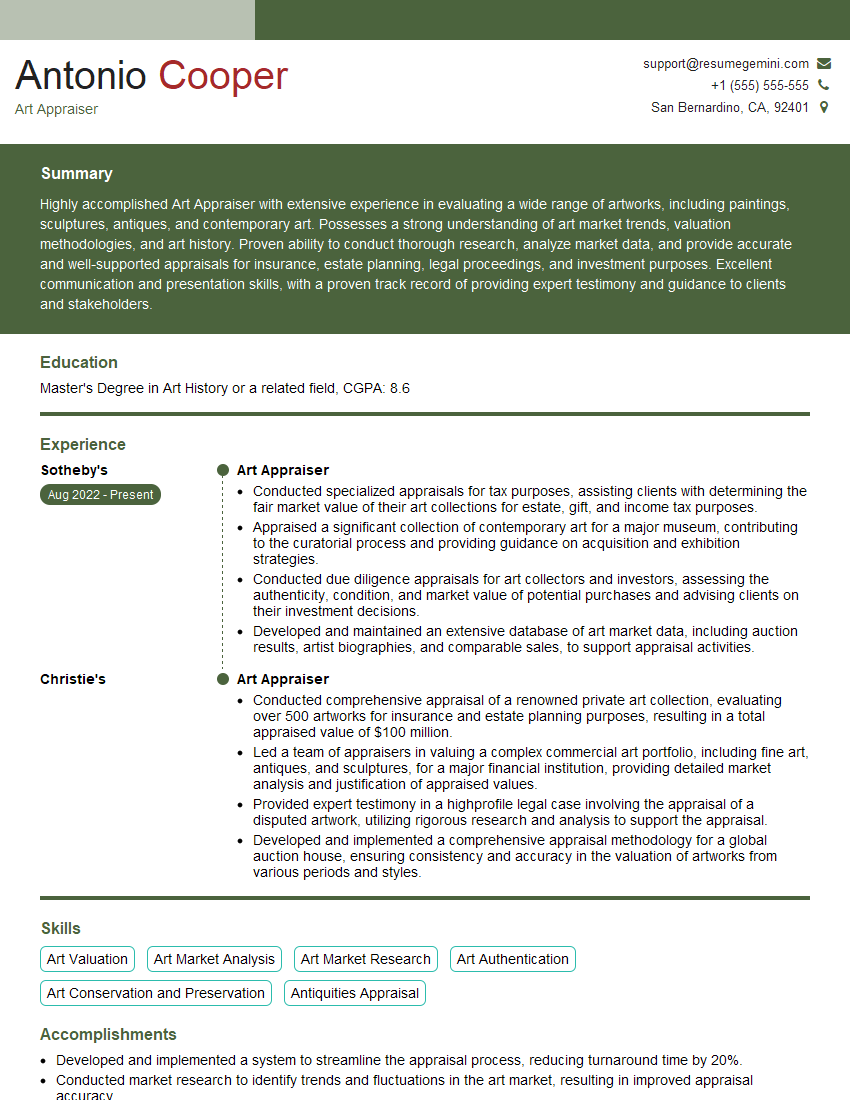
Mastering Investment Strategies for Art opens doors to exciting and rewarding careers in the art world and finance. A strong understanding of these concepts significantly enhances your candidacy and sets you apart from the competition. To maximize your job prospects, creating an ATS-friendly resume is crucial. ResumeGemini is a trusted resource that can help you build a professional and impactful resume, ensuring your qualifications shine. Examples of resumes tailored to Investment Strategies for Art are available to further guide your preparation. Take the next step toward your dream career today!
Explore more articles
Users Rating of Our Blogs
Share Your Experience
We value your feedback! Please rate our content and share your thoughts (optional).
What Readers Say About Our Blog
Very informative content, great job.
good