Every successful interview starts with knowing what to expect. In this blog, we’ll take you through the top IP Development interview questions, breaking them down with expert tips to help you deliver impactful answers. Step into your next interview fully prepared and ready to succeed.
Questions Asked in IP Development Interview
Q 1. Explain the difference between a patent, trademark, and copyright.
Patents, trademarks, and copyrights are all forms of intellectual property (IP) protection, but they protect different things. Think of it like this: a patent protects an invention, a trademark protects a brand, and a copyright protects creative works.
- Patent: Grants the inventor exclusive rights to make, use, and sell their invention for a set period. This applies to things like new processes, machines, manufactures, compositions of matter, or improvements to existing inventions. For example, a patent might protect a new type of smartphone battery.
- Trademark: Protects brand names, logos, and other identifying marks used on goods and services. This helps consumers distinguish your products from competitors. Think of the Apple logo or the Coca-Cola name – these are trademarks.
- Copyright: Protects original works of authorship, including literary, dramatic, musical, and certain other intellectual works. This includes books, songs, software code, and artwork. Copyright protection arises automatically upon creation, but registration offers additional benefits.
The key difference lies in what they protect: invention (patent), brand (trademark), and creative work (copyright).
Q 2. Describe the process of obtaining a utility patent.
Obtaining a utility patent, which protects the functionality of an invention, is a multi-step process that generally involves:
- Invention Disclosure: Clearly documenting your invention, including detailed descriptions, drawings, and claims of what makes it novel and non-obvious.
- Patent Search (Prior Art Search): Thoroughly searching existing patents and publications to ensure your invention is truly novel and non-obvious. This is crucial to avoid rejection.
- Patent Application Preparation: Drafting a detailed patent application, following strict formatting and disclosure requirements. This often requires the expertise of a patent attorney.
- Filing the Application: Submitting the application to the relevant patent office (e.g., the USPTO in the US).
- Examination: The patent examiner reviews the application for patentability, raising objections if necessary. This can involve multiple rounds of communication and amendment.
- Allowance: If the examiner finds the invention patentable, the application is allowed.
- Issue: After paying the issue fee, the patent is officially granted, providing you with exclusive rights for a set term (usually 20 years from the date of application).
It’s vital to consult with a patent attorney throughout this process, as navigating patent law can be complex.
Q 3. What are the key elements of a patentable invention?
To be patentable, an invention must generally meet these criteria:
- Utility: It must have a useful purpose. It can’t be purely theoretical or fanciful.
- Novelty: It must be new and not previously known or used by others. This is determined by comparing it to the ‘prior art’ – everything that has been publicly disclosed before the filing date.
- Non-obviousness: It must not be obvious to someone skilled in the art. This means that even if it’s new, it can’t be simply an incremental improvement that would be easily apparent to an expert in the field.
- Enablement: The patent application must describe the invention in sufficient detail to allow someone skilled in the art to make and use it without undue experimentation.
Meeting these criteria ensures that the patent protects something truly innovative and worthy of protection.
Q 4. How do you conduct a patent search?
Conducting a thorough patent search is essential before filing a patent application. This involves using various resources to identify prior art that might affect the patentability of your invention. Here’s a breakdown:
- Patent Databases: Utilize online databases like the USPTO’s website (for US patents), Espacenet (for worldwide patents), and Google Patents. These databases allow searching by keywords, classifications, and inventor names.
- Keyword Searching: Use relevant keywords related to your invention’s function and technology. Try variations and synonyms to broaden your search.
- Classification Codes: Use the International Patent Classification (IPC) or the Cooperative Patent Classification (CPC) codes to search patents categorized under similar technologies.
- Citation Searching: Once you identify relevant patents, examine their citations to uncover related patents that might not have appeared in your initial search.
- Non-patent Literature Search: Search scientific journals, technical articles, and other publications to uncover prior art that may not be in patent databases.
A comprehensive search significantly reduces the risk of wasting time and resources on an unpatentable invention.
Q 5. What are the different types of trademarks?
Trademarks fall into several categories, depending on what they represent:
- Brand Names (Trade Names): Words used to identify and distinguish a company or its goods and services (e.g., ‘Google’, ‘Nike’).
- Logos: Symbolic designs, often including words, that are used to represent a brand (e.g., the Apple logo).
- Slogans (Trade Slogans): Catchy phrases associated with a brand (e.g., ‘Just Do It’).
- Sounds: Unique sounds associated with a brand (e.g., the NBC chimes).
- Colors: Specific colors, when used consistently to identify a brand (e.g., Tiffany blue).
- Shapes: Unique shapes of products or packaging (e.g., the Coca-Cola bottle).
The type of trademark you seek will depend on the identifying features of your brand.
Q 6. What is the significance of a trademark registration?
Trademark registration provides several significant advantages:
- Legal Protection: It gives you the exclusive right to use your trademark in connection with the goods and services you have registered. This allows you to prevent others from using confusingly similar marks.
- Notice to the Public: Registration provides notice to the public that you own the trademark, making it easier to enforce your rights.
- National Protection: Registration provides nationwide protection in the country where it is registered.
- Basis for Legal Action: A registered trademark provides a stronger basis for legal action against infringers, allowing you to seek monetary damages and injunctions.
- International Protection: Registration in one country can serve as a basis for registration in other countries.
While you can use a trademark without registering it, registration offers significantly stronger legal protection and enforcement options.
Q 7. Explain the concept of ‘fair use’ in copyright law.
Fair use in copyright law is a doctrine that permits limited use of copyrighted material without obtaining permission from the copyright holder. It’s not a clearly defined rule, but a legal defense determined on a case-by-case basis. Factors considered include:
- Purpose and character of the use: Is it for commercial purposes or non-profit educational use? Transformative use (creating something new) is generally favored.
- Nature of the copyrighted work: Is it factual or fictional? Using factual works is generally more likely to be considered fair use.
- Amount and substantiality of the portion used: Using a small portion of the work is generally more likely to be considered fair use than using a large portion.
- Effect on the market for or value of the copyrighted work: Does the use harm the potential market for the original work? If so, it’s less likely to be considered fair use.
Example: Quoting a short passage from a book in a literary review would likely be considered fair use, while reproducing the entire book without permission would not. The line is blurry, and legal counsel is often advisable.
Q 8. How do you determine the scope of protection afforded by a patent?
The scope of protection afforded by a patent is determined by its claims. The claims are the heart of a patent, specifically defining what the invention is and what the inventor is legally entitled to exclude others from making, using, selling, importing, or offering for sale. Think of them as the legal boundaries of your invention.
Claims are carefully drafted by patent attorneys to precisely encompass the novel and non-obvious aspects of the invention. They’re usually written in highly specific technical language, defining features, functions, and relationships between components. A broader claim covers a wider range of embodiments, while a narrower claim offers more focused protection. The interpretation of claims can be complex and often involves legal arguments about the meaning of specific terms and the overall context of the patent specification.
Example: Imagine a patent for a new type of bicycle helmet. A broad claim might cover ‘a bicycle helmet with an improved impact-absorbing liner’. This protects a wide range of helmet designs with such a liner. A narrower claim might cover ‘a bicycle helmet with an impact-absorbing liner made of a specific type of foam, arranged in a particular geometric pattern’. This provides more specific, though potentially less broad, protection.
Determining the scope requires a deep understanding of patent law, claim construction principles, and the relevant prior art. It’s often best to consult with a qualified patent attorney to fully understand the extent of your protection.
Q 9. What are the key considerations when licensing intellectual property?
Licensing intellectual property (IP) involves transferring the right to use an invention or other IP asset to another party for a specific period and under agreed-upon terms. Key considerations include:
- Type of License: Exclusive (granted to only one licensee), non-exclusive (licensor can grant to multiple parties), or sole (only one licensee at a time but the licensor can also use the IP).
- Territory: Geographic area where the licensee is permitted to use the IP.
- Field of Use: Specific applications or industries where the licensee can utilize the IP.
- Royalty Rates: Payment structure for the use of the IP (e.g., lump sum, running royalties based on sales, milestones).
- Duration: Length of the licensing agreement.
- Grant of Rights: Clearly defining the rights granted (manufacturing, selling, sublicensing, etc.).
- Confidentiality Provisions: Protecting sensitive IP information.
- Indemnification: Provisions outlining liability responsibilities between the licensor and licensee.
- Termination Clauses: Conditions under which the agreement can be terminated.
- Dispute Resolution: Procedures for resolving conflicts.
A well-crafted licensing agreement protects both the licensor and licensee and ensures a clear understanding of the rights and responsibilities involved. Failure to adequately address these points can lead to costly disputes.
Q 10. How do you assess the value of an IP portfolio?
Assessing the value of an IP portfolio is a complex process that depends on numerous factors. It’s not simply a matter of counting patents; it’s about understanding their strategic value, potential for commercialization, and the overall strength of the portfolio.
Methods include:
- Income Approach: Estimating the future royalties or licensing fees that the IP could generate. This involves forecasting market size, market share, and royalty rates.
- Market Approach: Comparing the portfolio to similar IP portfolios that have been sold or licensed. This requires access to comparable transactions data.
- Cost Approach: Estimating the cost of developing or acquiring the IP. This is less common as it doesn’t reflect the market value.
Factors influencing value:
- Strength of the IP rights: Validity, enforceability, scope of claims.
- Market demand for the IP: Size and growth potential of the relevant market.
- Competitiveness of the IP: Existence of substitutes or alternatives.
- Commercialization potential: Ability to successfully develop and market the protected technology.
- Legal and regulatory environment: Potential risks and uncertainties related to IP litigation.
Professional valuation services from experienced IP appraisers are often used for accurate assessment, especially in situations like mergers and acquisitions.
Q 11. Describe your experience with IP due diligence.
My experience with IP due diligence involves conducting thorough investigations into the IP assets of a company before making a significant business decision, such as a merger, acquisition, or investment. This involves reviewing the company’s patent portfolio, trademarks, copyrights, and trade secrets to assess their value, validity, and enforceability.
The process typically includes:
- Reviewing IP documentation: Examining patent applications, granted patents, trademark registrations, and copyright registrations.
- Freedom-to-operate analysis: Determining whether the company’s operations infringe on third-party IP rights.
- Validity and enforceability assessments: Evaluating the strength and likelihood of success in defending or enforcing the IP rights.
- Identifying potential IP risks: Assessing the risk of infringement claims, invalidity challenges, or other IP-related disputes.
- Assessing the value of the IP portfolio: Determining the fair market value of the IP assets.
For instance, in one acquisition I worked on, we discovered a critical patent had been filed too late to be effective, which impacted our valuation and led to renegotiation of the deal terms. Due diligence is crucial to avoiding unexpected liabilities and ensuring that business decisions are made with accurate information.
Q 12. Explain the process of negotiating an IP license agreement.
Negotiating an IP license agreement is a complex process that requires careful planning and legal expertise. It’s essentially a give-and-take negotiation, aiming to find a balance that is beneficial to both the licensor and licensee.
The process generally includes:
- Initial discussions: Identifying the desired IP, clarifying the license type, and discussing initial terms.
- Drafting the agreement: Preparing a first draft of the agreement based on the negotiated terms. This involves highly specific language and definitions.
- Negotiation and revisions: Iterative process of reviewing and revising the draft agreement to address concerns and reach consensus.
- Legal review: Ensuring all terms are legally sound and protect the interests of both parties.
- Execution: Finalizing and signing the agreement.
Example Negotiation Point: A common point of contention is royalty rates. The licensor wants a high rate to reflect the value of the IP, while the licensee seeks a lower rate to ensure profitability. This often involves detailed discussions about market analysis, sales projections, and comparable licensing agreements.
Effective negotiation requires a clear understanding of the IP’s value, market dynamics, and the legal implications of different terms. Professional legal counsel is highly recommended.
Q 13. How do you manage IP risks within an organization?
Managing IP risks within an organization requires a proactive and comprehensive approach that combines preventative measures with a robust response plan. This includes:
- IP Audits: Regularly reviewing your IP portfolio to identify gaps, weaknesses, and potential risks.
- IP Protection Strategies: Implementing policies and procedures for protecting your IP, including patent applications, trademark registrations, copyright registrations, and trade secret protection.
- Employee Training: Educating employees about IP rights, responsibilities, and the importance of protecting confidential information.
- Non-Disclosure Agreements (NDAs): Using NDAs with employees, contractors, and business partners to protect confidential information.
- Monitoring for Infringement: Regularly searching for instances of IP infringement by competitors or others.
- Enforcement Procedures: Establishing procedures for addressing IP infringement, including cease-and-desist letters and litigation.
- Insurance: Considering IP insurance to cover potential losses from IP litigation or other IP-related events.
A well-structured IP management system is crucial for minimizing risks and maximizing the value of an organization’s IP assets.
Q 14. What are some common IP infringement issues?
Common IP infringement issues include:
- Patent Infringement: Making, using, selling, importing, or offering for sale a patented invention without authorization from the patent holder.
- Copyright Infringement: Reproducing, distributing, displaying, or performing a copyrighted work without permission from the copyright holder. This is very common in the digital space with software and media.
- Trademark Infringement: Using a trademark that is confusingly similar to another registered trademark. This can dilute the value of a brand and cause customer confusion.
- Trade Secret Misappropriation: Improperly acquiring, using, or disclosing a trade secret.
Example: A company might infringe on a patent by manufacturing a product that incorporates the patented technology without a license. Similarly, using a similar logo to an established brand is trademark infringement. A software company illegally copying code from another would be copyright infringement.
Identifying and addressing these issues requires a thorough understanding of IP law and a proactive approach to IP protection. It often involves investigating the infringing activity, contacting the infringer, and potentially pursuing legal action.
Q 15. How do you develop an IP strategy for a new product or technology?
Developing an IP strategy for a new product or technology is crucial for protecting your innovation and ensuring its market success. It’s a multifaceted process that begins even before the product is fully conceived.
- Competitive Landscape Analysis: First, thoroughly research existing patents and trademarks in your target market. This helps identify potential infringement issues and inform your own IP strategy. For example, if you’re developing a new type of smartphone app, you need to see if similar apps already exist and what IP protections are in place.
- IP Audit: This involves identifying all existing IP assets relevant to the new product, including inventions, designs, trade secrets, and brand names. This helps avoid redundancy and ensures you’re not overlooking existing IP.
- Prioritization of IP Assets: Determine which aspects of your product are most valuable and warrant the highest level of protection. This might be a novel algorithm, a unique user interface, or a catchy brand name. You’ll prioritize protecting these core elements.
- IP Protection Strategy: Based on your analysis, choose the most appropriate IP protection mechanisms, including patents (utility, design, etc.), trademarks, copyrights, and trade secret protection. The choice depends on the nature of your innovation and your business goals.
- Implementation and Enforcement: File the necessary applications with the relevant authorities and actively monitor for infringement. Regularly review and update the strategy to adapt to market changes and technological advancements.
For example, in my previous role, we developed a novel bio-sensor. Our IP strategy included filing both utility patents for the underlying technology and design patents for the device’s unique aesthetics, alongside trademarking the product name and pursuing trade secret protection for manufacturing processes. This comprehensive approach ensured robust protection of our innovation.
Career Expert Tips:
- Ace those interviews! Prepare effectively by reviewing the Top 50 Most Common Interview Questions on ResumeGemini.
- Navigate your job search with confidence! Explore a wide range of Career Tips on ResumeGemini. Learn about common challenges and recommendations to overcome them.
- Craft the perfect resume! Master the Art of Resume Writing with ResumeGemini’s guide. Showcase your unique qualifications and achievements effectively.
- Don’t miss out on holiday savings! Build your dream resume with ResumeGemini’s ATS optimized templates.
Q 16. What is the role of freedom-to-operate analysis in product development?
Freedom-to-operate (FTO) analysis is a critical step in product development. It’s essentially a legal risk assessment to determine if your product or technology infringes on any existing IP rights. Ignoring FTO can lead to costly lawsuits and product recalls.
The process typically involves searching patent databases, literature reviews, and potentially engaging with IP experts to identify potential conflicts. This helps understand the landscape of existing IP in the relevant field. For example, if your new medical device uses a particular patented material or process, the FTO analysis will reveal if using that is permissible.
An FTO search helps you:
- Identify potential infringements: Pinpointing any potential conflicts with existing patents, trademarks, or copyrights, allowing for modifications or alternative designs to avoid infringement.
- Mitigate legal risks: Reducing the risk of expensive lawsuits and potential product recalls.
- Develop a robust IP strategy: Informing decisions regarding IP protection strategies for your own product.
- Reduce Development Costs: By detecting issues early, it helps prevent costly redesigns and delays down the line.
A successful FTO analysis provides confidence that your product can be launched without fear of litigation and informs your design and commercialization plans.
Q 17. Explain the importance of maintaining accurate IP records.
Maintaining accurate IP records is essential for effective IP management and legal defensibility. Think of it like a meticulous accountant keeping track of a company’s finances; if your records are sloppy, you’re vulnerable. Accurate records provide a clear and verifiable history of your IP assets, crucial for proving ownership in case of disputes.
This includes:
- Inventor records: Detailed records of all inventors, their contributions, and dates of conception, reduction to practice, and disclosure.
- Conception records: Documentation including sketches, notes, email correspondence, etc., that demonstrate the earliest development of an invention.
- Disclosure records: Documentation showing when and to whom an invention was disclosed (e.g., internal memos, conference presentations).
- Patent application records: Tracking the status of all patent applications, including filing dates, prosecution history, and issue dates.
- Trademark records: Maintaining records of all trademarks, including application dates, registration status, and renewal dates.
- Copyright records: Documentation such as software source code and design files with copyright notices and registration numbers.
Lack of accurate records significantly weakens your position in case of an infringement claim. In my experience, companies without proper records often face challenges defending their IP, resulting in costly settlements or lost cases. A well-maintained IP record system is a cornerstone of successful IP protection.
Q 18. Describe your experience with IP portfolio management software.
I have extensive experience with various IP portfolio management software, including both cloud-based and on-premise solutions. These tools are invaluable for organizing and tracking IP assets. My experience encompasses using systems to manage patents, trademarks, copyrights, and trade secrets.
Key features I value include:
- Centralized database: A single location for storing all IP-related documents and information.
- Automated reminders: Alerts for upcoming deadlines, such as renewal dates or maintenance fees.
- Workflow management: Tools for streamlining the process of filing patent applications and managing trademark registrations.
- Reporting and analytics: Generating reports on the status of the IP portfolio and identifying potential risks.
- Integration with external systems: Connecting with other business systems such as legal databases and accounting software.
For example, in a previous role, we migrated our IP management from a spreadsheet-based system to a dedicated software solution. This streamlined our workflows considerably, improved data accuracy, and allowed for better decision-making based on data-driven insights about our portfolio. The improved visibility allowed for proactive management of IP and avoidance of costly lapses.
Q 19. How do you ensure compliance with IP regulations?
Ensuring compliance with IP regulations is crucial to avoid legal repercussions and maintain the integrity of your business operations. This requires a multi-pronged approach.
Key aspects include:
- Staying updated on changes in IP law: IP laws constantly evolve, so regular review of updates is essential. This might involve subscribing to legal updates, attending conferences, or consulting with IP counsel.
- Implementing IP policies and procedures: Clear internal policies outlining proper handling of IP assets, including invention disclosure processes and confidentiality agreements, are vital. This ensures that employees understand their responsibilities regarding IP protection.
- Conducting regular IP audits: Regular internal audits identify any potential compliance gaps and ensure that your company’s practices align with current regulations.
- Employee training: Educating employees about IP rights, responsibilities, and the importance of compliance fosters a culture of IP protection.
- Due diligence in mergers and acquisitions: If your company participates in M&A activities, thorough IP due diligence is vital to avoid acquiring problematic assets or facing infringement lawsuits.
Failure to comply can lead to infringement lawsuits, significant fines, and reputational damage. A proactive approach minimizes these risks.
Q 20. What are some strategies for protecting trade secrets?
Protecting trade secrets requires a comprehensive strategy that focuses on confidentiality, security, and legal safeguards. Trade secrets, unlike patents, offer indefinite protection as long as they remain secret and provide a competitive advantage.
Strategies include:
- Limited Access: Restrict access to trade secrets on a strict need-to-know basis. Utilize access control systems and limit physical access to sensitive information.
- Confidentiality Agreements (NDAs): Require employees, contractors, and business partners to sign NDAs to protect confidential information.
- Secure Storage: Store sensitive information securely, using encrypted files, password-protected systems, and physical security measures.
- Regular Audits: Conduct regular audits to ensure compliance with security protocols and identify any vulnerabilities.
- Employee Education: Educate employees about the importance of protecting trade secrets and the consequences of unauthorized disclosure.
- Legal Protection: Understand and utilize legal mechanisms to protect trade secrets, including obtaining injunctions if necessary.
For instance, a company with a unique manufacturing process for a high-demand material would tightly control access to the factory floor, use encrypted communication for design plans, and require strict non-disclosure agreements from all employees and contractors.
Q 21. Describe your experience working with IP counsel or attorneys.
I have a strong track record of collaborating effectively with IP counsel and attorneys. They provide crucial legal expertise in navigating the complexities of IP law. My experience spans working with both in-house and external counsel.
Effective collaboration involves:
- Clear Communication: Providing detailed and accurate information to counsel, ensuring they have a complete understanding of the technological aspects of the IP.
- Proactive Consultation: Engaging with counsel early in the innovation process to obtain advice on IP strategy and compliance.
- Joint Strategy Development: Collaboratively developing and implementing IP protection plans, combining technical knowledge with legal expertise.
- Document Management: Maintaining clear and organized documentation to support patent filings and other legal proceedings.
- Regular Feedback: Providing regular updates to counsel and actively seeking their feedback on ongoing projects.
For example, I worked closely with an IP attorney to file a patent application for a novel software algorithm. We collaboratively drafted the patent specification to ensure it accurately reflected the invention’s technical features while meeting the requirements of patent law. This resulted in a successfully granted patent.
Q 22. How do you handle conflicts between different IP rights?
Resolving IP conflicts requires a systematic approach. Conflicts can arise between patents, trademarks, copyrights, and trade secrets, even within a single company. The first step is clear identification of the conflicting rights and the parties involved. This often necessitates thorough legal review of the relevant IP documents. Next, we need to analyze the scope of each right – a patent claims a specific invention, while a trademark protects a brand name. Overlapping claims are the core of the conflict.
Several strategies exist to resolve conflicts: negotiation and licensing are preferred to avoid costly litigation. Licensing allows one party to use the other’s IP under agreed-upon terms. If negotiation fails, mediation or arbitration can provide a less adversarial alternative to court. Litigation, while a last resort, is sometimes necessary to protect the company’s interests. The strategy chosen depends on factors like the nature of the conflict, the value of the IP at stake, the relationship between the parties, and the potential cost of litigation. For example, a small company facing a conflict with a large corporation might find licensing or arbitration more pragmatic than a lawsuit.
- Clearly define the scope of each IP right.
- Explore negotiation and licensing options.
- Consider mediation or arbitration as alternatives to litigation.
- Document all communications and agreements thoroughly.
Q 23. What are the implications of open-source licenses on IP ownership?
Open-source licenses significantly impact IP ownership by altering the traditional model of exclusive rights. They grant users the right to use, modify, and distribute software or other works under specific terms. The most popular licenses, like MIT, GPL, and Apache, have different requirements. For example, the GPL requires derivative works to also be open-source, whereas the MIT license is more permissive.
The implications on IP ownership are primarily that the owner relinquishes certain exclusive rights. They typically retain copyright but allow others to use and modify the work freely. This can lead to rapid innovation and collaboration but might limit the owner’s ability to commercially exploit the work in specific ways. For instance, a company that releases its software under a GPL license might find it challenging to create a proprietary, closed-source version later on. Conversely, releasing under a more permissive license might allow commercialization while still fostering collaboration. Careful selection of the appropriate open-source license is crucial for balancing these competing interests.
Q 24. Explain the concept of patent prosecution.
Patent prosecution is the process of obtaining a patent from a patent office, like the USPTO (United States Patent and Trademark Office) or the EPO (European Patent Office). It’s a complex and often lengthy procedure, involving several key steps. It begins with drafting a patent application that clearly describes the invention, its function, and its novelty over existing technologies. The application includes claims that define the specific aspects of the invention that are sought to be protected.
The patent office then examines the application for patentability, considering factors like novelty, non-obviousness (inventive step), and utility. This examination can lead to office actions, where the examiner raises objections or requests further information. The applicant responds to these office actions, often amending the application to address the examiner’s concerns. This back-and-forth process can continue for several years. If the patent office approves the application, a patent is granted, giving the inventor exclusive rights to the invention for a set period. Failing to respond adequately to office actions can lead to abandonment of the application. Throughout the process, careful documentation and legal expertise are critical. For example, a poorly written claim might make a patent substantially weaker, whereas strong evidence of novelty may influence the patent office’s decision positively.
Q 25. What are the key considerations when selecting an IP protection strategy?
Selecting an IP protection strategy requires careful consideration of several factors. The first is the nature of the IP itself: is it a patentable invention, a copyrightable work, a trademarkable brand, or a trade secret? Each type of IP offers different forms of protection and has different requirements for securing those protections.
Next, consider your business goals. What are you trying to achieve with your IP? Are you aiming to license it, sell it, or use it internally to gain a competitive advantage? This informs which aspects to protect. Then you assess your risk tolerance, the potential cost of protection (e.g. patent prosecution is expensive), and the likelihood of infringement. A robust strategy might involve a combination of approaches: patenting key inventions, trademarking brand names, copyrighting software code, and using non-disclosure agreements to protect trade secrets. It’s also wise to consider geographical reach: where is your IP used, and what are the relevant jurisdictions? For example, a biotech startup might prioritize patenting a novel drug, while a software company might prioritize copyright and trade secret protection, particularly for algorithms and source code.
Q 26. How do you prioritize IP protection efforts within a limited budget?
Prioritizing IP protection with a limited budget requires a strategic approach that maximizes impact. The first step is to identify your most valuable IP assets – those that contribute most significantly to revenue, competitive advantage, or long-term growth. A cost-benefit analysis should be performed for each asset. This involves evaluating the potential returns from protection against the costs of obtaining and maintaining that protection. For example, securing a patent is more expensive than registering a trademark. So, prioritize those assets where the potential return on investment is the highest.
Consider alternative, lower-cost strategies. Trade secrets are often cheaper to maintain than patents, though they require diligent confidentiality measures. Strategic partnerships or licensing agreements can help leverage existing protection rather than investing in new patents. Furthermore, prioritizing those assets most likely to be infringed upon by competitors makes the most sense. Focusing on a few high-value assets often yields a better outcome than spreading resources thinly across multiple less significant ones.
Q 27. How do you measure the success of an IP development program?
Measuring the success of an IP development program requires a multi-faceted approach. Simple metrics like the number of patents filed or trademarks registered are insufficient. A more robust evaluation incorporates qualitative and quantitative measures.
Quantifiable metrics could include revenue generated from IP licensing or sales, reduced costs due to avoiding infringement, market share gains attributed to IP-protected technologies, and the number of successful enforcement actions. Qualitative metrics encompass factors such as employee morale and innovation, improved brand reputation, enhanced competitive positioning, and strengthened partnerships fostered through IP collaborations. Furthermore, regular reviews of the program and its effectiveness, including stakeholder feedback, are crucial. A balanced scorecard approach, combining various financial, customer, internal process, and learning and growth perspectives, offers a comprehensive view of the program’s success. For example, successful enforcement actions translate directly into financial returns, but enhanced employee morale, though harder to quantify, is a significant indicator of a healthy program encouraging future innovation.
Q 28. Describe a situation where you had to resolve a complex IP issue.
In a previous role, we faced a complex issue involving a patent infringement claim against our client, a small medical device company. A larger competitor claimed our client’s new device infringed on their patent. Initial assessments indicated a high likelihood of winning, as there were significant differences in the devices and our client’s device relied on a novel approach. However, the competitor was a much larger company, and the cost of litigation was prohibitive for our client.
Our strategy involved a three-pronged approach: first, a thorough analysis of the competitor’s patent claims and the client’s device to build a strong defense. Second, we engaged in extensive negotiations with the competitor, emphasizing the differences in the technologies, the costs of litigation, and the potential reputational damage to both parties. Third, we developed a licensing strategy as a contingency plan, should negotiations fail. Ultimately, through skillful negotiation, we secured a favorable settlement that avoided costly litigation, allowing our client to retain their market position while avoiding significant financial burden. The success relied on a combination of technical understanding, legal expertise, and strategic negotiation, tailored to the client’s resource constraints.
Key Topics to Learn for IP Development Interview
- IP Strategy and Portfolio Management: Understanding the lifecycle of intellectual property, from idea generation to commercialization, including patent prosecution strategies and portfolio optimization.
- Patent Searching and Analysis: Developing proficiency in using patent databases (e.g., USPTO, Espacenet) to identify prior art, assess patentability, and inform strategic decision-making. This includes understanding different search strategies and interpreting search results.
- Patent Drafting and Prosecution: Familiarity with the process of drafting patent applications, responding to office actions, and managing interactions with patent examiners. This involves understanding claim drafting techniques and the nuances of patent law.
- Intellectual Property Licensing and Commercialization: Understanding various licensing models (e.g., exclusive, non-exclusive, cross-licensing) and their implications. This includes negotiating license agreements and structuring deals for maximum value.
- Trade Secrets and Confidential Information: Understanding the legal framework surrounding trade secrets, including protection measures, enforcement strategies, and the implications for confidentiality agreements.
- IP Due Diligence: Conducting thorough IP audits and assessments to identify potential risks and opportunities, particularly in mergers and acquisitions or technology transfer.
- IP Litigation and Dispute Resolution: Basic understanding of IP litigation processes, alternative dispute resolution methods, and the legal landscape surrounding IP infringement.
- International IP Law: Awareness of key differences in IP laws across various jurisdictions and strategies for protecting IP globally.
- Practical Application: Ability to apply theoretical knowledge to real-world scenarios, such as analyzing a specific technology for patentability or developing a licensing strategy for a new product.
- Problem-Solving Approaches: Demonstrating the ability to analyze complex IP issues, identify potential solutions, and present well-reasoned arguments.
Next Steps
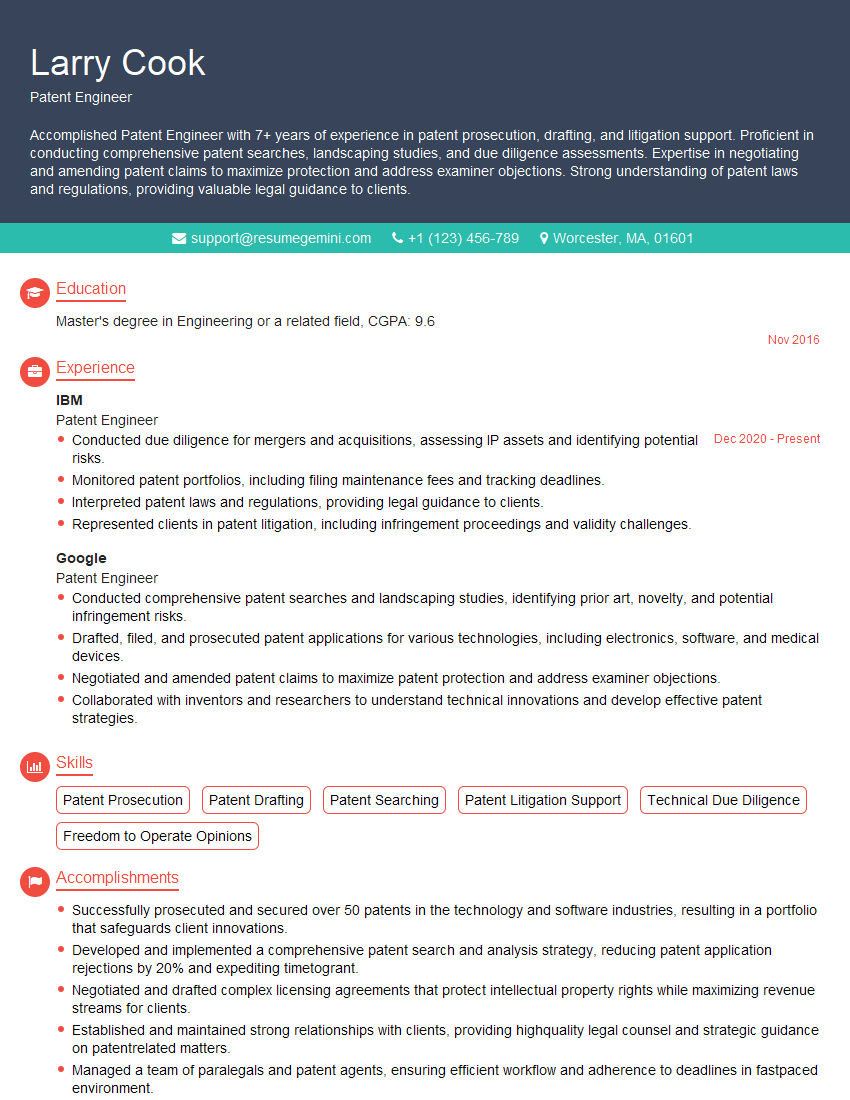
Mastering IP Development is crucial for a rewarding and successful career in a rapidly evolving technological landscape. A strong understanding of IP principles opens doors to diverse roles and higher earning potential. To maximize your job prospects, creating an ATS-friendly resume is essential. ResumeGemini is a trusted resource to help you build a professional and impactful resume that highlights your skills and experience effectively. Examples of resumes tailored to IP Development are available to help you create a compelling application.
Explore more articles
Users Rating of Our Blogs
Share Your Experience
We value your feedback! Please rate our content and share your thoughts (optional).
What Readers Say About Our Blog
Very informative content, great job.
good