Every successful interview starts with knowing what to expect. In this blog, we’ll take you through the top IT Service Management Frameworks (ITIL, COBIT, ISO 20000, etc.) interview questions, breaking them down with expert tips to help you deliver impactful answers. Step into your next interview fully prepared and ready to succeed.
Questions Asked in IT Service Management Frameworks (ITIL, COBIT, ISO 20000, etc.) Interview
Q 1. Explain the key principles of ITIL 4.
ITIL 4’s key principles guide the design and operation of effective service management. They provide a framework for focusing on value, rather than just following processes. Think of them as the foundational pillars supporting the entire ITIL structure.
- Focus on Value: Everything should ultimately contribute to delivering value to the business. This means aligning IT services with business goals and prioritizing activities that maximize positive outcomes.
- Progress Iteratively with Feedback: Continuous improvement is crucial. ITIL 4 promotes iterative development and feedback loops to ensure services are constantly refined and optimized. This means regularly assessing performance and making adjustments as needed.
- Collaborate and Promote Visibility: Effective communication and collaboration across teams and departments are essential. Transparent processes and readily available information help everyone stay aligned and work together effectively.
- Think Holistically: ITIL 4 emphasizes the interconnectedness of all service management activities. It encourages a holistic view, recognizing that changes in one area can affect others.
- Keep It Simple and Practical: Avoid unnecessary complexity. ITIL 4 promotes practical, adaptable approaches that are tailored to specific organizational contexts. This avoids creating a cumbersome system that hinders efficiency.
- Optimize and Automate: Leverage automation and technology to streamline processes and enhance efficiency. This can free up human resources for more strategic tasks.
- Observe and Evaluate Continuously: Monitor service performance, gather feedback, and use data-driven insights to improve service management practices. This emphasizes a culture of continuous learning and optimization.
For example, imagine a company launching a new e-commerce platform. Applying the ‘Focus on Value’ principle would mean defining clear business objectives (increased sales, improved customer satisfaction) and aligning IT services (website performance, order processing) directly with those objectives.
Q 2. Describe the four dimensions of service management in ITIL 4.
ITIL 4’s four dimensions of service management provide a holistic view of service delivery, going beyond the traditional technical aspects. They’re interconnected and influence each other significantly. Think of them as four lenses through which to view and manage your service management capabilities.
- Organizations and People: This dimension focuses on the people, culture, and organizational structures that support service management. It considers skills, roles, responsibilities, and the organizational culture itself.
- Information and Technology: This dimension encompasses the technology, data, and information used to deliver services. This includes infrastructure, applications, databases and the information flowing through them.
- Partners and Suppliers: This dimension looks at the external relationships and partnerships that contribute to service delivery. It recognizes the role of third-party providers and the need for effective collaboration.
- Value Streams and Processes: This dimension details the processes and value streams that deliver services to customers. It shows how different activities fit together to create value.
For instance, a successful service desk requires strong organizational and people aspects (skilled agents, empowered leadership), robust information and technology (ticket system, knowledge base), collaboration with vendors (software support), and efficient processes (incident handling, request fulfillment).
Q 3. What are the key differences between ITIL v3 and ITIL 4?
ITIL v3 and ITIL 4 represent a significant shift in approach. While v3 focused primarily on processes and a lifecycle approach, ITIL 4 emphasizes a more holistic and adaptable framework.
- Structure: ITIL v3 used a five-stage lifecycle (Service Strategy, Service Design, Service Transition, Service Operation, and Continual Service Improvement). ITIL 4 organizes around practices, guiding principles, and the four dimensions.
- Focus: ITIL v3 was very process-centric. ITIL 4 prioritizes value streams and outcomes, using practices as needed rather than adhering to a strict, prescribed order.
- Flexibility: ITIL 4 is far more flexible and adaptable to various organizations and contexts. V3 was often perceived as rigid and difficult to implement in its entirety.
- Integration: ITIL 4 emphasizes integration with other frameworks and methodologies, reflecting the modern, interconnected nature of IT. V3 focused primarily on ITIL-specific practices.
Think of it like this: v3 was a detailed instruction manual for building a specific type of house. ITIL 4 is a set of design principles and adaptable building blocks that allow you to build many different types of homes, using the best techniques for your specific needs and context.
Q 4. How does COBIT relate to ITIL?
COBIT (Control Objectives for Information and Related Technologies) and ITIL complement each other. COBIT provides a governance and management framework, while ITIL focuses on service delivery. They work together to ensure effective and efficient IT management.
COBIT provides the ‘what’ and ‘why’ – the overall goals and objectives for IT, setting the strategic direction and ensuring alignment with business needs. It focuses on enterprise governance and management of IT, including risk management, compliance, and resource optimization. ITIL, on the other hand, provides the ‘how’ – the processes and practices for delivering and managing IT services. It gives specific guidance on how to achieve the objectives set by COBIT.
For example, COBIT might define an objective to reduce IT infrastructure costs by 15%. ITIL would then provide the practices and processes for achieving this, such as optimizing infrastructure utilization, automating deployments, and streamlining maintenance processes.
Q 5. What are the key processes within the ITIL service lifecycle?
While ITIL 4 moves away from a strict lifecycle, the core processes from the ITIL v3 lifecycle remain relevant and are incorporated into ITIL 4 practices. These are fundamental processes for effective IT service management. Key processes within the ITIL service lifecycle include:
- Service Strategy: Defining the strategic direction for IT services, aligning them with business goals, and developing a service portfolio.
- Service Design: Designing the services, processes, and infrastructure required to deliver the services defined in the service strategy. This includes defining service levels, designing security measures, and developing detailed service designs.
- Service Transition: Planning and managing the implementation of new or changed services. This includes testing, deployment, and change management.
- Service Operation: Running and managing the day-to-day operation of services. This includes incident management, problem management, request fulfillment, and access management.
- Continual Service Improvement (CSI): Continuously evaluating and improving service management processes. This involves gathering data, analyzing performance, identifying areas for improvement, and implementing changes.
These processes are interconnected and form a continuous loop. For instance, feedback from service operation (e.g., recurring incidents) might lead to changes in service design or even adjustments to the service strategy.
Q 6. Describe the roles and responsibilities of an incident manager.
The Incident Manager is a crucial role in IT service management, responsible for the timely restoration of service and minimizing disruption. They lead the incident management process, ensuring incidents are handled efficiently and effectively.
Key Responsibilities:
- Incident Logging and Categorization: Receiving, logging, and classifying incoming incidents to ensure they are properly prioritized and routed.
- Incident Prioritization and Escalation: Determining the urgency and impact of incidents and escalating critical issues to the appropriate teams.
- Incident Resolution: Overseeing the resolution of incidents, coordinating with technical teams and ensuring timely restoration of service.
- Communication and Reporting: Keeping stakeholders informed about incident progress, providing regular updates, and reporting on key metrics.
- Incident Management Process Improvement: Identifying areas for improvement in incident management processes and implementing changes to enhance efficiency and effectiveness.
Think of the Incident Manager as the air traffic controller for IT issues, guiding incidents to resolution quickly and safely, minimizing disruption to operations.
Q 7. Explain the difference between a problem and an incident.
While both incidents and problems relate to service disruptions, they differ significantly in their nature and resolution. Understanding the distinction is crucial for effective IT service management.
- Incident: An unplanned interruption to an IT service or reduction in the quality of an IT service. Incidents are typically resolved by restoring the service to its normal operational state. An example is a server outage affecting a specific application.
- Problem: The underlying cause of one or more incidents. Problems are investigated to determine their root cause and prevent recurrence. For instance, the root cause of the server outage (incident) might be a hardware failure (problem).
The key difference is that an incident is a symptom, while a problem is the underlying disease. Resolving an incident merely addresses the symptom, while resolving a problem prevents the symptom from recurring. A good analogy is a headache (incident) and the underlying flu (problem). Treating the headache provides temporary relief, but addressing the flu solves the underlying issue and prevents future headaches.
Q 8. How do you prioritize incidents and problems?
Incident and problem prioritization is crucial for efficient IT service management. We use a prioritization matrix, often based on impact and urgency. Impact assesses the severity of the issue on business operations, while urgency reflects the time sensitivity of resolution.
For example, a system outage affecting a critical business application (high impact, high urgency) would be prioritized over a minor reporting issue affecting a small team (low impact, low urgency). We typically employ a system like this:
- Critical: Immediate impact on business operations requiring immediate resolution.
- High: Significant impact requiring rapid resolution.
- Medium: Noticeable impact, resolution within a defined timeframe.
- Low: Minor impact, resolution can be scheduled.
Tools like ticketing systems often incorporate automated prioritization based on pre-defined rules, but human oversight is vital, especially for nuanced situations. Consider a situation where a seemingly low-impact issue might be a symptom of a larger, looming problem. Experienced technicians can identify these precursors and escalate appropriately.
Q 9. What is the purpose of a change management process?
The purpose of a change management process is to ensure that changes to IT infrastructure, software, or services are implemented smoothly, efficiently, and with minimal disruption to business operations. It provides a structured approach to managing risk and maintaining stability.
A robust change management process involves assessing the risk of a proposed change, planning its implementation, testing thoroughly, and documenting the entire process. This prevents unintended consequences, improves communication, and promotes accountability. Without a well-defined process, organizations risk introducing instability, security vulnerabilities, and service outages. Think of it like renovating a house – you wouldn’t start tearing down walls without a plan and careful consideration of the consequences.
Q 10. Describe the different types of changes and their management.
Changes are typically categorized into:
- Standard Changes: Low-risk, pre-approved changes with documented procedures. Examples: password resets, adding users to a group.
- Normal Changes: Moderate-risk changes requiring assessment and approval. Examples: installing a minor software update, configuring a network device.
- Emergency Changes: High-risk changes implemented urgently to resolve critical incidents. Examples: restoring a system from backup after a failure, fixing a security vulnerability.
Each type has a different management approach. Standard changes are often automated or streamlined, requiring minimal approvals. Normal changes involve a change advisory board (CAB) review and authorization, often incorporating risk assessment forms and documented rollback plans. Emergency changes necessitate immediate action with a focus on resolution and post-implementation review to prevent recurrence.
Q 11. What is a Request Fulfillment process and how does it work?
Request fulfillment is a process that addresses user requests for services or information. It’s about efficiently delivering those services and ensuring customer satisfaction. It differs from incident management, which focuses on resolving disruptions. Think of it as proactively providing services versus reactively resolving problems.
The process generally involves:
- Request Logging: Users submit requests through a service desk portal or other channel.
- Request Categorization and Prioritization: The service desk categorizes and prioritizes requests based on pre-defined rules.
- Fulfillment: The request is fulfilled through automated processes or manual actions.
- Closure: The request is closed after successful fulfillment, and the user is notified.
Example: A user requests a new laptop. The request is logged, validated, and then the IT team processes the request, orders the laptop, configures it, and delivers it to the user. The entire process is tracked, and the user receives updates at each stage.
Q 12. What metrics would you use to measure the effectiveness of the service desk?
Measuring service desk effectiveness requires a balanced set of Key Performance Indicators (KPIs). Some key metrics include:
- First Call Resolution (FCR): Percentage of incidents resolved on the first contact.
- Average Handling Time (AHT): Average time taken to resolve an incident or fulfill a request.
- Customer Satisfaction (CSAT): Measured through surveys or feedback mechanisms.
- Mean Time To Restore (MTTR): Average time taken to restore service after an outage.
- Ticket Resolution Time: The time it takes to resolve a ticket from its creation to its closure.
These metrics provide insights into efficiency, effectiveness, and customer satisfaction. Trends in these metrics over time can help identify areas for improvement. For example, consistently low FCR might indicate a need for better training or knowledge base updates.
Q 13. Explain the concept of service level agreements (SLAs).
Service Level Agreements (SLAs) are formal agreements between a service provider and its customer defining the level of service expected. They specify measurable targets for various aspects of service delivery, such as availability, response times, resolution times, and performance.
SLAs are crucial for managing expectations, measuring performance, and ensuring accountability. They typically include specific metrics, targets, and consequences for not meeting those targets. For example, an SLA might specify that the service provider must resolve 95% of incidents within four hours. Failure to meet this target might trigger penalties or service credits for the customer.
Well-defined SLAs foster transparency and trust between the service provider and customer. They also help the service provider prioritize and allocate resources effectively.
Q 14. How do you ensure compliance with ISO 20000?
Ensuring compliance with ISO 20000, the standard for IT service management systems, requires a structured and systematic approach. This involves implementing a robust IT service management system that conforms to the standard’s requirements.
Key steps include:
- Gap Analysis: Identifying the differences between the existing IT service management processes and the requirements of ISO 20000.
- Implementation: Implementing processes and controls to address the identified gaps.
- Documentation: Developing and maintaining comprehensive documentation of processes, procedures, and records.
- Internal Audits: Conducting regular internal audits to verify compliance with the implemented system.
- Management Review: Regularly reviewing the effectiveness of the IT service management system.
- Certification: Seeking certification from an accredited certification body to demonstrate compliance with ISO 20000.
Maintaining compliance is an ongoing process requiring continuous monitoring, improvement, and adaptation to changes in the business environment and technology.
Q 15. What are the key components of a successful service catalog?
A successful service catalog is the single source of truth for all IT services offered to an organization. It acts as a shop window, allowing users to easily browse, request, and understand the services available. Think of it like a restaurant menu – it clearly outlines the offerings, their descriptions, and associated costs (or in IT’s case, SLAs).
- Service Descriptions: Clear, concise descriptions of each service, including its purpose, functionality, and intended audience. Avoid technical jargon whenever possible.
- Request Processes: Detailed instructions on how to request each service, including forms, contact information, and expected turnaround times.
- Service Level Agreements (SLAs): Explicitly stated agreements outlining service availability, response times, and resolution targets. This builds trust and sets expectations.
- Pricing (if applicable): Cost information for each service, allowing for budget planning and chargeback mechanisms.
- Related Information: Links to FAQs, knowledge base articles, and support contacts for each service. This empowers users to self-serve and reduces support tickets.
- Categorization and Search Functionality: Effective categorization and a robust search engine allow for easy navigation and discovery of services.
For example, a service catalog might include entries for ‘Laptop Provisioning,’ ‘Software Installation,’ and ‘Help Desk Support,’ each with detailed descriptions and associated SLAs. A well-designed catalog reduces user frustration and improves overall IT efficiency.
Career Expert Tips:
- Ace those interviews! Prepare effectively by reviewing the Top 50 Most Common Interview Questions on ResumeGemini.
- Navigate your job search with confidence! Explore a wide range of Career Tips on ResumeGemini. Learn about common challenges and recommendations to overcome them.
- Craft the perfect resume! Master the Art of Resume Writing with ResumeGemini’s guide. Showcase your unique qualifications and achievements effectively.
- Don’t miss out on holiday savings! Build your dream resume with ResumeGemini’s ATS optimized templates.
Q 16. How do you manage capacity planning within an organization?
Capacity planning is the process of determining the computing resources – servers, storage, network bandwidth – needed to meet current and future business demands. It’s about proactively preventing bottlenecks and ensuring optimal performance. Imagine planning for a concert; you need to know how many attendees to expect and ensure sufficient seating, parking, and security personnel.
Effective capacity planning involves:
- Forecasting Demand: Analyzing historical data and future business projections to predict resource needs. This might involve trend analysis, statistical modeling, or collaborating with business units.
- Monitoring Current Usage: Continuously monitoring resource utilization to identify trends and potential issues. This often involves using monitoring tools and dashboards.
- Resource Optimization: Identifying opportunities to improve resource efficiency, such as consolidating servers or optimizing software.
- Scenario Planning: Developing plans for various scenarios, such as unexpected spikes in demand or hardware failures.
- Regular Reviews: Conducting regular capacity reviews to ensure the plans are still aligned with business needs.
Tools like performance monitoring software and capacity planning tools play a crucial role. For example, if we see consistent high CPU utilization on a particular server, it signals the need for either upgrade or scaling.
Q 17. Explain the concept of continuous improvement in ITSM.
Continuous improvement in ITSM is a fundamental principle emphasizing ongoing refinement of processes, services, and technologies to enhance efficiency, effectiveness, and user satisfaction. It’s an iterative cycle of identifying areas for improvement, implementing changes, and measuring the results. Think of it like a gardener tending to their plants – constantly nurturing and improving them for better growth.
The Plan-Do-Check-Act (PDCA) cycle is a commonly used framework:
- Plan: Identify areas for improvement, define goals, and develop a plan for change.
- Do: Implement the planned changes.
- Check: Monitor the results, measure the impact, and gather feedback.
- Act: Based on the results, either standardize the changes or adjust the plan and repeat the cycle.
Examples of continuous improvement initiatives include automating manual tasks, improving incident response times, or optimizing service request fulfillment processes. Regular reviews of Key Performance Indicators (KPIs) and user feedback are crucial in guiding these efforts. For example, if customer satisfaction surveys show dissatisfaction with a particular service, it signals an area needing improvement.
Q 18. Describe your experience with ITSM tools and technologies.
Throughout my career, I’ve worked extensively with various ITSM tools and technologies, ranging from ServiceNow and Jira Service Management for ticketing and incident management to BMC Remedy for comprehensive ITSM solutions. I’ve also used monitoring tools like Nagios and Zabbix for infrastructure monitoring and capacity planning. My experience extends beyond just using these tools; I’ve been involved in implementing, customizing, and integrating them into complex IT environments.
For instance, in a previous role, I was instrumental in migrating our incident management system from a legacy system to ServiceNow. This involved data migration, user training, process re-engineering, and ongoing support and maintenance. I’m proficient in configuring workflows, dashboards, and reports to gain valuable insights and drive process improvements. My skills also extend to integrating ITSM tools with other enterprise systems, enabling seamless data flow and automation.
Q 19. How do you handle challenging situations in a fast-paced environment?
In fast-paced environments, calm and systematic problem-solving is crucial. My approach involves a combination of prioritization, clear communication, and collaborative teamwork. I begin by assessing the situation, identifying the critical issues, and prioritizing them based on impact and urgency. Think of it as a firefighter – attending to the most critical fires first.
Clear communication is paramount. I ensure all stakeholders are informed of the situation and the planned actions. Collaboration is key; I work closely with my team and other relevant departments to leverage diverse expertise and resources. When facing time constraints, I’m adept at delegating tasks effectively and monitoring progress closely. Documentation is important for transparency and to enable smooth handover if necessary.
One instance involved a major system outage during peak business hours. I swiftly assembled a crisis management team, prioritizing the most critical services and coordinating efforts across different technical teams. Open communication and a structured approach minimized downtime and ensured rapid resolution.
Q 20. What is your experience with risk management in relation to IT services?
Risk management in IT services is the process of identifying, assessing, and mitigating potential threats to the availability, confidentiality, and integrity of IT services. It’s about proactively preventing disruptions and protecting sensitive data. It’s like having an insurance policy for your business – mitigating the potential for significant losses.
My experience includes conducting risk assessments using frameworks like NIST Cybersecurity Framework, identifying vulnerabilities through penetration testing, and developing mitigation strategies. I’ve also been involved in developing Business Continuity Plans (BCPs) and Disaster Recovery Plans (DRPs) to ensure business operations can continue even during major disruptions. I’m familiar with various risk management methodologies, including qualitative and quantitative risk analysis.
For example, I’ve worked on projects where we identified the risk of a ransomware attack. This involved assessing the likelihood and impact, implementing security controls like multi-factor authentication and regular backups, and developing an incident response plan to address such an event.
Q 21. Explain the concept of knowledge management in ITSM.
Knowledge management in ITSM is the systematic process of creating, capturing, sharing, and using organizational knowledge to improve service delivery and efficiency. It’s about leveraging collective intelligence and preventing the same mistakes from being repeated. Think of it as creating a shared brain for your IT organization.
Effective knowledge management involves:
- Knowledge Capture: Collecting knowledge from various sources, such as incident reports, troubleshooting guides, and expert interviews.
- Knowledge Organization: Structuring and categorizing knowledge for easy access and retrieval. This often involves using a knowledge base or wiki.
- Knowledge Sharing: Making knowledge readily available to all relevant personnel through various channels, such as internal portals, training sessions, and knowledge articles.
- Knowledge Application: Promoting the use of knowledge to resolve incidents, improve processes, and prevent future problems.
In practice, this involves creating a comprehensive knowledge base, conducting regular knowledge audits to identify gaps, and incentivizing knowledge sharing among team members. For instance, we can implement a system where resolving a recurring issue leads to the creation of a knowledge base article, preventing others from facing the same problem.
Q 22. Describe your approach to problem-solving in an ITSM context.
My approach to problem-solving in an ITSM context is systematic and follows a structured methodology, often mirroring the Incident and Problem Management processes within ITIL. I begin by clearly defining the problem, gathering all relevant information from various sources, and analyzing the situation to understand its root cause. This involves using diagnostic tools, reviewing logs, and interviewing stakeholders. Once the root cause is identified, I develop and implement a solution, testing it thoroughly to ensure its effectiveness and minimize unintended consequences. Finally, I document the entire process, including the problem, solution, and lessons learned, to prevent similar issues in the future. For example, if facing a recurring network outage, I wouldn’t just restore service; I’d investigate the underlying cause – perhaps faulty hardware or a configuration issue – implement a fix, and document the process to update our knowledge base and prevent future outages.
Q 23. How do you communicate effectively with technical and non-technical stakeholders?
Effective communication is crucial in ITSM. I tailor my communication style to the audience. With technical stakeholders, I use precise technical language and focus on details, diagrams, and data. For instance, when discussing a database performance issue with a DBA, I’d use SQL queries and performance metrics to illustrate my points. With non-technical stakeholders, I employ simpler language, focusing on the impact on business operations and avoiding jargon. I use analogies and visualizations to illustrate complex technical issues. For example, explaining a network bottleneck to a CEO, I might use the analogy of a highway traffic jam to illustrate the impact on data flow. Regardless of the audience, I prioritize active listening, clarity, and concise messaging. Regular status reports, visual dashboards, and collaborative tools are invaluable for keeping everyone informed.
Q 24. How would you measure the success of an ITSM initiative?
Measuring the success of an ITSM initiative requires a multi-faceted approach using Key Performance Indicators (KPIs). These KPIs should align with business objectives. For example, reduced downtime (measured in Mean Time To Repair – MTTR), increased user satisfaction (measured through surveys), improved service availability (measured as uptime percentage), and reduced operational costs are all valuable metrics. Furthermore, we should track the efficiency of processes, such as the number of incidents resolved within Service Level Agreements (SLAs). The choice of KPIs depends on the specific initiative. For instance, implementing a new incident management system might focus on MTTR improvement, while a service improvement project might track customer satisfaction scores. Regular monitoring and reporting of these KPIs provides valuable insights into the initiative’s effectiveness and allows for necessary adjustments along the way.
Q 25. What are your strengths and weaknesses in the context of ITSM?
My strengths lie in my analytical skills, problem-solving abilities, and my experience in implementing and managing various ITSM frameworks like ITIL. I’m adept at process optimization and automation, improving efficiency and reducing operational costs. I excel at collaborating with diverse teams and stakeholders to achieve common goals. However, my weakness lies in delegating tasks effectively at times; I sometimes find it challenging to relinquish control over projects, preferring to be directly involved in every step. I’m actively working on improving this by focusing on building stronger teams and trusting individuals with the appropriate responsibilities.
Q 26. Describe your experience with implementing and managing ITIL processes.
I have extensive experience in implementing and managing ITIL processes, particularly Incident, Problem, Change, and Service Level Management. In a previous role, I led the implementation of a new ITIL-based service desk using a ServiceNow platform. This involved defining roles and responsibilities, customizing workflows, and establishing KPIs. We achieved significant improvements in incident resolution times and user satisfaction. Another project involved streamlining the change management process, introducing automation to reduce manual intervention and improve the speed and efficiency of deployments. This involved careful risk assessment, thorough testing, and comprehensive documentation, ensuring minimal disruption to business operations. I’m proficient in using ITSM tools and methodologies to improve service delivery and operational efficiency.
Q 27. What are the benefits of using a framework like ITIL, COBIT, or ISO 20000?
Frameworks like ITIL, COBIT, and ISO 20000 provide a structured approach to IT service management, offering significant benefits. ITIL provides a comprehensive set of best practices for aligning IT services with business needs. COBIT offers a framework for governance and management of enterprise IT, ensuring alignment with business goals and risk management. ISO 20000 focuses specifically on establishing and maintaining an IT service management system, ensuring compliance with international standards. Using these frameworks leads to improved service delivery, reduced costs, increased efficiency, better risk management, and enhanced compliance. For instance, implementing ITIL can lead to faster incident resolution times and higher customer satisfaction, while COBIT can help organizations ensure their IT investments are aligned with business strategy.
Q 28. How do you stay current with the latest trends and best practices in ITSM?
Staying current in ITSM requires continuous learning. I actively participate in industry events and conferences, read industry publications and blogs, and engage with online communities. I pursue relevant certifications like ITIL 4 Foundation, maintaining a strong understanding of evolving best practices. I also follow thought leaders in the field and participate in online training courses. Furthermore, I regularly review industry reports and white papers to stay informed about the latest trends, such as DevOps, Agile methodologies, and AI-powered ITSM solutions. Continuous learning ensures my skills and knowledge remain relevant and adaptable to the dynamic nature of the IT industry.
Key Topics to Learn for IT Service Management Frameworks (ITIL, COBIT, ISO 20000, etc.) Interview
- ITIL Foundation: Understand the core concepts of the ITIL framework, including its lifecycle stages (Service Strategy, Service Design, Service Transition, Service Operation, Service Continual Improvement) and key processes.
- COBIT Framework: Grasp the principles of governance and management of enterprise IT, focusing on aligning IT with business goals and managing IT risk.
- ISO 20000: Familiarize yourself with the requirements for establishing, implementing, maintaining, and improving an IT service management system.
- Service Level Management: Learn how to define, agree upon, and monitor service levels to meet business needs. Consider practical application in negotiating SLAs and managing performance against those agreements.
- Incident Management: Master the process of identifying, logging, restoring service, and analyzing incidents to prevent recurrence. Explore different prioritization techniques and escalation paths.
- Problem Management: Understand how to identify underlying causes of incidents and implement permanent solutions to prevent future occurrences. This includes root cause analysis techniques.
- Change Management: Learn the importance of controlled changes to minimize disruption and ensure stability. Practice explaining the change management process and its impact on service availability.
- Capacity Management: Understand how to plan and manage IT resources to meet current and future demand. Discuss strategies for optimizing resource utilization and avoiding bottlenecks.
- Continual Service Improvement (CSI): Explore methods for measuring service performance, identifying areas for improvement, and implementing changes to enhance service quality and efficiency. Discuss relevant metrics and reporting.
- IT Governance & Risk Management: Understand how these frameworks contribute to overall IT strategy and risk mitigation. Be prepared to discuss aligning IT investments with business objectives.
Next Steps
Mastering IT Service Management Frameworks like ITIL, COBIT, and ISO 20000 is crucial for career advancement in IT. These frameworks are fundamental to many IT roles, demonstrating your ability to manage and improve IT services efficiently and effectively. This knowledge will significantly strengthen your candidacy and make you a highly competitive applicant.
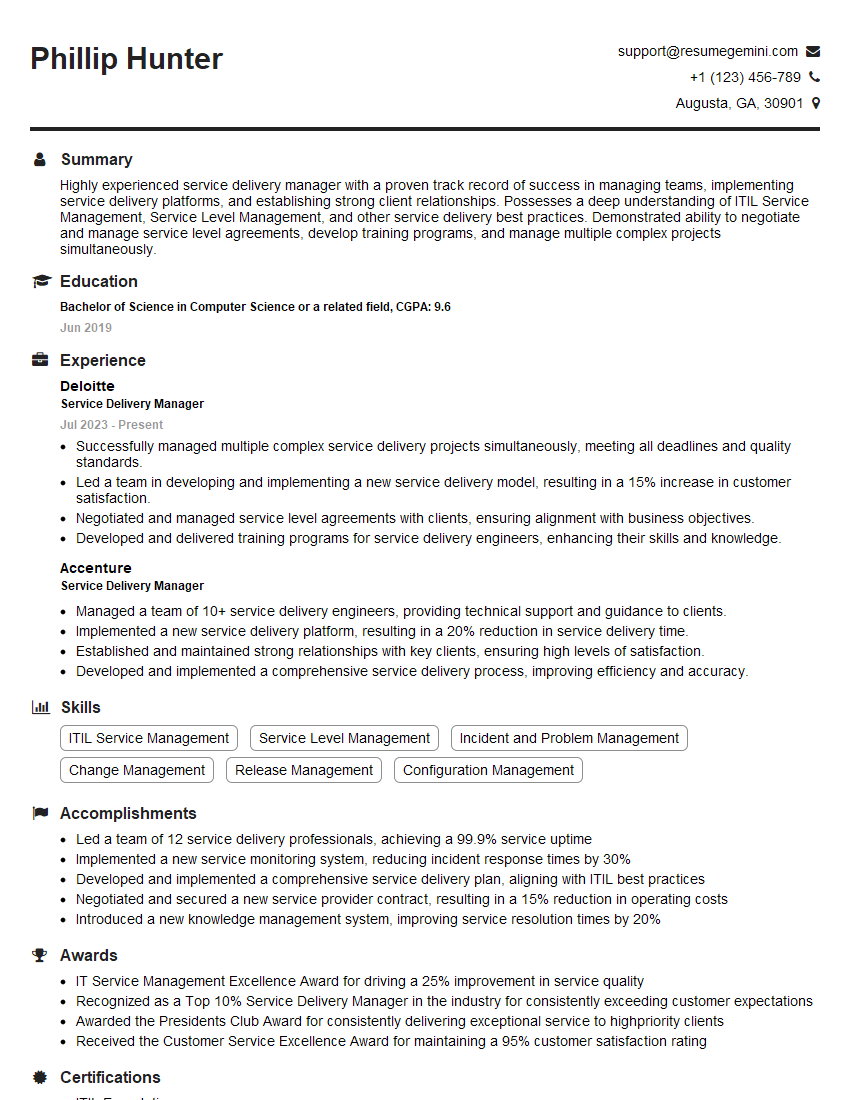
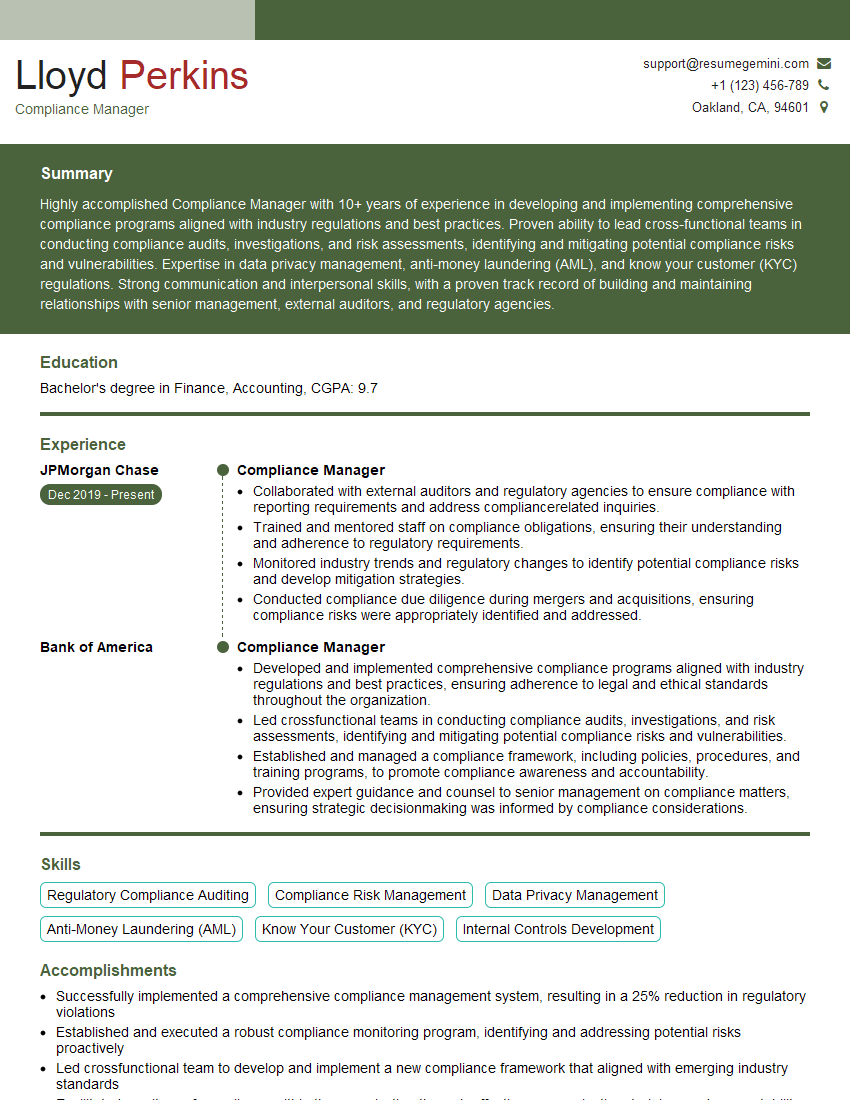
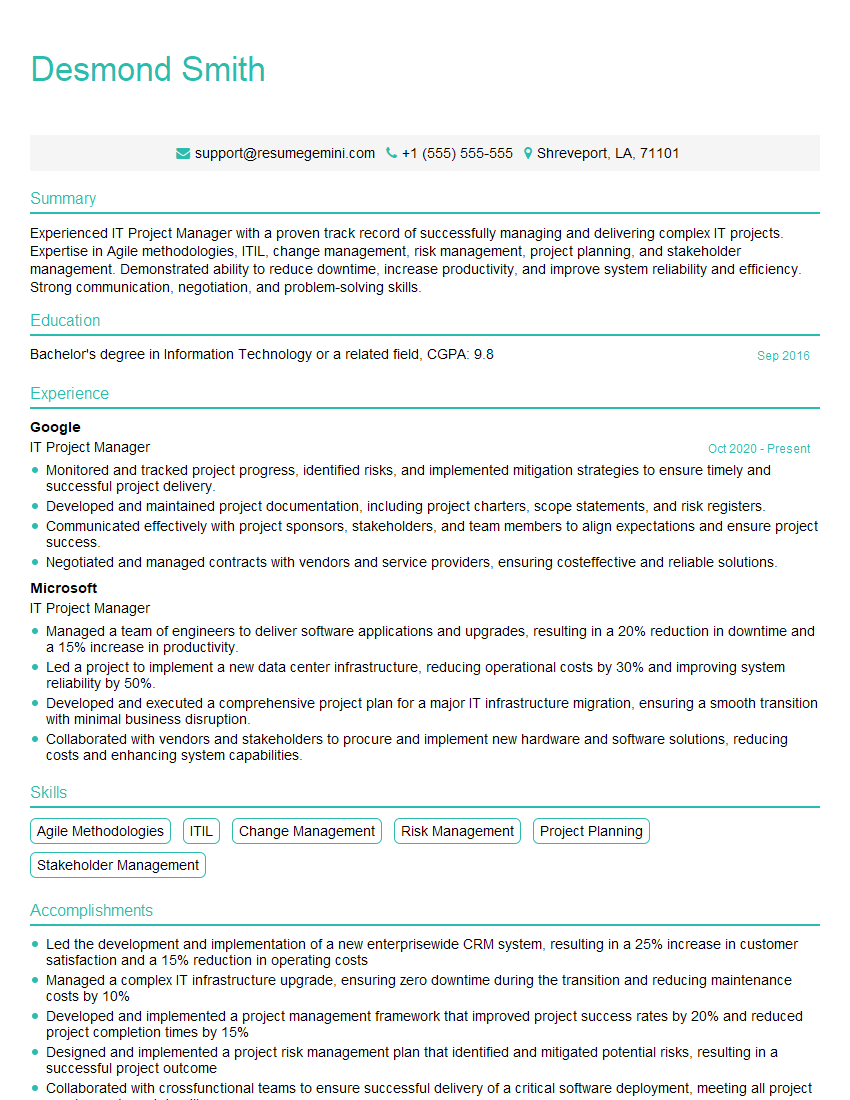
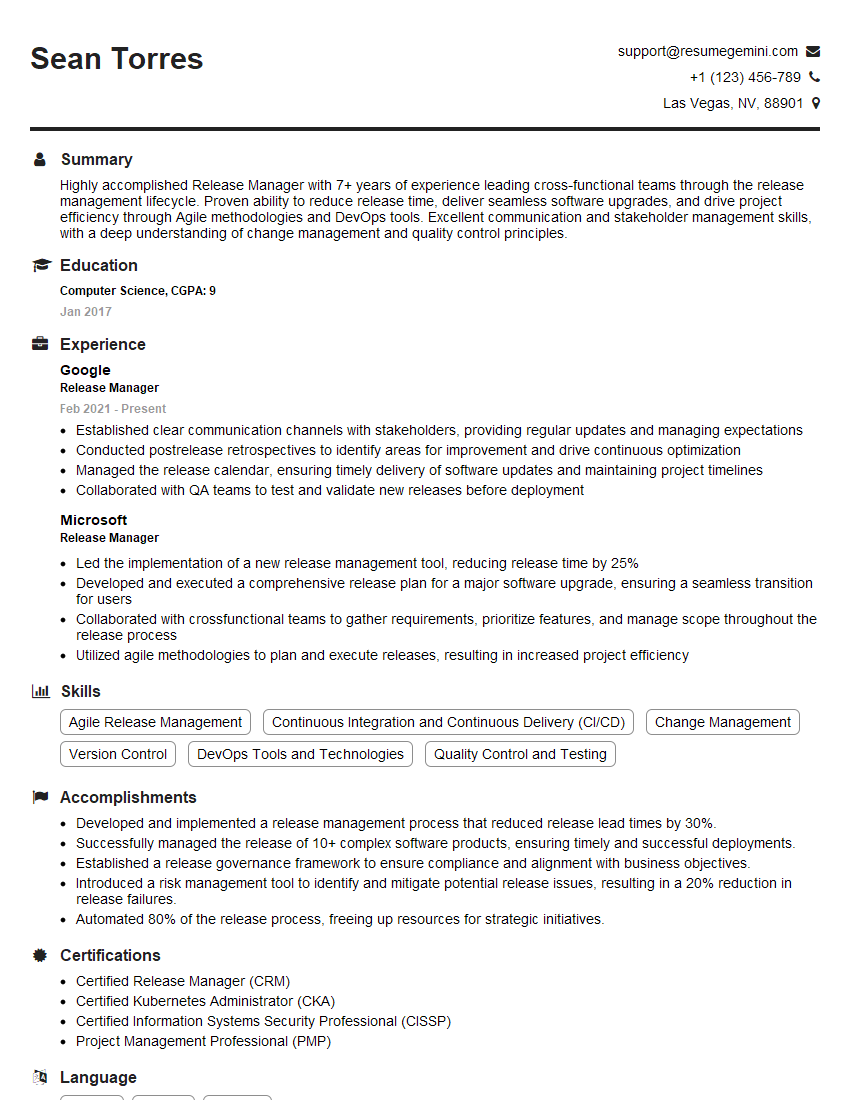
To boost your job prospects, create an ATS-friendly resume that highlights your relevant skills and experience. ResumeGemini is a trusted resource that can help you build a professional and impactful resume tailored to the IT Service Management field. Examples of resumes specifically designed for roles involving ITIL, COBIT, and ISO 20000 are available to guide you.
Explore more articles
Users Rating of Our Blogs
Share Your Experience
We value your feedback! Please rate our content and share your thoughts (optional).
What Readers Say About Our Blog
Very informative content, great job.
good