Every successful interview starts with knowing what to expect. In this blog, we’ll take you through the top Jazz Singing interview questions, breaking them down with expert tips to help you deliver impactful answers. Step into your next interview fully prepared and ready to succeed.
Questions Asked in Jazz Singing Interview
Q 1. Describe your vocal range and preferred vocal style within the Jazz genre.
My vocal range comfortably spans from a low A3 to a high C6, though I often focus on the mid-range for optimal resonance and control in jazz singing. My preferred style leans towards a blend of lyrical balladry and a more vocally textured approach, drawing inspiration from singers like Ella Fitzgerald and Sarah Vaughan. I appreciate the ability to convey both vulnerability and power within a single phrase, allowing for a dramatic arc throughout a performance. While I can execute more powerful, belting techniques, I tend to favor a refined approach that prioritizes tonal beauty and emotional depth.
Q 2. Explain your understanding of improvisation in Jazz singing.
Improvisation in jazz singing is the art of spontaneously creating melodies and phrasing within the framework of a song’s harmony. It’s not just about making up notes randomly; it’s about engaging in a musical conversation with the rhythm section and other instrumentalists, reacting to their ideas and weaving your own musical narrative. This requires a thorough understanding of harmony, rhythm, and melody, as well as a deep listening ability. It involves knowing scales, chord progressions, and how different melodic motifs can interact. Think of it like a painter who starts with a planned canvas but allows their brushstrokes to lead them into unexpected expressive territory. My improvisation is guided by the song’s structure and the emotional story I’m trying to tell, and it’s constantly evolving and developing as I perform.
Q 3. What are some common Jazz vocal techniques, and how do you utilize them?
Jazz vocal techniques are numerous but some crucial ones include:
- Melismatic phrasing: This involves singing many notes on a single syllable, adding ornamentation and expressiveness. I use this extensively to create musical interest and showcase my vocal agility. For instance, on a simple chord change I might not sing one note per syllable but 3-4 depending on the song and my feelings.
- Swing rhythm: Jazz is characterized by a distinctive swung eighth-note feel, which I incorporate through a precise articulation and feel. It’s not about simply speeding up and slowing down; it’s about creating a lilt and groove that feels inherently jazzy.
- Breath control and phrasing: Jazz singing requires significant breath support to sustain long notes and intricate phrasing, crucial to creating a lyrical quality and controlling dynamics. I practice breathing exercises regularly and consciously shape my phrases to create emotional impact.
- Vocal tone and timbre: Cultivating a warm, resonant tone and using varied timbres to express different emotions is essential. I spend time working on my tone, focusing on relaxation and resonance in the vocal tract.
These techniques are intertwined, not used in isolation. It’s about combining them to create a unique and engaging vocal performance. It’s an ongoing process of honing and refinement.
Q 4. Discuss your experience with scat singing and its role in Jazz performance.
Scat singing, the art of improvising vocal melodies using nonsense syllables, is a vital aspect of jazz. It’s a way to express musical ideas without the constraints of lyrics, allowing for pure instrumental-like improvisation. I view it as an extension of my instrumental capabilities as a singer; it’s a chance to explore complex harmonic ideas and rhythmic patterns. Think of it as a vocal solo that interacts dynamically with the instrumental soloists in the ensemble. I often use scat singing as a bridge between sections, a way to build excitement, and sometimes even as a way to build a narrative that mirrors the instrumental parts. I’ve worked with instrumentalists in improvisational settings where the scat singing becomes a dynamic conversation, much like a musical call and response. It’s a spontaneous and thrilling expression of musicality.
Q 5. How do you approach learning and performing a new Jazz standard?
Learning a new jazz standard involves a multi-step process:
- Harmonic analysis: I thoroughly analyze the chord changes, understanding the underlying harmony to grasp the song’s structure and improvisational potential.
- Melodic study: I carefully study the melody, paying attention to phrasing, rhythm, and articulation, trying to grasp its essence.
- Lyric interpretation: I delve deeply into the lyrics, understanding their meaning and emotional context to ensure an authentic interpretation. This informs my phrasing and vocal delivery.
- Improvisation development: Based on my harmonic analysis, I create melodic ideas and phrases that fit within the song’s structure. I experiment with different rhythmic patterns and melodic motifs.
- Performance practice: I practice performing the song repeatedly, refining my phrasing, dynamics, and overall interpretation. I work on integrating my improvisation seamlessly within the song’s framework.
Each step is iterative; I revisit the earlier stages as I gain more understanding of the song and my own interpretation. This iterative process makes sure I’m connected with the song and its overall story.
Q 6. Describe your experience with different Jazz subgenres (e.g., Bebop, Swing, etc.).
My experience encompasses various jazz subgenres. Swing, with its emphasis on rhythmic swing and big-band arrangements, provides a foundation in lyrical phrasing and ensemble dynamics. Bebop, with its fast tempos and complex harmonies, pushes me to refine my improvisational skills and technical agility. I’ve also delved into other styles, and the stylistic differences impact my approach: the intimacy of a ballad demands a different nuance compared to the upbeat energy of a swing tune. This versatility allows me to adapt my singing style and interpretation to suit the unique characteristics of each subgenre, bringing the unique personality of the song to life.
Q 7. How do you maintain your vocal health and technique?
Maintaining vocal health is paramount. My routine includes:
- Vocal warm-ups: I religiously perform vocal exercises before every performance and rehearsal. These include scales, sirens, hums, and lip trills, to prepare my vocal cords for optimal function.
- Hydration: I drink plenty of water throughout the day to keep my vocal cords lubricated. I also avoid excessive caffeine and alcohol.
- Rest: Adequate rest is crucial for vocal recovery, allowing my vocal cords to heal from the strain of singing. I prioritize sleep and avoid overexerting my voice.
- Healthy lifestyle: I maintain a healthy diet and exercise regularly; overall physical wellness contributes to vocal health. I avoid smoking and limit exposure to environmental irritants that can damage the vocal cords.
- Vocal rest: This is especially crucial after strenuous performances; I give my voice a proper rest so it can recuperate properly.
- Professional guidance: Regular check-ups with a vocal coach and an ENT specialist ensure early detection and treatment of potential issues. Consistent feedback and guidance are crucial to maintaining my technique and optimizing my vocal health.
These practices are not optional; they are integral to my ability to maintain my vocal technique and longevity as a performing artist.
Q 8. Explain your understanding of phrasing and rhythmic interpretation in Jazz singing.
Phrasing and rhythmic interpretation are the lifeblood of jazz singing. It’s about shaping musical lines not just according to the written notes, but according to the feeling and intention of the music. Think of it like sculpting with sound. You’re not just hitting the notes, you’re bending, stretching, and shaping them to create a compelling narrative.
Rhythmic interpretation goes beyond simply staying on the beat. It involves understanding swing feel (that characteristic lilt in jazz rhythm), syncopation (placing accents off the beat), and rubato (flexible tempo). A skilled jazz singer can subtly alter the rhythm to emphasize certain words or phrases, creating a dynamic and expressive performance. For example, in a ballad, you might subtly lengthen a note on a particularly poignant word, or shorten notes in a faster section to build excitement. Conversely, a more up-tempo tune might involve strategically employing syncopation to create a sense of playfulness and excitement.
- Swing Feel: Instead of playing each eighth note equally, a swing feel involves a ‘long-short’ approach, emphasizing the first of the two eighth notes. It’s almost like a subtle dance between the beats.
- Syncopation: Accenting the off-beats creates a surprise and rhythmic interest. Think of Ella Fitzgerald’s playful phrasing—she masterfully used syncopation to inject her own personality into the music.
- Rubato: The ability to subtly speed up or slow down the tempo for expressive purposes.
Q 9. How do you interact with instrumentalists during a Jazz performance?
Interaction with instrumentalists is paramount in jazz. It’s a true conversation, a call and response between the vocalist and the band. It’s about listening intently, responding to their solos and improvisations, and creating a unified musical experience. I consider myself a part of the ensemble; it’s not just my solo performance, but rather a collective creation.
This interaction involves several elements:
- Active Listening: Paying close attention to the melodic and harmonic choices of the instrumentalists, understanding their phrasing and dynamics.
- Improvisation: Responding spontaneously to their musical ideas, weaving my own melodic and rhythmic lines within the framework of the song’s harmony.
- Non-Verbal Communication: Eye contact, subtle nods, and facial expressions can help convey the musical energy and build a shared understanding of the performance’s direction.
- Pre-Performance Discussion: Having a chat with the band before the performance about the arrangement, tempos, and individual musical approaches can help foster collaboration and create a smoother flow.
For example, if a saxophone player takes a particularly bluesy solo, I might respond with a vocal line that reflects that bluesy feeling, perhaps incorporating some bluesy phrasing and ornamentation in my melody.
Q 10. Discuss your experience with microphone technique and stage presence.
Microphone technique and stage presence are crucial for projecting both vocal quality and artistic persona. Microphone technique involves using the microphone effectively to optimize sound quality without distortion or feedback. This means finding the sweet spot on the microphone, maintaining a consistent distance, and avoiding harsh pops or sibilants.
Stage presence encompasses a range of aspects:
- Connecting with the Audience: Engaging the audience through eye contact, facial expressions, and body language—communicating the emotion and story of the song.
- Physical Comfort and Confidence: Feeling at ease on stage allows for natural movement and gesture, conveying musical expression without appearing stiff or unnatural.
- Vocal Projection and Control: Using proper breath support and vocal technique to project the voice clearly and evenly across the venue.
- Costume and Style: Choosing appropriate attire that complements the music and the overall aesthetic of the performance.
I remember one performance where the microphone was positioned slightly off, causing a faint feedback. I quickly adjusted my position to eliminate the feedback without disrupting the flow of the song. This required both technical proficiency and quick thinking.
Q 11. Describe your approach to vocal arranging within a Jazz context.
Vocal arranging in jazz is about taking a pre-existing melody or chord progression and transforming it into a unique and personal vocal interpretation. It’s not merely about adding harmonies; it’s about crafting a vocal arrangement that complements the musical style, enhances the emotional impact, and showcases the singer’s own artistic voice.
My approach usually involves:
- Analyzing the Harmonic Structure: Understanding the chord changes is essential for creating appropriate vocal harmonies and countermelodies.
- Developing Melodic Variations: Creating variations of the melody to add interest and texture. This could involve adding embellishments, improvisational passages, or exploring different rhythmic patterns.
- Designing Vocal Harmonies: Crafting harmonies that complement the melody, creating a rich and full sound while maintaining clarity and balance.
- Considering Dynamics and Phrasing: Arranging the vocal parts to create a dynamic and expressive performance, paying close attention to phrasing, articulation, and emotional nuance.
- Instrumental Considerations: Tailoring the vocal arrangement to work well with the instrumental accompaniment, ensuring a cohesive and integrated performance.
For example, I might take a standard jazz tune and add some scatting sections, extended vocal improvisation, or create a more layered arrangement using close harmonies and call-and-response patterns.
Q 12. How do you handle unexpected situations during a live Jazz performance?
Handling unexpected situations during a live performance requires adaptability and quick thinking. It’s about maintaining composure and finding creative solutions to keep the performance flowing smoothly.
My strategies include:
- Problem Solving: If a bandmate makes a mistake, I might adjust my phrasing or improvisation to seamlessly cover the error. If there’s a technical malfunction (like a microphone cutting out), I will maintain stage presence while the issue is addressed.
- Improvisation: Unexpected events often create opportunities for spontaneous improvisation. I might use a brief instrumental break to re-orient myself, or incorporate the unexpected occurrence into a more playful or humorous improvisation.
- Flexibility and Adaptability: Being able to adjust my performance on the fly, altering tempos, dynamics, or phrasing to compensate for the unexpected.
- Maintaining Professionalism: Keeping my composure, even under pressure, projects professionalism and reassures the audience and bandmates that the performance is still under control.
In one performance, a sudden power outage occurred mid-song. Instead of panicking, I continued singing a cappella, seamlessly transitioning into a quieter, more intimate vocal performance until power was restored. The audience appreciated the grace under pressure.
Q 13. What is your experience with recording Jazz vocals in a studio setting?
Recording jazz vocals in a studio setting demands a different approach than live performance. It’s about capturing the nuances of the performance with the highest possible fidelity. This requires attention to detail, both technically and artistically.
My experience involves:
- Microphone Selection and Placement: Choosing the right microphones (e.g., condenser mics for detail, dynamic mics for projection) and placing them strategically to capture the optimal sound.
- Vocal Technique: Using precise vocal control to ensure clear, balanced recordings without harshness or unwanted artifacts. This often means a more controlled approach than live performance, in order to maximize the clarity.
- Monitoring and Feedback: Actively listening to playback through headphones and adjusting performance as needed to meet the director’s specifications.
- Multiple Takes: Recording multiple takes of the same passage to capture the best performance, giving flexibility in post-production.
- Collaboration: Working closely with the producer, engineer, and other musicians to create a cohesive and well-produced recording.
In a recent recording, I worked with the producer to achieve a specific vintage sound, requiring careful microphone selection and subtle adjustments to my vocal technique. The final result was an authentic yet modern sound.
Q 14. How familiar are you with the history and evolution of Jazz vocal styles?
My understanding of jazz vocal styles spans its rich history and evolution. From the early blues influences to the bebop era and beyond, I see a continuous thread of innovation and personal expression. Each era built upon the previous one, pushing the boundaries of vocal technique, improvisation, and musicality.
Key eras and styles that have influenced my work:
- Early Jazz (1920s-30s): The influence of blues and ragtime, characterized by simple melodies and emotional delivery. Think Bessie Smith and Louis Armstrong.
- Swing Era (1930s-40s): Big band sounds, intricate arrangements, and virtuosic scat singing. Ella Fitzgerald and Billie Holiday epitomize this era.
- Bebop (1940s-50s): Fast tempos, complex harmonies, and improvisation-focused performances. Sarah Vaughan and Charlie Parker pushed the boundaries of improvisation.
- Cool Jazz (1950s): Subdued tempos, relaxed phrasing, and introspective sounds. Dave Brubeck and Chet Baker represent this mood.
- Modern Jazz (1960s-present): A wide array of styles, incorporating elements of soul, funk, and world music. Dianne Reeves and Cassandra Wilson demonstrate the diversity of contemporary styles.
Studying these different eras helps me not only to perform songs from these periods authentically but also to incorporate elements of their styles and approaches into my own creative work.
Q 15. Describe your experience working with a band or ensemble in a Jazz setting.
Working with a jazz ensemble is a truly collaborative experience. It’s less about individual performance and more about a conversation between musicians. My experience has primarily involved working with small combos – a rhythm section (piano, bass, drums) and sometimes a horn player or two. The key is active listening. You’re not just singing your notes; you’re responding to the nuances of the rhythm section, anticipating their phrasing, and reacting to their improvisations.
For instance, in a performance of ‘Autumn Leaves,’ the pianist might subtly shift the harmony in the bridge. My response would be to adjust my vocal phrasing, perhaps adding a slight rubato (flexible tempo) to match the emotional shift in the music, or subtly altering my melody to complement the new harmonic direction. The successful interaction creates something far greater than the sum of its parts. It’s a spontaneous creation, a true musical dialogue.
Career Expert Tips:
- Ace those interviews! Prepare effectively by reviewing the Top 50 Most Common Interview Questions on ResumeGemini.
- Navigate your job search with confidence! Explore a wide range of Career Tips on ResumeGemini. Learn about common challenges and recommendations to overcome them.
- Craft the perfect resume! Master the Art of Resume Writing with ResumeGemini’s guide. Showcase your unique qualifications and achievements effectively.
- Don’t miss out on holiday savings! Build your dream resume with ResumeGemini’s ATS optimized templates.
Q 16. How do you adapt your vocal performance to different venues and audiences?
Adapting to different venues and audiences requires sensitivity and flexibility. A small, intimate club demands a more nuanced, intimate vocal delivery – softer dynamics, closer microphone placement, and a greater focus on storytelling. In contrast, a larger concert hall requires projection, careful microphone technique to ensure clarity, and a bolder vocal approach. The audience also plays a huge role. A sophisticated audience might appreciate subtle improvisations and complex harmonic shifts, while a more general audience might prefer more familiar melodies and straightforward phrasing. I assess the atmosphere before the performance, and adjust my volume, phrasing, and song selection accordingly.
For example, a ballad like ‘Misty’ might be performed with a breathy, intimate tone in a small club, but with greater power and projection in a large venue. Similarly, song selection is key – a high-energy bebop tune might be better suited for a lively club, while more introspective ballads are well-suited to a quieter setting. Observing the audience’s response helps inform my choices throughout the set, allowing for a dynamic and engaging performance.
Q 17. Explain your understanding of harmony and chord progressions in Jazz music.
Harmony and chord progressions are the very foundation of jazz. Understanding them allows me to improvise meaningfully and create compelling melodies. Jazz often utilizes 7th chords (major 7th, minor 7th, dominant 7th, half-diminished, etc.) and extended chords (9th, 11th, 13th chords), creating rich harmonic landscapes. A typical jazz standard like ‘So What’ by Miles Davis relies heavily on the interplay of minor 7th and major 7th chords. Understanding the function of each chord within a progression – for instance, a dominant 7th chord creating tension before resolving to a tonic chord – informs my melodic choices and phrasing. I use this knowledge to create vocal lines that fit the harmony, while still allowing for improvisation and personal expression.
For instance, knowing that a dominant 7th chord creates tension, I might use a slightly more syncopated rhythm or a higher note on that chord to emphasize that tension. Conversely, I might use a more legato (smooth and connected) phrase over a tonic chord to create a feeling of resolution. This awareness allows me to create a truly engaging musical narrative.
Q 18. Describe your experience with vocal exercises and training techniques.
Vocal training is a lifelong commitment for a jazz singer. My regimen includes regular exercises focused on breath control (diaphragmatic breathing), vocal agility (scales, arpeggios, chromatic runs), and resonance (finding and developing resonant points in the vocal tract). I work with a vocal coach regularly, focusing on refining technique and expanding my vocal range and power. Additionally, I incorporate warm-up exercises such as humming, lip trills, and tongue trills to prepare my vocal cords for performance. This careful preparation prevents vocal strain and ensures optimal vocal health.
Specific exercises might include practicing scales using different articulations (legato, staccato) to develop control over phrasing. Another example is working on vocal runs using chromatic scales to improve agility. Beyond technical exercises, I also focus on ear training to improve my ability to sing in tune and improvise effectively. Consistency is key – dedicated practice is the foundation of strong vocal technique.
Q 19. How do you develop your own individual vocal style within the Jazz genre?
Developing a unique vocal style in jazz is about finding the intersection of technique and personal expression. It’s about combining learned skills with your inherent vocal qualities and musical sensibilities. I’ve focused on developing my own phrasing, my own approach to rhythm and articulation, and my own unique timbral qualities. I listen to a wide range of jazz singers but try not to directly imitate. Instead, I draw inspiration from their techniques and apply them in a way that is authentic to my own voice.
For instance, I might borrow Ella Fitzgerald’s scat singing techniques, but I strive to incorporate my own rhythmic nuances and melodic inventions. I also focus on developing my own improvisational style – finding my own vocabulary of melodic ideas and rhythmic patterns. This process is ongoing and evolutionary. It’s about continuous experimentation, refinement, and self-discovery. It’s about continuously pushing boundaries and finding new ways to express my musical personality.
Q 20. What are some of your favorite Jazz vocalists and why?
My favorite jazz vocalists are diverse, reflecting the vast spectrum of the genre. Ella Fitzgerald’s unparalleled vocal agility and scat singing ability remains inspirational. Her ability to improvise complex melodies and rhythms with seemingly effortless grace is unparalleled. Billie Holiday’s emotional depth and phrasing—her ability to convey raw emotion through subtle nuances—is deeply moving. Sarah Vaughan’s powerful tone and sophisticated improvisational skills are always captivating. Each artist brings a unique approach to phrasing, harmony, and emotional delivery. They are masters of telling stories through their music, expressing a vast array of emotions through their vocal expression. Their distinct styles and technical mastery continue to inspire me.
Q 21. How do you incorporate dynamics and emotion into your Jazz vocal performances?
Incorporating dynamics and emotion is crucial to a compelling jazz vocal performance. Dynamics refer to variations in volume – from soft pianissimo (pp) to powerful fortissimo (ff). These variations create contrast and emphasis, mirroring the emotional arc of a song. Similarly, phrasing—the way a melody is shaped and articulated—is key to expressing emotion. A long, sustained note can convey vulnerability, while a series of short, staccato notes can express excitement or urgency. The use of rubato (flexible tempo) can add a sense of spontaneity and emotion, making the performance feel more alive and expressive. Furthermore, careful articulation and attention to micro-tonal variations add layers of complexity to the performance.
For example, in a ballad, I might begin softly, gradually increasing volume to the climax, and then tapering off to a quiet ending. This mirrors the emotional journey of the song. I might use breathy tones to create intimacy or a more powerful tone to express joy or sorrow. A truly effective jazz vocal performance goes beyond simply singing the notes; it’s about embodying the song’s emotion and sharing it with the audience.
Q 22. What are your strengths and weaknesses as a Jazz singer?
My greatest strength as a jazz singer lies in my ability to blend technical proficiency with emotional expressiveness. I have a solid foundation in vocal technique, encompassing breath control, vocal agility, and phrasing. I can execute complex melodies and improvisations with accuracy and precision. Equally important, I strive to imbue every note with genuine feeling, connecting with the lyrics and the inherent storytelling in the music. This emotional depth allows me to truly engage with the audience and create a powerful listening experience.
However, like any artist, I have areas for improvement. One weakness I’m actively working on is expanding my repertoire of lesser-known standards and exploring more contemporary jazz compositions. While I’m comfortable with the classics, venturing outside my comfort zone will enhance my versatility and appeal to a broader audience. Another area is developing a stronger stage presence; while I’m confident vocally, I aim to improve my physicality and interaction with the band and audience to enhance the overall performance.
Q 23. How do you handle constructive criticism and feedback on your vocal performance?
Constructive criticism is invaluable to my growth. I approach feedback with an open mind, viewing it as an opportunity for learning and refinement. I actively listen to the feedback, asking clarifying questions to ensure I fully understand the points being raised. I then reflect on the criticism, considering its validity in relation to my overall performance goals. For instance, if a critic suggests my vibrato is too wide in a specific passage, I’ll analyze that section of the performance, paying attention to my breath support and vocal placement to refine my technique. I document the feedback, creating a log of suggestions to track my progress and ensure consistent improvement. I believe in a collaborative approach, engaging in dialogue with mentors, bandmates, and critics to foster a shared understanding and ultimately enhance my artistry.
Q 24. Describe a time you had to overcome a challenge during a Jazz performance.
During a performance at a prestigious club, my microphone suddenly cut out mid-song. Panic wasn’t an option. I immediately assessed the situation; the band was still playing, and the audience was attentive. Rather than stopping, I maintained eye contact with my bandmates, continuing to project my voice as powerfully as possible without amplification. I adjusted my phrasing to make my vocals more easily heard, focusing on clarity and projection. The band subtly adjusted their volume to compensate. The audience was incredibly supportive, and we managed to finish the song with grace and even some humor, turning a potentially disastrous situation into a memorable moment of improvisation and teamwork. This experience reinforced the importance of adaptability, quick thinking, and strong collaboration within a jazz ensemble. It also underlined the vital role of projecting the emotion even without microphone support.
Q 25. What are your career goals as a Jazz singer?
My career goals are multifaceted. In the short term, I aim to secure regular gigs at reputable venues, expanding my network within the jazz community. I’m actively seeking opportunities to collaborate with established musicians and record my own album. Long-term, my aspirations include performing internationally, potentially leading my own jazz ensemble, and establishing myself as a respected and influential figure within the jazz vocal landscape. I also hope to dedicate time to mentoring aspiring jazz singers, sharing the knowledge and experience I’ve gained throughout my career. Ultimately, I want to contribute to the evolution of jazz music while connecting with audiences through the transformative power of song.
Q 26. What is your approach to learning and practicing Jazz vocal improvisation?
My approach to learning and practicing jazz vocal improvisation is multifaceted. It involves a combination of formal study, focused listening, and dedicated practice. I begin by studying the harmonic structure of jazz standards, learning to identify chord changes and progressions. This theoretical understanding forms the foundation for improvisational phrasing. Next, I immerse myself in the work of master jazz vocalists, analyzing their phrasing, rhythmic choices, and melodic ideas. I transcribe solos to understand how they build their improvisations logically and emotionally. My practice sessions are structured; I begin with vocal exercises to warm up and maintain vocal health, followed by focused work on specific scales, arpeggios, and melodic patterns. I then practice improvising over backing tracks, progressively increasing the complexity of the harmonic structure. Regular performance is crucial; the pressure of a live setting helps me refine my improvisational skills in a real-world context.
Q 27. What software or tools are you familiar with for music notation or vocal arrangement?
I’m proficient in using several software tools for music notation and vocal arrangement. Sibelius and Finale are my go-to programs for creating accurate scores and arranging vocal parts. I utilize Audacity for audio editing, which is essential for recording practice sessions and refining my performances. I’m also familiar with Pro Tools for professional-level recording and mixing. Furthermore, I utilize various apps and online resources for backing tracks and sheet music. My proficiency in these tools allows me to independently prepare for performances and create professional-quality recordings.
Q 28. How do you manage your time and prioritize tasks related to your jazz singing career?
Time management is critical for a successful career in jazz. I use a combination of digital and analog tools for organization. I maintain a detailed calendar outlining performances, rehearsals, lessons, and recording sessions. This calendar is integrated with reminders and notifications to ensure I’m always prepared. I prioritize tasks based on deadlines and their importance to my overall career goals. For instance, practicing for an upcoming high-profile gig takes precedence over less urgent tasks. I also allocate specific blocks of time for practicing, networking, and administrative work. This structured approach ensures I maximize my time effectively and avoid burnout. Regular review of my schedule and priorities allows me to adapt to unforeseen events and maintain a healthy work-life balance.
Key Topics to Learn for Your Jazz Singing Interview
- Vocal Technique: Understanding breath support, resonance, and vocal placement specific to the demands of jazz phrasing and improvisation.
- Jazz Harmony and Theory: Demonstrating knowledge of chord progressions, scales (major, minor, blues, altered), and understanding how they inform melodic improvisation.
- Improvisation: Articulating your approach to improvisation, including scales, arpeggios, melodic motifs, and rhythmic variation. Be prepared to discuss your personal improvisational style.
- Styles and Subgenres: Familiarity with various jazz styles (e.g., bebop, swing, Latin jazz) and the stylistic nuances of each.
- Interpretation and Expression: Discussing your approach to interpreting a jazz standard, conveying emotion and musicality through phrasing, dynamics, and articulation.
- Performance Practice: Understanding stage presence, microphone technique, and collaboration with instrumentalists.
- Listening Skills: Ability to actively listen to and analyze jazz music, identifying melodic, harmonic, and rhythmic elements.
- Repertoire: Having a well-rounded repertoire of jazz standards to showcase your abilities and versatility. Be prepared to discuss your choices.
- Musical History and Context: Demonstrating an understanding of the historical development of jazz and its key figures.
Next Steps
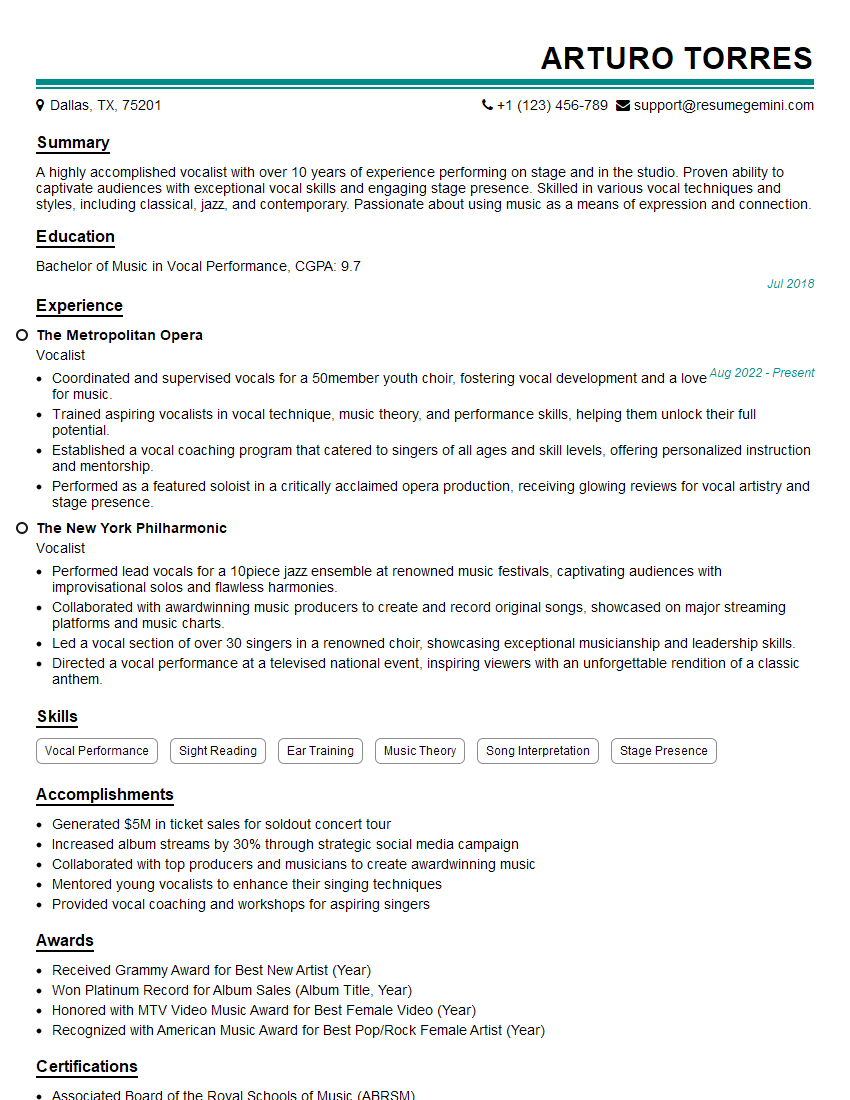
Mastering jazz singing opens doors to a fulfilling career in performance, teaching, or music education. To maximize your job prospects, a strong, ATS-friendly resume is crucial. ResumeGemini can help you craft a compelling resume that highlights your unique skills and experience. We offer examples of resumes tailored specifically for jazz singers to help you get started. Invest the time to build a resume that showcases your talent and professionalism – it’s an investment in your future.
Explore more articles
Users Rating of Our Blogs
Share Your Experience
We value your feedback! Please rate our content and share your thoughts (optional).
What Readers Say About Our Blog
Very informative content, great job.
good