Interviews are opportunities to demonstrate your expertise, and this guide is here to help you shine. Explore the essential Journeyman Wig Maker interview questions that employers frequently ask, paired with strategies for crafting responses that set you apart from the competition.
Questions Asked in Journeyman Wig Maker Interview
Q 1. Describe your experience with various wig construction techniques (e.g., hand-tied, machine-made, wefting).
As a Journeyman Wig Maker, I’m proficient in various construction techniques, each offering unique advantages. Hand-tied wigs, for instance, are known for their incredibly natural look and feel because each hair is individually knotted onto the cap. This meticulous process allows for exceptional breathability and a lightweight feel, ideal for clients with sensitive scalps or who prefer a truly realistic appearance. Think of it like creating a custom tapestry, strand by strand.
Machine-made wigs, on the other hand, offer a more efficient and cost-effective solution. While not as bespoke as hand-tied options, advancements in technology have significantly improved the natural look of machine-made wigs. They’re often a preferred choice for clients seeking durability and affordability.
Wefted wigs utilize wefts—rows of hair sewn together—which are then attached to the cap. This method is a happy medium between hand-tied and machine-made, offering a good balance of cost, durability, and natural appearance. Wefting is particularly well-suited for creating fuller, voluminous styles.
My experience encompasses all three methods, and I select the technique best suited to the client’s needs and budget, always prioritizing a natural and comfortable result.
Q 2. Explain the process of measuring a client’s head for a custom wig.
Precise head measurements are crucial for a perfectly fitting custom wig. I use a soft measuring tape, beginning at the hairline, and measuring the circumference of the head at various points. These points usually include the front hairline, across the forehead, around the crown, and at the nape of the neck. I also measure the ear-to-ear distance, the temple-to-temple distance, and the nape-of-neck-to-forehead length. I always take multiple measurements to ensure accuracy.
Beyond these standard measurements, I take note of any unique features, like prominent bumps or indentations. For example, a client with a receding hairline might require specialized adjustments to ensure a natural-looking hairline placement on their wig. These individual considerations ensure the final wig conforms perfectly and comfortably to the client’s head.
Q 3. How do you select the appropriate wig cap construction for different hair types and needs?
Selecting the appropriate wig cap construction is essential for both comfort and aesthetics. Factors like hair type, desired style, and client needs guide my choice. For clients with fine or thinning hair, a lace-front cap offers a seamless, natural-looking hairline and allows for diverse styling options. The delicate lace blends invisibly with the scalp.
For individuals with thicker or coarser hair, a monofilament cap might be more suitable. The fine mesh provides ventilation and allows the hair to move more naturally. It also creates a more realistic scalp appearance. A full cap construction would be a good choice for clients desiring maximum coverage and durability.
For clients prioritizing breathability and comfort in warmer climates, a cap with open wefts or a lighter material would be a better option. I often discuss these options with the client, explaining the pros and cons of each type to ensure they select the best option for their needs.
Q 4. What are the different types of hair fibers used in wig making, and their respective advantages and disadvantages?
The choice of hair fiber significantly impacts a wig’s appearance, durability, and cost. Human hair, for example, offers unparalleled realism, styling versatility, and longevity. However, it is the most expensive option. Its natural texture and movement are difficult to replicate in synthetic fibers.
Synthetic fibers, conversely, are more affordable and require less maintenance. They come in a vast array of colors and styles, but they are generally less durable than human hair and can look less natural. Heat-resistant synthetics have improved this, but they still don’t match human hair’s versatility.
There are also blends of human and synthetic hair, which often offer a compromise between cost, quality, and styling capabilities. I explain the advantages and disadvantages of each fiber type to my clients, helping them make informed decisions based on their budget, lifestyle, and styling preferences.
Q 5. How do you match hair color and texture to a client’s natural hair?
Matching hair color and texture is paramount. I begin by carefully assessing the client’s natural hair color and texture in different lighting conditions. I use color charts and hair swatches to find the closest match in both the fiber type and color. I take into account variations in lighting, highlighting, lowlighting, and the overall tone of the hair.
For texture, I examine the hair’s wave pattern, curl type, and overall density. I consider factors such as straight, wavy, curly, kinky, and coily hair types. The aim is to find a fiber that replicates the natural movement and bounce of the client’s hair. This involves careful consideration of density, length, and wave pattern.
Often, I will create custom blends or use highlighting techniques to achieve a perfect match. Sometimes, achieving a perfect match is impossible, so I work with the client to create a style that complements their natural features and looks flattering.
Q 6. Describe your experience with wig styling and finishing techniques.
Wig styling and finishing are as important as the construction process itself. I utilize a range of techniques to achieve the desired look, from basic styling using brushes, combs, and styling products to more advanced techniques like cutting, layering, and blending. I might use heat tools like curling irons or straighteners on human hair wigs, always carefully considering the fiber type and the client’s desired style.
Finishing touches are crucial; I ensure the wig is perfectly shaped and that all knots are secure and hidden. I can also create custom partings and adjust the hairline for a more natural look. For example, I might use specialized tools and techniques to create a more realistic hairline in a lace-front wig, ensuring a flawless blend with the client’s scalp.
Q 7. How do you handle client consultations to determine their wig needs and preferences?
Client consultations are the foundation of a successful wig creation. I start by establishing rapport, creating a comfortable environment for open communication. We discuss the client’s needs, preferences, and lifestyle, considering factors like hair loss reasons, daily activities, and budget constraints. I ask about their desired style, length, color, and texture, while also offering suggestions based on my expertise.
I address any concerns or anxieties the client may have regarding their hair loss and the wig itself. This includes explaining the different construction techniques, hair fibers, and styling options. It’s essential to discuss care and maintenance of their new wig so they can enjoy it for as long as possible. My goal is to empower clients, enabling them to feel confident and comfortable with their choice.
Q 8. Explain your process for creating a custom wig from initial consultation to final fitting.
Creating a custom wig is a collaborative journey, beginning with a thorough consultation. We discuss the client’s desired style, hair color, length, and texture. We also assess their head shape and size to ensure a comfortable and natural fit. Next, I take precise measurements of their head using a soft measuring tape. Then, I select the appropriate wig cap construction (e.g., hand-tied, machine-made, lace front) based on their needs and budget. I carefully choose the hair fibers – human hair, synthetic, or a blend – considering factors like durability, sheen, and styling ease. The next step is creating a custom pattern based on the head measurements and wig design. This pattern acts as a template for assembling the wig cap. Once the cap is constructed, I meticulously attach the hair strands, one by one for hand-tied caps, or utilizing a machine for machine-made options. The process is meticulously time-consuming, often involving hours of careful work. The final stages involve styling the wig to match the client’s preferences, applying any desired treatments, and final fitting adjustments for optimal comfort and aesthetic appeal. This often involves a trial fitting to ensure everything is just right. The client then receives instructions on how to care for and style their new wig.
Q 9. What are the common challenges faced in wig making, and how do you overcome them?
Wig making presents several challenges. Matching hair color and texture perfectly can be difficult, especially with human hair which varies in shade and texture from batch to batch. Achieving a natural hairline and creating realistic parting areas can be particularly demanding, requiring a keen eye for detail and years of experience. Working with different hair types requires understanding their unique properties and adjusting techniques accordingly. For example, extremely curly hair can be challenging to sew onto a cap. Also, maintaining consistent tension during the weaving or knotting process is crucial to prevent bald spots or areas of excessive bulkiness. I overcome these challenges through careful planning, precise measurement, and a meticulous approach. I also regularly practice and refine my techniques, and continually source new high-quality materials. For example, if color matching is difficult, I may blend multiple hair shades until a perfect match is achieved. Patience and attention to detail are essential to overcoming these hurdles and consistently producing high-quality wigs.
Q 10. How do you maintain the quality and longevity of a wig?
Maintaining wig quality and longevity involves proper care and storage. Human hair wigs require gentle washing with specialized shampoos and conditioners designed for wigs and hairpieces. Avoid harsh chemicals or hot water which can damage the hair fibers. Synthetic wigs require gentler treatment still. Always follow the manufacturer’s instructions that come with the wig. It’s important to air dry wigs on a wig stand to prevent stretching or damage, avoiding heat styling tools whenever possible. When not in use, wigs should be stored on a wig stand or in a breathable container to prevent tangling and matting. Regular detangling using a wide-tooth comb, starting from the ends and working upwards, is crucial. Avoiding harsh brushing also keeps the wig looking great for longer. With careful attention and appropriate care, a well-made wig can last for several years.
Q 11. Describe your experience with wig repair and maintenance.
Wig repair and maintenance are significant aspects of my work. Common repairs include fixing snags, repairing tears in the cap, replacing damaged hair strands, and re-styling damaged wigs. I carefully assess the damage to determine the best repair method. Minor snags can be easily fixed with a needle and thread. More extensive damage may require replacing sections of hair or even parts of the cap. I have experience with various repair techniques, including re-knotting, re-weaving, and re-bonding, ensuring seamless repairs that blend naturally with the rest of the wig. Regular maintenance includes detangling, cleaning, and conditioning. I always advise clients on the appropriate aftercare methods, including how to prevent future damage. This helps extend the life of their wig and maintain its quality.
Q 12. What software or tools do you use for wig design or pattern creation?
While advanced CAD software isn’t typically used in traditional wig making, I utilize several tools to aid in design and pattern creation. A precise measuring tape is essential for accurate head measurements. I create my patterns using specialized paper patterns and tailor them based on the client’s head shape and wig style. Simple design sketches are often utilized to visualize the desired style. Software like Adobe Illustrator can be used for more intricate design development, though hand-drawn patterns are still the standard in my process. The accuracy of the pattern is paramount to a well-fitting and beautiful wig.
Q 13. How do you ensure hygiene and sanitation practices in your wig-making process?
Maintaining strict hygiene and sanitation practices is paramount in wig making. I use clean work surfaces, regularly disinfected tools, and clean hands throughout the entire process. Each client receives a clean, sterilized wig cap and hair materials are thoroughly cleaned before use. All tools, including combs, needles, and shears, are thoroughly disinfected before and after each use. The work area is kept clean and organized, minimizing the risk of contamination. Proper storage procedures are also followed, preventing dust and debris from settling on wigs and materials. Adherence to these standards ensures the health and safety of both clients and myself. A clean and organized workspace contributes to efficiency and high-quality results.
Q 14. Explain your understanding of different wig cap sizes and shapes.
Wig cap sizes and shapes vary significantly to accommodate diverse head sizes and shapes. Cap sizes are typically measured in inches or centimeters, encompassing circumference, front-to-back length, and ear-to-ear width. Standard sizes range from small to extra-large, but custom measurements are essential for optimal fit. Cap shapes include oval, round, and oblong, reflecting common head shapes. Different cap constructions (e.g., capless, monofilament, lace front) further influence the final fit and appearance. For example, a lace front cap provides a more natural-looking hairline, while a monofilament cap allows for more natural parting versatility. Understanding these variations allows me to select the most appropriate cap for each client, ensuring both comfort and a natural look.
Q 15. How do you deal with challenging hairlines or scalp conditions during wig creation?
Challenging hairlines and scalp conditions require careful consideration and customized approaches. For receding hairlines, I often use a combination of techniques. This might involve strategically placing knots to mimic natural hair growth, using a finer knotting technique for a more natural-looking hairline, or even incorporating a lace closure that’s specifically designed to seamlessly blend with the client’s existing hairline. For clients with sensitive scalps, I use hypoallergenic adhesives and ensure the wig cap is properly ventilated to prevent irritation. I might also recommend a wig cap liner made from breathable materials like silk or cotton.
For example, a client with alopecia might require a full-lace wig with a customized hairline to fully conceal the affected area. I would consult with them to determine their desired hair color, style, and density to create a natural and comfortable fit. Another example involves clients with scarring. Here, careful placement of knots and skillful use of hair fibers allows for a visually pleasing and realistic outcome, minimizing the visibility of scarring.
Career Expert Tips:
- Ace those interviews! Prepare effectively by reviewing the Top 50 Most Common Interview Questions on ResumeGemini.
- Navigate your job search with confidence! Explore a wide range of Career Tips on ResumeGemini. Learn about common challenges and recommendations to overcome them.
- Craft the perfect resume! Master the Art of Resume Writing with ResumeGemini’s guide. Showcase your unique qualifications and achievements effectively.
- Don’t miss out on holiday savings! Build your dream resume with ResumeGemini’s ATS optimized templates.
Q 16. Describe your experience with working with different types of lace fronts.
My experience with lace fronts encompasses various types, including Swiss lace, HD lace, and French lace. Each type offers unique characteristics. Swiss lace, known for its delicate and almost invisible appearance, is ideal for creating a very natural-looking hairline. HD lace, with its finer knotting and transparency, is perfect for clients with darker complexions. French lace, while more durable, provides a slightly less transparent effect. The choice of lace depends on individual client needs, skin tone, and desired level of realism.
I’ve worked extensively with all three types, adapting my techniques to each. For instance, knotting techniques for Swiss lace need to be exceptionally fine to avoid detection, while HD lace allows for slightly more flexibility in knot placement and density. I’ve even customized lace by hand-bleaching it to perfectly match a client’s skin tone for an absolutely seamless look.
Q 17. How do you customize a wig to fit individual client needs and preferences?
Customization is paramount in wig making. I begin by having an in-depth consultation with the client, discussing their lifestyle, hair preferences (length, color, texture, style), and any specific needs. I take precise measurements of their head to ensure a perfect fit. This includes circumference, ear-to-ear distance, and nape-to-forehead measurement. I also analyze their facial features to recommend a style that complements their face shape.
Beyond the initial measurements, customization extends to the wig’s construction. This could involve hand-tying specific areas to achieve a desired volume or texture, custom coloring to match a specific shade, or even adding individual hand-placed hairs to create incredibly realistic highlights and lowlights. For example, a client with a heart-shaped face may benefit from a wig that adds volume to the crown and tapers slightly towards the cheekbones to balance their features.
Q 18. What is your experience with applying and removing wigs?
Applying and removing wigs requires a gentle touch and proper technique. Application starts with preparing the client’s scalp by cleansing it and ensuring it’s dry. Then, I carefully measure and adjust the wig cap to fit snugly but comfortably. I use appropriate adhesive, following the manufacturer’s instructions, and apply it in thin, even layers to avoid irritation. Secure attachment depends on the type of wig and client’s preference – using clips, combs, or adhesive.
Removal involves gently releasing the adhesive or detaching clips and combs. I recommend using a specialized adhesive remover to avoid damaging the client’s hair or scalp. I always emphasize the importance of proper aftercare, both for the wig and the client’s natural hair, to maintain its health and longevity. I’ve trained numerous clients in proper wig maintenance and care routines, ensuring they understand the importance of gentle handling and regular cleaning.
Q 19. What safety precautions do you take when working with chemicals or tools?
Safety is my top priority. When working with chemicals like hair dyes or adhesives, I always work in a well-ventilated area and wear appropriate personal protective equipment (PPE), including gloves, a mask, and eye protection. I follow the manufacturer’s safety data sheets (SDS) for all chemicals meticulously. Tools, such as scissors, needles, and combs, are kept sharp and clean to minimize the risk of accidents.
I also maintain a clean and organized workspace to prevent slips, trips, and falls. All sharp tools are stored securely when not in use. Before starting any task, I ensure I have a clear understanding of the procedure and have all necessary materials readily available. For example, I would never mix chemicals without carefully reading the instructions and taking the appropriate precautions. Regular maintenance checks on equipment are vital too, ensuring safe operation of tools.
Q 20. How do you manage your time and workload when creating multiple wigs simultaneously?
Managing multiple wig projects simultaneously requires meticulous planning and organization. I use a project management system, often a digital calendar or task management tool, to track deadlines and allocate time effectively. I break down larger projects into smaller, manageable tasks, focusing on one stage of the process at a time for each wig. Prioritization is crucial; I tackle urgent tasks first, ensuring timely delivery to clients.
For example, I might dedicate Monday to prepping lace fronts for several wigs, Tuesday to knotting, Wednesday to styling, etc. This approach maintains a consistent workflow and prevents bottlenecks. Regular review of my schedule helps me identify and address any potential delays, ensuring I meet all deadlines without compromising quality. Flexibility is also essential. Unexpected situations, such as a rush order, can require adjusting the schedule to ensure client satisfaction.
Q 21. Describe your experience with working in a team environment.
I thrive in a team environment. Collaboration is essential in the wig-making industry. My past experiences have involved collaborating with other wig makers, stylists, and hairdressers. This collaboration allowed for diverse perspectives and creative problem-solving. I’ve learned to effectively communicate my ideas and listen to the input of others, resulting in high-quality wigs that meet or exceed client expectations.
For example, I’ve been part of teams where one person specializes in lace work, another in styling, and another in customization. This division of labor allows us to manage larger projects efficiently and achieve a superior outcome. Effective teamwork requires strong communication, mutual respect, and shared responsibility. I’ve always found that a supportive team environment fosters creativity and enhances productivity.
Q 22. How do you handle client complaints or concerns effectively?
Handling client complaints requires empathy, active listening, and a problem-solving approach. I begin by acknowledging the client’s feelings and validating their concerns. I then carefully listen to their specific complaint, asking clarifying questions to ensure complete understanding. This avoids assumptions and allows me to address the root issue. For example, if a client is unhappy with the color of their wig, I would ask about their expectations, the lighting conditions they viewed it in, and if any specific photos were used as a reference. Once I understand the problem, I work collaboratively with the client to find a solution. This could involve a re-styling, a color correction, or even a remake, depending on the severity of the issue. I maintain open communication throughout the process, keeping the client informed of my progress and any adjustments needed. Ultimately, my goal is to exceed their expectations and restore their confidence in my work.
Q 23. How do you stay updated with the latest trends and techniques in wig making?
Staying current in wig making requires a multi-faceted approach. I regularly attend industry workshops and conferences, like those hosted by the professional wig-making associations. These events expose me to the latest techniques, materials, and technologies. I also subscribe to relevant trade publications and online forums, which keep me abreast of new trends and innovations. Moreover, I actively engage with other wig makers, both online and offline, through networking events and online communities, sharing knowledge and discussing best practices. This continuous learning process allows me to refine my skills and ensure that my work remains at the forefront of the industry.
Q 24. What are your salary expectations?
My salary expectations are commensurate with my experience and skill level as a Journeyman Wig Maker, reflecting the market rate for professionals with my qualifications. I am open to discussing a specific salary range based on the details of the position and the company’s compensation structure.
Q 25. What are your long-term career goals in wig making?
My long-term career goals involve establishing myself as a leading wig maker, potentially opening my own studio or salon. I also aspire to mentor and train aspiring wig makers, sharing my knowledge and experience to elevate the profession. This could involve teaching workshops, creating online tutorials, or participating in educational programs. Ultimately, I aim to contribute meaningfully to the wig-making community and leave a lasting impact on the industry.
Q 26. Why are you interested in this specific position?
I am particularly interested in this position because of [Company Name]’s reputation for excellence and innovation in the wig-making field. The opportunity to collaborate with a team of talented professionals, while utilizing cutting-edge techniques and technologies, is incredibly appealing. I also appreciate [Company Name]’s commitment to [mention company value, e.g., client satisfaction, ethical sourcing, etc.], which aligns perfectly with my own professional values.
Q 27. What are your strengths and weaknesses as a wig maker?
My strengths as a wig maker include meticulous attention to detail, a keen eye for color and texture, and excellent communication skills. I am adept at handling a variety of wig construction techniques, from hand-tying to machine-wefting, and can adapt my approach to individual client needs. A weakness I am actively working on is time management, particularly when handling multiple complex projects simultaneously. To improve, I am implementing project management techniques to better prioritize tasks and allocate my time efficiently.
Q 28. Describe a time you had to solve a complex problem in wig making.
I once received a commission for a very intricate, historically accurate wig for a theatrical production. The design included a complex braid pattern and required the use of several different types of hair fibers to achieve the desired texture and color variations. The challenge was in seamlessly blending the different hair types to avoid visible seams and maintain the integrity of the braid. I overcame this by meticulously sectioning the hair and utilizing a specialized knotting technique to create a seamless transition between the different fibers. The final result was a stunning and authentic wig that met the exacting demands of the production.
Key Topics to Learn for Journeyman Wig Maker Interview
- Wig Construction Techniques: Understanding various wig-making methods (hand-tied, machine-made, etc.), their applications, and advantages/disadvantages.
- Hair Selection and Preparation: Knowledge of different hair types (human hair, synthetic fibers), their properties, and preparation techniques for optimal use in wig construction.
- Measurement and Fitting: Mastering accurate head measurements, creating custom wig caps, and ensuring proper fit for a comfortable and natural-looking result.
- Wig Styling and Finishing: Proficiency in various styling techniques, including cutting, layering, and shaping wigs to achieve desired styles. Understanding the use of finishing products and maintenance.
- Hairpiece Repair and Maintenance: Knowledge of common wig damage and repair techniques, as well as proper cleaning and storage methods to extend wig lifespan.
- Client Consultation and Communication: Effective communication skills to understand client needs, advise on suitable wig styles and hair types, and manage expectations.
- Health and Safety Regulations: Understanding and adhering to all relevant health and safety regulations concerning the handling of hair and wig-making materials.
- Troubleshooting and Problem-Solving: Ability to identify and resolve common issues encountered during wig construction, styling, or maintenance.
- Industry Trends and Innovations: Staying up-to-date with the latest trends in wig making, new materials, and technologies used in the field.
Next Steps
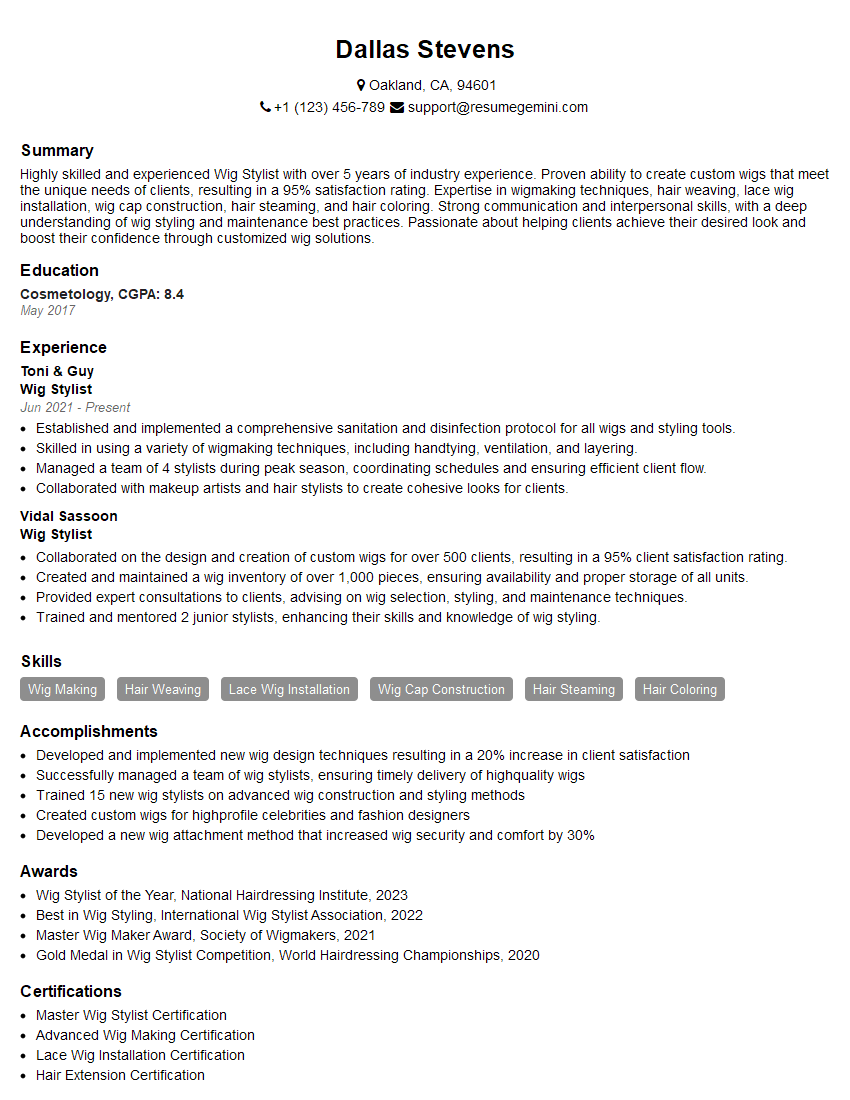
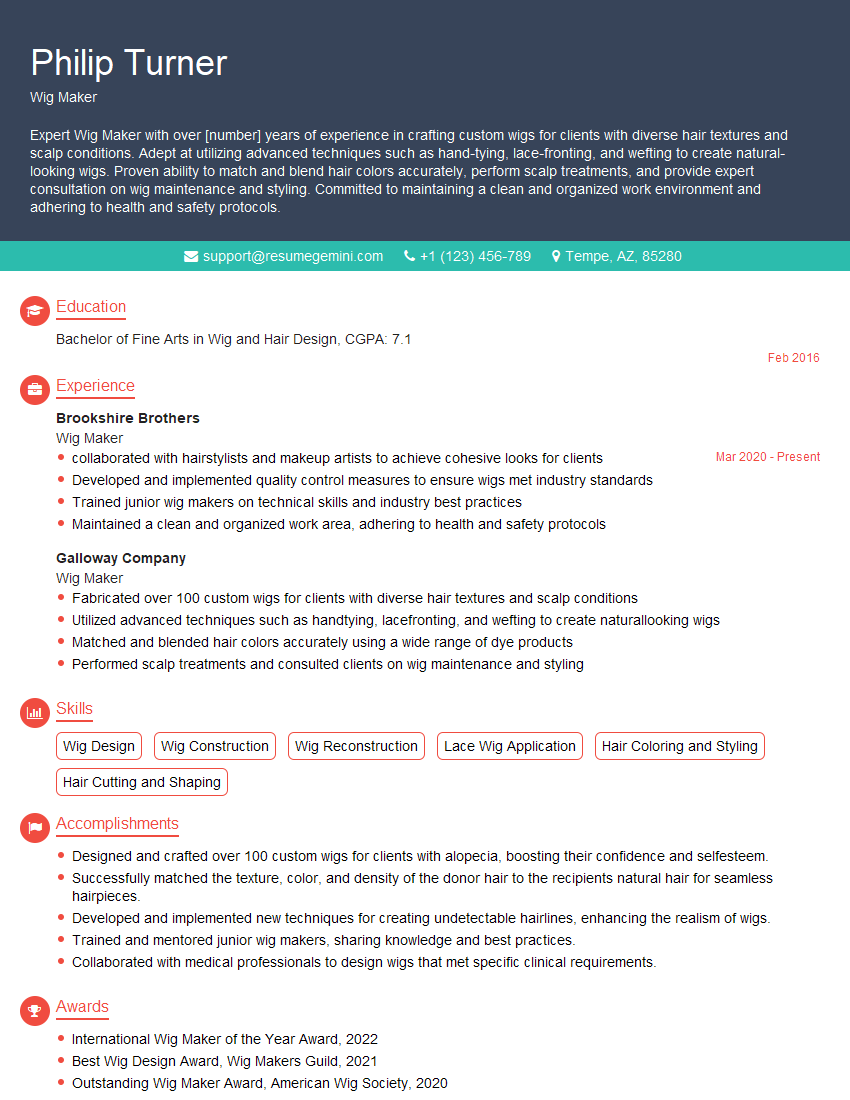
Mastering the skills and knowledge of a Journeyman Wig Maker opens doors to exciting career opportunities and professional growth, allowing you to build a successful and fulfilling career in this creative and demanding field. To enhance your job prospects, creating an ATS-friendly resume is crucial. We highly recommend using ResumeGemini to build a professional and impactful resume that highlights your skills and experience effectively. ResumeGemini offers examples of resumes tailored to the Journeyman Wig Maker position to help you get started. Invest time in crafting a strong resume—it’s your first impression on potential employers.
Explore more articles
Users Rating of Our Blogs
Share Your Experience
We value your feedback! Please rate our content and share your thoughts (optional).
What Readers Say About Our Blog
Very informative content, great job.
good