Are you ready to stand out in your next interview? Understanding and preparing for Knowledge of Coaching Techniques interview questions is a game-changer. In this blog, we’ve compiled key questions and expert advice to help you showcase your skills with confidence and precision. Let’s get started on your journey to acing the interview.
Questions Asked in Knowledge of Coaching Techniques Interview
Q 1. Explain the difference between coaching, mentoring, and consulting.
While coaching, mentoring, and consulting all aim to improve performance, they differ significantly in their approach and focus. Think of them as different levels of support on a ladder.
- Coaching focuses on unlocking a coachee’s potential by helping them identify and overcome obstacles to achieve their own goals. It’s future-oriented, empowering the coachee to find their own solutions. For example, a coach might work with a manager to improve their communication skills by helping them identify their communication style, explore different approaches, and practice new techniques.
- Mentoring involves a more experienced individual guiding a less experienced person through advice, sharing of knowledge and experience, and sponsorship. It’s often more directional, with the mentor providing expertise and insights based on their own journey. A mentor might guide a junior software developer by sharing their experience in project management and navigating career challenges.
- Consulting provides expert advice and solutions to a specific problem or challenge. The consultant typically possesses specialized knowledge and offers solutions directly, rather than empowering the client to find their own answers. A consultant might be hired by a company to design a new marketing strategy, providing specific recommendations and plans.
In short: Coaching = unlocking potential; Mentoring = guidance and sponsorship; Consulting = expert advice and solutions.
Q 2. Describe your preferred coaching model and why you chose it.
My preferred coaching model is a blend of the GROW model and solution-focused brief therapy. The GROW model (Goal, Reality, Options, Will) provides a structured framework for goal setting and action planning, while solution-focused brief therapy emphasizes identifying strengths and focusing on creating positive change quickly.
I chose this blend because it offers both structure and flexibility. The GROW model ensures we stay focused and make progress, while the solution-focused approach allows me to tap into the coachee’s inherent resources and resilience, fostering a sense of empowerment and agency. It’s like providing both a roadmap (GROW) and a powerful engine (solution-focused) to drive the coachee forward.
Q 3. How do you establish rapport and build trust with a coachee?
Establishing rapport and trust is crucial for successful coaching. I prioritize creating a safe and non-judgmental space where the coachee feels comfortable being vulnerable and honest. This involves:
- Active Listening: Demonstrating genuine interest in what the coachee has to say, both verbally and nonverbally.
- Empathy: Showing understanding and validating their feelings and experiences.
- Building a Connection: Sharing relevant personal experiences (where appropriate) to build common ground and demonstrate authenticity.
- Clear Communication: Being transparent about my role, expectations, and approach. This includes setting clear boundaries and confidentiality guidelines.
- Creating a Partnership: Framing coaching as a collaborative journey, where we work together to achieve their goals.
For example, at the beginning of a coaching session, I might start by asking about their week, acknowledging any challenges they might be facing, and letting them lead the initial conversation to show I’m interested in them as a person and not just their goals.
Q 4. What are some key listening skills crucial for effective coaching?
Effective coaching hinges on strong listening skills. These include:
- Attentive Listening: Paying close attention to both verbal and nonverbal cues, focusing on the coachee’s message rather than formulating a response.
- Reflective Listening: Summarizing and paraphrasing the coachee’s statements to ensure understanding and show that you’re actively engaged.
- Empathetic Listening: Trying to understand the coachee’s perspective and feelings, even if you don’t necessarily agree.
- Critical Listening: Identifying underlying assumptions, biases, and inconsistencies in the coachee’s statements.
- Appreciative Listening: Focusing on the positive aspects of the coachee’s contributions and recognizing their efforts.
For instance, instead of interrupting or offering immediate solutions, I might say something like, “So, it sounds like you’re feeling frustrated because of the recent project delays, and you’re concerned about meeting the deadline.” This demonstrates reflective listening and shows the coachee that I am paying close attention to their emotions and concerns.
Q 5. How do you identify a coachee’s learning style and adapt your approach?
Identifying a coachee’s learning style is essential for tailoring my approach. I typically use a combination of observation and questioning to assess their preferences. For example, I might ask about their past learning experiences, how they best process information, and how they prefer to receive feedback.
Common learning styles include:
- Visual: Learns best through seeing, using diagrams, charts, and visual aids.
- Auditory: Learns best through hearing, preferring discussions, lectures, and audio recordings.
- Kinesthetic: Learns best through doing, needing hands-on activities and practical experiences.
Once I’ve identified their preference, I can adapt my coaching style accordingly. For a visual learner, I might use visual aids or metaphors. For an auditory learner, I might facilitate discussions or use storytelling. For a kinesthetic learner, I might incorporate role-playing or simulations into our sessions. This ensures the learning process is engaging and effective.
Q 6. Explain your process for setting coaching goals with a coachee.
Setting SMART goals is central to effective coaching. I use a collaborative approach, ensuring the goals are aligned with the coachee’s aspirations and values. The process usually involves:
- Identifying Aspirations: We begin by exploring the coachee’s long-term vision and ambitions, understanding their overall goals and values.
- Defining Specific Goals: We then focus on translating these broader aspirations into specific, measurable, achievable, relevant, and time-bound (SMART) goals. We break down larger goals into smaller, manageable steps.
- Establishing Metrics: We establish clear metrics to track progress toward each goal, enabling regular evaluation and adjustments as needed.
- Developing an Action Plan: We collaboratively create an action plan outlining the specific steps, timelines, and resources required to achieve the goals.
- Review and Adjustment: We regularly review progress and make necessary adjustments to the goals and action plan, ensuring they remain relevant and achievable.
For example, instead of a vague goal like “improve communication skills,” we might set a specific goal such as “deliver three presentations to different teams, incorporating positive feedback techniques, within the next three months, and receive positive feedback on two out of three presentations.”
Q 7. How do you handle a coachee who is resistant to change or feedback?
Resistance to change or feedback is common, and I approach it with empathy and understanding. My strategy focuses on building trust, fostering self-awareness, and creating a sense of ownership.
- Understanding the Resistance: I begin by actively listening and trying to understand the root cause of the resistance. This might involve exploring underlying fears, anxieties, or past experiences.
- Building Trust and Rapport: I reiterate my commitment to supporting the coachee and emphasize that our collaboration is a partnership. I emphasize that change is a process and it’s ok to have doubts or concerns.
- Framing Feedback Positively: I frame feedback as an opportunity for growth and improvement, focusing on strengths and potential areas for development. I avoid judgmental language and focus on providing constructive suggestions.
- Empowering Self-Discovery: I use powerful questions to help the coachee discover their own reasons for resistance, allowing them to develop insights and ownership of their change process.
- Celebrating Small Wins: Acknowledging and celebrating small successes along the way helps build momentum and confidence. This reinforces positive behavior and reduces the feeling of being overwhelmed.
For example, if a coachee resists feedback on their presentation style, I might ask, “What are your thoughts on the feedback? What aspects of the presentation are you most comfortable with? What might be the first small step we can take to address your concerns?” This approach is designed to elicit self-reflection and help the coachee gradually embrace the change process.
Q 8. Describe your approach to providing constructive criticism and feedback.
My approach to constructive criticism and feedback centers around a growth-oriented, strengths-based model. I prioritize creating a safe and trusting environment where the coachee feels comfortable receiving feedback. I avoid judgmental language and focus on specific observable behaviors rather than making personality assessments. My process involves:
- Active Listening and Understanding: I begin by ensuring I fully understand the coachee’s perspective and the context surrounding their actions.
- Framing Feedback Positively: I start with acknowledging strengths and achievements before addressing areas for improvement. For instance, I might say, “I’ve noticed how effectively you’ve managed the X project, and that’s fantastic. However, in the Y situation, we might explore ways to improve communication to achieve Z.”
- Specific and Actionable Feedback: I provide concrete examples of behavior and the impact it had. Vague statements are avoided. Instead of ‘You need to improve your communication,’ I’d say ‘In the team meeting, your interruptions made it difficult for others to fully express their ideas. Let’s explore techniques for active listening and thoughtful contributions.’
- Collaborative Problem-Solving: I facilitate a discussion to explore potential solutions and strategies for improvement, empowering the coachee to take ownership of their development.
- Follow-up and Support: I schedule follow-up sessions to discuss progress and provide ongoing support.
This approach ensures the feedback is not only received but also effectively integrated into their behavior and working style.
Q 9. How do you measure the effectiveness of your coaching interventions?
Measuring the effectiveness of my coaching interventions involves a multi-faceted approach. It’s not solely about immediate results but also about sustained growth and behavioral changes. I use a combination of methods:
- Goal Attainment Scaling (GAS): At the beginning of the coaching engagement, we collaboratively define specific, measurable, achievable, relevant, and time-bound (SMART) goals. We assign a numerical score (0-10) to the current state and the desired future state. Throughout the coaching process, we reassess the score, tracking progress towards the desired outcome.
- 360-Degree Feedback: Where appropriate, I utilize 360-degree feedback to gather input from colleagues, supervisors, and subordinates, offering a broader perspective on the coachee’s performance and development.
- Regular Check-ins and Progress Reviews: Consistent progress reviews ensure continuous tracking, offering opportunities for adjustments and course correction.
- Self-Assessment and Reflection: I encourage the coachee to regularly reflect on their progress, identifying areas of strength and challenges, which provides valuable qualitative data.
- Behavioral Observation: In some cases, I’ll directly observe the coachee in their work environment (with consent) to assess behavioral changes resulting from the coaching.
By combining quantitative and qualitative data, I can gain a comprehensive understanding of the effectiveness of my interventions and adjust my approach as needed.
Q 10. What is your experience with different coaching methodologies (e.g., GROW, solution-focused)?
I’m proficient in several coaching methodologies and adapt my approach based on the individual coachee’s needs and the specific challenges they face. My experience includes:
- GROW model: This is a highly effective framework focusing on Goal setting, Reality assessment, Options exploration, and Will/Way forward. It provides a structured approach to problem-solving and goal achievement. I use it frequently as a foundation for many coaching sessions.
- Solution-Focused Brief Therapy (SFBT): I leverage this approach for coachees who benefit from focusing on exceptions to their problems and identifying resources and strengths. It’s particularly helpful when dealing with rapid results or specific challenges. The emphasis is on what’s already working and building upon it.
- Strengths-Based Coaching: This is central to my approach. I believe in identifying and leveraging a coachee’s inherent strengths to address their challenges. This fosters confidence and builds resilience.
- Cognitive Behavioral Coaching (CBC): I draw upon principles of CBC to help coachees identify and modify unhelpful thinking patterns and behaviors that impact their performance and well-being.
My approach is eclectic, meaning I draw from different methodologies depending on the context. I find that a flexible approach yields the best results.
Q 11. How do you handle ethical dilemmas in a coaching relationship?
Ethical dilemmas in coaching are addressed proactively through adherence to a strict ethical code. Key considerations include:
- Confidentiality: Maintaining client confidentiality is paramount. I only share information with explicit consent, except in cases where there’s a legal obligation or risk of harm.
- Boundaries: Clear boundaries are essential. This includes avoiding dual relationships (e.g., being a coach and a friend simultaneously), maintaining professional conduct, and managing expectations.
- Informed Consent: Coachees are fully informed about the coaching process, including its limitations and potential risks, before commencing the engagement. This includes the coaching agreement which clearly outlines confidentiality, boundaries, payment, etc.
- Competence: I only work within my area of expertise. If a coachee’s needs exceed my competence, I refer them to a more suitable professional.
- Conflict of Interest: I actively identify and manage any potential conflicts of interest. If any arise, I address them transparently with the coachee, ensuring they are comfortable proceeding.
In situations where a clear ethical conflict arises, I seek supervision or consult with other ethical professionals to make informed decisions that prioritize the coachee’s well-being and ethical practice.
Q 12. Describe a time you had to adapt your coaching style to meet the needs of a particular coachee.
I once worked with a coachee who was highly analytical and detail-oriented but struggled with decisiveness. My initial approach, which relied heavily on structured frameworks like GROW, proved less effective. He felt overwhelmed by the process and found it difficult to prioritize actions. I recognized the need to adapt my style.
I shifted my focus towards a more intuitive and collaborative approach. Instead of rigidly following a structured framework, I emphasized exploring his feelings and understanding his underlying concerns about making decisions. We used visualization techniques and brainstorming sessions to generate options, allowing him to explore various scenarios and gradually build confidence in his decision-making process. This more flexible and empathetic approach resonated much better with his personality and allowed for more rapid progress. The key was to adapt to his learning style and preferences, rather than trying to force a particular methodology.
Q 13. How do you maintain confidentiality in your coaching sessions?
Maintaining confidentiality is a cornerstone of my coaching practice. Several measures are in place to protect sensitive information:
- Verbal Agreement: At the outset, I clearly establish the confidential nature of our sessions.
- Written Agreement: A formal coaching agreement explicitly addresses confidentiality and the limits of this confidentiality (e.g., legal requirements).
- Secure Communication: I use secure platforms for communication, avoiding emails or messaging services that do not offer encryption.
- Data Storage: All client records are securely stored and are only accessible to me, with strict password protection and limited access.
- Anonymity: When discussing the coachee or case studies, I always use pseudonyms and avoid disclosing identifying information.
By adhering to these practices, I ensure the utmost respect for the privacy of my coachees and build a foundation of trust essential for effective coaching.
Q 14. How do you deal with a coaching relationship that isn’t progressing as expected?
When a coaching relationship isn’t progressing as expected, a systematic approach is crucial. I first assess the situation, considering various factors:
- Goal Clarity: Are the goals still relevant and appropriately defined? Sometimes, revisiting and refining goals is necessary.
- Coachee’s Commitment: Is the coachee fully committed to the process? A lack of commitment can significantly hinder progress.
- Coaching Approach: Is my coaching approach aligned with the coachee’s learning style and needs? A change in strategy may be needed.
- External Factors: Are external factors (workplace stress, personal issues) impacting the coachee’s ability to participate fully?
- Chemistry and Rapport: Is there a good working relationship and rapport between the coach and coachee? Sometimes, a lack of connection can impede progress.
Based on this assessment, I’d then:
- Have an Open Discussion: I’d openly discuss any challenges with the coachee, creating a space for feedback and collaborative problem-solving.
- Adjust the Approach: I might modify my coaching techniques, using different models or exploring new strategies.
- Seek External Support: In some cases, seeking support from a supervisor or mentor may be beneficial.
- Consider Termination: In situations where progress remains stagnant despite intervention, and the coachee’s needs are beyond my capabilities, I may recommend termination of the coaching relationship with appropriate closure and referrals.
The key is proactive communication, honest assessment, and a willingness to adapt for the best interest of the coachee.
Q 15. What are your strategies for overcoming coaching plateaus with a coachee?
Coaching plateaus are inevitable. They occur when progress stalls, despite consistent effort. My strategy involves a multi-pronged approach focusing on reevaluating the goals, exploring limiting beliefs, and adjusting the coaching approach itself.
Re-evaluate Goals: We collaboratively revisit the coachee’s goals. Have they changed? Are they still aligned with their values and aspirations? Sometimes, a minor shift in focus can reignite motivation. For example, if a coachee is aiming for a huge promotion and feeling stuck, we might break it down into smaller, achievable steps, focusing on skill development for each step.
Uncover Limiting Beliefs: Plateaus often stem from unconscious limiting beliefs. I use techniques like cognitive reframing and visualization to help the coachee challenge and replace negative thoughts with empowering ones. For instance, if a coachee believes they’re ‘not good enough’ for a promotion, we’ll explore the evidence supporting and refuting this belief.
Adjust the Coaching Approach: If the current strategies aren’t working, I adapt my approach. This might involve introducing new tools, techniques, or perspectives. Perhaps we need to explore a different learning style, delve deeper into emotional blocks, or incorporate external resources like mentors or workshops.
Essentially, overcoming a plateau is a collaborative process requiring flexibility, open communication, and a willingness to experiment with different strategies until we find what works best.
Career Expert Tips:
- Ace those interviews! Prepare effectively by reviewing the Top 50 Most Common Interview Questions on ResumeGemini.
- Navigate your job search with confidence! Explore a wide range of Career Tips on ResumeGemini. Learn about common challenges and recommendations to overcome them.
- Craft the perfect resume! Master the Art of Resume Writing with ResumeGemini’s guide. Showcase your unique qualifications and achievements effectively.
- Don’t miss out on holiday savings! Build your dream resume with ResumeGemini’s ATS optimized templates.
Q 16. Describe your experience with coaching diverse populations or individuals with different backgrounds.
I have extensive experience coaching diverse populations, encompassing individuals from various cultural backgrounds, socioeconomic statuses, and professional fields. My approach is grounded in cultural sensitivity and an understanding that coaching styles need to be adaptable.
Cultural Sensitivity: I recognize that communication styles, values, and approaches to problem-solving vary significantly across cultures. I actively listen to understand each coachee’s unique perspective, ensuring our interactions are respectful and effective. For example, I adjust my communication style to be more direct or indirect depending on the cultural context.
Individualized Approaches: I avoid a ‘one-size-fits-all’ approach. Instead, I tailor my coaching strategies to each individual’s learning style, personality, and background. Some individuals respond better to a highly structured approach, while others prefer more flexibility and exploration.
Building Trust: Building rapport and trust is paramount, especially when working with diverse populations. This involves demonstrating empathy, active listening, and a genuine interest in the coachee’s experiences and aspirations.
Ultimately, my aim is to create a safe and inclusive environment where every coachee feels comfortable exploring their goals, challenges, and aspirations.
Q 17. How do you utilize active listening to uncover underlying issues or concerns?
Active listening is crucial for uncovering underlying issues. It’s more than just hearing words; it involves fully engaging with the coachee’s message, both verbally and nonverbally.
Verbal cues: I pay close attention to the language the coachee uses, identifying recurring themes, contradictions, or emotional undertones. For instance, if a coachee repeatedly mentions feeling overwhelmed, it might point to a deeper issue of time management or workload.
Nonverbal cues: I observe body language – posture, facial expressions, eye contact – which often reveals unspoken emotions or anxieties. If a coachee avoids eye contact and fidgets while discussing a specific topic, it could indicate discomfort or hidden resistance.
Paraphrasing and Summarizing: I regularly paraphrase or summarize what the coachee has said to ensure understanding and to encourage them to elaborate further. This technique often prompts deeper insights and reveals unspoken concerns. For example, saying “So, it sounds like you’re feeling frustrated because of the lack of support from your team” can prompt a more detailed explanation of their challenges.
Open-Ended Questions: I use open-ended questions (those that can’t be answered with a simple ‘yes’ or ‘no’) to encourage the coachee to explore their thoughts and feelings. Questions like “Tell me more about that” or “How did that make you feel?” can unearth critical information.
By combining these active listening techniques, I create a space where coachees feel heard and understood, enabling them to reveal underlying issues they might not otherwise articulate.
Q 18. What tools or techniques do you use to help coachees overcome limiting beliefs?
Limiting beliefs are deeply ingrained negative thoughts that hinder progress. To help coachees overcome them, I utilize several techniques:
Identifying Limiting Beliefs: We begin by identifying these beliefs through self-reflection, journaling, and open discussion. Often, these beliefs manifest as self-doubt, fear of failure, or negative self-talk.
Challenging Beliefs: Once identified, we challenge the validity of these beliefs. We examine the evidence supporting and refuting them, showing the coachee that many of these beliefs are based on assumptions or past experiences, not necessarily facts.
Cognitive Reframing: We reframe negative thoughts into more positive and empowering ones. This involves changing the way the coachee perceives a situation and their role in it. For example, turning “I’m not good enough” into “I am capable and have valuable skills; I need to focus on developing specific skills”
Visualization: We use visualization exercises to help the coachee imagine themselves successfully overcoming challenges and achieving their goals. This strengthens their self-belief and confidence.
Affirmations: We create and use positive affirmations that reinforce the new, empowering beliefs. These affirmations are repeated regularly to embed them in the coachee’s subconscious mind.
The process is iterative, requiring patience and consistent effort. It’s about helping the coachee build a more positive and realistic self-image, enabling them to approach challenges with greater confidence and resilience.
Q 19. How do you foster accountability and commitment in your coachees?
Fostering accountability and commitment is essential for successful coaching. I use a combination of strategies:
SMART Goals: We collaboratively set Specific, Measurable, Achievable, Relevant, and Time-bound (SMART) goals. This ensures clarity, focus, and measurable progress.
Regular Check-ins: We schedule regular check-in sessions to monitor progress, address challenges, and maintain momentum. These sessions provide opportunities for feedback, adjustments, and reinforcement of commitment.
Action Planning: We develop detailed action plans outlining specific steps, timelines, and resources needed to achieve goals. This breaks down large tasks into manageable steps, increasing the likelihood of success.
Accountability Partner: When appropriate, I encourage the coachee to find an accountability partner – someone who can provide support, encouragement, and gentle reminders. This adds external pressure to stay on track.
Celebrating Successes: We celebrate milestones and achievements, no matter how small. This reinforces positive behavior and motivates continued effort.
Ultimately, accountability is a shared responsibility. My role is to provide support, guidance, and structure, while the coachee takes ownership of their goals and actions.
Q 20. How do you assess a coachee’s readiness for coaching?
Assessing a coachee’s readiness involves evaluating their motivation, commitment, and willingness to engage in the coaching process.
Motivation: Is the coachee genuinely motivated to make changes? Are they clear about their goals and the reasons behind them? A lack of intrinsic motivation will hinder progress.
Commitment: Are they willing to invest the time and effort required for coaching? Coaching requires active participation and a dedication to self-improvement. A lack of commitment suggests they’re not ready.
Self-Awareness: Do they possess a degree of self-awareness regarding their strengths, weaknesses, and areas for improvement? Coaching is most effective when the coachee has some understanding of themselves and their needs.
Openness to Feedback: Are they open to receiving constructive feedback and willing to consider different perspectives? A defensive or resistant attitude hinders the coaching relationship.
I typically use an initial consultation or assessment to gauge their readiness. This might involve questionnaires, discussions, or a combination of both. If they are not fully ready, I help them identify and address any underlying concerns or hesitations before starting the coaching process.
Q 21. How do you handle challenging emotions or behaviors displayed by a coachee?
Challenging emotions or behaviors are normal in a coaching relationship. My approach focuses on creating a safe and supportive environment where these emotions can be explored constructively.
Validation and Empathy: I start by validating the coachee’s feelings. Letting them know their emotions are understood and accepted creates a space for open dialogue. For example, “I can see you’re feeling quite frustrated right now; that’s understandable given the circumstances.”
Active Listening: I use active listening to understand the root cause of the emotions or behaviors. What triggered them? What needs are unmet?
Setting Boundaries: While creating a supportive environment, it’s crucial to set healthy boundaries. If behavior becomes disruptive or inappropriate, I address it directly and respectfully. This might involve reminding them of the coaching agreement or suggesting a break.
Seeking External Support: If the challenging emotions or behaviors are severe or beyond my scope of expertise, I might recommend seeking professional help from a therapist or counselor.
Refocusing: Once the immediate emotional intensity has subsided, we refocus on the coaching goals. We collaboratively identify strategies to cope with similar situations in the future. This could involve developing coping mechanisms, emotional regulation techniques, or stress-management strategies.
Handling challenging emotions and behaviors is a crucial part of coaching. It requires patience, empathy, and a clear understanding of professional boundaries.
Q 22. Explain your understanding of the coaching contract and its importance.
The coaching contract is a formal agreement between the coach and the coachee, outlining the scope, goals, and expectations of the coaching relationship. It’s a crucial document that sets the foundation for a successful and productive partnership. Think of it as a roadmap for the journey.
- Scope of work: This defines what will be covered during the coaching sessions, the frequency of meetings, and the overall duration of the engagement.
- Goals and objectives: Clearly stated, measurable, achievable, relevant, and time-bound (SMART) goals are essential. This ensures both parties are working towards the same outcomes.
- Confidentiality: This section emphasizes the importance of protecting the coachee’s personal and sensitive information.
- Payment terms: This clarifies the fees, payment schedule, and any potential cancellation policies.
- Termination clause: This outlines the process for ending the coaching relationship should either party decide to terminate it.
Without a clear contract, misunderstandings can easily arise, leading to frustration and ultimately hindering the effectiveness of the coaching process. A well-defined contract ensures both coach and coachee are on the same page from the start, fostering trust and mutual understanding.
Q 23. How do you ensure the coaching process aligns with the coachee’s values and goals?
Aligning the coaching process with the coachee’s values and goals is paramount for successful coaching. It’s about ensuring the journey is not only effective but also meaningful to the individual. I achieve this through a collaborative process that involves:
- Values clarification: Early in the process, we spend time exploring the coachee’s core values – what’s truly important to them. This can be done through guided discussions, questionnaires, or even creative exercises.
- Goal setting: We collaboratively define SMART goals that resonate with the coachee’s values. This involves exploring their aspirations, identifying potential obstacles, and developing strategies to overcome them.
- Ongoing assessment: Regular check-ins help to ensure the coaching plan remains aligned with the coachee’s evolving values and priorities. Life changes, and it’s important to adapt.
- Empowerment: Throughout the process, I emphasize the coachee’s agency, ensuring they have ownership over their goals and the strategies to achieve them.
For example, a coachee might value work-life balance and personal growth. If we set goals solely focused on career advancement, the coaching won’t be as effective or fulfilling because it will conflict with their deeper values. We’d need to adjust the goals to reflect these priorities.
Q 24. What is your experience with using assessments or tools to support coaching?
Assessments and tools play a vital supporting role in my coaching practice, providing valuable insights and enhancing the coaching process. I use various tools depending on the coachee’s specific needs and goals. These may include:
- Personality assessments (e.g., Myers-Briggs Type Indicator): To understand communication styles and behavioral patterns.
- Strengths-based assessments (e.g., CliftonStrengths): To identify talents and leverage them for improved performance.
- Goal-setting frameworks (e.g., SMART goals): To ensure the goals are measurable and achievable.
- Emotional intelligence assessments: To foster self-awareness and improve interpersonal relationships.
For instance, using a strengths-based assessment can help a coachee discover hidden talents and leverage them to overcome challenges. It provides objective data that can spark powerful self-discovery, leading to actionable steps. The results aren’t used in isolation; they are a catalyst for discussion and reflection.
Q 25. Describe your process for closing a coaching engagement.
Closing a coaching engagement is a crucial step that ensures a smooth transition and reinforces the progress made. My process includes:
- Reviewing goals and achievements: We reflect on the initial goals set at the beginning of the engagement and assess how well those goals were met. This is a time for celebration and recognition.
- Identifying next steps: We plan for how the coachee will maintain their progress and navigate future challenges independently. This might involve creating a self-coaching plan or connecting them with other resources.
- Gathering feedback: I actively seek feedback from the coachee regarding the coaching experience to inform my practice and improve future engagements.
- Formal closure: We finalize any outstanding paperwork, such as invoices or final reports, and mutually agree on the end date of the coaching relationship.
- Follow-up: I usually follow up with the coachee after a set period to check on their progress and offer any needed support.
This structured approach ensures a positive and productive conclusion to the coaching relationship, leaving the coachee feeling empowered and equipped to continue their growth journey.
Q 26. How do you maintain your own professional development as a coach?
Maintaining my professional development is a continuous commitment. I believe that staying current with the latest coaching techniques and best practices is vital to providing effective support to my coachees. My approach includes:
- Continuing education: I regularly attend workshops, conferences, and online courses to expand my knowledge and skills in various coaching modalities.
- Supervision: I engage in regular supervision sessions with a seasoned coaching professional to receive feedback on my practice and explore complex client cases.
- Mentorship: I seek mentorship from experienced coaches to gain insights and guidance on navigating challenges and enhancing my approach.
- Reading and research: I actively read books, journals, and research articles to stay up-to-date on the latest advancements in the field.
- Networking: I participate in coaching communities and professional organizations to engage with other coaches and learn from their experiences.
This multifaceted approach ensures that I remain a competent and effective coach, able to adapt to the ever-evolving needs of my clients.
Q 27. What are some common challenges you encounter in coaching and how do you address them?
Several common challenges emerge in coaching. Some of these include:
- Resistance to change: Some coachees may be hesitant to embrace new ideas or strategies. I address this by helping them understand the benefits of change, working collaboratively to create a comfortable pace, and emphasizing their autonomy.
- Lack of clarity on goals: Ambiguous or ill-defined goals can hinder progress. I facilitate goal clarification exercises and ensure the goals are SMART.
- Emotional blocks: Unresolved emotional issues can impede a coachee’s progress. I provide a safe and supportive space for exploration and, when necessary, refer to appropriate resources.
- Time constraints: Balancing coaching with other demands can be challenging. We develop a realistic schedule and prioritize key areas for focus.
My approach to addressing these challenges involves active listening, empathy, and a flexible yet structured approach tailored to the individual coachee’s needs. I use various techniques, such as reframing, motivational interviewing, and solution-focused therapy, to help them overcome these obstacles.
Q 28. Describe a time you had to manage a conflict between a coachee’s personal and professional goals.
I once worked with a high-achieving executive who was striving for a promotion but also deeply valued spending more time with her family. These goals initially appeared to be in conflict. She felt immense pressure to succeed at work, leading to burnout and neglecting her family life.
To address this, I used a collaborative approach. We explored her values in depth, identifying the importance of both career success and family connection. We then reframed the challenge, exploring how she could achieve both goals. This involved:
- Prioritization: We prioritized specific tasks at work and delegated some responsibilities.
- Time management: We worked on implementing effective time management strategies, scheduling dedicated family time.
- Boundary setting: We developed strategies for setting boundaries at work to prevent overcommitment.
- Self-care: We integrated self-care practices into her schedule to combat burnout.
By working through this process, she realized she could achieve professional success without sacrificing her family life. The key was to find creative solutions that aligned with her values and prioritized both personal and professional well-being.
Key Topics to Learn for Knowledge of Coaching Techniques Interview
- Active Listening & Questioning: Understanding different questioning techniques (open-ended, probing, reflective) and their application in eliciting client needs and goals. Practical application: Describe a situation where you used powerful questioning to uncover a hidden obstacle for a client.
- Goal Setting & Action Planning: Mastering the SMART goal framework and assisting clients in creating achievable action plans. Practical application: Explain your process for helping clients define measurable and attainable goals.
- Building Rapport & Trust: Establishing a safe and supportive environment for open communication and vulnerability. Practical application: Discuss strategies you employ to build trust and rapport with diverse individuals.
- Identifying Limiting Beliefs & Empowering Beliefs: Recognizing and addressing negative thought patterns that hinder progress. Practical application: Illustrate how you’ve helped a client overcome a limiting belief to achieve their goals.
- Ethical Considerations & Confidentiality: Understanding the ethical responsibilities of a coach and maintaining client confidentiality. Practical application: Describe your approach to handling sensitive client information and maintaining professional boundaries.
- Coaching Models & Frameworks: Familiarity with various coaching models (e.g., GROW model, Solution-Focused Brief Therapy) and their practical applications. Practical application: Compare and contrast two different coaching models and their suitability for different client needs.
- Feedback & Evaluation: Providing constructive feedback and evaluating the effectiveness of coaching interventions. Practical application: Outline your process for providing feedback that is both encouraging and action-oriented.
Next Steps
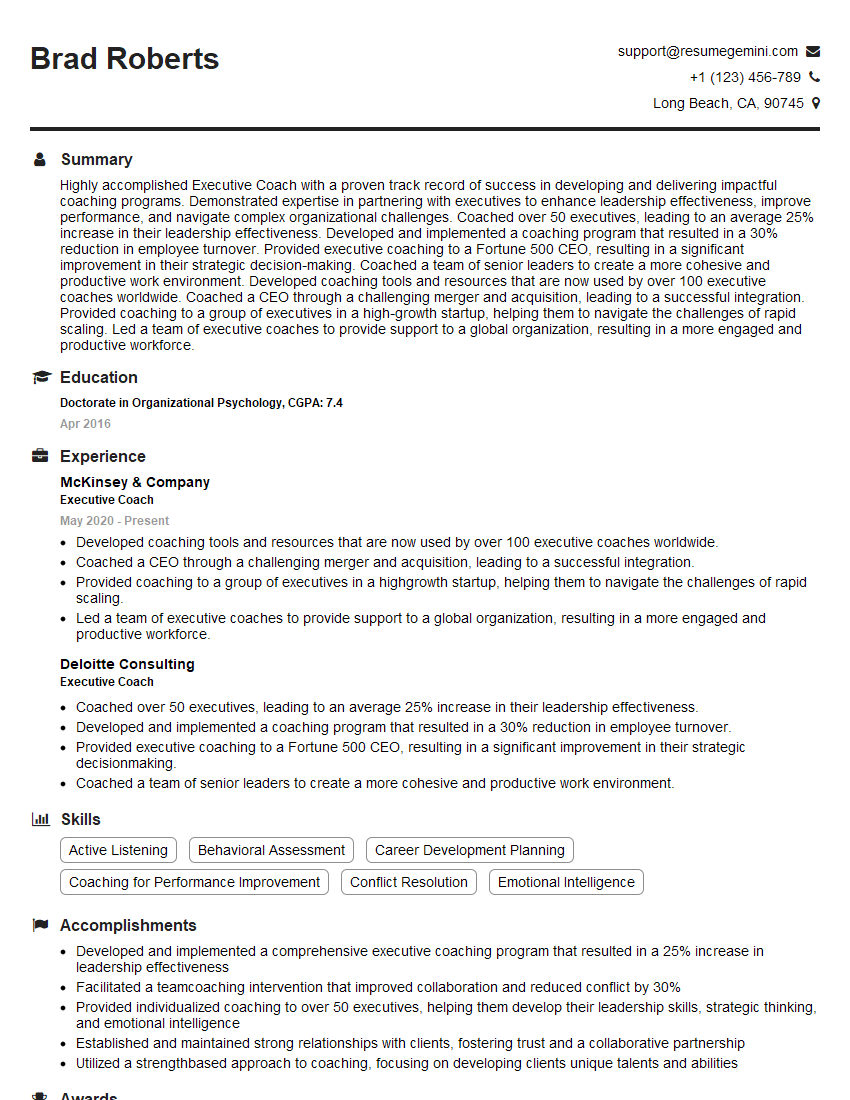
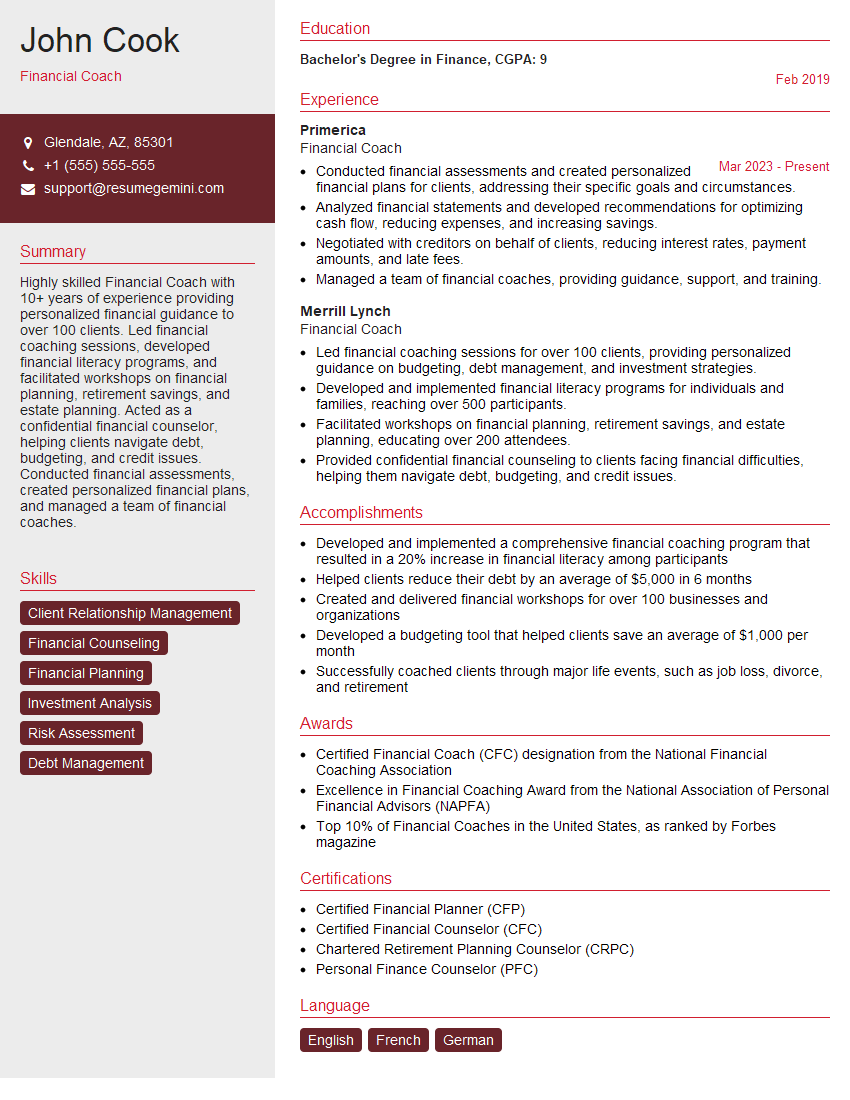
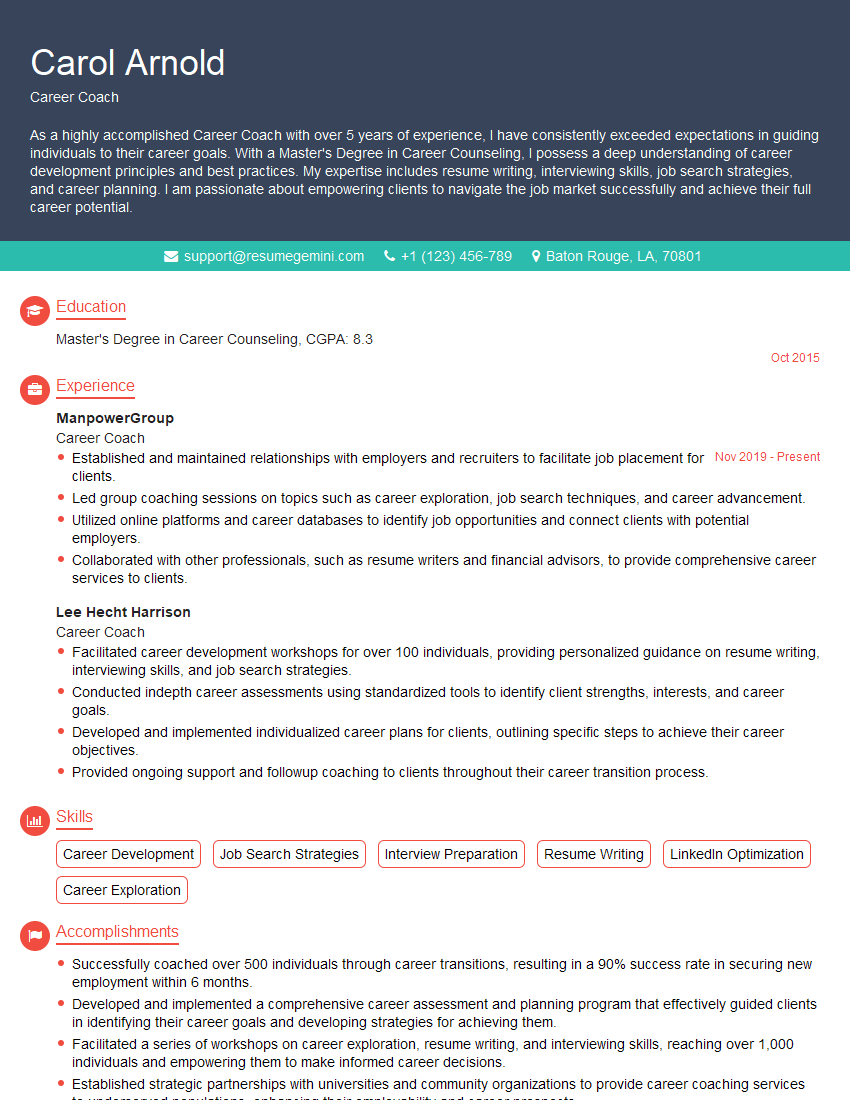
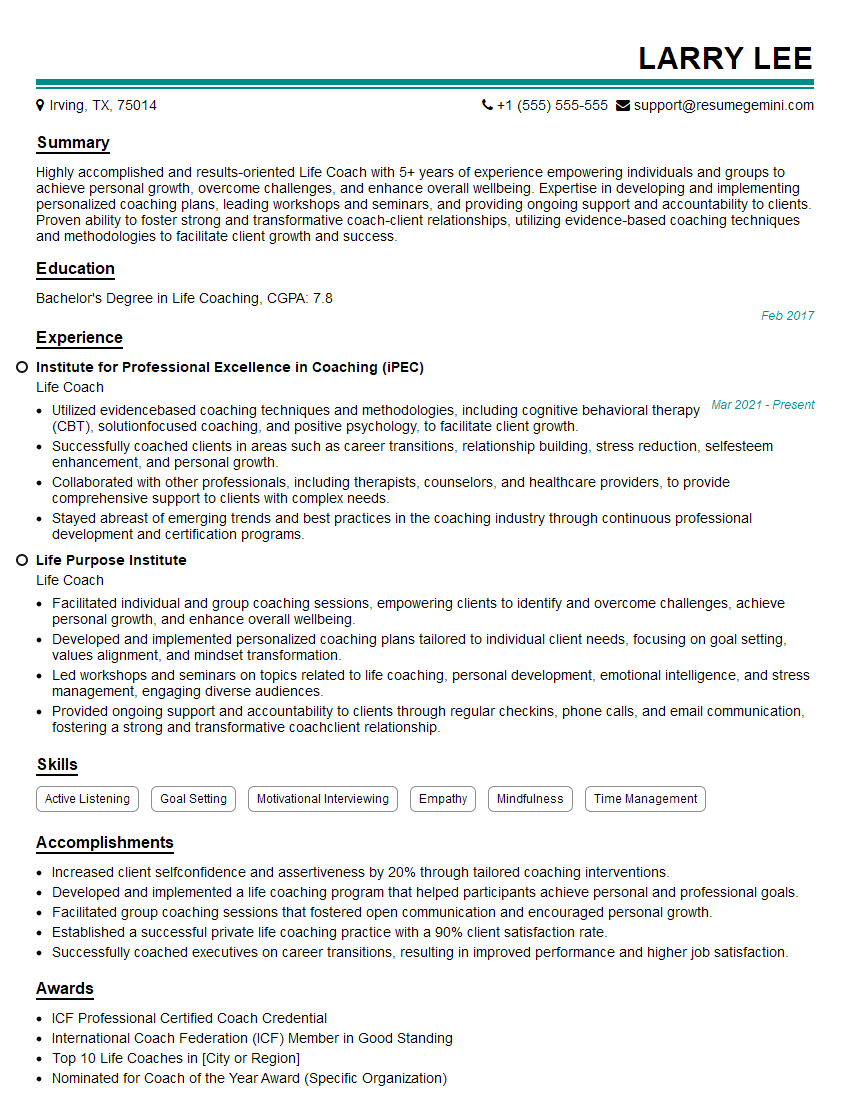
Mastering knowledge of coaching techniques is crucial for career advancement in this dynamic field. A strong understanding of these principles will significantly enhance your ability to connect with clients, achieve impactful results, and build a successful coaching practice. To elevate your job prospects, creating an ATS-friendly resume is essential. ResumeGemini is a trusted resource that can help you build a professional and impactful resume tailored to highlight your coaching skills and experience. Examples of resumes tailored to showcase expertise in Knowledge of Coaching Techniques are available to help guide you.

Explore more articles
Users Rating of Our Blogs
Share Your Experience
We value your feedback! Please rate our content and share your thoughts (optional).
What Readers Say About Our Blog
Very informative content, great job.
good