Feeling uncertain about what to expect in your upcoming interview? We’ve got you covered! This blog highlights the most important Knowledge of different musical styles and genres interview questions and provides actionable advice to help you stand out as the ideal candidate. Let’s pave the way for your success.
Questions Asked in Knowledge of different musical styles and genres Interview
Q 1. Differentiate between Blues and Jazz, providing specific musical characteristics of each.
Blues and Jazz, while deeply intertwined, possess distinct musical characteristics. Blues, born from the African American experience in the Deep South, is characterized by its raw emotionality and a focus on improvisation within a specific harmonic framework. Jazz, which emerged later, built upon the blues foundation but expanded its harmonic and rhythmic vocabulary significantly.
- Blues:
- Harmonic structure: Primarily uses the blues scale (a pentatonic scale with a flattened third and seventh), often employing I, IV, and V chords. Think of the classic 12-bar blues progression.
- Rhythmic structure: Typically features a strong, steady beat with swung rhythms, often emphasizing the off-beat. Think of the rhythmic feel in Robert Johnson’s ‘Cross Road Blues’.
- Melodic structure: Often features a call-and-response structure, simple, repetitive melodic phrases, and heavy use of blue notes (slightly flattened notes that give it its characteristic melancholic sound).
- Jazz:
- Harmonic structure: Uses complex chord progressions, incorporating altered dominants, substitutions, and extended harmonies, far beyond the simple blues forms. Think of the intricate chord changes in a Charlie Parker solo.
- Rhythmic structure: Features a wider range of rhythmic complexity, from swing to syncopation to complex polyrhythms. Consider the rhythmic interplay in a Miles Davis quintet.
- Melodic structure: Emphasizes improvisation based on chord changes, often incorporating virtuosic techniques and extended melodic lines. Think of the improvisational solos in Louis Armstrong’s recordings.
In essence, blues provides the foundation, while jazz takes it to a new level of harmonic and rhythmic sophistication.
Q 2. Compare and contrast the harmonic structures of Classical and Baroque music.
Classical and Baroque music, while both falling under the umbrella of Western art music, differ significantly in their harmonic structures. Baroque music (roughly 1600-1750) favored a more homophonic texture, with a clear melody supported by chords, while Classical music (roughly 1730-1820) saw a greater emphasis on counterpoint and a more complex interplay between melodic lines.
- Baroque Harmony:
- Continuo: Frequent use of basso continuo, a foundational bass line often played by a cello and harpsichord, which provided the harmonic framework. This resulted in a richer, fuller harmonic sound.
- Modal Harmony: Greater reliance on church modes (different scales than the major and minor scales common today) creating a less tonal center and a more varied harmonic palette.
- Terraced Dynamics: Sudden shifts in volume rather than gradual changes, creating a dramatic effect.
- Classical Harmony:
- Clearer Tonal Centers: Stronger emphasis on major and minor keys, creating a clearer sense of tonal gravity.
- Functional Harmony: Greater use of functional harmony, where chords have specific roles (tonic, dominant, subdominant, etc.) to create a sense of direction and resolution within a piece.
- Balanced Phrases: Musical phrases tend to be more symmetrical and balanced, leading to a clearer structure.
- Dynamic Variety: More gradual changes in volume (crescendo and diminuendo).
Imagine the grandeur and elaborate ornamentation of Bach’s fugues versus the clarity and structural elegance of a Mozart symphony. This difference reflects the shift from the complex, ornamented style of the Baroque to the clearer, more balanced style of the Classical period.
Q 3. Explain the rhythmic differences between Reggae and Ska.
Reggae and Ska, both originating in Jamaica, share roots but have distinct rhythmic characteristics. The difference mainly lies in the off-beat emphasis and the overall rhythmic feel.
- Ska: Characterized by its upbeat, driving rhythm with a strong emphasis on the off-beat, creating a distinct ‘skank’ sound. This is often achieved through a combination of the guitar and horn section. The tempo is generally faster than reggae.
- Reggae: Features a slower tempo and a more relaxed, laid-back rhythm. The emphasis on the off-beat is less pronounced than in ska, resulting in a smoother, more flowing feel. The characteristic ‘one drop’ rhythm, where the bass drum emphasizes the third beat of each measure, is a hallmark of reggae.
Think of the energetic, jumpy feel of early Ska artists like The Skatalites compared to the relaxed groove of Bob Marley’s reggae. The rhythmic difference is instantly noticeable.
Q 4. Describe the key characteristics of Funk music, including instrumentation and rhythmic patterns.
Funk music, emerging in the late 1960s and 70s, is defined by its infectious grooves, syncopated rhythms, and emphasis on rhythmic interplay.
- Instrumentation: Typically features a rhythm section of electric bass, drums, and electric guitar, often augmented by horns (saxophone, trumpet, trombone), keyboards, and vocals. The emphasis is on the rhythmic interplay between these instruments.
- Rhythmic Patterns: Characterized by syncopated rhythms, complex drum fills, and heavy use of the off-beat. The bass line often plays a crucial role in establishing the groove, providing a strong foundation for the rest of the instrumentation. Think of the complex and infectious basslines of James Brown.
- Groove: The overall feel of funk music is heavily reliant on groove. It’s about creating a feeling of movement and energy that makes listeners want to dance.
Artists like James Brown, Parliament-Funkadelic, and Sly & the Family Stone exemplify the key characteristics of Funk music, showcasing its unique blend of rhythm, instrumentation, and groove.
Q 5. Identify three defining characteristics of Hip Hop music.
Hip Hop, a genre born in the Bronx in the 1970s, is defined by three key elements:
- Rapping: The rhythmic and rhyming speech that forms the lyrical content of hip hop songs. This can range from simple rhymes to complex wordplay and storytelling.
- DJing: The art of manipulating recorded music using turntables and mixers, creating loops, breaks, and other sonic effects. This often involves scratching, beatmatching, and sampling.
- Breakdancing: An acrobatic dance style performed to the rhythm of the music. It often includes complex movements, spins, and freezes.
These three elements, while often augmented by others like graffiti art and beat production, form the core of what defines hip hop as a cultural movement and musical genre.
Q 6. How does the use of instrumentation distinguish between Folk and Country music?
Folk and Country music, while often overlapping, can be distinguished by their instrumentation. While both genres utilize acoustic instruments, the specific choices and emphasis differ.
- Folk Music: Emphasizes acoustic instruments that are often simple and readily available. Common instruments include acoustic guitar, banjo, fiddle, harmonica, and vocals. The instrumentation is often relatively sparse, with a focus on the melody and lyrics.
- Country Music: Also utilizes acoustic instruments, but often incorporates more electric instruments, particularly the steel guitar, electric guitar, and bass. The instrumentation is often more elaborate than folk, with a stronger emphasis on instrumentation. Banjo and fiddle are still common but often integrated into a broader instrumental palette.
Think of the simple acoustic guitar and vocals of a traditional folk song versus the more elaborate instrumentation of a modern country song featuring electric guitars and a steel guitar. The instrumentation helps shape the overall sound and texture of each genre.
Q 7. What are the key elements that define Electronic Dance Music (EDM)?
Electronic Dance Music (EDM) is a broad genre encompassing many subgenres, but several key elements define it:
- Electronic Instrumentation: Relies heavily on electronic instruments such as synthesizers, drum machines, samplers, and sequencers. These instruments are used to create a wide variety of sounds and textures.
- Repetitive Rhythmic Structures: Often employs repetitive rhythmic structures and strong four-on-the-floor beats designed to create a hypnotic and danceable groove. This is often driven by a strong bassline.
- Emphasis on Danceability: The primary purpose of most EDM is to be danceable, hence its frequent use in clubs, raves and festivals. The structure and rhythm of tracks are designed for dance.
- Subgenres: While the common elements listed above exist, EDM contains many subgenres, each with its own characteristics, from the techno of Detroit, the trance of Europe, to the house music of Chicago, each bringing a different feel and emphasis within the broader EDM framework.
The diverse subgenres within EDM demonstrate the genre’s flexibility and adaptability, but its reliance on electronic instruments, repetitive rhythmic structures, and danceability unite these diverse styles.
Q 8. Compare the vocal techniques used in Opera and R&B.
Opera and R&B, while seemingly disparate, share the fundamental goal of emotive vocal expression. However, their techniques differ drastically. Opera singers typically employ a bel canto technique, focusing on breath control, projection, and a wide vocal range, often spanning several octaves. This involves meticulous training to achieve a resonant, powerful tone capable of filling large opera houses without amplification. Think of the soaring high notes of a soprano like Maria Callas or the dramatic power of a Wagnerian baritone. R&B, on the other hand, emphasizes a more intimate, often gritty, and emotionally raw style. Techniques may include melisma (singing multiple notes on a single syllable), runs, and riffs, prioritizing emotional conveyance and rhythmic complexity over sheer vocal power. Think of the soulful phrasing of Aretha Franklin or the nuanced vocal runs of Beyoncé. While opera prioritizes technical precision and sustained power, R&B values expressive flexibility and rhythmic groove.
In essence, opera prioritizes technical mastery for projection and sustained power, while R&B prioritizes emotional expression and rhythmic intricacy.
Q 9. Discuss the evolution of Rock music from its early forms to modern subgenres.
Rock music’s evolution is a fascinating journey. Its roots lie in blues, rhythm and blues (R&B), and country music, merging in the 1950s with artists like Chuck Berry and Elvis Presley. Early rock and roll was characterized by its rebellious spirit, simple song structures, and amplified instrumentation. The 1960s witnessed a diversification of rock, with the British Invasion introducing bands like The Beatles and The Rolling Stones, who refined songwriting and brought a more sophisticated sound. The 60s also saw the emergence of psychedelic rock (Jimi Hendrix), folk rock (Bob Dylan), and hard rock (Led Zeppelin). The 1970s brought progressive rock (Pink Floyd), punk rock (Sex Pistols), and heavy metal (Black Sabbath). From the 80s onwards, rock fragmented into numerous subgenres, including glam metal (Mötley Crüe), grunge (Nirvana), and alternative rock (Radiohead). Modern rock encompasses diverse styles, blending elements from earlier eras and incorporating influences from other genres.
Essentially, rock’s evolution is a continuous process of fusion, rebellion, and stylistic innovation, constantly pushing boundaries and reinventing itself.
Q 10. What are some key differences between Punk and Post-Punk music?
Punk and post-punk, while closely related, represent distinct phases in rock’s history. Punk, emerging in the mid-1970s, was characterized by its raw energy, minimalist approach, and anti-establishment lyrics. Think of the Sex Pistols’ aggressive sound and nihilistic themes. Musically, punk was often simple, relying on fast tempos, power chords, and straightforward song structures. Post-punk, which followed in the late 1970s and early 1980s, built upon punk’s rebellious spirit but incorporated more complex musical structures, experimental sounds, and introspective lyrics. Bands like Joy Division and The Cure explored darker themes and utilized unconventional instrumentation, developing a more sophisticated and less immediately accessible sound. While punk was a direct, visceral reaction against societal norms, post-punk explored the aftermath, delving into more complex emotional landscapes and musical experimentation.
In short: Punk was raw, simple, and aggressively anti-establishment; post-punk was more complex, experimental, and introspective.
Q 11. How has technology impacted the creation and distribution of music across different genres?
Technology has revolutionized music creation and distribution across all genres. Digital Audio Workstations (DAWs) like Pro Tools and Ableton Live have replaced tape recorders, offering musicians unprecedented control over recording, editing, and mixing. Synthesizers and samplers provide access to a vast array of sounds, blurring genre boundaries and enabling the creation of entirely new sonic landscapes. The internet and streaming platforms like Spotify and Apple Music have democratized music distribution, allowing independent artists to reach global audiences without relying on traditional record labels. Social media platforms like TikTok have become powerful tools for music discovery and promotion. This has led to a significant shift in the way music is consumed and shared, with a greater focus on individual playlists and personalized listening experiences. The rise of AI-powered music generation tools is also beginning to shape the future of music composition and production.
Essentially, technology has empowered artists, democratized distribution, and transformed how we experience music.
Q 12. Describe the influence of African musical traditions on other genres like Jazz and Pop.
African musical traditions have profoundly impacted numerous genres, including Jazz and Pop. The rhythmic complexity, call-and-response vocals, and improvisational elements prevalent in many African musical styles found fertile ground in Jazz. Early Jazz pioneers like Louis Armstrong and Duke Ellington incorporated African rhythmic patterns and blues scales into their music, creating a uniquely American art form. The influence of African rhythms and instrumentation is evident in the syncopated beats and polyrhythms that characterize Jazz. Similarly, Pop music has borrowed extensively from African musical traditions, particularly in its use of percussive elements, vocal harmonies, and dance rhythms. Artists like Michael Jackson, for example, incorporated African musical elements into his highly successful and influential pop music.
In conclusion, the rhythmic intricacy, call-and-response techniques, and improvisational spirit of African music have deeply influenced the development and character of both Jazz and Pop.
Q 13. Name three influential composers from the Classical period and their defining works.
The Classical period (roughly 1730-1820) boasts a wealth of influential composers. Three stand out:
- Wolfgang Amadeus Mozart: Known for his prolific output across various genres, Mozart’s works are characterized by their elegance, clarity, and emotional depth. Defining works include his operas The Marriage of Figaro and The Magic Flute, as well as his symphonies No. 40 and No. 41 (the ‘Jupiter’ Symphony).
- Joseph Haydn: Often called the ‘Father of the Symphony,’ Haydn standardized the symphony form and composed numerous groundbreaking string quartets. His symphonies, such as his Surprise Symphony (No. 94) and his London Symphonies, are celebrated for their innovative structures and melodic inventiveness.
- Ludwig van Beethoven: Bridging the Classical and Romantic periods, Beethoven expanded the scope and emotional intensity of the symphony and sonata. His defining works include his three most famous symphonies (Nos. 5, 6, and 9), the latter featuring the iconic ‘Ode to Joy’ choral movement, and his piano sonatas, notably the Moonlight Sonata (Sonata No. 14).
Q 14. Identify a significant artist or band from each of the following genres: Pop, Metal, Latin.
Here are some significant artists representing Pop, Metal, and Latin music:
- Pop: Michael Jackson – His innovative music videos and undeniable charisma fused with incredible musical talent made him a global icon. His influence continues to shape the pop landscape.
- Metal: Metallica – A pivotal band in the thrash metal genre, Metallica’s aggressive sound and virtuosic musicianship have earned them worldwide recognition and immense influence on heavy metal’s evolution.
- Latin: Shakira – A Colombian singer-songwriter known for her energetic performances and fusion of Latin pop, rock, and other global influences. Shakira has helped bridge the gap between Latin and mainstream music.
Q 15. Explain the concept of musical form in relation to a specific piece of music.
Musical form refers to the overall structure and organization of a piece of music. Think of it like the blueprint of a house; it dictates how different sections fit together to create a cohesive whole. Let’s take a look at the classic song structure of many pop songs: Verse-Chorus-Verse-Chorus-Bridge-Chorus.
Each section (Verse, Chorus, Bridge) has its own distinct melodic and lyrical content. The Verse typically introduces the main idea or story, often changing slightly with each repetition. The Chorus is the memorable and catchy part, often expressing the main theme or emotion. The Bridge provides a contrasting section, offering a change of pace or perspective before returning to the Chorus for a powerful resolution.
For a concrete example, consider ‘Hey Jude’ by The Beatles. It follows a modified verse-chorus structure but extends the outro significantly, creating a unique form. The verses tell a story, the choruses provide a sense of hope, and the extended outro builds to a powerful crescendo, demonstrating the fluidity and adaptability of musical form.
Career Expert Tips:
- Ace those interviews! Prepare effectively by reviewing the Top 50 Most Common Interview Questions on ResumeGemini.
- Navigate your job search with confidence! Explore a wide range of Career Tips on ResumeGemini. Learn about common challenges and recommendations to overcome them.
- Craft the perfect resume! Master the Art of Resume Writing with ResumeGemini’s guide. Showcase your unique qualifications and achievements effectively.
- Don’t miss out on holiday savings! Build your dream resume with ResumeGemini’s ATS optimized templates.
Q 16. What are the different types of musical notation and when would you use each?
Musical notation is the system of writing down music. There are several types, each suited to different purposes:
- Staff Notation: This is the most common system, using a staff of five lines and four spaces to represent pitch. It also indicates rhythm, dynamics, and other musical elements. It’s highly precise and used for virtually all Western classical music, as well as many other genres.
- Tablature (Tab): Primarily used for fretted instruments like guitar, bass, and ukulele. Tab shows the position of fingers on the fretboard instead of musical notes, making it easier for beginners to learn. It’s less precise than staff notation for complex musical ideas.
- Numeral Notation: Uses Roman numerals to represent chords, making it a concise way to outline harmonic structure. Commonly used in music theory textbooks and for quick sketches of chord progressions. It doesn’t convey melodic information.
- Graphic Notation: A visual representation of musical ideas, often used in contemporary and experimental music. It may use symbols, shapes, or other visual elements to represent musical ideas, offering a non-traditional approach to writing music.
The choice of notation depends on the complexity of the music, the instrument being played, and the intended audience. For example, a complex orchestral piece would require staff notation, while a simple guitar riff might be effectively conveyed using tablature.
Q 17. Discuss the relationship between music theory and the creation of music.
Music theory and music creation are inextricably linked. Music theory provides the framework and vocabulary for understanding music, while creating music involves applying these principles in a creative and expressive way. Think of theory as the grammar and vocabulary of music, and composition as the creative writing process.
Theory helps composers understand harmony, melody, rhythm, and form. For instance, knowledge of chord progressions helps create compelling harmonic movement. Understanding scales and modes allows composers to build melodies that are tonally coherent and emotionally resonant. Analyzing existing music through the lens of theory can inspire new ideas and approaches.
However, theory is just a tool; it doesn’t guarantee artistic success. Many great musicians possess intuitive musicality and compose without formal training. Ultimately, the creative process involves intuition, experimentation, and a deep understanding of the musical language—which music theory helps to cultivate and refine.
Q 18. How do different musical instruments contribute to the overall sound of a specific genre?
The instrumentation of a genre dramatically shapes its overall sound and character. Let’s consider jazz as an example. The combination of instruments like saxophone, trumpet, piano, double bass, and drums is key to its distinctive sound.
The saxophone’s warm tone and expressive capabilities are perfect for melodic improvisation. The trumpet offers a bright, cutting sound often used for lead lines and call-and-response phrases. The piano provides rhythmic and harmonic support, creating a rich sonic texture. The double bass provides a solid foundation, while the drums add rhythmic energy and drive. The interplay between these instruments, particularly improvisation, defines jazz’s unique character.
In contrast, genres like classical music use a much broader range of instruments, from strings and woodwinds to brass and percussion, often organized into large ensembles like orchestras. This leads to a far richer, more complex texture, with different instruments playing distinct melodic and harmonic roles.
Q 19. What are some common chord progressions used in popular music?
Several chord progressions appear frequently in popular music because they are inherently satisfying to the ear. They create a sense of resolution and movement. Here are some common examples:
I-IV-V-I(e.g., C-F-G-C): This is a very common progression, known as the ‘perfect cadence’ when it ends on the tonic chord (I). It creates a strong sense of closure.ii-V-I(e.g., Dm-G-C): Another very popular progression. The ii-V creates tension, which is resolved by the I chord. This progression is found in jazz, blues, and many pop songs.vi-IV-I-V(e.g., Am-F-C-G): This progression is often used to create a more melancholic or reflective mood.I-vi-IV-V(e.g., C-Am-F-G): A variation of the previous progression, it can offer a sense of both reflection and resolution.
These progressions, while simple in their structure, can be infinitely varied through rhythmic changes, inversions, and the addition of seventh chords and other embellishments. This allows for creativity while maintaining the underlying harmonic structure.
Q 20. Explain the difference between major and minor keys and their emotional impact.
Major and minor keys are the fundamental building blocks of Western music, each conveying a distinct emotional character. The difference lies primarily in the third degree of the scale:
- Major Key: The third degree is a major third above the tonic (root note). Major keys generally sound bright, happy, and optimistic. Think of the upbeat feel of many pop songs.
- Minor Key: The third degree is a minor third above the tonic. Minor keys generally evoke feelings of sadness, melancholy, or introspection. Think of many ballads or film scores.
It’s important to note that emotional response to major and minor keys is culturally influenced. However, the inherent difference in their intervals creates a contrasting emotional impact, with major scales often perceived as brighter and more stable, while minor scales tend towards a more introspective and sometimes unsettling feel. Many composers strategically use modulations (changes of key) to shift moods within a single piece.
Q 21. Describe the use of dynamics and tempo in creating musical expression.
Dynamics and tempo are crucial elements in creating musical expression. They add layers of meaning and emotion that go beyond the basic melody and harmony.
- Dynamics: Refer to the loudness and softness of the music (e.g., piano (soft), forte (loud), crescendo (gradually getting louder), diminuendo (gradually getting softer)). Changing dynamics allows composers to build tension, create emotional peaks and valleys, and emphasize certain phrases. Imagine a suspenseful film score that uses a gradual crescendo to build anticipation before a sudden, loud climax.
- Tempo: Refers to the speed of the music, typically expressed in beats per minute (BPM). Tempo choices significantly affect the mood. A fast tempo can create a sense of excitement and urgency, while a slow tempo can evoke feelings of calm, reflection, or sadness. A funeral march, for instance, would use a slow tempo.
The skillful manipulation of dynamics and tempo is a key element of musical expression. By carefully crafting changes in loudness and speed, composers can paint vivid emotional pictures and create deeply engaging musical experiences.
Q 22. How does harmony differ in different musical periods and styles?
Harmony, the simultaneous sounding of different notes, has evolved dramatically throughout musical history. Early music, like that of the Medieval and Renaissance periods, often featured simpler harmonies, largely built on consonant intervals like thirds and fifths. Think of the pure, unadorned harmonies in a Renaissance motet. The Baroque period saw the blossoming of counterpoint, where independent melodic lines intertwined harmonically, creating richer textures (we’ll discuss this further in a later question). The Classical period favored clearer, more homophonic textures – melody supported by chords – as heard in the works of Mozart and Haydn. Romanticism brought greater harmonic complexity and chromaticism, pushing boundaries with surprising chord changes and more dissonance, as exemplified by Wagner’s operas. The 20th and 21st centuries experimented even further, with atonal and microtonal music rejecting traditional harmonic frameworks altogether. Modern jazz, for example, uses complex chord progressions and alterations, far removed from the simpler harmony of earlier eras.
Q 23. What are some common musical structures found in songs (e.g., verse-chorus, AABA)?
Song structures provide a framework for presenting musical ideas. Some common structures include:
- Verse-Chorus: This is the most prevalent structure in popular music. Verses tell a story or present different perspectives, while the chorus provides a recurring refrain, usually the song’s main idea. Think of countless pop songs following this model.
- AABA: This structure features three sections (A, A, B) where two sections (A) are identical or very similar, and the B section offers a contrasting feel before returning to the familiar A section. This is commonly found in Tin Pan Alley songs and some Broadway show tunes.
- ABAB: Similar to AABA, but with alternating A and B sections. This can be found across a range of genres, lending itself well to songs that explore contrasting ideas.
- 32-bar song form: Common in jazz standards, this form uses a specific number of bars (measures) per section, often with a clear break and return to the main theme.
Many songs blend and adapt these structures, creating variations and unique forms. The selection of structure profoundly influences the song’s narrative and emotional impact.
Q 24. Describe the use of counterpoint in Baroque music.
Counterpoint in Baroque music is a defining characteristic. It involves the independent weaving of two or more melodic lines that are simultaneously interesting and harmonically compatible. Composers like Bach and Handel mastered this technique. Unlike simpler homophonic textures where one melody is dominant, Baroque counterpoint treated each melodic line as equally important. These lines often imitate each other (one line echoes the other), creating a sense of dialogue or interplay. The skill lies in balancing the individual melodic lines while ensuring the resulting harmony remains consonant and pleasing. Think of the intricate fugues in Bach’s Well-Tempered Clavier, where multiple voices enter successively, each stating the same theme but developing independently.
Q 25. Discuss the impact of improvisation in Jazz and other genres.
Improvisation is central to jazz, but its impact extends to many other genres. In jazz, improvisation allows musicians to spontaneously create melodies and variations on a harmonic framework (often chord changes in a particular key). This creates unique performances, making each rendition special. Think of the legendary solos of Charlie Parker or John Coltrane. Improvisation in other genres might not be as central, but it still plays a role. Rock guitar solos, blues harmonica riffs, and even certain sections in classical performances can involve a degree of improvisation, though perhaps within more structured parameters. Improvisation fosters creativity, spontaneity, and unique interpretations of musical ideas.
Q 26. Explain the role of rhythm and meter in creating a sense of groove.
Rhythm (the arrangement of sounds and silences in time) and meter (the organization of beats into groups or measures) are fundamental to creating groove. Groove is that irresistible feeling of rhythmic momentum that makes you want to move. A strong rhythmic pulse, often established by the drums and bass, forms the foundation. The interplay between these rhythmic elements, along with the syncopation (placement of accents off the beat) of other instruments, contributes to the groove’s character. For instance, a simple 4/4 meter with a steady bass drum on beats 1 and 3 can establish a basic groove. Adding a snare drum on beat 2 and 4, along with syncopated accents from the guitar or other instruments, intensifies and enhances the groove. The complexity and intensity of a groove depend heavily on the interplay between rhythm and meter.
Q 27. How do lyrics and melody interact to create meaning in a song?
Lyrics and melody are inseparable partners in creating a song’s meaning. The melody’s contour (its rise and fall) can directly reflect the emotional content of the lyrics. A soaring melody might emphasize a feeling of joy or triumph, while a descending melody might express sadness or loss. The rhythm of the melody can also complement the rhythm of the words, highlighting certain syllables or creating a sense of urgency or calmness. Moreover, the combination of words and musical phrasing can create poetic and symbolic effects. For example, a specific melodic motif might repeatedly accompany a key word or phrase, emphasizing its importance. The interplay between the two creates layers of meaning, often going beyond the literal meaning of the lyrics. A skilled songwriter will deliberately shape the melody to enhance and amplify the impact of the lyrics.
Q 28. Describe your familiarity with various music production software and tools.
My experience encompasses a wide range of Digital Audio Workstations (DAWs) and music production tools. I’m proficient in industry-standard software such as Pro Tools, Logic Pro X, Ableton Live, and Cubase. I understand their respective strengths and weaknesses, selecting the best tool for the task at hand. Beyond DAWs, I’m comfortable using various virtual instruments (VSTs) and effects plugins from companies like Native Instruments, Waves, and Universal Audio. I also possess practical experience with audio editing and mastering techniques, including noise reduction, EQ, compression, and reverb. My experience extends to hardware as well, including audio interfaces, MIDI controllers, and studio monitors. This comprehensive skill set allows me to approach music production from various perspectives and achieve high-quality results across a diverse array of styles.
Key Topics to Learn for Knowledge of Different Musical Styles and Genres Interview
- Historical Context: Understanding the evolution and cultural influences of various genres (e.g., Blues, Jazz, Rock, Classical, Electronic). This includes key periods, influential artists, and significant technological advancements.
- Genre Characteristics: Identifying defining features of different styles, including instrumentation, rhythm, melody, harmony, and form. Be prepared to discuss the nuances that distinguish one genre from another.
- Formal Analysis: Applying musical theory to analyze the structure and composition of pieces from various genres. This involves understanding concepts like chord progressions, melodic phrasing, and rhythmic patterns.
- Cross-Genre Influences: Recognizing how genres have interacted and influenced each other throughout history. Examples include fusion genres or the borrowing of elements across styles.
- Practical Application: Discuss how your knowledge of different genres informs your own musical practice, whether it’s performance, composition, production, or analysis. Be ready to provide specific examples.
- Cultural Significance: Understanding the social and cultural impact of music across different genres and periods. This demonstrates a broader understanding beyond purely technical aspects.
Next Steps
A strong understanding of diverse musical styles and genres is invaluable for career advancement in many music-related fields. Whether you’re aiming for a performance, production, academic, or journalistic role, demonstrating this knowledge showcases your expertise and passion. To significantly increase your job prospects, crafting an ATS-friendly resume is crucial. ResumeGemini offers a trusted platform for building professional and effective resumes tailored to your specific experience. We provide examples of resumes specifically designed for candidates with expertise in Knowledge of different musical styles and genres to help you present your skills effectively. Take advantage of this resource to showcase your talents and land your dream job.
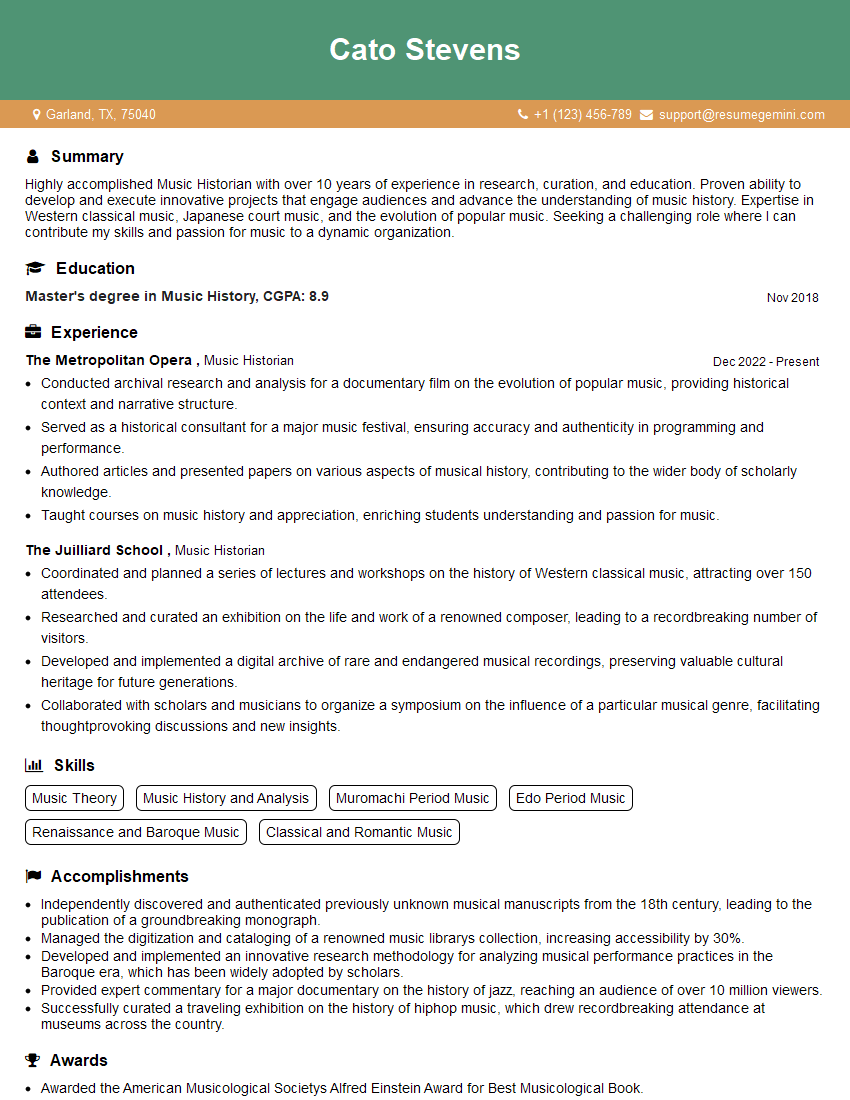
Music Historian Resume Sample
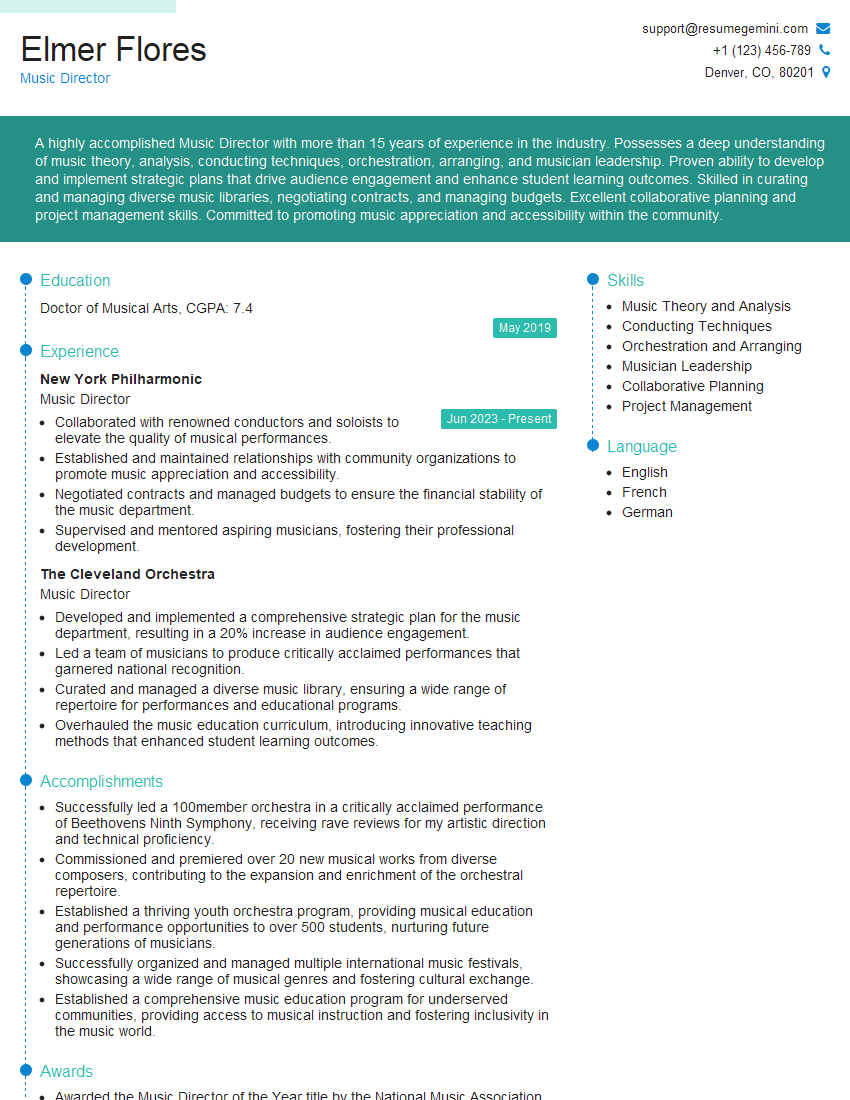
Music Director Resume Sample
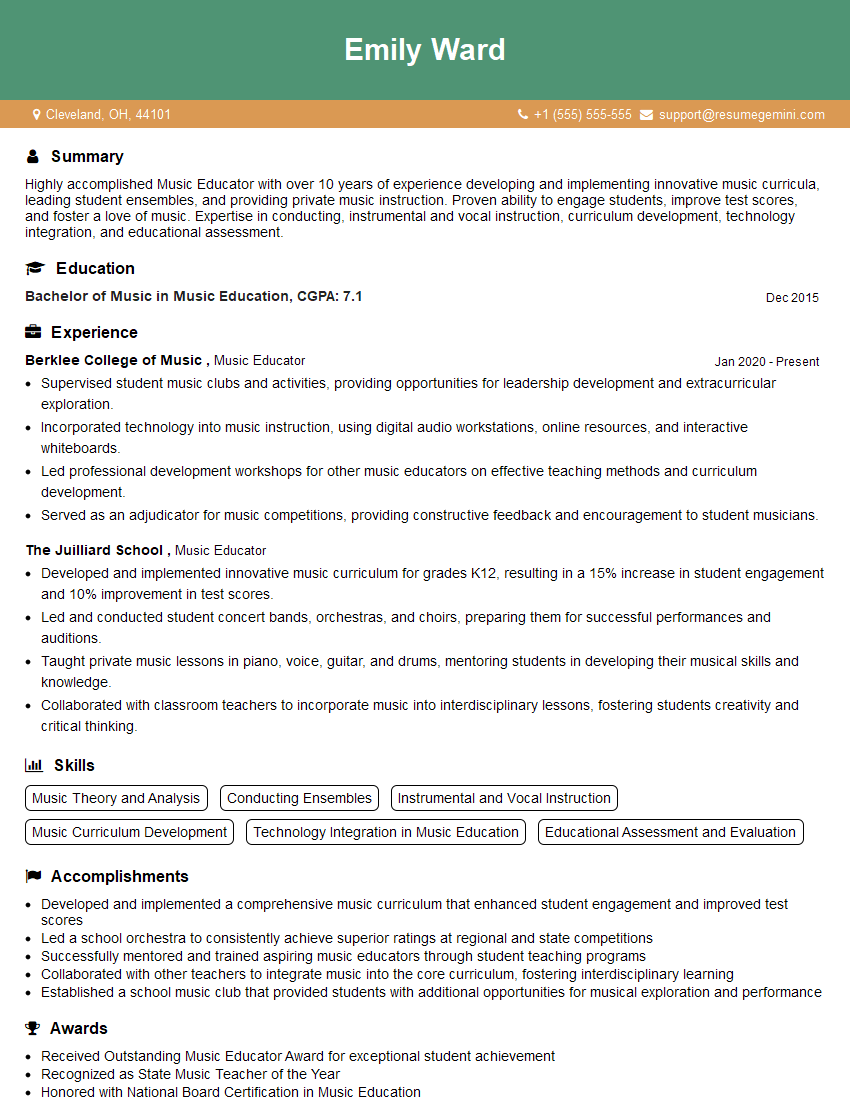
Music Educator Resume Sample

Music Supervisor Resume Sample
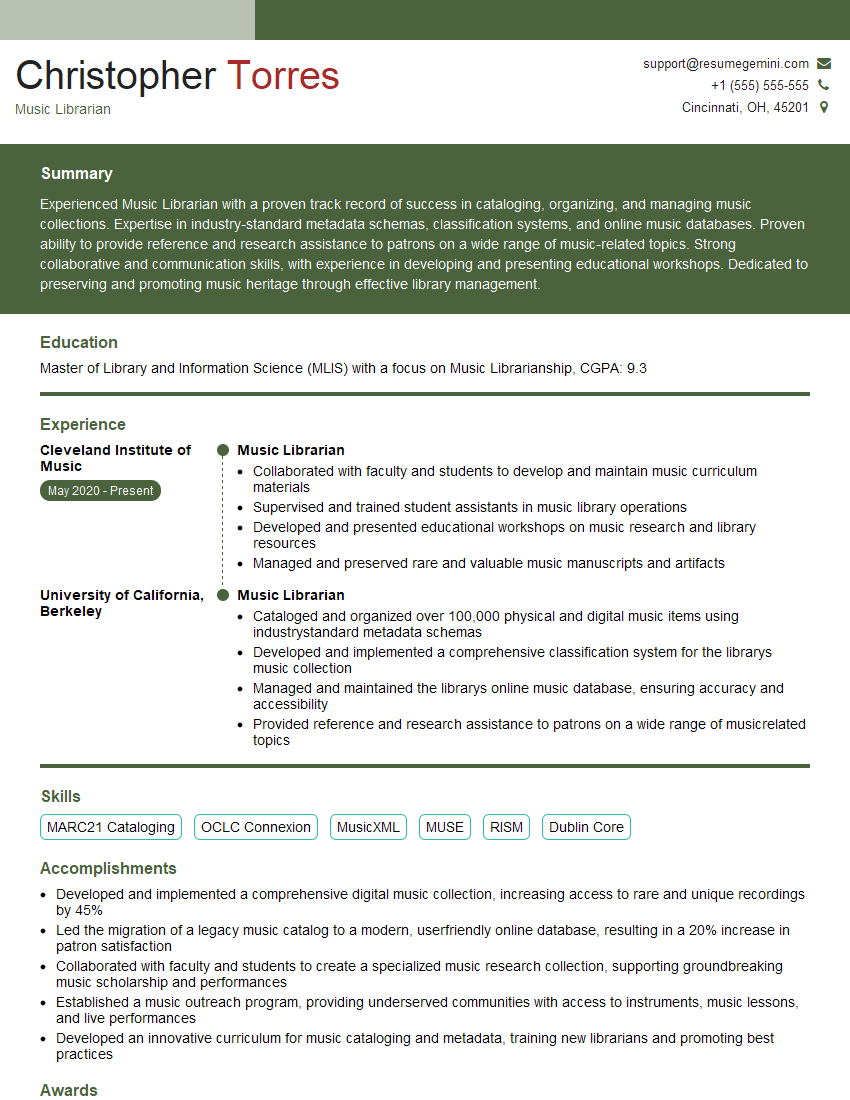
Music Librarian Resume Sample
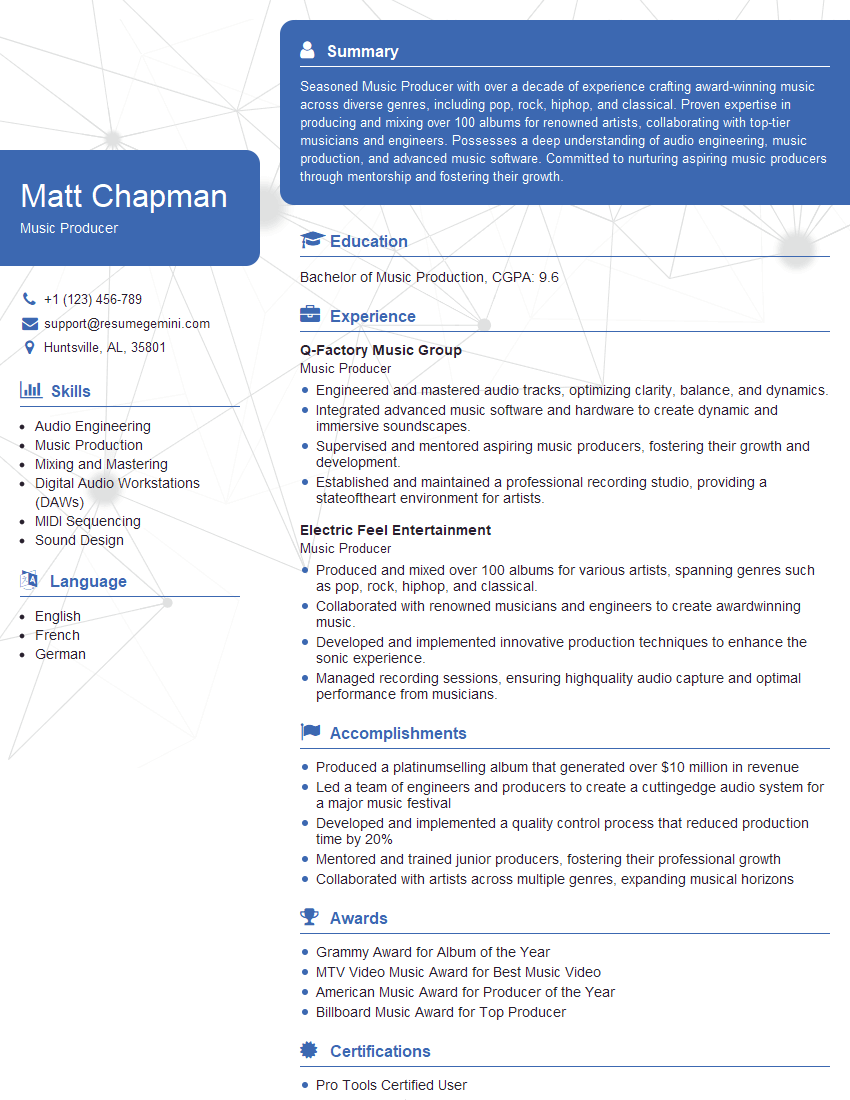
Music Producer Resume Sample

Composer Resume Sample

Orchestra Conductor Resume Sample

Songwriter Resume Sample
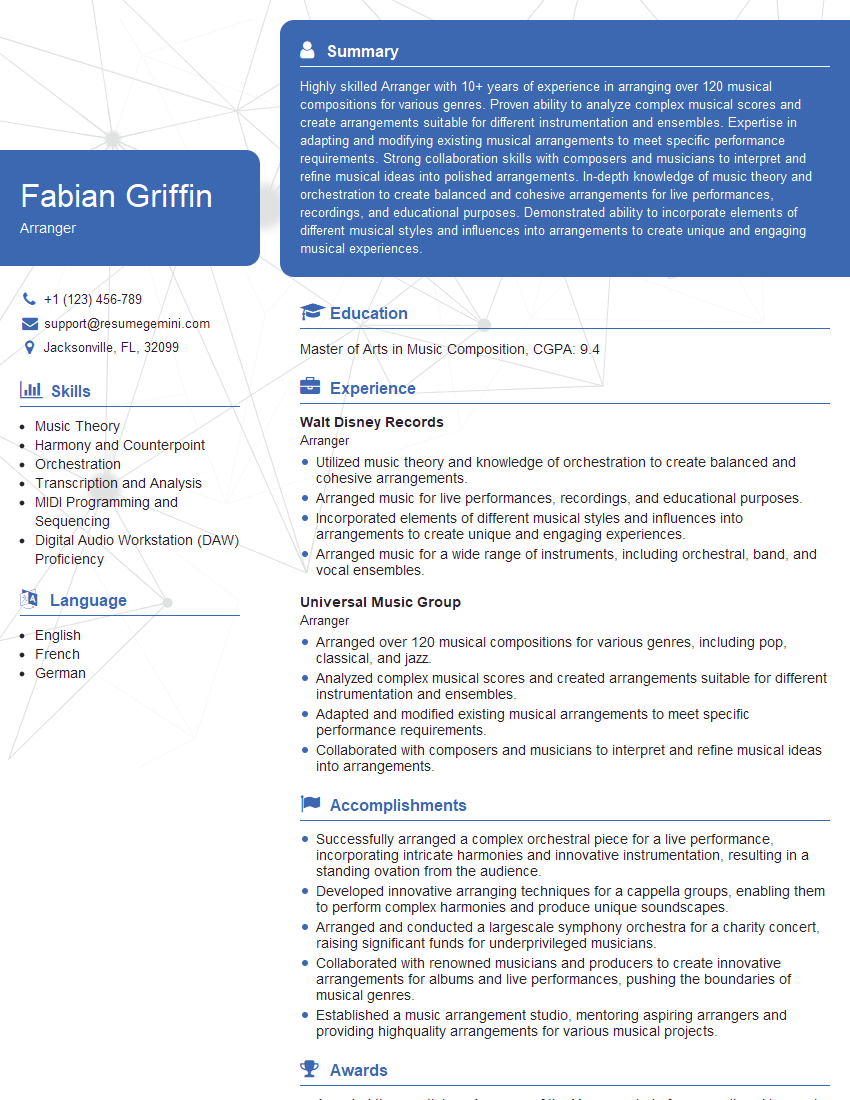
Arranger Resume Sample
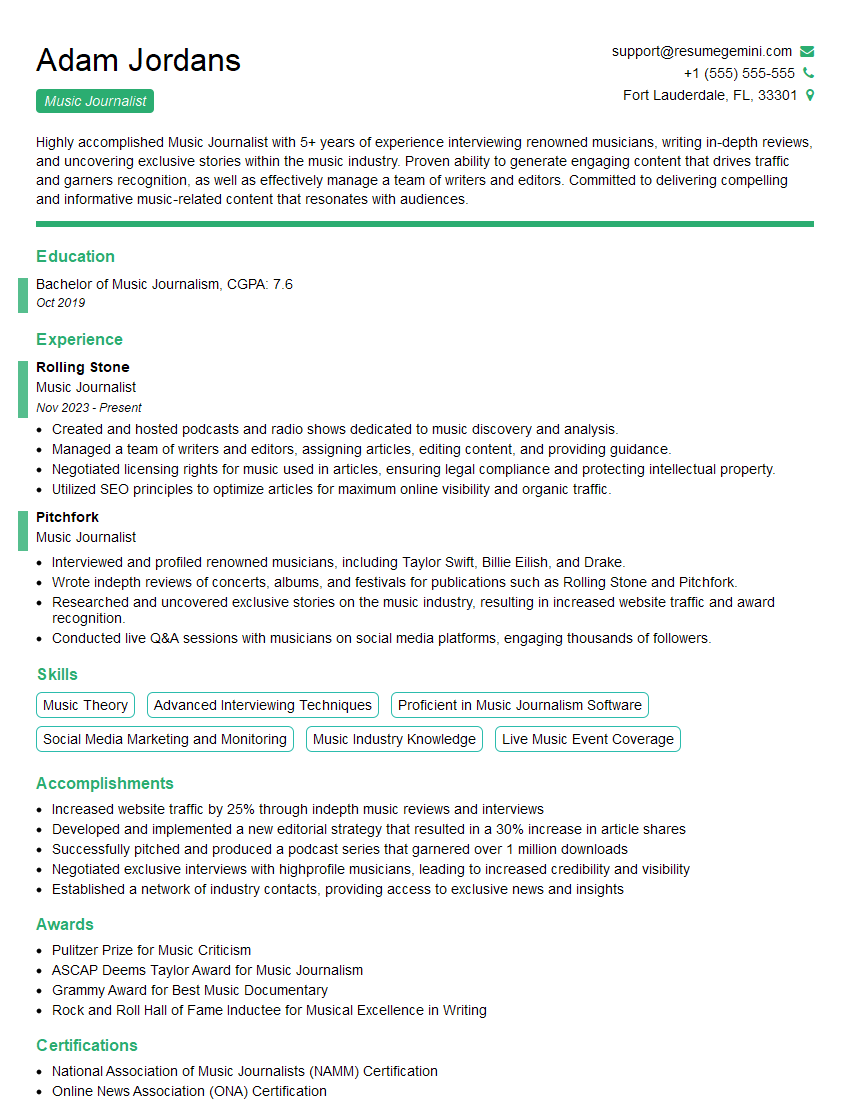
Music Journalist Resume Sample
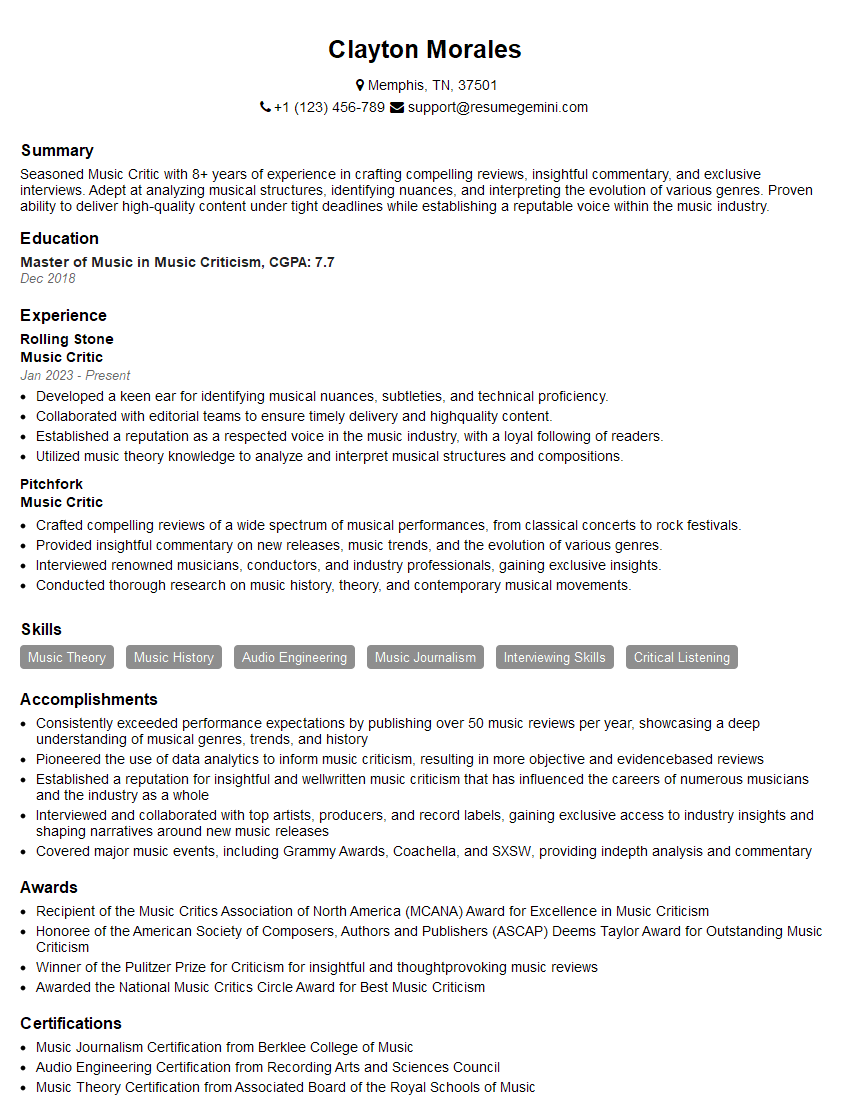
Music Critic Resume Sample

Sound Engineer Resume Sample

Music Therapist Resume Sample
Explore more articles
Users Rating of Our Blogs
Share Your Experience
We value your feedback! Please rate our content and share your thoughts (optional).
What Readers Say About Our Blog
Very informative content, great job.
good