Interviews are more than just a Q&A session—they’re a chance to prove your worth. This blog dives into essential Knowledge of Pattern Making interview questions and expert tips to help you align your answers with what hiring managers are looking for. Start preparing to shine!
Questions Asked in Knowledge of Pattern Making Interview
Q 1. Explain the difference between sloper and a block pattern.
Both slopers and block patterns are foundational pattern pieces, but they serve different purposes. Think of a sloper as a blank canvas and a block pattern as a more developed sketch.
A sloper is a basic, two-dimensional representation of a body shape. It’s essentially a highly customized pattern piece, unique to an individual’s measurements. It’s created by drafting or draping directly on a dress form or taking precise body measurements. It forms the basis for all subsequent pattern designs for that specific individual. It’s a foundational tool, much like a painter’s primed canvas.
A block pattern, also called a base pattern, is a more generalized pattern based on standard body measurements. It’s a size-graded pattern that you can easily find commercially or create yourself using industry standard measurement charts. While you can adjust a block pattern for fit, it’s not as personalized as a sloper. It’s more like a template, allowing for mass production or quick design iterations. It’s more like starting with a pre-sketched outline.
In short: A sloper is highly personalized; a block pattern is standardized. A sloper requires more time to create and is ideal for creating garments that fit perfectly to one body type; a block pattern is faster to use for making adjustments across multiple sizes.
Q 2. Describe your experience with various pattern making methods (e.g., draping, flat pattern making).
My experience spans both draping and flat pattern making, each offering unique advantages. Draping, a hands-on method, allows for excellent fit and creative exploration of fabric drape. I’ve used draping extensively to create designs requiring a specific flow or unique fit like evening gowns or tailored jackets on a mannequin. This method excels in producing unique, body-conforming designs, but it can be time-consuming and less suitable for mass production.
Flat pattern making, conversely, is a more technical approach using mathematical calculations and precise measurements to create patterns on paper. I’m highly proficient in this method, leveraging my understanding of body proportions and garment construction. I regularly use flat pattern making when designing ready-to-wear garments. This method is efficient for creating multiple sizes and is easily reproducible.
I’ve also worked with hybrid approaches, combining aspects of both methods to achieve specific design goals. For example, I might drape a basic bodice shape and then use flat pattern techniques to create the sleeves or skirt.
Q 3. How do you grade patterns for different sizes?
Grading patterns for different sizes involves systematically scaling the pattern pieces to accommodate various body measurements. This is a crucial step in ensuring the garment fits correctly across a range of sizes. I typically use a combination of manual and digital techniques.
Manual grading involves using grading rulers or scales to add or subtract measurements proportionally across the pattern pieces. This requires a deep understanding of body proportions and garment construction to maintain balance and proportion across the entire garment.
Digital grading utilizes specialized pattern-making software such as Gerber Accumark or Optitex. These programs offer automated grading functions, speeding up the process and minimizing errors. This method uses a combination of algorithms and manual adjustments to ensure accuracy. I can adapt to both manual and digital techniques depending on the project’s scale and requirements.
Regardless of the method, accurate grading ensures the structural integrity of the garment in each size. I meticulously check the graded pattern to maintain balance in areas such as the armholes, necklines, and other critical points.
Q 4. What software are you proficient in for pattern making (e.g., Gerber, Optitex, Lectra)?
I’m proficient in several industry-standard pattern-making software packages, including Gerber Accumark, Optitex, and Lectra Modaris. My expertise in these programs allows me to efficiently create, grade, and manipulate patterns digitally. Each software package has its strengths. For example, Gerber Accumark excels in its marker-making capabilities for efficient fabric utilization, while Optitex is known for its 3D simulation tools that allow visualization of garment drape before production.
My proficiency isn’t limited to just the software’s features. I understand the underlying principles of pattern making and can effectively use the software to solve complex design challenges. For example, I can use the software to efficiently create graded patterns for different size ranges while maintaining design integrity, including complex design elements like darts, princess seams, and intricate shaping.
Q 5. How do you handle pattern adjustments for fit issues?
Addressing fit issues requires a systematic approach, combining understanding of garment construction and pattern adjustments. I begin by carefully analyzing the fit problem on a muslin prototype. Is it too tight in the bust? Too loose in the waist? Identifying the precise areas needing adjustment is crucial.
Then, I make targeted adjustments to the pattern. For example, if the garment is too tight across the bust, I would add fullness by spreading the pattern pieces at the bust point, ensuring the change is proportionally applied to maintain balance. Similarly, easing out excess fullness in the waist might involve taking darts in or pivoting design lines. The process often involves iterative adjustments and testing on new muslins until the desired fit is achieved.
My experience allows me to anticipate potential fit problems during the initial pattern development stage itself, minimizing the need for significant rework later. This includes paying close attention to factors like ease, grainlines, and seam allowances.
Q 6. Explain your process for creating a muslin.
Creating a muslin is a critical step in the garment making process, allowing for fit testing before cutting into the final fabric. The process is straightforward yet crucial for fit accuracy.
First, I cut the pattern pieces from a relatively inexpensive fabric like muslin or calico. I then sew the pieces together, leaving seams open for adjustments. Next, I try the garment on the intended wearer, carefully noting any areas of tightness, looseness, or distortion. This often involves using pins to mark adjustments directly on the muslin.
Once the fit issues are identified, I carefully remove the muslin and mark the adjustments directly on the fabric. I then use these markings to adjust the original paper pattern pieces. The process is repeated until the fit is satisfactory. The muslin acts as a test garment and allows me to adjust the pattern before cutting into expensive materials, thus saving time and resources.
Q 7. How do you interpret technical sketches and design specifications?
Interpreting technical sketches and design specifications is fundamental to my work. Technical sketches provide a visual representation of the garment’s design, including details like style lines, seam placement, and construction details. Design specifications offer the supporting numerical data, clarifying measurements, fabric requirements, and other important information.
My process involves a careful review of both documents, cross-referencing the visual details with the numerical data to ensure consistency. I pay close attention to details like seam allowances, dart placement, and any unique construction methods outlined in the specification. Any ambiguities are clarified with the designer to avoid errors during pattern creation.
Essentially, I translate the designer’s vision – both visual and numerical – into a functional, accurate pattern. Strong communication and attention to detail are critical in this stage to ensure the final product matches the design intent.
Q 8. Describe your experience with different fabrics and their impact on pattern making.
Fabric selection is paramount in pattern making. Different fabrics behave differently – some drape beautifully, others are stiff and hold their shape. Understanding these properties is key to creating a successful garment. For example, a flowing silk requires a pattern with generous ease to avoid it clinging awkwardly, while a structured cotton twill might need minimal ease and precise seam allowances to maintain its shape.
- Lightweight Fabrics (Silk, Chiffon): These require careful consideration of drape and potential slippage during cutting and construction. Patterns need to be designed with more ease to account for the fabric’s movement.
- Medium-Weight Fabrics (Cotton, Linen): These are relatively easy to work with and offer a good balance of drape and structure. Patterns can be adapted more easily for different designs.
- Heavyweight Fabrics (Wool, Denim): These fabrics require precise cutting and more robust seam allowances to handle their weight and thickness. The pattern needs to be designed with the added bulk in mind, adjusting seam allowances accordingly.
I have extensive experience working with a wide range of fabrics, from delicate lace to heavy-duty canvas, and this experience informs every decision I make when creating a pattern.
Q 9. How do you manage multiple projects simultaneously?
Managing multiple projects involves meticulous organization and prioritization. I utilize project management tools to track deadlines, maintain detailed notes, and allocate time effectively. This includes creating a prioritized task list, breaking down large projects into smaller, manageable steps, and setting realistic deadlines. I also regularly review my progress and adjust my schedule as needed.
For example, I might have a client needing a dress pattern urgently while simultaneously developing a sample range for a new collection. I’d prioritize the urgent project to meet the deadline, while dedicating specific blocks of time each day to the sample range development. This ensures both projects receive the attention they need without compromising quality or delivery.
Q 10. What are your preferred methods for marking and cutting patterns?
My preferred method for marking patterns is using tailor’s chalk and a tracing wheel on pattern paper. This allows for precise marking and easy removal of marks after cutting. For cutting, I prefer using sharp fabric shears for straight cuts and pinking shears for finishing seams to prevent fraying. I always lay out my fabric carefully, ensuring the grainlines are aligned correctly before cutting to maintain accuracy and avoid distortions.
For intricate designs, I sometimes use a projector to accurately trace the pattern onto the fabric, especially when working with delicate or expensive materials where mistakes are costly.
Q 11. Explain your understanding of grainlines and their importance in pattern making.
Grainlines are the lengthwise and crosswise yarns in a fabric. Understanding and using grainlines correctly is fundamental to creating well-fitting garments. The lengthwise grain (warp) provides the most stability and least stretch, while the crosswise grain (weft) has more give. Cutting a garment piece on the bias (at a 45-degree angle to the grain) will result in more drape and stretch.
Imagine trying to build a house with misaligned supports – it wouldn’t stand! Similarly, ignoring grainlines can lead to a garment that hangs poorly, stretches unevenly, or distorts during wear. For instance, a skirt cut off-grain might twist or hang unevenly. Always aligning the grainline markings on your pattern pieces with the fabric’s grain before cutting ensures a proper fit and shape.
Q 12. How do you ensure pattern accuracy and consistency?
Accuracy and consistency are maintained through meticulous attention to detail at every stage. This starts with accurate measurements of the wearer (or model) and the precise drafting of the pattern itself. I utilize pattern grading software to ensure consistent sizing across multiple sizes. I always test patterns on a sample fabric before cutting the final fabric. This allows for corrections and adjustments before committing to the final garment.
Regularly checking measurements during the cutting process, using tools like rulers and squares, further contributes to accuracy. Maintaining a clean, organized workspace also helps minimize errors and promotes efficiency.
Q 13. Describe your experience with creating patterns for different garment types (e.g., jackets, dresses, trousers).
I have extensive experience creating patterns for a variety of garment types. Each type presents unique challenges and requires a different approach.
- Jackets: Require precise fitting around the shoulders, armscyes, and bust. Understanding different collar constructions and sleeve adaptations is crucial.
- Dresses: The complexity varies greatly depending on the style, from simple A-line shapes to intricate fitted styles with various necklines and sleeve options. Understanding dart placement and shaping is vital.
- Trousers: Accurate measurements and adjustments around the waist, hips, and seat are essential for proper fit. Understanding the different trouser styles, inseams, and fly front constructions is key.
Each project requires a deep understanding of construction techniques and the ability to adapt the pattern to the specific characteristics of the fabric and desired style.
Q 14. How do you troubleshoot pattern problems?
Troubleshooting pattern problems is a common part of the pattern-making process. I systematically address issues by first identifying the problem, then analyzing the possible causes, and finally implementing solutions.
For example, if a sleeve cap is puckering, it might be due to incorrect sleeve cap height or ease. I might adjust the sleeve cap height and re-cut to resolve the issue. Or, if a garment is too tight in the bust, I’d check the measurements, the ease allowance in the pattern, and potentially add darts or adjust the pattern for better fit. I use my experience and knowledge of garment construction to diagnose and correct these problems efficiently. Sometimes, creating a muslin (a test garment from inexpensive fabric) is useful for identifying and resolving fit problems before cutting the final fabric.
Q 15. How do you work with fit models to refine patterns?
Working with fit models is crucial for refining patterns and ensuring a garment fits its intended wearer perfectly. It’s an iterative process involving multiple fittings and adjustments. I begin by draping a muslin toile (a test garment made from inexpensive fabric) on the fit model, carefully observing how the fabric hangs and conforms to their body. This initial fitting reveals areas of looseness, tightness, or distortion. I then make detailed notes and sketches, marking areas needing adjustments directly on the muslin.
Next, I remove the toile and transfer these markings to my pattern pieces. This involves making adjustments to the pattern’s seam lines, adding or removing fabric in specific areas (e.g., easing out a tight sleeve cap, taking in the waist for a better fit), and recalculating curve lines for a smooth fit. After making adjustments to the pattern, I sew another toile, and repeat this process until I achieve the desired fit. This might involve several iterations before a perfect fit is achieved for the particular body type of the model. It’s important to note that I always maintain the design integrity of the garment whilst making these adjustments.
Career Expert Tips:
- Ace those interviews! Prepare effectively by reviewing the Top 50 Most Common Interview Questions on ResumeGemini.
- Navigate your job search with confidence! Explore a wide range of Career Tips on ResumeGemini. Learn about common challenges and recommendations to overcome them.
- Craft the perfect resume! Master the Art of Resume Writing with ResumeGemini’s guide. Showcase your unique qualifications and achievements effectively.
- Don’t miss out on holiday savings! Build your dream resume with ResumeGemini’s ATS optimized templates.
Q 16. What is your experience with pattern making for different body types?
My experience encompasses pattern making for a wide range of body types, from petite to plus-size, and considering variations in height, posture, and body proportions. I understand that a standard size chart is often insufficient for achieving truly tailored garments. I utilize various techniques to adapt patterns for different body shapes. For example, for a plus-size pattern, I may need to adjust the overall sizing, broaden the shoulder and hip areas, and account for a fuller bust and waist. For petite bodies, I might shorten the length and adjust the proportions to suit the smaller scale while maintaining the original design aesthetic. I also carefully consider body variations like swayback, high bust, or a prominent abdomen, adapting the pattern to accommodate these unique features. Accurate measurements and a keen eye for body shape analysis are essential for success in this aspect of pattern making.
Q 17. How do you incorporate ease and seam allowances into your patterns?
Ease and seam allowances are critical for a well-fitting, functional garment. Ease is the extra fabric added to the pattern to allow for comfort and movement. It’s not simply extra fabric; it’s strategically placed to allow for ease of movement and drape according to the garment’s style and function. For example, a dress might need more ease in the bust and arms for comfortable movement, whereas a tailored jacket might have less ease for a close fit. I typically determine the amount of ease required based on the style of the garment, the fabric’s drape, and the desired fit. Ease is usually incorporated by adding extra fabric to specific areas of the pattern during the design process.
Seam allowance is the extra fabric added to each pattern piece to allow for stitching. A standard seam allowance is typically 5/8” (1.5cm), but this can vary depending on the fabric, construction techniques, and designer preference. I always clearly mark the seam allowance on my patterns, either by drawing the cutting line and adding the allowance or by creating a separate seam allowance line on the pattern piece. Maintaining consistent seam allowances across all pieces is essential for accurate garment construction.
Q 18. What are some common challenges you face in pattern making, and how do you overcome them?
One common challenge is achieving a balanced and aesthetically pleasing fit across all body areas. For example, ensuring that the shoulder line sits properly, the waist sits correctly, and the garment drapes well overall can be challenging, especially when dealing with complex designs or unusual body types. I overcome this by meticulously using fitting tools and iterative fitting sessions, paying close attention to detail during each stage of the process. Another challenge is working with difficult fabrics. Fabric with poor drape or excessive stretch can make it difficult to achieve a clean, polished fit. To handle this, I adapt my pattern-making techniques, using techniques like underlining or interfacing and ensuring the pattern is drafted with the fabric’s unique characteristics in mind.
Another issue that sometimes arises is maintaining accuracy and consistency throughout the pattern making process, especially when working on large or complex patterns. To manage this, I always use accurate measuring tools and maintain meticulous record-keeping of each step and adjustment.
Q 19. How do you maintain accurate pattern documentation?
Accurate pattern documentation is essential for reproducibility and future use. I maintain detailed records of each pattern, including the name of the pattern, date of creation, size, measurements used, and any adjustments made during the fitting process. I also include sketches or photographs of the finished garment to assist in visualizing the pattern. For each pattern, I use a combination of digital and physical methods for record-keeping. Digitally, I use CAD software to create and save digital copies of patterns. Physically, I use clear and concise labeling on the pattern pieces themselves. I usually include the name, size, date and important notes directly onto the paper. This way, the pattern can be easily identified and used again in the future. I also keep a comprehensive database or digital archive to store these records, ensuring that the information is easily accessible and organized.
Q 20. Describe your experience using different types of pattern paper.
My experience includes using various types of pattern paper, each suited for different purposes. I frequently use lightweight pattern tissue paper for drafting initial patterns due to its smooth surface and ease of manipulation. For patterns that require more durability and stability, especially for more complex designs, I use heavier-weight pattern paper, which is often less prone to tearing and better at maintaining its shape. I also use specialty papers like those designed for CAD cutting. The choice of paper depends on factors such as the complexity of the pattern, the durability needed during repeated use, and the intended construction technique. For example, heavier pattern paper would be ideal for creating patterns that are repeatedly used for production, whereas thinner pattern tissue might be better for a quick test toile.
Q 21. How familiar are you with different types of notches and markings used in pattern making?
I am very familiar with various notches and markings used in pattern making. These markings are crucial for accurately assembling garment pieces. Notches are small cuts or triangles along the seam lines indicating matching points between pattern pieces. There are different types of notches—single notches, double notches, and more—each with a specific purpose. They ensure that when joining multiple pattern pieces, the pieces are aligned accurately for symmetry and prevent distortion. Besides notches, other markings include grainlines, which indicate the direction of the fabric’s warp and weft and are essential for proper drape; dart markings, which show the placement of darts for shaping the garment; and seam allowance lines, which show the area to be sewn.
Understanding and correctly utilizing these markings is vital for success in pattern making. It enables seamless sewing and helps create professional-looking garments. Improper use or omission of these markings can lead to poorly fitted garments and significant issues during the sewing process.
Q 22. Describe your experience with creating and using pattern grading rules.
Pattern grading is the process of scaling a base pattern to create different sizes. Grading rules are the precise measurements and adjustments applied at each size increment. My experience encompasses creating these rules from scratch, understanding the nuances of different body types and garment styles, and utilizing existing grading rules within a production environment.
For example, I’ve developed grading rules for a women’s blouse where the sleeve cap height increased by 1/8 inch per size, while the chest width increased by 1 inch per size. This wasn’t a uniform increase across all measurements; the back width increased proportionally less than the front width to account for the natural curvature of the back. This involves a deep understanding of how different body measurements correlate, ensuring consistent fit and style across all graded sizes. I’ve also extensively used industry-standard grading software to streamline this process, ensuring precision and efficiency, particularly when working on complex garments like coats or jackets.
Furthermore, I’ve had to troubleshoot discrepancies in existing grading rules, identifying and resolving issues such as inconsistent sizing or distortions in shape. This often involves reviewing the original pattern, analyzing the grading rules, and correcting any errors to maintain a consistent fit across all sizes.
Q 23. How do you ensure your patterns are suitable for mass production?
Ensuring patterns are mass-production ready involves several critical steps. Firstly, the pattern must be technically sound: seam allowances must be consistent and generous enough for manufacturing tolerances, ease (extra fabric for comfort and movement) must be carefully considered and consistent across all sizes, and the design must be adaptable to efficient cutting layouts (reducing fabric waste).
Secondly, the pattern needs to be clearly documented. This includes detailed markings for notches, darts, and other construction details, size specifications, fabric requirements and accurate grading rules. Clear and concise documentation prevents confusion and errors during manufacturing.
Thirdly, I conduct thorough testing. This involves creating sample garments in different sizes from the graded patterns, examining fit and construction, and making adjustments as needed. These tests refine the pattern, ensuring it is robust and produces consistent quality garments during mass production. This feedback loop is crucial; real-world testing often reveals flaws that are not apparent during the initial pattern design phase.
Q 24. What are the key differences between hand-drafting and CAD pattern making?
Hand-drafting and CAD pattern making are both methods of creating patterns, but they differ significantly in their approach and capabilities. Hand-drafting relies on manual skills and tools, like French curves and rulers, while CAD uses computer software to design and manipulate patterns digitally.
- Hand-drafting is more time-consuming and labour-intensive, requiring a deep understanding of garment construction and geometry. It’s highly suited for custom-made or low-volume productions.
- CAD pattern making, on the other hand, offers greater speed, precision, and repeatability. It’s ideal for mass production where consistency and efficiency are paramount. CAD also enables easier pattern grading, manipulation, and manipulation of design details. The ability to easily make changes and compare various design iterations is a huge advantage.
For example, adjusting a dart placement in hand-drafting requires redrawing sections of the pattern, potentially leading to inconsistencies. In CAD, this adjustment is instantaneous and precise. However, hand-drafting allows for a deeper intuitive understanding of the fabric drape and garment construction. I find a balance between the two techniques, using hand-drafting for initial design ideas and prototyping then transitioning to CAD for grading and refinement.
Q 25. Explain your understanding of pattern manipulation techniques.
Pattern manipulation techniques are methods used to modify existing patterns to achieve a desired design or fit alteration. These techniques are essential for creating unique styles and adapting patterns for different body shapes and garment styles.
Examples include:
- Adding or removing darts: Shifting the shape and fit by altering the way fabric is shaped.
- Slash and spread: Cutting the pattern into sections to increase or decrease width, commonly used to add fullness to skirts or sleeves.
- Pivot and slide: Rotating and repositioning sections of the pattern to change the garment’s silhouette.
- Adding or removing ease: Adjusting the amount of extra fabric within a pattern to alter fit, comfort, and drape.
Mastering these techniques requires a firm understanding of garment construction principles and how pattern adjustments affect the final garment’s fit and form. I frequently use these techniques to develop variations of existing designs and to fine-tune fit based on the individual’s needs. For instance, when designing a dress with a princess seam, I might employ the pivot and slide technique to adjust the position of the seam to better accentuate the wearer’s figure.
Q 26. How do you stay current with industry trends and best practices in pattern making?
Staying current in pattern making requires a multifaceted approach. I regularly attend industry conferences and workshops, learning about new technologies, techniques, and design trends. Reading trade publications and industry blogs helps me stay informed about innovations in software, fabric technology, and manufacturing processes.
I actively network with other pattern makers and designers, participating in online forums and attending industry events. This provides opportunities to exchange ideas, learn from others’ experiences and stay aware of emerging trends. Experimentation is also key; I constantly seek new ways to apply emerging technologies to improve my pattern-making workflow and efficiency.
Furthermore, I continuously evaluate my own techniques and look for ways to improve my skills. I’m currently exploring the use of 3D pattern design software to further enhance design accuracy, efficiency and overall pattern production.
Q 27. How do you prioritize tasks and manage your time effectively in a fast-paced environment?
In a fast-paced environment, effective time management and task prioritization are crucial. I use a combination of strategies to manage my workload. I begin with clearly defining tasks and their deadlines. I then prioritize these tasks based on their urgency and importance. This often involves using a Kanban board or a similar visual system to track progress and identify potential bottlenecks.
I break down large tasks into smaller, more manageable steps, making them less overwhelming and easier to schedule. I also allocate specific time blocks for focused work, minimizing distractions. This focused work helps avoid multitasking and improves my overall productivity.
Regularly reviewing my schedule and adapting it as needed is essential. I proactively communicate with my team and clients to manage expectations and ensure timely delivery of results. This collaborative approach helps prevent unexpected delays and ensures everyone is aligned on project timelines and priorities. In short, a proactive, organized, and communicative approach is key to success in a fast-paced environment.
Q 28. Describe a time you had to solve a complex pattern-making problem. What was your approach?
I once encountered a challenge while creating a pattern for a complex, asymmetrical draped top. The drape, crucial to the design’s aesthetic, was proving incredibly difficult to replicate consistently across different sizes. Initial attempts resulted in significant distortions in the drape as the pattern was graded.
My approach was systematic:
- Analysis: I carefully analyzed the source of the distortion, identifying the specific pattern sections contributing to the problem. This involved meticulous measurements and comparison across sizes.
- Experimentation: I experimented with several pattern manipulation techniques including pivot and slide adjustments and the addition of control points. I tested several approaches and recorded the results to compare effectiveness.
- Prototyping: I created several prototypes using the modified patterns, testing the drape in various sizes and fabrics. This iterative process allowed me to observe and refine the pattern until the desired drape was achieved consistently across the size range.
- Documentation: Once a successful solution was found, I meticulously documented all adjustments, creating precise grading rules that ensured consistent results during mass production.
This experience highlighted the importance of a systematic approach to problem-solving. Combining analytical skills, careful experimentation and consistent prototyping led to a successful outcome and provided valuable insights into tackling similarly complex pattern-making challenges.
Key Topics to Learn for Your Knowledge of Pattern Making Interview
- Drafting Techniques: Understanding flat pattern drafting methods (e.g., sloper construction, basic bodice blocks), including variations for different garment types and body shapes. Be prepared to discuss the advantages and limitations of different techniques.
- Pattern Alterations & Grading: Demonstrate your ability to adjust patterns for fit issues (e.g., ease adjustments, adjustments for different body measurements) and to grade patterns for various sizes. Explain your process for ensuring consistent sizing and fit.
- Computer-Aided Design (CAD) Software: Familiarity with industry-standard CAD software used in pattern making (mention specific software you’re proficient in). Be ready to discuss your experience using digital tools for pattern design and manipulation, including its benefits over manual methods.
- Fabric Knowledge & Selection: Discuss how fabric properties (drape, stretch, weight) influence pattern design and construction. Explain your approach to selecting appropriate fabrics for different garment styles.
- Pattern Cutting & Construction: Explain your proficiency in accurately cutting patterns and constructing test garments. Be able to discuss different cutting techniques, seam allowances, and the importance of precise cutting for a successful garment.
- Problem-Solving & Troubleshooting: Describe your approach to identifying and resolving pattern-making challenges, such as fit problems, pattern distortions, or fabric handling issues. Provide examples of how you’ve overcome such obstacles.
- Industry Standards & Best Practices: Demonstrate understanding of industry standards related to pattern making, including terminology, techniques, and quality control measures.
Next Steps
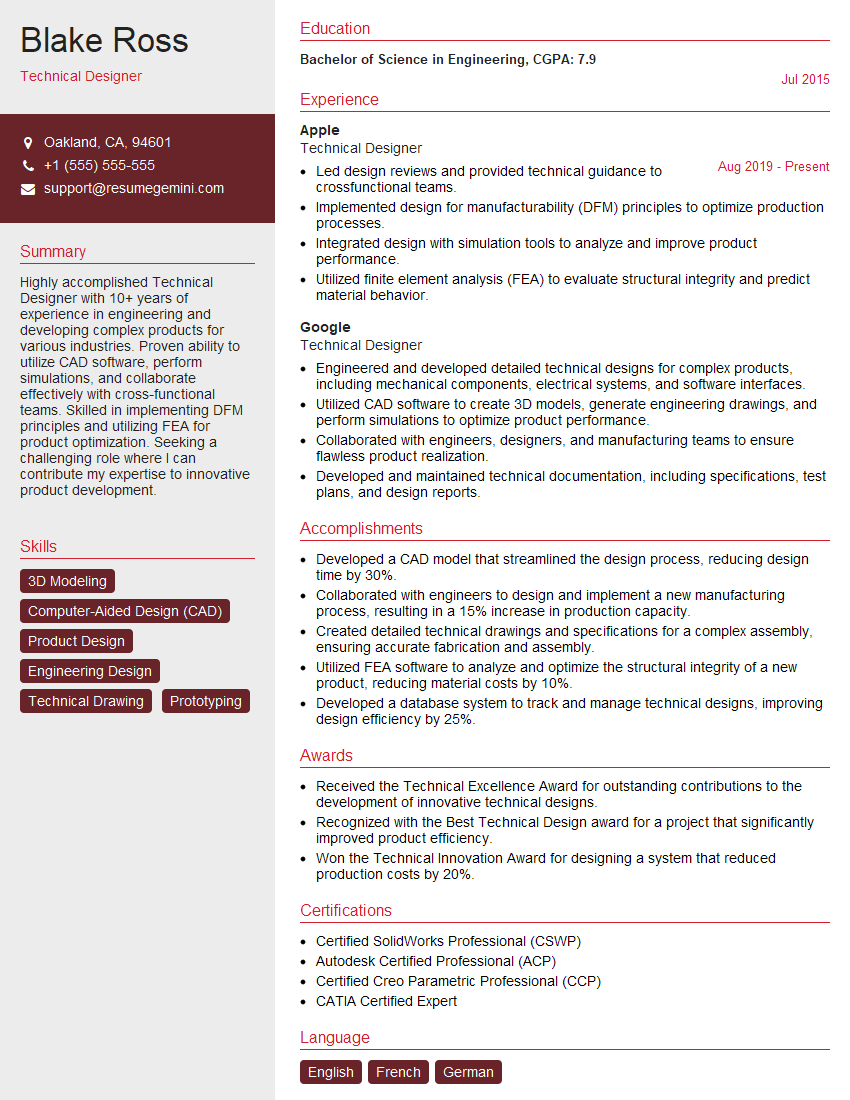
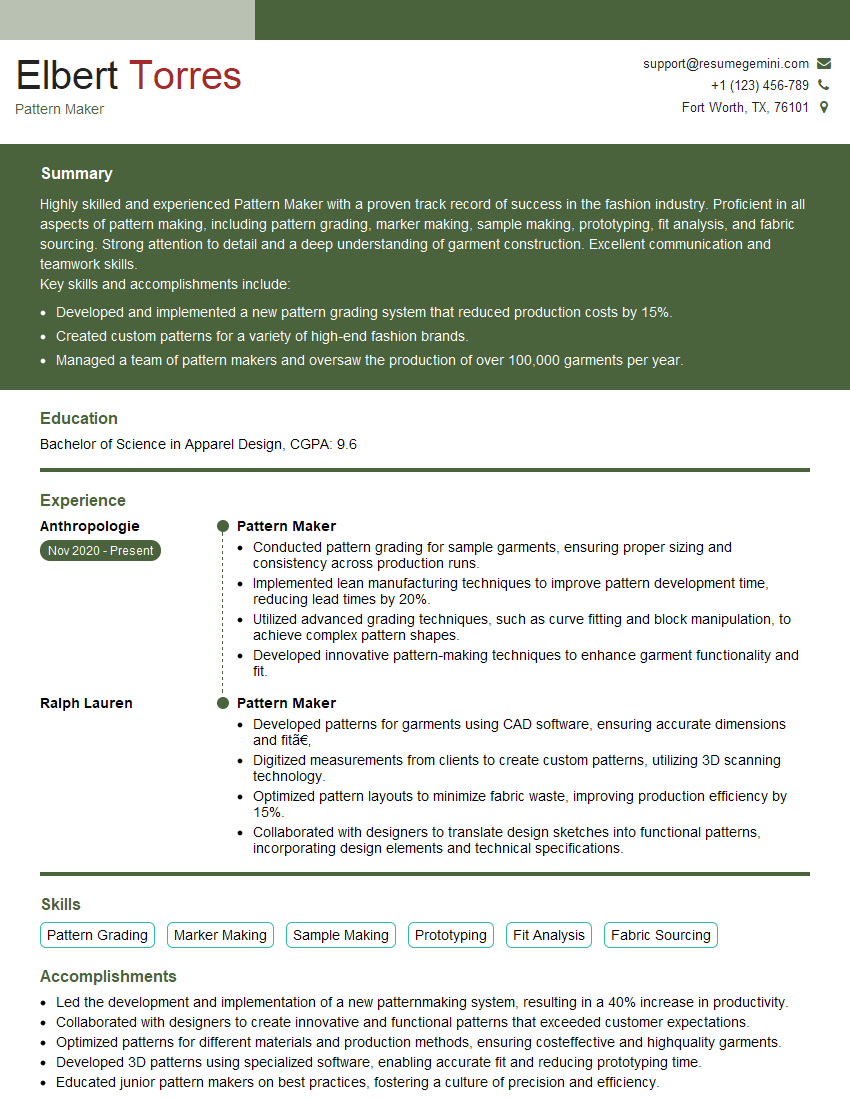
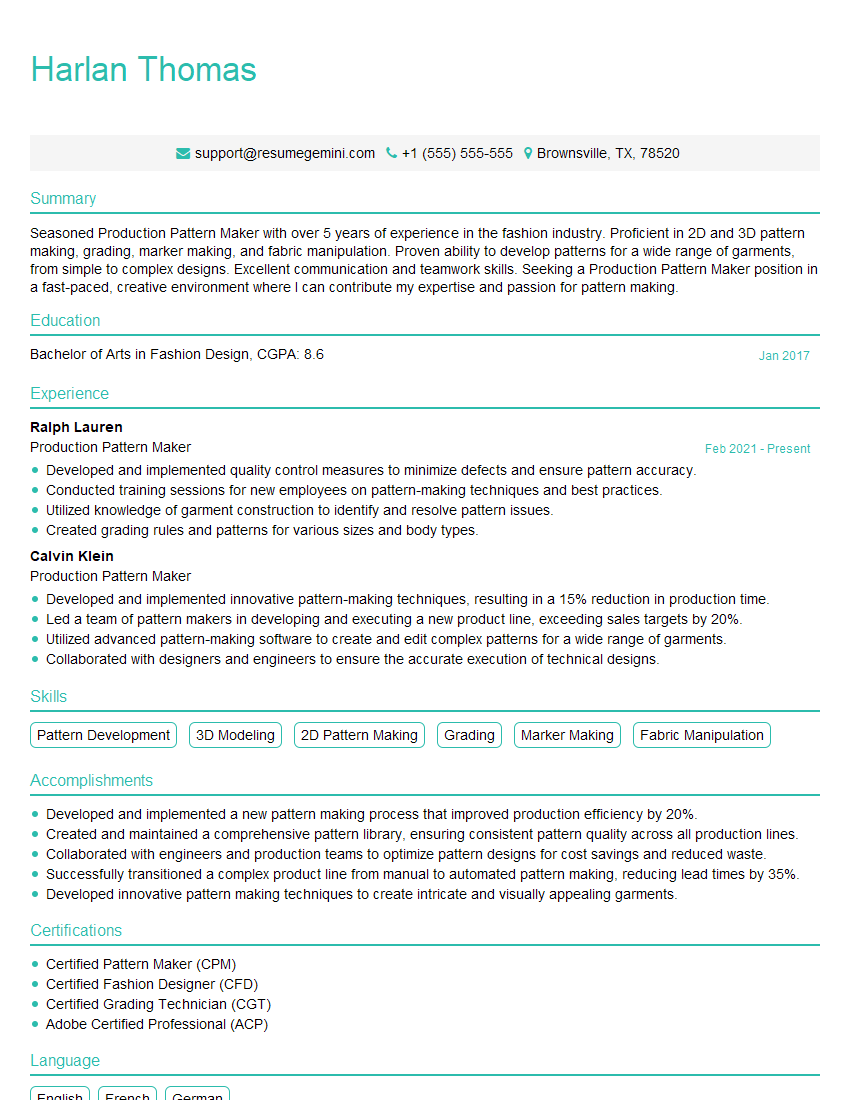
Mastering the art of pattern making is crucial for a successful and rewarding career in the fashion industry. It opens doors to diverse roles and allows for creative expression and technical expertise. To significantly enhance your job prospects, a well-crafted, ATS-friendly resume is essential. ResumeGemini can help you create a professional resume that highlights your skills and experience effectively, increasing your chances of landing your dream job. Examples of resumes tailored to showcasing expertise in Knowledge of Pattern Making are available through ResumeGemini to help you get started.
Explore more articles
Users Rating of Our Blogs
Share Your Experience
We value your feedback! Please rate our content and share your thoughts (optional).
What Readers Say About Our Blog
Hello,
we currently offer a complimentary backlink and URL indexing test for search engine optimization professionals.
You can get complimentary indexing credits to test how link discovery works in practice.
No credit card is required and there is no recurring fee.
You can find details here:
https://wikipedia-backlinks.com/indexing/
Regards
NICE RESPONSE TO Q & A
hi
The aim of this message is regarding an unclaimed deposit of a deceased nationale that bears the same name as you. You are not relate to him as there are millions of people answering the names across around the world. But i will use my position to influence the release of the deposit to you for our mutual benefit.
Respond for full details and how to claim the deposit. This is 100% risk free. Send hello to my email id: [email protected]
Luka Chachibaialuka
Hey interviewgemini.com, just wanted to follow up on my last email.
We just launched Call the Monster, an parenting app that lets you summon friendly ‘monsters’ kids actually listen to.
We’re also running a giveaway for everyone who downloads the app. Since it’s brand new, there aren’t many users yet, which means you’ve got a much better chance of winning some great prizes.
You can check it out here: https://bit.ly/callamonsterapp
Or follow us on Instagram: https://www.instagram.com/callamonsterapp
Thanks,
Ryan
CEO – Call the Monster App
Hey interviewgemini.com, I saw your website and love your approach.
I just want this to look like spam email, but want to share something important to you. We just launched Call the Monster, a parenting app that lets you summon friendly ‘monsters’ kids actually listen to.
Parents are loving it for calming chaos before bedtime. Thought you might want to try it: https://bit.ly/callamonsterapp or just follow our fun monster lore on Instagram: https://www.instagram.com/callamonsterapp
Thanks,
Ryan
CEO – Call A Monster APP
To the interviewgemini.com Owner.
Dear interviewgemini.com Webmaster!
Hi interviewgemini.com Webmaster!
Dear interviewgemini.com Webmaster!
excellent
Hello,
We found issues with your domain’s email setup that may be sending your messages to spam or blocking them completely. InboxShield Mini shows you how to fix it in minutes — no tech skills required.
Scan your domain now for details: https://inboxshield-mini.com/
— Adam @ InboxShield Mini
Reply STOP to unsubscribe
Hi, are you owner of interviewgemini.com? What if I told you I could help you find extra time in your schedule, reconnect with leads you didn’t even realize you missed, and bring in more “I want to work with you” conversations, without increasing your ad spend or hiring a full-time employee?
All with a flexible, budget-friendly service that could easily pay for itself. Sounds good?
Would it be nice to jump on a quick 10-minute call so I can show you exactly how we make this work?
Best,
Hapei
Marketing Director
Hey, I know you’re the owner of interviewgemini.com. I’ll be quick.
Fundraising for your business is tough and time-consuming. We make it easier by guaranteeing two private investor meetings each month, for six months. No demos, no pitch events – just direct introductions to active investors matched to your startup.
If youR17;re raising, this could help you build real momentum. Want me to send more info?
Hi, I represent an SEO company that specialises in getting you AI citations and higher rankings on Google. I’d like to offer you a 100% free SEO audit for your website. Would you be interested?
Hi, I represent an SEO company that specialises in getting you AI citations and higher rankings on Google. I’d like to offer you a 100% free SEO audit for your website. Would you be interested?
good