Preparation is the key to success in any interview. In this post, we’ll explore crucial Knowledgeable in Lighting Design Software (e.g., MA Lighting, ETC EOS) interview questions and equip you with strategies to craft impactful answers. Whether you’re a beginner or a pro, these tips will elevate your preparation.
Questions Asked in Knowledgeable in Lighting Design Software (e.g., MA Lighting, ETC EOS) Interview
Q 1. Explain the difference between a cue and a preset in MA Lighting grandMA2.
In MA Lighting grandMA2, cues and presets are fundamental building blocks for creating a lighting show, but they serve distinct purposes. Think of a preset as a snapshot of your lighting state – a specific configuration of fixture positions, colors, and intensities. You might have a preset for a ‘full stage wash’ or a ‘spotlight on the lead singer’. You create and store these individually.
A cue, on the other hand, is a transition or change *between* presets. It’s not just a static picture, but an instruction telling the console how to move from one lighting state to another. This transition can be instantaneous, or it can be a gradual fade or more complex movement over time. A cue might take you from your ‘full stage wash’ preset to your ‘spotlight on lead singer’ preset, specifying the duration of the fade and the type of dimming curve to use.
Example: Imagine a theatre production. You might have a preset called “Upstage Wash Blue” and another called “Downstage Wash Amber”. Cue 1 could be a slow crossfade from “Upstage Wash Blue” to “Downstage Wash Amber”, while Cue 2 might be an instant jump back to “Upstage Wash Blue”. Each cue orchestrates the movement *between* the presets, giving you precise control over the lighting evolution throughout the performance.
Q 2. Describe your experience using ETC EOS’s ‘Magic Sheets’ feature.
ETC EOS’s Magic Sheets are a game-changer for managing complex lighting designs. Essentially, they’re customizable spreadsheets that let you visually organize and edit fixture data. Instead of navigating through layers of menus, you can see all your fixture information in a single, intuitive view. This is particularly useful for large shows with hundreds of fixtures.
My experience with Magic Sheets has been overwhelmingly positive. I’ve used them extensively to create and manage complex lighting looks, especially when working with large-scale productions requiring intricate lighting changes. For example, I used Magic Sheets to quickly adjust the color temperatures of all the front-of-house LED fixtures during a concert – a task that would have been incredibly time-consuming using traditional methods. The ability to make global adjustments or fine-tune individual fixtures within this spreadsheet interface dramatically boosts efficiency and minimizes errors.
One particularly helpful aspect is the ability to create custom columns. This means I can add information relevant to the specific production, such as the fixture’s position on the stage or its designated function within the show. This further enhances organization and reduces potential confusion during setup and programming.
Q 3. How would you troubleshoot a flickering fixture during a live show using MA Lighting?
Troubleshooting a flickering fixture during a live show using MA Lighting requires a systematic approach. The first step is to isolate the problem. Is it a single fixture or multiple fixtures flickering? Is the flicker constant or intermittent? Does it affect all colors or just certain ones?
Next, check the obvious: are the power connections secure? Is the DMX cable properly connected and free from damage? A visual inspection of the fixture itself can often reveal loose wiring or other physical issues. If you have access to the fixture’s internal settings, check for any errors or warnings.
If the issue persists, the problem might lie in the console’s configuration. Verify that the fixture is correctly patched and that the DMX universe assignment is accurate. A simple check could involve patching the fixture to a different universe or address to see if the flicker moves or disappears. Finally, try temporarily disabling other effects or cues to see if they’re interacting negatively with the affected fixture. In MA Lighting, you can use the ‘Fixture Status’ view to monitor individual fixture information in real-time and isolate any potential issues.
Documentation is key: Record the steps you take and any observations you make so that you can identify the root cause efficiently and accurately. This information also helps prevent recurrence in future shows.
Q 4. Explain the concept of patching in the context of lighting consoles.
Patching, in the context of lighting consoles, is the process of assigning physical fixtures to channels on the console. Think of it as establishing a communication link between the lighting console and each individual lighting fixture. Each fixture needs a unique channel number or address to receive instructions from the console. Without patching, the console wouldn’t know which fixture to control.
The patching process involves associating a physical fixture with a specific console channel. This is usually done via a software interface where you select the fixture type, the universe and address the fixture is on, and then assign it to a console channel. For example, a fixture at DMX address 10 on Universe 1 might be patched to console channel 10. The console then sends commands to that channel, which the fixture receives and interprets.
Why is this important? Efficient patching helps you organize the many fixtures, making the console more user-friendly, preventing accidental overwriting and ensuring that commands are sent to the correct equipment.
Q 5. How do you manage complex lighting cues with many fixtures using ETC EOS?
Managing complex lighting cues with many fixtures in ETC EOS often involves leveraging the console’s powerful organizational tools. Grouping fixtures logically is critical. ETC EOS allows you to create fixture groups based on function (e.g., frontlights, backlights, specials), location (e.g., stage left, stage right), or any other relevant criteria. This allows you to control multiple fixtures simultaneously without having to address each one individually.
Submasters are incredibly useful for building layers of control. These allow you to create and control overall intensities or combinations of fixture groups. A simple example is using a submaster to control the overall brightness of the stage wash while retaining the ability to adjust individual fixture groups for specific effects. Cue Lists help to organize cues sequentially and provide additional layers of control over the timing and execution of the lighting show. They also facilitate easy recall of specific lighting states.
Utilizing workspaces allows you to set up different configurations for various parts of the show, enabling a structured workflow. For instance, you could have one workspace for setting up your base lighting levels and another for programming effects.
Finally, effective labeling and documentation are essential for maintainability and collaboration. Clearly naming groups, cues, and submasters ensures that the entire team, even if they did not originally program the show, understands the design.
Q 6. What are the different types of dimming curves available in MA Lighting, and when would you use each one?
MA Lighting offers a variety of dimming curves, each impacting how smoothly and quickly a fixture’s intensity changes. These curves go beyond simple linear fades, allowing for creative control of light transitions.
- Linear: A straight-line fade, where the intensity changes at a constant rate. It’s the most straightforward and often used for simple crossfades.
- Square: A fast rise and fall, resembling a square wave. Useful for sharp, dramatic changes.
- S-Curve: A slower start and end, giving a smoother, more natural-feeling transition. Excellent for avoiding harsh jumps in intensity.
- Inverse S-Curve: The opposite of the S-curve – slow start and finish – ideal for subtle lighting adjustments.
- Exponential: A rapid change at the beginning and slower towards the end, creating a gradual transition.
The choice of curve depends entirely on the desired effect. A linear curve is perfect for a simple fade between two colors. An S-curve might be preferred for a smoother transition between scenes, and a square curve might be used for a quick, impactful change.
Q 7. How do you create and use palettes in ETC EOS?
Palettes in ETC EOS are a fantastic way to store and recall frequently used lighting looks or effects. They work like pre-programmed snapshots of your lighting state but are designed for rapid access and layering. Instead of recalling individual cues, you can simply activate or combine palettes to achieve different lighting styles.
Creating a Palette: You select the fixtures and set their parameters (color, intensity, position, etc.) to create the desired look. Then, you use the palette creation function within ETC EOS to save this look under a descriptive name. You can add as many palettes as you need.
Using a Palette: Once a palette is created, you can access it directly from the console’s palette display. You can execute a palette directly or combine multiple palettes to build more complex looks. Palettes are very powerful for generating quick and interesting lighting effects. They are incredibly valuable for speeding up the workflow when repeated lighting states are needed during the show.
Example: You might create palettes for a ‘warm ambient’ look, a ‘dramatic spotlight’ look, and a ‘fast strobe’ effect. During the performance, you can instantly recall these palettes – or even blend them together seamlessly – resulting in complex, dynamic lighting sequences without lengthy cue programming.
Q 8. Describe your experience working with moving lights and their various parameters.
Moving lights are the workhorses of modern lighting design, offering incredible flexibility and creativity. My experience encompasses a wide range of fixtures, from basic movers with limited features to sophisticated units with extensive pan/tilt, color mixing, gobo projection, and effects capabilities. Understanding their parameters is crucial for effective programming. These parameters typically include:
- Pan and Tilt: Control the horizontal and vertical movement of the fixture. Think of it like aiming a spotlight – you need precise control to point it exactly where you want.
- Color Mixing: Most modern movers utilize CMY (Cyan, Magenta, Yellow) or CMYW (adding White) color mixing systems, allowing for a vast spectrum of colors. Some also include RGB (Red, Green, Blue) or even RGBA (adding Amber) for even more options. Understanding how these colors interact is key to achieving specific hues.
- Gobo Projection: These are metal or glass templates placed in the light path to create patterns or images. Parameters include gobo selection, rotation, and size.
- Prism: These create beams of light that split into multiple beams, adding depth and texture.
- Dimmer: Controls the intensity of the light output.
- Shutter: Controls the on/off state of the light, often used for strobing or other quick effects.
- Focus/Zoom: Adjusts the beam angle, from a tight spot to a wide wash.
- Effects: Pre-programmed sequences of movements, color changes, and other parameters.
For example, during a recent theatre production, I programmed a complex chase sequence using the pan/tilt, color mixing, and gobo rotation parameters of several moving heads to create a dynamic and visually engaging effect across the stage.
Q 9. How do you handle color mixing on MA Lighting to achieve specific hues?
MA Lighting consoles offer several ways to achieve precise color mixing. I primarily use the color picker wheel, which provides a visual representation of the entire color spectrum. By clicking on the desired hue, the console automatically calculates the necessary CMY or RGB values. However, for more precise control, I often use the numerical RGB or CMY values directly, allowing fine adjustments to achieve subtle nuances. For instance, I can adjust the yellow value slightly to make a certain shade of green warmer or cooler. I also use the color palettes in MA Lighting to save specific colors and apply them easily to multiple fixtures.
Sometimes, a precise color cannot be achieved through direct CMY/RGB mixing due to the limitations of the fixture’s color wheel. In such cases, I utilize techniques like color correction and color temperature adjustment in the console to achieve the desired visual result. Sometimes, I might even blend several fixtures with slightly different colors to get the most accurate color representation.
Q 10. Explain your process for programming a complex lighting show using ETC EOS.
My process for programming a complex lighting show on ETC EOS is structured and methodical. It involves the following steps:
- Pre-programming: I start by thoroughly reviewing the design and discussing the director’s vision. This includes analyzing the script, set design, and costume design to understand the overall aesthetic. I also create a lighting plot, specifying fixture positions and types.
- Patching: I assign the physical fixtures to channels within the console. This establishes the communication pathway between the console and the lights.
- Cue Programming: I program individual cues, starting with the basic looks for each scene. I use the EOS’s powerful cue layering and submaster features to build complexity, allowing for gradual changes and smooth transitions between looks. This process includes focusing individual fixtures, selecting gobos and color mixes.
- Sequence and Timing: I build the show’s timing and sequence using the cue lists and the powerful macros. Here, I refine the timing and transitions to ensure a smooth flow.
- Testing and Refinement: Once the programming is complete, I conduct thorough testing and rehearsals, making adjustments as needed to ensure that the lighting design meets the artistic vision.
- Documentation: Finally, I document the entire process, including a comprehensive cue list and notes, for future reference.
For instance, on a recent musical, I used submasters extensively to control separate lighting areas, allowing me to create complex crossfades and build the intensity effectively and efficiently.
Q 11. What are some common troubleshooting techniques for DMX communication issues?
DMX communication issues are common in lighting, but often solvable with systematic troubleshooting. My approach involves:
- Check Cables and Connections: Start by visually inspecting all DMX cables for damage and ensuring that all connections are secure at both the console and fixture ends. A loose connection is the most frequent cause of issues.
- Verify DMX Addressing: Ensure that each fixture has a unique DMX address and that the addressing sequence is correct. Address conflicts are common sources of problems.
- Test the DMX Signal: Use a DMX signal tester to check the signal strength and continuity throughout the DMX chain, identifying any signal breaks or drops. This helps pinpoint the section where the problem lies.
- Check the DMX Splitter/Merger: If a DMX splitter or merger is in use, check its functionality and ensure there are no faulty nodes.
- Isolate the Problem: Try disconnecting and reconnecting parts of the DMX chain to isolate the problem. Start by disconnecting half the fixtures, seeing if you are now getting a good signal, then work on the rest if needed.
- Verify Console Settings: Check the console’s DMX output settings to ensure they are properly configured.
- Reboot Hardware: Sometimes a simple reboot of the console or DMX devices can resolve temporary glitches.
Remember, always work methodically, and record your progress. I often document my troubleshooting steps, which is particularly useful when working with large-scale systems.
Q 12. How do you create and manage lighting looks for different scenes in a production?
Creating and managing lighting looks for different scenes requires organization and a clear understanding of the production’s needs. My approach involves:
- Defining Looks: I work closely with the director to define the mood, color palette, and overall style of each scene. This ensures that the lighting accurately reflects the narrative and emotions.
- Cue Lists and Submasters: I utilize cue lists and submasters extensively to organize and control different looks. This enables me to recall and modify lighting states easily and efficiently during the show.
- Naming Conventions: A consistent and descriptive naming convention for cues and submasters is essential for efficient organization and recall. For example, `Scene1_Intro`, `Scene1_Dialogue`, `Scene1_Climax`.
- Color Palettes: Using color palettes within the console significantly streamlines the process, allowing for quick access to pre-selected colors that match the scene’s aesthetic.
- Backup and Version Control: Regularly backing up my lighting programming is crucial. This protects against data loss and allows me to revert to previous versions if necessary.
For instance, in a recent play, I created distinct looks for each act, further subdividing them into scenes using submasters and well-named cues. This enabled smooth transitions and a high level of control during the performance.
Q 13. Describe your experience with network protocols used in lighting control systems (e.g., Art-Net, sACN).
I am proficient in several network protocols used in lighting control systems. Art-Net and sACN (Streaming ACN) are the most prevalent. Art-Net is a simpler, older protocol, generally more forgiving, but it has limitations in terms of scalability and reliability compared to sACN. sACN, based on the ANSI E1.31 standard, is a much more robust and reliable protocol, offering features such as redundancy and error correction, particularly useful for large and complex shows. It’s capable of handling a much higher number of fixtures and has superior capabilities for handling signal loss and recovery.
My experience includes designing and implementing networks using both protocols. I understand the differences in their functionalities, addressing schemes, and setup procedures. I can configure routers, network switches, and network interfaces to optimize network performance and ensure a reliable DMX signal transmission. Furthermore, I understand the importance of network monitoring tools to detect and troubleshoot network problems efficiently.
Q 14. How familiar are you with different fixture types (LED, tungsten, discharge)?
I’m very familiar with various fixture types including LED, tungsten, and discharge (HID) lights. Each type has its own unique characteristics and applications:
- LED (Light Emitting Diode): Energy-efficient, long lifespan, and excellent color mixing capabilities. They’re versatile, used in everything from small theatrical productions to large concerts. They offer very precise color control and are highly versatile.
- Tungsten: Produce warm, pleasing light, but are less energy-efficient and have a shorter lifespan than LEDs. They generate significant heat, requiring specialized handling. Tungsten fixtures remain useful for creating a specific aesthetic in situations where the heat output isn’t a problem, and their color rendition is desirable.
- Discharge (HID – High-Intensity Discharge): Include fixtures like HMI (Hydrargyrum Medium-arc Iodide) and metal halide. They offer high light output, but are less energy-efficient than LEDs. Their color rendering is also not as good as LEDs and they often take a little time to warm up to full output. They’re still common in some large-scale applications, but their use is declining due to the advantages of LEDs.
Understanding the strengths and weaknesses of each type is critical for selecting the appropriate fixture for a given application. For example, in a situation requiring high color accuracy and long-term operation, LEDs are preferable, while tungsten might be selected for a production seeking a specific vintage aesthetic.
Q 15. What safety procedures do you follow when working with high-voltage lighting equipment?
Safety is paramount when working with high-voltage lighting equipment. My approach is built on a foundation of rigorous adherence to safety protocols and best practices. Before even touching any equipment, I always ensure that the power is completely disconnected and locked out/tagged out. This prevents accidental energization. I then use appropriate personal protective equipment (PPE), including insulated gloves, safety glasses, and non-conductive footwear. I meticulously inspect all cables and connectors for any signs of damage before use, rejecting any showing wear or tear. During setup and operation, I maintain a safe working distance from energized equipment and avoid working alone. I always have a designated spotter or assistant on hand, especially when working at heights or in confined spaces. Finally, I’m thoroughly familiar with emergency shutdown procedures and the location of safety equipment like fire extinguishers and first-aid kits.
For example, on a recent outdoor event, we were using powerful moving lights. Before powering them on, we meticulously inspected every cable and connector and ensured that all ground connections were secure. We also used a designated area away from the audience, properly grounded, to stage and test all fixtures. This proactive approach minimizes risk and prevents accidents.
Career Expert Tips:
- Ace those interviews! Prepare effectively by reviewing the Top 50 Most Common Interview Questions on ResumeGemini.
- Navigate your job search with confidence! Explore a wide range of Career Tips on ResumeGemini. Learn about common challenges and recommendations to overcome them.
- Craft the perfect resume! Master the Art of Resume Writing with ResumeGemini’s guide. Showcase your unique qualifications and achievements effectively.
- Don’t miss out on holiday savings! Build your dream resume with ResumeGemini’s ATS optimized templates.
Q 16. How do you ensure the accurate representation of lighting plots in a virtual environment?
Accurately representing lighting plots in a virtual environment is crucial for visualization and client communication. I leverage the powerful visualization tools within lighting design software like MA Lighting’s grandMA3 or ETC’s Eos family. These software packages allow me to import 3D models of the venue, accurately position lighting fixtures, and simulate the lighting effects. I meticulously enter the correct fixture data, including beam angles, color temperatures, and gobo patterns, ensuring the virtual representation mirrors reality as closely as possible. Rendering settings are carefully considered to achieve photorealistic results, allowing clients to comprehend the lighting design’s impact and make informed decisions.
For instance, when designing the lighting for a theatre production, I imported the stage’s 3D model into the software. I then positioned the lights, programmed the cues, and rendered high-quality visualizations which showcased different scenes with precise lighting. This greatly aided client approval and the overall efficiency of the project by reducing the number of iterations needed.
Q 17. How do you effectively collaborate with other lighting professionals during the design and implementation stages?
Effective collaboration is the cornerstone of successful lighting design. I actively foster collaboration through clear communication, utilizing shared platforms and tools. I regularly attend meetings with lighting technicians, set designers, and production managers to ensure alignment on goals and technical specifications. We use cloud-based platforms to share lighting plots, design documents, and technical riders, facilitating seamless information exchange. Software-based file sharing of lighting data (like .gld files) ensures everyone works with the most up-to-date information. During implementation, I maintain open communication with the technical crew, answering questions and addressing any arising challenges promptly. Active listening and a willingness to incorporate feedback from colleagues are vital to the process.
In one project, we utilized a shared online project management tool to track progress, communicate issues and share files. This transparent approach allowed for efficient collaboration across all departments, ensuring a smooth process.
Q 18. Explain your understanding of different lighting design styles and aesthetics.
My understanding of lighting design styles encompasses a broad range, from the subtle elegance of minimalist designs to the dramatic flair of theatrical productions. I’m familiar with various aesthetics, including:
- Minimalist: Emphasizing clean lines and subtle illumination, often using natural light sources or concealed fixtures.
- Dramatic: Creating strong contrasts and impactful visuals using intense lighting, gobos, and color effects.
- Ambient: Providing a comfortable and welcoming atmosphere through diffuse lighting, often used in hospitality settings.
- Accent: Highlighting specific features or architectural elements using focused lighting.
- Theatrical: Employing a wide array of techniques and technologies to create mood, atmosphere, and narrative.
For example, a restaurant might require an ambient style with warm lighting, while a concert would necessitate a dramatic approach to enhance the performance.
Q 19. What is your experience with integrating lighting design software with other production software?
I have extensive experience integrating lighting design software with other production software, such as media servers, video control systems, and CAD programs. For example, I frequently use the DMX output of lighting consoles to synchronise lighting with video playback on media servers, creating integrated visual spectacles. I’m proficient in using various file formats and protocols like sACN (streaming Architecture for Control Networks) and Art-Net to bridge communication between different systems. Furthermore, I regularly import 3D models from CAD software into my lighting design software, allowing precise placement of fixtures within a virtual environment.
In a recent project involving a large-scale projection mapping, I integrated the MA Lighting console with a Resolume media server using Art-Net, creating precisely timed lighting cues synchronized with the video content. This ensured a seamless visual experience.
Q 20. Describe your experience with lighting documentation and as-built drawings.
Precise lighting documentation is essential for efficient implementation and future maintenance. I meticulously create detailed lighting plots, including fixture schedules, cable plans, and power distribution diagrams. These documents serve as a blueprint for the installation team, ensuring accuracy and reducing errors. Following the event or installation, I produce as-built drawings reflecting any modifications made during implementation. These as-built documents are crucial for future reference and troubleshooting, and include accurate positioning of all fixtures and cable routing, often incorporating photos for visual confirmation.
My documentation always includes clear labeling and annotations, using industry-standard symbols and conventions for maximum clarity. This approach ensures that others can easily understand the design and maintain the lighting system effectively.
Q 21. How would you approach creating a lighting design for a large-scale outdoor event?
Designing lighting for a large-scale outdoor event requires a comprehensive approach. First, I’d conduct a thorough site survey, considering factors like the venue’s size, power availability, and potential obstructions. I’d develop a detailed lighting plot incorporating a mix of automated lighting fixtures (moving lights) for dynamic effects and static fixtures for wash and ambient lighting. Careful consideration would be given to the event’s type and desired atmosphere. Power distribution would be carefully planned to ensure adequate capacity, potentially requiring multiple power sources and generators. Safety is paramount, requiring rigorous adherence to relevant regulations, with a focus on ground fault protection and proper cable management. The design would be thoroughly simulated within lighting design software before implementation, providing the opportunity to fine-tune the lighting and address any potential issues beforehand.
For example, a large outdoor concert would require powerful wash lights to illuminate the stage, strategically placed moving lights for dynamic effects, and possibly specialized lighting for audience areas. I would use software simulations to preview the design’s impact across varying weather conditions to account for ambient light changes.
Q 22. Explain the process for calibrating lighting fixtures and ensuring consistent color temperature.
Calibrating lighting fixtures to ensure consistent color temperature is crucial for a visually harmonious show. It involves a multi-step process, starting with individual fixture adjustments and culminating in overall show balance.
First, we’ll use a color meter or spectrophotometer to measure the actual color temperature of each fixture. This is often done using a white light setting at a specific intensity. This gives us a baseline. We then adjust the fixture’s internal settings (often accessed via DMX commands or onboard controls) to match the desired color temperature. This might involve adjusting color correction wheels, gels, or even using the console’s color mixing capabilities to compensate for variations.
For example, if a fixture is reading at 3000K (warm white) when we need 3200K, we’ll subtly increase the blue channel in the console’s color mixing until the reading matches. We repeat this process for each fixture type used in the production, creating a library of calibrated settings. Finally, we review the overall scene, looking for any discrepancies in color. Small adjustments on the console are made to blend colors and create a uniform look across all the fixtures on stage.
Q 23. What are some best practices for maintaining lighting equipment and preventing malfunctions?
Maintaining lighting equipment is essential to prevent malfunctions and ensure a smooth production. Proactive maintenance involves a combination of regular cleaning, careful handling, and preventative checks.
- Regular Cleaning: Lenses should be cleaned regularly with appropriate lens cleaning solutions and microfiber cloths to prevent dust build-up, which affects light output and color quality. Fixtures should be inspected for loose parts and debris.
- Cable Management: Properly organizing and securing cables prevents tripping hazards, damage to the cables, and ensures dependable connectivity. Using cable ties and labeled connectors is essential for efficiency.
- Preventative Checks: Regular inspection of all connections, bulbs, and moving parts are crucial. This could include checking for any loose connections, dimming issues, or abnormal sounds. We should regularly check and update firmware on the consoles and fixtures.
- Environmental Factors: Protect the equipment from extreme temperatures, moisture, and dust. This includes using protective covers when not in use and ensuring proper ventilation in the lighting rig.
Thinking of it like maintaining a car, regular servicing prevents major problems down the road. Neglecting even small maintenance tasks can result in costly repairs or show delays.
Q 24. How do you handle unexpected issues or technical problems during a live show?
Handling unexpected issues during a live show requires quick thinking, problem-solving skills, and a calm demeanor. My approach is based on a structured process.
- Assess the situation: Quickly determine the nature and severity of the problem. Is it a single fixture failure, a console malfunction, or a power outage?
- Isolate the problem: Try to pinpoint the exact source of the failure. This often involves checking connections, examining the console for error messages, and visually inspecting the lighting fixtures.
- Implement a workaround: Depending on the problem, we might have backup fixtures, pre-programmed alternative cues, or the ability to adjust the show’s lighting design to compensate. For example, if a fixture fails, we might shift the emphasis to other fixtures, or if a console has a glitch, we may have a backup.
- Communicate effectively: Keep the stage manager and other crew members informed about the situation and the implemented solutions. Clear communication is key to a smooth recovery.
- Document the issue: After the show, we’ll document the problem, the solution, and any lessons learned. This helps improve future procedures and prevent similar issues.
For example, during a recent concert, one of the main moving lights unexpectedly stopped responding. We quickly switched to a backup fixture programmed with a similar cue, minimizing the impact on the performance.
Q 25. How do you incorporate audience interaction into your lighting design?
Incorporating audience interaction into lighting design can significantly enhance the show’s engagement. This can be achieved through various techniques.
- Reactive Lighting: Using sensors that detect audience movement or noise levels can trigger changes in lighting intensity, color, or movement. For instance, brighter lights during moments of heightened audience response.
- Interactive Projections: Projecting images or patterns onto the audience, responding to their actions in real-time, creates a dynamic and immersive experience.
- Audience-Controlled Effects: Integrating simple controls allowing the audience to influence specific aspects of the lighting, such as color changes via a voting system or app, adds a playful element.
- Dynamic Lighting Sequences: Implementing lighting designs that change and evolve based on audience participation, like changing the rhythm or color intensity based on applause.
In a recent theater production, we used audience-activated LEDs in the seating area that responded to applause and cheers. The intensity and color of the LEDs fed back into the stage lighting design creating a truly interactive experience.
Q 26. What are your preferred methods for creating effective lighting cues and transitions?
Creating effective lighting cues and transitions is a crucial aspect of lighting design. The key is to create a seamless and visually compelling narrative using a combination of techniques.
- Timing and Pacing: Carefully consider the speed and duration of transitions to match the mood and rhythm of the performance. Fast transitions can create excitement, while slow, gradual changes can evoke calmness.
- Color and Intensity Changes: Smoothly modulating color temperatures and intensities creates a more natural and visually pleasing effect than abrupt shifts.
- Shape and Position: Subtle shifts in the shape and position of lighting beams can be used to draw attention to specific areas on stage and add depth.
- Go/No-Go cues: Establishing clear and well-defined cues with a reliable backup system is essential to avoid miscommunication during a live show. We use clear labeling and cue sheets to maintain synchronization.
- Using effects: Incorporating strobe effects, chases, and other dynamic effects can add energy and visual excitement to the performance but needs to be used judiciously to avoid distraction.
For example, a scene transition from a lively dance sequence to a tender moment might involve a gradual dimming of the lights, a shift from vibrant colors to warmer tones, and the use of softer, more diffuse lighting.
Q 27. Explain your experience with different lighting fixture manufacturers and their specific features.
I have extensive experience with a wide range of lighting fixture manufacturers, each with its own strengths and features.
- ETC (Electronic Theatre Controls): Known for their robust and reliable consoles, such as the EOS family, offering a powerful and intuitive interface. Their Source Four fixtures are industry standards renowned for their high-quality optics and versatile color rendering capabilities.
- MA Lighting: Their grandMA consoles are favored for large-scale productions and their sophisticated features for complex lighting designs and effects. They offer a wide range of moving lights with exceptional color mixing and effects capabilities.
- Clay Paky: These fixtures are known for their exceptional brightness and vibrant colors, often used in concert and large-scale events. Their unique optics and moving head features allow for dynamic and creative lighting effects.
- Martin Professional: This brand provides a range of versatile fixtures, often used in architectural lighting and stage productions. Their products are well-regarded for their ease of use and reliability.
The choice of manufacturer and specific fixture depends heavily on the project’s needs, budget, and the desired aesthetic.
Q 28. Describe your workflow for importing and exporting show files between different consoles and software.
Importing and exporting show files between different consoles and software requires careful attention to compatibility and file formats.
The most common method involves using industry-standard file formats like .gld (GrandMA2), .dat (ETC EOS), or .mx (MA Lighting). The specific workflow depends on the software and hardware involved. I typically use the console’s built-in import/export features. However, direct transfer isn’t always possible.
Sometimes, we’ll use third-party conversion tools to translate files between incompatible formats. This may require some manual adjustments after conversion to ensure accurate representation of cues and settings. In certain instances, it’s more efficient to recreate aspects of a show file from scratch, rather than trying to force an imperfect conversion.
In my experience, comprehensive documentation of the show file’s settings is crucial. This includes comments, naming conventions, and detailed cue descriptions. This helps reduce errors during the import/export process and streamlines any manual adjustments that might be needed. A consistent naming convention across projects ensures easier file management and reduces the risk of accidental overwrites.
Key Topics to Learn for Knowledgeable in Lighting Design Software (e.g., MA Lighting, ETC EOS) Interview
- Console Interface & Navigation: Mastering the console’s layout, menus, and shortcuts for efficient operation.
- Fixture Addressing & Patching: Understanding how to assign fixtures, create patch lists, and manage complex lighting rigs.
- Programming Techniques: Familiarize yourself with various programming methods, including cue lists, chases, and effects creation.
- Color Mixing & Manipulation: Learn about color spaces (RGB, CMY, etc.), color temperature, and gel emulation within the software.
- Shape & Beam Shaping: Understand the use of gobos, shutters, and other beam shaping tools to create unique lighting effects.
- Moving Light Programming: Develop proficiency in programming and controlling moving lights, including positioning, effects, and palettes.
- Data Backup & Management: Learn the best practices for show file management, including backup procedures and data organization.
- Troubleshooting & Problem Solving: Practice diagnosing common issues such as fixture malfunctions and software errors.
- Networking & Communication Protocols: Understand how the console communicates with lighting fixtures and other network devices.
- Show File Organization and Documentation: Practice creating well-organized and documented show files for easy collaboration and future reference.
Next Steps
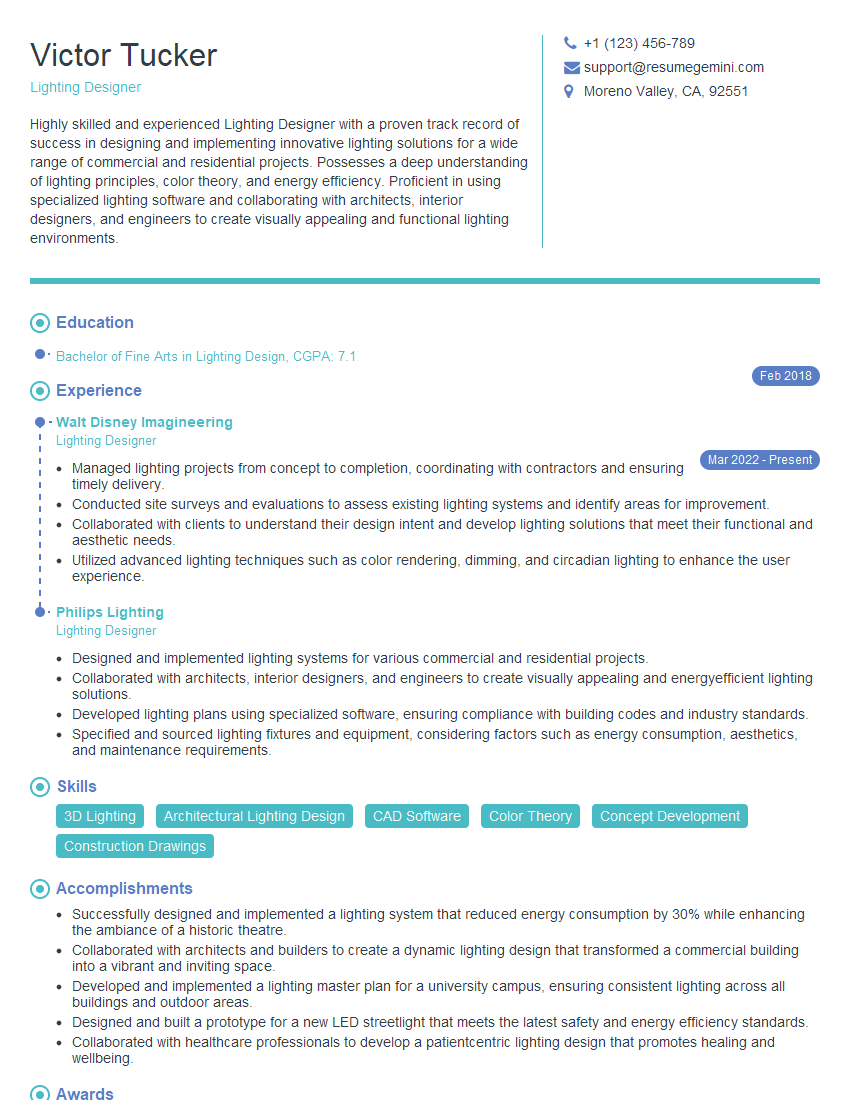
Mastering lighting design software like MA Lighting and ETC EOS is crucial for career advancement in the entertainment and architectural lighting industries. It demonstrates a high level of technical skill and opens doors to more challenging and rewarding projects. To maximize your job prospects, creating a strong, ATS-friendly resume is essential. ResumeGemini is a trusted resource to help you build a professional resume that showcases your skills and experience effectively. Examples of resumes tailored to highlight proficiency in MA Lighting and ETC EOS are available to guide you. Investing time in crafting a compelling resume is an investment in your future career success.
Explore more articles
Users Rating of Our Blogs
Share Your Experience
We value your feedback! Please rate our content and share your thoughts (optional).
What Readers Say About Our Blog
good