Interviews are opportunities to demonstrate your expertise, and this guide is here to help you shine. Explore the essential Ladder Stitch interview questions that employers frequently ask, paired with strategies for crafting responses that set you apart from the competition.
Questions Asked in Ladder Stitch Interview
Q 1. Explain the purpose of the Ladder Stitch.
The Ladder Stitch is an invisible hand stitch primarily used for sewing seams together, closing openings, or neatly joining fabric edges. Its purpose is to create a nearly invisible seam that’s strong and durable, making it ideal for fine work such as mending tears, attaching linings, or closing seams in garments where a visible stitch would be undesirable.
Q 2. Describe the materials needed for performing a Ladder Stitch.
The materials needed for a Ladder Stitch are minimal and readily available. You’ll need:
- A needle: A sharp, fine needle is crucial for ease of insertion and a neat finish. The size will depend on the fabric weight; a finer needle for lighter fabrics and a slightly heavier one for thicker materials.
- Thread: Choose thread that closely matches the fabric color for maximum invisibility. Use a thread that’s strong and appropriate for the fabric type.
- Fabric: The fabric you’re working with – this could be anything from delicate silk to sturdy cotton.
- Scissors: For trimming excess thread.
That’s it! The simplicity of the materials makes it a readily accessible stitch for all skill levels.
Q 3. What types of fabrics are most suitable for a Ladder Stitch?
The Ladder Stitch is versatile and works well on a range of fabrics. However, it’s particularly well-suited to delicate and lightweight fabrics such as silk, chiffon, and fine linens where a less intrusive stitch is preferred. It can also be used on medium-weight fabrics like cotton and blends, but may be more challenging on very thick or heavy materials.
Avoid using it on fabrics that are excessively stretchy or prone to fraying extensively, as the stitch’s delicate nature might not provide sufficient support.
Q 4. How does the Ladder Stitch differ from a slip stitch?
While both the Ladder Stitch and the Slip Stitch are invisible stitches, they differ significantly in their execution and applications. The Slip Stitch involves catching only a single thread from each edge, creating a looser, more flexible seam. It’s often used for seams that need to stretch or have some give, like those on knitwear.
The Ladder Stitch, on the other hand, picks up several threads from both edges of the seam creating a much stronger, more secure seam. It’s preferred when invisibility and strength are paramount, making it unsuitable for stretchy fabrics.
Think of it this way: the Slip Stitch is like lightly holding hands, while the Ladder Stitch is like firmly interlocking fingers – offering greater strength and security.
Q 5. What are the advantages and disadvantages of using a Ladder Stitch?
Advantages:
- Invisibility: The stitch is nearly invisible, making it ideal for fine mending or seam finishing.
- Strength: When executed correctly, it’s surprisingly strong and durable.
- Versatility: It can be used on a variety of fabrics.
- Simplicity: It’s relatively easy to learn once the basic technique is mastered.
Disadvantages:
- Time-consuming: Compared to other stitches, it can be slower to perform.
- Not suitable for all fabrics: It may not be appropriate for extremely thick or stretchy fabrics.
- Requires practice: Achieving consistent tension and invisibility takes practice.
Q 6. Describe the steps involved in performing a Ladder Stitch, step-by-step.
Here’s a step-by-step guide to performing a Ladder Stitch:
- Prepare the edges: Place the two fabric edges together, aligning them carefully. If mending, ensure the tear is neatly closed.
- Begin the stitch: Insert the needle from the underside of one fabric edge, close to the seam line, and bring it up to the top.
- Pick up a thread: Catch a single thread from the opposite edge, going from the right to left, moving the needle directly across to the opposite side, to the underside.
- Repeat: Repeat steps 2 and 3, picking up a thread from the opposite edge with each stitch, maintaining an even distance between stitches.
- Maintain even tension: Keep the tension consistent to create a smooth, even seam. Avoid pulling the thread too tightly, which can pucker the fabric or break the thread.
- Finish the stitch: Once you reach the end of the seam, knot the thread securely on the underside of the fabric. Trim the excess thread close to the knot.
Remember to practice on scrap fabric before attempting it on your project!
Q 7. How do you maintain consistent tension while performing a Ladder Stitch?
Maintaining consistent tension is key to achieving an invisible and strong Ladder Stitch. Here’s how:
- Use your non-dominant hand: Gently hold the fabric edges together with your non-dominant hand, ensuring they remain aligned and taut. This provides a consistent base for stitching.
- Control the thread: Hold the thread gently but firmly with your dominant hand, pulling the needle through with a slow, steady motion. Avoid sudden jerks or pulling too hard. Imagine you’re gently guiding the thread, not forcing it.
- Practice makes perfect: Practice on scrap fabric until you develop a feel for the right amount of tension. You’ll find that your touch and rhythm will naturally improve with practice.
- Check your work regularly: Periodically examine your stitching to ensure the tension is consistent and the seam is lying flat. Make adjustments as needed.
By developing a mindful approach to stitching, you’ll become adept at maintaining that perfect balance – neither too tight nor too loose – resulting in a beautifully invisible and durable seam.
Q 8. How do you adapt the Ladder Stitch for different fabric thicknesses?
Adapting the ladder stitch to different fabric thicknesses is all about adjusting your needle and thread. Think of it like building a bridge – you need stronger materials for a heavier load. For thicker fabrics like denim or upholstery, use a stronger, heavier thread and a slightly larger needle (size 12-16). This allows the needle to easily pierce the material without breaking the thread. For delicate fabrics like silk or chiffon, opt for a very fine needle (size 7-10) and a thin, high-quality thread like silk or embroidery thread. A smaller needle minimizes the hole size, preventing damage to the fabric. The key is to maintain consistent tension throughout; too loose, and the stitch will be weak; too tight, and you risk breaking the thread or damaging the fabric.
Example: When mending a tear in a pair of jeans, I’d use a heavier-duty needle and thread. However, repairing a delicate lace trim would require a much finer approach.
Q 9. How do you ensure the stitch is invisible after completion?
Invisibility in a ladder stitch is achieved through precision and the right technique. The goal is to make the stitches blend seamlessly with the existing fabric. This is primarily accomplished by using a thread that closely matches the fabric color. The stitches themselves should be small, even, and perfectly aligned with the fabric’s weave, almost disappearing into the existing seam. You need to work slowly and carefully, ensuring the needle picks up only a few fibers from each side of the seam. Avoid pulling the thread too tightly, which can distort the fabric and make the stitch more visible. Using a sharp needle helps to create smaller, neater holes, further enhancing the invisibility.
Tip: Practice on a scrap fabric first to get a feel for the tension and stitch size before working on your project.
Q 10. What are some common mistakes to avoid when using a Ladder Stitch?
Common mistakes with the ladder stitch often stem from impatience or lack of attention to detail. Here are some to watch out for:
- Uneven stitches: This happens when you don’t pay close enough attention to the length and tension of each stitch. Consistent stitch size is essential for a neat and invisible finish.
- Pulling the thread too tight: This can pucker or distort the fabric, making the stitch more obvious. Maintain gentle, even tension.
- Incorrect thread color: A visible thread defeats the purpose of an invisible stitch. Always choose a thread that matches the fabric closely.
- Using the wrong needle: Too large a needle creates larger holes, compromising invisibility; too small a needle can cause the thread to break.
- Skipping stitches: This leads to gaps in the seam and a weakened repair.
Q 11. How do you troubleshoot a Ladder Stitch that is unraveling?
If your ladder stitch is unraveling, it likely means the tension was inconsistent or the thread was weak. Troubleshooting involves carefully examining the area where it’s coming undone. You can often reinforce the stitching by going back over the loose section, carefully picking up the same fibers as before and ensuring even tension. In cases where the thread itself is weak or broken, you might need to unpick the affected section and restitch it with a stronger thread and proper technique. If the unraveling is extensive, it’s best to unpick the entire stitch and re-do it.
Example: I once had a ladder stitch on a silk scarf start to come apart. I carefully restitched the section using a finer needle and stronger silk thread, matching the original color perfectly. The repair was undetectable.
Q 12. Can you use a Ladder Stitch on delicate fabrics? If so, how?
Yes, the ladder stitch is suitable for delicate fabrics, but it requires a lighter touch and the right tools. Using a very fine needle (size 7 or 8) and a thin, high-quality thread (silk or fine cotton) is crucial. Work slowly and carefully, using gentle tension to avoid damaging the fabric. Take smaller stitches than you would on a heavier fabric. It helps to use a thimble to protect your finger and maintain consistent pressure.
Example: I’ve successfully used a ladder stitch to mend tears in antique lace and delicate silk garments without causing further damage.
Q 13. How does the choice of needle affect the Ladder Stitch outcome?
Needle choice significantly impacts the outcome of a ladder stitch. The needle’s size and sharpness determine the size of the holes created in the fabric and the ease of passing the thread through. A sharp needle is essential for creating small, neat holes, which is vital for the stitch’s invisibility. Too large a needle will create large holes, while too small a needle may cause the thread to break or damage the fabric. The needle’s type (e.g., sharp, embroidery, or microtex) also matters. Sharps are generally best for most fabrics. Microtex needles are excellent for delicate fabrics, as they are designed to minimize fabric damage.
Q 14. What type of thread is best suited for a Ladder Stitch?
The best thread for a ladder stitch is one that closely matches the fabric’s color and weight. For strength and invisibility, high-quality threads such as silk thread, fine cotton thread (like 60/2 or 80/2), or even a good quality polyester thread are ideal. The thread should be thin enough to create almost invisible stitches but strong enough to hold the fabric together securely. Avoid using overly thick or stiff threads, as these can make the stitches more noticeable and difficult to work with.
Tip: Consider using a thread that is slightly finer than the fabric’s weave to enhance the invisibility.
Q 15. Describe situations where a Ladder Stitch is particularly useful.
The Ladder Stitch, also known as the invisible stitch, is incredibly useful when you need to join two pieces of fabric seamlessly, creating an almost undetectable seam. This is invaluable in several situations:
- Fine Sewing and Repairs: Mending delicate fabrics like silk or lace, where a visible stitch would be disastrous. Imagine repairing a tear in a valuable antique tablecloth – the Ladder Stitch is the perfect choice.
- Invisible Seams in Clothing: Creating completely invisible seams in garments, particularly in areas that need a smooth, flat finish like seams on a tailored suit or a finely-crafted dress.
- Joining Fabric Edges: Seamlessly joining fabric edges when creating quilts, particularly using different fabrics. The invisibility preserves the visual integrity of the patchwork.
- Appliqué Work: Attaching appliqués to the base fabric with almost no visible stitching. This technique allows the appliqué to blend seamlessly with the main fabric, preserving the overall design.
- Embroidery and Patchwork: Securing seams in patchwork projects, embroidery, or other detailed fabric work, allowing the artistry to be the focal point.
Career Expert Tips:
- Ace those interviews! Prepare effectively by reviewing the Top 50 Most Common Interview Questions on ResumeGemini.
- Navigate your job search with confidence! Explore a wide range of Career Tips on ResumeGemini. Learn about common challenges and recommendations to overcome them.
- Craft the perfect resume! Master the Art of Resume Writing with ResumeGemini’s guide. Showcase your unique qualifications and achievements effectively.
- Don’t miss out on holiday savings! Build your dream resume with ResumeGemini’s ATS optimized templates.
Q 16. How do you start and end a Ladder Stitch neatly?
Starting and ending a Ladder Stitch neatly is crucial to maintain its invisibility. To begin, you’ll make a tiny knot at the beginning of your thread. Instead of piercing the fabric, the Ladder Stitch weaves the thread between the fabric threads, creating a smooth seam. Insert your needle close to the edge of the fabric on one side of the seam and go through to the other side; do this without making a stitch visible.
To finish, simply weave the thread under several stitches, securing the tail inside the seam. Trim any excess thread as close to the fabric as possible. Think of it like weaving a thread through an already existing structure, instead of piercing through it.
Practice is key to achieving a truly seamless finish; the more you practice, the more naturally the thread will disappear into the fabric.
Q 17. How can you adjust the stitch length for different applications?
Adjusting the stitch length is straightforward and directly impacts the stitch’s overall appearance and strength. Shorter stitches create a more durable and nearly invisible seam, ideal for areas requiring high strength. Longer stitches offer a slightly faster approach, but the seam may not be as inconspicuous; it will show a bit more. The length is adjusted by simply taking larger or smaller steps between inserting your needle on the opposite side of the seam.
For delicate fabrics, use shorter stitches to prevent the fabric from stretching or tearing. Conversely, with thicker materials, slightly larger stitches will suffice.
Q 18. How do you repair a seam using a Ladder Stitch?
Repairing a seam with a Ladder Stitch involves matching the existing stitches as closely as possible. Start by carefully pressing the fabric flat to align the torn edges.
- Insert the needle between the fabric threads on one side of the seam, following the original stitch path, then go through to the other side.
- Repeat this process, matching the length of the original stitches.
- Continue until the seam is closed.
- Secure the thread at the end by weaving the thread under several stitches and then trimming.
The key to successful seam repair is matching stitch length and direction, making the repaired area blend seamlessly with the original stitching.
Q 19. Can you perform a Ladder Stitch by hand and by machine? Explain the differences.
While the Ladder Stitch is primarily a hand stitch, there are ways to achieve similar results with a sewing machine. However, true Ladder Stitch is a hand technique.
Hand-Stitching: Offers unparalleled precision and control. You can easily adjust stitch length and adapt to the specific needs of the fabric. This is the most commonly used method.
Machine-Stitching: A sewing machine can’t directly replicate the Ladder Stitch’s invisibility. However, using a very fine stitch length and a slightly loose tension can create a seam that’s relatively inconspicuous. You might use a narrow zigzag stitch as a very loose imitation. However, it will always be visibly a stitched seam and never truly invisible like a Ladder Stitch.
Q 20. What are the limitations of using a Ladder Stitch?
Despite its versatility, the Ladder Stitch does have some limitations:
- Time-Consuming: It’s a relatively slow stitch, making it less suitable for large projects or mass production.
- Requires Practice: Mastering the technique requires patience and practice; the results depend heavily on the skill level of the sewer.
- Not Suitable for All Fabrics: While adaptable, it can be challenging to use with very thick, stiff, or loosely woven fabrics.
- Not Very Strong: While neat, it may not provide the same strength as other stitches for high-stress areas.
Q 21. Compare and contrast the Ladder Stitch with other invisible stitches.
Several invisible stitches exist, each with its strengths and weaknesses. The Ladder Stitch stands out due to its almost total invisibility when expertly done.
- Compared to Slip Stitch: The Slip Stitch is similar in its invisibility, but it’s slightly faster and easier to learn, but less invisible than the Ladder Stitch in most cases.
- Compared to Blind Stitch: The Blind Stitch is often used for hemming and creates a very neat, almost invisible seam on the right side. However, the Ladder Stitch can be more versatile in its applications.
Ultimately, the choice depends on the specific project requirements and the desired level of invisibility.
Q 22. How do you adapt the Ladder Stitch for curved seams?
Adapting the Ladder Stitch to curved seams requires a bit more finesse than working on straight lines. The key is to take smaller, more frequent stitches. Instead of aiming for long, even stitches across the curve, you’ll work in small sections. Think of it like following the contour of a coastline – you’d need many small steps to accurately trace the shape.
Imagine you are stitching a curved hem. Instead of a single long stitch spanning the curve, you’ll take several small stitches along the curved edge, each slightly adjusting to the curve’s direction. Each stitch will be a miniature ladder stitch, independently following the shape. This prevents pulling and distortion along the seam. The smaller the stitches, the smoother and more natural the curve will look. You can also ease the curve before stitching; gently stretching the fabric around the curved area can help create a smoother seam before you begin stitching.
Q 23. Explain how to achieve a uniform stitch length and appearance.
Uniform stitch length and appearance are crucial for a beautiful and strong Ladder Stitch. The secret lies in consistent tension and methodical work. Think of it like knitting; each loop needs to be the same size for a smooth, even fabric. For consistent stitch length, use a consistent amount of slack in your needle and thread before pulling each stitch tight. You don’t want it too loose (it’ll look sloppy) or too tight (it’ll pucker).
Practice helps immensely. Start on a scrap fabric to experiment and find your rhythm. A good habit is to use your non-dominant hand to guide the fabric gently. Keeping the tension even with both hands avoids pulling the stitch tighter on one side than the other. Also, maintaining a similar distance between stitches along the seam is important. Once you get a feel for your stitch length, try to maintain the same distance for each stitch. Finally, choose a needle that works well with your fabric; using a blunt needle on delicate fabrics can cause issues. A sharp needle helps with accurate stitch placement.
Q 24. How would you explain the Ladder Stitch technique to a beginner?
The Ladder Stitch is a nearly invisible stitch, perfect for closing seams or mending tears. Imagine you’re climbing a ladder; each step is like a stitch. We’re creating tiny loops that interlock between the two edges of the fabric.
- Step 1: Start by inserting your needle from the inside of one fabric piece through to the outside, very close to the seam edge.
- Step 2: Bring the needle back down to the inside, catching a tiny amount of the opposite fabric edge.
- Step 3: Now, bring the needle back up to the outside, very close to where your last stitch exited. You’ll be picking up only a tiny bit of the original fabric edge this time.
- Step 4: Repeat Steps 2 and 3. You’re essentially making tiny ladder rungs. The result will be a very neat line of interlocked stitches.
- Step 5: Once you’ve reached the end of your seam, weave the thread to the back and knot it securely.
With practice, it becomes second nature, and the almost invisible stitches will beautifully blend into your project.
Q 25. Describe a time you had to troubleshoot a problem with a Ladder Stitch.
I once had a client who wanted a Ladder Stitch used on a very delicate silk fabric. The stitch kept breaking, and I couldn’t figure out why. The silk was so fine that the needle kept splitting the fibers even with the sharpest needle. After trying different thread types, I realized the problem wasn’t the needle or thread, but the tension. The thread was initially too tight which increased the stress and splitting. To fix this, I switched to a finer, stronger thread specifically designed for silk. I also adjusted my technique, being exceptionally gentle and using a loose but steady tension, almost imperceptible. The new technique and thread gave me the result we wanted.
Q 26. How do you ensure the strength and durability of a Ladder Stitch?
Strength and durability in a Ladder Stitch come from consistent, even stitches and the choice of thread. The strength of your stitch is directly related to the quality of the thread. Use a strong, high-quality thread suitable for the fabric type. Avoid weak threads, as the stitches will easily break. As mentioned before, maintaining consistent tension during stitching is vital. Neither too tight nor too loose. Too tight will cause the fabric to pucker, which will compromise the stitch’s overall strength. Too loose will cause a weak, insecure seam. A properly executed Ladder Stitch, with even tension and high-quality thread, can be incredibly strong and durable.
Q 27. What are some alternative stitches that could be used instead of a Ladder Stitch?
Several stitches can act as alternatives to the Ladder Stitch, depending on the project’s needs and the desired visibility of the seam. For example, the Slip Stitch offers an almost invisible finish, similar to the Ladder Stitch, and is easier for beginners. The Whip Stitch is another option; while more visible, it’s faster and simpler for heavier fabrics. Finally, for very sturdy seams, a backstitch is excellent, providing superior strength. The choice depends on the application; if invisibility is key, a Slip Stitch or Ladder Stitch is preferable, while strength favors a Whip Stitch or Backstitch.
Q 28. How can you prevent puckering when using a Ladder Stitch on stretchy fabrics?
Preventing puckering when using a Ladder Stitch on stretchy fabrics is crucial. The key is to ease the tension. You can’t pull the stitches as tightly as you would on a non-stretchy fabric; doing so will restrict the fabric’s movement and cause puckering. Use a lightweight, stretchy thread, ideally matched to the fabric’s fiber content. Before stitching, gently stretch the fabric near the seam to alleviate any stress from the upcoming stitches. Instead of stitching in long sections, work in small, manageable sections that ease into the stretch of the fabric. Always use a smaller stitch length than usual; this helps distribute the tension better and reduces puckering.
Key Topics to Learn for Ladder Stitch Interview
- Understanding the Stitch Mechanism: Explore the fundamental principles behind the ladder stitch, including its structure, tension, and stitch formation. Consider the variations in technique and their impact on the final product.
- Material Selection and Suitability: Analyze the different types of fabric and thread best suited for ladder stitching. Discuss the challenges and adjustments needed for various material combinations (e.g., lightweight fabrics vs. heavy-duty materials).
- Practical Applications and Use Cases: Examine the diverse applications of the ladder stitch in various fields, including sewing, quilting, mending, and embroidery. Be prepared to discuss specific scenarios where this stitch is particularly effective.
- Troubleshooting Common Issues: Identify and analyze common problems encountered during ladder stitching (e.g., uneven stitches, loose threads, broken needles). Develop strategies for problem-solving and quality control.
- Advanced Techniques and Variations: Investigate advanced variations of the ladder stitch, such as invisible ladder stitching or its use in specific projects. This demonstrates a comprehensive understanding beyond basic techniques.
- Hand vs. Machine Stitching: Compare and contrast the techniques and results achieved using hand-stitching versus machine-stitching variations of the ladder stitch. Discuss the advantages and disadvantages of each approach.
Next Steps
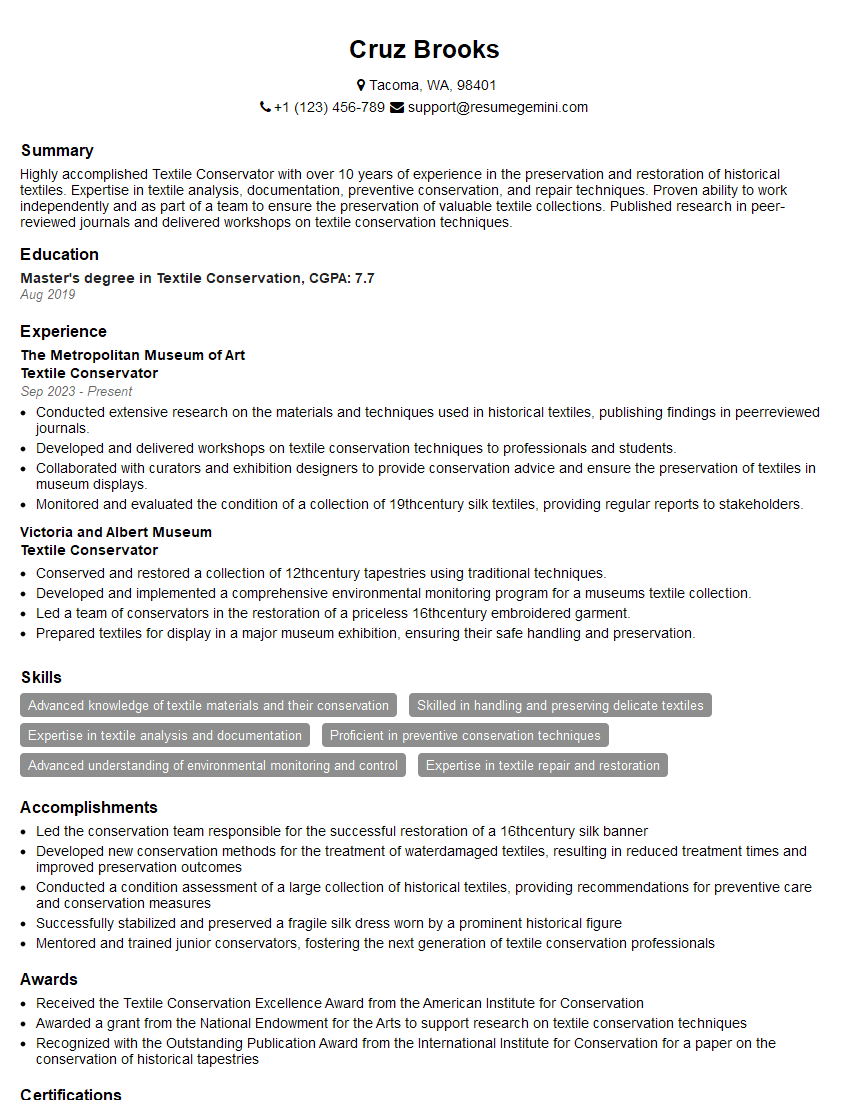
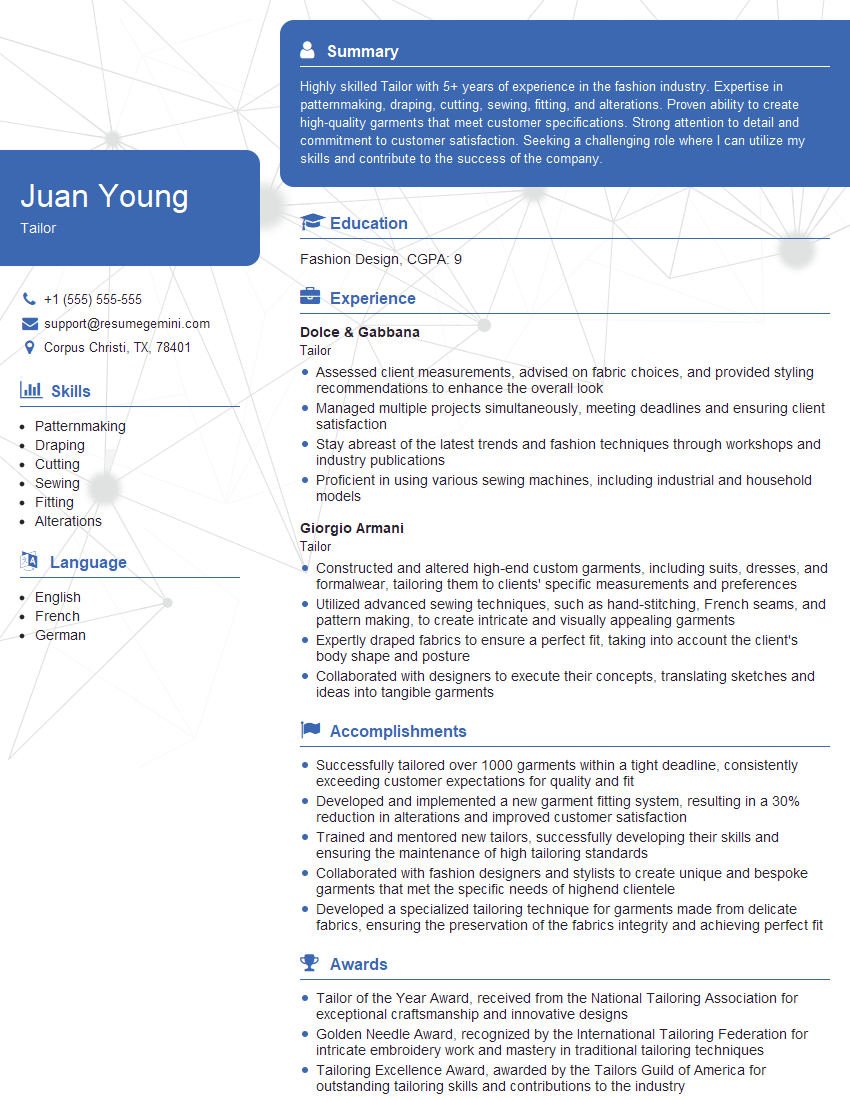
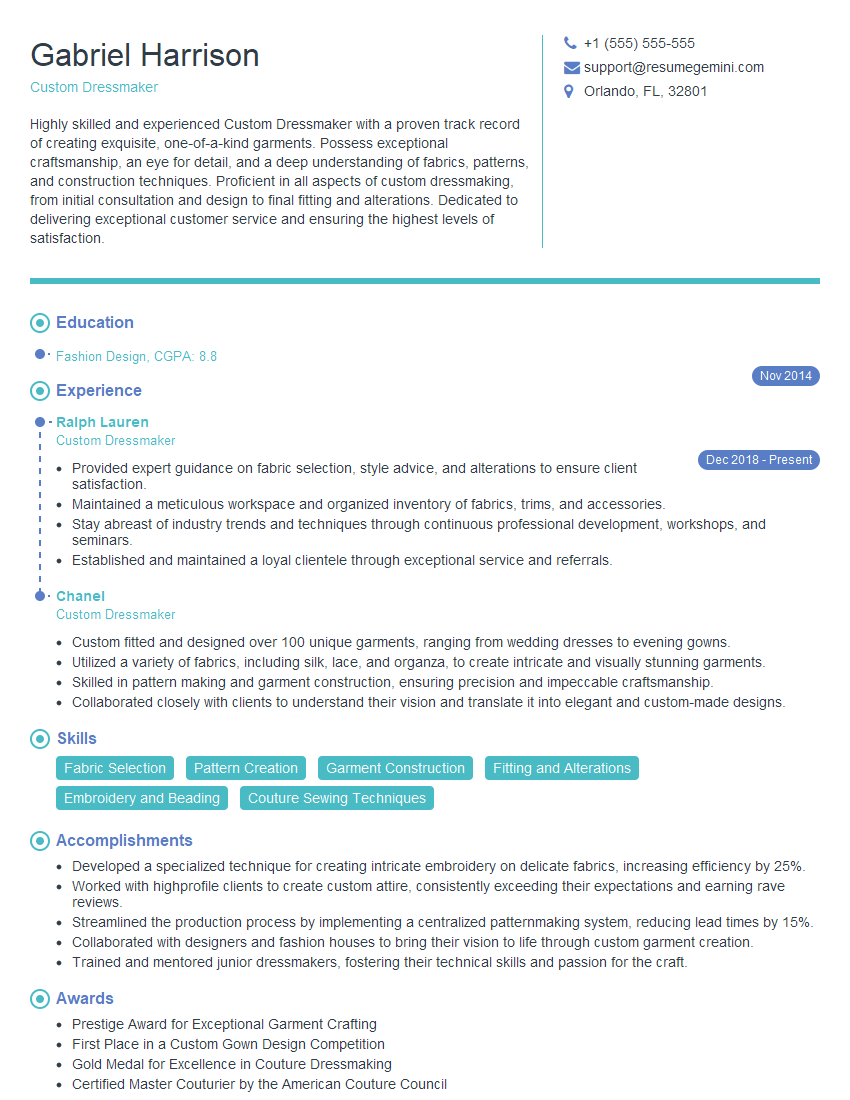
Mastering the ladder stitch demonstrates a high level of hand-sewing skill and attention to detail—highly valued in many creative industries. This expertise can significantly boost your career prospects and open doors to exciting opportunities. To maximize your chances, creating an ATS-friendly resume is crucial. ResumeGemini is a trusted resource that can help you build a professional resume that highlights your skills effectively. We offer examples of resumes tailored to Ladder Stitch expertise to provide you with a strong foundation for crafting your own compelling application materials.





Explore more articles
Users Rating of Our Blogs
Share Your Experience
We value your feedback! Please rate our content and share your thoughts (optional).
What Readers Say About Our Blog
Very informative content, great job.
good