Cracking a skill-specific interview, like one for Laser Cutting and Drilling, requires understanding the nuances of the role. In this blog, we present the questions you’re most likely to encounter, along with insights into how to answer them effectively. Let’s ensure you’re ready to make a strong impression.
Questions Asked in Laser Cutting and Drilling Interview
Q 1. Explain the difference between CO2 and fiber lasers.
CO2 and fiber lasers are both widely used in laser cutting and drilling, but they differ significantly in their operational principles and applications. CO2 lasers use a gas mixture (typically carbon dioxide, nitrogen, and helium) excited by electrical discharge to produce infrared laser light at a wavelength around 10.6 microns. This wavelength interacts well with non-metals like wood, acrylic, and some fabrics, causing efficient cutting and engraving. Fiber lasers, on the other hand, utilize a fiber optic cable doped with rare-earth elements (typically ytterbium) as the lasing medium. They produce laser light in the near-infrared spectrum, around 1 micron. This shorter wavelength is highly effective at cutting and welding metals due to its superior absorption characteristics in metal materials.
In short: CO2 lasers excel at cutting non-metals, while fiber lasers are better suited for metals. The choice depends heavily on the material being processed. For instance, cutting intricate designs in plywood would benefit from a CO2 laser, whereas cutting sheet steel would require a fiber laser.
Q 2. Describe the process of laser cutting different materials (e.g., wood, metal, acrylic).
The laser cutting process, while conceptually similar across materials, requires adjustments depending on the material’s properties. Let’s break it down:
- Wood: CO2 lasers are ideal. The laser beam’s heat causes the wood to vaporize and combust, creating a clean cut. The process is relatively fast, but settings need adjustments for different wood types and thicknesses to prevent burning or incomplete cuts. We often use lower power and slower speeds for thinner pieces to avoid scorching.
- Metal: Fiber lasers are preferred for their high power and precision. The laser beam melts and vaporizes the metal, producing a narrow kerf (cut width). The process involves very high power densities and often requires assisting gas (e.g., oxygen or nitrogen) to enhance the cutting action and manage the molten material. Parameters vary greatly depending on the metal type (stainless steel, aluminum, etc.) and thickness. Thicker metals generally require higher power and slower speeds.
- Acrylic: CO2 lasers work effectively here. Acrylic tends to melt and cleanly separate when exposed to the laser, producing a relatively smooth edge. The settings need to be carefully balanced to prevent excessive melting and discoloration. A slower speed may lead to a cleaner edge, while too high a speed can result in a rough or incomplete cut.
In each case, material thickness, desired cut quality, and available laser power significantly influence the parameters used. Trial and error, or utilizing the machine’s automated optimization functions if available, are often part of the process.
Q 3. What safety precautions must be taken when operating laser cutting and drilling equipment?
Safety is paramount when working with laser cutting and drilling equipment. The high-power laser beam poses significant risks to eyes and skin. Here are crucial safety measures:
- Eye Protection: Always wear appropriate laser safety eyewear rated for the laser’s wavelength and power. This is the single most important precaution.
- Enclosure/Barriers: Work within an enclosed system whenever possible to contain the laser beam. This minimizes the risk of accidental exposure.
- Fire Safety: Be aware of potential fire hazards, especially when cutting flammable materials like wood or plastics. Have a fire extinguisher readily available and ensure proper ventilation to remove fumes and smoke.
- Proper Training: Comprehensive training on the operation and safety procedures of the laser system is essential before operating the equipment.
- Emergency Shutdown: Know the location and operation of the emergency stop button.
- Material Handling: Use appropriate handling techniques to avoid injury and to prevent damage to the materials or equipment.
- Personal Protective Equipment (PPE): Wear appropriate clothing, including long sleeves and closed-toe shoes, to minimize the risk of skin exposure.
Regular inspection and maintenance of the laser system are also crucial to ensure its safe operation. Neglecting safety precautions can lead to serious injuries or damage.
Q 4. How do you determine the optimal laser power and speed settings for a specific job?
Determining the optimal laser power and speed settings is a crucial step in achieving high-quality cuts and efficient production. There’s no single answer, as it depends heavily on the material, thickness, desired cut quality, and the specific laser system. Here’s a process:
- Start with Material Testing: Perform test cuts on a sample piece of the material using a range of power and speed combinations. Note the resulting cut quality (e.g., edge smoothness, kerf width, burning).
- Analyze Results: Evaluate the test cuts and identify the settings producing the desired result. Too much power may lead to excessive burning or melting, while insufficient power may lead to incomplete cuts or rough edges. Too high a speed can result in incomplete cuts, while too slow a speed can cause excessive burning or distortion.
- Iterative Adjustment: Refine the settings based on your initial tests. Adjust power and speed incrementally to optimize the outcome. This often involves a balance – higher power might allow for faster speeds, but excessive power can negatively affect cut quality.
- Utilize Software Assistance: Many laser cutting machines have software that can help you automate and optimize the process, often providing preset parameter settings for common materials and thicknesses.
- Documentation: Record the optimal settings for future reference.
Remember to always start with conservative settings and gradually increase power and/or decrease speed until you achieve the desired results. Safety should always be the primary concern.
Q 5. Explain the concept of laser beam focusing and its impact on cut quality.
Laser beam focusing is critical for achieving precise and high-quality cuts. The lens system in a laser cutter focuses the laser beam to a small spot size at the workpiece’s surface. This spot size determines the power density (power per unit area). A smaller spot size results in a higher power density, leading to more efficient cutting, narrower kerfs, and improved detail. Conversely, a larger spot size results in lower power density, leading to slower cutting speeds, wider kerfs, and potentially rougher edges.
The focal length of the lens is a key factor. The optimal focal length depends on the material thickness and the desired cut quality. An incorrectly focused beam will result in inconsistent cuts, uneven kerf widths, or even incomplete cutting. Think of it like focusing a magnifying glass on a piece of paper; a sharp focus creates a more concentrated heat, allowing for a faster, cleaner burn. An out-of-focus beam will cause a more diffuse burn, leading to damage and poor cut quality.
Q 6. What are the common causes of laser cutting defects, and how can they be addressed?
Several factors can contribute to defects in laser cutting:
- Incorrect Power/Speed Settings: This is the most common cause, often resulting in incomplete cuts, burning, or rough edges.
- Poor Beam Focus: A poorly focused beam can cause uneven cuts, tapered kerfs, or incomplete cuts.
- Material Variations: Inconsistent material thickness or density can lead to variations in the cutting quality.
- Assist Gas Issues: Insufficient or improperly adjusted assist gas can result in incomplete cuts or excessive burning.
- Lens Contamination: A dirty or damaged lens can affect the beam quality and lead to inconsistencies.
- Machine Alignment: Misalignment of the laser head or the workpiece can lead to inaccurate cuts.
Addressing these defects requires systematic troubleshooting. Start by reviewing the power and speed settings, checking the beam focus, inspecting the lens and assist gas flow, and verifying the machine’s alignment. Careful material selection and proper preparation are also essential to minimize defects.
Q 7. Describe your experience with CAD/CAM software for laser cutting and drilling.
I have extensive experience using various CAD/CAM software packages for laser cutting and drilling applications, including AutoCAD, CorelDRAW, and LightBurn. My expertise spans from designing parts and generating toolpaths to optimizing cutting parameters and managing production workflows. I’m proficient in creating vector-based designs suitable for laser cutting, utilizing different tools and functions to ensure precise and efficient output. This includes applying different hatch patterns for engraving, optimizing kerf compensation for achieving precise dimensions and using various features to create complex designs.
I’ve worked on projects requiring intricate detail and complex geometries, successfully translating 2D and 3D designs into accurate and efficient laser cutting programs. I’m comfortable exporting files in various formats, including DXF, AI, and SVG, and adapting designs to suit the capabilities of different laser cutting machines. A recent example involved a project requiring the cutting of hundreds of customized wooden puzzle pieces. Using LightBurn, I designed the puzzle pieces, optimized the tool paths to minimize material waste and cut time, and successfully executed the job, resulting in a highly efficient and accurate production run.
Q 8. How do you perform routine maintenance and troubleshooting on laser cutting machines?
Routine maintenance on a laser cutting machine is crucial for ensuring its longevity, precision, and safety. It involves a multi-faceted approach, focusing on both the optical system and the mechanical components.
- Optical System: This includes regular cleaning of mirrors, lenses, and the nozzle. Dust, debris, or even fingerprints can significantly impact the laser beam’s quality and cut accuracy. We use compressed air and lens cleaning wipes, always being extremely careful to avoid scratching any optical surfaces. A misaligned optic can lead to inconsistent cuts or even damage to the machine.
- Assist Gas System: Checking the gas pressure and purity is essential. The correct gas type and pressure are critical for a clean cut; using the wrong gas, or insufficient pressure, will impact cut quality and can even damage the nozzle or the laser tube itself. Regular checks prevent costly repairs.
- Mechanical Components: This encompasses lubricating moving parts like the gantry and belts, ensuring smooth operation and preventing wear and tear. Checking for loose screws, worn belts, and general wear and tear is important. I’d also regularly inspect the exhaust system to make sure it’s clear of obstructions. A blocked exhaust system is a major safety hazard.
- Troubleshooting: Common issues include erratic cuts, poor edge quality, or machine errors. I systematically address these problems using a checklist, beginning with simple checks like gas pressure and optics alignment before moving to more complex issues such as a faulty laser tube or control board malfunction. Thorough documentation is key for future troubleshooting and preventative maintenance.
Think of it like maintaining a high-precision instrument; consistent care is necessary for optimal performance.
Q 9. What are the different types of laser nozzles, and when would you use each one?
Laser nozzles play a critical role in directing the assist gas flow and focusing the laser beam onto the workpiece. Different nozzle types cater to different materials and cutting thicknesses.
- Standard Nozzles: These are the most common and suitable for a wide range of materials and thicknesses. They provide a balanced gas flow and beam focusing.
- Small-diameter Nozzles: Used for intricate cuts on thinner materials, providing better control and reducing heat-affected zones (HAZ). Think of fine jewelry or detailed circuit boards.
- Large-diameter Nozzles: Best suited for thicker materials and cutting through tougher materials, delivering a higher volume of assist gas for efficient material removal. We would utilize these for cutting through steel, for example.
- Special Nozzles: Some nozzles are designed for specific applications, such as those with a built-in air ring for better cutting quality on reflective materials. This would be used to mitigate issues encountered with materials that reflect the laser back into the optical system.
Choosing the correct nozzle is not just about getting a good cut, it’s about preventing damage to the nozzle, optics and ensuring operator safety. The wrong nozzle can lead to poor quality cuts, or even damage to the cutting head itself.
Q 10. Explain the concept of kerf width and its significance in laser cutting.
Kerf width refers to the width of the cut produced by the laser beam. It’s essentially the gap left behind after the material is vaporized or melted. Understanding kerf width is crucial for ensuring that the final part dimensions match the design specifications.
Several factors influence kerf width, including laser power, material type, assist gas, cutting speed, and focus position. For example, a higher laser power will usually result in a wider kerf. Conversely, materials with high thermal conductivity will exhibit a wider kerf.
Its significance lies in the fact that it’s an inherent characteristic of laser cutting. We always account for kerf width when creating designs. Designs are typically adjusted to compensate for the expected kerf width to ensure the final product meets the required dimensions. Failing to account for this can lead to parts that are too small or too large.
Imagine designing a puzzle piece: you need to account for the thickness of the saw blade, which is analogous to the kerf width in laser cutting.
Q 11. How do you ensure the accuracy and precision of laser-cut parts?
Ensuring accuracy and precision in laser-cut parts requires a multi-pronged approach, starting with design and extending through the cutting process.
- Precise Design: Vector-based design software is crucial. We use CAD software which allows for precise measurements and tolerances. It is paramount to design in the kerf width to get the desired result.
- Calibration: Regular calibration of the laser cutting machine is essential. This involves using calibration tools to check for alignment, focus, and other critical parameters. Any deviation will directly affect the accuracy of the cuts.
- Material Selection: The material’s consistency directly impacts accuracy. Variations in thickness or quality can lead to inconsistent cuts.
- Parameter Optimization: Fine-tuning laser power, speed, and assist gas pressure for each material and thickness is key. These parameters influence the quality and precision of the cut. Improper settings may cause burns, undercuts or other errors.
- Regular Maintenance: As mentioned previously, this helps prevent issues that could compromise precision.
Accuracy and precision are not just about the machine; they also depend on expertise in material selection, parameter optimization and meticulous pre- and post-processing.
Q 12. Describe your experience with different types of assist gases used in laser cutting.
Assist gases play a vital role in laser cutting, influencing the quality of the cut and protecting the optical components from debris and heat. Different gases are suited for different materials and applications.
- Oxygen (O2): Oxygen is highly reactive and supports exothermic oxidation reactions with the material, producing a very clean cut. This is ideal for many metals, resulting in a narrower kerf width and reduced HAZ.
- Nitrogen (N2): Nitrogen is an inert gas that helps prevent oxidation and provides a clean, non-oxidative cut. It is often preferred for materials sensitive to oxidation, such as stainless steel or aluminum, to prevent discoloration or material degradation.
- Compressed Air: Compressed air is a cost-effective option, but it doesn’t have the same cutting efficiency as oxygen. It is primarily used for non-metallic materials like wood or acrylic.
- Other Gases: In specific applications, other gases like argon or helium may be used for specialized cutting or to enhance the quality of the cut. These often relate to niche materials or to minimize heat-related damage
Choosing the right assist gas is vital for achieving optimal cutting results and ensuring the longevity of the machine. Using the wrong gas could result in poor cut quality, material damage, and even damage to the laser system itself.
Q 13. How do you handle material warping during the laser cutting process?
Material warping during laser cutting is a common challenge, particularly with thinner materials or those with high thermal expansion coefficients. It’s caused by the rapid heating and cooling during the cutting process.
- Fixturing Techniques: Securely clamping or holding the material down using appropriate fixtures is a crucial first step. This minimizes movement and reduces the chances of warping.
- Lowering Power and Speed: Reducing the laser power and cutting speed can help reduce the amount of heat applied, therefore minimizing warping.
- Multiple Passes: Performing multiple passes with reduced power can result in a cleaner cut with less heat-induced distortion. It’s like delicately carving instead of aggressively cutting.
- Material Selection: Choosing a material that is less prone to warping will significantly improve the results. There are certain materials that are inherently more resistant to this issue.
- Post-Processing: Some warping can often be corrected through gentle post-processing methods, such as pressing or using a jig to return the warped parts to their original shape.
Warping is often a tradeoff between cutting speed and precision. If warping is a significant concern, it’s usually better to prioritize quality over speed, through careful parameter adjustments.
Q 14. What are the limitations of laser cutting technology?
While laser cutting offers many advantages, it does have limitations:
- Material Compatibility: Laser cutting isn’t suitable for all materials. Some materials, like certain plastics or some metals, can produce toxic fumes or are difficult to cut cleanly.
- Edge Quality: Depending on the material and settings, the cut edges might need further processing (e.g., deburring) to achieve a perfect finish. This can increase the production time and costs.
- Heat Affected Zone (HAZ): The HAZ, the area surrounding the cut that is affected by heat, can alter the material properties in some materials, making them brittle or less durable.
- Cost: Laser cutting machines are a significant investment, and their operation, including the cost of gas and maintenance, can be substantial.
- Limitations in Material Thickness: While some high-powered lasers can cut through thick materials, it often isn’t efficient to do so. There are limits to how thick a laser can efficiently cut a given material.
Understanding these limitations allows us to choose appropriate processes and materials to achieve optimal outcomes. Sometimes, other processes such as waterjet cutting or traditional machining are more suitable depending on the requirements.
Q 15. Explain your experience with laser marking or engraving.
Laser marking and engraving involves using a laser beam to alter the surface of a material, creating permanent markings or intricate designs. My experience spans various applications, from marking serial numbers on medical devices to creating personalized gifts with intricate detail. I’ve worked with different laser types, including CO2 and fiber lasers, each suited to specific materials and desired effects. For instance, fiber lasers excel in marking metals due to their high precision and ability to achieve fine details, while CO2 lasers are more suitable for engraving wood or plastics. I’m proficient in selecting the appropriate laser parameters (power, speed, frequency) to achieve the desired depth, contrast, and quality of the marking. This includes understanding the material’s properties and how they affect the engraving process. A recent project involved creating highly detailed logos on stainless steel surgical instruments, requiring precise control of the laser beam to ensure legibility and durability.
Career Expert Tips:
- Ace those interviews! Prepare effectively by reviewing the Top 50 Most Common Interview Questions on ResumeGemini.
- Navigate your job search with confidence! Explore a wide range of Career Tips on ResumeGemini. Learn about common challenges and recommendations to overcome them.
- Craft the perfect resume! Master the Art of Resume Writing with ResumeGemini’s guide. Showcase your unique qualifications and achievements effectively.
- Don’t miss out on holiday savings! Build your dream resume with ResumeGemini’s ATS optimized templates.
Q 16. What are the advantages and disadvantages of laser cutting compared to other cutting methods (e.g., waterjet cutting)?
Laser cutting offers several advantages over other methods like waterjet cutting. Its primary benefit is precision. Laser beams can create incredibly fine cuts with minimal kerf (the width of the cut), ideal for intricate designs and tight tolerances. This is in contrast to waterjet cutting which, while also precise, often results in wider kerfs. Furthermore, laser cutting is a non-contact process, eliminating the need for tooling and reducing wear and tear. This leads to lower operational costs and less downtime. The process is also highly automated, increasing productivity. However, laser cutting does have limitations. It’s generally best suited for thinner materials; thicker materials can lead to longer cutting times and reduced quality. Waterjet cutting, on the other hand, can handle thicker materials with ease. Also, the choice of laser type dictates which materials can be cut effectively. For example, CO2 lasers work well with wood and acrylic, but not always with metals. Finally, the initial investment for a laser cutting system can be substantial compared to some other methods.
Q 17. How do you calculate the cost of a laser cutting job?
Calculating the cost of a laser cutting job requires considering several factors. The most significant is material cost. This includes the raw material’s price and its dimensions. Next is machine time. This is calculated based on the complexity of the design, the material thickness, and the laser’s cutting speed. More intricate designs or thicker materials will naturally take longer, increasing the cost. Operational costs such as electricity, gas (for CO2 lasers), and maintenance are also factored in. Finally, labor costs should be included, representing the time spent on setting up the machine, monitoring the process, and post-processing (e.g., cleaning). A simple formula might be: Total Cost = Material Cost + Machine Time Cost + Operational Cost + Labor Cost. For example, a simple cut on a small piece of acrylic would have low costs across the board, whereas a complex, multi-layered design on a sheet of stainless steel would result in a significantly higher cost.
Q 18. Describe your experience with different types of laser scanning systems.
My experience encompasses various laser scanning systems, primarily focused on those used in conjunction with CAD/CAM software for laser cutting. These systems generally use either contact or non-contact methods to digitize a physical object or design. Contact scanners, often using a probe, provide highly accurate 3D data. Non-contact methods, such as laser triangulation or structured light scanning, are faster but may have slightly lower accuracy. I’ve worked extensively with systems employing structured light projection, which projects a pattern of light onto the object and analyzes the distortion of the pattern to reconstruct the 3D shape. This technique is particularly useful for creating accurate 3D models for intricate parts before laser cutting. I understand the importance of choosing the right scanning system based on factors such as desired accuracy, scan speed, material properties, and the complexity of the object being scanned. The accuracy of the scanned data is paramount in ensuring the laser cutting process is successful and produces parts that meet specifications.
Q 19. How do you ensure the quality control of laser-cut parts?
Quality control in laser cutting is crucial. It starts with meticulous design and preparation of the digital file. Any imperfections in the design will translate directly to the final product. During the cutting process, consistent monitoring of the laser parameters is essential to ensure the cut is clean and consistent. This might involve regularly checking the focus and alignment of the laser beam. After cutting, thorough inspection is vital. This includes checking for dimensional accuracy using calibrated measuring instruments, verifying the cut quality (absence of burrs, scorch marks, or incomplete cuts), and inspecting for any defects or inconsistencies in the final part. Statistical Process Control (SPC) techniques can be applied to track and analyze the variation in the process over time, helping to identify potential problems early on and prevent defects. Documenting the entire process—from design to final inspection—helps trace the root cause of any issues and facilitates continuous improvement.
Q 20. What are the common safety hazards associated with laser systems, and how to mitigate them?
Laser systems present various safety hazards, primarily stemming from the intense light emitted by the laser. Eye exposure is the most significant risk, potentially causing irreversible damage. Therefore, appropriate laser safety eyewear is mandatory, and proper eye protection procedures must be strictly followed. Skin exposure can also lead to burns, necessitating protective clothing like gloves and lab coats. Fire is another hazard, particularly when working with flammable materials. Having a fire extinguisher readily available and knowing how to use it are crucial. Finally, the high voltages used in laser systems pose an electrical shock risk. Proper grounding and adherence to electrical safety regulations are vital. Mitigation strategies include: implementing strict safety procedures, regular machine maintenance, providing thorough safety training to all personnel, using appropriate personal protective equipment (PPE), and ensuring the laser system is properly shielded and enclosed to prevent accidental exposure.
Q 21. Explain the principles of laser beam delivery systems.
Laser beam delivery systems are crucial for directing the laser beam to the workpiece accurately and efficiently. They typically involve mirrors, lenses, and other optical components. The system’s design depends on several factors, including the laser type, the desired beam quality, and the size and shape of the workpiece. A common approach involves using a series of mirrors to guide the beam along a path, allowing for precise positioning of the cutting head. Lenses focus the beam to achieve the necessary spot size for cutting or engraving. The entire system requires precise alignment and stability to ensure the beam remains focused and accurately positioned throughout the process. Furthermore, beam delivery systems often incorporate mechanisms for adjusting beam power and shape, enabling control over the cutting parameters. A well-designed delivery system is crucial for achieving high-quality cuts, maximizing throughput, and enhancing the overall efficiency of the laser cutting process.
Q 22. Describe your experience with different types of laser control systems.
My experience encompasses a wide range of laser control systems, from basic analog controls to sophisticated CNC (Computer Numerical Control) systems with digital signal processing. Early in my career, I worked extensively with galvanometer-based systems, where mirrors are precisely controlled to direct the laser beam. These systems excel in high-speed, intricate cutting and engraving. I’ve also gained significant experience with stepper motor-driven systems, providing more robust control for heavier materials and larger workspaces. More recently, I’ve worked extensively with industrial-grade CNC systems incorporating advanced features like automatic focus adjustment, real-time process monitoring, and integrated vision systems for automated part placement and recognition. For example, I optimized a galvanometer-based system for a high-precision jewelry engraving project by fine-tuning the control parameters to minimize jitter and improve line quality. This involved adjusting the acceleration and deceleration rates of the mirrors to match the material’s properties.
- Galvanometer-based systems: Ideal for high-speed, intricate cutting and engraving.
- Stepper motor-driven systems: Suitable for heavier materials and larger workspaces.
- CNC systems with advanced features: Offer enhanced precision, automation, and monitoring capabilities.
Q 23. How do you troubleshoot common laser cutting machine errors?
Troubleshooting laser cutting machine errors requires a systematic approach. I typically start by checking the most common issues: Is the laser firing correctly? Is the material properly positioned and secured? Are the machine’s safety interlocks functioning? I then move to more advanced diagnostics. For instance, if the cut quality is poor, I check for inconsistencies in the laser power, beam focus, or cutting speed. A blurry or inconsistent cut might suggest a problem with the optics, such as a dirty lens or misaligned mirrors. If the machine is not moving correctly, I might inspect the drive system, checking for belt tension or lubrication issues, and reviewing the machine’s diagnostics logs for any error codes. I rely on error codes and logs to diagnose issues, and if needed I use specialized diagnostic tools to investigate the control systems. Remember, safety is paramount – always power down the machine and follow established safety protocols before attempting any repairs.
For instance, I once encountered a situation where a laser consistently missed its target. By checking the system logs, I found a minor software glitch in the control system’s positional feedback loop. A simple software update resolved the problem.
Q 24. What is your experience with process optimization in laser cutting?
Process optimization in laser cutting is crucial for maximizing efficiency and minimizing costs. My approach involves systematically evaluating every aspect of the process. This includes selecting the optimal laser parameters (power, speed, frequency), choosing the appropriate assist gas (type and pressure), and ensuring the proper material handling techniques. Data-driven approaches are key. I use software to track key performance indicators such as cut speed, kerf width, edge quality, and material waste. I conduct experiments using Design of Experiments (DOE) methodologies to identify the optimal parameter combinations for a specific material and application.
For example, in a recent project involving cutting stainless steel, I used DOE to determine the optimal combination of laser power, speed, and assist gas pressure, resulting in a 15% increase in cutting speed and a 10% reduction in edge imperfections.
Q 25. Explain your understanding of laser power measurement and calibration.
Laser power measurement and calibration are essential for consistent and accurate cutting. I use power meters to measure the actual laser power output, comparing this to the system’s reported value. Calibrations involve adjusting the system to match the measured power to the desired value, using the control system’s calibration routines or manually adjusting laser parameters if needed. Regular calibration, using traceable standards, is critical for maintaining accuracy and ensuring consistent results. It’s important to account for variations in laser power caused by factors like the laser’s age, the ambient environment, and the type of laser used (CO2, fiber, etc.).
Inaccuracies in power measurement can lead to inconsistent cuts, causing either incomplete cuts or damage to the material. Calibration ensures the system accurately delivers the specified power level, leading to improved quality and repeatability.
Q 26. Describe your experience working with different types of laser cutting software.
My experience with laser cutting software includes various CAD/CAM (Computer-Aided Design/Computer-Aided Manufacturing) packages. I’m proficient in industry-standard software such as AutoCAD, SolidWorks, and specialized laser cutting software like Lasercut, LPKF Laser software and others. My expertise extends beyond basic file import and export; I understand how to optimize cutting paths, nest parts efficiently to minimize material waste, and generate the G-code (numerical control code) required by the laser control system. I’m also familiar with software features like automatic nesting, which optimizes part placement on the material sheet for efficiency. This expertise allows me to seamlessly translate a design into a manufacturing plan and execute it flawlessly on the laser cutting machine.
For instance, in a large-scale project, by carefully optimizing the nesting strategy within the CAD/CAM software, we reduced material waste by nearly 20%.
Q 27. How do you interpret technical drawings and specifications for laser cutting projects?
Interpreting technical drawings and specifications is fundamental to successful laser cutting. I carefully examine the drawing to understand the dimensions, tolerances, material type, and any special instructions. Specific features like cutting depth, kerf width (width of the cut), and surface finish requirements are analyzed. Understanding the tolerances is crucial – the drawing will specify acceptable variations in dimensions. I need to ensure the laser cutting process meets those tolerances. I also look for notes on material type, thickness, and any specific requirements regarding the finished product such as edge quality or surface finish.
For instance, if a drawing specifies a tight tolerance on a hole diameter, I’ll adjust the laser parameters to minimize the kerf width and ensure precise hole drilling. I would also select a process suitable for producing accurate holes while taking into account the material properties.
Q 28. Explain your experience with different types of laser cutting applications.
My experience spans a variety of laser cutting applications across many industries. I’ve worked on projects ranging from prototyping and small-scale production to large-scale manufacturing. Examples include:
- Prototyping: Creating rapid prototypes for new product designs from various materials, including wood, acrylic, and metal.
- Sign Making: Designing and cutting signs and logos from a variety of materials such as acrylic, aluminum composite materials (ACM), and polycarbonate.
- Industrial Manufacturing: Producing high-precision parts for various industries, including aerospace, automotive, and medical devices, using materials such as stainless steel, aluminum, and titanium.
- Art and Craft: Creating intricate designs and patterns on various materials for artistic purposes.
- Textile Cutting: Cutting intricate patterns for apparel manufacturing and other textile applications.
Each application requires a different approach to material selection, parameter optimization, and quality control, drawing upon my broad experience to find the most appropriate method.
Key Topics to Learn for Laser Cutting and Drilling Interview
- Laser Fundamentals: Understanding laser types (CO2, fiber, etc.), beam characteristics (wavelength, power, focus), and safety protocols.
- Material Interaction: Knowing how different materials react to laser cutting and drilling; understanding factors influencing cut quality (e.g., material thickness, speed, power).
- Machine Operation: Familiarity with CNC laser cutting and drilling machines, including setup, operation, and basic troubleshooting.
- Process Parameters: Ability to adjust parameters (power, speed, assist gas) to optimize cut quality and efficiency for various materials and designs.
- Design for Manufacturing (DFM): Understanding design considerations for laser cutting and drilling, including kerf width, tolerances, and part nesting.
- Quality Control: Implementing quality control measures to ensure consistent product quality and identify potential issues.
- Maintenance & Troubleshooting: Basic understanding of machine maintenance, common problems, and their solutions.
- Safety Procedures: Deep knowledge of laser safety regulations and best practices to prevent accidents.
- CAM Software: Experience with CAD/CAM software for generating laser cutting and drilling programs.
- Applications & Industries: Understanding the diverse applications of laser cutting and drilling across various industries (e.g., manufacturing, aerospace, medical).
Next Steps
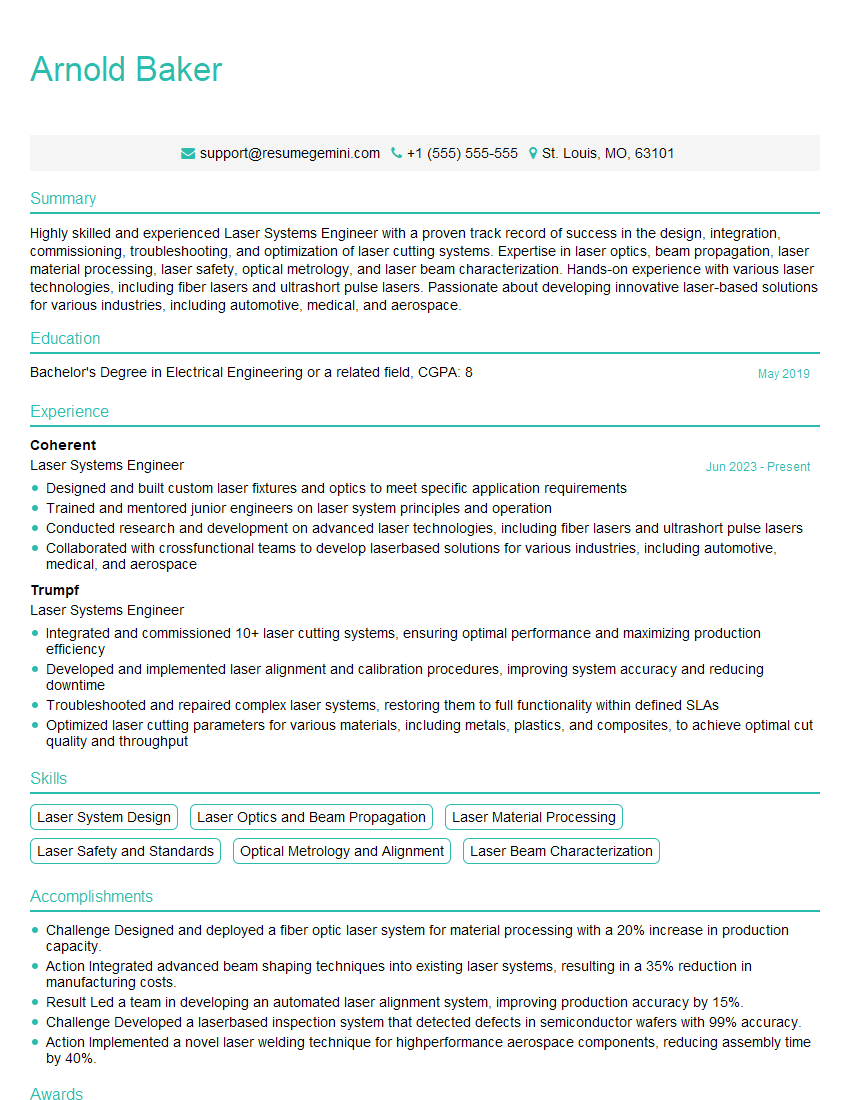
Mastering laser cutting and drilling opens doors to exciting and rewarding careers in advanced manufacturing and numerous other high-tech sectors. Your expertise in this field is highly sought after, offering excellent job prospects and growth potential. To maximize your chances of landing your dream role, it’s crucial to present yourself effectively. Creating an ATS-friendly resume is essential for getting noticed by recruiters and ensuring your application makes it through applicant tracking systems. ResumeGemini is a trusted resource to help you build a professional, impactful resume that highlights your skills and experience. They offer examples of resumes specifically tailored to the Laser Cutting and Drilling industry to guide you in creating a compelling application.
Explore more articles
Users Rating of Our Blogs
Share Your Experience
We value your feedback! Please rate our content and share your thoughts (optional).
What Readers Say About Our Blog
Very informative content, great job.
good