Every successful interview starts with knowing what to expect. In this blog, we’ll take you through the top Laser Optics and Beam Propagation interview questions, breaking them down with expert tips to help you deliver impactful answers. Step into your next interview fully prepared and ready to succeed.
Questions Asked in Laser Optics and Beam Propagation Interview
Q 1. Explain the concept of Gaussian beam propagation.
Gaussian beam propagation describes how the spatial profile of a laser beam, often approximated as a Gaussian function, evolves as it travels through free space or optical systems. Imagine throwing a perfectly round pebble into a still pond – the ripples expanding outwards represent the beam’s propagation. The Gaussian beam’s intensity profile remains Gaussian, but its width (beam waist) and curvature change with distance. The key parameters are the beam waist (the narrowest point of the beam), the Rayleigh range (the distance over which the beam diameter approximately doubles), and the divergence angle (how quickly the beam spreads).
Mathematically, it’s described by complex beam parameter q, which elegantly combines the beam radius and radius of curvature. This parameter simplifies calculations of beam propagation through optical elements.
A key aspect is the beam’s diffraction-limited nature; the spreading of the beam is fundamentally limited by diffraction, which is the bending of light waves around obstacles. This minimal spreading is a desirable trait for many applications.
Q 2. Describe the ABCD matrix method and its applications in beam propagation.
The ABCD matrix method is a powerful tool for analyzing the propagation of Gaussian beams through complex optical systems. It represents optical elements (lenses, free space, mirrors) as 2×2 matrices. Multiplying these matrices together yields a single matrix describing the overall system’s effect on the beam. This simplifies the complex calculations involved in tracing a beam’s path and allows for quick analysis of the beam’s parameters (beam waist, radius of curvature) after passing through the system.
Each matrix element (A, B, C, D) has a specific physical meaning related to how the element transforms the beam’s position and angle. For instance, free space propagation is represented by a matrix, and a thin lens has its own matrix.
[ A  B ]       [ 1  d ]       [ 1  0 ]
[ C  D ] =    [ 0  1 ]  or   [ -1/f 1 ]
(Example matrices for free space propagation and a thin lens, respectively. ‘d’ is the propagation distance, ‘f’ is the focal length)
Applications range from laser resonator design to beam shaping and focusing in various optical systems, including microscopes, telescopes, and laser cutting machines. It allows for precise prediction of the final beam parameters after passing through an intricate setup without complex numerical simulations for each component.
Q 3. What are the different types of laser resonators, and how do they affect beam quality?
Laser resonators are the heart of a laser, providing feedback to amplify the light. Different resonator designs affect the output beam’s quality (e.g., spatial mode, divergence).
- Fabry-Perot resonator: The simplest, consisting of two parallel mirrors. It’s prone to producing multiple transverse modes (higher-order modes that are less desirable), resulting in a poor beam quality. This is analogous to a poorly tuned musical instrument producing multiple, dissonant notes.
- Stable resonators: These configurations ensure the beam remains confined within the resonator cavity, often employing curved mirrors. They produce stable transverse modes, enhancing beam quality. Properly designed stable resonators produce mostly the fundamental Gaussian mode.
- Unstable resonators: These utilize mirrors with a specific curvature that causes the beam to spill out at the edges. They lead to high-power output, but also a less-uniform transverse mode profile, compromising the beam quality. The trade-off is high power for potential beam inhomogeneity.
- Helical resonators: A special case where the beam travels on a helical path, providing specialized properties for some applications.
The choice of resonator directly impacts beam quality, affecting its divergence, spatial profile, and overall performance in applications requiring specific beam characteristics.
Q 4. How do you characterize a laser beam (e.g., beam diameter, divergence, M² factor)?
Characterizing a laser beam involves measuring several key parameters:
- Beam Diameter: Often defined as the diameter containing a certain percentage (e.g., 86%) of the total beam power. This is typically measured using a beam profiler, which creates a 2D map of the beam’s intensity.
- Beam Divergence: The angle at which the beam spreads as it propagates. A low divergence indicates a highly collimated beam. It’s usually measured by observing the beam’s diameter at various distances from the output aperture.
- M² factor (Beam Quality Factor): A measure of how close the beam’s characteristics are to an ideal Gaussian beam. An M² of 1 indicates a perfect Gaussian beam. Higher values indicate a greater deviation from an ideal beam, often due to higher-order transverse modes. It’s determined by measuring the beam’s width at multiple points and fitting the data to a theoretical Gaussian beam propagation model.
These parameters are crucial for optimizing beam delivery in applications such as laser cutting, material processing, and optical communication, where a well-defined and controllable beam is essential for precision and efficiency.
Q 5. Explain the phenomenon of diffraction and its impact on beam propagation.
Diffraction is the phenomenon where light waves bend around obstacles or spread out after passing through an aperture. Think of water waves encountering a breakwater – the waves bend and spread after passing the obstacle. In laser beam propagation, diffraction limits the minimum beam size and causes the beam to diverge. It’s a fundamental limit imposed by the wave nature of light.
The impact on beam propagation is significant. Even a perfectly collimated laser beam will eventually diverge due to diffraction. The extent of this divergence is inversely proportional to the beam’s initial diameter. A larger initial beam diameter leads to slower divergence.
The effects of diffraction are described by the Airy pattern, which describes the intensity distribution of a diffracted wave. Minimizing the effects of diffraction involves using lenses to collimate or focus the beam or ensuring a large initial beam diameter.
Q 6. What are the different types of optical aberrations, and how do they affect beam quality?
Optical aberrations are imperfections in optical systems that distort the wavefront of the beam, leading to a degradation in beam quality and performance.
- Spherical aberration: Occurs when light rays passing through different parts of a lens do not converge at a single point, resulting in blurred focusing.
- Chromatic aberration: Caused by the dependence of a lens’s refractive index on wavelength. Different wavelengths focus at different points, leading to color fringing.
- Astigmatism: Results from a lens having different focal lengths in different planes, causing a point source to be imaged as a line.
- Coma: Creates a comet-shaped image of a point source, caused by off-axis rays being focused differently than on-axis rays.
- Distortion: Causes a systematic change in the magnification across the image field, leading to image deformation.
These aberrations can significantly degrade beam quality, leading to reduced focusing efficiency, increased spot size, and non-uniform intensity distribution. They are often minimized through careful lens design, using specialized lens coatings, or employing adaptive optics techniques.
Q 7. Describe different techniques for beam shaping and steering.
Beam shaping and steering are crucial for many laser applications, and several techniques exist to achieve this:
- Diffractive Optical Elements (DOEs): These specially designed elements use diffraction to reshape the beam, creating uniform flat-top beams or other custom profiles. They are compact and efficient solutions.
- Refractive elements (lenses): A combination of lenses can be used to collimate, focus, or change the beam’s shape. This is a widely used and versatile approach.
- Mirrors: Mirrors are used for directing and steering the beam, offering high reflectance and low losses.
- Spatial Light Modulators (SLMs): These devices can dynamically control the phase and amplitude of the light wave, allowing for real-time shaping and steering of the beam.
- Axicons: These conical lenses create a long, narrow focal line, ideal for applications like laser micromachining and material processing.
The choice of technique depends on the specific application’s requirements for beam shape, precision, and dynamic control. For example, SLMs provide dynamic control useful in adaptive optics or laser displays, while DOEs are preferred for static beam shaping in material processing.
Q 8. Explain the principles of laser mode locking.
Laser mode locking is a technique used to create ultrashort laser pulses. Imagine a race where many runners (laser modes) are initially out of sync. Mode locking synchronizes these runners, making them cross the finish line (emit a pulse) together. This is achieved by introducing a mechanism that forces the different longitudinal modes of the laser cavity to oscillate with a fixed phase relationship. This creates a train of short, high-intensity pulses.
Several methods exist for mode locking, including active mode locking (using an external modulator to introduce phase modulation) and passive mode locking (using a saturable absorber to preferentially allow high-intensity pulses to pass through). Active mode locking is like having a referee in the race constantly ensuring runners maintain pace; passive mode locking is more like letting the fastest runners naturally pull the others along.
The pulse duration produced depends on the number of locked modes and the gain bandwidth of the laser medium. Mode-locked lasers are crucial in applications requiring high peak power and precision timing, such as optical communications, material processing, and scientific research (e.g., ultrafast spectroscopy).
Q 9. How does atmospheric turbulence affect beam propagation?
Atmospheric turbulence, caused by variations in temperature and density of the air, significantly affects beam propagation. Imagine shining a laser pointer through a heat haze – the beam appears to wiggle and shimmer. This is because the refractive index of air fluctuates, causing the laser beam to bend randomly as it travels. This bending leads to beam wander (a change in the beam’s average pointing direction), beam broadening (an increase in beam size), and intensity fluctuations (variations in the beam’s brightness). The severity of these effects depends on the distance the beam travels, the wavelength of the laser light, and the strength of the turbulence.
These effects severely degrade the performance of many laser-based systems, such as free-space optical communication links and laser ranging systems.
Q 10. Discuss different methods for compensating for atmospheric turbulence.
Several methods exist to compensate for atmospheric turbulence. These techniques aim to either predict and correct for the distortions or actively counteract them.
- Adaptive Optics: This involves using a deformable mirror to shape the wavefront of the laser beam in real-time, counteracting the distortions introduced by atmospheric turbulence. Think of it as dynamically adjusting the shape of the laser beam to compensate for the twists and turns caused by the atmosphere. A wavefront sensor measures the distortions, and a control system adjusts the mirror to correct them.
- Speckle Interferometry: This technique uses the interference pattern (speckle) created by the turbulent beam to reconstruct the wavefront and correct for distortions.
- Wavefront Shaping: This method involves using spatial light modulators to precisely control the phase and amplitude of the laser beam, creating a focus that is less sensitive to atmospheric turbulence.
- Multiple-Wavelength Techniques: By employing multiple wavelengths, the effects of turbulence on each wavelength can differ and are statistically independent. This information can then be used to correct for the turbulence.
The choice of method depends on the specific application and the severity of the turbulence. For long-distance applications, adaptive optics is frequently employed.
Q 11. Explain the concept of optical resonators and their stability criteria.
Optical resonators, also known as laser cavities, are crucial for laser operation. They provide feedback for the light generated within the gain medium, amplifying it and producing a coherent beam. A simple resonator consists of two mirrors facing each other. Light bounces between these mirrors, undergoing multiple passes through the gain medium, each time increasing its intensity. This process is analogous to creating a standing wave inside a pipe (acoustic resonator) using reflected sound.
The stability of a resonator is determined by its geometry and the reflectivity of the mirrors. The stability criteria ensure that the light remains confined within the resonator, preventing divergence and loss. A common way to express these criteria is using the g-parameters, defined as g1 = 1 - L/R1 and g2 = 1 - L/R2, where L is the distance between mirrors and R1 and R2 are their radii of curvature. For a stable resonator, the condition 0 < g1 * g2 < 1 must be met. Different values of g1 and g2 lead to different resonator types with varying properties (e.g., plane-parallel, confocal, concentric).
Q 12. Describe the different types of optical fibers and their applications in beam delivery.
Optical fibers are essential for delivering laser beams over long distances with minimal loss. Different types of fibers are used based on their application.
- Single-mode fibers: These fibers have a core diameter that is only slightly larger than the wavelength of light, allowing only one mode to propagate. This leads to low dispersion and minimal signal distortion, making them ideal for long-distance communication and high-bandwidth applications.
- Multi-mode fibers: These fibers have a larger core diameter, allowing multiple modes to propagate. This makes them less susceptible to bending losses, but they have higher dispersion and thus are more suitable for shorter-distance applications like local area networks.
- Polarization-maintaining fibers: These fibers are designed to preserve the polarization state of the light, crucial in applications like coherent optical communication and fiber sensors.
- Photonic crystal fibers (PCFs): These fibers have a complex structure of air holes surrounding the core, which allows for fine control over the light's propagation characteristics, enabling unique applications such as supercontinuum generation.
The choice of fiber depends on the application's requirements. Single-mode fibers are typically used for long-distance communication and high-precision applications, while multi-mode fibers are more appropriate for short-range applications. PCFs offer unique advantages in specialized applications like nonlinear optics.
Q 13. What are the safety considerations when working with lasers?
Laser safety is paramount due to the potential for eye and skin damage. The risks depend on the laser's power, wavelength, and exposure duration. Key safety considerations include:
- Eye Protection: Appropriate laser safety eyewear is crucial, filtering out the specific wavelength emitted by the laser. The eyewear's optical density (OD) rating should match the laser's power and class.
- Beam Containment: Enclosing the laser beam path using appropriate barriers and enclosures prevents accidental exposure.
- Warning Signage: Clear warning signs indicating laser operation and safety precautions should be prominently displayed.
- Training and Procedures: Personnel operating lasers must receive adequate training in safe operating procedures.
- Laser Safety Officer (LSO): In many environments, a designated LSO is responsible for overseeing laser safety protocols.
- Class Designation: Lasers are categorized into different classes based on their hazard potential; proper classification and handling are vital.
Ignoring laser safety precautions can lead to serious and permanent injuries, emphasizing the need for careful planning and adherence to safety guidelines. It's always best to err on the side of caution when dealing with lasers.
Q 14. Explain the concept of laser speckle and its effects.
Laser speckle is a granular interference pattern that appears when coherent laser light is scattered from a rough surface. Imagine shining a laser pointer on a wall with a slightly uneven texture. Instead of a uniform spot, you'll observe a speckled pattern of bright and dark regions. This pattern results from the superposition of waves scattered from different points on the surface, interfering constructively and destructively. The speckle pattern is highly sensitive to changes in the scattering surface or the laser's wavelength and polarization.
Speckle can be problematic in applications such as laser scanning and imaging, where it reduces image quality and contrast. However, it can also be used in various applications, including speckle interferometry, which is used for non-destructive testing and surface deformation measurements. Techniques like speckle reduction (e.g., rotating diffusers, spatial averaging) are used to mitigate the negative impacts of speckle in applications where a uniform illumination is desired.
Q 15. How do you design an optical system for a specific laser application?
Designing an optical system for a laser application is a multi-step process requiring a deep understanding of the laser's properties and the desired outcome. It begins with clearly defining the application's needs. What is the laser's intended purpose? What power, wavelength, and beam quality are required? What is the target material or environment?
Next, we select the appropriate laser source. Different applications demand different laser types. For example, a high-precision micromachining application might require a pulsed, ultrashort-pulse laser, while a long-distance communication system would utilize a continuous-wave, single-mode fiber laser.
Once the laser is chosen, the optical components are selected and arranged to manipulate the beam. This may include lenses to focus the beam, mirrors to redirect it, beam expanders to control the beam diameter, and filters to modify the wavelength or polarization. Careful consideration is given to minimizing aberrations and maintaining the desired beam quality. Software simulation tools like Zemax or COMSOL are often used to model and optimize the design, predicting beam propagation and performance before building a physical prototype. This iterative process of simulation, design refinement, and experimental validation is crucial for success.
Finally, the entire system needs to be integrated and tested. This involves aligning all optical components precisely, monitoring the laser's performance, and ensuring the system operates within safety guidelines. For example, interlocks and safety shutters are often implemented to protect users from laser exposure. The final system needs to be robust, reliable, and meet all performance specifications.
Career Expert Tips:
- Ace those interviews! Prepare effectively by reviewing the Top 50 Most Common Interview Questions on ResumeGemini.
- Navigate your job search with confidence! Explore a wide range of Career Tips on ResumeGemini. Learn about common challenges and recommendations to overcome them.
- Craft the perfect resume! Master the Art of Resume Writing with ResumeGemini's guide. Showcase your unique qualifications and achievements effectively.
- Don't miss out on holiday savings! Build your dream resume with ResumeGemini's ATS optimized templates.
Q 16. What are the advantages and disadvantages of different laser types (e.g., diode lasers, solid-state lasers, gas lasers)?
Different laser types offer unique advantages and disadvantages, making the selection crucial for the application. Let's compare three common types:
- Diode Lasers: These are compact, efficient, and relatively inexpensive. They are excellent for applications requiring small size and low power consumption, such as laser pointers or barcode scanners. However, their beam quality is often poor, making them less suitable for applications requiring high precision.
- Solid-State Lasers: These lasers use a solid-state gain medium (e.g., doped crystals or glass). They offer higher power output and better beam quality than diode lasers, making them suitable for applications such as laser cutting, welding, and marking. They tend to be more expensive and less efficient than diode lasers. Examples include Nd:YAG and Yb:YAG lasers.
- Gas Lasers: These lasers use a gas as the gain medium. They offer specific advantages based on the gas used. Helium-neon (HeNe) lasers produce a stable, visible red beam, useful in metrology and education. CO2 lasers operate in the infrared and are powerful enough for industrial cutting and material processing. However, gas lasers are often larger, less efficient, and require more complex cooling systems compared to solid-state or diode lasers.
Q 17. Explain the concept of laser beam polarization and its importance.
Laser beam polarization refers to the orientation of the electric field vector as the light wave propagates. A linearly polarized beam has the electric field oscillating in a single plane, while a circularly polarized beam has the electric field vector rotating as the light travels. Unpolarized light has the electric field oscillating randomly in all directions.
The polarization of a laser beam is crucial because it affects how the light interacts with matter. For example, some materials are more transparent or reflective to light of a specific polarization. This is exploited in various applications such as:
- Polarization microscopy: Studying the structure and properties of materials by analyzing how they affect polarized light.
- Optical data storage: Using polarized light to write and read data on optical media.
- Laser cutting and welding: Controlling the polarization to optimize the absorption of light by the material being processed.
Polarization can be controlled using various optical elements such as polarizers, waveplates, and polarization beam splitters.
Q 18. Describe the different types of optical detectors and their applications.
Optical detectors convert light into electrical signals. Different detectors are optimized for specific wavelengths, sensitivity, and response times. Here are some common types:
- Photodiodes: These are semiconductor devices that generate a current proportional to the incident light intensity. They are widely used in various applications, from simple light sensors to high-speed optical communication systems.
- Photomultiplier tubes (PMTs): These detectors use a cascade of electron multiplication to amplify the signal generated by incident light, achieving very high sensitivity. They are ideal for detecting very weak light signals, such as in astronomy or fluorescence microscopy.
- Charge-coupled devices (CCDs) and complementary metal-oxide-semiconductors (CMOS) image sensors: These devices are arrays of photosensitive elements that capture a spatial image of the incident light. They are essential components in digital cameras, astronomical telescopes, and medical imaging systems.
- Phototransistors: These are transistors whose current is controlled by light intensity. They offer high gain and are suitable for low-light applications.
The choice of detector depends heavily on the application. For example, high-speed optical communication needs fast response times, while astronomy applications prioritize extreme sensitivity.
Q 19. How do you calculate the power density of a laser beam?
The power density of a laser beam, often expressed in Watts per square centimeter (W/cm²), represents the laser power concentrated per unit area. It's crucial for many applications because it determines the intensity of the laser's interaction with a material.
To calculate the power density (Pd), we use the formula:
Pd = P / Awhere:
- P is the laser power (in Watts)
- A is the cross-sectional area of the beam (in cm²)
For a circular beam, the area is calculated as A = πr², where r is the radius of the beam.
Example: A laser with a power of 10 W and a beam radius of 0.5 mm has a power density of:
Pd = 10 W / (π * (0.05 cm)² ) ≈ 1273 W/cm²Accurate measurement of beam radius is critical for precise power density calculation. Methods such as knife-edge scanning or beam profiling cameras are employed to determine the beam's spatial profile.
Q 20. Explain the concept of Rayleigh scattering and its effect on beam propagation.
Rayleigh scattering is an elastic scattering process where light interacts with particles much smaller than its wavelength (typically air molecules). This interaction causes the light to be scattered in all directions, reducing the intensity of the original beam and causing it to appear hazy or diffuse.
The intensity of Rayleigh scattering is inversely proportional to the fourth power of the wavelength (λ-4). This means shorter wavelengths (like blue light) are scattered much more strongly than longer wavelengths (like red light). This is why the sky appears blue – blue light is scattered more effectively by the atmosphere.
In laser beam propagation, Rayleigh scattering can significantly reduce the beam's intensity, especially over long distances. It also affects the beam's spatial coherence, potentially leading to degradation in applications that require high beam quality. The effect of Rayleigh scattering is particularly pronounced in the atmosphere and can be mitigated in some instances by using longer wavelengths or by employing adaptive optics to compensate for atmospheric turbulence.
Q 21. Describe the principles of nonlinear optics and their applications in laser systems.
Nonlinear optics describes the interaction of light with matter where the response of the material is not proportional to the incident light intensity. This occurs when the light intensity is sufficiently high, such as in high-power laser systems.
Several important nonlinear optical processes are utilized in laser systems:
- Second-harmonic generation (SHG): This process converts light at one frequency (ω) into light at twice the frequency (2ω). This is commonly used to generate shorter-wavelength light sources such as green light from infrared lasers.
- Optical parametric amplification (OPA): This process amplifies a weak signal beam using the energy from a pump beam. It's employed to generate tunable laser light sources over a wide range of frequencies.
- Stimulated Raman scattering (SRS): This involves the inelastic scattering of light, shifting its frequency. This can be used for frequency shifting or the creation of new laser wavelengths.
Nonlinear optical phenomena are crucial for various advanced applications including:
- Frequency conversion: Generating new wavelengths of light from existing laser sources.
- Optical limiting: Protecting optical components from high-intensity laser pulses.
- Optical switching: Controlling the flow of light in optical communication networks.
Understanding and mastering nonlinear optics is essential for developing advanced laser technologies and applications.
Q 22. How do you measure the wavelength of a laser?
Measuring the wavelength of a laser relies on exploiting the wave nature of light. Several techniques exist, with the choice depending on the desired accuracy and the laser's characteristics. One common method is using a spectrometer. This instrument disperses the laser light using a diffraction grating or prism, separating the light into its constituent wavelengths. A detector then measures the intensity at each wavelength, revealing a sharp peak corresponding to the laser's wavelength. The precision of this method is determined by the grating's resolution and the detector's sensitivity. Another method involves interferometry, where the laser's light interferes with a known reference wavelength. By analyzing the interference pattern, the laser's wavelength can be precisely determined. For example, a Michelson interferometer can be used to measure extremely small changes in wavelength with high accuracy. Finally, simple methods like using a diffraction grating and measuring the distance between diffraction orders can provide a rough estimate of the wavelength. The specific choice of technique depends on the application and required accuracy.
Q 23. Explain the concept of optical coherence and its importance in interferometry.
Optical coherence refers to the correlation between the phases of an electromagnetic wave at different points in time or space. Imagine dropping two pebbles into a still pond. If the pebbles hit the water simultaneously, the resulting ripples will overlap and interfere with each other in a predictable pattern. Similarly, highly coherent light waves maintain a consistent phase relationship over time and distance. This is crucial in interferometry because interferometry relies on the superposition of light waves. If the light isn't coherent, the interference pattern will be washed out, hindering the measurement. In interferometry, we use the interference pattern created by combining two beams of light to measure differences in optical path length or changes in refractive index. High coherence is essential for creating stable and clear interference fringes, ensuring accurate measurements. Techniques like Michelson interferometry for surface profiling and optical coherence tomography (OCT) for medical imaging heavily depend on optical coherence to provide high-resolution images.
Q 24. Describe different methods for laser beam alignment and pointing.
Laser beam alignment and pointing are critical for many applications, from laser surgery to optical communication. Several methods exist, each with its advantages and limitations. Autocollimators are precision instruments used for precise alignment, detecting minute angular deviations. They are particularly useful for aligning optical components in complex systems. HeNe lasers, due to their inherent stability and visible red light, are frequently used as alignment lasers. The visible beam allows for easy visual tracking. Optical power meters combined with appropriate apertures can measure the power distribution in the beam profile, helping to diagnose misalignments and optimize beam quality. Furthermore, simple alignment tools like crosshairs, target screens, and adjustable mounts are crucial in aligning the laser to its target. Advanced systems utilize computer-controlled alignment mechanisms, allowing for automated adjustment and precise control, often incorporated in robotic systems for high-precision tasks. The selection of the technique depends on the desired accuracy, complexity of the optical system, and the environment.
Q 25. What are the different types of optical coatings and their applications?
Optical coatings are thin layers of material deposited onto optical surfaces to modify their properties. They are crucial for optimizing performance in a wide range of applications. Common types include:
- Anti-reflection (AR) coatings: Minimize reflection at specific wavelengths, increasing transmission. Example: AR coatings on lenses and prisms.
- High-reflection (HR) coatings: Maximize reflection at specific wavelengths, creating mirrors with high reflectivity. Example: Mirrors in laser cavities.
- Dichroic coatings: Reflect certain wavelengths while transmitting others, enabling color separation. Example: Dichroic mirrors used in laser systems and cameras.
- Polarizing coatings: Selectively transmit or reflect light with a specific polarization. Example: Polarizers used to control polarization state.
Q 26. Explain the concept of thermal lensing and its effect on beam propagation.
Thermal lensing is an effect where the passage of a high-power laser beam through a medium causes a temperature gradient, inducing a change in the refractive index. Imagine focusing a magnifying glass on a piece of paper. The focused light heats up the paper, causing it to deform. Similarly, in a laser beam, the absorption of light generates heat, creating a lens-like effect within the material. This thermal lens can cause the beam to diverge or converge, affecting its quality and propagation. This is particularly problematic in high-power laser systems where significant heat is generated. The effect is more pronounced in materials with low thermal conductivity and high absorption. Mitigation strategies include using materials with high thermal conductivity, employing active cooling systems, or designing optical components to minimize absorption.
Q 27. Describe the principles of holography and its applications in laser optics.
Holography relies on recording the amplitude and phase information of a light wave, allowing for the reconstruction of a three-dimensional image. Unlike conventional photography, which records only the intensity of light, holography captures the interference pattern created by the superposition of a reference beam and an object beam. This interference pattern is stored on a photosensitive material. Illuminating the recorded hologram with the reference beam reconstructs the original object wave, creating a virtual image that appears three-dimensional. Applications in laser optics include:
- Optical data storage: Holographic data storage offers high storage density.
- Non-destructive testing: Holographic interferometry can detect minute surface deformations.
- Three-dimensional imaging: Holography enables the creation of realistic 3D images.
Q 28. How do you design a laser safety program for a laboratory or industrial setting?
Designing a comprehensive laser safety program is crucial for preventing accidents. It should encompass several key elements:
- Risk assessment: Identify all potential hazards associated with laser use in the specific environment.
- Engineering controls: Implement safety measures like interlocks, enclosure, and beam attenuation to minimize exposure.
- Administrative controls: Establish procedures for laser operation, maintenance, and emergency response.
- Personal protective equipment (PPE): Provide appropriate eyewear and other protective gear.
- Training and education: Train personnel on safe laser operation and emergency procedures.
- Regular inspections and maintenance: Ensure that safety equipment is functioning correctly and regularly inspect the laser system.
- Documentation and record-keeping: Maintain detailed records of laser use, safety training, and any incidents.
Key Topics to Learn for Laser Optics and Beam Propagation Interview
- Gaussian Beam Propagation: Understand beam parameters (waist, divergence, Rayleigh range), ABCD matrix formalism, and its application in optical systems design.
- Diffraction and Interference: Master the concepts of Fresnel and Fraunhofer diffraction, and their impact on beam quality and shaping. Apply these principles to analyzing interferometric setups.
- Laser Resonators: Analyze stable and unstable resonators, understand the role of cavity mirrors and their impact on beam characteristics (mode structure, output power).
- Optical Resonators and Modes: Explore different resonator configurations (Fabry-Perot, ring), understand transverse and longitudinal modes, and their relationship to laser output.
- Nonlinear Optics in Beam Propagation: Familiarize yourself with concepts like self-focusing, second-harmonic generation, and their effects on beam propagation in nonlinear media.
- Beam Shaping and Manipulation: Learn about techniques for manipulating beam profiles (e.g., using spatial light modulators, diffractive optics) and their applications in various fields.
- Practical Applications: Discuss the applications of your knowledge in areas like optical communication, laser micromachining, medical imaging, or laser spectroscopy. Be ready to describe specific examples of projects or experiences.
- Problem-Solving Approach: Practice solving problems related to beam propagation, using appropriate equations and numerical methods. Develop a systematic approach to tackling complex optical problems.
- Advanced Topics (depending on the role): Consider exploring areas like adaptive optics, optical fiber propagation, or specific laser types (e.g., fiber lasers, solid-state lasers) depending on the job description.
Next Steps
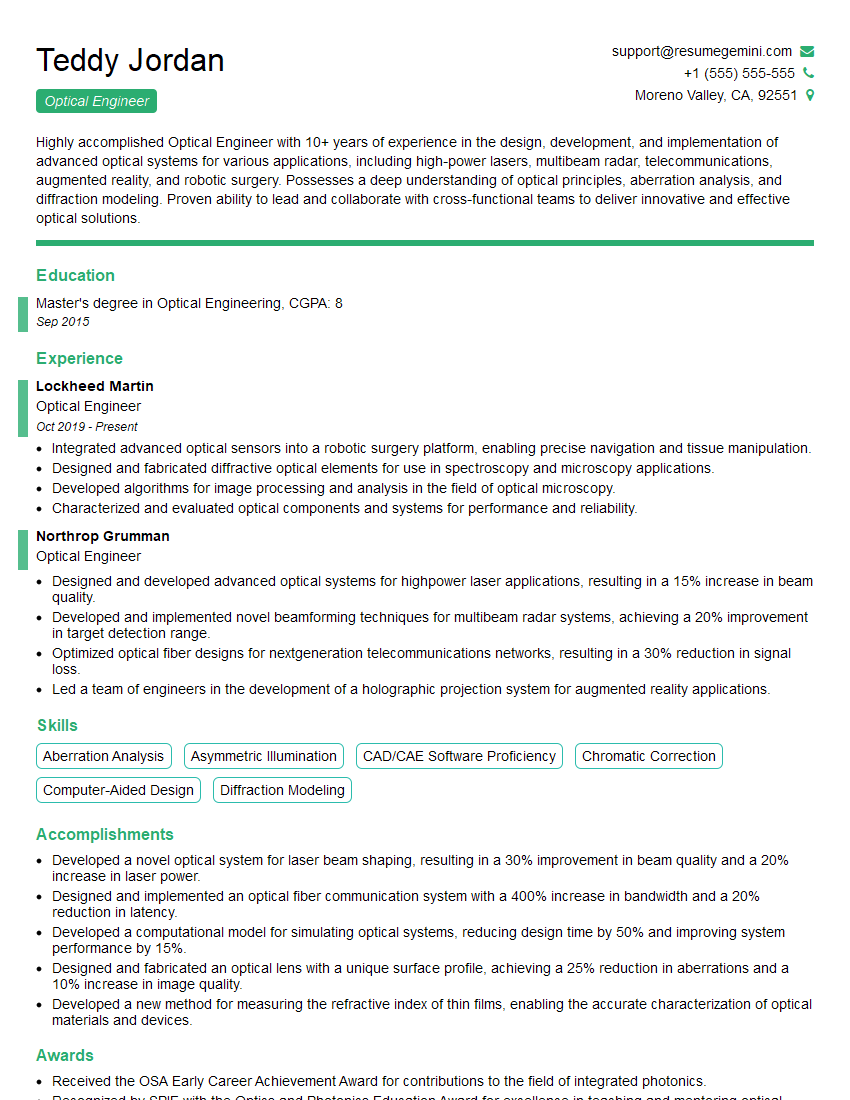
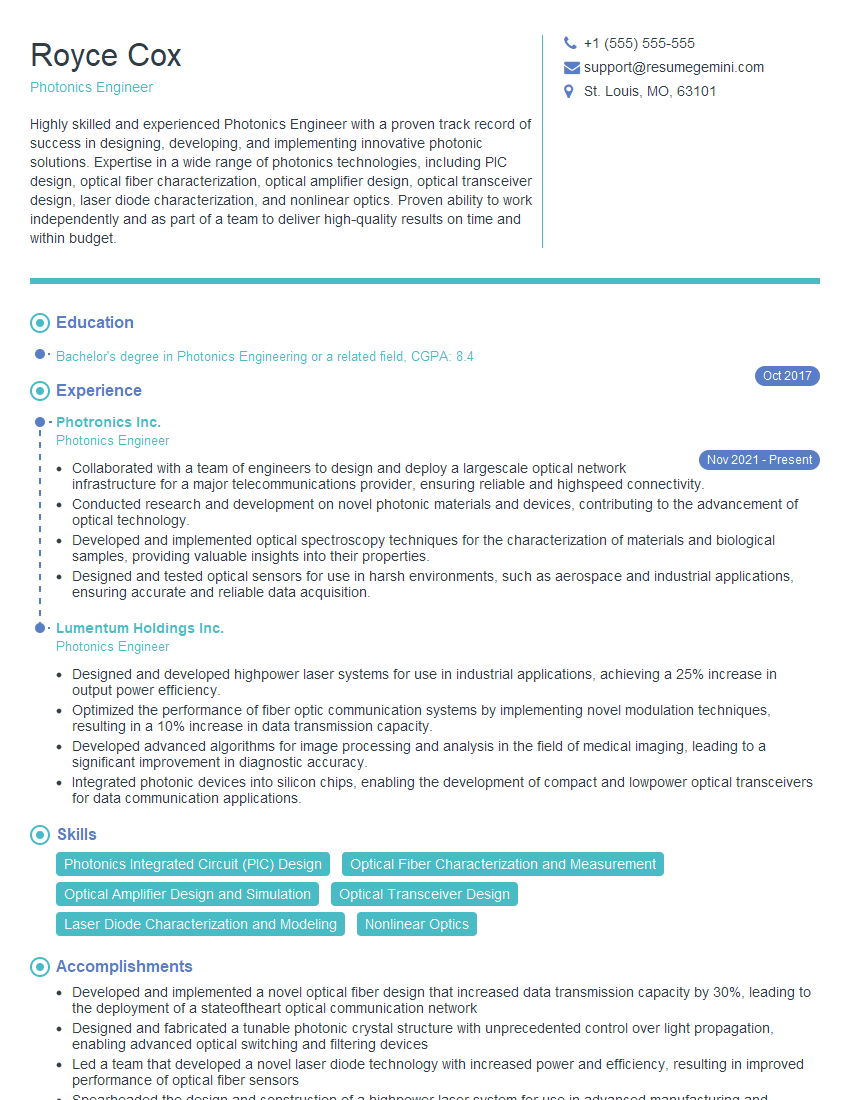
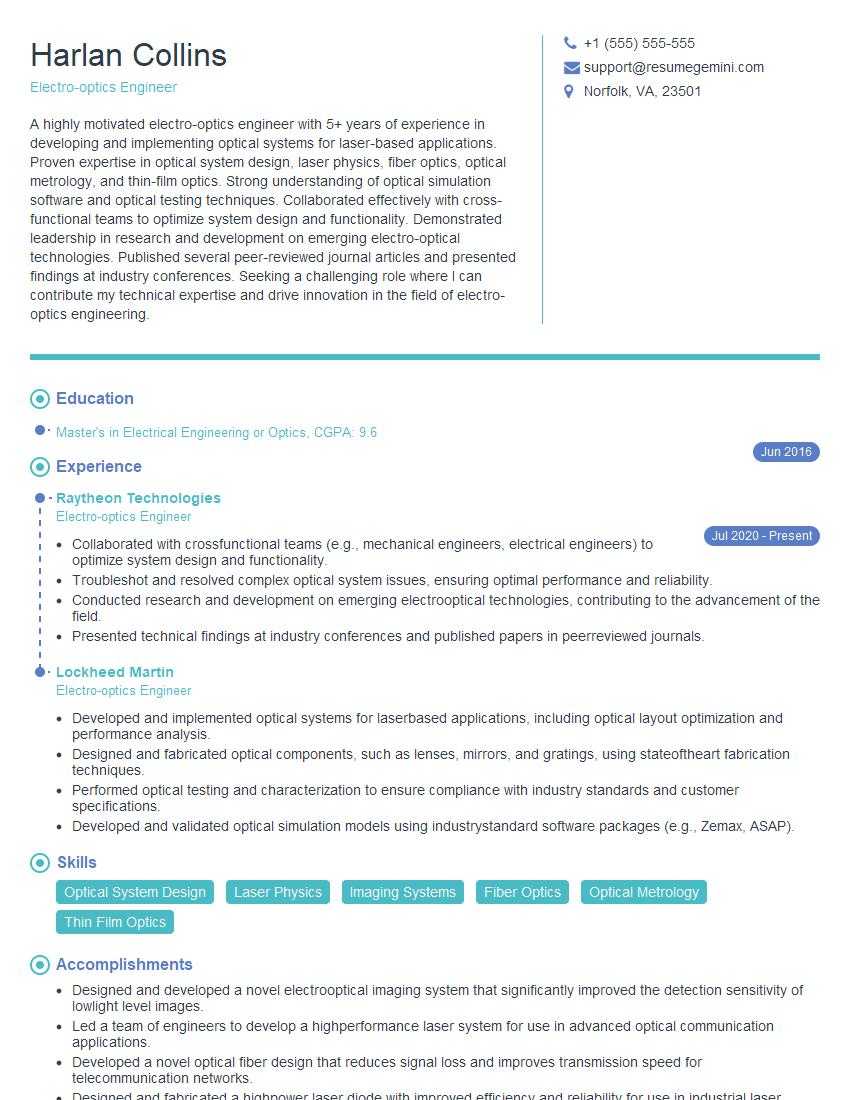
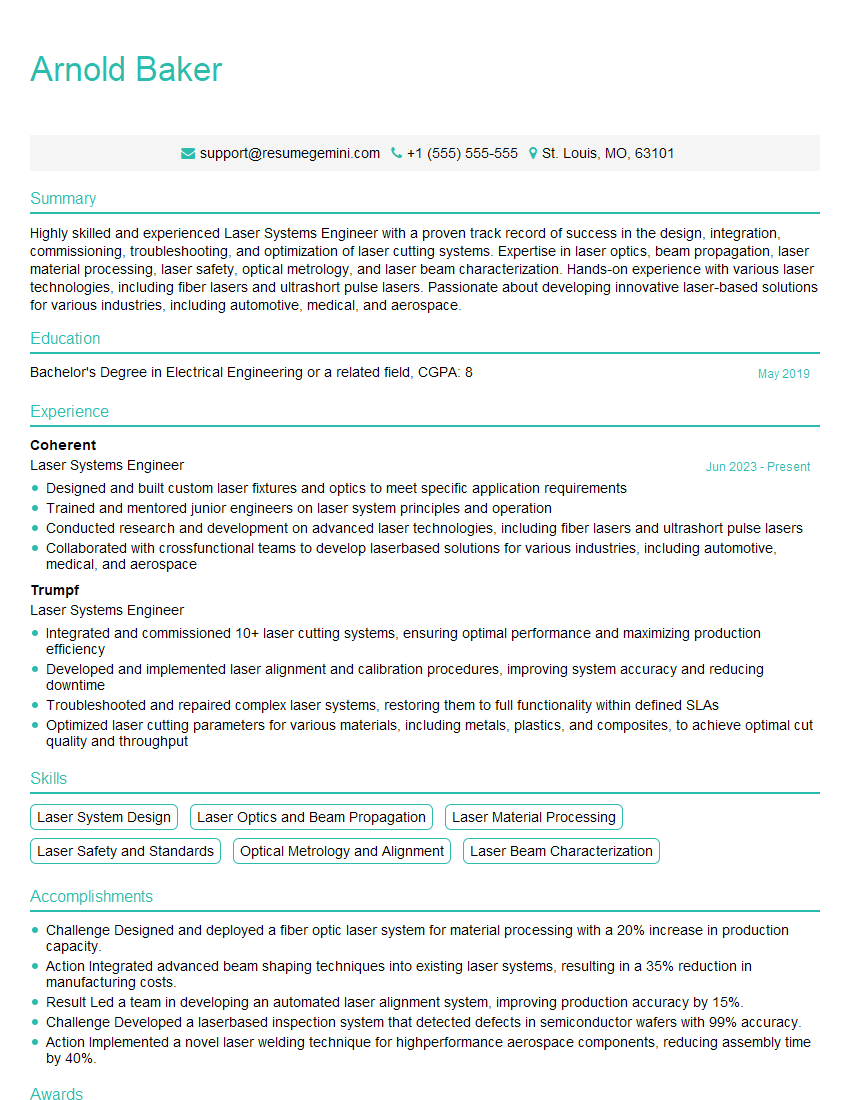
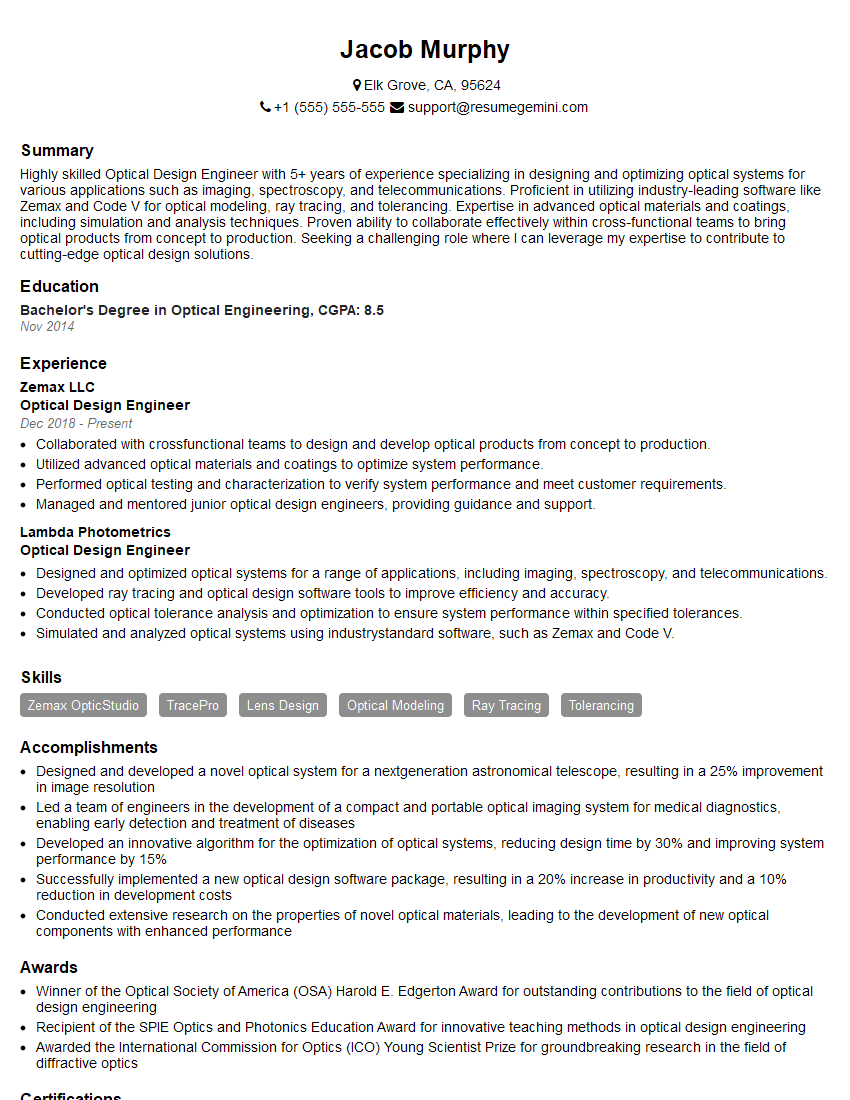
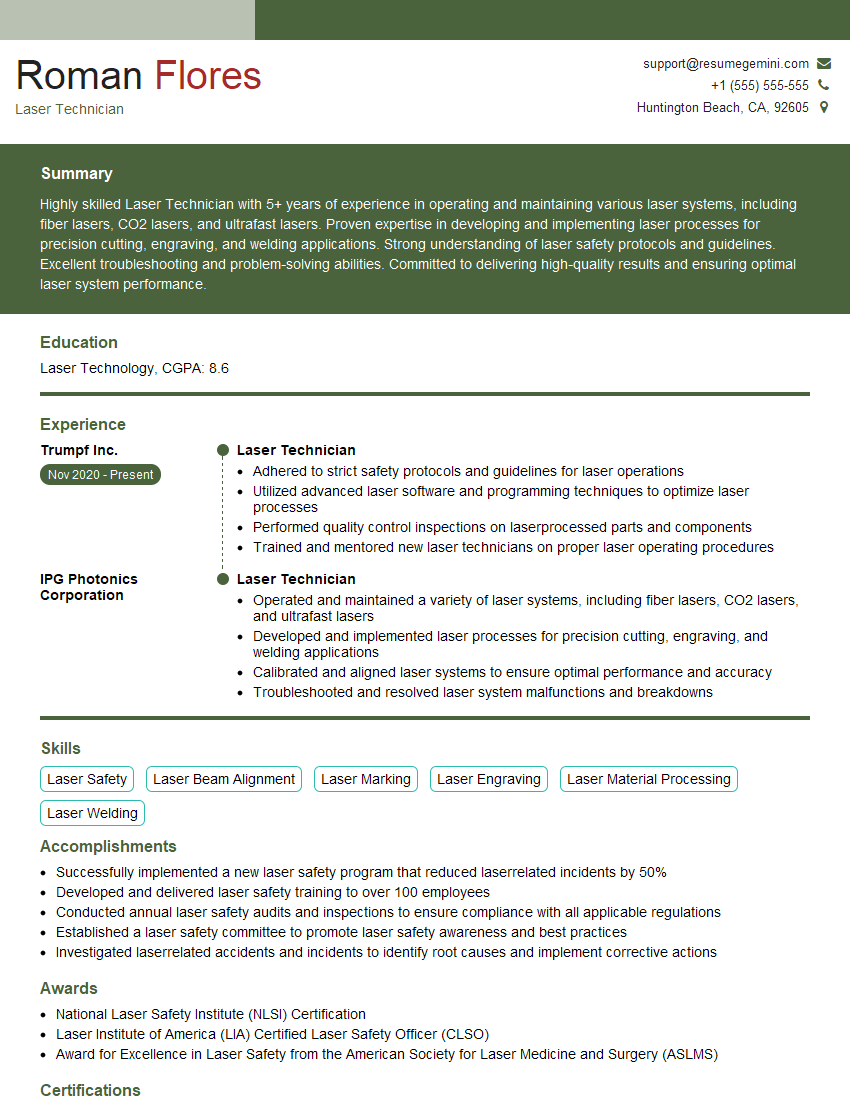
Mastering Laser Optics and Beam Propagation opens doors to exciting careers in cutting-edge fields. A strong understanding of these concepts is crucial for success in research, development, and engineering roles within the optics industry. To maximize your job prospects, it’s vital to present your skills effectively. Creating an ATS-friendly resume is key to getting your application noticed. ResumeGemini is a trusted resource that can help you build a professional and impactful resume tailored to the specific requirements of the Laser Optics and Beam Propagation field. Examples of resumes tailored to this area are available to help you get started.

Explore more articles
Users Rating of Our Blogs
Share Your Experience
We value your feedback! Please rate our content and share your thoughts (optional).
What Readers Say About Our Blog
Very informative content, great job.
good