The thought of an interview can be nerve-wracking, but the right preparation can make all the difference. Explore this comprehensive guide to Laser Systems Engineering interview questions and gain the confidence you need to showcase your abilities and secure the role.
Questions Asked in Laser Systems Engineering Interview
Q 1. Explain the principle of laser operation.
Laser operation relies on a phenomenon called stimulated emission. Imagine atoms as tiny energy storage units. When an atom absorbs energy (e.g., from an electrical current or flash lamp), its electrons jump to a higher energy level – an excited state. These excited atoms are unstable; they want to return to their original, lower energy level (ground state). When a photon (a particle of light) with the exact energy difference between these two levels interacts with an excited atom, it triggers the atom to release another photon, identical to the first in terms of wavelength, phase, and direction. This is stimulated emission – one photon in, two identical photons out. This process cascades, amplifying the light exponentially within a resonant cavity (a space bounded by mirrors).
The cavity ensures that the photons repeatedly pass through the gain medium (the material with the excited atoms), leading to further stimulated emission and a highly coherent and monochromatic beam. One mirror is partially reflective, allowing a portion of the amplified light to escape as the laser beam.
Q 2. Describe different types of lasers and their applications.
Lasers come in a wide variety of types, categorized by their gain medium, wavelength, and operational mode. Some examples include:
- Gas lasers (HeNe, CO2): Utilize a mixture of gases as the gain medium. HeNe lasers produce visible red light and are commonly used in barcode scanners. CO2 lasers emit infrared radiation and are powerful tools for industrial cutting and welding.
- Solid-state lasers (Nd:YAG, Ruby): Employ a solid crystal doped with specific ions as the gain medium. Nd:YAG lasers (Neodymium-doped Yttrium Aluminum Garnet) emit near-infrared light and are used in medical applications (laser surgery), material processing, and rangefinding. Ruby lasers were historically significant for their role in early laser research.
- Semiconductor lasers (diode lasers): These compact and efficient lasers are built from semiconductor materials. They are widely used in CD/DVD players, laser pointers, and fiber optic communication systems. Their small size and low power consumption make them ideal for various applications.
- Fiber lasers: The gain medium is a doped optical fiber. They offer high power, good beam quality, and excellent efficiency, making them popular in industrial applications such as laser cutting and welding.
- Excimer lasers: Use a mixture of noble gases and halogens to produce ultraviolet light. They have niche applications in microelectronics and medical procedures like LASIK eye surgery.
The choice of laser type depends heavily on the desired wavelength, power, beam quality, efficiency, and overall application requirements.
Q 3. What are the key components of a laser system?
A typical laser system consists of several key components:
- Gain medium: The material that amplifies light through stimulated emission. This could be a gas, solid, liquid, or semiconductor.
- Pump source: Provides the energy to excite the atoms in the gain medium. Examples include flash lamps, electrical discharges, or other lasers.
- Optical resonator (cavity): Formed by mirrors that reflect light back and forth through the gain medium, leading to amplification. One mirror is partially reflective to allow laser output.
- Power supply: Provides the electrical power to the pump source and other system components.
- Cooling system: Manages the heat generated by the laser, which can be significant depending on the power level.
- Beam delivery system: Directs the laser beam to the target. This can involve mirrors, lenses, optical fibers, or other optical components.
- Control system: Regulates the laser’s output power, beam characteristics, and operational parameters.
Q 4. How do you ensure laser safety in a work environment?
Laser safety is paramount. Procedures should encompass the following:
- Engineering controls: Enclosures, interlocks, and beam paths designed to minimize exposure.
- Administrative controls: Standard operating procedures (SOPs), training programs, and access restrictions.
- Personal protective equipment (PPE): Laser safety eyewear with appropriate optical density (OD) ratings for the specific laser wavelength and power level. This is crucial to prevent eye damage. Other PPE might include gloves and protective clothing for skin protection, particularly with high-power lasers.
- Regular safety inspections: Regular checks of laser systems, safety devices, and PPE to ensure that they are functioning correctly and to identify any potential hazards.
- Emergency procedures: Defined procedures for handling laser-related accidents or emergencies.
- Laser safety officer (LSO): Many facilities designate an LSO responsible for overseeing laser safety programs and ensuring compliance with relevant regulations (such as ANSI Z136).
Remember, the power level and wavelength of the laser directly influence the potential hazards. Higher power lasers present a significantly greater risk.
Q 5. Explain the concept of laser beam quality (M²).
Beam quality, often represented by the M² factor (beam propagation ratio), describes how closely a laser beam’s divergence resembles that of an ideal Gaussian beam. An ideal Gaussian beam has an M² value of 1. Higher M² values indicate a beam that diverges more rapidly than an ideal Gaussian beam, implying lower beam quality. This is crucial because a beam with poor quality will spread out quickly over distance, reducing its intensity and making it less suitable for precision applications.
Imagine shining two laser pointers onto a distant wall: one with an M² of 1 (near-perfect beam), the other with an M² of 5 (poor beam). The second laser’s spot on the wall will be significantly larger and less intense due to its faster divergence. This translates to reduced precision in applications like laser cutting, laser surgery, or material processing. M² is typically measured using a beam profiler and analyzing the beam’s width as it propagates.
Q 6. Describe different laser beam shaping techniques.
Several techniques exist to shape laser beams depending on the desired output:
- Lenses: Simple lenses can focus, collimate, or expand laser beams. Different lens types (e.g., spherical, cylindrical, aspheric) provide varied shaping capabilities.
- Spatial light modulators (SLMs): These devices use liquid crystals or other technologies to dynamically control the phase and amplitude of a laser beam, allowing for complex beam shaping. They are employed in advanced applications such as creating structured light patterns or shaping beams for material processing.
- Diffractive optical elements (DOEs): These components use diffraction gratings or other diffractive structures to reshape laser beams. They can create flat-top beams, Bessel beams, or other specialized beam profiles.
- Axicons: These conical lenses generate a long, non-diffracting Bessel beam that is useful for applications requiring long interaction lengths.
- Beam expanders: These optical systems increase the beam diameter, which is crucial for applications where a larger spot size or reduced divergence is needed. They generally consist of two lenses arranged in a telescope configuration.
The selection of a beam shaping technique hinges on the application’s demands. For instance, a flat-top beam might be preferred for uniform material processing, whereas a focused Gaussian beam is better suited for high-precision applications.
Q 7. How do you measure laser power and beam profile?
Measuring laser power and beam profile requires specialized instruments:
- Power measurement: Power meters (or calorimeters) directly measure the laser’s output power in units like watts (W) or milliwatts (mW). They employ various techniques to absorb the laser energy and convert it into a measurable signal. The choice of power meter depends on the laser’s wavelength and power level.
- Beam profile measurement: Beam profilers provide a spatial map of the laser beam’s intensity distribution. These instruments typically use a CCD camera to capture the beam’s image and provide data such as beam diameter, beam shape (e.g., Gaussian, flat-top), and M² factor. Some beam profilers use knife-edge techniques or other methods to measure the beam profile.
Calibration of these instruments is vital to ensure accurate measurements. Proper alignment of the laser beam relative to the power meter or beam profiler is equally important for reliable results. In a professional setting, traceable calibrations are essential to maintain accuracy and ensure compliance with quality standards.
Q 8. Explain the principles of laser-material interaction.
Laser-material interaction describes the processes that occur when a laser beam strikes a material. It’s fundamentally about energy transfer: the laser’s photons deposit energy into the material, leading to various effects depending on factors like laser parameters (wavelength, power, pulse duration), material properties (absorption coefficient, thermal conductivity, melting point), and the interaction environment (ambient atmosphere).
The primary interaction mechanisms include:
- Absorption: The material absorbs the laser energy, leading to an increase in temperature. This is the foundation for most laser processing techniques.
- Reflection: A portion of the laser light is reflected from the material’s surface. The reflectivity depends on the material and the laser’s wavelength.
- Transmission: Some laser light may pass through the material, especially with transparent materials or at wavelengths where absorption is low.
- Scattering: The laser light can be scattered within the material, leading to less efficient energy deposition.
The absorbed energy causes a rise in temperature, potentially leading to melting, vaporization, or even plasma formation. The specific outcome dictates the type of laser processing that can be achieved. For instance, a high absorption rate will lead to efficient cutting or welding, while a low absorption might be preferable for surface marking.
Consider, for example, cutting steel with a CO2 laser. The steel strongly absorbs the CO2 laser’s infrared wavelength, leading to rapid heating and vaporization of the material, enabling precise cutting.
Q 9. Describe different laser processing techniques (e.g., cutting, welding, marking).
Laser processing techniques exploit the precise control and high power density of lasers to manipulate materials. Several common techniques include:
- Laser Cutting: The laser beam is focused to a small spot, generating high power density to melt and vaporize the material, creating a precise cut. This is used extensively in sheet metal processing, textiles, and even delicate materials like wood.
- Laser Welding: The laser beam melts the material’s edges, creating a weld pool that solidifies to join two parts. The high precision of lasers allows for very fine and deep welds, crucial in applications such as automotive manufacturing and electronics.
- Laser Marking: The laser beam alters the material’s surface properties without completely removing material. This can involve discoloration, etching, or ablation, creating marks or engravings for identification, decoration, or traceability. Examples include serial numbers on products or decorative patterns on jewelry.
- Laser Drilling: High-power pulsed lasers are used to create precise holes in various materials. This is critical in applications such as creating micro-fluidic channels or perforating materials for filtration.
- Laser Ablation: The laser removes material layer by layer, allowing for very precise micromachining. It is frequently used in the creation of intricate micro-devices.
Each technique requires careful selection of laser parameters (power, pulse duration, wavelength, focus) and material properties to achieve the desired outcome. For instance, deep penetration welding often requires high power continuous wave lasers, while fine marking may utilize low power pulsed lasers.
Q 10. How do you choose the appropriate laser for a specific application?
Choosing the right laser for an application involves a careful assessment of several factors:
- Material Properties: The material’s absorption coefficient at different wavelengths is crucial. Some materials absorb CO2 lasers well, while others may require fiber lasers or UV lasers.
- Processing Requirements: The desired process (cutting, welding, marking) dictates the needed laser power, pulse duration, and beam quality. Deep penetration welding needs high average power, while delicate marking may require short pulses with low energy.
- Precision and Speed: The required accuracy and processing speed influence the choice of laser and focusing optics. High-precision applications necessitate high-quality beam profiles and precise control systems.
- Cost and Maintenance: Different laser types vary significantly in cost and maintenance requirements. The overall operational cost needs to be factored into the decision.
- Safety and Environmental Concerns: Certain lasers require specific safety measures and might generate hazardous byproducts. Environmental regulations also need to be considered.
For example, a fiber laser might be ideal for high-speed metal cutting due to its efficiency and excellent beam quality, while a UV laser might be chosen for fine marking on polymers due to its ability to ablate material without excessive heat spread.
Q 11. What are the advantages and disadvantages of different laser types?
Different laser types offer unique advantages and disadvantages:
- CO2 Lasers: Advantages: high power output, good for cutting and welding many materials (especially metals and non-metals). Disadvantages: less efficient than fiber lasers, requires gas handling systems, typically larger and less portable.
- Fiber Lasers: Advantages: high efficiency, compact size, excellent beam quality, good for metal processing, lower maintenance. Disadvantages: Can be expensive upfront, relatively less efficient for non-metal processing compared to CO2 lasers.
- Nd:YAG Lasers: Advantages: Versatile wavelength options (fundamental, doubled, tripled), good for marking and precision micromachining. Disadvantages: Lower efficiency than fiber lasers, more complex systems, can require cooling systems.
- UV Lasers: Advantages: excellent for photo-ablation of polymers and other materials, minimal heat-affected zones. Disadvantages: lower power output compared to other laser types, often more expensive.
The optimal choice depends on the specific application, balancing performance requirements, cost, and maintenance considerations. Each type excels in different aspects of material processing.
Q 12. Explain the concept of optical resonators.
An optical resonator, also known as a laser cavity, is the heart of a laser system. It provides positive feedback for the light amplification process. It’s essentially a structure that confines the light, allowing it to pass back and forth between mirrors, stimulating further emission of photons from the gain medium (e.g., a crystal, gas, or semiconductor).
A typical resonator consists of two mirrors (often highly reflective) placed at a precise distance apart. Light generated within the gain medium bounces back and forth, building up intensity through stimulated emission. One mirror is usually partially reflective to allow a portion of the amplified light to escape as the laser beam.
The design of the resonator influences critical laser characteristics like beam quality, mode structure, and output power. Different resonator configurations (e.g., Fabry-Pérot, unstable resonators) are used to optimize for specific applications. For example, a stable resonator produces a low-divergence beam ideal for precision applications, whereas an unstable resonator is used when high output power is prioritized over beam quality.
Q 13. Describe different types of optical components used in laser systems.
Laser systems utilize a variety of optical components, each with a specific function:
- Mirrors: Highly reflective mirrors are essential for creating the optical resonator. Different mirror coatings are chosen based on the laser’s wavelength.
- Lenses: Lenses focus or collimate the laser beam, controlling its size and divergence. Various lens types are available (e.g., spherical, aspheric, cylindrical) for different applications.
- Beam Expanders: Expand the laser beam diameter, decreasing its divergence, and improving beam quality for applications needing long propagation distances.
- Polarizers: Control the polarization of the laser beam. This is critical in certain applications like laser cutting and material processing.
- Beam Splitters: Divide the laser beam into two or more beams, allowing for simultaneous processing or beam monitoring.
- Optical Isolators: Protect the laser from back-reflections, which can damage the laser source.
- Filters: Select specific wavelengths, removing unwanted wavelengths or reducing background noise.
The selection and arrangement of these components are critical to the overall laser system design, ensuring optimal performance and functionality. For example, a high-quality beam expander is crucial in laser scanning systems to achieve fine resolution over a large area.
Q 14. How do you design a laser system for a specific application?
Designing a laser system is a multi-step process involving:
- Defining Requirements: Clearly define the application, material to be processed, required precision, throughput, and other relevant parameters.
- Laser Selection: Choose the appropriate laser type and power based on the material and process requirements.
- Optical Design: Design the optical path, including the resonator, lenses, mirrors, and other components to focus and deliver the laser beam to the work piece with the desired intensity and spot size. Modeling software is frequently used here.
- Control System Design: Design a control system to regulate laser power, beam position, and other parameters, ensuring precise and repeatable processing. This often involves software and hardware integration.
- Safety Considerations: Incorporate safety measures to protect operators and the surrounding environment from laser radiation. This includes laser safety enclosures, interlocks, and appropriate warning systems.
- Testing and Optimization: Thoroughly test the system and optimize its parameters to achieve the desired performance.
Example: Designing a laser marking system for product identification would involve selecting a laser with appropriate wavelength and pulse characteristics for the material (e.g., a fiber laser for metals, or a UV laser for plastics), designing an optical setup for precise beam delivery and focus, and incorporating a control system to program specific marking patterns. The entire system needs to comply with relevant safety standards.
Q 15. What are the challenges in aligning and maintaining a laser system?
Aligning and maintaining a laser system is a crucial aspect of ensuring its performance and longevity. It’s akin to carefully tuning a musical instrument – even a tiny misalignment can significantly impact the final output. The challenges stem from several factors:
Mechanical Stability: Vibrations, temperature fluctuations, and even slight movements can throw off the delicate alignment of optical components. Imagine trying to hit a target with a laser pointer while standing on a bouncy castle! This requires robust mounting systems and vibration isolation techniques.
Thermal Effects: Heat generated by the laser itself or surrounding components can cause thermal expansion and lens distortion, leading to misalignment. Proper thermal management, including cooling systems and temperature-controlled environments, is essential.
Optical Component Degradation: Over time, optical components like mirrors and lenses can degrade, causing scattering and loss of beam quality. Regular cleaning and replacement are crucial. Think of it like a telescope lens – dust and smudges will blur the image.
Alignment Precision: Achieving and maintaining precise alignment requires specialized tools and techniques, often involving micrometer adjustments. The tolerance for error can be extremely small, on the order of micrometers or even nanometers, depending on the application.
Overcoming these challenges involves using high-precision mounts, active feedback control systems (which constantly monitor and correct for misalignments), robust thermal management, and regular maintenance procedures. Proper preventative measures are key to reducing downtime and maximizing system lifespan.
Career Expert Tips:
- Ace those interviews! Prepare effectively by reviewing the Top 50 Most Common Interview Questions on ResumeGemini.
- Navigate your job search with confidence! Explore a wide range of Career Tips on ResumeGemini. Learn about common challenges and recommendations to overcome them.
- Craft the perfect resume! Master the Art of Resume Writing with ResumeGemini’s guide. Showcase your unique qualifications and achievements effectively.
- Don’t miss out on holiday savings! Build your dream resume with ResumeGemini’s ATS optimized templates.
Q 16. Explain the concept of laser beam delivery systems.
Laser beam delivery systems are the pathways that guide the laser beam from its source to its target. They’re critical for ensuring the beam maintains its quality, intensity, and direction. Think of them as the roads that a laser beam travels on. These systems can be quite simple, like a single lens, or incredibly complex, involving multiple mirrors, lenses, fibers, and even free-space propagation through air or vacuum.
Key components often include:
Focusing Optics: Lenses and mirrors used to concentrate or expand the beam to achieve the desired spot size and intensity at the target.
Beam Steering Mechanisms: Mirrors mounted on actuators that allow precise control of the beam direction, essential in applications like laser scanning or laser surgery.
Optical Fibers: Flexible waveguides that transmit the beam over distances, often used in medical and industrial applications where flexibility is crucial.
Beam Expanders: Devices used to increase the beam diameter, improving propagation characteristics and reducing divergence.
The design of a laser beam delivery system heavily depends on the specific application. For example, a laser cutting system will require a different design compared to a laser communications system. Considerations include beam quality, power levels, propagation distance, target size, and the environment.
Q 17. Describe different types of laser diagnostics.
Laser diagnostics are essential for characterizing and optimizing laser performance. They act like a doctor’s checkup for a laser system, providing critical information about its health. Several methods exist:
Power Measurement: Using power meters to determine the output power of the laser, essential for monitoring performance and ensuring safety.
Beam Profiling: Techniques like scanning slit methods or CCD cameras to measure the spatial distribution of the beam intensity, giving insights into beam quality (e.g., M2).
Wavelength Measurement: Spectrometers or interferometers used to determine the precise wavelength (and potentially linewidth) of the laser emission.
Beam pointing stability measurement: Sensors that monitor the position and orientation of the beam to quantify its stability over time.
Temporal analysis: Measuring pulse characteristics (duration, shape, repetition rate) for pulsed lasers using oscilloscopes or autocorrelators.
Mode analysis: Techniques such as interferometry to determine the transverse and longitudinal modes that the laser is operating in. This is crucial for single-mode laser operation.
The choice of diagnostic tools depends on the specific laser system and the application. A simple laser pointer may only require power measurement, while a high-power industrial laser may need a comprehensive suite of diagnostic tools to ensure optimal performance and safety.
Q 18. How do you troubleshoot common laser system problems?
Troubleshooting laser system problems requires a systematic approach. It’s like detective work, where you systematically eliminate possibilities until you find the culprit.
Identify the symptom: What exactly is wrong? Is the laser not emitting, is the beam misaligned, is the output power low? Clearly defining the problem is the first step.
Check the basics: Ensure the laser is properly powered on, the cooling system is functioning, and all interconnections are secure. Often, the simplest solutions are overlooked.
Use diagnostic tools: Employ the appropriate diagnostic tools (as discussed earlier) to gather data on laser parameters. This data helps pinpoint the source of the problem.
Check for alignment issues: Carefully examine the alignment of all optical components. Even minor misalignments can significantly affect performance.
Inspect optical components: Look for damage, dirt, or scratches on mirrors, lenses, and other optical elements. Clean or replace components as needed.
Review operational logs: Many laser systems maintain logs of operational data. These logs can help identify trends or anomalies that may indicate a developing problem.
Consult technical documentation: Refer to the system’s manuals and technical specifications for troubleshooting guides and error codes.
Often, a combination of these steps is necessary. If the problem persists, seeking expert assistance is recommended.
Q 19. Explain the concept of laser wavelength selection.
Laser wavelength selection is crucial because it dictates the laser’s interaction with matter. Different wavelengths have different absorption and scattering properties, making them suitable for various applications.
The choice of wavelength depends heavily on the intended application:
Medical applications: Certain wavelengths are absorbed more readily by specific tissues, making them ideal for laser surgery or therapeutic treatments. For example, 1064 nm Nd:YAG lasers are commonly used for tissue ablation because of their good penetration depth.
Material processing: Different materials absorb light at different wavelengths, impacting the efficiency of laser cutting, welding, or marking processes. For example, CO2 lasers (10.6 μm) are efficient at cutting organic materials.
Optical sensing: Wavelength selection is vital in sensing applications. Specific wavelengths can be used to detect or measure certain substances or environmental parameters.
Communications: Fiber optic communications systems utilize wavelengths in specific windows to minimize signal attenuation and maximize transmission efficiency. The standard telecom windows are around 1550 nm.
Laser wavelength is determined by the gain medium and the laser cavity design. A change in the gain medium or resonator configuration will alter the wavelength of the laser output.
Q 20. What are the different types of laser modulation techniques?
Laser modulation techniques are used to control the intensity, frequency, or phase of the laser beam over time. This enables diverse applications, from data transmission to precision material processing.
Amplitude Modulation (AM): Varying the intensity of the laser beam. Commonly used in laser displays and optical communication systems. Think of turning a dimmer switch for a lightbulb.
Frequency Modulation (FM): Varying the frequency of the laser beam. Used extensively in optical communication systems for high-bandwidth data transmission.
Phase Modulation (PM): Varying the phase of the laser beam. This is crucial in coherent optical communication systems and interferometry.
Pulse Modulation: Generating short pulses of light, either by Q-switching or mode-locking, which are useful for high-precision material processing or time-resolved measurements. This is like using short bursts instead of continuous light.
Direct Modulation: Directly modulating the pump current or voltage applied to the laser diode, a simpler and less expensive method but with limitations on bandwidth and modulation depth.
External Modulation: Using external electro-optic modulators like Mach-Zehnder interferometers, which can provide high-bandwidth modulation and better control of signal characteristics.
The choice of modulation technique depends on the specific application requirements and the trade-offs between bandwidth, efficiency, and complexity.
Q 21. How do you ensure the stability of a laser system?
Ensuring the stability of a laser system is paramount for reliable operation and consistent results. Instabilities can manifest as fluctuations in output power, beam pointing, or wavelength, all of which can negatively impact performance. Strategies for ensuring stability include:
Temperature Control: Precise temperature control of the laser cavity and surrounding environment minimizes thermal expansion and refractive index changes that can affect the laser’s parameters. This often involves thermoelectric coolers (TECs) and temperature-stabilized enclosures.
Vibration Isolation: Minimizing vibrations that can affect the alignment of optical components. This can be achieved through the use of vibration isolation tables or active vibration damping systems.
Active Feedback Control: Employing sensors to monitor laser parameters (e.g., power, wavelength, beam pointing) and using feedback loops to actively correct for deviations from the desired setpoint. This is like using an autopilot for the laser.
Power Supply Regulation: Using highly regulated power supplies to ensure a stable and consistent supply of power to the laser, preventing fluctuations in output power.
Cleanliness: Maintaining a clean optical path, minimizing dust and other contaminants that can scatter the beam and degrade performance. This often involves using cleanroom environments or specialized cleaning techniques.
The specific techniques used to achieve stability will depend on the type of laser, its application, and the level of stability required. Some lasers are inherently more stable than others. For example, diode-pumped solid-state lasers (DPSSLs) are generally more stable than gas lasers.
Q 22. Describe your experience with laser safety standards and regulations.
Laser safety is paramount in my work, and I have extensive experience adhering to international standards like ANSI Z136.1 and IEC 60825. These standards classify lasers based on their potential hazard, dictating necessary safety precautions. For example, Class 4 lasers, the most powerful, require stringent controls including interlocks, safety eyewear specific to the laser’s wavelength, and controlled access areas. I’ve personally been involved in risk assessments for numerous laser systems, ensuring compliance by implementing safety measures such as beam enclosures, warning signs, and emergency shutoff mechanisms. In one project, we designed a custom enclosure for a high-power laser system, incorporating multiple layers of safety interlocks to prevent accidental exposure. This involved meticulous design and rigorous testing to ensure compliance with all relevant safety regulations.
Beyond compliance, I also emphasize proactive safety training for all personnel who work with lasers, emphasizing proper procedures and emergency response protocols. This holistic approach minimizes risk and ensures a safe working environment.
Q 23. Explain your experience with laser system design software.
My experience with laser system design software is extensive, encompassing both commercially available packages and custom-developed tools. I’m proficient in software like Zemax OpticStudio for optical design and simulation, allowing for accurate modeling of beam propagation, aberrations, and system performance. This is crucial for optimizing laser performance and ensuring the system meets its design specifications. For instance, in designing a laser scanning system for medical imaging, Zemax was instrumental in optimizing the beam shape and minimizing distortion across the scanning field. I’ve also worked with COMSOL Multiphysics for thermal simulations of laser components, essential in ensuring the system can handle the heat generated during operation, preventing damage and ensuring longevity. Furthermore, I have experience with programming languages such as MATLAB and Python for custom data analysis and control system development, enabling precise control over various laser parameters.
Beyond these commercial packages, I’ve participated in developing custom software for specific laser system requirements, including real-time monitoring and control algorithms. This bespoke approach allows for tailoring solutions precisely to project demands.
Q 24. Describe your experience working with different types of laser control systems.
I’ve worked with a diverse range of laser control systems, from simple analog circuits to sophisticated digital control loops. This experience encompasses various control methods including analog proportional-integral-derivative (PID) controllers, digital signal processors (DSPs), and programmable logic controllers (PLCs). My experience extends to closed-loop feedback systems that constantly monitor and adjust laser parameters like power, beam position, and polarization, ensuring stability and precision. For example, in a high-precision laser cutting application, I implemented a sophisticated closed-loop control system to maintain consistent cutting speed and quality despite variations in material thickness. This involved designing feedback loops using both optical sensors (measuring beam position and cut depth) and physical sensors (monitoring cutting head speed). In another instance, I utilized a PLC to orchestrate the entire laser system, integrating safety interlocks and sequencing multiple operations in a precise, automated fashion.
The selection of the optimal control system depends heavily on the application and the required level of precision and complexity.
Q 25. How do you perform laser system calibration and maintenance?
Laser system calibration and maintenance are critical to ensuring accuracy, repeatability, and safety. Calibration typically involves aligning optical components to optimize beam quality and power distribution, followed by verifying laser power output using a calibrated power meter. This process often requires precise adjustments using micro-positioners and alignment tools, utilizing techniques such as auto-collimation and knife-edge scanning. I’ve regularly used specialized equipment like beam profilers to analyze the spatial characteristics of the laser beam, confirming its uniformity and conformity to design specifications. Maintenance includes routine checks of optical components for cleanliness and damage, cleaning optical surfaces with appropriate techniques to prevent scratching, and replacing components as needed.
Regular maintenance also entails checking the cooling systems to ensure proper heat dissipation, testing safety interlocks and emergency shutoff mechanisms, and reviewing operational logs to identify potential issues. Proactive maintenance is vital in preventing costly downtime and ensuring the safe and reliable operation of the laser system. For example, I successfully identified a potential cooling system failure in a high-power laser system during routine maintenance, preventing a costly system breakdown.
Q 26. Describe your experience with laser system integration and testing.
Laser system integration and testing involve a systematic approach encompassing mechanical, optical, and electrical integration, followed by thorough performance testing. Mechanical integration includes precise mounting and alignment of optical components, ensuring stability and minimizing vibrations. Optical integration focuses on aligning the laser beam path through the various optical elements, optimizing beam quality and efficiency. Electrical integration involves interfacing the laser with the control system, power supplies, and safety interlocks. Thorough testing is crucial, including beam profiling, power measurements, and functional testing to validate the system’s performance against design specifications. This often involves using specialized test equipment, such as optical spectrum analyzers, oscilloscopes, and power meters.
One notable integration project involved incorporating a high-power fiber laser into a complex industrial manufacturing process. This required meticulous planning and coordination with the manufacturing team to ensure seamless integration. Rigorous testing was performed to ensure the laser system could meet the stringent throughput requirements and maintain acceptable product quality.
Q 27. What are the environmental factors that affect laser system performance?
Environmental factors significantly influence laser system performance. Temperature fluctuations can affect optical component alignment, causing beam wander and reduced power stability. Humidity can lead to condensation on optical surfaces, degrading beam quality and potentially damaging components. Dust and other airborne particles can scatter the laser beam, reducing power and introducing noise. Vibrations can misalign optical components, negatively impacting beam pointing accuracy and stability. Additionally, electromagnetic interference (EMI) can disrupt control signals and affect laser operation. To mitigate these issues, we often use temperature-controlled enclosures, desiccant packs to control humidity, air filtration systems to remove dust particles, vibration isolation tables, and EMI shielding.
In a recent project involving an outdoor laser rangefinder, we had to design a weatherproof enclosure and implement active temperature compensation to ensure reliable operation under varying environmental conditions.
Q 28. Explain the concept of laser beam polarization.
Laser beam polarization describes the orientation of the electric field vector as the beam propagates. Light is a transverse electromagnetic wave, meaning the electric and magnetic fields oscillate perpendicular to the direction of propagation. In unpolarized light, the electric field vector oscillates randomly in all directions perpendicular to the beam axis. However, in polarized light, the electric field vector oscillates preferentially along a specific direction. Common polarization states include linear polarization (electric field oscillates along a single plane), circular polarization (electric field rotates around the propagation axis), and elliptical polarization (a combination of linear and circular polarization).
Polarization is significant in various laser applications. For example, in optical communication systems, polarization-maintaining fibers are used to preserve the polarization state of the signal, reducing signal degradation. In laser cutting and material processing, specific polarization states can be used to optimize material interaction and cutting efficiency. In laser scanning systems, controlling the polarization state can improve image quality and reduce noise.
Key Topics to Learn for Laser Systems Engineering Interview
- Laser Fundamentals: Understanding laser principles, including gain media, optical resonators, and laser types (e.g., gas, solid-state, fiber, semiconductor). Prepare to discuss different laser operating modes and their characteristics.
- Optical Design and Components: Familiarity with optical design software, lenses, mirrors, beam expanders, and other optical components used in laser systems. Be ready to discuss optical alignment, tolerances, and aberrations.
- Laser Beam Propagation and Control: Knowledge of Gaussian beam propagation, beam shaping techniques, and methods for controlling beam direction and intensity. Consider exploring applications like beam steering and focusing.
- Laser Safety and Regulations: Understanding laser safety standards and regulations is crucial. Be prepared to discuss hazard classifications, safety procedures, and personal protective equipment.
- Laser Applications: Explore diverse applications of laser systems in areas like materials processing, medical applications, sensing, and communication. Focus on specific examples where your skills and experience align.
- Signal Processing and Data Acquisition: Many laser systems utilize advanced signal processing techniques for data analysis. Review relevant methods and their application to specific laser system projects.
- Control Systems and Automation: Understanding the principles of control systems and their integration with laser systems is essential, especially for complex applications requiring precision and automation.
- Problem-Solving and Troubleshooting: Demonstrate your ability to diagnose and resolve issues in laser systems. Prepare examples of your problem-solving skills in a technical context.
Next Steps
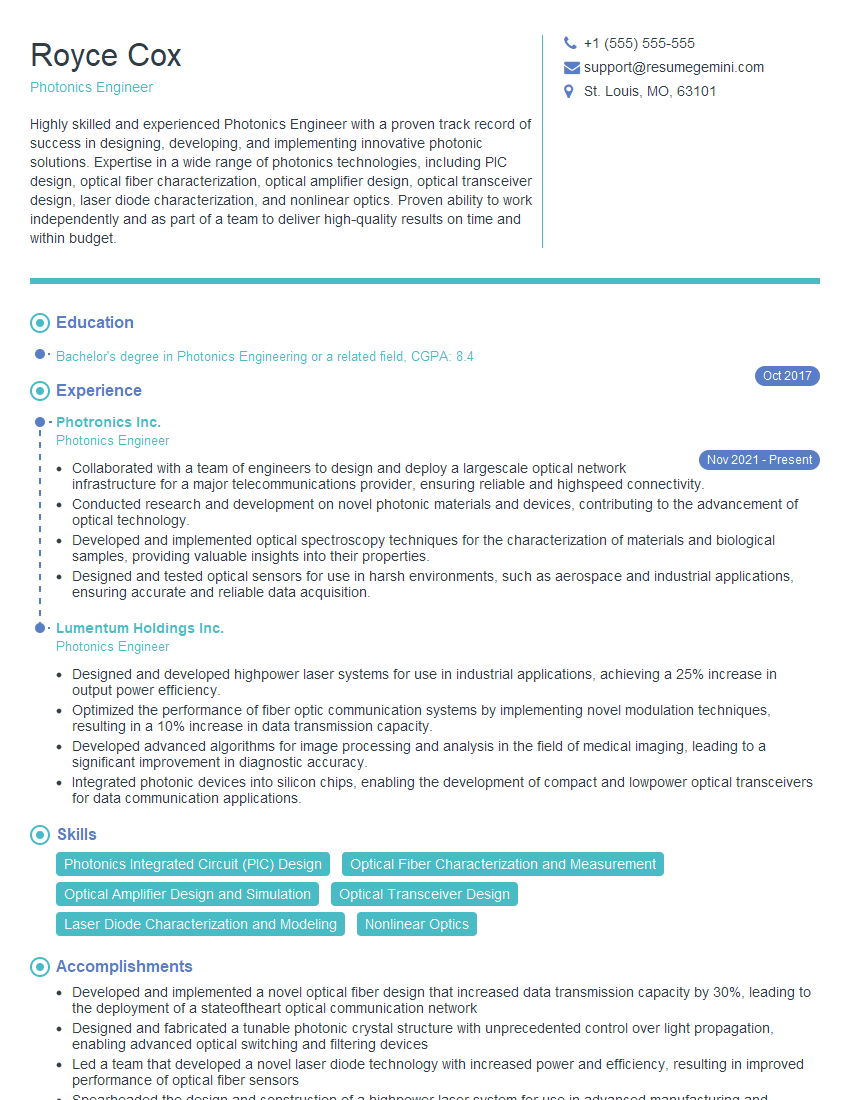
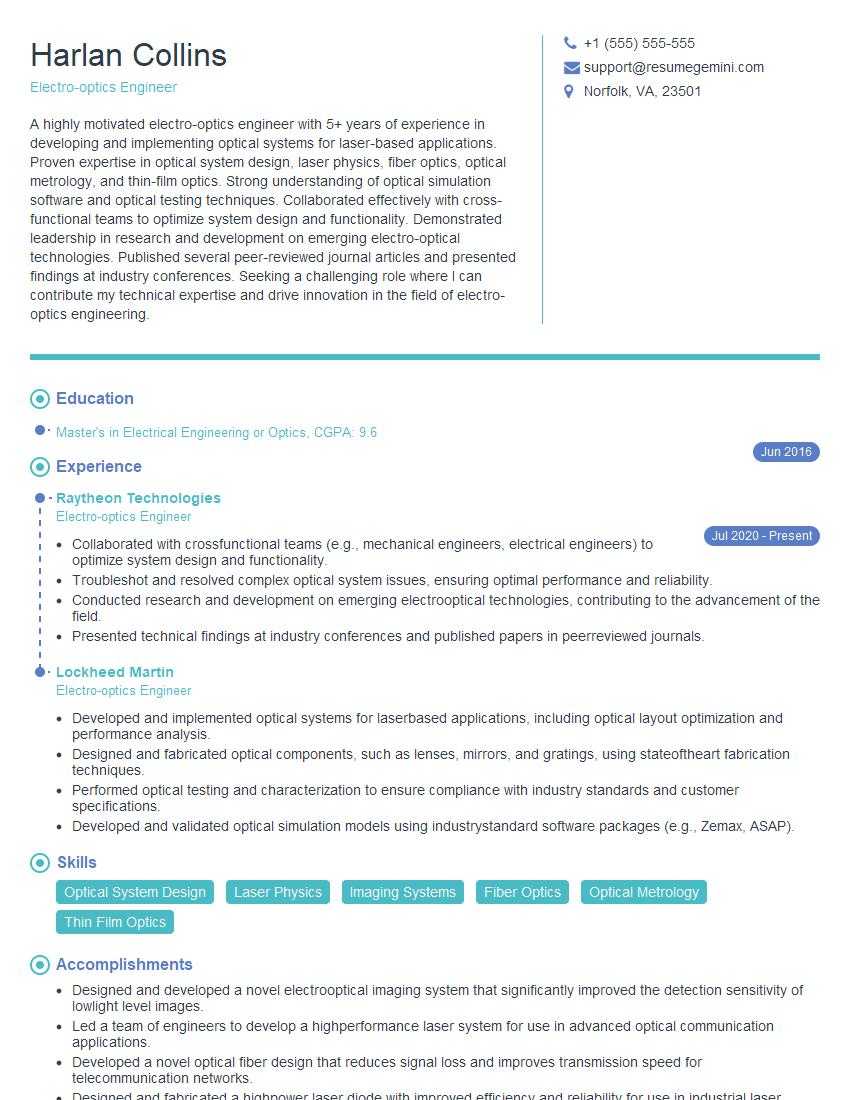
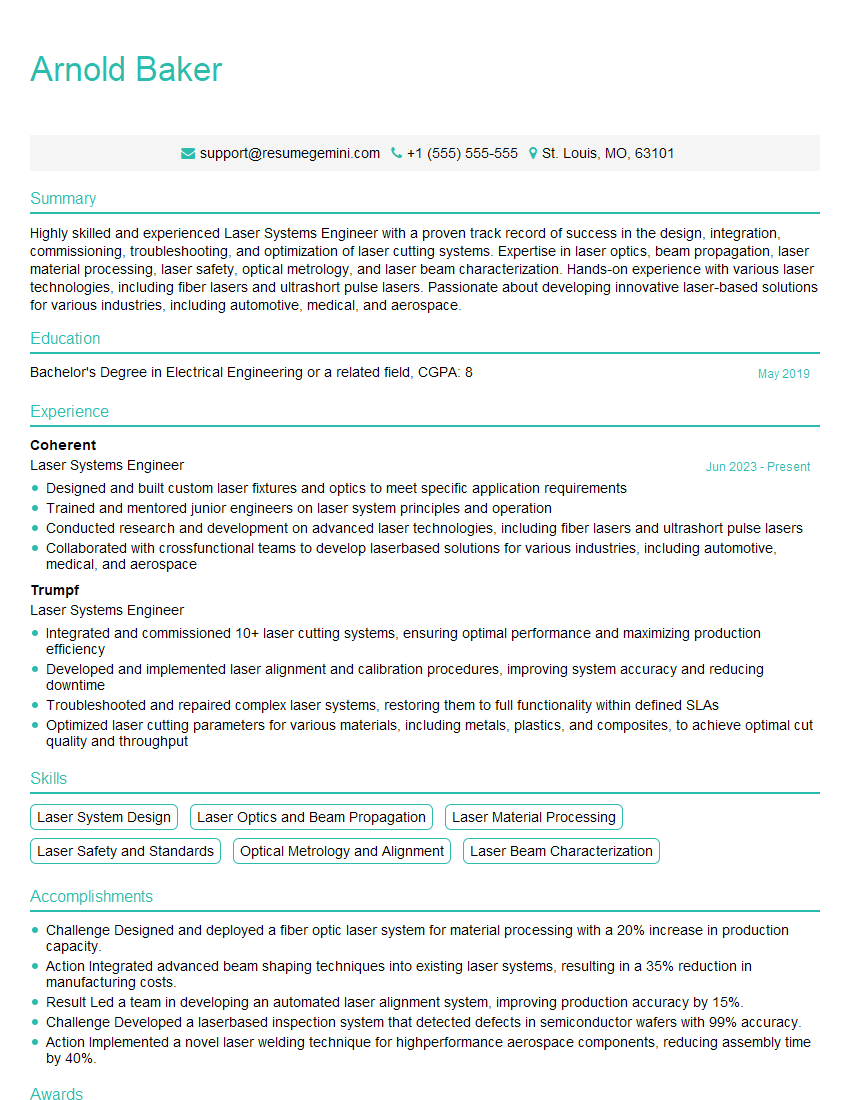
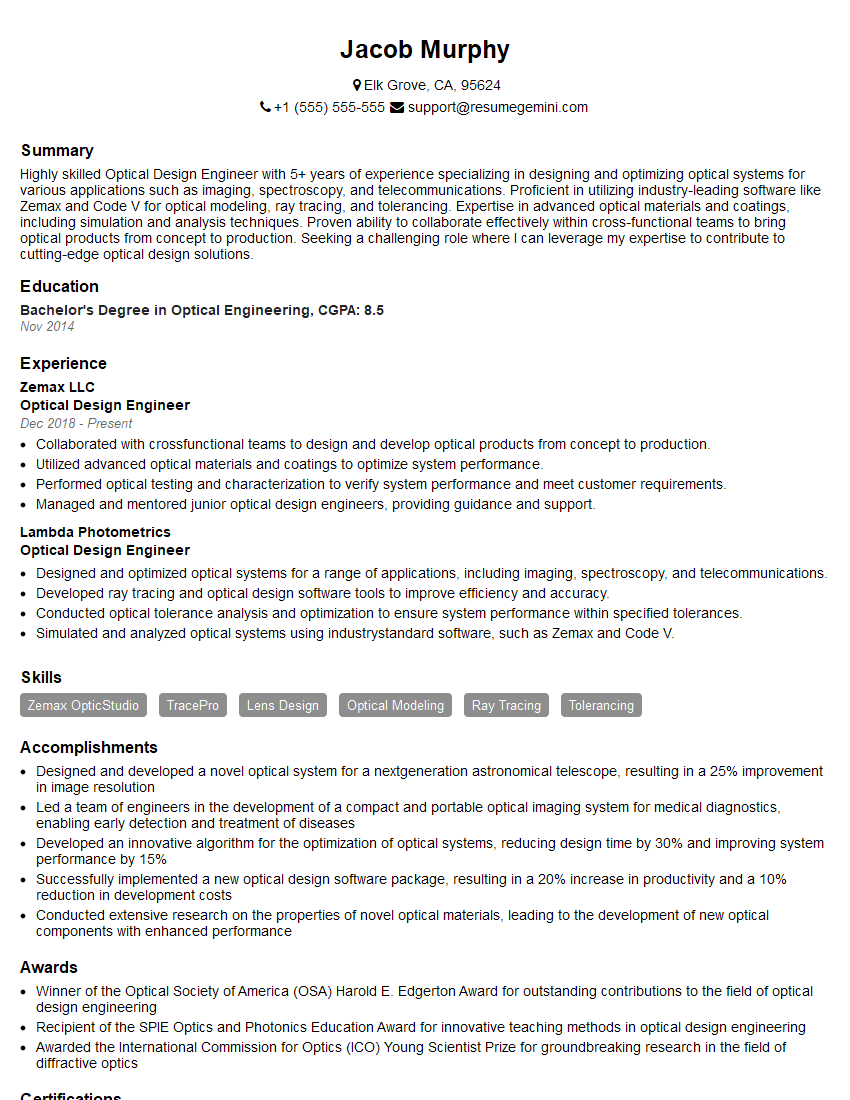
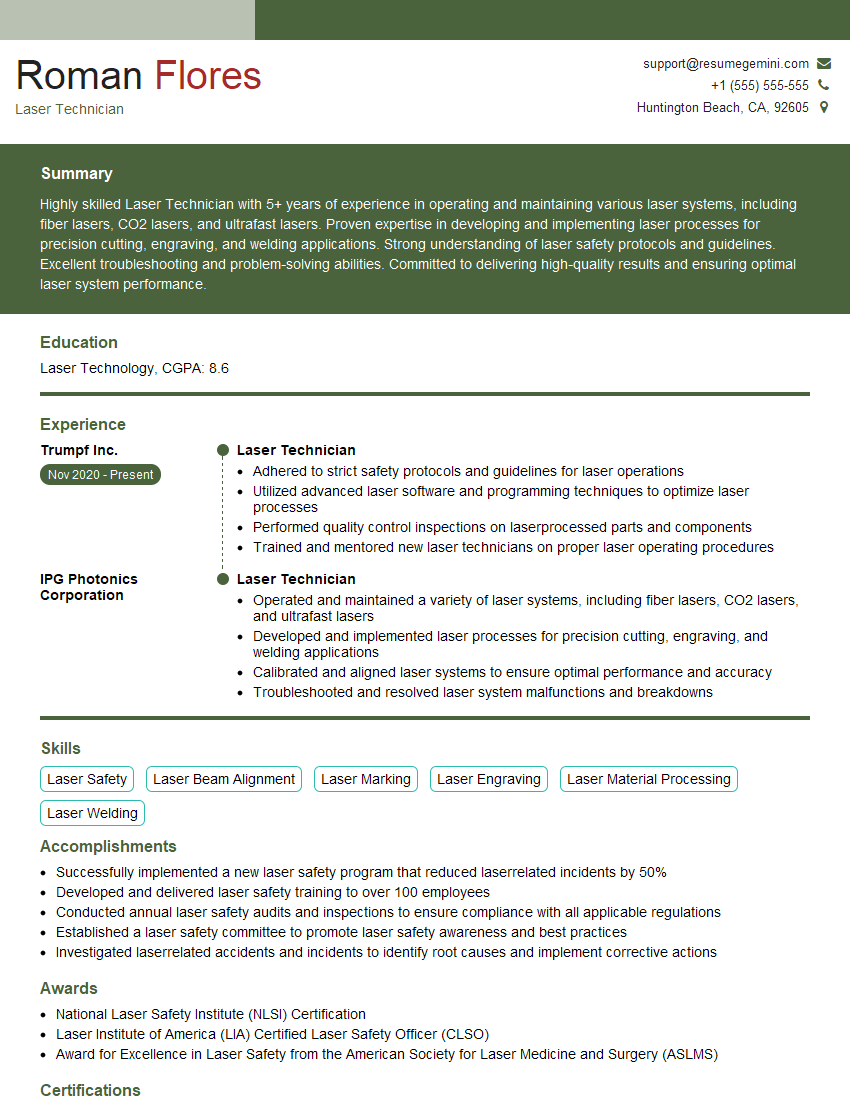
Mastering Laser Systems Engineering opens doors to exciting and impactful careers in cutting-edge technology. To maximize your job prospects, invest in creating a strong, ATS-friendly resume that highlights your skills and experience effectively. ResumeGemini is a trusted resource that can help you build a professional resume that makes a lasting impression on potential employers. ResumeGemini provides examples of resumes tailored to Laser Systems Engineering, helping you present your qualifications in the best possible light. Take the next step in your career journey and craft a resume that showcases your expertise.


Explore more articles
Users Rating of Our Blogs
Share Your Experience
We value your feedback! Please rate our content and share your thoughts (optional).
What Readers Say About Our Blog
Very informative content, great job.
good