Every successful interview starts with knowing what to expect. In this blog, we’ll take you through the top Layout Design (EDA Tools) interview questions, breaking them down with expert tips to help you deliver impactful answers. Step into your next interview fully prepared and ready to succeed.
Questions Asked in Layout Design (EDA Tools) Interview
Q 1. Explain the difference between top-down and bottom-up layout design flows.
Top-down and bottom-up layout design flows represent contrasting approaches to creating an integrated circuit (IC) layout. Think of it like building a house: top-down is like starting with the architectural blueprint and progressively detailing each room, while bottom-up is like assembling pre-fabricated modules to form the final structure.
Top-down design starts with a high-level schematic and partitions it into smaller, manageable blocks. Each block is then designed and laid out independently, before being integrated into the overall chip layout. This method is advantageous for complex designs as it promotes modularity, parallelization, and better management of complexity. However, it can be less efficient in terms of overall area optimization, as block placement and routing are done independently and then integrated.
Bottom-up design, conversely, starts with individual components or cells. These are then combined and arranged to form larger blocks and ultimately the complete chip layout. This is efficient for smaller designs or when reusing pre-designed components (IP cores). It allows for fine-grained control and potential area optimization at the component level. However, it can become difficult to manage for larger, more complex designs, leading to potential integration issues and challenges in maintaining design consistency.
In practice, many designs employ a hybrid approach, combining aspects of both top-down and bottom-up methodologies to leverage the strengths of each. For instance, a complex system-on-a-chip (SoC) might use a top-down strategy for initial block partitioning but employ bottom-up techniques for optimizing the placement and routing of critical paths within individual blocks.
Q 2. Describe your experience with different EDA tools (e.g., Cadence Allegro, Mentor Graphics, Synopsys IC Compiler).
My experience encompasses a broad range of EDA tools, primarily focusing on Cadence Allegro, Mentor Graphics, and Synopsys IC Compiler. I’ve used Cadence Allegro extensively for high-speed digital and analog layout, appreciating its powerful schematic capture and routing capabilities. I’ve particularly found its constraint manager and signal integrity analysis tools invaluable in ensuring design robustness.
With Mentor Graphics, I’ve worked on both PCB and IC design projects, leveraging its robust design rule checking (DRC) and layout versus schematic (LVS) tools for verification. The ability to seamlessly integrate different design stages within the Mentor Graphics flow has been crucial for streamlining complex projects.
My experience with Synopsys IC Compiler centers on physical synthesis and optimization, particularly for complex digital designs with tight timing constraints. I’ve used its advanced placement and routing algorithms to optimize power consumption and signal integrity while meeting performance goals. The tool’s capability to handle large designs with multiple clock domains has proven to be very effective.
In each case, my proficiency goes beyond mere tool usage. I understand the underlying algorithms and methodologies underpinning the tools’ functionality, enabling me to effectively troubleshoot issues and optimize design flow for maximum efficiency and quality.
Q 3. How do you handle design rule checking (DRC) and layout versus schematic (LVS) violations?
Handling DRC and LVS violations requires a systematic and thorough approach. DRC (Design Rule Checking) violations indicate layout issues that break the fabrication rules, while LVS (Layout Versus Schematic) violations signify discrepancies between the schematic and layout. Both can lead to manufacturing failures.
My strategy involves:
- Proactive DRC/LVS checks: I incorporate regular DRC and LVS checks throughout the design process, not just at the end. This allows for early detection and correction of errors, preventing their propagation and saving time and effort later.
- Comprehensive analysis: When violations occur, I use the EDA tool’s reporting features to identify the specific location and nature of each violation. I delve into the details, studying the affected components and their interactions.
- Systematic debugging: I systematically address violations, often prioritizing critical ones based on their potential impact on functionality and manufacturability. I make use of visualization tools to comprehend spatial relationships and pinpoint issues visually.
- Iterative refinement: After correcting violations, I perform re-verification checks to ensure the fixes are effective and haven’t introduced new problems. This iterative refinement process is crucial for achieving a clean and manufacturable layout.
- Documentation: I meticulously document all violations, corrections, and verification results. This is critical for traceability and debugging in later stages or for future design iterations.
For example, if I encounter a DRC violation involving minimum spacing between two metal layers, I might adjust the routing to meet the specified clearance or use a different metal layer. If an LVS violation shows a missing transistor in the layout, I would carefully review both the schematic and layout to identify and correct the omission.
Q 4. What are your strategies for optimizing routing congestion in high-density layouts?
Optimizing routing congestion in high-density layouts is a significant challenge, requiring a multi-pronged approach. Think of it as managing traffic flow in a crowded city – you need smart strategies to avoid gridlock.
My strategies include:
- Strategic placement: Carefully placing macro-blocks and cells to minimize the distance between interconnected components. This reduces overall wire length and congestion.
- Hierarchical routing: Utilizing hierarchical routing methodologies, breaking down the routing task into smaller, more manageable blocks, to improve efficiency and reduce congestion.
- Smart routing algorithms: Employing advanced routing algorithms in the EDA tool that can efficiently handle dense routing environments. These algorithms often incorporate techniques like maze routing, rip-up and reroute, and congestion-driven routing.
- Layer assignment optimization: Selecting appropriate metal layers for different nets based on their criticality and length. This can significantly alleviate congestion in specific layers.
- Careful net ordering: Prioritizing routing of critical nets earlier in the process to ensure they have sufficient routing resources. Less critical nets can then be routed subsequently.
- Buffer insertion: Strategically inserting buffers to reduce signal delay and allow for more relaxed routing constraints, potentially alleviating congestion in critical areas.
- Design rule relaxation (with caution): Considering carefully planned design rule relaxation (after thorough analysis and justification), where certain design rules might be slightly relaxed to improve routability without compromising signal integrity or manufacturability.
Combining these strategies ensures that the routing process is efficient and leads to a design that minimizes congestion and meets signal integrity requirements.
Q 5. Explain your understanding of signal integrity and power integrity analysis in layout design.
Signal integrity and power integrity are crucial aspects of layout design, directly impacting the functionality and reliability of the chip. Signal integrity refers to the fidelity of a signal as it travels through the interconnect, while power integrity focuses on ensuring stable and sufficient power delivery to all components.
Signal integrity analysis involves simulating signal propagation to identify potential issues such as reflections, crosstalk, and signal attenuation. I use EDA tools to perform simulations like time-domain reflectometry (TDR) and transmission line simulations to assess the impact of layout parameters on signal quality. Layout modifications, such as adjusting trace widths, lengths, and adding shielding or termination, are made based on these simulations to improve signal integrity.
Power integrity analysis involves evaluating the voltage fluctuations and noise caused by varying current demands. Techniques like power grid simulation and IR drop analysis are employed to identify potential issues like voltage droop and electromigration. I address these problems by optimizing the power delivery network (PDN) using strategies such as adding decoupling capacitors, optimizing power plane design, and ensuring adequate trace widths.
Both signal and power integrity analysis are iterative processes. Simulations are run, analyzed, and layout modifications are made until the design meets the desired specifications. This iterative refinement is critical for ensuring the long-term reliability and performance of the integrated circuit.
Q 6. How do you manage large and complex layout projects?
Managing large and complex layout projects requires meticulous planning and execution. It’s like orchestrating a large-scale construction project – coordination and organization are paramount.
My approach includes:
- Project decomposition: Breaking down the project into smaller, manageable tasks assigned to team members with appropriate expertise.
- Version control: Utilizing a robust version control system (like Git) to track changes and allow for collaboration among team members.
- Design review process: Establishing a formal design review process with regular checkpoints to identify and address potential issues early on.
- Communication and collaboration: Maintaining clear communication channels among team members to ensure everyone is on the same page and working towards common goals.
- Layout partitioning and floorplanning: Strategically partitioning the layout into smaller blocks and optimizing floorplanning to improve routing and congestion management.
- Automation and scripting: Using scripting and automation to reduce manual effort and improve the efficiency of repetitive tasks.
- Tools and technologies: Leveraging EDA tools with strong collaborative capabilities and features for managing large designs.
By employing these methods, I ensure that even the most complex projects are managed effectively, promoting timely completion and high-quality results.
Q 7. Describe your experience with different layout methodologies (e.g., manual, automated, semi-automated).
My experience encompasses a variety of layout methodologies, each with its own strengths and weaknesses. The choice of methodology depends heavily on design complexity, timing constraints, and project goals.
Manual layout offers fine-grained control but is time-consuming and unsuitable for large designs. It’s often used for critical analog blocks or when highly specific placement and routing are essential.
Automated layout leverages EDA tools to automate placement, routing, and other tasks. This is efficient for large digital designs, but may require careful constraint definition and iterative refinement to achieve optimal results. The level of automation can vary; some tools offer more intelligent algorithms than others, thus impacting the quality of the resulting layout.
Semi-automated layout combines manual and automated approaches. Critical blocks might be designed manually, while less critical blocks can be handled using automation. This hybrid approach balances control and efficiency, allowing for targeted optimization.
For instance, I’ve used manual layout for high-speed analog circuits where precise control over component placement and routing was vital for minimizing noise and achieving high performance. For large digital blocks, I’ve leveraged automated placement and routing tools, complemented with manual intervention to address routing congestion or optimize critical paths. The hybrid approach offers a flexible and efficient strategy for various design scenarios.
Q 8. What are the key considerations for analog layout design?
Analog layout design presents unique challenges compared to digital design. The key considerations revolve around matching, noise immunity, and parasitic effects. Think of it like building a finely tuned musical instrument – every component needs to interact harmoniously.
- Matching: Achieving precise matching of device parameters (e.g., transistor dimensions, capacitances) is crucial for circuit performance. Layout techniques like common centroid placement and symmetric layout are essential to minimize mismatch due to process variations. For example, in an operational amplifier, precise matching of input transistors is paramount for high common-mode rejection ratio (CMRR).
- Noise Immunity: Analog circuits are highly susceptible to noise from various sources. Layout techniques such as shielding, guard rings, and proper placement of analog and digital blocks are critical to minimize noise coupling. Imagine a microphone – you’d want to isolate it from extraneous sounds to get a clean recording. Similarly, we shield sensitive analog components.
- Parasitic Effects: Unintended capacitances and inductances (parasitics) introduced by the layout itself can significantly impact performance. Careful routing and consideration of metal layer selection are vital to minimize these effects. Think of it as adding unwanted background hum to your audio – you need to minimize these unintentional elements.
- Thermal Considerations: Temperature variations across the chip can degrade performance and stability. Proper layout strategies are essential to ensure uniform temperature distribution across critical components.
Q 9. How do you ensure manufacturability of your layouts?
Ensuring manufacturability is paramount; a beautifully designed circuit that can’t be fabricated is useless. This requires adhering to design rules provided by the fabrication foundry and incorporating robust design-for-manufacturability (DFM) techniques.
- Design Rule Checking (DRC): This automated process verifies that the layout adheres to the foundry’s minimum feature sizes, spacing rules, and other constraints. Violations can lead to manufacturing failures. I regularly utilize DRC tools within my EDA flow to catch errors early.
- Layout vs. Schematic (LVS): This critical check ensures that the physical layout accurately reflects the schematic. Any discrepancies will result in a non-functional circuit. LVS is a vital step in my verification process.
- Antenna Rule Checking (ARC): This check prevents the formation of antennas, which can lead to latch-up or device damage during manufacturing. High-speed digital circuits require careful consideration of ARC rules.
- Process Variation Analysis: This involves using simulations to assess the circuit’s performance across a range of process variations. This ensures robustness and reliability even with manufacturing tolerances.
For example, I recently worked on a project where DRC flagged a critical violation in a high-speed interconnect. Addressing this early in the process saved considerable time and cost compared to finding it during fabrication.
Q 10. Explain your experience with different packaging technologies.
My experience encompasses various packaging technologies, each with its own set of design considerations and trade-offs.
- QFN (Quad Flat No-Lead): Compact and low-profile, ideal for space-constrained applications. Layout must account for thermal considerations due to limited heat dissipation.
- BGA (Ball Grid Array): High pin count and high density, enabling complex system-on-chip (SoC) designs. Careful routing of high-speed signals is crucial to minimize signal integrity issues. Thermal management also plays a critical role, often requiring underfill.
- QFP (Quad Flat Package): Offers a good balance between pin count, size, and cost. Suitable for a wide range of applications.
- WLCSP (Wafer Level Chip Scale Package): Extremely small and cost-effective, suitable for miniature applications. Presents challenges related to thermal management and I/O routing.
In a previous project, we transitioned from a QFP to a BGA package to accommodate increased functionality. This required extensive layout modifications and rigorous signal integrity analysis to ensure proper performance after the package change.
Q 11. What are the challenges of designing high-speed digital circuits?
Designing high-speed digital circuits presents significant challenges stemming from signal integrity and electromagnetic interference (EMI) issues.
- Signal Integrity: High-speed signals are susceptible to reflections, crosstalk, and attenuation. Careful routing, controlled impedance lines, and proper termination are crucial to maintain signal integrity. Think of it like sending a message across a long distance – you want to ensure the message arrives clearly and without distortion.
- EMI: High-speed circuits generate electromagnetic radiation that can interfere with other components on the board or even external devices. Proper shielding, grounding, and careful layout techniques are essential to minimize EMI.
- Power Delivery: High-speed circuits require clean and stable power distribution. Proper decoupling capacitors, power planes, and routing techniques are crucial to prevent power supply noise from affecting signal integrity.
- Clock Distribution: The clock signal is critical, and variations in its arrival time (clock skew) can lead to timing violations. Careful planning of clock tree synthesis is crucial to minimize skew.
Q 12. How do you handle thermal management in your layouts?
Thermal management is crucial to prevent overheating, which can lead to device failure and performance degradation. This involves careful consideration of power dissipation and heat transfer mechanisms.
- Power Density Analysis: Identifying areas of high power density is the first step. This helps optimize placement of heat-generating components and guides the placement of heat sinks.
- Heat Spreading: Using materials with high thermal conductivity (e.g., copper) in the layout can improve heat dissipation. Placement of components and routing should also consider maximizing heat spreading to minimize hotspots.
- Thermal Vias: These vias provide vertical paths for heat to escape from the chip. Their placement should be optimized for efficient heat transfer.
- Thermal Simulation: Using thermal simulation tools allows predicting the temperature distribution across the chip and identifying potential hotspots. This helps make informed decisions on layout changes and cooling solutions.
For example, in a recent project involving a high-power processor, thermal simulations guided the placement of thermal vias and the design of a custom heat sink to keep the chip within its safe operating temperature.
Q 13. What are your preferred methods for verification and validation of layouts?
Verification and validation are integral to ensuring a reliable and functional layout. My preferred methods involve a multi-pronged approach combining automated checks with thorough manual reviews.
- Design Rule Checking (DRC): Automated checks for layout rule violations.
- Layout Versus Schematic (LVS): Ensures that the layout matches the schematic.
- Antenna Rule Checking (ARC): Identifies potential antenna effects that could cause damage during manufacturing.
- Static Timing Analysis (STA): Verifies that the circuit meets its timing requirements.
- Signal Integrity Analysis: Simulates signal propagation and identifies potential issues like reflections and crosstalk.
- Electromagnetic Interference (EMI) Analysis: Assesses the circuit’s electromagnetic emissions and susceptibility.
- Thermal Simulation: Predicts temperature distribution and identifies potential hotspots.
- Manual Review: A thorough visual inspection of the layout to catch any subtle issues not detected by automated checks.
I always prioritize a layered verification process, starting with automated checks and ending with careful manual inspection to ensure thorough coverage and reduce the risk of errors.
Q 14. Describe your experience with scripting languages (e.g., SKILL, TCL) in the context of EDA tools.
Scripting languages like SKILL (for Cadence Allegro) and TCL (for many EDA tools) are invaluable for automating repetitive tasks, customizing workflows, and extending the capabilities of EDA tools. They are crucial for productivity and avoiding manual errors.
- Automation: I use scripts to automate tasks such as layer assignment, design rule checking, and report generation, drastically reducing manual effort and improving efficiency. For instance, a SKILL script can automatically generate a netlist report with specific formatting preferences.
- Customization: Scripts can be tailored to specific project needs, providing flexibility and control over the EDA environment. This allows creating custom commands or functions that simplify complex design tasks.
- Integration: Scripts facilitate integration between different EDA tools, streamlining the design flow and enabling automation across various stages of the design process.
; Example SKILL snippet for automating layer assignment in Cadence Allegro procedure(assignLayer(net, layer) let((netName)) netName = getNetName(net); setLayer(netName, layer); ) )
This simple example demonstrates how a SKILL script can perform a task that would otherwise be performed manually, improving efficiency and reducing errors. I have extensive experience developing and maintaining such scripts to enhance my design workflow.
Q 15. Explain your experience with different layer stackups and their impact on performance.
Layer stackup refers to the vertical arrangement of different dielectric and conductive layers in a printed circuit board (PCB). The choice of stackup significantly impacts signal integrity, power delivery, and overall PCB performance. A poorly designed stackup can lead to signal attenuation, crosstalk, and EMI issues.
For example, a high-speed design might benefit from a stackup with multiple power and ground planes to minimize impedance variations and reduce noise. This is often achieved using a ‘power-ground-power-ground’ arrangement, interleaving power and ground planes to effectively act as a shield. In contrast, a simpler design might utilize a single ground plane for cost-effectiveness.
- Multiple power/ground planes: Excellent for high-speed signals, reducing noise and improving signal integrity. Increases cost and board thickness.
- Single ground plane: Simpler, cheaper, and thinner board, but may have compromised signal integrity, particularly for high-frequency applications.
- Embedded passive components: Integrating capacitors or inductors within the stackup can improve power delivery and reduce noise, but adds complexity to the manufacturing process.
My experience includes designing stackups for various applications, from low-power consumer electronics with simple two-layer boards to high-speed digital designs requiring ten or more layers with complex power distribution networks. I consider factors such as signal speed, impedance matching, thermal management, and manufacturing constraints when selecting a suitable layer stackup.
Career Expert Tips:
- Ace those interviews! Prepare effectively by reviewing the Top 50 Most Common Interview Questions on ResumeGemini.
- Navigate your job search with confidence! Explore a wide range of Career Tips on ResumeGemini. Learn about common challenges and recommendations to overcome them.
- Craft the perfect resume! Master the Art of Resume Writing with ResumeGemini’s guide. Showcase your unique qualifications and achievements effectively.
- Don’t miss out on holiday savings! Build your dream resume with ResumeGemini’s ATS optimized templates.
Q 16. How do you manage component placement to minimize signal delay and crosstalk?
Careful component placement is crucial for minimizing signal delay and crosstalk. Signal delay is the time it takes for a signal to travel from its source to its destination, while crosstalk is the unwanted coupling of signals between adjacent traces. Both can lead to malfunction if not properly managed.
My approach involves using a combination of techniques:
- Clustering: Grouping components with high-frequency or sensitive signals close together reduces trace lengths and minimizes signal degradation.
- Signal integrity analysis: Using simulation tools to analyze signal paths and identify potential issues, such as excessive delay or crosstalk. Tools like HyperLynx or Sigrity are essential in this process.
- Routing strategies: Employing controlled impedance routing for high-speed signals to ensure predictable signal propagation. This often involves using specific trace widths and spacing to achieve a desired impedance.
- Differential pair routing: For high-speed data transmission, using differential pairs (two signals with equal amplitude but opposite polarity) helps cancel out noise and improve signal integrity. Keeping these pairs close together and with controlled spacing is key.
- Grounding and decoupling: Placing decoupling capacitors close to the power pins of ICs helps reduce noise and voltage fluctuations. A well-designed ground plane is equally crucial for providing a low-impedance return path for signals.
For example, I once worked on a high-speed data acquisition system where proper component placement and differential pair routing were critical for achieving the required data rate with minimal errors. Using simulation, I identified a potential crosstalk problem between two adjacent high-speed lines and mitigated it by increasing the spacing between them and adding a ground plane to act as a shield.
Q 17. Explain your understanding of electromagnetic interference (EMI) and how it relates to layout design.
Electromagnetic interference (EMI) is the emission of electromagnetic energy from a device that can disrupt the operation of other devices. In PCB layout, EMI is a significant concern, especially in high-speed designs. Poor layout practices can lead to unwanted radiation of electromagnetic waves, causing interference with nearby circuits or even regulatory non-compliance.
EMI control in layout design involves several strategies:
- Shielding: Using conductive enclosures or ground planes to prevent electromagnetic radiation from escaping the PCB.
- Filtering: Employing filters on power lines and signal lines to attenuate unwanted frequencies.
- Controlled impedance routing: Minimizing impedance discontinuities to reduce signal reflections that can generate EMI.
- Proper grounding: Establishing a low-impedance path for ground currents to prevent noise from circulating.
- Careful component placement: Keeping high-frequency components away from sensitive circuits to reduce interference.
For instance, I once worked on a project involving sensitive medical equipment. Meeting stringent EMI emission standards was critical. We used a combination of shielding, filtering, and controlled impedance routing to ensure that the device remained compliant with international regulations.
Q 18. What are your methods for ensuring signal integrity in high-speed serial links?
Ensuring signal integrity in high-speed serial links requires a meticulous approach focusing on minimizing signal degradation, distortion, and interference. Key strategies include:
- Controlled impedance routing: Maintaining consistent impedance along the entire signal path to prevent reflections and signal distortion. This often involves using specific trace widths, spacing, and dielectric materials.
- Differential signaling: Employing differential pairs to reduce the impact of noise and common-mode interference. Careful matching of trace lengths and impedance is vital for this technique.
- Termination: Using appropriate termination resistors at the source and receiver ends of the high-speed link to absorb reflections and match impedance. The choice of termination scheme (series, parallel, or AC coupling) depends on specific link characteristics.
- Signal integrity simulation and analysis: Using tools such as HyperLynx or Sigrity to simulate the signal path and identify potential issues, such as reflections, crosstalk, or jitter.
- Careful component selection: Choosing components with appropriate high-frequency characteristics and low parasitic capacitance and inductance. This is crucial for preserving signal integrity.
In a recent project involving a 10 Gigabit Ethernet link, I used simulation tools to model the entire signal path, including the transmitter, receiver, and the PCB traces. This allowed me to optimize the trace design to minimize reflections and jitter, ensuring reliable data transmission at high speeds.
Q 19. How do you optimize for power consumption in your layouts?
Power consumption optimization in PCB layout focuses on minimizing power losses and maximizing power efficiency. Several techniques are employed:
- Efficient power distribution network (PDN): Designing a PDN that delivers power to components with minimal voltage drop and noise. This involves proper placement of decoupling capacitors, use of multiple power and ground planes, and optimized routing of power traces.
- Low-power components: Selecting components with low power consumption. This requires careful component selection based on power specifications and operating conditions.
- Power gating: Implementing power gating circuitry to switch off unused parts of the circuit, reducing overall power consumption.
- Thermal management: Ensuring adequate heat dissipation to prevent overheating and performance degradation. This can involve using heat sinks, vias, and careful placement of heat-generating components.
- Clock tree synthesis: Optimizing the clock distribution network to minimize power consumption by using techniques such as buffer insertion and clock gating.
In a recent battery-powered device project, I optimized the power distribution network by carefully placing decoupling capacitors near each IC and using multiple power and ground planes. This significantly reduced voltage fluctuations and improved the efficiency of the power delivery, extending battery life.
Q 20. Describe your experience with using constraint management in EDA tools.
Constraint management in EDA tools is crucial for ensuring that the final layout meets the design specifications. Constraints define rules and guidelines that the layout must adhere to, such as trace lengths, impedance, spacing, and signal integrity requirements.
My experience with constraint management involves using tools like Allegro and Cadence to define and manage various types of constraints, including:
- Routing constraints: Defining rules for routing traces, such as trace width, spacing, length, and layer restrictions.
- Timing constraints: Specifying timing requirements for signal paths to ensure that the design meets its performance goals.
- Electrical constraints: Defining impedance, voltage, and current limits for signal paths and power delivery networks.
- Physical constraints: Specifying physical restrictions, such as component placement, keep-out zones, and clearance requirements.
Effective constraint management involves a thorough understanding of the design requirements and the capabilities of the EDA tool. I typically begin by defining high-level constraints based on the specifications, and then refine them iteratively as the layout progresses. This ensures that any potential violations are identified early in the design process, reducing rework and improving overall design quality.
Q 21. How do you collaborate with other engineers (e.g., front-end, back-end, verification) in a team environment?
Collaboration is essential in PCB layout design. I actively participate in a team environment, communicating effectively with front-end, back-end, and verification engineers to ensure a successful project outcome.
My approach involves:
- Regular meetings: Participating in regular design reviews to discuss progress, address concerns, and ensure alignment between different engineering teams.
- Clear communication: Using clear and concise communication methods (e.g., email, documentation, design reviews) to relay information effectively to all team members.
- Version control: Using version control systems (e.g., Git) to manage design files and track changes, minimizing confusion and conflicts.
- Data exchange: Using standardized data formats and interfaces for seamless data exchange between different design tools and teams.
- Proactive problem-solving: Identifying and addressing potential problems before they escalate. This often involves close collaboration with other engineers to find solutions.
For example, in a recent project, I worked closely with the front-end team to ensure that the schematic design was suitable for PCB layout. We communicated regularly to address any discrepancies or concerns, which prevented potential problems later in the design cycle. Collaboration with the verification team ensured that the layout met all the required specifications before the manufacturing phase.
Q 22. What is your approach to troubleshooting layout issues?
My approach to troubleshooting layout issues is systematic and iterative. I start by understanding the specific error message or symptom. This might involve examining design rule check (DRC) reports, layout view analysis, or even simulations. Next, I isolate the problem area using tools like the EDA software’s built-in debugging features or scripting capabilities. For example, if I see a short circuit, I’ll focus on the nets involved and check for unintended overlaps or incorrect layer assignments.
I then consider several possible root causes: human error (incorrect placement, routing, or netlist), tool limitations (bugs, unexpected behavior), or design specification ambiguities. I systematically rule out each possibility. Often, visual inspection is crucial; using different layers, zoom levels, and highlighting options in the EDA tool can reveal hidden issues.
Once the root cause is identified, I implement the fix, which might involve moving components, rerouting nets, fixing netlist discrepancies, or even adjusting design rules. Crucially, I thoroughly verify the fix using DRC and LVS (Layout Versus Schematic) checks to ensure the issue is truly resolved and no new problems are introduced. This iterative process continues until the issue is completely rectified.
Q 23. Describe your experience with different types of routing algorithms.
I have extensive experience with various routing algorithms, each with its strengths and weaknesses. For example, maze routers are excellent for finding shortest paths but can struggle with high density and complex designs. They essentially explore all possible paths like a maze, selecting the shortest one that doesn’t violate design rules. I find them most useful for initial routing or less congested regions of the chip.
Lee routers, a variation on maze routing, use wavefront propagation to find paths, offering faster performance and better results in certain situations. Line-probe routers are quite efficient for global routing, focusing on the overall net topology before tackling detailed local routing. This global-local approach is a common strategy.
Rip-up and reroute algorithms are iterative. They initially create a rough routing, and then iteratively improve it by identifying congested areas and rerouting segments. This is crucial for high-density designs but computationally intensive. Finally, I’ve used detailed routers which optimize routing within a specific area, often focusing on minimizing wirelength or improving signal integrity.
The choice of algorithm depends heavily on the design’s complexity, density, and performance requirements. In complex designs, a hybrid approach, combining different algorithms for various routing stages, is often the most effective.
Q 24. Explain your understanding of different types of vias and their application.
Vias are essential for connecting different layers in a multi-layer PCB or integrated circuit. They act as vertical interconnects, allowing electrical signals to travel between layers. There are several types:
- Through-vias: These extend through all layers of the substrate, providing connections across the entire board or chip.
- Blind vias: They only extend from one surface to an internal layer, not going all the way through.
- Buried vias: These connect two internal layers without extending to the surface.
- Microvias: These are significantly smaller than through-vias, enabling higher density packaging.
The choice of via type depends on design requirements and technical constraints. Through-vias are generally simpler to manufacture but can lead to less dense designs. Blind and buried vias are critical for high-density designs, where space is at a premium. Microvias enable extremely high-density interconnect technologies used in advanced integrated circuits. Factors like signal integrity, impedance matching, and manufacturing capabilities must all be considered when choosing via types.
Q 25. What are your experiences with different design rule specifications (e.g., GDSII, ODB++)?
I have extensive experience with various design rule specifications, primarily GDSII and ODB++. GDSII (Graphic Data System II) is a legacy format but still widely used. It’s essentially a binary format representing the layout geometry. While versatile, it can be challenging to parse directly. I have used various tools and scripts to handle GDSII data for verification, analysis, and manufacturing preparation.
ODB++ (Open DataBase++), on the other hand, is a more modern and flexible standard. It offers a structured database representation of the layout, offering significant advantages in terms of data manipulation and analysis. I find it particularly useful for complex designs because it supports advanced queries and data extraction. For example, it allows quick access to information about specific nets or components which can speed up debugging.
The choice between GDSII and ODB++ depends on the tools used and the design’s complexity. For legacy designs or when working with older tools, GDSII might be necessary. However, for new projects and advanced design workflows, ODB++ offers clear advantages in terms of data handling and analysis.
Q 26. How do you stay updated with the latest advancements in EDA tools and layout design techniques?
Keeping abreast of the latest advancements in EDA tools and layout design techniques is vital. I regularly attend conferences like DAC (Design Automation Conference) and other industry events to learn about the newest innovations. I actively follow publications like IEEE Transactions on Computer-Aided Design of Integrated Circuits and Systems.
I subscribe to industry newsletters and online resources, actively participating in online communities and forums focusing on layout design. I also engage in self-learning by exploring the documentation and tutorials of new EDA tools and experimenting with different techniques on smaller test projects. Staying updated helps me remain competitive and allows me to continuously improve my layout design skills.
Q 27. Explain your experience with creating and interpreting layout-related reports.
Creating and interpreting layout-related reports is a crucial part of my workflow. I routinely generate DRC reports to identify design rule violations, ensuring the layout meets the specified constraints. These reports often highlight issues like shorts, opens, spacing violations, and antenna effects. I use the report data to pinpoint and rectify layout flaws.
LVS (Layout Versus Schematic) reports compare the layout to the schematic, verifying that the implemented layout accurately reflects the design intent. This is critical to avoid functionality errors. Other reports I routinely work with include power analysis reports, which provide insights into power consumption and potential hotspots, and signal integrity reports, which assess issues like crosstalk, reflections, and delay variations.
My experience allows me to interpret these reports effectively and take appropriate corrective actions. The ability to read and understand these reports is critical for efficient design closure.
Q 28. Describe a challenging layout project you worked on and how you overcame the challenges.
One challenging project involved designing a high-speed serializer-deserializer (SerDes) for a cutting-edge data center application. The key challenge was the extremely high data rates and stringent signal integrity requirements. The high clock frequency led to significant electromagnetic interference (EMI) concerns. Achieving reliable operation within the tight timing constraints required meticulous attention to layout details.
We overcame this by employing several advanced techniques. We used controlled impedance routing to maintain signal integrity across all traces. Differential pair routing, along with careful consideration of trace lengths and return paths, minimized crosstalk. We implemented advanced shielding techniques to minimize EMI. Extensive simulation and analysis, using tools like electromagnetic field solvers, was vital in identifying and mitigating potential problems. The use of advanced routing algorithms, specifically targeted at handling high-speed signals, also proved critical.
The project required a collaborative effort between layout engineers, circuit designers, and signal integrity experts. Ultimately, we successfully completed the design, achieving the required data rates and exceeding signal integrity specifications. This success highlighted the importance of a systematic approach, combining advanced design techniques with thorough analysis and verification.
Key Topics to Learn for Layout Design (EDA Tools) Interview
- Floorplanning and Placement: Understanding different algorithms (e.g., simulated annealing, force-directed placement), their strengths and weaknesses, and their impact on chip performance and area. Practical application: Analyzing placement results and identifying areas for improvement using EDA tools.
- Routing: Mastering global and detailed routing techniques, congestion analysis, and timing closure challenges. Practical application: Optimizing routing strategies to minimize wire length and signal delay. Troubleshooting routing violations.
- Timing Analysis: Proficiency in Static Timing Analysis (STA) concepts, setup and hold violations, and timing closure techniques. Practical application: Interpreting STA reports, identifying critical paths, and implementing timing optimization strategies.
- Physical Verification: Understanding Design Rule Checking (DRC), Layout Versus Schematic (LVS), and other verification methodologies. Practical application: Ensuring the physical layout meets design specifications and identifying and resolving discrepancies.
- Low-Power Design Techniques: Familiarity with techniques like clock gating, power gating, and multi-voltage design. Practical application: Applying low-power design techniques to reduce power consumption in chip designs.
- EDA Tool Proficiency: Demonstrating hands-on experience with industry-standard EDA tools (mention specific tools if applicable, e.g., Cadence Innovus, Synopsys IC Compiler). Practical application: Showcase your ability to efficiently use these tools for layout design and verification.
- Understanding of Design Constraints and Specifications: Interpreting design requirements and translating them into actionable layout strategies. Practical application: Working within specified timing, area, and power budgets.
Next Steps
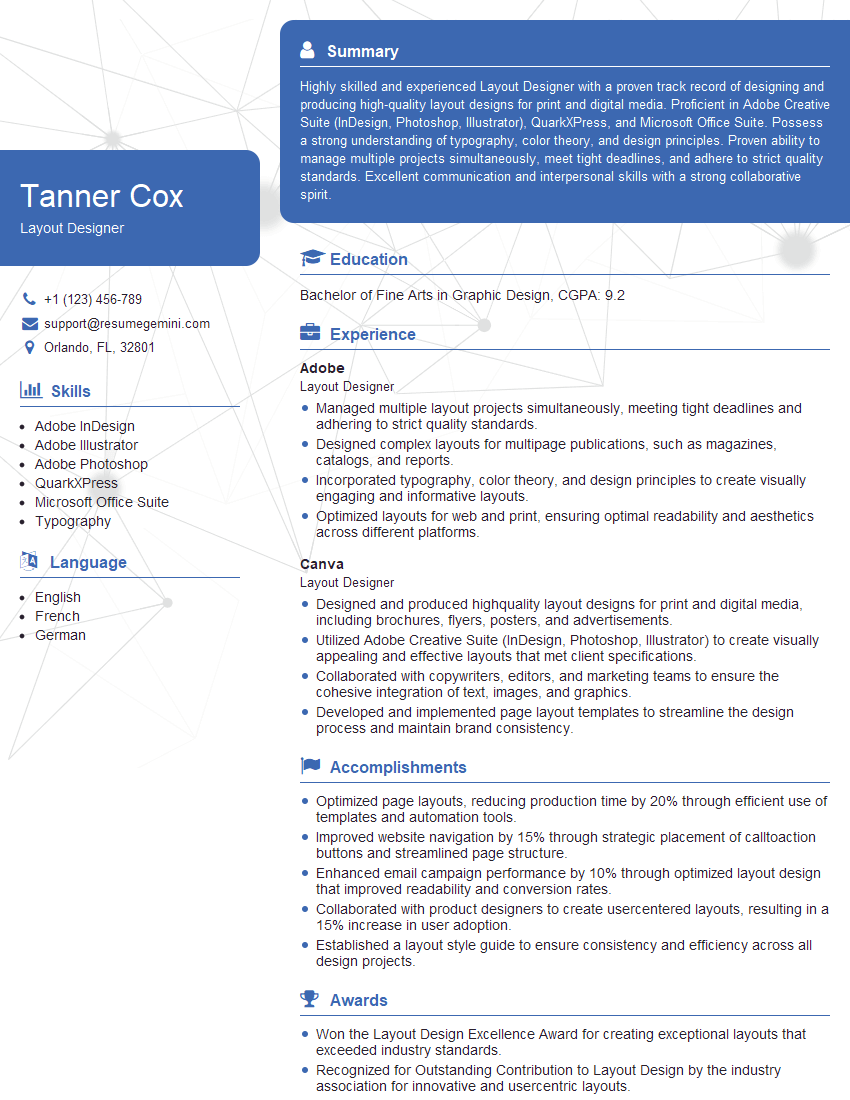
Mastering Layout Design using EDA tools is crucial for a successful and rewarding career in the semiconductor industry. It opens doors to exciting opportunities in a constantly evolving field. To significantly boost your job prospects, create a compelling and ATS-friendly resume that highlights your skills and experience. We highly recommend using ResumeGemini to build a professional resume that stands out. ResumeGemini offers a user-friendly platform and provides examples of resumes tailored to Layout Design (EDA Tools) roles, helping you present your qualifications effectively. Take the next step in your career journey today!

Explore more articles
Users Rating of Our Blogs
Share Your Experience
We value your feedback! Please rate our content and share your thoughts (optional).
What Readers Say About Our Blog
Very informative content, great job.
good