Feeling uncertain about what to expect in your upcoming interview? We’ve got you covered! This blog highlights the most important Leaf Remote Sensing interview questions and provides actionable advice to help you stand out as the ideal candidate. Let’s pave the way for your success.
Questions Asked in Leaf Remote Sensing Interview
Q 1. Explain the concept of Normalized Difference Vegetation Index (NDVI) and its limitations.
The Normalized Difference Vegetation Index (NDVI) is a simple yet powerful tool in remote sensing, used to assess vegetation health and biomass. It’s calculated using the near-infrared (NIR) and red reflectance values from a sensor. Specifically, NDVI = (NIR – Red) / (NIR + Red). Healthy vegetation strongly absorbs red light for photosynthesis and reflects a significant portion of NIR light. Therefore, a high NDVI value (closer to +1) indicates lush, healthy vegetation, while a low NDVI value (closer to -1 or 0) suggests sparse or unhealthy vegetation, or even bare soil.
However, NDVI has limitations. It’s sensitive to atmospheric effects like aerosols and water vapor, which can scatter and absorb light, affecting the accuracy of the measurements. Furthermore, NDVI can saturate at high biomass levels, meaning it won’t accurately distinguish between very dense and extremely dense vegetation. The presence of other factors like soil background, shadows, and sensor calibration differences also impacts NDVI’s accuracy. For instance, a very bright, reflective soil surface could artificially increase the NDVI value even in the absence of abundant vegetation.
Q 2. Describe different types of sensors used in leaf remote sensing (e.g., multispectral, hyperspectral).
Leaf remote sensing employs a variety of sensors, each with unique capabilities. Multispectral sensors measure reflectance at a limited number of discrete spectral bands (e.g., red, green, blue, NIR, red-edge). These sensors are relatively inexpensive and provide data suitable for calculating vegetation indices like NDVI. Examples include sensors on satellites like Landsat and Sentinel, as well as on unmanned aerial vehicles (UAVs).
Hyperspectral sensors, on the other hand, acquire data across a very large number of contiguous spectral bands, offering a far more detailed spectral signature of the leaf. This fine spectral resolution allows for detecting subtle variations in leaf biochemistry and physiology, enabling more precise estimations of leaf traits such as chlorophyll content, water content, and nitrogen levels. Hyperspectral sensors are typically more expensive and require more complex data processing. Examples include airborne and laboratory hyperspectral imagers. There are also specialized sensors designed for close-range measurements, like spectrometers used for leaf-level analysis in controlled environments.
Q 3. How do atmospheric effects influence leaf remote sensing data, and how can they be corrected?
Atmospheric effects significantly influence leaf remote sensing data. Atmospheric gases (water vapor, ozone, carbon dioxide) and aerosols (dust, pollutants) scatter and absorb light, reducing the amount of radiation reaching the sensor and altering the spectral signal. This can lead to inaccurate measurements of leaf reflectance and, subsequently, inaccurate estimates of vegetation indices. For example, water vapor absorption can strongly affect NIR bands, leading to underestimation of biomass.
Atmospheric correction techniques are essential to mitigate these effects. These techniques involve mathematically removing the atmospheric contribution from the measured reflectance values. Common methods include empirical methods (based on atmospheric models and ground measurements) and radiative transfer models (more complex models simulating light interaction with the atmosphere). Some advanced methods utilize atmospheric profiles derived from meteorological data or ancillary sensor data to improve accuracy. The choice of correction method depends on factors such as the sensor type, atmospheric conditions, and the desired accuracy.
Q 4. What are the key differences between multispectral and hyperspectral remote sensing for leaf analysis?
Multispectral and hyperspectral remote sensing differ significantly in their spectral resolution, impacting their applications in leaf analysis. Multispectral sensors provide a coarser spectral view, offering a limited number of broad spectral bands. This makes them suitable for calculating broad vegetation indices like NDVI but limits their ability to resolve fine spectral details related to leaf biochemistry and stress detection.
Hyperspectral sensors, with their high spectral resolution, capture a much finer spectral signature of the leaf. This allows for identification of subtle spectral features indicative of various leaf traits, like chlorophyll, carotenoid, and water content, as well as detecting the presence of stress indicators like disease or nutrient deficiency. The enhanced spectral information permits more sophisticated analyses, such as spectral unmixing to identify different leaf components or the application of advanced machine learning algorithms for detailed vegetation characterization. However, hyperspectral data are computationally more demanding to process and analyze.
Q 5. Explain the process of image pre-processing in leaf remote sensing.
Image preprocessing in leaf remote sensing is crucial for improving data quality and accuracy. It typically involves several steps:
- Radiometric Correction: This corrects for sensor-related variations and inconsistencies in the recorded reflectance values. This may involve dark object subtraction, flat-field correction, or sensor calibration using known reflectance targets.
- Geometric Correction: This corrects for geometric distortions in the imagery due to sensor orientation, terrain relief, and atmospheric effects. This might include orthorectification, using ground control points to align the imagery to a known map coordinate system.
- Atmospheric Correction: As discussed previously, this addresses the effects of the atmosphere on the spectral signatures. Methods range from simple empirical corrections to advanced radiative transfer modeling.
- Data Filtering/Smoothing: Noise and artifacts in the image can be reduced using techniques like spatial filtering (e.g., median filtering) to remove random noise or spectral smoothing to remove high-frequency noise in the spectral profiles.
- Data Normalization: Scaling data to a common range (e.g., 0-1) is essential for consistent processing and comparison across different images or sensor systems.
Proper preprocessing ensures that subsequent analyses, such as vegetation index calculation or classification, are accurate and reliable.
Q 6. Discuss various vegetation indices (e.g., EVI, SAVI) and their applications.
Several vegetation indices beyond NDVI are used in leaf remote sensing, each with its strengths and weaknesses. The Enhanced Vegetation Index (EVI) is designed to reduce saturation issues at high biomass levels and is less sensitive to canopy background effects than NDVI. The formula for EVI incorporates a soil adjustment factor, making it more robust in situations with varying soil conditions. EVI = G * (NIR – Red) / (NIR + C1 * Red – C2 * Blue + L).
The Soil-Adjusted Vegetation Index (SAVI) is another index that aims to minimize soil background effects. It includes a soil adjustment factor (L), which is typically set to 0.5. SAVI = (NIR – Red) / (NIR + Red + L) * (1 + L). SAVI is particularly useful in areas with sparse vegetation where soil background significantly affects NDVI.
The choice of index depends on the specific application and characteristics of the study area. NDVI remains widely used due to its simplicity and effectiveness, but EVI and SAVI can offer advantages in certain scenarios. For example, EVI might be preferred for monitoring dense forests, while SAVI could be better suited for monitoring grasslands or areas with significant soil exposure.
Q 7. How do you assess the quality of remote sensing data for leaf analysis?
Assessing the quality of remote sensing data for leaf analysis involves several steps:
- Sensor Calibration and Validation: Evaluating the accuracy and precision of the sensor’s measurements using ground-based measurements and calibration targets is crucial. This helps ensure that the data are reliable.
- Atmospheric Correction Assessment: The effectiveness of the atmospheric correction method used should be evaluated. Residual atmospheric effects can be assessed by comparing corrected reflectance values with reference data or by analyzing the spectral signature of known targets.
- Spatial and Spectral Resolution Assessment: The spatial resolution should be sufficient to capture the details of individual leaves or leaf canopies, while the spectral resolution should be appropriate for the specific vegetation indices or spectral features being analyzed.
- Noise and Artifact Analysis: Evaluating the level of noise and artifacts present in the data is essential. High noise levels can significantly affect the accuracy of subsequent analyses.
- Accuracy Assessment of Derived Products: The accuracy of any derived products (e.g., vegetation indices, biochemical estimates) should be evaluated using ground-truth data or independent validation techniques. This might involve statistical measures like RMSE (Root Mean Squared Error) or R2 (coefficient of determination).
A combination of these assessments provides a comprehensive evaluation of data quality, guiding decisions on data usability and informing subsequent analysis.
Q 8. Describe different methods for leaf area index (LAI) estimation using remote sensing data.
Estimating Leaf Area Index (LAI), a crucial metric representing the leaf area per unit ground area, using remote sensing involves several methods. These methods leverage the relationship between vegetation canopy structure and the reflected or absorbed electromagnetic radiation.
LiDAR (Light Detection and Ranging): LiDAR uses laser pulses to measure the distance to and the structure of the canopy. By analyzing the point cloud data, we can directly estimate LAI by calculating the projected leaf area from the 3D structure. This method is highly accurate but expensive and can be limited by cloud cover.
Multispectral Imagery: This approach utilizes the variations in reflectance across different wavelengths to infer LAI. Various vegetation indices (VIs), such as the Normalized Difference Vegetation Index (NDVI) and Enhanced Vegetation Index (EVI), are calculated from multispectral imagery. These indices are then empirically related to LAI using regression models developed from field measurements. The accuracy depends heavily on the quality of the imagery and the calibration of the regression model.
Hyperspectral Imagery: Hyperspectral sensors capture hundreds of narrow, contiguous spectral bands, providing more detailed information about leaf biochemistry and structure. This allows for more sophisticated models to be used for LAI estimation, often incorporating radiative transfer models to simulate light interactions within the canopy. However, hyperspectral data is computationally intensive and requires specialized processing techniques.
Thermal Imagery: Thermal sensors measure the canopy temperature, which can be indirectly linked to LAI. Canopies with high LAI tend to have lower temperatures due to increased evapotranspiration. However, thermal data is sensitive to environmental conditions like air temperature and wind speed, making this method less reliable on its own.
Choosing the appropriate method depends on factors like budget, required accuracy, spatial resolution, and the availability of ground truth data. Often a combination of methods provides the most robust LAI estimates.
Q 9. Explain the relationship between leaf reflectance and leaf biochemical content.
Leaf reflectance, the proportion of light reflected by a leaf, is strongly linked to its biochemical content. Different pigments and chemical compounds within the leaf absorb and reflect specific wavelengths of light. Chlorophyll, a primary pigment in photosynthesis, strongly absorbs red and blue light, resulting in low reflectance in those bands. Conversely, chlorophyll reflects near-infrared (NIR) light, resulting in high NIR reflectance. This is the basis for many vegetation indices.
Other biochemical components also affect reflectance. For example, high levels of carotenoids (yellow and orange pigments) influence reflectance in the green wavelengths, while water content affects reflectance across the spectrum. By analyzing the spectral signature of a leaf (reflectance across different wavelengths), we can estimate the concentrations of these biochemical components using advanced techniques like spectral unmixing.
For example, a leaf with high chlorophyll content will exhibit a high NDVI value because of the strong contrast between high NIR and low red reflectance. Conversely, a leaf experiencing stress and showing senescence (aging) will have lower chlorophyll content, resulting in a lower NDVI.
Q 10. How can remote sensing be used to monitor plant stress and disease?
Remote sensing plays a vital role in monitoring plant stress and disease. Changes in leaf biochemistry and physiology due to stress or disease alter the spectral reflectance properties of the leaf. These changes can be detected by comparing healthy and stressed/diseased plants.
Changes in reflectance: Stressed or diseased plants often exhibit reduced chlorophyll content, leading to lower red reflectance and lower NDVI. Changes in leaf water content and other biochemical constituents will also affect reflectance across different wavelengths.
Thermal anomalies: Diseased or stressed plants might show altered temperature patterns compared to healthy plants due to changes in transpiration or other physiological processes. Thermal infrared remote sensing can identify such temperature anomalies.
Hyperspectral analysis: Hyperspectral data can provide highly sensitive indicators of stress or disease. Specific spectral features linked to stress-related pigments or biochemical changes can be detected, allowing for precise disease identification and monitoring.
For instance, a farmer could use multispectral imagery from a drone to monitor a field of crops. By comparing the NDVI values to a baseline, they can identify areas showing signs of stress and deploy targeted interventions. Early detection enabled by remote sensing allows for timely management, reducing crop losses and optimizing resource use.
Q 11. What are the advantages and disadvantages of using UAVs for leaf remote sensing?
Unmanned Aerial Vehicles (UAVs), or drones, offer several advantages for leaf remote sensing:
High spatial resolution: UAVs can capture images with very high spatial resolution, providing detailed information about individual plants or even leaves, enabling better identification of localized stresses or diseases.
Flexibility and accessibility: UAVs offer significant flexibility in terms of deployment, allowing for targeted data acquisition over specific areas. This is especially advantageous in inaccessible terrains.
Cost-effectiveness: Compared to satellite-based remote sensing, UAVs offer a relatively cost-effective solution for monitoring smaller areas, especially for repeated monitoring over time.
Rapid data acquisition: UAV surveys can be conducted quickly, allowing for timely monitoring and response to rapidly changing conditions.
However, UAVs also have limitations:
Limited flight time: Battery life restricts the area that can be covered in a single flight, requiring multiple flights for large areas.
Weather dependency: UAV operations are susceptible to weather conditions such as strong winds and rain.
Regulatory restrictions: Obtaining permits and adhering to regulations for UAV operation can add complexity.
Data processing: Processing high-resolution UAV imagery requires significant computational resources and expertise.
Overall, UAVs are a powerful tool for leaf remote sensing, particularly for precise, targeted monitoring, but careful planning and consideration of limitations are essential.
Q 12. Describe different image classification techniques used in leaf remote sensing.
Image classification techniques are crucial for extracting meaningful information from leaf remote sensing data. These techniques assign pixels in an image to predefined classes representing different leaf types, health statuses, or other characteristics.
Supervised Classification: This involves training a classifier using a set of labeled samples representing the different classes. Common algorithms include maximum likelihood classification, support vector machines (SVM), and random forests. The classifier then uses the learned characteristics to classify unlabeled pixels.
Unsupervised Classification: This method doesn’t require labeled samples. Algorithms like k-means clustering group pixels based on their spectral similarity. The resulting clusters are then interpreted based on their spectral characteristics.
Object-Based Image Analysis (OBIA): OBIA uses image segmentation to create objects (groups of pixels) before classification. This approach incorporates spatial context and improves classification accuracy, especially in heterogeneous landscapes. Features extracted from each object, such as shape, texture, and spectral properties, are used for classification.
The choice of classification technique depends on factors such as the availability of training data, the complexity of the scene, and the desired level of accuracy. Often, a combination of techniques is used to achieve optimal results. For instance, one might use OBIA for initial segmentation and then apply a supervised classifier to the resulting objects.
Q 13. Explain the concept of spectral unmixing in leaf remote sensing.
Spectral unmixing is a technique used to decompose the spectral signature of a mixed pixel into the contributions of its constituent components. In leaf remote sensing, a mixed pixel might contain contributions from multiple leaf types, soil, or shadows. Spectral unmixing aims to disentangle these contributions and estimate the abundance of each component within the pixel.
This technique relies on spectral libraries containing the reflectance spectra of individual components (e.g., different leaf types, soil). A linear mixing model is commonly used, assuming that the reflectance of a mixed pixel is a linear combination of the reflectances of its constituent components, weighted by their abundances. The abundances are then estimated using algorithms like least squares regression or constrained non-negative matrix factorization.
For example, if a pixel contains a mixture of healthy and stressed leaves and soil, spectral unmixing can estimate the proportion of each component in that pixel, providing valuable insights into the spatial distribution of stress within a canopy.
Spectral unmixing requires high-quality spectral data (e.g., hyperspectral imagery) and accurate spectral libraries. The success of the technique also depends on the validity of the linear mixing assumption.
Q 14. How do you handle cloud cover in remote sensing data for leaf analysis?
Cloud cover is a significant challenge in remote sensing data for leaf analysis, as clouds obscure the ground and prevent acquisition of useful data. Several strategies are employed to handle this:
Cloud masking: This involves identifying and removing cloud-covered areas from the image. This can be done using various techniques, including thresholding based on reflectance in specific spectral bands (clouds generally have high reflectance across multiple bands) or using more advanced methods like cloud detection algorithms. The cleaned data can then be used for further analysis.
Data acquisition planning: Careful planning of data acquisition, taking into account weather patterns and cloud cover forecasts, can minimize the impact of cloud cover. Selecting suitable dates with minimal cloud cover can significantly improve data quality.
Temporal compositing: If multiple images are available over time, a composite image can be created by selecting the clearest pixels from different images. This approach helps to reduce the impact of cloud cover by using data from cloud-free days.
Cloud filling techniques: More advanced techniques use spatial and temporal information from neighboring pixels to estimate the reflectance values in cloud-covered regions. These methods require careful consideration and validation to ensure accuracy.
The best strategy depends on the available data, the extent of cloud cover, and the desired accuracy of the analysis. A combination of these strategies is often the most effective approach.
Q 15. Discuss the role of spatial resolution in leaf remote sensing.
Spatial resolution in leaf remote sensing refers to the size of the smallest area on the ground that can be distinguished by the sensor. Think of it like the pixels in a camera; a higher spatial resolution means smaller pixels, allowing for a more detailed image. In leaf remote sensing, this is crucial because it determines our ability to resolve individual leaves or small groups of leaves. A high spatial resolution (e.g., using very high-resolution imagery from drones or airplanes) is essential for accurate measurements of individual leaf characteristics such as size, shape, and orientation. Lower spatial resolution (e.g., from satellites) provides coarser information, suitable for analyzing larger areas but potentially missing fine details. For example, trying to assess the health of individual leaves in a dense canopy with low spatial resolution data would be difficult, leading to potential errors in estimations. Conversely, high spatial resolution would allow for individual leaf analysis leading to more precise assessment of disease or stress.
The choice of spatial resolution depends entirely on the research question. If we’re interested in mapping the overall health of a large forest, a lower resolution might suffice. However, if we’re studying the impact of a specific disease on individual leaves, a very high resolution is necessary. This trade-off between spatial resolution and area coverage is a fundamental consideration in leaf remote sensing project design.
Career Expert Tips:
- Ace those interviews! Prepare effectively by reviewing the Top 50 Most Common Interview Questions on ResumeGemini.
- Navigate your job search with confidence! Explore a wide range of Career Tips on ResumeGemini. Learn about common challenges and recommendations to overcome them.
- Craft the perfect resume! Master the Art of Resume Writing with ResumeGemini’s guide. Showcase your unique qualifications and achievements effectively.
- Don’t miss out on holiday savings! Build your dream resume with ResumeGemini’s ATS optimized templates.
Q 16. What are the ethical considerations in using remote sensing data for leaf analysis?
Ethical considerations in leaf remote sensing primarily revolve around data privacy, access, and responsible use. Since remote sensing can capture imagery of private lands, it’s crucial to obtain necessary permissions and ensure compliance with all relevant regulations. This is particularly important when using high-resolution imagery, which could potentially identify individual trees or even structures on private property. Another critical concern is data ownership and access. Clear guidelines are necessary to define who owns the data, who can access it, and under what conditions. Open-access initiatives can be beneficial, but they also necessitate careful management to prevent misuse of the data.
Furthermore, there are ethical implications regarding the interpretation and application of the data. For example, if remote sensing reveals evidence of disease or stress in a particular area, it’s crucial to communicate this information responsibly, avoiding alarmist statements or misinterpretations. Responsible data analysis and transparent communication to stakeholders are pivotal.
Q 17. How can remote sensing data be integrated with other data sources for a more comprehensive analysis?
Integrating remote sensing data with other data sources significantly enhances the accuracy and scope of leaf analysis. For instance, combining remote sensing data with ground-based measurements (e.g., leaf area index from direct measurements, leaf chlorophyll content measured with a spectrophotometer) provides valuable ground truth data for validation and calibration of remotely sensed estimations. This process is often referred to as ‘ground truthing’. This allows for better correction of sensor errors and improvement of the overall accuracy of remotely sensed leaf properties.
Furthermore, integrating remote sensing with environmental data, such as weather data, soil information, and topographic data, allows for a comprehensive understanding of the factors affecting leaf properties. For example, correlating leaf water content from remote sensing with rainfall data can help explain variations in leaf water status. Similarly, integrating spectral data with GPS data facilitates spatial modeling of leaf properties within an ecosystem.
Integrating with existing databases, such as species databases or forest inventory records, can enrich the interpretation and contextualization of remote sensing findings. This adds a crucial layer of ecological understanding to the results.
Q 18. Explain the concept of time series analysis in leaf remote sensing.
Time series analysis in leaf remote sensing involves monitoring changes in leaf properties over time. Imagine tracking the growth of a leaf throughout a growing season, or observing the effects of a drought on a forest canopy over several months. This is accomplished by repeatedly acquiring remote sensing data at regular intervals, creating a ‘time series’ of observations. We then analyze this time series to detect patterns, trends, and events related to leaf development, stress, or phenological changes. For example, analyzing time-series data from satellite images can detect the timing of leaf emergence (spring), peak biomass (summer), and senescence (fall).
Time series analysis relies on various statistical techniques to identify significant changes in leaf properties over time, such as calculating the rate of leaf area development, detecting stress events (such as drought or disease) and examining the timing and duration of leaf senescence. This approach is extremely valuable for understanding the dynamic nature of leaf processes and their responses to environmental changes.
Q 19. How do you validate remote sensing-based estimates of leaf properties?
Validating remote sensing-based estimates of leaf properties is crucial for ensuring the accuracy and reliability of our findings. This is typically achieved through a combination of approaches, primarily involving ground-truthing. Ground truthing involves collecting direct measurements of leaf properties at specific locations within the area covered by the remote sensing data. These measurements, which might include leaf area index, chlorophyll content, or water content, are then compared with estimates derived from the remote sensing data. Statistical methods are used to assess the agreement between these two sets of data, determining the accuracy of the remote sensing estimations.
Other validation techniques involve inter-comparison, using multiple remote sensing sensors with differing capabilities. If similar results are obtained across these independent datasets, confidence in the accuracy increases. Also, model validation techniques, using established models of leaf development or stress responses, help to compare remote sensing estimates to theoretically expected results.
The success of validation hinges on the careful design and execution of the ground truthing process. This includes careful selection of sampling locations that are representative of the overall area, use of precise measurement techniques, and sufficient sample sizes to ensure robust statistical analysis.
Q 20. Describe different software and tools used for leaf remote sensing data processing and analysis.
A range of software and tools are used for processing and analyzing leaf remote sensing data. These tools vary depending on the type of remote sensing data used (e.g., hyperspectral, multispectral, LiDAR), and the type of analysis performed (e.g., image classification, spectral index calculation, time series analysis). Popular software packages include:
- ENVI (Exelis Visual Information): A comprehensive software platform for processing and analyzing various types of remote sensing data, including hyperspectral and multispectral imagery. It provides tools for image preprocessing, classification, and spectral analysis.
- Erdas Imagine: Another powerful software package used for similar purposes as ENVI, specializing in geospatial image analysis.
- QGIS (Quantum GIS): A free and open-source geographic information system (GIS) that can be used for processing, analyzing, and visualizing remote sensing data. While not as specialized as ENVI or Erdas, its open-source nature and flexibility make it very popular.
- R: A powerful statistical programming language with many packages dedicated to remote sensing data analysis, such as
rasterandsp. R is particularly useful for time series analysis and statistical modeling. - Python with libraries like scikit-learn, NumPy, and pandas: A versatile programming language that offers extensive capabilities for data analysis. Libraries like these provide tools for statistical analysis, machine learning, and data manipulation. For instance,
rasteriois useful for reading and writing raster data.
The choice of software often depends on personal preference, project requirements, data type, budget, and the availability of specialized tools for specific analyses.
Q 21. What are the challenges and future directions in leaf remote sensing?
Despite significant advancements, challenges remain in leaf remote sensing. One major challenge is the complexity of extracting accurate information from complex canopies. The overlapping nature of leaves and varying illumination conditions can make it difficult to isolate individual leaves and accurately measure their properties. Furthermore, the development of robust algorithms for handling atmospheric effects and sensor noise continues to be a focus of research. Improvements in algorithms are constantly being developed and refined to improve the accuracy of estimates.
Future directions involve integrating multiple data sources and developing more advanced analytical methods. The use of artificial intelligence (AI) and machine learning (ML) techniques offers considerable potential for automated feature extraction and improved accuracy. For instance, deep learning models can improve image classification and recognition of leaf diseases. Another exciting avenue is the development of novel sensors, such as those operating in the hyperspectral or LiDAR range, offering increased sensitivity and spatial resolution. Further research into overcoming the influence of atmospheric conditions on the spectral data will also be essential.
Ultimately, the field is moving towards more automated, efficient, and accurate methods for measuring leaf properties, providing vital data for various applications, including precision agriculture, forest management, and ecological monitoring.
Q 22. Explain the difference between active and passive remote sensing techniques in vegetation monitoring.
Active and passive remote sensing differ fundamentally in how they acquire data about vegetation. Passive sensors, like those on most satellites, measure the reflected sunlight from the Earth’s surface. Think of it like taking a photograph – you’re capturing the light that’s already bouncing off the leaves. The amount and wavelengths of light reflected tell us about leaf properties such as chlorophyll content or water stress.
Active sensors, on the other hand, emit their own electromagnetic radiation (like radar or lidar) and measure the amount of energy that’s reflected back. It’s like shining a flashlight and seeing how much light bounces back. This allows us to gather information even in low-light conditions or penetrate through cloud cover, which is a significant advantage. For instance, LiDAR can provide detailed 3D information about canopy structure, offering insights into leaf area index and biomass that are difficult to obtain with passive sensors alone.
In leaf-level vegetation monitoring, passive sensors are more commonly used due to their cost-effectiveness and availability, particularly for large-scale studies. However, active sensors are increasingly important for detailed measurements in specific applications such as forest inventories or high-resolution mapping of individual tree crowns.
Q 23. Describe different methods for extracting quantitative information (biomass, chlorophyll) from leaf spectra.
Extracting quantitative information from leaf spectra relies on various techniques, broadly categorized as empirical and physical models. Empirical models establish statistical relationships between spectral reflectance and biochemical properties through calibration with field measurements. For example, we might use a linear regression to predict chlorophyll content based on the reflectance at specific wavelengths (e.g., red edge position).
Physical models, conversely, are based on the understanding of how light interacts with leaf tissues. These models often require detailed knowledge of leaf structure and biochemical composition. They can be more complex to implement but offer the potential for better generalization across different species and environmental conditions. Examples include radiative transfer models, which simulate light propagation within the leaf.
Specific methods include:
- Spectral Indices: These are simple calculations that combine reflectance values at different wavelengths. The Normalized Difference Vegetation Index (NDVI), calculated as (NIR – Red) / (NIR + Red), is a widely used index for estimating vegetation vigor and biomass. Different indices have been developed to focus on specific leaf properties, like the Photochemical Reflectance Index (PRI) for measuring photosynthetic activity.
- Partial Least Squares Regression (PLSR): This statistical technique models the relationship between the entire spectrum and the target variable (e.g., biomass, chlorophyll), handling the high dimensionality of spectral data effectively.
- Support Vector Machines (SVM): SVMs are machine learning algorithms that can be trained to predict biochemical properties based on spectral information. They are particularly useful when dealing with complex, non-linear relationships.
The choice of method depends on the availability of data, the desired accuracy, and the complexity of the relationship between leaf spectra and the target variable.
Q 24. How do you deal with data noise and artifacts in remote sensing imagery?
Dealing with noise and artifacts in remote sensing imagery is crucial for accurate analysis. These issues can arise from various sources, including atmospheric effects (e.g., scattering and absorption), sensor noise, and geometric distortions.
My approach involves a multi-step strategy:
- Atmospheric Correction: Algorithms like FLAASH (Fast Line-of-sight Atmospheric Analysis of Spectral Hypercubes) correct for the influence of the atmosphere on the measured reflectance. This is essential for comparing data acquired across different times and locations.
- Radiometric Calibration: This process converts digital numbers (DN) recorded by the sensor to physically meaningful units (e.g., reflectance). It accounts for variations in sensor sensitivity and illumination.
- Geometric Correction: This involves correcting for geometric distortions caused by sensor perspective, Earth’s curvature, and platform motion. Georeferencing ensures that the data are accurately positioned on a map.
- Filtering Techniques: Spatial filtering, such as median filtering or moving average filtering, can reduce noise by averaging pixel values within a defined window. Spectral filtering can be employed to remove specific noise bands or artifacts in the spectral dimension.
- Outlier Removal: Identifying and removing outliers based on statistical measures (e.g., standard deviation) can improve data quality.
The specific techniques used depend on the nature of the noise and the sensor characteristics. Often, a combination of methods is necessary to achieve the best results. For example, a combination of atmospheric correction followed by a spectral smoothing filter is quite common.
Q 25. Discuss the applications of leaf remote sensing in precision agriculture.
Leaf remote sensing plays a significant role in precision agriculture by providing spatially explicit information about crop health and stress. This allows farmers to make targeted management decisions, optimizing resource use and maximizing yields.
Applications include:
- Nitrogen Management: By monitoring chlorophyll content and vegetation indices, farmers can assess nitrogen status and adjust fertilizer application to meet plant needs. This minimizes environmental impact and reduces costs.
- Irrigation Scheduling: Leaf water content can be estimated from spectral data, helping determine optimal irrigation timing. This can improve water use efficiency and prevent water stress.
- Pest and Disease Detection: Early detection of pest infestations or diseases through changes in leaf reflectance can trigger timely intervention. This minimizes crop damage and reduces the need for broad-spectrum pesticides.
- Yield Prediction: Remote sensing data can be used to predict crop yields with reasonable accuracy, allowing farmers to plan for harvesting and storage.
For example, using multispectral drone imagery, I helped a local farmer optimize nitrogen application in his cornfield. By analyzing NDVI maps, we identified areas with lower nitrogen levels and recommended targeted fertilizer application, resulting in a 15% increase in yield compared to traditional uniform application.
Q 26. How can remote sensing be used to monitor the effects of climate change on vegetation?
Remote sensing provides a powerful tool for monitoring the effects of climate change on vegetation at regional and global scales. By tracking changes in vegetation indices, leaf area index, and other biophysical parameters over time, we can detect trends related to drought, heat stress, changes in growing season length, and shifts in vegetation distribution.
Specific applications include:
- Monitoring Drought Impacts: Changes in NDVI over time can indicate the severity and extent of drought-induced vegetation stress.
- Assessing the Carbon Cycle: Remote sensing data can be used to estimate carbon sequestration by vegetation, providing valuable insights into the role of vegetation in climate regulation.
- Tracking Deforestation and Forest Degradation: High-resolution satellite imagery can monitor deforestation rates and identify areas experiencing habitat loss.
- Detecting Changes in Species Distribution: By analyzing spectral signatures, remote sensing can track changes in the distribution of plant species in response to changing climate conditions.
Time-series analysis of satellite data, for instance, from Landsat or MODIS, is crucial for detecting long-term trends and identifying statistically significant changes in vegetation patterns due to climate change. In my research, I have used this type of analysis to assess the impact of prolonged drought on the health of Mediterranean forests.
Q 27. Describe your experience with different remote sensing platforms (e.g., satellites, aircraft, drones).
My experience with remote sensing platforms is extensive. I’ve worked with a variety of platforms, each offering unique advantages and disadvantages.
- Satellites: I have experience using data from Landsat, MODIS, Sentinel, and other satellites for large-scale monitoring of vegetation. Satellites offer synoptic views and extensive temporal coverage but may have limited spatial resolution.
- Aircraft: I’ve been involved in airborne campaigns using both manned and unmanned aircraft equipped with hyperspectral and multispectral sensors. This provided higher spatial and spectral resolution compared to satellite data, useful for detailed vegetation mapping and assessing specific areas of interest.
- Drones (UAVs): I have substantial experience using drones for high-resolution remote sensing, especially at the leaf and canopy levels. This allows for detailed measurements of individual trees or plants, enabling precise assessments of vegetation health and biomass. Drones are highly versatile and adaptable to various field conditions.
The selection of the optimal platform depends on the spatial and temporal resolution required, the study area’s size, budget constraints, and the specific research objectives.
Q 28. Explain your experience with specific software used for data processing (e.g., ENVI, ArcGIS, QGIS)
I’m proficient in several software packages commonly used in remote sensing data processing and analysis. My expertise includes:
- ENVI (Exelis Visual Information): ENVI is my primary software for processing hyperspectral and multispectral imagery. I use it for atmospheric correction, spectral analysis, image classification, and other tasks. For example, I regularly use ENVI’s tools for spectral unmixing to separate the spectral contributions of different vegetation types in a mixed pixel.
- ArcGIS: ArcGIS provides robust capabilities for geospatial data management and analysis. I utilize it for handling vector data, creating maps, performing spatial analysis, and integrating remote sensing data with other geographic information.
- QGIS: QGIS is a powerful open-source alternative to ArcGIS. I use it for various tasks including data visualization, spatial analysis, and creating publication-quality maps. I find it particularly helpful for tasks that don’t require the advanced licensing options available in ArcGIS.
Beyond these, I am also familiar with programming languages like Python, using libraries such as GDAL, scikit-learn, and OpenCV, to automate data processing, develop custom algorithms, and conduct advanced statistical analysis. This combination of software proficiency allows me to tackle various challenges in leaf remote sensing.
Key Topics to Learn for Leaf Remote Sensing Interview
- Remote Sensing Fundamentals: Understand the principles of electromagnetic radiation, sensor types (e.g., multispectral, hyperspectral), and data acquisition techniques.
- Leaf-Level Analysis: Explore methods for extracting biophysical parameters from remote sensing data, including chlorophyll content, leaf area index (LAI), and leaf water content. Consider the challenges of scale and spatial resolution.
- Image Processing and Analysis: Familiarize yourself with common image processing techniques such as atmospheric correction, geometric correction, and various classification algorithms (e.g., supervised, unsupervised). Practice interpreting imagery and identifying key features relevant to leaf properties.
- Data Modeling and Interpretation: Learn how to apply statistical models and machine learning techniques to analyze remote sensing data and derive meaningful insights about leaf characteristics and their relationships to environmental factors.
- Specific Applications in Leaf Remote Sensing: Investigate applications within precision agriculture, forestry, and environmental monitoring. Understand how leaf-level information contributes to broader ecological and agricultural assessments.
- Error Analysis and Uncertainty Quantification: Develop a strong understanding of potential sources of error in remote sensing data and methodologies for assessing and quantifying uncertainty in derived parameters.
- Software and Tools: Gain familiarity with commonly used remote sensing software packages (mentioning specific software is avoided to remain general and encourage independent research).
Next Steps
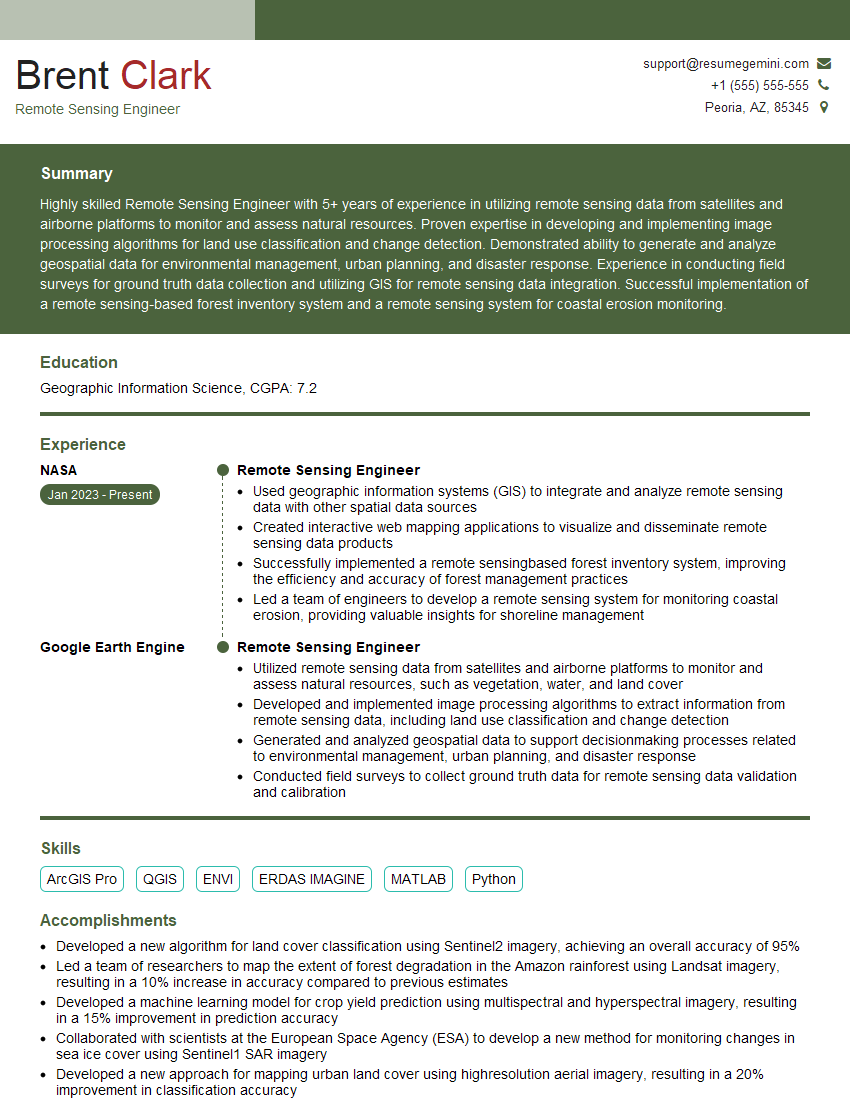
Mastering Leaf Remote Sensing opens doors to exciting career opportunities in a rapidly growing field. A strong understanding of these concepts significantly enhances your competitiveness in the job market. To further boost your chances, creating an Applicant Tracking System (ATS)-friendly resume is crucial. ResumeGemini is a trusted resource that can help you build a professional and impactful resume tailored to the specific requirements of your target roles. Examples of resumes optimized for Leaf Remote Sensing positions are available to guide you through the process.
Explore more articles
Users Rating of Our Blogs
Share Your Experience
We value your feedback! Please rate our content and share your thoughts (optional).
What Readers Say About Our Blog
Very informative content, great job.
good