Cracking a skill-specific interview, like one for Leather Technology, requires understanding the nuances of the role. In this blog, we present the questions you’re most likely to encounter, along with insights into how to answer them effectively. Let’s ensure you’re ready to make a strong impression.
Questions Asked in Leather Technology Interview
Q 1. Explain the different types of leather tanning processes.
Leather tanning is the crucial process of transforming raw animal hides into durable, stable leather. Several methods exist, each impacting the final product’s characteristics. The most common are:
- Chrome Tanning: This is the most prevalent method, using chromium salts (typically chromium(III) sulfate) to preserve the hide. It’s relatively fast, efficient, and produces a soft, supple leather often used in garments and upholstery. The process involves soaking the hides, liming (removing hair and other impurities), bating (enzyme treatment for softness), pickling (acid treatment), and then tanning with chromium salts. The leather is then neutralized, fatliquored (to add suppleness), and finished.
- Vegetable Tanning: This ancient technique employs natural tannins extracted from plant materials like bark, wood, and leaves. It’s a slower, more environmentally friendly process, resulting in a stronger, more durable leather often used for high-quality goods like belts, bags, and saddles. The tanning process takes much longer and requires careful control of temperature and pH. The resulting leather is typically firmer and less resistant to water than chrome-tanned leather.
- Aldehyde Tanning: This utilizes aldehydes like glutaraldehyde or formaldehyde as tanning agents. It offers a fast tanning process and produces leather with good strength and water resistance, but its use is becoming less common due to concerns about formaldehyde’s toxicity. Often used in combination with other tanning methods.
- Mineral Tanning (e.g., Zirconium, Iron, Aluminum): These methods employ various metal salts as tanning agents, each offering unique characteristics. Zirconium tanning, for example, produces leather with good fullness and strength, often used in shoe uppers. Iron tanning is less common due to potential color limitations.
The choice of tanning method depends on factors such as the desired final properties of the leather, cost considerations, and environmental concerns.
Q 2. Describe the role of retanning in leather production.
Retanning is a crucial step in leather production following the primary tanning process. It involves treating the already tanned leather with additional tanning agents or other materials to modify its properties and improve its quality.
The primary roles of retanning are:
- Improved fullness and body: Retanning agents add volume and substance to the leather, enhancing its feel and drape.
- Enhanced dyeing properties: Retanning can improve the leather’s ability to absorb dyes, leading to richer and more uniform colors. For instance, retanning with synthetic tannins can improve dye uptake.
- Modification of handle (feel): Retanning agents can be selected to adjust the leather’s softness, firmness, or flexibility to meet specific requirements. A vegetable retan, for example, might be used to increase firmness.
- Improved tensile strength and tear resistance: Certain retanning materials can enhance the leather’s physical strength, making it more durable.
- Improved resistance to water, abrasion, and chemicals: Retanning can enhance the leather’s resistance to external factors, improving its longevity. A synthetic polymer retan might be utilized to increase water resistance.
Retanning agents can include vegetable tannins, synthetic tannins, or other polymers, carefully selected based on the desired outcome and the type of leather being produced.
Q 3. What are the key factors affecting leather’s physical and chemical properties?
The physical and chemical properties of leather are influenced by a complex interplay of factors throughout the production process. Key factors include:
- Raw Material (Hide): The species of animal, age, and health of the animal all affect the hide’s structure and quality, ultimately impacting the final leather’s characteristics. For example, hides from older animals are often thicker and stronger.
- Tanning Method: Different tanning methods produce leather with drastically different properties. Chrome tanning generally results in softer leather than vegetable tanning.
- Retanning Agents: As discussed previously, the choice and concentration of retanning materials significantly influence the final leather properties.
- Finishing Processes: The finishing process plays a critical role in influencing final properties. Application of coatings, pigments, and topcoats affects the leather’s appearance, feel, water resistance, and durability.
- Fatliquoring: This process, which involves adding oils and fats, significantly affects the leather’s softness, flexibility, and water resistance.
- Environmental Conditions during Processing: Temperature, humidity, and the pH of various solutions all affect the chemical reactions and physical changes occurring during leather processing. Variations can lead to inconsistencies in leather quality.
Understanding and controlling these factors is crucial for producing leather with consistent and desired properties.
Q 4. How do you ensure consistent quality throughout the leather production process?
Ensuring consistent quality in leather production is a multifaceted challenge requiring rigorous control at every stage. Key strategies include:
- Strict Raw Material Selection: Implementing detailed quality control checks on incoming hides to ensure uniformity in thickness, area, and absence of defects.
- Standardized Processing Parameters: Maintaining precise control over temperature, pH, time, and chemical concentrations in each stage of the process (liming, bating, tanning, retanning, etc.). This often involves automated systems and careful monitoring.
- Regular Quality Control Testing: Implementing a robust testing program at multiple stages of production to monitor key properties (thickness, tensile strength, elongation, tear strength, water absorption). This includes both physical and chemical testing.
- Statistical Process Control (SPC): Employing statistical methods to monitor process variations and identify potential problems early, enabling timely corrective actions.
- Skilled Workforce: Training and experience are vital. A well-trained workforce is adept at recognizing subtle variations and making necessary adjustments.
- Proper Equipment Maintenance: Regular maintenance and calibration of equipment are essential to ensure consistent performance and accurate results.
- Traceability: Implementing a traceability system to track the entire process history of each batch of leather, allowing for identification of potential sources of variability.
A combination of these strategies ensures consistent leather quality, minimizes defects, and maintains brand reputation.
Q 5. What are the different types of leather finishes and their applications?
Leather finishes are applied to enhance the leather’s appearance, durability, and functionality. Various types exist, each suited for different applications:
- Topcoats: These protective coatings enhance scratch and scuff resistance, water repellency, and durability. Common examples include polyurethane and acrylic coatings.
- Pigmented Finishes: These add color and cover imperfections on the leather surface, offering a uniform appearance. They can achieve a wide range of colors and finishes from matte to gloss.
- Glazed Finishes: These impart a high-gloss sheen to the leather, enhancing its elegance and luxury appeal, often found in high-end footwear and handbags.
- Embossed Finishes: These use heat and pressure to create surface patterns and textures on the leather, mimicking materials like crocodile skin or adding decorative designs.
- Aniline Finishes: These are minimal finishes applied to high-quality leather, showcasing the leather’s natural grain and color variations. They highlight the natural beauty but often offer less protection.
- Semi-aniline Finishes: These offer a balance between aniline and pigmented finishes, revealing some natural grain while offering improved color uniformity and scratch resistance.
- Nubuck Finishes: These finishes create a velvety, suede-like surface. They require specialized care to maintain their soft texture.
The choice of finish depends largely on the intended application, the type of leather, and the desired aesthetic and functional properties.
Q 6. Explain the importance of testing in the leather production process.
Testing is integral to ensuring consistent leather quality and meeting customer specifications. It’s a crucial quality control measure performed at multiple stages of production.
Key testing methods include:
- Physical Testing: This involves assessing the leather’s physical properties like thickness, tensile strength (resistance to stretching), elongation (amount of stretching before breaking), tear strength, bursting strength (resistance to pressure), and abrasion resistance.
- Chemical Testing: This analyzes the leather’s chemical composition, including the presence of chromium (in chrome-tanned leather), the type and amount of tanning agents, and the presence of harmful substances.
- Appearance Testing: Visual inspection to assess color uniformity, grain pattern, surface imperfections, and overall aesthetics.
- Water Resistance Testing: Assessing the leather’s resistance to water penetration and its ability to withstand moisture.
- Lightfastness Testing: Determining the leather’s resistance to fading caused by exposure to sunlight or ultraviolet (UV) light.
- Flex Testing: Assessing the leather’s flexibility and resistance to cracking during bending.
These tests provide valuable data to monitor process efficiency, identify potential problems, ensure product consistency, and meet regulatory requirements. The precise tests conducted vary depending on the type of leather and its intended application.
Q 7. Describe the various types of leather defects and their causes.
Leather defects can significantly impact quality and value. They can occur at various stages of production. Here are some common types and their causes:
- Scars and Brand Marks: These are caused by injuries or branding on the animal’s hide before slaughter.
- Insect Bites and Damage: Insect activity can create holes or uneven surfaces.
- Stretch Marks: These are caused by uneven growth of the animal’s hide.
- Grain Cracks: These appear as fine cracks in the leather’s grain layer, often caused by excessive drying or improper handling during processing.
- Grub Holes: Small holes caused by insect larvae that feed on the hide.
- Flesh Marks: Irregularities on the leather’s flesh side, sometimes caused by incomplete removal of the flesh layer during processing.
- Color Variations: Uneven dyeing or inconsistent tanning can lead to color inconsistencies.
- Stiffness and Hardness: Improper fatliquoring or inadequate processing can result in rigid leather.
- Splits: Separation or tearing of the leather fibers, often caused by excessive tension during processing.
Careful selection of raw materials, precise control over processing parameters, and thorough quality control checks throughout production help minimize the incidence of leather defects.
Q 8. How do you assess the quality of raw hides?
Assessing raw hide quality is crucial for producing high-quality leather. It involves a multi-sensory evaluation focusing on several key aspects. Think of it like a doctor performing a thorough check-up – we need to look for any underlying issues that could impact the final product.
Visual Inspection: We examine the hide for defects like scars, brands, insect bites, and cuts. The overall uniformity of the hide’s thickness and grain is also assessed. A hide with fewer imperfections will yield higher-quality leather.
Physical Examination: This involves assessing the hide’s stretch, feel, and firmness. A supple, yet firm hide usually indicates good quality. We also check for its moisture content; excessively dry or wet hides are undesirable.
Smell Test: An experienced leather professional can often detect undesirable odors indicating spoilage or improper handling. A clean, slightly sweet smell is a good sign.
Testing for Defects: Advanced techniques like X-ray fluorescence (XRF) can detect the presence of heavy metals which might compromise the final leather quality. This is particularly important for eco-conscious manufacturers and brands.
For instance, a hide with numerous deep scars might be suitable only for lower-grade leather applications, while a flawless hide is ideal for high-end products like luxury handbags or footwear.
Q 9. What are the environmental considerations in leather manufacturing?
Environmental considerations are paramount in modern leather manufacturing. The industry is under increasing scrutiny to minimize its ecological footprint. Think of it as a balancing act – creating a beautiful and durable product while minimizing harm to the planet.
Water Usage: Leather production is water-intensive. Implementing water recycling systems and efficient water treatment processes is vital to reduce consumption and protect water resources. This includes careful monitoring of effluent and compliance with discharge regulations.
Waste Management: Tanneries generate significant solid and liquid waste. Responsible waste management practices are essential, including proper disposal of hazardous materials like chromium salts, and implementation of recycling programs for waste materials wherever possible. For example, trimmings can be used for lower grade leathers.
Air Emissions: The tanning process releases volatile organic compounds (VOCs) into the atmosphere. Adopting cleaner production techniques and installing air pollution control systems is crucial to reduce emissions and improve air quality in surrounding communities.
Energy Consumption: Leather manufacturing is energy-intensive. Switching to renewable energy sources and optimizing energy-efficient equipment and processes helps to minimize the carbon footprint.
Chemical Usage: The industry is moving toward the use of more eco-friendly tanning agents and chemicals, reducing reliance on harmful substances, and increasing transparency in ingredient sourcing.
Many tanneries now achieve certifications like Leather Working Group (LWG) to demonstrate their commitment to sustainability.
Q 10. Explain the process of leather dyeing.
Leather dyeing is a complex process that imparts color and enhances the aesthetic appeal of leather. Think of it as giving the leather its personality and visual character.
Pre-treatment: Before dyeing, the leather is prepared by processes like degreasing, pickling (adjusting pH), and sometimes retanning to improve dye uptake and evenness.
Dyeing: Various dyeing methods are employed, including drum dyeing (the most common), spray dyeing, and padding. The choice of method depends on the desired shade, leather type, and finishing effects.
Dye Selection: Different types of dyes, such as acid dyes, basic dyes, and reactive dyes, each with their own properties, are chosen based on the desired color and the leather’s characteristics. For example, acid dyes work well on chrome-tanned leather.
After-treatment: After dyeing, the leather undergoes post-processes such as neutralization, fatliquoring (adding oils and greases), and setting to enhance its softness, fullness, and durability. This stabilizes the dye and improves the leather’s resistance to fading and abrasion.
For instance, vegetable tanning produces naturally warm, earthy tones. While synthetic dyes offer a wider range of colors and greater consistency.
Q 11. What are the different types of leather testing equipment?
Leather testing equipment is crucial for quality control and ensuring the leather meets specific standards. It’s like a sophisticated toolkit for assessing the leather’s physical and chemical properties.
Tensile Strength Tester: Measures the leather’s resistance to tearing and stretching, vital for determining its durability.
Thickness Gauge: Measures the leather’s thickness at various points, ensuring uniformity.
Hardness Tester: Determines the leather’s firmness and stiffness, crucial for selecting appropriate applications.
Abrasion Tester: Measures the leather’s resistance to wear and tear under friction. This is important for applications like upholstery.
Lightfastness Tester: Evaluates the leather’s resistance to fading when exposed to light. This is critical for outdoor applications.
Colorfastness Tester: Assesses the leather’s colorfastness against washing, rubbing, and other factors. Crucial for maintaining color vibrancy.
Water Resistance Tester: Evaluates the leather’s resistance to water penetration and absorption. Essential for footwear and outerwear.
These tests help guarantee the leather’s quality, making it suitable for its intended purpose.
Q 12. Describe the different types of leather used in footwear.
Footwear uses a variety of leathers, each with its own properties and applications. It’s like choosing the right ingredient for a dish, each leather type has a specific role.
Full-Grain Leather: The highest quality, showing the natural grain of the hide. It’s durable and luxurious, commonly used in high-end footwear.
Top-Grain Leather: The top layer of the hide, after the grain layer has been removed. It’s more affordable than full-grain but still durable, used in many footwear applications.
Genuine Leather: A broader term that can encompass different layers of the hide, often including split leather. Generally less expensive than full-grain or top-grain.
Split Leather: The layer beneath the top grain. It’s thinner and less durable than top-grain, often requiring additional coatings for finishing. Often used for linings or less-demanding parts of footwear.
Nubuck Leather: Suede-like leather with a velvety nap, offering a unique texture and aesthetic. Used for stylish, yet less durable elements of footwear.
Patent Leather: Leather with a glossy, high-sheen finish, usually achieved with a coating. Commonly seen in dress shoes.
The choice of leather depends on factors like the shoe’s design, price point, and intended use.
Q 13. How do you troubleshoot problems in the leather manufacturing process?
Troubleshooting in leather manufacturing requires a systematic approach, a bit like detective work. We need to identify the root cause and implement the appropriate solution.
Identify the Problem: Carefully observe and document the issue. This includes location, type of defect, and affected batches. Are there discoloration, cracking, unevenness, or stiffness?
Analyze the Process: Review the entire production process, focusing on steps leading up to the defect. Did anything change in the raw materials, chemicals, or machinery?
Gather Data: Collect samples of the affected leather and test them for chemical composition, physical properties, and moisture content.
Isolate the Cause: Based on the data and analysis, pinpoint the cause of the defect. This might involve factors like inadequate pre-treatment, incorrect dyeing temperature, or malfunctioning machinery.
Implement Corrective Actions: Once the root cause is identified, implement corrective actions. This could include adjusting chemical concentrations, replacing faulty equipment, or modifying processing parameters.
Monitor and Prevent Recurrence: Implement quality control measures to prevent similar defects in the future. Regular monitoring of the production process is essential.
For example, if leather is cracking after dyeing, it might indicate insufficient fatliquoring. Addressing the fatliquoring process will rectify the issue.
Q 14. What are the different types of leather adhesives and their applications?
Leather adhesives play a critical role in the assembly of leather goods, bonding various components together. It’s like the glue that holds the pieces of a puzzle together, ensuring strength and durability.
Water-Based Adhesives: These are environmentally friendly and offer good adhesion for many leather types. They’re often used in footwear construction, such as attaching soles or insoles.
Solvent-Based Adhesives: These offer strong bonds and fast setting times but are often less environmentally friendly due to VOC emissions. They are more suitable for applications requiring high strength and resistance to moisture, such as in high-performance footwear or heavy-duty leather goods.
Hot Melt Adhesives: These are applied in molten form and solidify upon cooling. They offer quick bonding and are suitable for automated assembly processes. These are often employed for bag making or other high volume applications.
Reactive Adhesives: These form strong covalent bonds, providing excellent durability and resistance to various stresses. They’re often used in applications requiring extreme durability, such as in automotive interiors or protective gear.
The selection of adhesive depends on several factors, including the types of leather being bonded, the required bond strength, the processing conditions, and environmental considerations.
Q 15. Explain the importance of water management in leather processing.
Water management is absolutely critical in leather processing, impacting every stage from pre-tanning to finishing. It’s not just about the quantity of water used, but also its quality and efficient reuse. Improper water management leads to environmental damage, increased costs, and inferior leather quality.
Firstly, water is essential for soaking hides, allowing them to rehydrate and become pliable for further processing. The quality of this water – its pH and mineral content – directly influences the hide’s condition and the effectiveness of subsequent chemical treatments. Secondly, various tanning and finishing processes heavily rely on water as a solvent or carrier for chemicals. Efficient water management minimizes waste and reduces the risk of chemical spills, which pose health and environmental hazards. Lastly, wastewater treatment is a crucial element. Untreated wastewater can contaminate water sources and harm ecosystems. Effective treatment removes chemicals and reduces pollution.
Imagine trying to knead bread dough without enough water – it would be stiff and unworkable. Similarly, insufficient or poorly managed water in leather processing leads to inconsistent results and damaged hides. Conversely, careful water management ensures the hides are properly prepared, the chemicals are effective, and the finished leather is of high quality.
Career Expert Tips:
- Ace those interviews! Prepare effectively by reviewing the Top 50 Most Common Interview Questions on ResumeGemini.
- Navigate your job search with confidence! Explore a wide range of Career Tips on ResumeGemini. Learn about common challenges and recommendations to overcome them.
- Craft the perfect resume! Master the Art of Resume Writing with ResumeGemini’s guide. Showcase your unique qualifications and achievements effectively.
- Don’t miss out on holiday savings! Build your dream resume with ResumeGemini’s ATS optimized templates.
Q 16. Describe the various types of leather finishing machinery.
Leather finishing machinery is diverse, encompassing a range of equipment designed to enhance the appearance, feel, and durability of leather. These machines operate in a sequential manner, each stage contributing to the final product. The key categories include:
- Splitting Machines: These machines split the hide into different layers (e.g., top grain, split leather) to optimize material usage and create different leather types.
- Shaving Machines: Used to level the leather thickness for uniformity.
- Buffing Machines: Abrasive machines that smooth the leather surface and improve its texture.
- Dyeing Machines: These apply dyes to the leather, imparting the desired color and creating different shades and effects. Various types exist, including drum dyers and spray dyers.
- Finishing Machines: This category includes a vast array of equipment for applying topcoats, pigments, and finishes. Examples include glazing machines, embossing machines, and spraying machines. These machines determine the final appearance, such as gloss, matte, or embossed effects.
- Drying Machines: These machines facilitate the drying of the leather after various treatments, ensuring even moisture content and preventing damage.
The specific machinery used will depend on the type of leather being produced and the desired finish. For example, a high-end luxury leather may require more sophisticated finishing equipment than a more basic type of leather.
Q 17. What are the safety precautions in leather manufacturing?
Safety is paramount in leather manufacturing, given the chemicals, machinery, and processes involved. Comprehensive safety precautions are essential to protect workers and the environment. These include:
- Personal Protective Equipment (PPE): Workers must consistently wear appropriate PPE such as gloves, aprons, eye protection, and respirators to protect against chemical exposure and physical hazards.
- Chemical Handling: Strict protocols must be followed for handling and storing chemicals. This includes proper labeling, ventilation, and emergency spill procedures.
- Machine Safety: Regular maintenance and inspections of machinery are essential to prevent accidents. Guardrails, emergency stops, and lock-out/tag-out procedures are crucial.
- Waste Management: Proper handling, storage, and disposal of waste materials are crucial to minimize environmental impact and worker exposure. This often includes dedicated waste disposal systems for different types of waste.
- Training and Education: Workers must receive comprehensive training on safe work practices, chemical handling, and emergency procedures.
- Emergency Response Plan: A well-defined emergency response plan should be in place to address incidents such as chemical spills, fires, or injuries.
Neglecting safety precautions can lead to serious accidents, injuries, environmental damage, and legal repercussions. A proactive safety culture is critical in the successful and ethical operation of a leather tannery.
Q 18. What are some common challenges faced in leather production?
Leather production faces several challenges, impacting both efficiency and sustainability. These include:
- Raw Material Availability and Costs: Fluctuations in the availability and price of hides can significantly impact production costs and profitability.
- Environmental Regulations: Increasingly stringent environmental regulations related to water pollution and waste disposal necessitate investment in cleaner technologies and sustainable practices.
- Competition and Global Markets: Intense competition from other countries and changing global market demands require adaptability and innovation.
- Labor Costs and Skilled Labor Shortages: Finding and retaining skilled labor can be challenging in certain regions.
- Technological Advancements: Keeping up with technological advancements and adopting new, efficient processes requires investment and expertise.
- Consumer Demand for Sustainability: Growing consumer awareness of environmental and social responsibility puts pressure on manufacturers to adopt more sustainable practices.
Successfully navigating these challenges requires a combination of strategic planning, technological innovation, and a commitment to sustainability and ethical sourcing. For example, embracing circular economy principles by using byproducts and reducing waste is becoming increasingly important.
Q 19. How do you maintain leather equipment?
Regular and proper maintenance is vital to ensure the longevity and optimal performance of leather equipment. A preventative maintenance program is more cost-effective than dealing with breakdowns. This involves:
- Regular Cleaning: Daily cleaning of machines removes debris and prevents build-up, extending the lifespan of components.
- Lubrication: Regularly lubricating moving parts reduces friction and wear, ensuring smooth operation.
- Inspection: Regular inspections identify potential issues before they become major problems, minimizing downtime.
- Calibration and Adjustment: Periodic calibration and adjustment of machines ensure accuracy and consistency in processing.
- Component Replacement: Replacing worn-out parts as needed prevents catastrophic failures and maintains performance.
- Documentation: Keeping detailed records of maintenance activities is essential for tracking performance and planning future maintenance.
Think of it like maintaining a car – regular servicing prevents major breakdowns and keeps it running smoothly. Similarly, consistent maintenance of leather equipment minimizes downtime, reduces repair costs, and ensures high-quality leather production.
Q 20. What are the current trends in the leather industry?
The leather industry is undergoing significant transformation driven by consumer demand and technological advancements. Current trends include:
- Sustainability: There’s a strong focus on sustainable and ethical sourcing of raw materials, reducing water and energy consumption, and minimizing waste generation. This includes using vegetable tannins and recycled materials.
- Innovation in Materials and Processes: Research and development are focused on creating innovative leather alternatives, improving existing tanning methods, and developing more sustainable finishing processes.
- Technological Advancements: Automation and digitalization are transforming leather production, improving efficiency and consistency. This includes using advanced sensors and data analytics for process optimization.
- Traceability and Transparency: Consumers are demanding greater transparency about the origin and production methods of leather. Blockchain technology is being explored for improving traceability.
- Focus on High-Value Products: The industry is moving towards producing high-value, specialized leathers with unique properties and finishes catering to niche markets.
These trends are reshaping the industry, driving innovation and pushing towards more sustainable and ethically responsible practices.
Q 21. How do you select appropriate leather for specific applications?
Selecting the appropriate leather for a specific application requires a detailed understanding of the leather’s properties and the demands of the end-use. Several factors are crucial:
- Type of Leather: Different types of leather (e.g., full-grain, top-grain, corrected grain, suede, nubuck) possess different characteristics in terms of durability, appearance, and feel.
- Thickness and Weight: The thickness and weight of the leather directly influence its strength, flexibility, and suitability for various applications.
- Strength and Durability: Certain applications require higher strength and durability than others. For example, upholstery leather needs to be more durable than leather for gloves.
- Appearance and Finish: The desired aesthetic plays a critical role in leather selection. The finish (e.g., glossy, matte, embossed) can significantly affect the final look.
- Chemical Resistance: Some applications may require leather with specific chemical resistance (e.g., water resistance, stain resistance).
- Cost: The budget significantly influences the type and quality of leather chosen.
For example, a high-end handbag might use full-grain leather for its luxurious look and durability, while a work glove might use a more durable, less expensive split leather. Thorough consideration of these factors ensures the selected leather meets the performance and aesthetic requirements of the specific application.
Q 22. Explain the importance of traceability in the leather supply chain.
Traceability in the leather supply chain is paramount for ethical sourcing, quality control, and brand reputation. It’s essentially a detailed record of the leather’s journey, from the animal’s origin to the finished product. Think of it like a detailed passport for your leather. This allows brands to verify the origin of their materials, ensuring compliance with animal welfare standards, environmental regulations, and labor laws.
For example, a luxury handbag maker might utilize traceability systems to ensure the leather used comes from tanneries adhering to specific environmental standards, such as reduced water and chemical usage. This information can be crucial for demonstrating sustainability initiatives and appealing to ethically conscious consumers. A complete traceability system involves recording details like the farm of origin, slaughterhouse information, tannery processes, and the subsequent manufacturing steps, creating a complete and transparent audit trail.
- Improved Brand Reputation: Consumers are increasingly demanding transparency. Traceability enhances trust and builds a positive brand image.
- Risk Mitigation: Quickly identifying and rectifying issues related to quality defects or non-compliance allows for proactive risk management.
- Enhanced Sustainability: Traceability assists in monitoring environmental impact and promoting responsible sourcing practices.
Q 23. Describe your experience with leather chemical regulations.
My experience with leather chemical regulations spans over a decade, encompassing both European Union (REACH) and United States (TSCA) regulations. I’ve been directly involved in the implementation of these regulations within multiple leather production facilities. This includes ensuring compliance with restricted substance lists, conducting risk assessments, and maintaining detailed chemical inventories.
REACH, for instance, requires manufacturers to register substances of very high concern (SVHCs) and provide information on their safe use. We’ve had to adapt our tanning processes to utilize chemicals that are REACH compliant, sometimes requiring significant investment in new technologies and processes. Similarly, working with TSCA involves rigorous testing and reporting to comply with its requirements for various chemicals used in leather production. This also extends to managing waste effectively and disposing of hazardous materials in a compliant manner.
Successfully navigating these regulations requires a multi-faceted approach. This includes staying abreast of regulatory updates, regularly auditing our processes, and collaborating with chemical suppliers to ensure we’re using compliant materials. It’s not just about compliance; it’s about responsible chemical management to ensure the safety of workers and the environment.
Q 24. How do you manage leather waste?
Leather waste management is crucial for environmental responsibility and cost-effectiveness. We employ a multi-pronged approach that prioritizes reduction, reuse, and recycling. Imagine it like a tiered system: first, we minimize waste generation at the source through efficient cutting processes and optimized production planning.
Secondly, we reuse leather scraps whenever possible. Smaller pieces might be used for creating smaller leather goods or as filling materials in other products. Larger pieces may be repurposed within the production line, reducing material waste significantly. Thirdly, we engage in recycling programs. This could involve selling leather scraps to companies that specialize in recycling leather into other products, such as leatherboard or fertilizer. Finally, we partner with waste management companies to ensure responsible disposal of non-recyclable waste in line with environmental regulations.
Our key performance indicators (KPIs) for waste management track the amount of waste generated, the percentage of waste reused or recycled, and the cost associated with waste disposal. Continuous monitoring and improvement in these KPIs are vital for maintaining environmental stewardship.
Q 25. Explain the concept of ‘full-grain’ and ‘top-grain’ leather.
Full-grain and top-grain leather represent different levels of leather processing and consequently, vary in their characteristics and cost. Imagine the hide as a layered cake.
Full-grain leather retains the hide’s natural grain layer – the outermost layer with its unique texture and markings. It’s the most durable and highest-quality leather, as it hasn’t been sanded or buffed, retaining its natural strength and character. It develops a beautiful patina over time, reflecting its natural aging process. Because of the natural imperfections present in full-grain leather, it often commands a higher price point.
Top-grain leather is produced by sanding down the full-grain layer to remove imperfections. This results in a smoother, more consistent surface. Although more uniform, top-grain leather lacks the strength and durability of full-grain leather, and it’s also often coated with a protective layer to increase its durability. While less expensive than full-grain, it is also less resistant to wear and tear.
Q 26. What are the differences between vegetable and chrome tanning?
Vegetable and chrome tanning are two fundamental methods for preserving animal hides, each resulting in distinct leather properties.
Vegetable tanning utilizes plant-based tannins, such as those from tree bark or leaves, to transform rawhide into leather. This process is slower, more environmentally friendly, and imparts a natural, often rustic look to the leather. Vegetable-tanned leather is often more biodegradable, softer, and more breathable, but also less durable and more susceptible to water damage.
Chrome tanning uses chromium salts, a more efficient and quicker method producing a more durable and water-resistant leather. It’s widely used due to its speed and consistent results, making it more cost-effective for large-scale production. However, chrome tanning raises environmental concerns due to the potential for chromium pollution. Proper wastewater treatment is crucial in chrome tanning to minimize its environmental impact.
Choosing between vegetable and chrome tanning depends on the desired characteristics and application of the leather. High-end goods often utilize vegetable tanning for its unique properties, while mass-produced items often rely on chrome tanning due to cost-effectiveness and durability.
Q 27. What are the key performance indicators (KPIs) for a leather production facility?
Key performance indicators (KPIs) for a leather production facility are multifaceted and cover areas of production efficiency, quality, and environmental responsibility.
- Production Efficiency: This includes metrics like hides processed per unit time, yield percentage (ratio of finished leather to rawhide), and overall equipment effectiveness (OEE).
- Quality Control: KPIs here might include defect rates, customer returns, and consistency of leather properties across batches.
- Environmental Performance: This would involve tracking water consumption, energy usage, waste generation, and chemical usage per unit of leather produced.
- Financial Performance: KPIs like production costs per unit, profitability, and inventory turnover rate also play a critical role.
- Safety: The number of safety incidents and lost time due to injuries are vital indicators of a safe working environment.
Regular monitoring and analysis of these KPIs are essential for identifying areas for improvement, optimizing processes, and ensuring the sustainable and profitable operation of the facility.
Q 28. How do you stay updated on the latest developments in leather technology?
Staying current in leather technology requires a multi-pronged approach. I actively participate in industry conferences and trade shows, such as APLF and Lineapelle, allowing for direct interaction with experts and exposure to the latest innovations.
I also subscribe to leading industry publications and journals, such as the Journal of the Society of Leather Technologists and Chemists, to stay informed about research and new developments. Online resources and professional networks are also indispensable. I actively participate in online forums and engage with industry professionals on social media platforms to exchange information and ideas. Finally, collaborating with suppliers of tanning chemicals and machinery provides valuable insight into advancements in materials and processing techniques. Continuous learning is a key component of my approach to maintaining expertise in the dynamic field of leather technology.
Key Topics to Learn for Leather Technology Interview
- Leather Chemistry: Understanding the chemical composition of hides and skins, tanning processes (vegetable, chrome, etc.), and the impact of different chemicals on leather properties.
- Leather Manufacturing Processes: Familiarize yourself with the entire production chain, from raw material selection and pre-tanning processes to finishing and quality control. Be prepared to discuss different types of leather manufacturing equipment and their applications.
- Leather Properties and Testing: Master the methods for evaluating leather quality, including physical properties (strength, elasticity, thickness), chemical properties (water resistance, lightfastness), and appearance. Understanding relevant testing standards is crucial.
- Leather Finishing Techniques: Learn about various finishing methods (e.g., dyeing, pigmenting, embossing) and their effects on the final product’s appearance, feel, and performance. Discuss the environmental implications of different finishing processes.
- Leather Defects and Remediation: Be prepared to discuss common leather defects, their causes, and potential solutions. This demonstrates problem-solving skills relevant to the industry.
- Sustainability and Environmental Concerns in Leather Production: Showcase your awareness of eco-friendly practices and sustainable leather manufacturing techniques. This is increasingly important in the industry.
- Leather Applications and Market Trends: Demonstrate knowledge of the various applications of leather (e.g., footwear, apparel, automotive, upholstery) and current market trends affecting the industry.
Next Steps
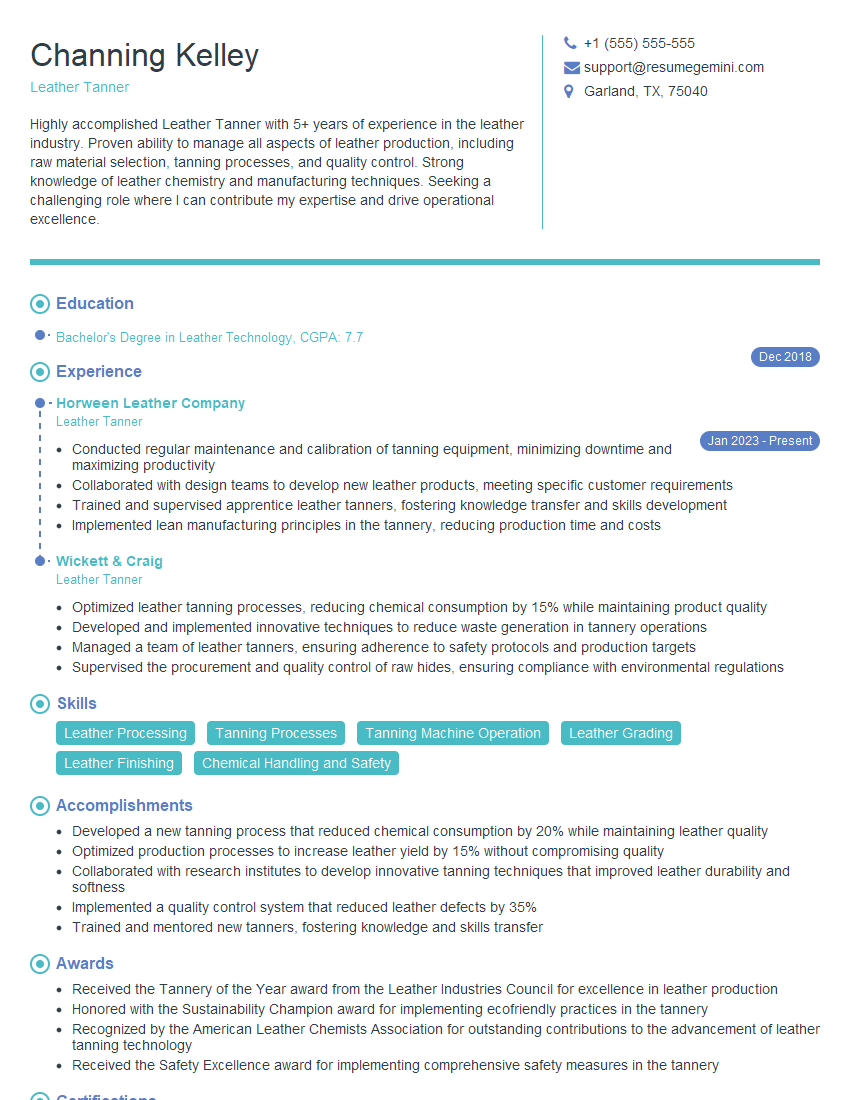
Mastering Leather Technology opens doors to exciting career opportunities in a dynamic and evolving industry. To maximize your job prospects, creating a strong, ATS-friendly resume is essential. ResumeGemini can help you craft a professional and impactful resume that highlights your skills and experience effectively. ResumeGemini provides examples of resumes tailored to the Leather Technology field, ensuring your application stands out. Take advantage of this resource to build a compelling resume that showcases your expertise and secures your dream job.

Explore more articles
Users Rating of Our Blogs
Share Your Experience
We value your feedback! Please rate our content and share your thoughts (optional).
What Readers Say About Our Blog
Very informative content, great job.
good