Unlock your full potential by mastering the most common Lighting Design and Optimization interview questions. This blog offers a deep dive into the critical topics, ensuring you’re not only prepared to answer but to excel. With these insights, you’ll approach your interview with clarity and confidence.
Questions Asked in Lighting Design and Optimization Interview
Q 1. Explain the difference between luminous flux and illuminance.
Luminous flux and illuminance are both crucial concepts in lighting design, but they represent different aspects of light.
Luminous flux (measured in lumens) represents the total amount of visible light emitted by a source. Think of it as the total light output of a bulb. A 1000-lumen bulb emits more light than a 60-lumen bulb. It’s the total power of the light source.
Illuminance (measured in lux), on the other hand, is the amount of light falling on a surface. It’s how much light actually lands on a particular area, like your desk or a painting in a gallery. Imagine shining a 1000-lumen bulb directly onto a small area – the illuminance there would be high. If you spread that same light over a larger area, the illuminance would decrease. It’s the density of light on a surface.
Analogy: Imagine a water sprinkler. Luminous flux is the total amount of water the sprinkler produces, while illuminance is how much water hits a specific square foot of your lawn. The same amount of water spread over a larger area means less water per square foot.
Q 2. Describe the inverse square law and its implications in lighting design.
The inverse square law states that the intensity of light decreases proportionally to the square of the distance from the source. Simply put, if you double the distance from a light source, the illuminance on the surface drops to one-fourth its original value. If you triple the distance, it drops to one-ninth.
Formula: E = I / d² where ‘E’ is illuminance, ‘I’ is luminous intensity (candelas), and ‘d’ is the distance from the source.
Implications in lighting design: This law is vital for calculating the appropriate number and placement of luminaires. For instance, if you need a certain level of illuminance on a workspace, you need to account for the distance between the lights and the work surface. Placing lights too far away would result in insufficient illuminance, while placing them too close might create glare or uneven distribution.
Example: Imagine you need 500 lux on a desk. Using the inverse square law, we can calculate the required luminous intensity from a light source at a specific distance. If we increase the distance, the required luminous intensity increases dramatically to maintain the same illuminance.
Q 3. What are the key considerations for designing lighting for a museum?
Designing lighting for a museum requires a meticulous approach that considers preservation, aesthetics, and the visitor experience. Key considerations include:
- Minimizing UV and IR radiation: These wavelengths can damage artwork, so specialized filters and low-output sources are crucial. LEDs are a popular choice, offering excellent control and reduced harmful emissions.
- Color rendering: High CRI lighting (Color Rendering Index) is vital for accurately displaying colors and preserving the artist’s intent. A CRI of 90 or higher is often recommended.
- Light levels: Illuminance levels must be carefully controlled to prevent fading and degradation of artwork. This usually involves lower illuminance values than what you would find in a typical office setting. The duration and intensity of exposure should also be carefully managed.
- Glare control: Direct glare can be distracting and harmful to both artwork and visitors. Diffusers, baffles, and proper fixture placement are essential.
- Light distribution: Even and consistent lighting is crucial to avoid uneven highlighting, shadows, or hot spots. Specialized lighting techniques such as grazing or washing are frequently employed.
- Security: The lighting design should also consider security aspects, including illumination of walkways and strategic placement of lights to deter vandalism.
Example: A museum might use track lighting with adjustable heads and UV filters to highlight individual pieces without harming them, while also using general ambient lighting with a low illuminance value to maintain a comfortable atmosphere.
Q 4. How do you determine the appropriate color temperature for a specific space?
Choosing the appropriate color temperature depends heavily on the space’s intended mood and function. Color temperature is measured in Kelvin (K).
- Warm light (2700K-3000K): Creates a cozy and inviting atmosphere, often used in residential settings, restaurants, or areas meant to promote relaxation. Think of a candle’s warm glow.
- Neutral light (3500K-4100K): Offers a balanced and versatile option, suitable for offices, classrooms, or retail spaces where clear vision is important. This tends to mimic natural daylight.
- Cool light (5000K and above): Provides a bright and energetic feel, ideal for industrial settings, garages, or areas requiring high visibility. Think of the clear light of a bright sunny day.
The choice also depends on factors like the surrounding colors and materials in a room. Warm light can enhance warm tones, while cool light accentuates cool tones. A professional lighting designer considers all these aspects to create a harmonious lighting scheme.
Example: A clothing store might use warmer color temperatures to highlight the colors of clothes, while a hospital might use neutral or cool color temperatures to maintain a clean and sterile environment.
Q 5. What are the advantages and disadvantages of LED lighting compared to traditional lighting sources?
LED lighting has revolutionized the industry, offering numerous advantages over traditional sources like incandescent and fluorescent bulbs.
- Advantages:
- Energy efficiency: LEDs consume significantly less energy for the same amount of light output, leading to lower electricity bills and reduced environmental impact.
- Longevity: LEDs have a much longer lifespan than traditional bulbs, reducing replacement costs and maintenance.
- Compactness and design flexibility: LEDs are compact and versatile, allowing for innovative lighting designs.
- Instant on/off: Unlike fluorescent lamps, LEDs light up instantly without any warm-up time.
- Controllability: LEDs are easily dimmable and offer advanced control options through smart systems.
- Disadvantages:
- Initial cost: The upfront cost of LEDs can be higher than traditional lighting, though this is often offset by long-term savings.
- Heat sensitivity: While improved, excessive heat can still affect the lifespan of some LED fixtures.
- Light quality concerns: The color rendering index (CRI) and color consistency can vary among LED manufacturers.
- Light pollution: Some LEDs, particularly those with high blue light output, can contribute to light pollution, affecting nocturnal ecosystems.
Example: A large office building can significantly reduce its energy consumption and maintenance costs by switching to LED lighting, but the initial investment will be substantial.
Q 6. Explain the concept of color rendering index (CRI) and its importance.
The Color Rendering Index (CRI) is a measure of how accurately a light source renders the colors of objects compared to a reference source (usually daylight).
Scale: CRI is rated on a scale of 0 to 100, with 100 being the best rendering of colors. A CRI of 80 or higher is generally considered good for most applications, while a CRI of 90 or higher is preferred for color-critical environments like museums or art galleries.
Importance: A high CRI ensures that colors appear natural and true to life. Poor CRI can lead to distorted colors, making objects look unnatural or washed out. This is particularly important in applications where accurate color representation is essential.
Example: A high-CRI light source will accurately render the colors of a painting, showcasing the artist’s true intent. A low-CRI source might make the colors appear dull, washed out, or even different from reality. In a retail store, accurate color rendering is vital for customers to evaluate products like clothes and cosmetics.
Q 7. Describe different types of lighting control systems and their applications.
Lighting control systems enhance efficiency, convenience, and ambiance. Several types exist:
- Manual switches and dimmers: The simplest form, offering basic on/off and dimming functionality. Suitable for small-scale applications.
- Relay-based systems: Use relays to switch lights on and off remotely or based on schedules. More complex than manual controls but still relatively basic.
- DALI (Digital Addressable Lighting Interface): A digital protocol offering individual control of luminaires, allowing for precise dimming, scheduling, and monitoring. Widely used in commercial buildings.
- Wireless control systems (e.g., Zigbee, Bluetooth, Wi-Fi): These systems use wireless communication to control lights remotely, often via smartphone apps or central control panels. Offer flexibility and integration with smart home systems.
- Building management systems (BMS): Integrate lighting control with other building systems like HVAC and security, enabling centralized management and optimization of energy use.
Applications:
- Manual switches/dimmers: Homes, small offices.
- Relay-based systems: Small commercial spaces with basic scheduling needs.
- DALI: Large commercial buildings, offices, retail spaces.
- Wireless systems: Homes, offices, retail spaces requiring flexible control.
- BMS: Large commercial buildings, industrial facilities seeking integrated energy management.
Example: A museum might use a DALI system to control individual spotlights, ensuring precise illumination of artwork and minimizing energy waste, while a smart home might employ wireless controls to adjust lighting levels based on occupancy and time of day.
Q 8. How do you calculate the lighting power density (LPD) for a space?
Lighting Power Density (LPD) is a crucial metric in lighting design, representing the installed lighting power per unit area. It’s expressed in watts per square meter (W/m²) or watts per square foot (W/ft²). Calculating LPD helps determine the energy efficiency of a lighting system and facilitates comparisons between different designs.
The calculation is straightforward: LPD = Total Lighting Power (Watts) / Area of the Space (m² or ft²)
For example, if a 100m² office space has 2000 Watts of installed lighting, the LPD is 2000W / 100m² = 20 W/m².
It’s vital to remember that LPD is just one factor; effective lighting design considers factors beyond LPD, such as illuminance levels, light quality, and occupant comfort.
Q 9. What are the key factors to consider when designing for energy-efficient lighting?
Designing for energy-efficient lighting requires a holistic approach, focusing on several key factors:
- High-Efficacy Light Sources: Switching to LEDs is often the first step. LEDs offer significantly higher lumens per watt compared to traditional sources like incandescent or fluorescent lamps.
- Effective Lighting Controls: Implementing occupancy sensors, daylight harvesting systems, and dimming controls drastically reduces energy consumption by only lighting spaces when needed and adjusting light levels according to available daylight.
- Optimized Lighting Layout and Fixture Selection: Careful placement of fixtures minimizes energy waste by directing light effectively to the task areas, avoiding excessive spill light.
- Daylight Integration: Maximizing the use of natural daylight reduces the reliance on artificial lighting. This involves strategic window placement and the use of light shelves or other daylight redirecting elements.
- Energy-Efficient Ballasts (for fluorescent/HID systems): Choosing energy-efficient ballasts significantly improves the overall efficiency of the lighting system (though less relevant with the prevalence of LEDs).
- Regular Maintenance: Cleaning luminaires and replacing lamps as needed maintains light output and prevents energy losses.
Consider a retail space. By using high-efficacy LEDs, occupancy sensors in storage areas, and dimming controls in the main sales area to adjust to daylight, we can significantly reduce the energy footprint without compromising visual comfort.
Q 10. What software are you proficient in for lighting design and simulation?
I am proficient in several industry-standard lighting design and simulation software packages, including:
- Dialux evo: A widely used software for lighting calculations, offering powerful features for both interior and exterior lighting design.
- Relux: Another robust software known for its accuracy and extensive library of luminaires.
- Agilent Lighting Simulation: This software provides advanced simulation capabilities, particularly useful for complex projects.
- Autodesk Revit: While not exclusively for lighting, Revit integrates seamlessly with lighting design, allowing for coordinated modeling and documentation.
My expertise spans both the theoretical calculations within these programs and the practical application to real-world projects.
Q 11. Explain your experience with lighting calculations and design software.
My experience with lighting calculations and design software is extensive. I’ve utilized these tools across various project scales, from small residential spaces to large commercial buildings and outdoor environments. This includes performing illuminance calculations to ensure compliance with relevant standards (e.g., IES, CIE), generating photometric reports, and creating detailed 3D visualizations.
For example, on a recent project involving a museum, I used Dialux evo to model the lighting scheme, ensuring uniform illuminance on the artifacts while minimizing glare and UV damage. The software allowed me to test different fixture types and positions until I achieved the desired result, all documented within a detailed report.
My proficiency extends to troubleshooting potential lighting issues identified through simulations, allowing for proactive problem-solving before construction begins.
Q 12. Describe your process for developing a lighting design scheme.
My process for developing a lighting design scheme follows a structured approach:
- Client Consultation & Brief: Understanding the client’s needs, budget, and functional requirements is paramount.
- Space Analysis & Site Survey: A thorough site visit to assess the space’s dimensions, existing infrastructure, and daylight conditions is crucial.
- Design Concept Development: Based on the brief and site analysis, I develop a preliminary lighting concept, considering aesthetics, functionality, and energy efficiency.
- Lighting Calculations & Simulation: Using specialized software, I perform detailed lighting calculations to ensure compliance with standards and meet the desired illuminance levels.
- Fixture Selection & Specification: Selecting appropriate luminaires that meet the design requirements, budget constraints, and aesthetic goals.
- 3D Visualization & Rendering: Creating realistic visualizations to help the client visualize the final lighting scheme and make informed decisions.
- Documentation & Report Generation: Producing detailed design documents, including lighting plans, specifications, and energy calculations.
- Implementation & Commissioning: Overseeing the installation process and ensuring the lighting system performs as designed.
This iterative process allows for continuous refinement and feedback, ensuring the final design meets the client’s vision and performs optimally.
Q 13. How do you address glare issues in a lighting design?
Glare is a significant factor affecting visual comfort and performance. Addressing glare requires a multifaceted approach:
- Appropriate Luminaire Selection: Choosing fixtures with low-glare optics, such as those with diffusers or louvers, minimizes direct light reaching the eyes.
- Careful Fixture Placement: Strategic placement of fixtures can prevent direct glare, particularly by avoiding positioning them directly above viewing areas.
- Shielding Devices: Using baffles or other shielding devices can block direct light sources while still allowing for adequate illumination.
- Light Level Control: Dimming controls can adjust light levels to minimize glare in situations where high light levels are not always necessary.
- Surface Reflectance: Using materials with appropriate reflectance properties can reduce glare by diffusing light. Darker ceilings help reduce light bounce.
For instance, in a classroom setting, using recessed troffers with parabolic louvers prevents direct glare from students’ eyes while ensuring sufficient illumination for reading. Careful attention to wall and ceiling reflectance is equally important.
Q 14. Explain your experience with daylight harvesting strategies.
Daylight harvesting strategies utilize natural daylight to reduce the reliance on electric lighting, leading to significant energy savings and improved visual comfort. My experience encompasses several strategies:
- Light Shelves: These horizontal shelves above windows deflect daylight deeper into the space, increasing natural light penetration.
- Automated Daylight Controls: Sensors monitor the amount of available daylight and automatically adjust electric lighting levels to maintain consistent illuminance levels, minimizing energy waste.
- Tunable White Lighting: Using lighting systems that adjust color temperature based on daylight conditions improves visual comfort and adapts to changing ambient lighting. This minimizes the need for high intensity artificial lights during the day.
- Light Tubes and Tunnels: These systems transfer natural light from a roof or other external source deep into the building’s interior.
- Window Placement and Sizing: Strategic window placement and sizing are fundamental in maximizing daylight penetration. This also considers orientation and potential glare from direct sunlight.
In a recent office project, we incorporated an automated daylight harvesting system with tunable white LEDs. The system dynamically adjusts the electric lighting levels and color temperature throughout the day, creating a pleasant and energy-efficient environment.
Q 15. How do you incorporate sustainability principles into your lighting designs?
Sustainability is paramount in modern lighting design. It’s not just about saving energy; it’s about minimizing the environmental impact throughout the entire lifecycle of the lighting system, from manufacturing to disposal. My approach incorporates several key strategies:
- Energy-Efficient Fixtures: I prioritize high-efficiency LED luminaires with long lifespans, significantly reducing energy consumption and operational costs. For example, choosing LEDs with high lumens per watt (lm/W) ratings is crucial.
- Daylight Harvesting: I design systems that maximize the use of natural light, reducing the reliance on artificial lighting. This often involves strategically placing sensors and using automated dimming systems to adjust lighting levels based on available daylight.
- Smart Lighting Controls: Implementing occupancy sensors, daylight sensors, and programmable timers ensures lights are only on when and where needed. This reduces energy waste and improves operational efficiency. I’ve successfully implemented systems that reduce energy consumption by up to 60% in various projects.
- Sustainable Materials: I specify fixtures made from recycled or recyclable materials and those that meet stringent environmental standards. This reduces the overall environmental footprint of the project.
- Heat Management: Efficient thermal management of lighting systems minimizes the load on HVAC systems, further reducing energy consumption. Proper heat dissipation design is essential, particularly in densely packed installations.
- End-of-Life Considerations: I incorporate plans for proper disposal and recycling of lighting components at the end of their lifespan, promoting responsible waste management.
By combining these strategies, I create lighting designs that are both aesthetically pleasing and environmentally responsible.
Career Expert Tips:
- Ace those interviews! Prepare effectively by reviewing the Top 50 Most Common Interview Questions on ResumeGemini.
- Navigate your job search with confidence! Explore a wide range of Career Tips on ResumeGemini. Learn about common challenges and recommendations to overcome them.
- Craft the perfect resume! Master the Art of Resume Writing with ResumeGemini’s guide. Showcase your unique qualifications and achievements effectively.
- Don’t miss out on holiday savings! Build your dream resume with ResumeGemini’s ATS optimized templates.
Q 16. What are your experiences with different lighting fixture types?
My experience spans a wide range of lighting fixture types, from traditional incandescent and fluorescent to the latest LED technologies. Each type has its own strengths and weaknesses:
- Incandescent: While warm and aesthetically pleasing, they are highly inefficient and have short lifespans. I rarely specify them unless a specific historical aesthetic is required.
- Fluorescent: More energy-efficient than incandescent, but they contain mercury and have a shorter lifespan than LEDs. They are less common now due to LED advancements.
- LED: My most frequently used fixture type, offering high energy efficiency, long lifespan, and design flexibility. I have extensive experience with various LED technologies, including COB (Chip on Board), SMD (Surface Mount Device), and integrated LEDs, selecting the optimal type based on the project’s needs.
- High-Intensity Discharge (HID): Used in some high-bay applications, requiring specialized ballasts and producing significant heat. Less common due to the advantages of LEDs in similar applications.
- Linear Fixtures: Ideal for long corridors and commercial spaces; I consider their distribution, efficacy, and mounting options carefully.
- Recessed Fixtures: Used frequently for ambient lighting, requiring careful consideration of ceiling heights and thermal management.
- Track Lighting: Offers versatility and precise light positioning, useful for accent lighting and display spaces.
My selection criteria always prioritize energy efficiency, light quality, and longevity, considering factors like cost, maintenance, and the overall aesthetic impact on the space.
Q 17. Describe your understanding of lighting standards and codes (e.g., IES, ASHRAE).
Understanding and adhering to lighting standards and codes is crucial for ensuring safe, efficient, and compliant lighting designs. I’m familiar with standards from organizations like the Illuminating Engineering Society (IES) and the American Society of Heating, Refrigerating and Air-Conditioning Engineers (ASHRAE). These standards cover various aspects, including:
- Illuminance Levels: IES publishes recommended illuminance levels (lux or foot-candles) for different spaces and activities. For example, a library requires higher illuminance than a warehouse.
- Energy Efficiency: ASHRAE standards address energy efficiency in building design, including lighting systems. This includes considerations for energy codes and maximum allowable power densities.
- Glare Control: Standards address visual comfort and the need to control glare, ensuring that the lighting design does not cause discomfort or visual impairment. I carefully design lighting layouts to minimize direct and reflected glare.
- Color Rendering Index (CRI): I consider the CRI of light sources. A higher CRI indicates better color rendering, which is critical in spaces where color accuracy is important (e.g., art galleries, retail spaces).
- Light Pollution: I’m aware of guidelines aimed at minimizing light pollution. This involves selecting appropriate lighting fixtures and controlling light spill outside the intended areas.
- Safety Codes: I ensure that all lighting designs comply with relevant safety codes, addressing issues such as emergency lighting and electrical safety.
Staying updated on the latest codes and standards is an ongoing process, and I regularly consult resources like the IES and ASHRAE websites to ensure my designs meet the highest standards.
Q 18. How do you handle client feedback and revisions during the design process?
Client feedback is essential for successful lighting design. My approach emphasizes open communication and collaboration throughout the process:
- Initial Consultations: I begin by having in-depth discussions with clients to understand their needs, preferences, and budget. I use mood boards and visuals to help them visualize the desired lighting.
- Design Presentations: I present initial design concepts, including renderings and simulations, to clients for feedback. This allows for early adjustments and prevents costly rework later in the project.
- Iterative Revisions: I incorporate client feedback into design revisions, ensuring that the final design meets their specific requirements and aesthetic preferences. I provide detailed explanations for design choices and readily answer questions.
- Documentation: I maintain thorough documentation of all design revisions, including comments and changes made in response to client feedback.
- Project Management: I use project management tools to track progress, manage revisions, and keep clients informed every step of the way. This maintains transparency and allows for proactive problem-solving.
By proactively seeking and incorporating client input, I foster a collaborative environment and deliver lighting designs that exceed client expectations.
Q 19. Explain your approach to troubleshooting lighting problems.
Troubleshooting lighting problems requires a systematic approach:
- Identify the Problem: Clearly define the issue. Is it insufficient illuminance, excessive glare, flickering lights, or a malfunctioning fixture?
- Gather Information: Collect relevant information, such as the type of fixtures, age of the system, existing controls, and any recent changes to the system.
- Visual Inspection: Conduct a thorough visual inspection of the lighting system, checking for loose connections, damaged components, or malfunctioning ballasts.
- Testing and Measurements: Use appropriate instruments (e.g., lux meters) to measure illuminance levels and verify the functionality of individual fixtures and controls.
- System Analysis: Analyze the entire lighting system to identify potential causes of the problem. This may involve checking wiring diagrams, control schematics, and sensor settings.
- Corrective Actions: Implement appropriate corrective actions. This may involve replacing faulty components, adjusting control settings, or redesigning parts of the lighting system.
- Documentation: Document all troubleshooting steps, findings, and implemented solutions.
For example, if a room is dimly lit, I would systematically check for issues such as a blown bulb, a faulty dimmer, or a problem with the circuit breaker. A systematic approach ensures efficient problem identification and resolution.
Q 20. Describe a challenging lighting project and how you overcame the obstacles.
One challenging project involved designing the lighting for a large, historic art museum. The primary challenges were:
- Preservation of Historic Elements: The building contained sensitive historic features that couldn’t be altered, limiting fixture placement options.
- Complex Lighting Requirements: Different galleries required diverse lighting schemes, balancing ambient illumination with specialized lighting for specific artworks, each with specific color temperature and illuminance needs.
- Energy Efficiency Targets: The client had stringent energy efficiency targets that needed to be met without compromising the quality of the lighting.
To overcome these obstacles, I employed a multifaceted approach:
- Careful Site Analysis: I conducted a detailed site analysis, documenting the existing conditions, architectural features, and the precise lighting requirements of each gallery.
- Custom Fixture Design: For certain areas, I collaborated with manufacturers to design custom lighting fixtures that met the specific requirements without damaging the historic structure. This involved careful consideration of materials and mounting techniques.
- Advanced Lighting Controls: I integrated a sophisticated lighting control system to manage illuminance levels dynamically, ensuring energy efficiency and the ability to adjust lighting according to different exhibitions and events.
- Extensive Simulations: I conducted extensive lighting simulations using specialized software to optimize the placement and performance of the fixtures, predicting illuminance levels and controlling glare.
The project successfully delivered a lighting system that met the challenging energy efficiency targets, showcased the artwork beautifully, and preserved the museum’s historic integrity. This demonstrated the importance of combining creativity, technical expertise, and careful planning when confronting intricate lighting design scenarios.
Q 21. What are your preferred methods for lighting calculations?
My preferred methods for lighting calculations involve a combination of manual calculations, specialized software, and lighting simulation programs:
- Manual Calculations: I use basic formulas for illuminance calculations (e.g., inverse square law) to quickly estimate lighting requirements and check software outputs. This ensures I thoroughly understand the fundamental principles underlying the more advanced tools.
- Specialized Software: I regularly use software like DIALux evo or Relux, which offer powerful features for calculating illuminance, luminance, and glare, enabling precise design and optimization. These programs allow me to input fixture data, space geometry, and reflectance properties, generating detailed reports and visualizations.
- Lighting Simulation Programs: For complex projects, especially those involving daylighting or dynamic lighting systems, I use advanced simulation tools like AGi32. These programs use sophisticated algorithms to model light behavior accurately and predict lighting conditions under various scenarios.
Regardless of the tools employed, I always verify the results using different methods and ensure that the calculations align with the lighting standards and client requirements. Accuracy is paramount in lighting design to avoid over or under-illumination and ensure visual comfort.
Q 22. How familiar are you with different lighting control protocols (e.g., DALI, DMX)?
Lighting control protocols are the backbone of any sophisticated lighting system, allowing for dynamic and efficient management. I’m highly proficient in several, most notably DALI and DMX. DALI (Digital Addressable Lighting Interface) is a digital protocol offering precise control over individual luminaires, ideal for large-scale projects requiring granular adjustments. Its two-wire system simplifies installation and reduces costs compared to other methods. For example, I’ve used DALI in a recent office refurbishment to create personalized lighting scenes for different work areas, boosting productivity and employee comfort. DMX (Digital Multiplex) is a more versatile protocol often preferred for theatrical lighting and dynamic installations. It allows for up to 512 channels, offering greater control over complex lighting schemes, including color mixing and effects. In a recent museum project, DMX was critical for creating dynamic lighting sequences that highlighted specific artifacts. The choice between DALI and DMX depends heavily on the project’s scale, complexity, and budget. Other protocols like BACnet and KNX are also within my experience, demonstrating a breadth of knowledge across various building automation systems.
Q 23. Explain your experience with different types of light sources and their spectral characteristics.
My experience encompasses a wide range of light sources, each with unique spectral characteristics impacting both visual comfort and energy efficiency. Incandescent lamps, while warm and aesthetically pleasing due to their continuous spectrum, are inherently inefficient. Fluorescent lamps, though energy-efficient, often have a less desirable color rendering index (CRI) and may flicker, affecting visual comfort. LEDs (Light Emitting Diodes), the current industry standard, offer exceptional energy efficiency and a wide range of color temperatures and CRI values, allowing for precise control over the lighting ambiance. I’ve worked with various LED technologies, including COB (Chip on Board), which delivers high lumen output, and SMD (Surface Mount Device), ideal for creating sophisticated lighting effects. The spectral characteristics of each light source are crucial in selecting the optimal solution for a particular environment. For instance, high-CRI LEDs are preferred in retail spaces to accurately showcase product colors, while a lower CRI might suffice in less demanding settings like storage areas. I always consider the human factors; for instance, a cooler color temperature might be better for concentration in an office while a warmer temperature is ideal for relaxation in a residential space.
Q 24. Describe your approach to specifying lighting fixtures for different applications.
Specifying lighting fixtures requires a holistic approach considering the application’s specific needs and constraints. My process begins with a thorough understanding of the client’s requirements, including functional needs, aesthetic preferences, and budgetary limitations. I then evaluate the space’s characteristics, considering factors such as ceiling height, ambient light levels, and the presence of reflective surfaces. For instance, in a retail environment, I would prioritize high-CRI LEDs and strategic placement to highlight merchandise effectively. In a museum, the focus shifts towards minimizing UV and IR radiation to protect artifacts, necessitating specific fixture selection. For offices, I prioritize adjustable lighting to facilitate different tasks, incorporating daylight harvesting strategies to maximize natural light. I also consider the longevity and maintainability of the fixtures, selecting those with long lifespans and ease of access for maintenance. The entire process incorporates energy modelling and calculations, ensuring compliance with energy codes and achieving maximum energy efficiency while providing the desired aesthetic and functional performance.
Q 25. How do you integrate lighting design with other building systems?
Integrating lighting design with other building systems is paramount for optimizing performance and functionality. Lighting systems can be seamlessly integrated with Building Management Systems (BMS) for centralized control and monitoring. This allows for automated control of lighting based on occupancy, daylight levels, and time of day. For example, I worked on a project where the lighting system was integrated with the HVAC system to reduce energy consumption; when natural light levels were sufficient, both the lighting and heating systems would be dimmed. Similarly, integration with security systems can trigger lighting changes in response to alarms or other security events. Such holistic design reduces energy costs, enhances safety, and improves overall building efficiency. I use specialized software to model and simulate these integrations, ensuring a seamless and efficient overall system.
Q 26. What are your thoughts on the future of lighting technology?
The future of lighting technology is incredibly exciting and dynamic. We’re seeing significant advancements in several areas. The continued evolution of LED technology, encompassing higher efficiency, tunable white, and improved color rendering, remains a key driver. Smart lighting, using wireless communication protocols and integrated sensors, will become even more prevalent, enabling dynamic control and personalized lighting experiences. Human-centric lighting, focusing on the impact of light on circadian rhythms and wellbeing, will gain more importance. We’ll likely see more integration with Internet of Things (IoT) technologies, allowing for seamless control and data analysis. LiFi (Light Fidelity), using light waves for data transmission, holds enormous potential for high-bandwidth communication. Moreover, advances in lighting materials and design will further push the boundaries of creative applications. The focus will increasingly be on sustainable practices and responsible use of resources, contributing to a brighter, more efficient, and eco-friendly future.
Q 27. Explain your understanding of the relationship between lighting and human wellbeing.
The relationship between lighting and human wellbeing is profoundly significant. Light influences our circadian rhythms, impacting sleep-wake cycles, hormone production, and overall mood. Exposure to appropriate light levels throughout the day is crucial for maintaining alertness and promoting healthy sleep patterns. Conversely, inadequate or poorly designed lighting can lead to eye strain, headaches, and even more serious health issues. Human-centric lighting aims to leverage this understanding by providing light tailored to support our biological needs. For example, cooler color temperatures in the morning and warmer temperatures in the evening can help regulate circadian rhythms. Strategic use of daylight and dynamic lighting systems can significantly impact productivity, comfort, and overall wellbeing in various environments, from offices and schools to healthcare facilities. My designs always consider the effects of light on the human body and psyche.
Q 28. How do you balance aesthetic considerations with energy efficiency in your designs?
Balancing aesthetic considerations with energy efficiency is a core principle in my design philosophy. It’s not a compromise but rather an integrated approach. I achieve this through careful selection of fixtures, leveraging energy-efficient light sources like LEDs, and incorporating intelligent control systems. For example, I might use high-CRI LEDs with low power consumption to achieve a visually appealing and energy-efficient lighting scheme. Furthermore, utilizing daylight harvesting strategies and occupancy sensors can significantly reduce energy consumption without compromising the aesthetic outcome. Employing efficient design strategies such as optimized luminaire placement and proper light spill control further minimizes energy waste. In every project, I conduct thorough energy modeling and simulations to optimize the design for both aesthetic appeal and energy efficiency, proving that beautiful lighting doesn’t have to be energy-intensive. I often involve clients in the decision-making process to ensure a balanced outcome that meets their needs and preferences.
Key Topics to Learn for Lighting Design and Optimization Interview
- Illumination Fundamentals: Understanding lumen output, illuminance, luminance, color temperature, color rendering index (CRI), and their practical implications in various design scenarios.
- Lighting Technologies: Familiarity with LED, fluorescent, incandescent, and other lighting technologies; their energy efficiency, lifespan, and application suitability. Consider practical examples like comparing LED and fluorescent lighting for a retail space.
- Design Software Proficiency: Demonstrating expertise in relevant design software (e.g., DIALux evo, Relux, AgI32) and showcasing your ability to model, simulate, and analyze lighting designs.
- Energy Codes and Regulations: Knowledge of building codes and energy efficiency standards related to lighting design (e.g., ASHRAE, LEED) and their impact on project planning and optimization.
- Daylighting and Natural Light: Understanding the principles of daylight harvesting and its integration with artificial lighting systems for optimal energy efficiency and occupant comfort. Consider case studies of daylight optimization in office buildings.
- Lighting Controls and Automation: Familiarity with various lighting control systems (e.g., dimming, occupancy sensors, daylight harvesting controls) and their role in optimizing energy consumption and enhancing user experience.
- Sustainability and Green Lighting: Knowledge of sustainable lighting practices, including the selection of energy-efficient fixtures, responsible material sourcing, and end-of-life management.
- Problem-Solving and Design Thinking: The ability to approach lighting challenges creatively, considering factors like budget constraints, aesthetic preferences, and technical limitations. Be prepared to discuss your problem-solving approach using relevant examples from your past projects.
- Lighting for Specific Applications: Understanding the unique lighting requirements for different environments such as retail, hospitality, healthcare, or industrial settings. Showcase your expertise in adapting lighting solutions for specific needs.
Next Steps
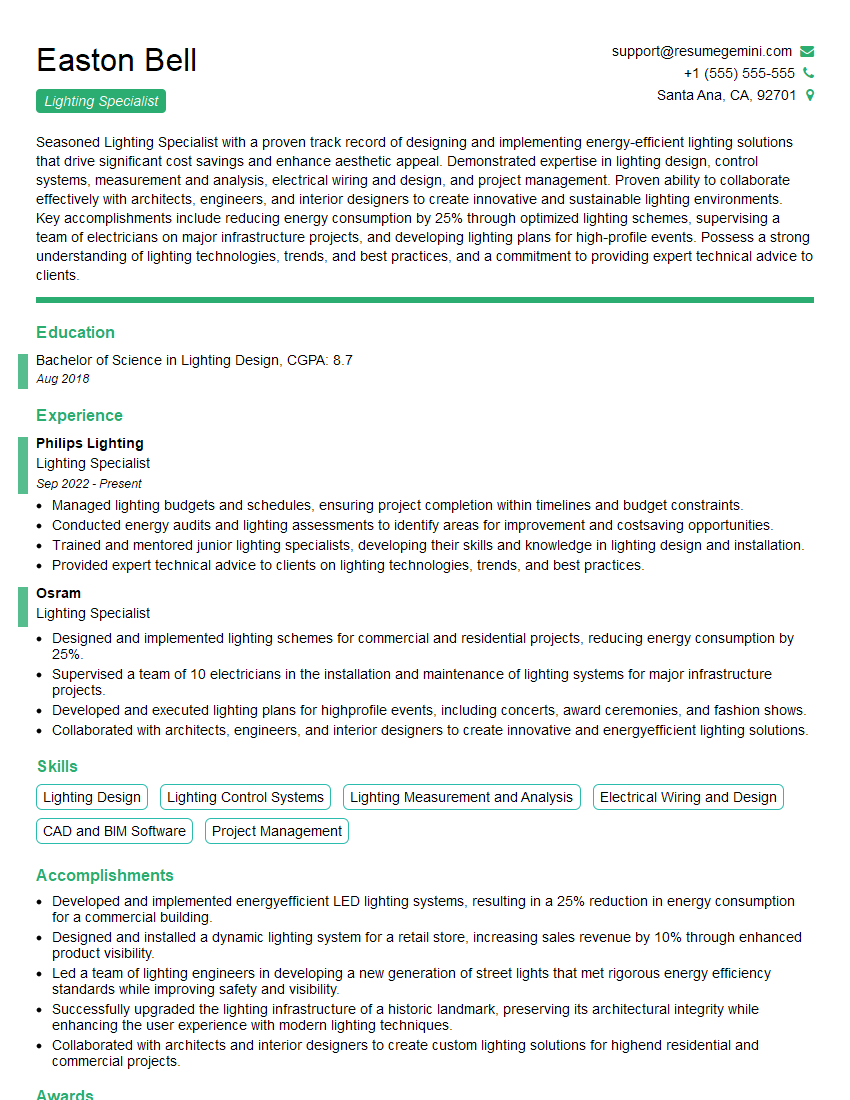
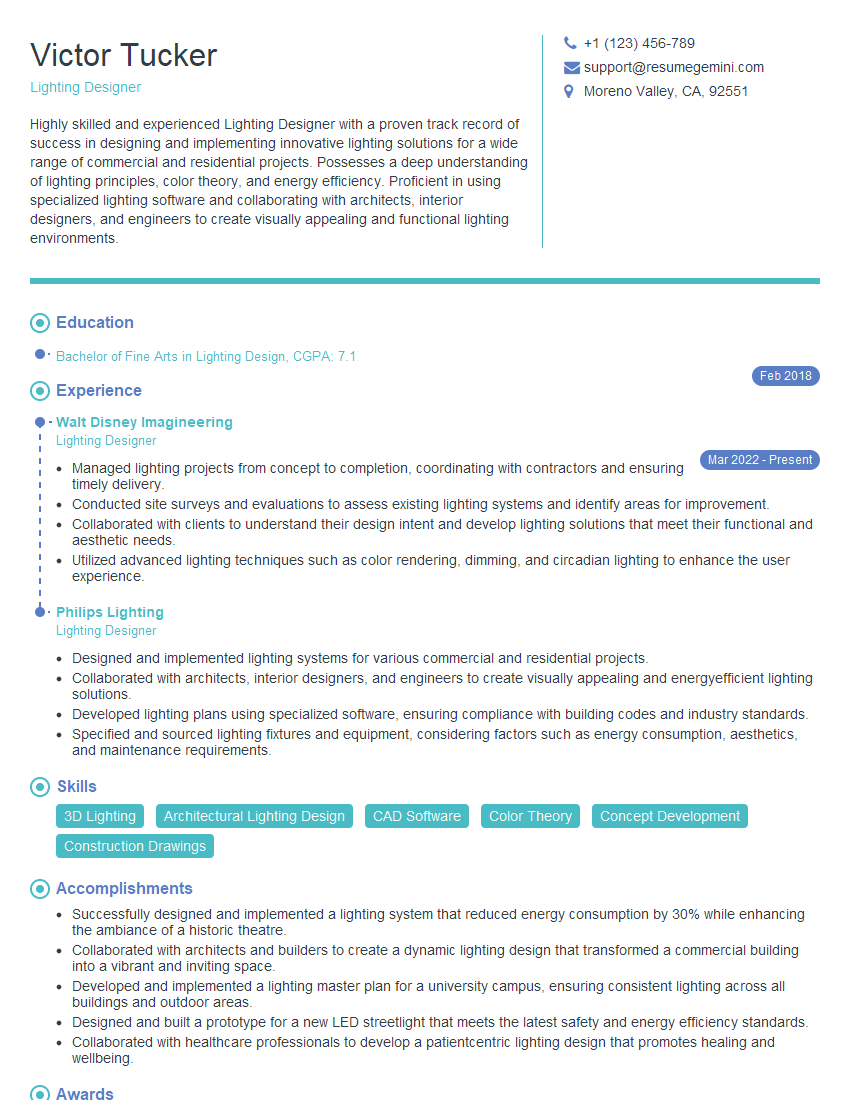
Mastering Lighting Design and Optimization is crucial for career advancement in this dynamic field. It opens doors to exciting projects, higher earning potential, and opportunities to shape innovative and sustainable lighting solutions. To maximize your job prospects, focus on creating an ATS-friendly resume that effectively highlights your skills and experience. ResumeGemini is a trusted resource to help you build a professional resume that stands out. They provide examples of resumes tailored to Lighting Design and Optimization to guide you through the process.
Explore more articles
Users Rating of Our Blogs
Share Your Experience
We value your feedback! Please rate our content and share your thoughts (optional).
What Readers Say About Our Blog
Very informative content, great job.
good