Every successful interview starts with knowing what to expect. In this blog, we’ll take you through the top Lighting Modeling and Simulation interview questions, breaking them down with expert tips to help you deliver impactful answers. Step into your next interview fully prepared and ready to succeed.
Questions Asked in Lighting Modeling and Simulation Interview
Q 1. Explain the difference between luminance and illuminance.
Luminance and illuminance are both crucial photometric quantities used in lighting, but they describe different aspects of light. Think of it like this: illuminance is how much light falls on a surface, while luminance is how much light that surface reflects or emits.
Illuminance (E) is measured in lux (lx) and represents the luminous flux incident on a surface per unit area. It’s essentially the amount of light hitting a specific point. A high illuminance value means a lot of light is landing on that spot. Imagine shining a flashlight directly onto a wall – that spot will have high illuminance.
Luminance (L) is measured in candelas per square meter (cd/m²), also known as nits. It describes the luminous intensity per unit area in a particular direction. It’s the brightness as perceived by the observer. The same flashlight spot on the wall will have a certain luminance depending on the wall’s reflectivity. A white wall will have higher luminance than a black wall under the same illuminance.
In short: Illuminance is about the light falling on a surface, while luminance is about the light leaving a surface towards the viewer.
Q 2. What are the key principles of light interaction with surfaces (reflection, refraction, absorption)?
Light’s interaction with surfaces is governed by three primary principles: reflection, refraction, and absorption. These principles determine how light behaves when it encounters a material, influencing the overall appearance of a scene in a lighting simulation.
- Reflection: This is when light bounces off a surface. The type of reflection depends on the surface’s properties. Specular reflection is like a mirror, producing a sharp, directed reflection. Diffuse reflection scatters light in various directions, resulting in a softer appearance. Think of a polished chrome surface versus a matte painted wall.
- Refraction: This occurs when light passes from one medium to another (e.g., from air to glass), causing it to bend. The amount of bending depends on the refractive indices of the two media. This is why objects appear to be slightly displaced when viewed through water.
- Absorption: This is when a material absorbs light energy, converting it into heat. Darker colors typically absorb more light than lighter colors. This is why a black shirt feels warmer in the sun than a white one.
Understanding these principles is crucial for accurate lighting simulations, as they dictate how light interacts with different materials and creates realistic shadows, highlights, and overall scene illumination.
Q 3. Describe different types of light sources used in lighting simulations (e.g., point, directional, area).
Lighting simulations utilize various light source models to accurately represent real-world lighting conditions. Here are some common types:
- Point Light: Emits light equally in all directions from a single point. Think of a light bulb.
- Directional Light: Represents parallel light rays, like the sun. The light source is considered infinitely far away.
- Area Light: Distributes light from a surface area, providing softer, more realistic shadows than point lights. Imagine a fluorescent light panel or a window.
- Spot Light: Emits light within a cone-shaped area, simulating spotlights or flashlights.
- IES Profile Light: Uses real-world measured light distribution data from an IES (Illuminating Engineering Society) file, providing highly accurate representations of specific luminaires.
The choice of light source depends on the desired level of realism and the complexity of the scene. For simple scenes, point lights may suffice, while complex scenes might require a combination of area lights and IES profile lights for accurate results.
Q 4. What are the advantages and disadvantages of using ray tracing vs. radiosity in lighting simulation?
Ray tracing and radiosity are two prominent global illumination algorithms used in lighting simulations, each with its strengths and weaknesses.
Ray Tracing: This method traces the path of light rays from the light source to the camera, simulating reflections and refractions accurately. It excels in handling specular reflections and transparent materials. However, it can be computationally expensive, especially for complex scenes with many light bounces.
Radiosity: This method focuses on the energy exchange between surfaces, calculating the light distribution based on the view factors between them. It handles diffuse reflections efficiently and produces soft shadows. However, it struggles with specular reflections and caustics (concentrated light effects like those seen under a glass of water).
Advantages of Ray Tracing: High accuracy for specular reflections and refractions, realistic caustics.
Disadvantages of Ray Tracing: Computationally expensive, slower rendering times.
Advantages of Radiosity: Efficient for diffuse reflections, soft shadows.
Disadvantages of Radiosity: Struggles with specular reflections and caustics.
In practice, hybrid approaches combining ray tracing and radiosity are often used to leverage the strengths of both methods and achieve highly realistic rendering.
Q 5. How do you handle complex geometries in lighting simulations?
Handling complex geometries in lighting simulations requires employing efficient techniques to manage the computational burden and maintain accuracy. Several strategies are commonly used:
- Mesh simplification: Reducing the polygon count of complex models to improve rendering performance without significant loss of visual fidelity. This is often done using decimation algorithms.
- Hierarchical representations: Using bounding volume hierarchies (BVHs) or octrees to organize the scene geometry, allowing for faster ray intersection tests in ray tracing.
- Adaptive algorithms: Employing algorithms that focus computational resources on areas of the scene that are visually important, reducing the processing needed for less significant details.
- Level of Detail (LOD): Using different levels of detail for the same geometry, switching to a simpler representation when it’s far from the camera. This is common in games and real-time applications.
- GPU acceleration: Leveraging the parallel processing power of GPUs to accelerate ray tracing and other computationally intensive tasks. Most modern rendering engines heavily rely on GPU acceleration for performance.
The optimal approach depends on the specific simulation requirements, the complexity of the geometry, and the available computational resources. Often, a combination of these techniques is employed to achieve the best balance between accuracy and performance.
Q 6. Explain the concept of global illumination and its importance in realistic rendering.
Global illumination (GI) refers to the simulation of indirect lighting in a scene. It considers the way light bounces off multiple surfaces before reaching the eye, creating a much more realistic rendering compared to local illumination, which only considers direct light from sources.
Imagine a room with a single lamp. Local illumination would only show the direct light from the lamp, resulting in dark areas. GI, however, simulates light bouncing off walls and ceiling, illuminating those darker areas realistically. This indirect lighting is crucial for creating believable shadows, reflections, and overall scene ambiance.
GI algorithms, like path tracing and photon mapping, simulate these light bounces to achieve accurate and realistic rendering. Its importance lies in creating photorealistic images and visualizations, enhancing the accuracy and visual appeal of lighting simulations used in architectural visualization, product design, and film production.
Q 7. What are the common file formats used for importing and exporting lighting data?
Several common file formats are used for importing and exporting lighting data, depending on the specific software and application:
- IES (Illuminating Engineering Society): A standard format for describing the luminous intensity distribution of luminaires (light fixtures). It’s essential for accurate simulations using real-world lighting equipment.
- FBX (Filmbox): A versatile 3D model format supporting geometry, materials, and animations. It’s commonly used for exchanging data between different 3D software packages.
- OBJ (Wavefront OBJ): A simple geometry-only format, commonly used for exchanging 3D models. It usually doesn’t contain lighting information directly.
- DAE (COLLADA): An open XML-based format for exchanging 3D assets, including geometry, materials, and animations. Similar to FBX, but with greater platform independence.
- HDR (High Dynamic Range): Used to store high-dynamic-range images, allowing for a much wider range of brightness and color than standard images. Useful for representing environmental lighting conditions or light probes.
The choice of format depends on the specific needs of the project. For accurate luminaire representation, IES files are essential. For exchanging complete scenes, FBX or DAE are often preferred, while HDR images are used for environment maps.
Q 8. How do you ensure accurate color representation in your simulations?
Accurate color representation in lighting simulations is crucial for achieving realistic and predictable results. It hinges on using appropriate color spaces and spectral data. Instead of relying solely on RGB values, which are device-dependent, we utilize spectral power distributions (SPDs). SPDs describe the intensity of light at different wavelengths, providing a much more accurate representation of light’s color and how it interacts with materials.
For example, a simple RGB value might appear the same on different screens, but their SPDs will differ, leading to inaccuracies when simulating how that light will reflect off surfaces or be perceived by the human eye. Software like DIALux and AGI32 often allow importing SPDs from manufacturers’ datasheets for luminaires, ensuring that the simulated color matches reality. We also need to be mindful of color rendering indices (CRI) which indicate how well a light source renders different colors compared to a reference source.
In practice, I’ve found that meticulously inputting spectral data significantly improves simulation accuracy, particularly in projects where color fidelity is paramount, like museum lighting or product photography studios. Ignoring this can lead to significant errors in rendering colors, such as warm-toned materials appearing unexpectedly cool under a simulated light source.
Q 9. Describe your experience with different lighting simulation software (e.g., DIALux, AGI32, Radiance).
My experience spans several leading lighting simulation software packages. I’ve extensively used DIALux for its user-friendly interface and comprehensive library of luminaires, making it ideal for quick design iterations and preliminary calculations, especially for interior lighting projects. AGI32, on the other hand, offers more advanced features and greater control over simulation parameters, making it my go-to for complex projects with specific requirements, such as exterior lighting simulations, or those involving intricate geometry and material properties.
Radiance, while more challenging to learn due to its command-line interface, provides unparalleled accuracy and control. I use it for situations where exceptional precision is needed, such as detailed studies of daylighting or analyses of glare, employing its powerful ray-tracing capabilities. I often employ a workflow where I use DIALux or AGI32 for initial design and then refine the model with Radiance for detailed analysis in critical aspects. This allows for efficient design and high precision, without sacrificing time.
Q 10. How do you validate the accuracy of your lighting simulations?
Validating the accuracy of lighting simulations is a critical step that involves comparing simulation results to real-world measurements. Several methods exist, ranging from simple spot measurements with a lux meter to more sophisticated techniques. For instance, I frequently conduct on-site luminance measurements after installation using a calibrated luminance meter to compare against the simulated illuminance levels at key locations.
For more detailed validation, I might use a goniophotometer to measure the luminous intensity distribution of a luminaire and compare it to the manufacturer’s provided data and the data used in the simulation. Discrepancies could highlight issues with the model’s geometry, material properties, or the luminaire data itself. Further, I often employ visual comparisons, taking photographs of the illuminated space after installation and comparing them to rendered images from the simulation. This helps identify any major discrepancies in color, luminance distribution, and overall visual impact.
A key aspect is understanding the limitations of the simulation. No simulation is perfect; it’s a model, not reality. We aim to minimize discrepancies, but some degree of difference is expected. The goal is to understand the sources of error and ensure the simulation remains a useful predictive tool within reasonable tolerance bounds.
Q 11. Explain the importance of photometric data in lighting design.
Photometric data is the cornerstone of accurate lighting design. It provides the quantitative information about the light emitted by a luminaire, including luminous flux, luminous intensity, illuminance, and intensity distribution. Without this data, our simulations would be mere guesswork.
For instance, the luminous flux (measured in lumens) tells us the total amount of light emitted by a source, while the luminous intensity (candelas) describes the light’s intensity in a specific direction. Illuminance (lux) measures the amount of light falling on a surface. Intensity distribution curves, usually presented as polar diagrams or IES files (Illuminating Engineering Society), show how the light is distributed spatially, crucial in predicting glare and determining how well a luminaire illuminates a specific area. Accurate photometric data allows for precise simulations that accurately predict lighting levels, glare, and energy consumption.
In practice, I always request and meticulously verify the photometric data from manufacturers before incorporating luminaires into a lighting simulation project. I’ve encountered situations where incorrect or outdated data led to significant errors in the design, highlighting the absolute necessity of reliable photometric information.
Q 12. How do you consider energy efficiency in your lighting designs?
Energy efficiency is paramount in contemporary lighting design. I incorporate energy-efficient practices throughout the entire simulation and design process. This starts with selecting energy-efficient luminaires with high efficacy (lumens per watt) and appropriate color temperatures. The simulation itself helps optimize the number and placement of luminaires to minimize energy consumption while achieving the desired illuminance levels.
I utilize the simulation software’s built-in energy calculation features to determine the total energy consumption of the lighting system. For example, DIALux and AGI32 provide tools for calculating energy usage based on the simulated lighting design and occupancy schedules. I also model different lighting control strategies, such as daylight harvesting and occupancy sensors, in the simulation to quantify their energy-saving potential. This allows for a comparative analysis of various scenarios, assisting in selecting the most energy-efficient design.
Beyond the software, I frequently incorporate strategies like using daylighting to reduce reliance on artificial lighting, and choosing luminaires with advanced dimming capabilities and daylight responsive controls. This holistic approach, combined with accurate simulation, ensures lighting systems are both effective and energy-conscious.
Q 13. Describe your experience with daylighting simulations.
Daylighting simulations are vital for optimizing natural light usage, reducing energy consumption, and enhancing occupant comfort. I use specialized software features and techniques to accurately model daylighting effects. This involves incorporating accurate building geometry, window properties (size, type, shading), and solar data specific to the project’s location and orientation.
Software like Radiance excels in daylighting simulations due to its ability to accurately model complex interactions between sunlight, building materials, and interior spaces. I’ve used Radiance to simulate the impact of different window designs, shading devices, and building orientations on daylight availability and glare. I might also use simpler tools like DIALux, which, although less sophisticated, still offers useful insights for quick daylighting assessments.
A crucial aspect is the correct input of solar data. This data, typically obtained from weather files, is crucial in simulating the sun’s position and intensity throughout the year, thus allowing the simulation to accurately predict daylight levels at different times and seasons. Accurate daylighting simulations allow us to design buildings that maximize natural light, reducing energy use and creating more pleasant and productive indoor environments.
Q 14. How do you model different lighting control systems in your simulations?
Modeling lighting control systems in simulations is critical for accurately assessing energy efficiency and occupant comfort. Many simulation software packages allow integration of lighting control strategies. This often involves creating schedules that define when lights turn on and off based on occupancy, time of day, or daylight availability.
For instance, I’ve modeled occupancy sensors by creating zones within the simulation and assigning dimming or switching behaviours based on virtual occupancy data. This allows me to simulate the energy savings achieved by reducing lighting levels in unoccupied areas. Similarly, daylight harvesting strategies can be integrated by including sensors that adjust artificial lighting levels based on the availability of daylight. The simulation will then show reduced electricity usage due to the efficient utilization of natural light.
More complex systems, like networked lighting controls, often require custom scripting or integration with external control system models. This involves more detailed programming and data input, but it provides a more realistic assessment of the control system’s performance. Accurate control system modeling is essential for achieving an optimal balance between energy efficiency, visual comfort, and occupant satisfaction.
Q 15. What are some common challenges you face in lighting simulations, and how do you overcome them?
Lighting simulations, while powerful tools, present several challenges. One common hurdle is achieving accurate material representation. Different materials reflect and absorb light in unique ways, and perfectly replicating these properties in a simulation can be difficult. For example, the subtle variations in a polished marble surface or the complex scattering within a translucent fabric require advanced material models and high-resolution geometry to accurately capture. We overcome this by using high-quality material libraries, employing advanced rendering techniques like physically based rendering (PBR), and, when necessary, creating custom material definitions based on measured reflectance data.
Another challenge lies in balancing simulation accuracy with computational efficiency. Highly detailed models and sophisticated rendering algorithms can significantly increase processing time. We tackle this by strategically simplifying geometries where appropriate, utilizing efficient rendering engines, and employing techniques like progressive refinement to achieve a balance between accuracy and speed. For instance, a large-scale urban environment simulation might use simplified building models for initial lighting calculations and then increase the detail level for specific areas of interest.
Finally, accurately predicting human perception of light is complex. Our eyes adapt to different light levels, and factors like glare and contrast significantly influence our visual experience. To address this, we incorporate advanced rendering techniques that account for visual perception, including HDRI (High Dynamic Range Imaging) and algorithms simulating human visual response. We also compare simulation results with real-world measurements or on-site lighting studies to validate our models and refine our approach.
Career Expert Tips:
- Ace those interviews! Prepare effectively by reviewing the Top 50 Most Common Interview Questions on ResumeGemini.
- Navigate your job search with confidence! Explore a wide range of Career Tips on ResumeGemini. Learn about common challenges and recommendations to overcome them.
- Craft the perfect resume! Master the Art of Resume Writing with ResumeGemini’s guide. Showcase your unique qualifications and achievements effectively.
- Don’t miss out on holiday savings! Build your dream resume with ResumeGemini’s ATS optimized templates.
Q 16. How do you collaborate with architects and other design professionals?
Collaboration is key to successful lighting design. I work closely with architects, interior designers, and other professionals throughout the entire process. This often involves attending design meetings early in the project to understand the overall design vision and functional requirements of the space. I typically provide input on material selection, ceiling heights, and other spatial considerations, as these directly impact the lighting design. I actively listen to their concerns, offering design alternatives and highlighting potential conflicts or opportunities related to lighting. We use collaborative design software and cloud-based platforms to share models, renderings, and design documents, enabling efficient feedback and iteration.
For example, on a recent museum project, I worked with the architect and curator to develop a lighting scheme that both highlighted the artwork and preserved its integrity. We engaged in multiple iterations, adjusting light levels and color temperatures to strike the perfect balance between aesthetics and preservation requirements. Clear communication and a willingness to compromise were crucial to achieving the desired outcome.
Q 17. Describe your experience with lighting calculations and design standards.
I have extensive experience in lighting calculations and adherence to design standards. My expertise spans various calculation methods, from simple point-by-point illuminance calculations to complex energy simulations using software like DIALux, AGi32, and Radiance. I am proficient in applying industry standards such as IES (Illuminating Engineering Society) and CIE (Commission Internationale de l’Eclairage) guidelines, ensuring that designs meet regulations related to energy efficiency, visual comfort, and safety. This includes calculations for illuminance levels, luminance ratios, glare index, and energy consumption. I carefully consider the specific requirements of the project – be it a commercial building, residential space, or public area – and tailor my calculations accordingly.
For instance, in a recent office building project, I had to ensure compliance with ASHRAE 90.1 (energy standard) and IES recommendations for workplace lighting. This involved careful selection of energy-efficient luminaires, strategic placement to minimize energy waste, and precise lighting calculations to verify illuminance levels met the required standards while optimizing energy consumption.
Q 18. Explain your process for creating a lighting design from initial concept to final render.
My lighting design process follows a structured approach. It begins with a thorough understanding of the project requirements, including the architectural plans, client brief, and functional needs. This initial phase involves extensive discussion with stakeholders to define the lighting goals, aesthetic preferences, and budgetary constraints. Next, I create a 3D model of the space using appropriate software, incorporating accurate geometric data and material properties.
The simulation phase utilizes specialized software to model the light distribution, taking into account the chosen luminaires, their placement, and the room’s geometry. I then analyze the results, focusing on parameters such as illuminance levels, luminance ratios, and glare. Based on the simulation results, I make iterative adjustments to the lighting design, refining the placement, type, and quantity of fixtures to achieve the desired lighting effect. This is followed by rendering high-quality visualizations to communicate the final design to the client. Finally, I prepare detailed technical documentation, including lighting plans, specifications, and energy calculations, for construction and installation.
Q 19. How do you handle changes and revisions in a lighting design project?
Changes and revisions are an inherent part of the design process. I handle them using a collaborative and iterative approach. Changes are thoroughly documented and communicated to all relevant stakeholders. I assess the impact of each revision on the overall design, including energy consumption and visual comfort. The revised design then undergoes further simulation and analysis to ensure that it continues to meet the project requirements. This iterative process continues until the client is satisfied with the design and all necessary approvals are obtained.
For example, a change in ceiling material might necessitate recalculating the lighting levels to compensate for differences in reflectance. I utilize version control in my software and documentation to track all changes, ensuring traceability and ease of managing revisions.
Q 20. What are your preferred methods for presenting lighting simulations and design proposals?
Presenting lighting simulations and design proposals effectively is crucial for client understanding and approval. I use a multi-faceted approach: I start with clear and concise presentations, incorporating high-quality renderings that visually demonstrate the lighting effect. These renderings showcase the ambience, highlight key areas, and address specific design features. To ensure accessibility and ease of comprehension, I avoid overly technical jargon. I also use interactive 3D models, allowing clients to explore the space virtually and experience the lighting from different viewpoints. This often involves creating walkthrough animations or virtual reality experiences for immersive engagement.
Furthermore, I use data visualization techniques to present key metrics such as illuminance levels and energy consumption in a clear and easily understandable format, such as charts and graphs. Finally, I provide comprehensive technical documentation, including lighting plans, specifications, and energy calculations, for detailed review and approval. This multifaceted approach ensures all stakeholders understand the design’s intent, performance, and impact.
Q 21. Explain your understanding of color temperature and its impact on lighting design.
Color temperature is a crucial aspect of lighting design, representing the perceived warmth or coolness of light. It’s measured in Kelvin (K). Lower Kelvin values (e.g., 2700K) represent warmer, more yellowish light, often associated with incandescent bulbs and creating a cozy atmosphere. Higher Kelvin values (e.g., 6500K) indicate cooler, bluer light, similar to daylight and often used to enhance productivity in workspaces. The choice of color temperature significantly influences the mood, atmosphere, and even the perceived size and color of objects within a space.
For example, using warm white light (around 2700K) in a restaurant can create a relaxing and inviting ambience, while using cool white light (around 4000K) in an office might enhance concentration and alertness. In retail environments, color temperature can be used to subtly influence consumer behavior, with warmer tones often associated with comfort and luxury. Understanding and carefully selecting the appropriate color temperature is fundamental to achieving the desired design effect and functional requirements of a space.
Q 22. Describe your experience with different types of lighting fixtures and their applications.
My experience encompasses a wide range of lighting fixtures, from simple incandescent bulbs to complex LED systems and specialized architectural luminaires. Understanding their distinct characteristics is crucial for effective lighting design. For instance, incandescent bulbs, while warm and aesthetically pleasing, are energy-inefficient. LEDs, on the other hand, offer energy savings and long lifespans, but their color rendering index (CRI) needs careful consideration depending on the application.
- Incandescent: Ideal for creating a warm, intimate ambiance in residential settings, though their inefficiency makes them less suitable for large-scale projects.
- Fluorescent: Cost-effective for general illumination in commercial spaces, but they can be less aesthetically pleasing and require proper disposal due to mercury content.
- LED: Versatile and energy-efficient, applicable across various sectors from residential to commercial and industrial, with different types offering varied color temperatures and CRI values. For instance, high-CRI LEDs are crucial in museums to accurately display artwork colours.
- High-Intensity Discharge (HID): Powerful and efficient for outdoor lighting like streetlights and sports stadiums, but they have longer start-up times and require specialized ballasts.
- Architectural Luminaires: These are custom-designed fixtures, integrated seamlessly into architectural elements, offering both functional and aesthetic value. I’ve worked extensively with these in museum design projects, where precise light control is paramount.
Selecting the right fixture depends heavily on the project’s requirements – energy efficiency, aesthetic goals, color rendering needs, and budget constraints all play a role. For example, in a retail environment, I’d choose fixtures that highlight merchandise effectively, while in a hospital, I’d prioritize glare reduction and even illumination for patient well-being.
Q 23. How do you ensure the safety and compliance of your lighting designs?
Safety and compliance are paramount in lighting design. My approach involves meticulous adherence to relevant codes and standards, including but not limited to the International Electrotechnical Commission (IEC) standards, local building codes, and energy efficiency regulations.
- Code Compliance: I meticulously review and incorporate all relevant regulations during the design process. This includes checking for appropriate voltage ratings, thermal considerations, emergency lighting requirements, and safe installation practices.
- Risk Assessment: I conduct thorough risk assessments to identify potential hazards such as glare, electrical shock, and fire risks, and then implement mitigation strategies. For example, selecting low-glare luminaires for office spaces or incorporating fire-rated components in critical areas.
- Documentation: Detailed documentation of designs, calculations, and material specifications ensures traceability and facilitates compliance audits. This includes lighting calculations demonstrating adherence to illuminance levels required by the relevant standards.
- Material Selection: I carefully choose materials based on their safety certifications and suitability for the intended application. This includes ensuring that materials are fire-resistant, impact-resistant and meet relevant environmental regulations.
Regular updates on the latest codes and regulations are vital, as standards often evolve. I stay abreast of these changes through professional development and industry publications to guarantee the continued safety and compliance of my designs.
Q 24. How do you manage large datasets in lighting simulations?
Managing large datasets in lighting simulations requires efficient strategies. My approach combines optimized modeling techniques with powerful computational tools.
- Simplified Geometry: I leverage simplified geometry and appropriate mesh resolutions to balance accuracy with computational efficiency. Overly detailed models can dramatically increase simulation time without providing proportionate gains in accuracy. I use techniques like proxies or simplified representations where appropriate.
- High-Performance Computing (HPC): For extremely large datasets, I utilize HPC resources, distributing the computational load across multiple processors or utilizing cloud-based computing services like AWS or Azure.
- Data Compression and Optimization: Data compression techniques are employed to reduce file sizes and improve processing speed. Optimization of data structures within the simulation software is also important to reduce memory footprint.
- Data Management Software: I utilize data management software to efficiently store, organize, and retrieve large datasets, making the workflow more manageable and improving collaboration among team members.
By employing these strategies, I ensure that simulations run smoothly and efficiently, even when dealing with complex projects featuring vast amounts of data. For instance, simulating the lighting of an entire city would require these techniques to achieve reasonable simulation times.
Q 25. Explain your experience with scripting or programming in the context of lighting simulations.
Scripting and programming are indispensable for automating tasks, customizing simulations, and analyzing results in lighting design. I’m proficient in several scripting languages commonly used in lighting simulation software.
- Python: I frequently use Python to automate repetitive tasks such as generating lighting layouts, running batch simulations, and processing large datasets. For example,
import os; for i in range(1,10): os.system(f'run_simulation file_{i}.dat')would run 10 different simulations automatically. - Dialux Evo API (or similar): The APIs of lighting simulation software allow me to extend the functionalities of the software, create custom tools, and integrate the simulation process into other workflows. This enables sophisticated analysis and automation of processes, reducing manual intervention and increasing efficiency.
- Data Analysis (e.g., using Pandas in Python): After simulations, I leverage programming languages like Python with libraries such as Pandas to analyze the vast amount of generated data – illuminance maps, luminance distributions, energy consumption – to draw meaningful conclusions and optimize designs.
These skills allow me to greatly increase my efficiency and create tailored solutions for unique lighting challenges, going beyond the capabilities of the software’s default features. The ability to automate tedious tasks frees up time for more creative problem solving and design iterations.
Q 26. Describe your experience with real-time lighting simulations.
Real-time lighting simulations are increasingly important for architectural visualization and interactive design. My experience with real-time engines such as Unreal Engine and Unity focuses on creating immersive and interactive environments.
- Game Engines: These engines allow designers to see lighting effects in real-time, providing immediate feedback and facilitating faster design iterations. This is particularly useful for client presentations or design reviews.
- Lighting Techniques: I apply advanced lighting techniques such as global illumination, light baking, and real-time shadows to achieve visually realistic results.
- Integration with BIM software: I often integrate real-time simulations with Building Information Modeling (BIM) data, ensuring accurate representation of the building geometry and lighting fixtures.
- Performance Optimization: Real-time simulations require careful performance optimization to maintain acceptable frame rates, particularly in complex scenes. This involves techniques like level of detail (LOD) management and efficient material usage.
Real-time simulations enable dynamic interaction with lighting designs, offering a level of immediacy and engagement that static renderings simply cannot match. This is particularly beneficial in collaboration with architects and interior designers, allowing for instant feedback and refinement of lighting schemes during the design process.
Q 27. How do you use lighting to create different moods and atmospheres?
Lighting is a powerful tool for shaping mood and atmosphere. My approach to this involves careful consideration of color temperature, intensity, layering, and directionality of light.
- Color Temperature: Warm colors (e.g., 2700K) create a cozy and inviting atmosphere, often used in residential spaces or restaurants. Cooler colors (e.g., 6500K) feel more modern and energetic, suitable for offices or retail environments.
- Intensity: Low intensity lighting creates a more intimate setting, while high intensity lighting makes a space feel open and expansive. A gradual transition in intensity can highlight certain areas or features.
- Layering: Combining different lighting layers – ambient, task, and accent lighting – adds depth and complexity. Ambient lighting provides general illumination, task lighting focuses on specific activities, and accent lighting highlights architectural details or artwork.
- Directionality: The direction of light sources influences the mood. Uplighting can create a dramatic and energetic feel, while downlighting provides a more calm and focused atmosphere.
For instance, in a museum, I would use low-intensity, high-CRI lighting to highlight artifacts without causing damage or glare, creating a respectful and contemplative atmosphere. In contrast, a nightclub would require vibrant, high-intensity lighting with dramatic effects to create an exciting ambiance.
Q 28. What are some current trends and advancements in lighting modeling and simulation?
Several exciting trends are shaping the future of lighting modeling and simulation.
- Increased Use of AI and Machine Learning: AI is revolutionizing lighting design by automating optimization processes, predicting energy consumption, and enabling personalized lighting experiences. Machine learning algorithms can be trained on large datasets of lighting designs to optimize designs automatically for specific goals.
- Integration with IoT and Smart Lighting Systems: The growing prevalence of smart lighting systems and IoT integration allows for dynamic and responsive lighting environments. This enables control and personalization through apps or voice commands, reacting to occupancy, daylight levels, or even user preferences.
- Virtual and Augmented Reality (VR/AR): VR/AR technologies are enhancing lighting design visualization and collaboration, enabling immersive experiences that improve the understanding of lighting design and its impact on the environment.
- Advancements in Rendering Technology: More efficient and accurate rendering techniques are continuously being developed, allowing for more realistic and detailed simulations. Ray tracing and path tracing are becoming increasingly commonplace, producing images with unprecedented levels of realism.
- Focus on Sustainability and Energy Efficiency: There is a growing focus on sustainable and energy-efficient lighting design, driven by environmental concerns and cost savings. Simulation tools are being enhanced to facilitate energy audits and optimize lighting systems for maximum efficiency.
These advancements are transforming the field, allowing for more efficient, sustainable, and personalized lighting solutions.
Key Topics to Learn for Lighting Modeling and Simulation Interview
- Radiometry and Photometry: Understand the fundamental principles of light measurement, including luminous flux, illuminance, luminance, and radiance. Be prepared to discuss their practical implications in lighting design.
- Light Sources and Their Characteristics: Develop a strong understanding of various light sources (LEDs, incandescent, fluorescent, etc.), their spectral power distributions, and how to model their behavior accurately in simulations.
- Rendering Techniques: Familiarize yourself with different rendering techniques like ray tracing, path tracing, radiosity, and their strengths and weaknesses in simulating lighting scenarios. Be ready to discuss the trade-offs between accuracy and computational cost.
- Material Properties and BRDFs: Gain a comprehensive understanding of bidirectional reflectance distribution functions (BRDFs) and how they influence the appearance of surfaces under different lighting conditions. Practice applying various BRDF models in simulations.
- Software Proficiency: Demonstrate expertise in at least one lighting simulation software (e.g., DIALux, AGi32, Radiance, or industry-standard rendering engines). Be ready to discuss your experience with specific features and workflows.
- Color Science and Colorimetry: Understand color spaces (sRGB, CIE XYZ, etc.), color temperature, and color rendering index (CRI). Be able to discuss the importance of accurate color representation in lighting simulations.
- Daylighting Simulation: If applicable to your target role, demonstrate knowledge of daylighting principles and the simulation of natural light sources, including sun position, sky luminance distribution, and shading effects.
- Problem-Solving and Case Studies: Prepare to discuss how you’ve approached and solved real-world lighting challenges using simulation techniques. Think about examples where you optimized lighting design for energy efficiency, visual comfort, or aesthetic appeal.
Next Steps
Mastering Lighting Modeling and Simulation opens doors to exciting career opportunities in architectural design, filmmaking, automotive engineering, and more. A strong understanding of these techniques significantly increases your value to potential employers. To maximize your job prospects, create an ATS-friendly resume that highlights your skills and experience effectively. ResumeGemini is a trusted resource that can help you build a professional resume tailored to your specific needs. Examples of resumes tailored for Lighting Modeling and Simulation professionals are available to guide you.
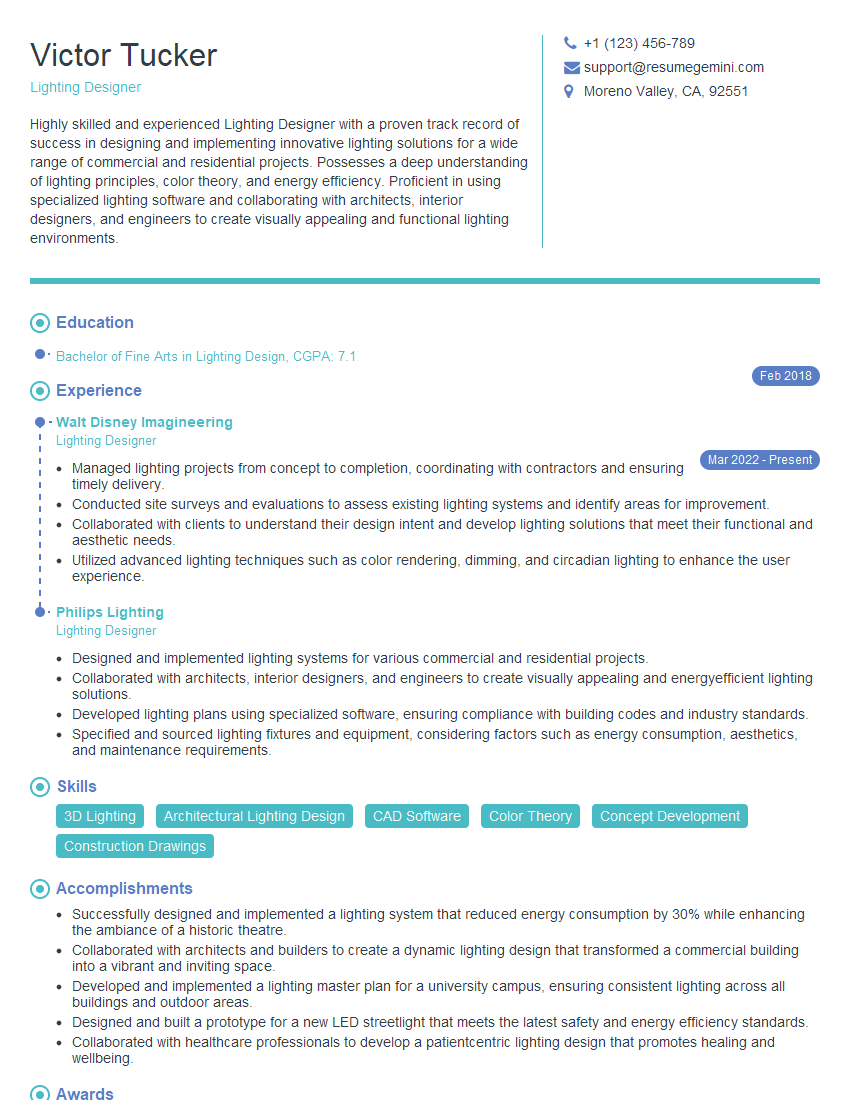
Explore more articles
Users Rating of Our Blogs
Share Your Experience
We value your feedback! Please rate our content and share your thoughts (optional).
What Readers Say About Our Blog
Hello,
we currently offer a complimentary backlink and URL indexing test for search engine optimization professionals.
You can get complimentary indexing credits to test how link discovery works in practice.
No credit card is required and there is no recurring fee.
You can find details here:
https://wikipedia-backlinks.com/indexing/
Regards
NICE RESPONSE TO Q & A
hi
The aim of this message is regarding an unclaimed deposit of a deceased nationale that bears the same name as you. You are not relate to him as there are millions of people answering the names across around the world. But i will use my position to influence the release of the deposit to you for our mutual benefit.
Respond for full details and how to claim the deposit. This is 100% risk free. Send hello to my email id: [email protected]
Luka Chachibaialuka
Hey interviewgemini.com, just wanted to follow up on my last email.
We just launched Call the Monster, an parenting app that lets you summon friendly ‘monsters’ kids actually listen to.
We’re also running a giveaway for everyone who downloads the app. Since it’s brand new, there aren’t many users yet, which means you’ve got a much better chance of winning some great prizes.
You can check it out here: https://bit.ly/callamonsterapp
Or follow us on Instagram: https://www.instagram.com/callamonsterapp
Thanks,
Ryan
CEO – Call the Monster App
Hey interviewgemini.com, I saw your website and love your approach.
I just want this to look like spam email, but want to share something important to you. We just launched Call the Monster, a parenting app that lets you summon friendly ‘monsters’ kids actually listen to.
Parents are loving it for calming chaos before bedtime. Thought you might want to try it: https://bit.ly/callamonsterapp or just follow our fun monster lore on Instagram: https://www.instagram.com/callamonsterapp
Thanks,
Ryan
CEO – Call A Monster APP
To the interviewgemini.com Owner.
Dear interviewgemini.com Webmaster!
Hi interviewgemini.com Webmaster!
Dear interviewgemini.com Webmaster!
excellent
Hello,
We found issues with your domain’s email setup that may be sending your messages to spam or blocking them completely. InboxShield Mini shows you how to fix it in minutes — no tech skills required.
Scan your domain now for details: https://inboxshield-mini.com/
— Adam @ InboxShield Mini
Reply STOP to unsubscribe
Hi, are you owner of interviewgemini.com? What if I told you I could help you find extra time in your schedule, reconnect with leads you didn’t even realize you missed, and bring in more “I want to work with you” conversations, without increasing your ad spend or hiring a full-time employee?
All with a flexible, budget-friendly service that could easily pay for itself. Sounds good?
Would it be nice to jump on a quick 10-minute call so I can show you exactly how we make this work?
Best,
Hapei
Marketing Director
Hey, I know you’re the owner of interviewgemini.com. I’ll be quick.
Fundraising for your business is tough and time-consuming. We make it easier by guaranteeing two private investor meetings each month, for six months. No demos, no pitch events – just direct introductions to active investors matched to your startup.
If youR17;re raising, this could help you build real momentum. Want me to send more info?
Hi, I represent an SEO company that specialises in getting you AI citations and higher rankings on Google. I’d like to offer you a 100% free SEO audit for your website. Would you be interested?
Hi, I represent an SEO company that specialises in getting you AI citations and higher rankings on Google. I’d like to offer you a 100% free SEO audit for your website. Would you be interested?
good