Interviews are opportunities to demonstrate your expertise, and this guide is here to help you shine. Explore the essential Lighting Setup and Operation interview questions that employers frequently ask, paired with strategies for crafting responses that set you apart from the competition.
Questions Asked in Lighting Setup and Operation Interview
Q 1. Explain the difference between hard and soft light.
The difference between hard and soft light lies in the quality of the light and how it affects the subject. Hard light creates strong shadows with a defined edge, resulting in high contrast. Think of the harsh midday sun – it casts deep, sharp shadows. Soft light, on the other hand, produces gentle shadows with soft edges, creating a more diffused and even illumination. An overcast day provides a good example of soft light; shadows are still present but much less pronounced.
The size of the light source is the key factor. A small light source (like a bare bulb) produces hard light, while a larger light source (like a softbox or large diffusion panel) produces soft light. The distance also matters; a light source closer to the subject will create harder light than the same source further away. This concept is crucial in photography, filmmaking, and stage lighting to control mood and highlight features.
Q 2. Describe the function of a dimmer board.
A dimmer board, also known as a lighting control console, is a device used to control the intensity of multiple lighting fixtures simultaneously. Think of it as a sophisticated volume control for lights. It allows lighting designers to smoothly adjust the brightness of individual lights or groups of lights, creating dynamic lighting effects. Each channel on a dimmer board typically corresponds to a specific lighting fixture. This enables precise control over the overall lighting scheme, allowing for gradual transitions, special effects (fades, chases), and complex lighting cues for stage productions, concerts, or even architectural lighting installations. Modern dimmer boards are often computerized, offering sophisticated programming options and memory recall.
Q 3. What are the safety precautions when working with high-voltage lighting equipment?
Working with high-voltage lighting equipment requires strict adherence to safety protocols. The most crucial precaution is always to de-energize the circuit before any work is performed. This means switching off the power at the breaker box, not just relying on switches on the fixtures themselves. Never assume a circuit is dead – always double-check with a non-contact voltage tester. Appropriate personal protective equipment (PPE) is vital, including insulated gloves, safety glasses, and potentially arc flash protective clothing depending on the voltage and potential hazards. Work should be done with a partner for safety reasons, so there’s someone available to assist in case of an emergency. Adequate grounding of equipment is essential to prevent electrical shock, and the workspace should be kept dry to minimize the risk of electrocution. Finally, understand the specific safety regulations and procedures outlined in the equipment’s manual and relevant industry standards. Neglecting these steps can lead to serious injury or death.
Q 4. How do you calculate the required wattage for a specific lighting setup?
Calculating required wattage depends on several factors: the size of the area to be lit, the desired illuminance (light level measured in lux or foot-candles), the efficiency of the light fixtures (lumens per watt), and the type of bulbs being used. There’s no single formula, but a common approach involves the following steps:
- Determine the area: Measure the length and width of the space to be illuminated.
- Specify desired illuminance: This varies depending on the application. A task-oriented space like a kitchen needs higher illuminance than a living room.
- Choose lighting fixtures: Select fixtures that suit the space and desired aesthetic.
- Find the lumen output: Consult the bulb’s specifications to determine its lumen output.
- Calculate total lumens needed: Multiply the area by the desired illuminance.
- Calculate required wattage: Divide the total lumens needed by the lumens per watt of the chosen bulbs. This will give you the total wattage required.
For example, let’s say you need to illuminate a 10 sq. meter room with 300 lux using bulbs with 100 lumens/watt. You’d need 3000 lumens (10 sq. m * 300 lux). To achieve this using bulbs with 100 lumens/watt, you’d need 30 watts (3000 lumens / 100 lumens/watt). Remember to factor in some safety margin and account for light loss due to fixture efficiency. It’s always better to have slightly more wattage than you think you need.
Q 5. What are the different types of lighting instruments and their applications?
There’s a wide variety of lighting instruments, each with specific applications:
- Fresnel: Produces a soft, adjustable beam, often used for spotlighting in theater and film.
- Ellipsoidal (Leko): Creates a sharp, controllable beam with shutters for shaping light, ideal for precise highlighting or gobo projection.
- PAR (Parabolic Aluminized Reflector): A versatile fixture producing a wide beam, commonly used in stage and architectural lighting.
- LED Par cans: Similar to traditional PAR cans, but use energy-efficient LED technology.
- Strip lights: Linear fixtures often used for background illumination or accent lighting.
- Softboxes and umbrellas: Diffuse light, producing soft shadows, often used in photography and film.
- Floodlights: Produce a wide, even wash of light over a large area.
The choice of instrument depends on the specific needs of the lighting design, such as the size of the area, the desired beam angle, and the need for precise control or soft diffusion.
Q 6. Explain the concept of three-point lighting.
Three-point lighting is a fundamental lighting technique in photography, film, and video production. It utilizes three light sources to illuminate a subject effectively, minimizing harsh shadows and creating depth and dimension. The three lights are:
- Key light: The main light source, providing the primary illumination and shaping the subject.
- Fill light: A softer light placed opposite the key light, reducing shadows and filling in the areas left dark by the key light. It balances the intensity of the key light.
- Back light (or rim light): Placed behind the subject, separating it from the background and adding depth. It creates a subtle highlight along the edges of the subject.
Properly balanced three-point lighting creates a more natural and flattering look. The key light sets the mood and overall lighting, the fill light provides balance, and the back light adds definition and dimension. The relative intensity and position of each light can be adjusted to achieve different effects.
Q 7. How do you troubleshoot a malfunctioning lighting fixture?
Troubleshooting a malfunctioning lighting fixture involves a systematic approach:
- Visual inspection: Check for obvious problems like loose connections, damaged wires, or blown bulbs. Look for any signs of physical damage or overheating.
- Check the power supply: Ensure the power is switched on at both the fixture and the circuit breaker. Use a voltage tester to confirm power is reaching the fixture.
- Test components individually: If possible, test components like bulbs, ballasts (for fluorescent or HID fixtures), or LED drivers individually to isolate the faulty component.
- Check wiring: Carefully examine all wiring connections for looseness or damage. Use a multimeter to check continuity and voltage at various points in the circuit.
- Consult the manual: Refer to the fixture’s manual for troubleshooting tips and diagrams. Some fixtures have built-in diagnostic features.
- Call an electrician: If you’re unsure or uncomfortable working with electrical systems, especially high-voltage systems, call a qualified electrician. Safety should always be the top priority.
This step-by-step process helps to quickly identify and resolve most lighting issues safely and effectively. Remember to always prioritize safety and de-energize the circuit when necessary.
Q 8. What are the different color temperatures used in lighting and their effects?
Color temperature in lighting refers to the apparent color of the light source, measured in Kelvin (K). Different color temperatures evoke different moods and atmospheres. Think of it like this: lower Kelvin values are warmer, while higher Kelvin values are cooler.
- Warm Light (2700K – 3000K): This range produces a yellowish or amber hue, often associated with feelings of comfort, relaxation, and intimacy. Imagine the warm glow of an incandescent bulb or a fireplace. It’s frequently used in residential settings, restaurants, and to create a nostalgic feel in film.
- Neutral Light (3500K – 5000K): This is a balanced, crisp white light, considered ideal for general illumination. Think of the light in a well-lit office or a bright, sunny day. It’s commonly used in retail spaces, studios, and environments needing accurate color representation.
- Cool Light (5500K – 6500K): This produces a bluish or slightly purplish white light, often perceived as clean, modern, and energetic. Imagine the light of a clear, midday sky or a bright LED bulb. It’s frequently used in modern architectural lighting, photography studios (especially for daylight-balanced shots), and to convey a sense of sterility or high technology in film.
Choosing the right color temperature is crucial for setting the overall tone of a scene. For instance, a horror film might utilize cool, bluish light to create a sense of unease, while a romantic comedy might opt for warm, amber tones to promote intimacy.
Q 9. Describe your experience with different types of lighting gels.
Lighting gels are colored transparent sheets placed in front of light fixtures to modify the color of the light. My experience spans a wide range of gel manufacturers and types, including Rosco, Lee, and Apollo. I’ve worked extensively with various gel colors, each serving a specific purpose:
- CTB (Color Temperature Blue): Used to cool down the color temperature of a light, often tungsten lights, to match daylight-balanced film stock or cameras.
- CTO (Color Temperature Orange): Used to warm up the color temperature of a light, bringing daylight sources to a warmer tungsten balance.
- Full-Color Gels: These come in an enormous variety of hues, enabling precise color matching, creating specific moods (e.g., deep reds for drama, vibrant blues for fantasy), and enhancing the overall aesthetic of a scene. I frequently use these for accent lighting, creating dramatic backlights, or matching the color of a practical light source.
Beyond simple color shifting, gels can also be used to diffuse or soften light (e.g., using frosted gels), or even to create special effects (e.g., using diffusion gels with gobos for patterned projections). The key is understanding the interplay between gel color, light source intensity, and the desired effect on the scene. Choosing the correct gel and its density is a vital skill in creating a well-lit and visually appealing production.
Q 10. Explain the use of barn doors and flags in lighting control.
Barn doors and flags are essential light shaping tools. They allow for precise control over the direction and spread of light, preventing spill and unwanted reflections.
- Barn Doors: These are four adjustable metal flaps attached to the front of a light fixture. Each flap can be individually opened or closed to shape the light beam, blocking light from unwanted areas. Think of them as shutters for your light, allowing for precise control over the light’s edges and preventing spill onto unintended surfaces.
- Flags: These are usually black, rectangular pieces of fabric mounted on a stand or directly attached to a light. They are used to block light from specific areas, creating shadows or preventing light from hitting a certain part of the set or actor. They’re more versatile than barn doors for larger, irregular shaping.
For example, if you want to highlight a subject without illuminating the background, you could use barn doors to tightly control the beam and a flag to block light spill onto the background. The combination of barn doors and flags provides flexibility and precision in lighting control, critical for achieving a desired look in photography and filmmaking.
Q 11. How do you achieve a specific lighting mood or atmosphere?
Achieving a specific lighting mood or atmosphere involves a multifaceted approach combining several techniques. It’s more than just choosing a color temperature; it’s about the interplay of light and shadow, color, and intensity.
- Color Temperature: As discussed earlier, the color of the light heavily influences mood. Warm tones create intimacy, while cool tones suggest unease or coldness.
- Light Intensity: High intensity creates drama and excitement, while low intensity creates mystery or tranquility. Consider the ratio between key light, fill light, and backlight to control the overall brightness and contrast.
- Light Direction: The direction of light creates depth and shadows, significantly influencing the scene’s mood. Front lighting is bright and even, backlighting creates silhouettes, and side lighting adds dimension and drama.
- Light Quality: Hard light, like that of a spotlight, creates harsh shadows and a more dramatic feel. Soft light, diffused through a softbox or scrim, creates softer shadows and a more calming or romantic feeling.
- Color Gels and Filters: These can subtly or dramatically alter the color of the light, further enhancing the desired mood.
For instance, a dark and mysterious scene would utilize low-intensity, cool-toned light with strong shadows, perhaps enhanced by dark-colored gels, while a bright and cheerful scene might employ high-intensity, warm-toned light with soft shadows and pastel-colored gels.
Q 12. What is the purpose of a light meter?
A light meter is a crucial tool for measuring the intensity of light, ensuring consistency and accuracy in lighting setups. It measures the amount of light falling on a surface, usually expressed in lux or foot-candles. This allows lighting technicians to accurately set light levels, ensuring that the scene is properly exposed and matches the desired level of brightness.
Different types of light meters exist:
- Incident Light Meters: These measure the light falling *onto* the subject, providing a more accurate representation of the light the camera will receive. I prefer to use an incident meter for its objectivity.
- Reflected Light Meters: These measure the light *reflecting* off the subject, making them sensitive to the subject’s reflectivity.
Using a light meter prevents guesswork and ensures that the scene is consistently lit, regardless of the ambient conditions or changes in the environment. This is especially critical in professional film and photography where consistent lighting is paramount. I’ve used light meters countless times to ensure even lighting across entire sets, particularly in situations with mixed lighting sources (natural and artificial).
Q 13. Describe your experience with different types of lighting stands and grip equipment.
My experience encompasses a variety of lighting stands and grip equipment crucial for supporting and manipulating lighting instruments on set. I’m proficient with:
- C-Stands: These versatile stands are incredibly sturdy and adaptable, used for supporting flags, reflectors, and even smaller lighting fixtures. Their adaptability is essential for complex setups.
- Light Stands: These come in various heights and weights, suited for different fixtures and lighting needs. Choosing the correct stand for the weight of the light is paramount for safety and stability.
- Boom Arms: These allow for positioning lights above and beyond the reach of standard stands, giving filmmakers and photographers greater creative flexibility for overhead lighting or unusual angles.
- Grip Heads: These are essential for attaching lighting instruments to stands, offering various adjustments for tilt and rotation.
- Sandbags and Weights: These are vital for ensuring stability, especially in windy conditions or when using heavy lighting equipment.
Proper use of these tools is fundamental for safety and achieving the desired lighting placement. I frequently use a combination of these to create elaborate lighting setups, ensuring both safety and precise positioning of lights. For instance, I might use a C-stand with a boom arm to position a flag precisely to block sunlight from a window.
Q 14. How do you plan and execute a complex lighting setup for a film or stage production?
Planning and executing a complex lighting setup for a film or stage production is a methodical process requiring careful consideration of several factors:
- Script and Storyboard Review: I begin by thoroughly analyzing the script and storyboards to understand the director’s vision, the mood, and the specific lighting needs of each scene. This informs the overall lighting design.
- Location Scouting (if applicable): If shooting on location, I assess the existing lighting, identifying potential challenges (e.g., harsh sunlight) and opportunities (e.g., existing ambient light).
- Lighting Plot Creation: I create a detailed lighting plot, a technical drawing depicting the placement of each light, its type, intensity, and any modifications (gels, barn doors, etc.). This serves as a blueprint for the crew.
- Equipment Selection: Based on the lighting plot, I choose the appropriate lighting instruments, stands, modifiers (softboxes, umbrellas, etc.), and grip equipment. I factor in available budget and resources.
- Crew Briefing: Before setup, I brief the lighting crew, ensuring everyone understands the lighting plan and their roles. Clear communication is critical for efficiency and accuracy.
- Rigging and Setup: The lighting crew meticulously sets up the lights according to the lighting plot, ensuring safety and proper positioning.
- Testing and Adjustments: Once the setup is complete, we rigorously test and adjust the lights, using a light meter to ensure proper exposure and consistency. This often involves several iterations of adjustments before finalizing the setup.
- Monitoring and Maintenance: Throughout the shoot or performance, I monitor the lighting setup, making adjustments as needed to account for changes in conditions (e.g., natural light variations) and maintaining the overall consistency of the lighting scheme.
This systematic approach, combined with experience and effective communication, ensures a successful and visually compelling lighting design for any complex production.
Q 15. What are your strategies for managing time and resources during a lighting setup?
Effective time and resource management in lighting setup is crucial for staying on schedule and within budget. My strategy involves a multi-stage approach. First, I meticulously review the lighting plot and script, identifying all lighting needs and potential challenges beforehand. This allows me to create a detailed lighting schedule, allocating specific timeframes for each task: hanging fixtures, focusing, geling, and testing. Second, I create a comprehensive equipment list, ensuring all necessary fixtures, cables, gels, and tools are readily available. This prevents costly delays caused by missing equipment. Third, I delegate tasks effectively within the team, assigning responsibilities based on individual skills and experience. Clear communication and regular progress checks ensure everyone is on track. Finally, I build in buffer time to account for unexpected issues, such as equipment malfunctions or creative changes. Think of it like baking a cake – you need precise measurements and timing, but also a little extra time to handle unforeseen spills or oven temperature variations.
Career Expert Tips:
- Ace those interviews! Prepare effectively by reviewing the Top 50 Most Common Interview Questions on ResumeGemini.
- Navigate your job search with confidence! Explore a wide range of Career Tips on ResumeGemini. Learn about common challenges and recommendations to overcome them.
- Craft the perfect resume! Master the Art of Resume Writing with ResumeGemini’s guide. Showcase your unique qualifications and achievements effectively.
- Don’t miss out on holiday savings! Build your dream resume with ResumeGemini’s ATS optimized templates.
Q 16. Explain your experience with different types of lighting control systems (e.g., DMX).
I have extensive experience with various lighting control systems, including DMX (Digital Multiplex), which is the industry standard for sophisticated lighting control. DMX allows precise control over individual lighting fixtures, enabling complex programming for dynamic lighting changes. I’m proficient in using DMX consoles, programming cues, and troubleshooting DMX network issues. For instance, on a recent theatrical production, I used a grandMA2 console to program intricate lighting sequences, incorporating chases, fades, and color changes synchronized with the music and action. I’ve also worked with simpler systems like dimmer boards for smaller-scale projects where DMX isn’t necessary. My experience spans both analog and digital control, giving me a broad understanding of the options and their respective capabilities. Understanding the limitations and benefits of each system is key to choosing the right one for any project.
Q 17. How do you ensure safety on a film or stage lighting set?
Safety is paramount on any lighting set. My approach to ensuring safety involves a multi-layered strategy. First, I conduct thorough risk assessments before any setup begins, identifying potential hazards such as tripping hazards from cables, the risk of electrocution, and potential falls from heights when hanging lights. Second, I strictly adhere to all relevant safety regulations and best practices, including using proper safety harnesses when working at heights, using appropriate cable management techniques, and ensuring all electrical equipment is properly grounded and inspected. Third, I implement clear communication protocols within the team, ensuring everyone understands the safety procedures and reporting any safety concerns immediately. This includes regular toolbox talks to reinforce safety awareness. Fourth, I ensure all lighting fixtures are correctly rigged and secured, and the set is properly lit to prevent accidents. A well-lit set is a safe set. Finally, I regularly inspect the entire setup throughout the shoot or performance to proactively identify and address any potential safety hazards.
Q 18. What are the common challenges encountered in lighting setup and how do you overcome them?
Common challenges in lighting setup include time constraints, budget limitations, unpredictable weather conditions (for outdoor shoots), and creative differences. To overcome time constraints, I utilize efficient workflow strategies, prioritize tasks, and delegate effectively. Budget limitations are addressed through creative problem-solving, such as sourcing affordable equipment or repurposing existing resources. Weather challenges are mitigated through meticulous planning, including contingency plans for inclement weather and the use of weatherproof equipment. Creative differences are resolved through open communication, collaborative brainstorming, and a willingness to compromise, always keeping the overall vision in mind. Remember, flexibility and adaptability are essential in navigating these challenges. For example, on one occasion, a sudden storm threatened to halt an outdoor shoot. By quickly relocating the equipment to a covered area and adjusting the lighting plan, we managed to complete the shoot without significant delays.
Q 19. Describe your experience with different types of lighting fixtures (e.g., Fresnels, PARs).
My experience encompasses a wide range of lighting fixtures, including Fresnels, PARs (Parabolic Aluminized Reflectors), LED panels, and moving lights. Fresnels, known for their sharp, controllable beam, are ideal for highlighting specific areas or creating dramatic effects. PARs, with their wider beam spread, are excellent for wash lighting and background illumination. I’m adept at using the different features of these fixtures, such as barn doors on Fresnels for precise light shaping and different lens options on PARs to adjust the beam angle. LED panels offer energy efficiency and color flexibility, while moving lights provide dynamic, automated control. Each fixture type has its strengths and weaknesses, and understanding their characteristics is key to choosing the right tool for the job. Selecting the appropriate fixture depends entirely on the desired look and available resources. For instance, a tight, focused beam might require a Fresnel, while a broad wash might call for PAR cans or LED panels. I often use a combination of fixture types to achieve a balanced and visually appealing lighting design.
Q 20. How do you work effectively within a team to achieve lighting goals?
Effective teamwork is fundamental in lighting. I foster collaboration through open communication, clear roles and responsibilities, and mutual respect for each team member’s expertise. Regular team meetings, both before and during setup, ensure everyone is on the same page and any potential issues are addressed proactively. I actively listen to the ideas and suggestions of my team members, creating a supportive environment where everyone feels comfortable contributing. This collaborative approach leads to more innovative solutions and a more efficient workflow. For instance, a lighting technician’s suggestion on a more efficient cable routing method during a recent film shoot saved us significant time and improved the overall safety of the set. Effective teamwork is not just about delegation; it is about building a cohesive unit that works harmoniously towards a common goal.
Q 21. How do you ensure consistency in lighting across different shots or scenes?
Maintaining consistent lighting across different shots or scenes is essential for a cohesive visual narrative. My approach centers around careful planning and meticulous execution. Before starting, I create a lighting design that considers the overall color temperature, light intensity, and overall mood across all scenes. This involves creating a lighting key, detailing the specific lighting setup for each shot. During the setup, I use color temperature meters and light meters to ensure consistency in the light levels and color balance across various shots. I also use reference images and color charts to maintain consistent color grading throughout. For moving shots, I use techniques such as maintaining consistent light levels and strategically placing lights to avoid drastic changes in lighting as the camera moves. In post-production, I collaborate closely with the colorist to ensure smooth transitions and consistent lighting throughout the project. Consistency is key to a polished and professional look. Consider the lighting scheme as a carefully orchestrated symphony – each instrument plays its part to create a harmonious whole.
Q 22. What is your experience with lighting for different camera types and formats?
My experience with lighting spans various camera types and formats, from high-end cinema cameras like Arri Alexa and RED cameras to smaller DSLRs and mirrorless systems. The key difference lies in the sensitivity of the sensor and the dynamic range. Cinema cameras, with their larger sensors and higher dynamic range, allow for more nuanced lighting and greater latitude in post-production. DSLRs, while more affordable, often require more precise lighting control to avoid blown highlights or crushed shadows. For instance, shooting a dimly lit scene with a cinema camera might allow me to capture subtle details in both the highlights and shadows, even without significant lighting adjustments. However, the same scene shot with a DSLR might necessitate more powerful lights and careful placement to avoid losing detail in the darker areas. I tailor my lighting approach based on the camera’s capabilities and the desired aesthetic. Working with different formats (e.g., 4K, 8K, HD) involves understanding the resolution’s impact on lighting; higher resolutions reveal more details, so lighting precision becomes even more critical.
Q 23. Explain your understanding of color correction and color matching in lighting.
Color correction and color matching are crucial for consistent and aesthetically pleasing lighting. Color correction addresses the inherent color casts in light sources and aims to achieve a neutral white balance. This might involve using color gels to compensate for the warm light of tungsten bulbs or the cool light of daylight. Imagine shooting a scene using both tungsten and fluorescent lights – you’ll have a distinct difference in color temperature. Color correction would involve using gels or in-camera settings to balance these differences. Color matching focuses on maintaining consistent color across multiple light sources and throughout a scene, creating visual harmony. This is especially important in multi-camera shoots where each camera might interpret color slightly differently. To achieve color matching, I use color meters to measure the color temperature and color rendering index (CRI) of each light and adjust accordingly, ensuring a consistent look across all cameras and light sources. Tools like color charts and software calibration are helpful.
Q 24. How do you maintain and care for lighting equipment?
Maintaining lighting equipment is vital for its longevity and performance. This involves regular cleaning, careful storage, and occasional servicing. I regularly wipe down light fixtures to remove dust and debris, which can affect light output and cause overheating. Cables are inspected for damage and stored neatly to avoid tangles and damage. I always follow the manufacturer’s instructions for cleaning and maintenance. More importantly, I regularly check the light stands and grips to ensure that no cracks or damages exist. Regular maintenance also includes checking the functionality of each light fixture by checking its power and bulb or LED condition. It’s better to catch damages early than to deal with it during shooting. For more complex equipment like HMI or LED panels, I typically schedule professional servicing, including bulb replacements and adjustments, to ensure optimal performance and safety. Proper storage in climate-controlled environments is also important to prevent damage from moisture or extreme temperatures.
Q 25. Describe your experience with rigging and safety procedures for lighting equipment.
Rigging and safety are paramount in lighting. My experience encompasses various rigging techniques, from basic light stands to more complex systems involving trusses, chains, and motors. Before any rigging operation, a thorough risk assessment is conducted, identifying potential hazards and implementing appropriate safety measures. I always use appropriate safety equipment, including harnesses, gloves, and safety straps. Each rigging component is inspected for damage or wear before use. When working at heights, I ensure proper fall protection and adhere to all relevant safety regulations. I am proficient in knot tying and understand the weight limits of all equipment. For example, before hanging a heavy fixture, I ensure the truss is properly rated, and the chain or cable has sufficient strength. A clear communication system is essential in collaboration with the rigging team and ensuring the safety of everyone on set.
Q 26. How do you handle unexpected issues or problems during a lighting setup?
Handling unexpected issues requires quick thinking and problem-solving skills. A common problem is a blown bulb during a shoot. My solution involves having spare bulbs on hand, promptly replacing the faulty bulb, and recalibrating the light output to match the others. Other problems may involve damaged equipment, power outages, or sudden changes in weather. For power outages, I have backup generators or battery-powered lighting solutions. In case of equipment failure, I assess the damage, and if a quick fix isn’t possible, I find a suitable replacement or adjust the lighting setup to compensate for the loss. For instance, if a key light malfunctions, I may utilize available fill lights or reposition the remaining lights to achieve the desired effect. Collaboration with the director and crew is crucial to adapt swiftly, minimize downtime, and maintain the creative vision.
Q 27. What software or programs are you familiar with for lighting design or programming?
I am proficient in several software programs for lighting design and programming. Vectorworks Spotlight is commonly used for large-scale projects, allowing me to create detailed lighting plots, visualize the setup, and manage equipment inventories. WYSIWYG is another powerful tool for pre-visualization and programming, enabling me to simulate lighting scenarios before the actual setup. For simpler projects, I’m comfortable using Capture to program lighting consoles and control light cues. I also have experience with various lighting control protocols such as DMX and Art-Net. These software programs allow for efficient planning, precise control, and the ability to save and recall lighting setups. This helps to standardize setups, maintain consistency, and quickly adjust to changes.
Q 28. How do you adapt your lighting setup to different environments or locations?
Adapting to different environments is a core skill. Factors like ambient light, available power, and the location’s physical constraints significantly influence my lighting approach. Shooting outdoors requires considering the sun’s position, weather conditions, and available shade. I might use diffusion filters to soften harsh sunlight or flags to control unwanted light. Shooting in tight spaces calls for compact, mobile lighting solutions and careful placement to avoid casting unwanted shadows. For locations with limited power, I’d prioritize battery-powered or low-power lighting solutions. Every location presents unique challenges. For example, shooting in a historic building may require careful consideration of the location’s architectural details and potential light sensitivity of the space. Careful planning, understanding the location’s limitations, and using creative lighting solutions are key to adapting effectively.
Key Topics to Learn for Lighting Setup and Operation Interview
- Safety Regulations and Procedures: Understanding and adhering to all relevant safety standards and protocols for handling lighting equipment and working at heights.
- Lighting Design Principles: Applying principles of light intensity, color temperature, and distribution to achieve desired effects in various settings (e.g., film, photography, stage).
- Equipment Knowledge: Familiarity with various types of lighting equipment (e.g., Fresnels, LEDs, HMI, moving lights), their functionalities, and limitations.
- Electrical Knowledge (basics): Understanding of voltage, amperage, and circuitry, including safe practices for connecting and operating lighting equipment.
- Practical Application: Experience in setting up lighting rigs, troubleshooting malfunctions, and maintaining equipment in optimal condition. This includes both planning and execution.
- Color Theory and Mixing: Understanding how to mix colors of light to achieve specific moods and effects, including the use of gels and other color correction tools.
- Lighting Instruments: Detailed knowledge of different lighting instruments and their specific applications – knowing when to use a specific instrument for optimal results.
- Problem-Solving & Troubleshooting: Ability to diagnose and resolve technical issues with lighting equipment quickly and efficiently; anticipating potential problems proactively.
- Software & Control Systems: Familiarity with lighting control consoles and software (e.g., industry-standard software packages) for programming and operating lighting systems.
- Communication & Teamwork: Demonstrating effective communication and collaboration skills within a team environment, including working with directors, cinematographers, or other professionals.
Next Steps
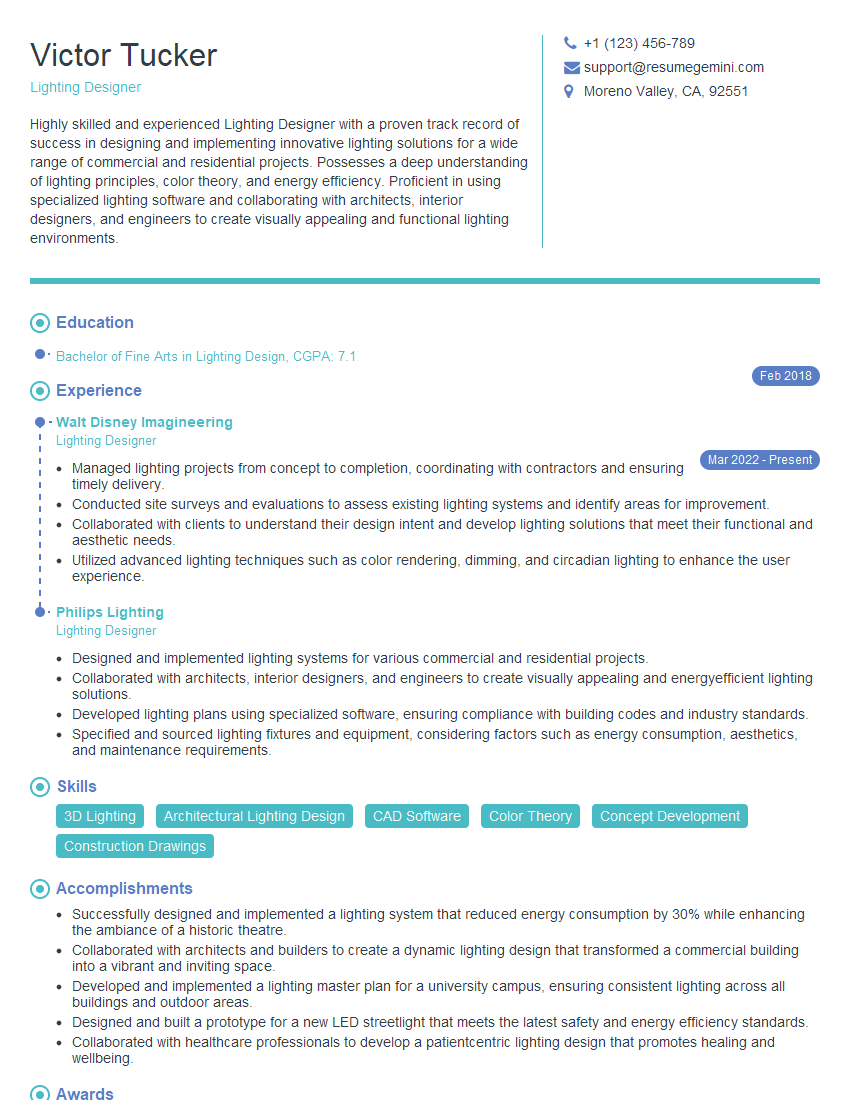
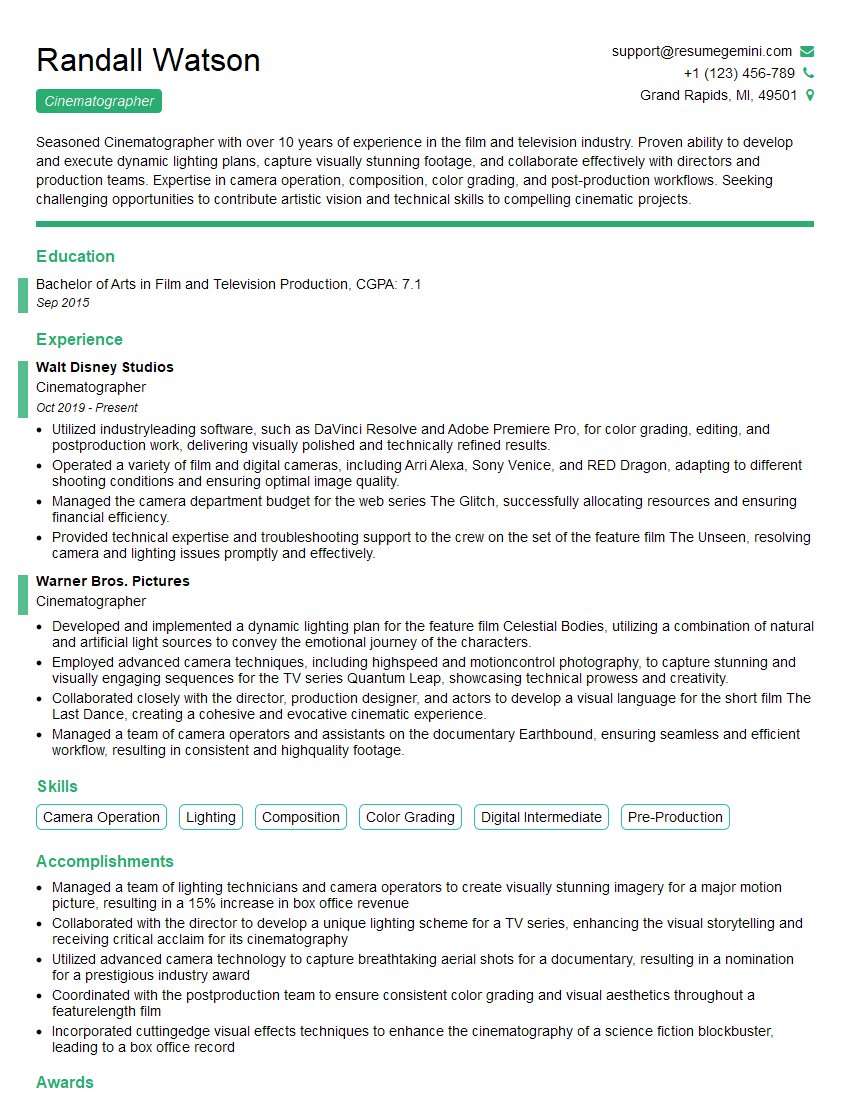
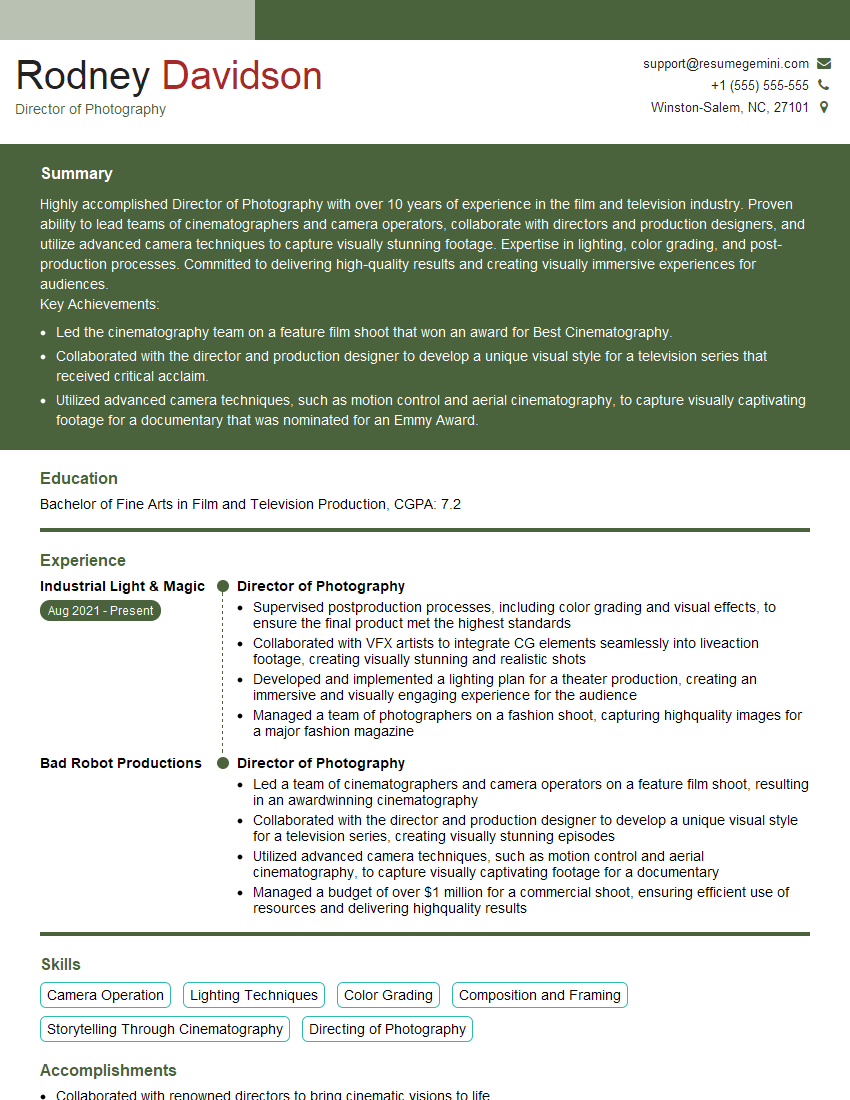
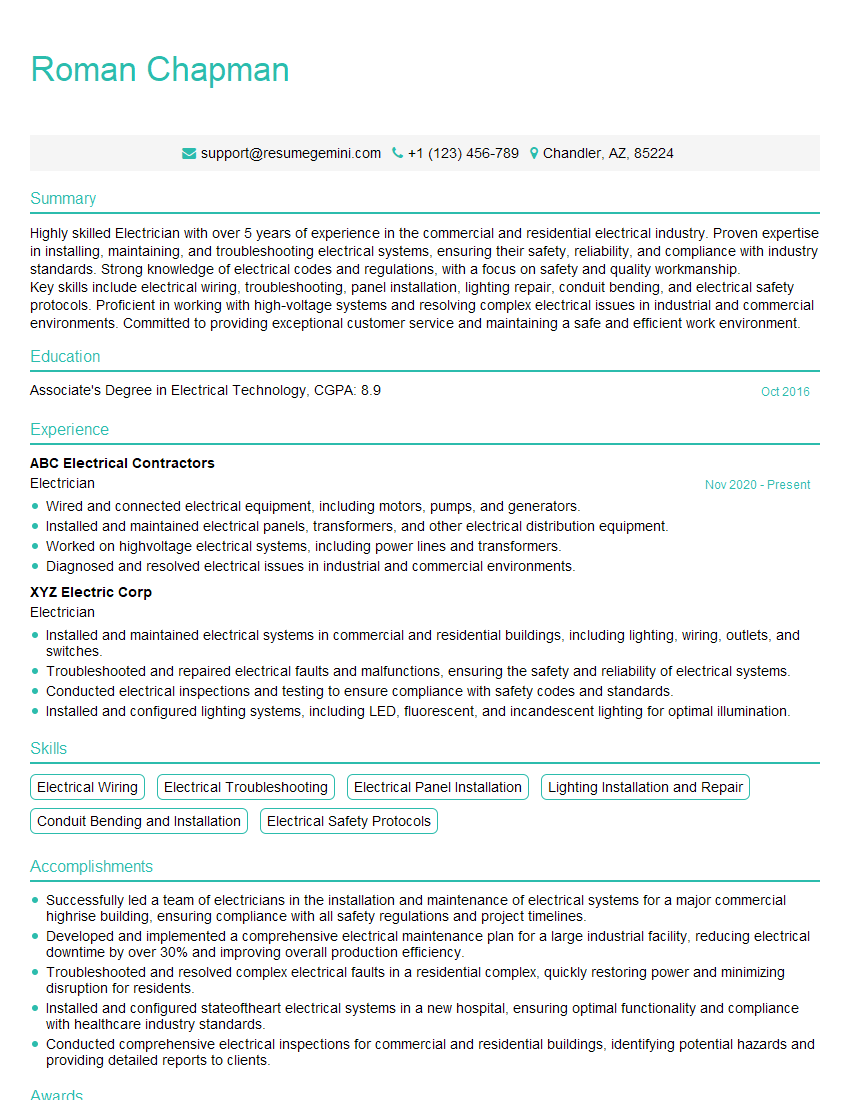
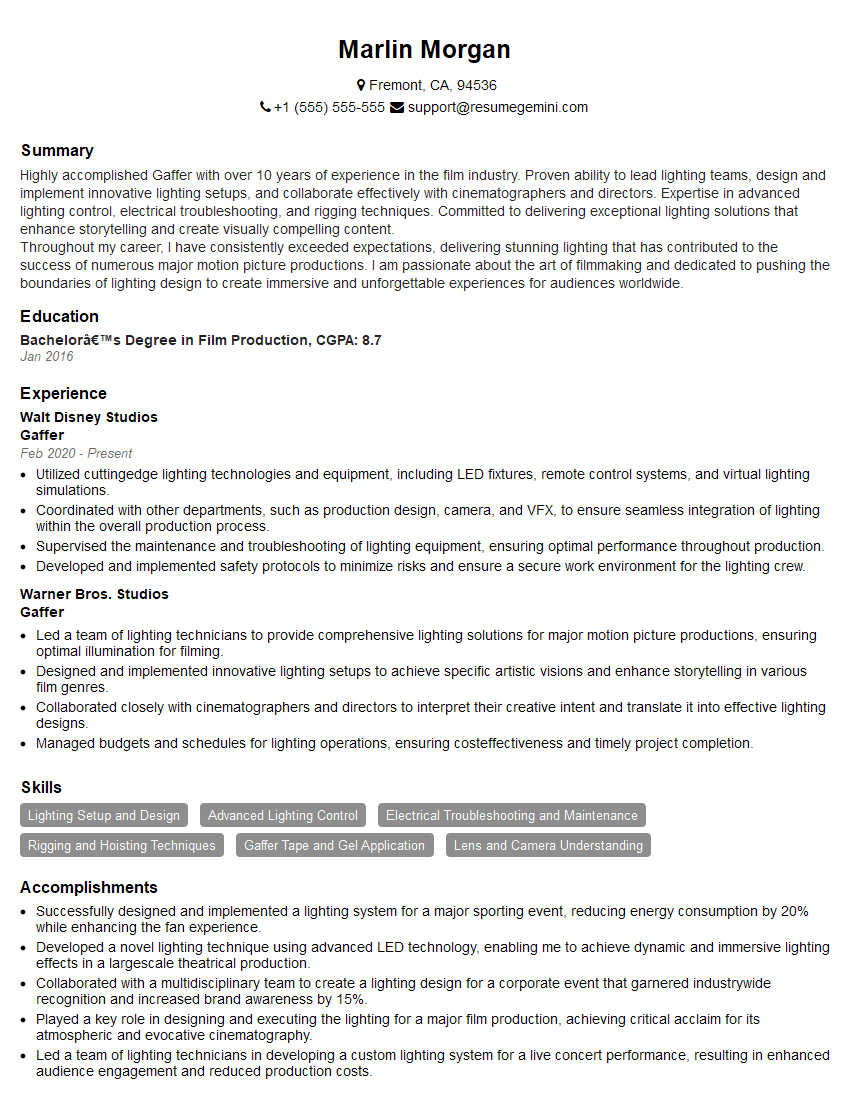
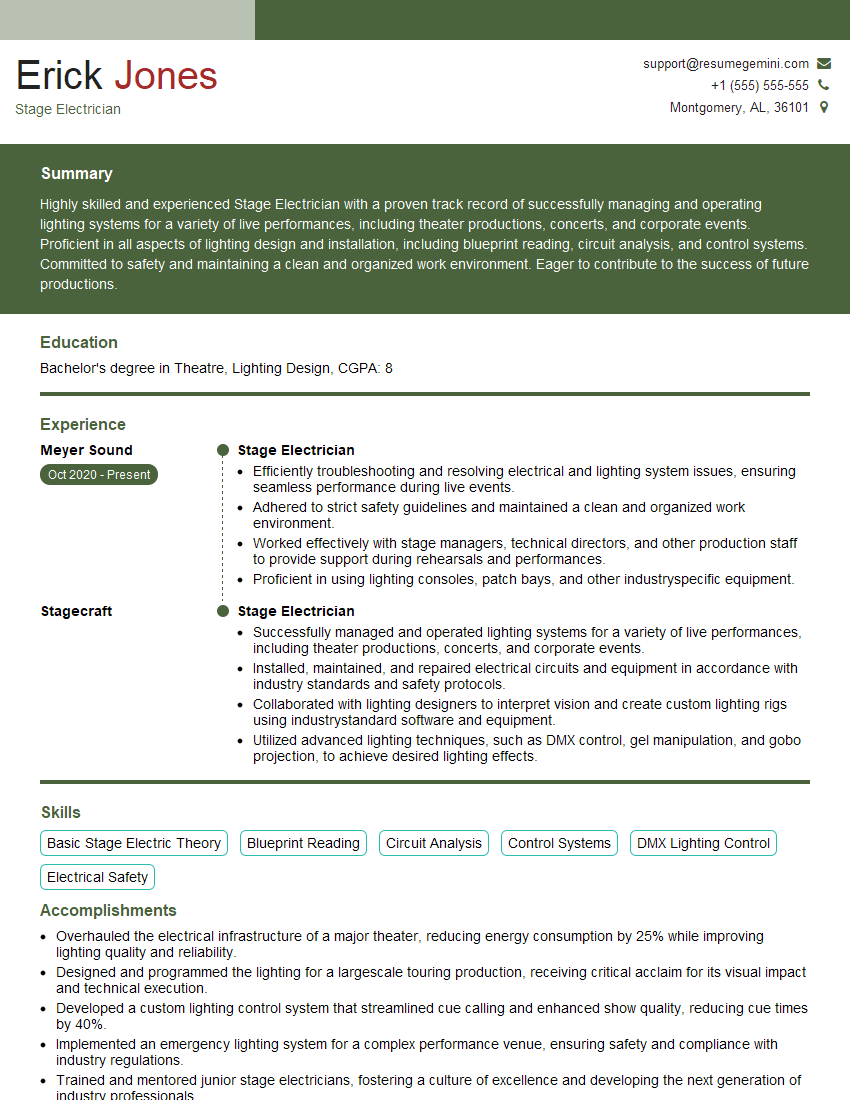
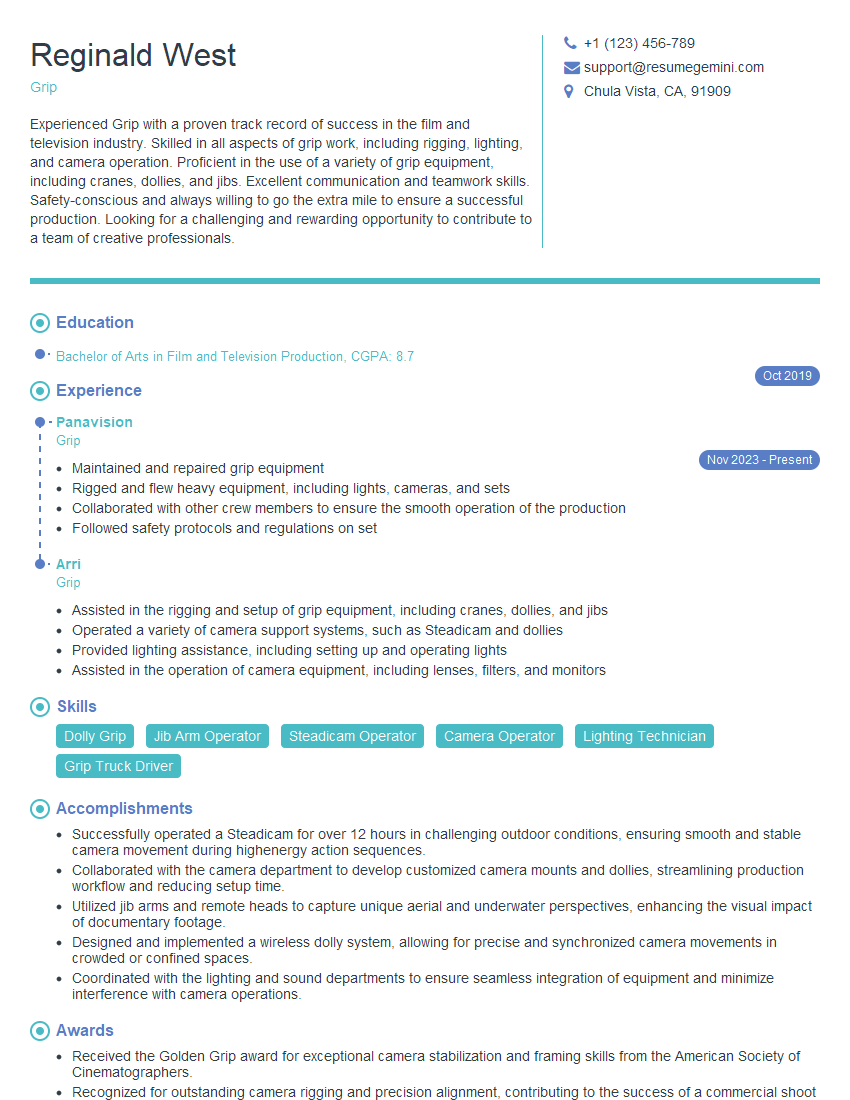
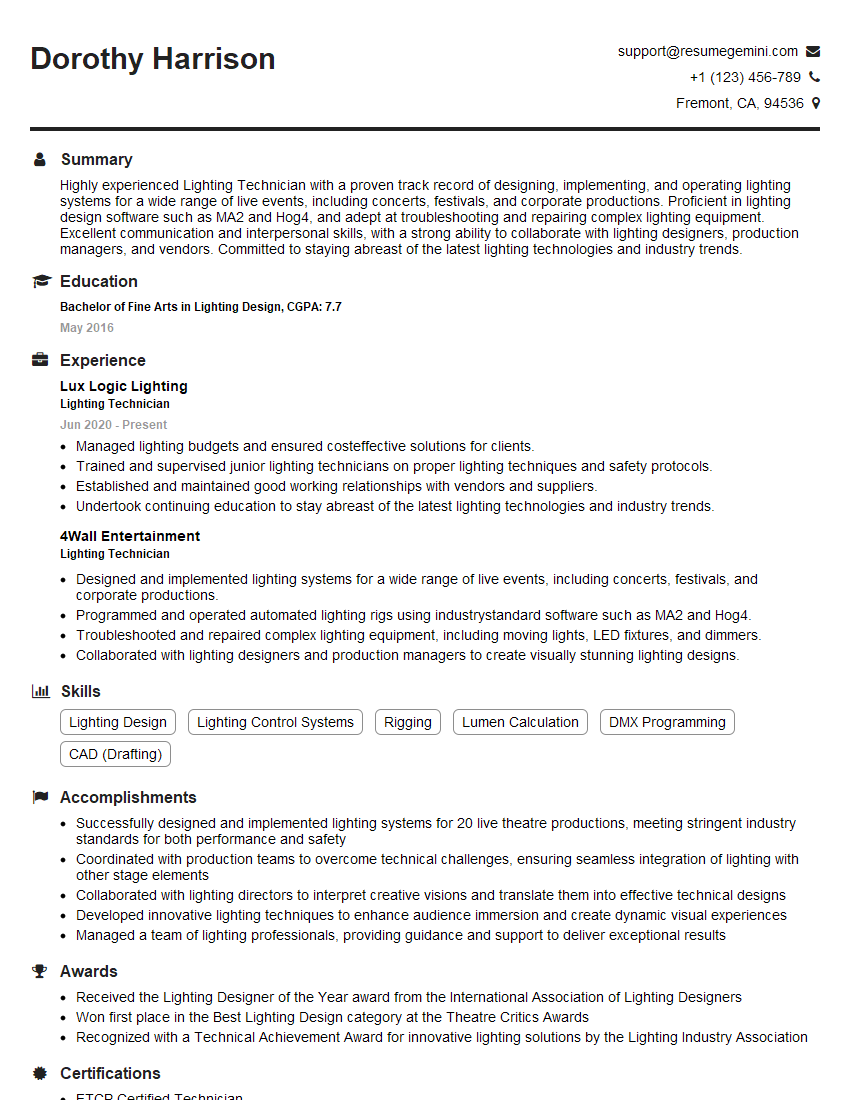
Mastering Lighting Setup and Operation opens doors to exciting career opportunities in various creative industries, offering diverse roles and excellent growth potential. To maximize your job prospects, creating a strong, ATS-friendly resume is crucial. ResumeGemini is a trusted resource that can help you build a professional and impactful resume, highlighting your skills and experience effectively. Examples of resumes tailored to Lighting Setup and Operation are available to guide you through the process.
Explore more articles
Users Rating of Our Blogs
Share Your Experience
We value your feedback! Please rate our content and share your thoughts (optional).
What Readers Say About Our Blog
Very informative content, great job.
good