Every successful interview starts with knowing what to expect. In this blog, we’ll take you through the top Linear Interpolation interview questions, breaking them down with expert tips to help you deliver impactful answers. Step into your next interview fully prepared and ready to succeed.
Questions Asked in Linear Interpolation Interview
Q 1. Explain the concept of linear interpolation.
Linear interpolation is a method for estimating values between known data points. Imagine you have a graph with a few points plotted. Linear interpolation essentially draws a straight line between those points, allowing you to predict the y-value for any x-value that falls between your known points. It’s a simple yet powerful technique for approximating values when you don’t have a precise measurement or formula.
For example, if you know the temperature at 1 PM was 20°C and at 2 PM it was 25°C, linear interpolation could help you estimate the temperature at 1:30 PM. It assumes a constant rate of change between the data points.
Q 2. What are the advantages and disadvantages of linear interpolation?
Advantages:
- Simplicity: It’s easy to understand, implement, and compute, requiring minimal computational resources.
- Efficiency: Calculations are very fast, making it suitable for real-time applications.
- Wide Applicability: Useful in diverse fields where continuous data is approximated from discrete measurements.
Disadvantages:
- Accuracy: Accuracy is limited. It assumes a linear relationship between data points, which may not always be true. Significant deviations from linearity can lead to inaccurate estimations.
- Extrapolation Issues: Extrapolating (estimating beyond the range of known data) can be highly unreliable and lead to significant errors.
- Sensitivity to Noise: Noisy data can significantly affect the accuracy of the interpolation.
Q 3. When is linear interpolation appropriate, and when is it not?
Linear interpolation is appropriate when:
- You have a small number of data points.
- The underlying relationship between the data is approximately linear.
- High accuracy isn’t critical.
- Computational speed is important.
Linear interpolation is not appropriate when:
- The relationship between data points is highly non-linear (e.g., exponential or sinusoidal).
- High accuracy is required.
- You need to extrapolate beyond the known data range.
- You have a large dataset—more sophisticated interpolation methods may be more suitable.
Think of it like this: if you’re estimating the distance traveled by a car based on its position at two time points, linear interpolation works well. However, if you are predicting the trajectory of a rocket, its highly non-linear path would require a far more complex model.
Q 4. Derive the formula for linear interpolation between two points.
Let’s say we have two points (x1, y1) and (x2, y2). We want to find the y-value (y) corresponding to a given x-value (x) between x1 and x2. The formula is derived from the equation of a straight line:
The slope of the line is: m = (y2 – y1) / (x2 – x1)
Using the point-slope form of a line equation (y – y1 = m(x – x1)), we can solve for y:
y = y1 + m(x – x1)
Substituting the expression for m, we get the linear interpolation formula:
y = y1 + ((y2 - y1) / (x2 - x1)) * (x - x1)
Q 5. How does linear interpolation handle extrapolation?
Linear interpolation is inherently designed for interpolation, meaning estimating values within the range of known data. Extrapolation, estimating values outside this range, is risky. While you can technically use the same formula, the results are unreliable because the linear relationship observed within the data range isn’t guaranteed to continue beyond it. The further you extrapolate, the less accurate your prediction becomes. It’s generally advisable to avoid extrapolation with linear interpolation unless you have strong evidence that the linear trend persists beyond the observed data.
Q 6. What are some common applications of linear interpolation in data science?
Linear interpolation finds its way into many data science applications:
- Image Processing: Resizing images often involves interpolating pixel values.
- Signal Processing: Estimating missing or corrupted data points in a signal.
- Financial Modeling: Estimating values of financial instruments between trading periods.
- Machine Learning: Used in some simpler algorithms as a preliminary step or as a fallback.
- Scientific Data Analysis: Filling in gaps in experimental data.
Essentially, anywhere you need to estimate a continuous value from discrete measurements and a linear approximation is reasonable, linear interpolation can be useful.
Q 7. How can you implement linear interpolation using Python?
Python offers several ways to implement linear interpolation. Here’s a simple example using NumPy:
import numpy as np x = np.array([1, 2, 3]) y = np.array([4, 7, 10]) x_new = 1.5 # Value to interpolate # Using NumPy's interp function y_new = np.interp(x_new, x, y) print(f"Interpolated value at x = {x_new}: {y_new}") This code snippet uses np.interp which directly performs linear interpolation. Alternatively, you could implement the formula directly using Python code, but NumPy’s optimized function is usually faster and more efficient for larger datasets.
Q 8. How can you implement linear interpolation using R?
Linear interpolation in R is straightforward. It involves finding the value of a function at a point within the range of known data points by assuming a linear relationship between those points. R’s built-in approx() function is perfectly suited for this.
Let’s say we have two points (x1, y1) and (x2, y2), and we want to find the interpolated value ‘y’ at a point ‘x’ between x1 and x2. The formula is: y = y1 + ((x – x1) / (x2 – x1)) * (y2 – y1). The approx() function handles this calculation efficiently.
Example:
x <- c(1, 3, 5)
y <- c(2, 4, 6)
x_new <- 2
approx(x, y, xout = x_new)$y
This code first defines the known x and y values. Then, it specifies the new x value (x_new) for which we want to find the interpolated y value. The approx() function performs the linear interpolation, and $y extracts the interpolated y value.
Another approach is using the base R lm() function for simple linear regression, which effectively performs linear interpolation when given just two points:
x <- c(1, 3)
y <- c(2, 4)
model <- lm(y ~ x)
predict(model, newdata = data.frame(x = 2))
This method fits a linear model to the known data and then uses the model to predict the y value at x = 2.
Q 9. How can you implement linear interpolation using MATLAB?
MATLAB also offers a simple way to perform linear interpolation. The interp1() function is the primary tool for this task. It takes the x and y data points and the point at which you want to interpolate as input.
Example:
x = [1, 3, 5];
y = [2, 4, 6];
x_new = 2;
y_new = interp1(x, y, x_new, 'linear');
This code defines the known x and y coordinates. interp1(x, y, x_new, 'linear') performs linear interpolation to estimate the y value at x_new. The ‘linear’ specification explicitly indicates linear interpolation. MATLAB also supports other interpolation methods (e.g., ‘nearest’, ‘spline’, ‘cubic’).
Q 10. Compare linear interpolation with other interpolation methods (e.g., polynomial, spline).
Linear interpolation is the simplest method, approximating the function by connecting consecutive data points with straight lines. It’s easy to understand and compute but lacks accuracy when the underlying function is not approximately linear.
- Polynomial interpolation uses a higher-order polynomial to fit all data points, potentially providing a more accurate representation of the function, especially if the function exhibits significant curvature. However, higher-order polynomials can be prone to oscillations (Runge’s phenomenon) and can be computationally expensive.
- Spline interpolation uses piecewise polynomial functions to approximate the function, combining the benefits of local accuracy (like linear interpolation) with the flexibility of higher-order polynomials. Cubic splines are commonly used, balancing accuracy and smoothness.
Imagine fitting a curve through scattered points. Linear interpolation is like connecting the dots with straight lines. Polynomial interpolation might try to fit a single, smooth curve through all the dots, which can be wavy. Spline interpolation uses several smaller, connected curves to fit the dots, creating a smoother and often more accurate representation.
Q 11. What is the order of accuracy of linear interpolation?
Linear interpolation has an order of accuracy of O(h2), where ‘h’ is the spacing between the data points. This means that the error in the interpolation decreases proportionally to the square of the spacing. So, halving the spacing reduces the error by a factor of four (approximately).
In simpler terms, the accuracy improves as the data points get closer together. The error is influenced by the curvature of the underlying function; linear interpolation is better for functions with low curvature.
Q 12. How does the choice of interpolation points affect the accuracy of the results?
The choice of interpolation points significantly impacts accuracy. Ideally, points should be evenly spaced if possible. Uneven spacing can lead to inaccuracies, particularly in regions with sparse data. In areas with closely spaced points, linear interpolation will provide a better approximation. However, in regions with widely spaced points, the interpolation may deviate substantially from the true underlying function.
Furthermore, the distribution of the interpolation points relative to the point of interest matters. Points closer to the point of interest contribute more strongly to the interpolation result than those farther away.
Imagine trying to draw a line between two widely spaced points; the result won’t be very representative of the actual curve. Conversely, with many points close to one another, you can create a more accurate representation of the curve in that area.
Q 13. Describe a scenario where linear interpolation would be a poor choice.
Linear interpolation would be a poor choice when dealing with functions that have significant curvature or rapid changes in value between data points. For instance, consider a dataset representing the trajectory of a projectile. The trajectory is parabolic, not linear. Using linear interpolation in such a scenario would give a highly inaccurate representation of the actual path, potentially leading to wrong conclusions.
Similarly, if you’re interpolating noisy data, linear interpolation might amplify the noise, giving a jagged and unreliable interpolation. In these cases, more sophisticated methods like spline interpolation or other smoothing techniques would be more appropriate.
Q 14. How would you handle missing data points using linear interpolation?
Handling missing data points with linear interpolation involves estimating the missing values using the surrounding known data. This is done by identifying the nearest known data points on either side of the gap and performing linear interpolation between them.
Example Scenario: Let’s say we have a time series with missing data at time ‘t’. We locate the known data point before (‘t1’) and after (‘t2’) the missing point. Linear interpolation then estimates the missing value at ‘t’ using the formula similar to what’s already been described.
Caveat: Multiple missing consecutive points need to be addressed carefully. You might have to employ iterative techniques or more robust methods (e.g., Kalman filtering) to ensure sensible estimations. Linear interpolation assumes a constant slope between neighboring points, which may not hold true for larger gaps.
Q 15. Explain how to interpolate between more than two points using linear interpolation.
Linear interpolation, at its core, works between two points. To interpolate between more than two points, you need to perform a series of pairwise linear interpolations. This is often called piecewise linear interpolation. Imagine you have data points (x1, y1), (x2, y2), (x3, y3), and you want to find the value at x, where x1 < x < x3. First, determine which interval x falls into. If x is between x1 and x2, you interpolate between (x1, y1) and (x2, y2). If x is between x2 and x3, you interpolate between (x2, y2) and (x3, y3). You essentially treat the data as a series of connected line segments.
Example: Let’s say we have points (1, 2), (3, 4), (5, 6) and want to find the value at x = 2. This falls between (1,2) and (3,4). Using the linear interpolation formula: y = y1 + ((x – x1) / (x2 – x1)) * (y2 – y1), we get y = 2 + ((2 – 1) / (3 – 1)) * (4 – 2) = 3.
For a more complex scenario involving more points, this process is repeated for each interval until the desired x value is found.
Career Expert Tips:
- Ace those interviews! Prepare effectively by reviewing the Top 50 Most Common Interview Questions on ResumeGemini.
- Navigate your job search with confidence! Explore a wide range of Career Tips on ResumeGemini. Learn about common challenges and recommendations to overcome them.
- Craft the perfect resume! Master the Art of Resume Writing with ResumeGemini’s guide. Showcase your unique qualifications and achievements effectively.
- Don’t miss out on holiday savings! Build your dream resume with ResumeGemini’s ATS optimized templates.
Q 16. How do you deal with data that is not evenly spaced when using linear interpolation?
Unevenly spaced data presents no fundamental problem for linear interpolation; the formula remains the same. The key is to correctly identify the two data points that bracket the interpolation point. The formula still applies: y = y1 + ((x - x1) / (x2 - x1)) * (y2 - y1), where (x1, y1) and (x2, y2) are the closest data points surrounding the target x value.
Example: Suppose we have points (1, 10), (4, 20), (8, 30). To interpolate at x = 3, we use (1, 10) and (4, 20) because 1 < 3 < 4. The calculation proceeds as normal.
Software libraries and tools often handle this selection automatically, making the uneven spacing transparent to the user. The only real difference is needing to implement a search algorithm to find the correct interval for the input x.
Q 17. What are some potential sources of error in linear interpolation?
Linear interpolation’s main source of error stems from its inherent assumption that the underlying relationship between x and y is linear. If the true relationship is non-linear (e.g., exponential, sinusoidal), linear interpolation will introduce approximation errors. The error increases as the data points become further apart or as the true relationship deviates more strongly from linearity.
Other sources of error include:
- Measurement error: Inaccuracies in the original data points directly propagate into the interpolated values.
- Rounding errors: Numerical calculations might introduce small rounding errors, especially with a large number of interpolation steps.
- Extrapolation errors: Using linear interpolation outside the range of the known data points (extrapolation) can lead to significant errors and unreliable results.
The magnitude of these errors is directly linked to the characteristics of the data and the interpolation method used.
Q 18. How can you evaluate the accuracy of a linear interpolation?
Evaluating the accuracy of linear interpolation depends on the context and the availability of additional information. If you have the ‘true’ values (e.g., from a high-fidelity model or precise measurements), you can directly compare the interpolated values to these true values, calculating metrics like mean absolute error (MAE), root mean squared error (RMSE), or maximum absolute error.
Without ‘true’ values, assessing accuracy becomes more challenging. Visual inspection of the interpolated data plotted against the original data points can reveal potential problems. A large deviation from the trend observed in the original data might indicate inaccurate interpolation. It’s also helpful to understand the data’s nature; if the data inherently exhibits a significant degree of noise, some level of interpolation error is expected.
In summary, a combination of quantitative error metrics (when possible) and qualitative visual inspection are crucial for evaluating the accuracy.
Q 19. Can linear interpolation be applied to non-linear data? If so, how and when?
Linear interpolation should ideally be applied to data that exhibits a relatively linear relationship. Applying it to strongly non-linear data will produce inaccurate results. However, it can still be *useful* for non-linear data in specific situations:
- As a preliminary step: Linear interpolation can be a quick and easy way to get a rough estimate, especially if the non-linearity is not too severe. This estimate can then be refined using more sophisticated methods.
- For local approximations: Over small intervals where the non-linear function is relatively flat, linear interpolation can provide a decent local approximation.
- For data visualization: Linear interpolation can be used to connect data points in a graph to create a smooth visual representation, even if the underlying relationship is non-linear. The emphasis here is on visual clarity, not precise accuracy.
It’s crucial to be aware of its limitations when dealing with non-linearity and to interpret results with caution.
Q 20. How does linear interpolation relate to regression analysis?
Linear interpolation and regression analysis are closely related, both dealing with estimating values between known data points. However, they differ significantly in their approach and goals:
- Linear interpolation estimates values *only* within the range of the known data (points). It essentially connects the data points with straight lines.
- Regression analysis aims to find the *best-fitting line* (or curve) that describes the overall relationship between variables. This line extends beyond the data range and aims to capture the underlying trend, rather than just connect the points directly.
Linear interpolation can be viewed as a very simple form of regression where the ‘best-fitting line’ is formed by connecting each pair of consecutive data points. Regression models, on the other hand, use statistical methods (like least squares) to determine the best-fitting line, providing a more generalized model.
Q 21. Explain how linear interpolation is used in image processing.
Linear interpolation plays a significant role in image processing, particularly in image scaling and resizing. When you enlarge or shrink an image, you’re essentially creating new pixel values where none existed before. Linear interpolation helps to estimate the color values of these new pixels.
How it works: Imagine enlarging an image. The new image will have more pixels than the original. Linear interpolation calculates the color value of a new pixel by taking a weighted average of the color values of the surrounding pixels in the original image. The weights are determined based on the relative distances between the new pixel and the surrounding pixels. This produces a smoother, less pixelated result than other simpler methods like nearest-neighbor interpolation. While more computationally expensive, bilinear and bicubic interpolation are commonly used in image processing to improve visual quality.
Q 22. Explain how linear interpolation is used in signal processing.
Linear interpolation in signal processing is a fundamental technique used to estimate values between known data points in a discrete signal. Imagine you have a recording of a sound wave sampled at regular intervals. Linear interpolation helps ‘fill in the gaps’ between these samples, creating a smoother, more continuous signal. This is particularly useful when upsampling a signal – increasing its sampling rate to improve resolution or reduce aliasing. It works by assuming a linear relationship between adjacent samples. The value at an intermediate point is calculated as a weighted average of the two nearest known samples, with the weights determined by the point’s proximity to each sample.
For instance, if we have samples at x1 = 1 with value y1 = 10 and x2 = 3 with value y2 = 20, and we want to find the value at x = 2, linear interpolation gives us:
y = y1 + (x - x1) * ((y2 - y1) / (x2 - x1))
Substituting our values: y = 10 + (2 - 1) * ((20 - 10) / (3 - 1)) = 15
This simple calculation provides a reasonable estimate of the signal’s value at x = 2. While simple, this method is computationally efficient and widely used in applications where real-time processing is crucial.
Q 23. Describe how linear interpolation is used in financial modeling.
In financial modeling, linear interpolation is frequently used to estimate values for variables between known data points, such as interest rates, exchange rates, or asset prices. For example, if we have the price of a bond at the beginning and end of a month, linear interpolation can be used to estimate its price on any given day within that month. This is particularly useful when constructing yield curves or valuing derivatives where continuous pricing is required. The simplicity of linear interpolation makes it computationally efficient, vital in complex financial models where numerous calculations are needed.
Consider a scenario where we need to determine the value of a specific asset on a particular date. We have recorded data for the asset’s value on January 1st (100) and January 31st (110). Using linear interpolation, we can estimate the value for January 15th. This estimation assumes a consistent linear growth over the month.
While useful, its limitation lies in the inherent assumption of a constant rate of change which might not always reflect market reality. More sophisticated methods are usually needed for pricing complex derivatives.
Q 24. How can you optimize linear interpolation for performance in large datasets?
Optimizing linear interpolation for large datasets involves leveraging techniques that reduce computational burden. One key strategy is to pre-compute and store intermediate results. For example, if you repeatedly need to interpolate within a specific range of a large dataset, you can pre-calculate and store the interpolation coefficients for that range. This avoids redundant calculations.
Another powerful technique is to utilize vectorized operations, common in languages like Python with NumPy or MATLAB. Vectorization allows the interpolation calculation to be applied to multiple data points simultaneously, significantly accelerating the process, especially with large arrays. Using optimized libraries that implement efficient algorithms is crucial. Libraries designed for numerical computation often include highly optimized linear interpolation routines, outperforming manual implementations.
Finally, consider data structures. If you’re interpolating frequently on a sorted dataset, efficient search algorithms (such as binary search) can help you quickly locate the two nearest neighbours to the target point. This minimizes the search time required before performing the interpolation itself.
Q 25. Discuss the limitations of using linear interpolation for large datasets.
The primary limitation of linear interpolation, especially with large datasets, is its inability to accurately capture non-linear trends. Linear interpolation assumes a constant rate of change between data points. In reality, many datasets exhibit complex, non-linear patterns. Applying linear interpolation in such scenarios can lead to significant errors, especially when the data points are widely spaced or when there is substantial curvature in the underlying data. This inaccuracy becomes more pronounced as the size of the dataset increases.
Another limitation is the sensitivity to outliers. A single outlier can drastically skew the interpolated values. The linear model, being sensitive to the specific value of each data point, will incorporate this errant data point into calculations, influencing all subsequent interpolated results. For large datasets where outliers might be present, more robust methods are needed.
Q 26. How would you handle outliers when using linear interpolation?
Handling outliers before applying linear interpolation is crucial to avoid skewed results. Several methods can be employed. Outlier detection techniques, such as the IQR (interquartile range) method or Z-score method, can identify data points that significantly deviate from the rest of the data. Once identified, these outliers can be handled in a few ways:
- Removal: Outliers can be simply removed from the dataset before interpolation. This is appropriate if the outliers are considered errors or anomalies.
- Transformation: Applying a data transformation (e.g., logarithmic transformation) can sometimes mitigate the influence of outliers by compressing their effect on the overall data distribution.
- Winsorizing or Clipping: This involves replacing outlier values with less extreme values within the dataset, instead of deleting them entirely. This preserves more of the original information.
- Robust Interpolation Methods: Consider using robust interpolation methods less sensitive to outliers, such as locally weighted regression (LOESS) instead of simple linear interpolation.
The best approach depends on the nature of the data and the reason for the outliers.
Q 27. How would you choose the appropriate interpolation method for a given dataset?
Choosing the right interpolation method depends on several factors, including the nature of the data, the desired accuracy, and computational constraints. Linear interpolation is a good starting point due to its simplicity and computational efficiency. However, it’s crucial to assess whether the underlying data exhibits a predominantly linear relationship.
If the data shows significant curvature or non-linearity, more sophisticated methods such as spline interpolation (cubic spline interpolation is popular) or polynomial interpolation might be more appropriate. Spline interpolation provides smoother curves, while polynomial interpolation offers higher accuracy but can be prone to oscillations if the order of the polynomial is too high. For noisy data, robust methods like LOESS might be preferable because they’re less affected by outliers.
Consider also the computational cost. For large datasets, the computational cost of higher-order methods can become a significant factor. Always visualize your data to understand its characteristics before deciding on the best interpolation method.
Q 28. Implement linear interpolation in your preferred programming language to solve a given problem.
Here’s a Python implementation using NumPy for linear interpolation, solving a simple problem: estimating intermediate values between known points.
Let’s say we have the following data points:
x = [1, 3, 5]
y = [2, 6, 10]
We want to interpolate the value of y at x = 2 and x = 4.
import numpy as np
x = np.array([1, 3, 5])
y = np.array([2, 6, 10])
x_new = np.array([2, 4])
y_interp = np.interp(x_new, x, y)
print(y_interp) # Output: [4. 8.]
np.interp efficiently performs linear interpolation. The output shows that the estimated values at x=2 and x=4 are 4 and 8, respectively, matching our expected linear relationship.
Key Topics to Learn for Linear Interpolation Interview
- Understanding the Fundamentals: Grasp the core concept of linear interpolation – estimating values within a known range based on a linear relationship between data points. Understand its limitations and when it’s appropriately applied.
- Formula and Calculations: Become proficient in applying the linear interpolation formula. Practice calculating interpolated values manually and understand the underlying mathematical principles.
- Graphical Representation: Visualize linear interpolation graphically. Understand how the interpolated value is determined from the graph and the relationship between the slope and the interpolation.
- Practical Applications: Explore real-world applications of linear interpolation, such as image scaling, signal processing, and data smoothing. Be prepared to discuss specific examples and how the technique is used to solve problems in these fields.
- Error Analysis: Understand potential sources of error in linear interpolation, such as extrapolation beyond the known data range and the impact of data point distribution. Be prepared to discuss how to minimize these errors.
- Comparison with other Interpolation Methods: While focusing on linear interpolation, be prepared to briefly compare and contrast it with other interpolation techniques (e.g., polynomial interpolation) highlighting their strengths and weaknesses.
- Algorithmic Implementation: Understand how linear interpolation can be implemented algorithmically. While you may not need to write code during the interview, familiarity with the basic steps will demonstrate your understanding.
Next Steps
Mastering linear interpolation demonstrates valuable analytical and problem-solving skills highly sought after in many technical roles. This proficiency can significantly boost your career prospects and open doors to exciting opportunities. To enhance your job search, crafting an ATS-friendly resume is crucial. ResumeGemini is a trusted resource that can help you build a professional and impactful resume that highlights your skills and experience effectively. Examples of resumes tailored to highlight Linear Interpolation expertise are available through ResumeGemini to help guide you.

Financial Analyst Resume Sample

Analyst Resume Sample

Data Analyst Resume Sample

Quantitative Analyst Resume Sample

Data Scientist Resume Sample

Research Scientist Resume Sample

Software Engineer Resume Sample

Geospatial Analyst Resume Sample

Actuary Resume Sample
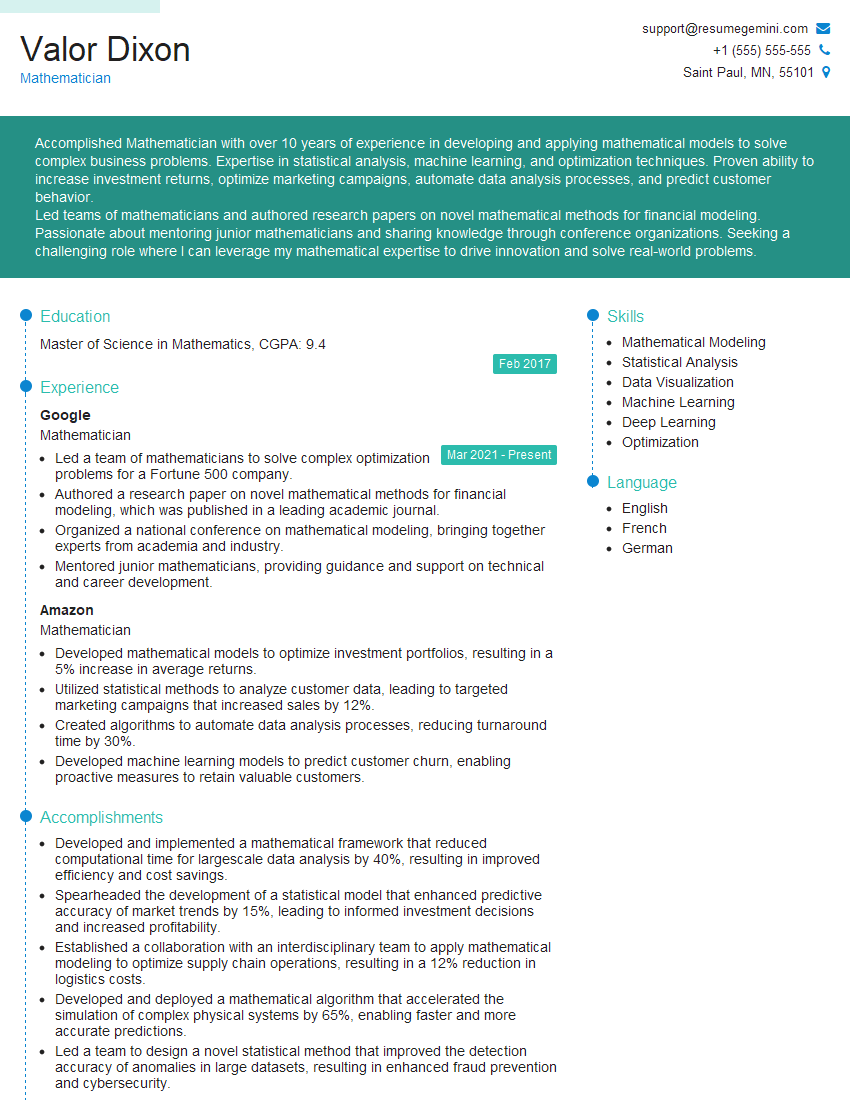
Mathematician Resume Sample

Operations Research Analyst Resume Sample

Statistician Resume Sample

Biostatistician Resume Sample

Engineer Resume Sample

Control Systems Engineer Resume Sample

Epidemiologist Resume Sample
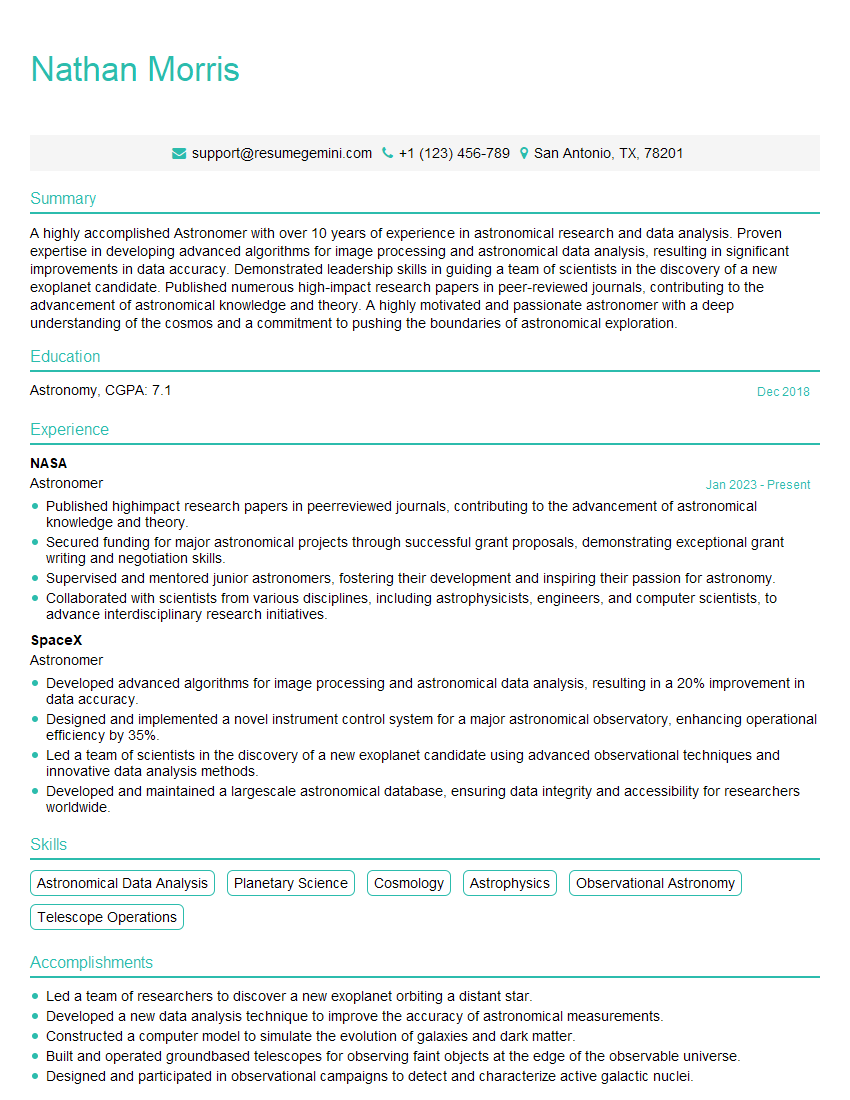
Astronomer Resume Sample

Physicist Resume Sample

Meteorologist Resume Sample

Econometrician Resume Sample
- Financial Analyst
- Analyst
- Data Analyst
- Quantitative Analyst
- Data Scientist
- Research Scientist
- Software Engineer
- Geospatial Analyst
- Actuary
- Mathematician
- Operations Research Analyst
- Statistician
- Biostatistician
- Engineer
- Control Systems Engineer
- Epidemiologist
- Astronomer
- Physicist
- Meteorologist
- Econometrician
Explore more articles
Users Rating of Our Blogs
Share Your Experience
We value your feedback! Please rate our content and share your thoughts (optional).
What Readers Say About Our Blog
Very informative content, great job.
good