Cracking a skill-specific interview, like one for Lock Stitch Machine Operation, requires understanding the nuances of the role. In this blog, we present the questions you’re most likely to encounter, along with insights into how to answer them effectively. Let’s ensure you’re ready to make a strong impression.
Questions Asked in Lock Stitch Machine Operation Interview
Q 1. What are the key differences between a lock stitch and a chain stitch?
The key difference between a lock stitch and a chain stitch lies in how the stitches are formed and their resulting strength. A lock stitch, used in most sewing machines, is created by two threads interlocked in a criss-cross pattern. Think of it like weaving – one thread goes over and under the other, creating a strong, durable stitch that’s resistant to unraveling. This interlocking action creates a secure, stable seam. A chain stitch, on the other hand, uses a single continuous thread looping over itself. Imagine a chain link – each link is a stitch, and the whole thing is held together by the continuous thread. While faster, chain stitches are significantly weaker and more prone to unraveling than lock stitches. Lock stitches are ideal for most apparel and upholstery applications due to their strength, while chain stitches are often found in temporary applications, overlocking, or in situations where speed is prioritized over seam strength.
Q 2. Explain the function of the presser foot and its adjustment.
The presser foot is a crucial component of a lock stitch machine, holding the fabric firmly in place against the feed dogs while stitching. Its consistent pressure ensures even stitch formation and prevents fabric slippage, leading to neat and precise seams. Adjustment of the presser foot pressure is vital and usually controlled by a dial or lever. Too little pressure can result in skipped stitches or puckering, while excessive pressure can cause fabric distortion or damage, especially with delicate materials. For example, working with silk would necessitate a lower presser foot pressure compared to heavier denim. The presser foot should also be raised when loading or unloading fabric to prevent needle damage and ensure smooth operation.
Q 3. How do you adjust the stitch length and width on a lock stitch machine?
Adjusting stitch length and width on a lock stitch machine typically involves using dials or levers located on the machine’s front panel. The stitch length dial controls the distance between each stitch. A longer stitch length is suitable for basting or quick sewing, while a shorter stitch length is ideal for areas that require extra strength or durability. Think of seams on jeans needing shorter stitches for robustness. The stitch width (or sometimes called stitch density) dial affects the width of the zigzag stitch in machines capable of producing zigzag stitch patterns. Narrower stitches are useful for finer details and cleaner seams, while wider stitches are useful for decorative stitches or seam reinforcement. Each machine has its own specific adjustments, so referring to the machine’s manual is essential for understanding these settings correctly.
Q 4. Describe the process of threading a lock stitch machine.
Threading a lock stitch machine involves a specific sequence of steps to ensure both the upper and lower threads are correctly engaged. The process generally involves:
- Upper thread: Starting with the spool of thread, the thread is guided through a series of tension discs, the take-up lever, and then finally into the needle. This path is usually clearly marked on the machine.
- Bobbin: A pre-wound bobbin is inserted into the bobbin case. The bobbin case is then inserted into the machine’s shuttle mechanism.
- Needle: Make sure the needle is inserted correctly and is tightly secured. The flat side of the needle should face the back of the machine.
It is crucial to follow the threading diagram specific to your machine model. Incorrect threading can result in broken threads, skipped stitches, or poor stitch quality. Many machines have a clear diagram printed directly onto the machine or included in the owner’s manual.
Q 5. What are the common causes of skipped stitches and how do you troubleshoot them?
Skipped stitches are a common issue with lock stitch machines, often caused by several factors:
- Incorrect threading: This is the most frequent cause. Double-check the threading path to ensure proper thread engagement in all components.
- Bent or damaged needle: A bent or dull needle cannot properly penetrate the fabric, leading to skipped stitches. Inspect the needle carefully and replace it if necessary.
- Improper needle type: Using the wrong needle for the fabric type can cause skipped stitches or breakages. Choose a needle designed for the fabric’s weight and type.
- Incorrect tension: Imbalance between upper and lower thread tension leads to inconsistent stitching. Adjust tension dials until a balanced loop is visible on both sides of the fabric.
- Poor quality thread: Using damaged or low-quality thread can contribute to skipped stitches. Use a high-quality thread appropriate for the project.
Troubleshooting involves systematically checking each of these points. Starting with the simplest fixes, like re-threading, and moving towards more complex issues, such as needle replacement, is an effective approach.
Q 6. How do you identify and resolve a broken needle?
A broken needle is easily identifiable by the snapped-off tip or visible damage to the needle shaft. This is usually accompanied by a distinct metallic ‘ping’ sound during operation. Before attempting to fix it, always ensure the machine is turned off and unplugged for safety. Remove the broken needle using needle removal tools included with most machines (often a small flathead tool). Inspect the needle plate and throat plate for damage caused by the broken needle. Replace the broken needle with a new one, carefully ensuring it’s inserted correctly, with the flat side facing the back. Always check the bobbin case area for any debris from the broken needle and ensure that everything moves freely after replacing the needle.
Q 7. Explain the importance of proper needle selection for different fabrics.
Proper needle selection is crucial for optimal stitching and prevents needle breakage or fabric damage. Different fabrics require different needle types and sizes. For example:
- Fine fabrics (silk, chiffon): Require fine needles with a sharp point to prevent snags. A size 60/8 needle is often suitable.
- Medium-weight fabrics (cotton, linen): Typically use universal needles in sizes 70/10 or 80/12.
- Heavyweight fabrics (denim, canvas): Demand heavy-duty needles with a stronger shaft to penetrate the thick fabric. Sizes 90/14 or 100/16 are frequently used.
- Stretch fabrics (Lycra, jersey): Benefit from stretch needles with a ballpoint tip that gently pushes the fibers apart rather than piercing them. These prevent runs or damage to the fabric’s stretch properties.
Using the wrong needle size can lead to skipped stitches, broken needles, or damaged fabric. Always consult a needle size chart provided by the needle manufacturer to select the appropriate needle for the fabric you are using.
Q 8. How do you maintain and clean a lock stitch machine to ensure optimal performance?
Maintaining a lock stitch machine for optimal performance is crucial for consistent stitching and longevity. Regular cleaning and lubrication are key. Think of it like servicing a car – regular maintenance prevents major problems down the line.
- Daily Cleaning: After each use, remove lint and thread trimmings from the hook area, bobbin case, and feed dogs using a brush or compressed air. A small vacuum cleaner with a narrow nozzle is also very effective.
- Weekly Cleaning: More thorough cleaning involves removing the bobbin case and thoroughly cleaning it with a brush and lint-free cloth. Pay close attention to the shuttle hook and the areas where the thread paths are.
- Lubrication: Apply a high-quality sewing machine oil to the moving parts as recommended by the manufacturer. Focus on areas like the needle bar, hook assembly, and feed dogs. Avoid over-lubrication, as excess oil can attract dust and lint.
- Periodic Servicing: Professional servicing every 6-12 months (depending on usage) is highly recommended. A technician can perform more in-depth cleaning, adjust timing, and identify any potential issues before they become major problems. Think of this as taking your car in for a tune-up.
Q 9. What safety precautions should be taken when operating a lock stitch machine?
Safety is paramount when operating any sewing machine, especially a lock stitch machine that uses high-speed needles. Always prioritize these precautions:
- Never reach under the needle while the machine is running. This is the most common cause of accidents.
- Keep your fingers away from moving parts. Use the finger guards or guides provided by the machine.
- Maintain good posture. Avoid straining yourself by sitting in a comfortable and ergonomic position.
- Use a well-lit workspace. Proper lighting minimizes eye strain and reduces the risk of accidents.
- Keep the area around the machine clear of clutter. Prevent tripping hazards and ensure easy access to power switches and emergency stop buttons.
- Disconnect the power cord before cleaning or making adjustments. This prevents accidental starts.
- Use the correct needle and thread type for the fabric. Broken needles are a common safety hazard if the wrong needle is used for a heavy duty fabric.
Remember, safety isn’t just about avoiding injury; it’s about efficient and productive work.
Q 10. Describe the different types of lock stitch machine needles and their applications.
Lock stitch machines use various needles, each designed for specific fabric types. The most common are:
- System Needles: These are general-purpose needles suitable for a wide range of fabrics, offering a good balance of strength and sharpness.
- Ballpoint Needles: Ideal for knit fabrics. The rounded tip glides between the fabric loops, preventing skipped stitches or snags. Think of it as gently navigating between the loops rather than piercing them.
- Stretch Needles: Specifically designed for highly elastic fabrics like lycra or spandex. They have a slightly different shape and strength to accommodate the stretch without breaking.
- Heavy-Duty Needles: Used for thick or heavy fabrics such as denim or canvas. These needles have a reinforced shaft to withstand the increased stress of thicker materials.
Choosing the right needle is vital for consistent stitching and prevents needle breakage. Always check the needle size and type recommended by the manufacturer for your fabric type.
Q 11. How do you adjust the tension on a lock stitch machine?
Tension adjustment on a lock stitch machine is critical for balanced stitching. Proper tension ensures that the top and bottom threads interlock correctly, creating a neat and secure seam.
Most lock stitch machines have separate tension controls for the upper and lower threads (bobbin tension). The upper thread tension is controlled via a dial or knob on the machine body. The bobbin tension is typically adjusted by turning a small screw on the bobbin case.
Adjusting the tension involves finding the right balance: If the stitches are loose, increase the upper tension. If the stitches are tight, decrease the upper tension. Similarly, if the lower thread shows on the top surface of the fabric, you’ll need to tighten the bobbin tension. If the upper thread shows on the bottom, you’ll need to loosen the bobbin tension. This requires observation and minor adjustments until you achieve a perfect balance.
Start with adjusting the upper thread first, then fine-tune the bobbin tension. It’s often a process of trial and error until you find the sweet spot for that particular fabric and thread.
Q 12. What is the role of the bobbin and how is it properly wound?
The bobbin holds the lower thread, essential for the lock stitch formation. Proper winding is crucial to avoid thread jams and ensure consistent stitching.
Proper bobbin winding involves these steps:
- Place an empty bobbin on the bobbin winder spindle. Ensure it’s securely in place.
- Thread the bobbin winder through the designated path. This usually involves threading through a small guide and then onto the bobbin itself.
- Engage the bobbin winder. This is done using a lever or button on the machine.
- Start the machine and allow the bobbin to wind. Stop the machine once the bobbin is full but not overly tight. Overfilling can cause problems.
- Disengage the bobbin winder and remove the full bobbin.
It’s essential to use the correct type and size of bobbin recommended by the manufacturer for your specific machine model. Winding a bobbin improperly is a common cause of machine malfunctions.
Q 13. How do you handle different fabric types (e.g., heavy, light, stretchy) on a lock stitch machine?
Sewing different fabrics requires adjustments to both the machine settings and the selection of needles and threads.
- Heavy Fabrics (e.g., denim, canvas): Use a heavy-duty needle and a heavier thread. You may also need to increase the machine’s stitch length and potentially adjust the presser foot pressure (some machines have an adjustable presser foot).
- Light Fabrics (e.g., silk, chiffon): Use a fine needle and a lightweight thread. Reduce the stitch length and decrease the presser foot pressure to prevent puckering or damage to the delicate fabric.
- Stretchy Fabrics (e.g., lycra, jersey): Use a stretch needle and a suitable thread that has some elasticity. Adjust the stitch length to accommodate the stretch, and consider using a walking foot (if your machine has one) to ensure even feeding.
Experimentation is key here; making small adjustments based on the fabric response is normal. Always test on a scrap piece of fabric before working on your final project.
Q 14. Describe the process of changing the needle on a lock stitch machine.
Changing a needle is a straightforward process but crucial for maintaining the machine’s performance and preventing damage.
The steps typically involve:
- Raise the needle to its highest position. This provides clear access to the needle clamp screw.
- Loosen the needle clamp screw. This is usually located on the needle bar. Turn it counter-clockwise.
- Remove the old needle by gently pulling it straight upwards. Avoid twisting or forcing it, which may damage the needle clamp.
- Insert the new needle into the needle clamp, making sure the flat side of the needle faces towards the back of the machine. This is essential for correct needle alignment.
- Tighten the needle clamp screw. Ensure the needle is firmly held in place.
Always use the correct needle size and type recommended for the fabric you’re sewing. A bent or damaged needle can cause skipped stitches, broken threads, and even damage the machine.
Q 15. What are the common maintenance tasks performed on a lock stitch machine?
Regular maintenance is crucial for the longevity and optimal performance of a lock stitch machine. Think of it like servicing your car – preventative care saves you from costly repairs later. Common tasks include:
- Lubrication: Applying the correct type of lubricant to moving parts like the needle bar, hook, and feed dogs prevents friction and wear. Over-lubrication can be as bad as under-lubrication, leading to oil build-up and attracting lint.
- Cleaning: Regularly removing lint, dust, and thread remnants from the hook assembly, bobbin case, and shuttle race is essential. Compressed air can help. A dirty machine is an inefficient machine.
- Needle and Bobbin Replacement: Worn or damaged needles and bobbins can cause skipped stitches, thread breakage, and ultimately damage the machine. Regular inspections and timely replacements are key.
- Tension Adjustment Check: Proper thread tension is vital for consistent stitch quality. Periodically check and adjust the upper and lower thread tensions to ensure balanced tension.
- Timing Check: Ensuring the correct timing between the needle and hook is critical for proper stitch formation. This is usually checked and adjusted by a professional.
- Belt Check: Inspect the drive belt for wear and tear. A worn belt can cause inconsistent speed and potential slippage.
Following a regular maintenance schedule, even a simple one, can significantly extend the life of your lock stitch machine and keep it producing high-quality stitches.
Career Expert Tips:
- Ace those interviews! Prepare effectively by reviewing the Top 50 Most Common Interview Questions on ResumeGemini.
- Navigate your job search with confidence! Explore a wide range of Career Tips on ResumeGemini. Learn about common challenges and recommendations to overcome them.
- Craft the perfect resume! Master the Art of Resume Writing with ResumeGemini’s guide. Showcase your unique qualifications and achievements effectively.
- Don’t miss out on holiday savings! Build your dream resume with ResumeGemini’s ATS optimized templates.
Q 16. How do you identify and correct a timing issue on a lock stitch machine?
Timing issues manifest as malformed stitches, often incomplete or broken loops. Identifying the problem requires careful observation and a systematic approach. First, visually inspect the stitch formation – are the loops consistently formed? If not, check the following:
- Needle Timing: The needle should pass through the hook at the precise moment for optimal stitch creation. Incorrect timing can lead to inconsistent loop formation. Adjustment usually requires specialized tools and knowledge and may involve loosening screws, adjusting gears, and rotating components to align the needle and the hook.
- Hook Timing: The hook’s movement needs to be synchronized with the needle. Timing adjustments may be necessary to correct the problem.
- Hook Condition: Inspect the hook for wear, damage, or burrs. A worn hook can significantly disrupt timing and affect stitch quality.
Correcting timing often involves adjusting the timing screws on the machine. This is best done by someone experienced as improper adjustment can damage the machine. If you’re unsure, consulting a qualified technician is crucial. Consider it a precision instrument; a slight misalignment can create larger problems.
Q 17. What are the signs of a worn-out needle or bobbin?
Recognizing a worn-out needle or bobbin is essential for preventing damage to your fabric and machine. Think of the needle and bobbin as a team; if one is weak, the other suffers.
- Worn Needle: Signs include bent tips, burrs along the shaft, or a dull point. A worn needle will cause skipped stitches, broken threads, and inconsistent stitch formation. You may even notice the needle is leaving visible marks on your fabric.
- Worn Bobbin: A worn bobbin will have a rough or damaged surface, potentially resulting in uneven thread tension, broken stitches, and thread jams. Similarly, a damaged bobbin case may cause issues.
Regular inspections, especially before starting a large project, are key. Always replace worn needles and bobbins promptly – it’s a cheap and easy prevention measure.
Q 18. How do you handle thread jams or breakages?
Thread jams and breakages are common occurrences in sewing, often caused by incorrect tension, a damaged needle, or lint build-up. Here’s a systematic approach:
- Identify the Source: Pinpoint the location of the jam – is it in the needle area, the bobbin area, or somewhere else?
- Turn off the machine: Always power down the machine before attempting any repair.
- Remove the Jam: Carefully remove any tangled thread using tweezers or small scissors. Avoid pulling forcefully as you might damage the machine.
- Clean the affected area: Remove any lint or debris from the machine using a brush, compressed air, or a lint-removal tool.
- Check the Needle and Bobbin: Inspect the needle and bobbin for damage. Replace them if necessary.
- Check Thread Tension: Verify that the upper and lower thread tensions are correctly adjusted.
- Re-thread the Machine: Carefully re-thread the machine following the manufacturer’s instructions. A incorrectly threaded machine leads to frequent jams.
Prevention is key – ensure regular cleaning, proper tension, and high-quality thread to minimize jams and breakages.
Q 19. Explain the relationship between stitch length, fabric type, and thread tension.
The relationship between stitch length, fabric type, and thread tension is crucial for achieving optimal results. They’re interdependent factors.
- Stitch Length: Longer stitches are suitable for stretchy fabrics or where seam strength isn’t critical (e.g., decorative stitching). Shorter stitches are needed for durable seams, especially in heavy fabrics or areas under stress.
- Fabric Type: Heavy fabrics need longer stitches to prevent puckering and breakage. Lightweight fabrics might require shorter stitches for neatness and strength.
- Thread Tension: Balanced tension is essential regardless of stitch length or fabric type. Uneven tension leads to puckering, skipped stitches, and unattractive seams.
For example, a heavy denim jacket requires a medium to longer stitch length with balanced tension, while a fine silk blouse needs a very short stitch length and carefully adjusted tension. Experimentation and adjustments are key to mastering the balance for each fabric type.
Q 20. What is the significance of the differential feed mechanism (if applicable)?
A differential feed mechanism is a significant feature of many industrial lock stitch machines. It allows independent control of the feed dogs at the front and back of the sewing area. This feature is important in feeding varying fabric thicknesses or textures and for creating more specialized and tailored seams.
- Feeding Problem Materials: On fabrics that stretch differently in the weft and warp directions, the differential feed helps manage stretch and prevent puckering.
- Creating Pleats and Gathers: Differential feeding can be used to create more even and precise pleats or gathers.
- Improved Seam Appearance: By adjusting the differential feed, the seam allowance is fed through at a controlled rate, giving a better final aesthetic.
- Ease of Sewing on Difficult Materials: This mechanism helps feed difficult to sew materials smoothly, reducing strain on the material and creating less stress on the machine.
In essence, the differential feed enhances versatility and stitch quality, especially when working with challenging fabrics or creating complex seams, enabling precise control over fabric feed.
Q 21. How do you measure stitch quality?
Measuring stitch quality involves assessing several aspects. It’s not just about the final product; the process itself matters. Here’s a framework:
- Stitch Consistency: Are stitches consistently spaced and formed? Use a ruler or magnifying glass to check for variations.
- Thread Tension: Is the thread tension balanced between the upper and lower threads? Uneven tension often results in visible puckering or loose stitches.
- Seam Strength: How strong is the seam? Try to gently pull on the seam to test its resistance to tearing.
- Stitch Appearance: Does the stitch look neat and uniform? This is a measure of professional presentation.
- Fabric Damage: Has the sewing process damaged the fabric? Check for needle marks, holes, or other imperfections.
A high-quality stitch is consistent, strong, aesthetically pleasing, and doesn’t damage the fabric. You’ll develop a keen eye for identifying excellent stitches with experience.
Q 22. How do you adjust the machine for different stitch patterns (if applicable)?
A lockstitch machine, unlike some other sewing machines, doesn’t inherently offer a wide variety of stitch patterns. Its core function is a straight stitch, created by the interlocking of the needle thread and the bobbin thread. Adjustments for stitch ‘patterns’ are therefore limited to variations in stitch length and width.
Stitch Length: This is controlled by a dial or lever usually marked in millimeters or stitches per inch (spi). A longer stitch length results in a looser stitch, while a shorter length creates a tighter, more dense stitch. The optimal stitch length depends on the fabric type and the desired strength of the seam. For example, heavier fabrics like denim require a shorter stitch length for durability, while lighter fabrics like silk might need a longer stitch to avoid puckering.
Stitch Width: While not as common to adjust directly in a typical lockstitch machine, stitch width can indirectly be affected by needle position adjustment. Some machines allow you to slightly offset the needle’s position left or right. This can influence the placement of the stitches in relation to the fabric edge, providing a slight variation in the apparent stitch width. But fundamentally, lockstitch machines are designed for consistent straight stitches.
Q 23. Describe your experience working with different types of lock stitch machines.
My experience encompasses a wide range of lockstitch machines, from basic single-needle models used in light manufacturing to heavy-duty industrial machines designed for high-volume production in garment factories. I’ve worked with both direct-drive and belt-drive machines, familiarizing myself with their unique operational characteristics. For instance, I’ve become proficient in handling machines from brands like Singer, Juki, and Brother, each having its own nuances in terms of maintenance and operational features. Working with these diverse models honed my skills in adapting to different machine interfaces, troubleshooting specific machine issues, and optimizing the setup for various fabric types and sewing operations.
Beyond the brand, my experience also involves different machine classes. I’ve worked with machines built for specific tasks like button sewing, blind stitching, or topstitching. This expanded my understanding of how different machine functionalities can be applied to different production requirements and fabric characteristics.
Q 24. What is your experience with troubleshooting machine malfunctions?
Troubleshooting malfunctions is a crucial part of my daily routine. My approach is systematic and begins with observation. I carefully examine the machine for any obvious issues like broken needles, damaged threads, or incorrect tension settings. I listen to the machine’s sounds – unusual noises like squeaking or grinding can often pinpoint the problem.
My troubleshooting process usually follows these steps:
- Visual Inspection: Checking for broken parts, thread jams, or loose components.
- Tension Adjustment: Verifying and correcting the needle and bobbin tension.
- Needle and Bobbin Replacement: Replacing damaged or worn needles and bobbins.
- Timing Check: In more complex issues, checking the machine’s timing mechanism.
- Lubrication: Ensuring proper lubrication of moving parts.
If the problem persists after these steps, I refer to the machine’s manual or consult with more experienced technicians. I’ve developed a strong understanding of the mechanics of these machines and can effectively diagnose and rectify problems related to feed dogs, stitch formation, and motor functionality. A recent example involved a machine repeatedly breaking needles. After systematic checks, I found a slight bend in the needle clamp, a small detail easily overlooked but crucial to proper needle alignment.
Q 25. How do you ensure consistent stitch quality throughout a production run?
Maintaining consistent stitch quality is paramount for efficient production and product quality. This involves a multi-faceted approach:
- Regular Maintenance: Preventative maintenance, including cleaning, oiling, and replacing worn parts, is key. A well-maintained machine operates smoothly and produces consistently high-quality stitches.
- Consistent Thread Tension: Properly adjusted needle and bobbin tension is vital. Incorrect tension leads to skipped stitches, broken threads, or uneven stitch formation. I regularly monitor and fine-tune the tension to ensure consistency.
- Fabric Consistency: Variations in fabric thickness and type can significantly affect stitch quality. Using consistent fabrics and adjusting stitch length accordingly minimizes these variations.
- Needle Selection: Choosing the right needle size and type is essential for the fabric being sewn. Using a needle too small or too large can cause skipped stitches or fabric damage.
- Speed Control: Excessive speed can compromise stitch quality. A moderate sewing speed allows for better stitch formation and control.
Monitoring the stitch quality throughout the production run involves regularly inspecting the seams. I am trained to identify subtle variations that might indicate a developing problem, preventing a large batch of substandard work.
Q 26. Describe your experience maintaining production targets.
Meeting production targets is a critical aspect of my role. I consistently achieve and often exceed targets by focusing on efficiency and problem prevention. My approach includes:
- Efficient Work Habits: I’ve developed quick and efficient techniques for threading machines, setting up for different jobs, and maintaining a consistent work pace. I avoid unnecessary downtime.
- Proactive Troubleshooting: Quickly identifying and resolving minor issues prevents larger disruptions that would impact production.
- Prioritization: I understand the importance of different tasks and prioritize those that have the greatest impact on overall output. In high-demand scenarios, I prioritize urgent orders while maintaining quality.
- Communication: Open communication with supervisors and colleagues allows for proactive problem-solving and efficient resource allocation.
I track my own production and analyze any inconsistencies to identify areas for improvement. Through consistent effort and effective strategies, I ensure consistently high output while maintaining the quality expected.
Q 27. How do you prioritize tasks and manage your time effectively in a fast-paced environment?
In a fast-paced environment, effective task prioritization and time management are essential. I utilize several techniques:
- Prioritization Matrix: I classify tasks based on urgency and importance. Urgent and important tasks receive immediate attention, while less urgent tasks are scheduled accordingly.
- Time Blocking: I allocate specific time slots for particular tasks, helping me stay focused and avoid distractions.
- Break Down Tasks: Complex tasks are broken into smaller, manageable steps, making them less overwhelming and easier to track progress on.
- Regular Review: I regularly review my schedule and adjust priorities as needed. This ensures flexibility to adapt to changing circumstances.
I find that maintaining a clear and organized workspace contributes significantly to efficient time management. A clutter-free environment promotes focus and minimizes the time spent searching for materials or tools.
Q 28. Describe a time you had to solve a complex machine problem.
One particularly challenging situation involved a machine that was producing inconsistent stitches, resulting in a significant number of rejects. Initially, I checked the usual suspects – needle, bobbin, tension – but the problem persisted. After several hours of methodical troubleshooting, I noticed a subtle vibration in the machine’s feed mechanism. Upon closer examination, I found a small, loose screw within the feed dog assembly. The vibration was causing inconsistent movement of the feed dogs, resulting in irregular stitch spacing. Tightening the screw instantly resolved the issue and restored the machine’s functionality. This experience reinforced the importance of thorough investigation and attention to even the smallest details. A seemingly insignificant loose screw almost caused a major production setback.
Key Topics to Learn for Lock Stitch Machine Operation Interview
- Machine Setup and Maintenance: Understanding the different components of a lockstitch machine, proper threading procedures, lubrication techniques, and routine maintenance checks.
- Stitch Formation and Adjustment: Knowing how the lockstitch is formed, the impact of different stitch lengths and tensions on fabric, and how to adjust these settings for various materials.
- Fabric Handling and Feeding: Mastering techniques for smooth fabric feeding, preventing puckering, and handling different fabric weights and types.
- Troubleshooting Common Issues: Identifying and resolving problems such as broken needles, skipped stitches, thread breaks, and inconsistent stitch formation. This includes understanding preventative measures.
- Safety Procedures and Regulations: Demonstrating knowledge of safe operating procedures, machine guarding, and adhering to workplace safety regulations.
- Production Efficiency and Speed: Understanding techniques to maximize production output while maintaining consistent stitch quality. This includes optimizing machine settings and workflow.
- Quality Control and Inspection: Knowing how to inspect finished work for defects, understanding quality standards, and implementing corrective actions.
- Different types of Lockstitch Machines: Familiarity with various models and their unique features and applications.
Next Steps
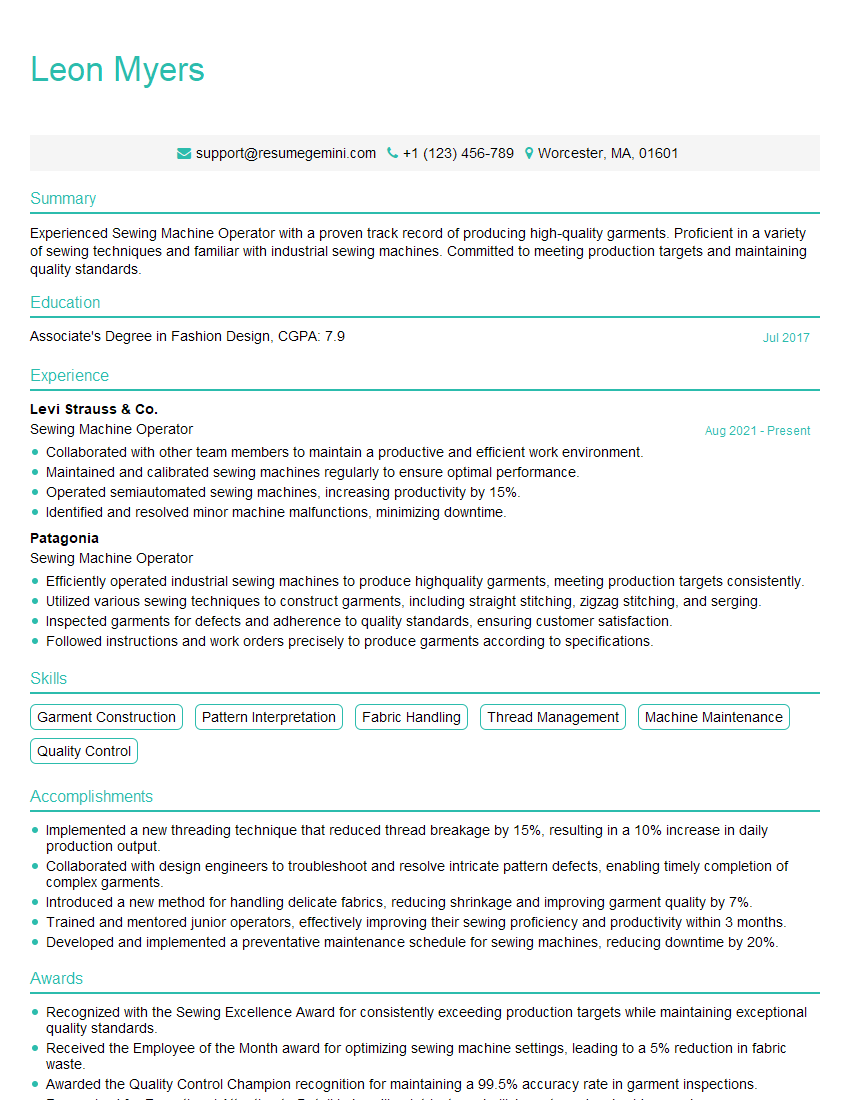
Mastering Lock Stitch Machine Operation opens doors to rewarding careers in the apparel and textile industries, offering opportunities for advancement and specialization. A strong resume is crucial for showcasing your skills and experience to potential employers. Creating an ATS-friendly resume is vital to ensure your application gets noticed. ResumeGemini is a trusted resource to help you build a professional and impactful resume, highlighting your abilities effectively. Examples of resumes tailored to Lock Stitch Machine Operation are available to help guide you.



Explore more articles
Users Rating of Our Blogs
Share Your Experience
We value your feedback! Please rate our content and share your thoughts (optional).
What Readers Say About Our Blog
Very informative content, great job.
good