Are you ready to stand out in your next interview? Understanding and preparing for Lyrical Composition interview questions is a game-changer. In this blog, we’ve compiled key questions and expert advice to help you showcase your skills with confidence and precision. Let’s get started on your journey to acing the interview.
Questions Asked in Lyrical Composition Interview
Q 1. Describe your songwriting process.
My songwriting process is iterative and deeply personal, but it generally follows these steps:
- Idea Generation: This can start anywhere – a striking image, a overheard conversation, a poignant memory. I keep a notebook and voice recorder handy to capture these fleeting moments of inspiration.
- Theme Development: Once I have a core idea, I explore its thematic depth. What emotions does it evoke? What story does it want to tell? I often brainstorm keywords and concepts to flesh out the narrative.
- Melody & Structure: I usually start with a melody, even if it’s just a simple hum. This helps dictate the rhythm and structure of the lyrics. I experiment with different verse-chorus structures, bridges, and outros to find the most effective arrangement.
- Lyrical Drafting: This is where the actual writing happens. I often start with free verse, pouring out all my thoughts and feelings related to the theme. Then, I refine and polish, paying close attention to word choice, imagery, and flow.
- Revision & Refinement: This is a crucial stage. I step away from the lyrics for a while, then return with fresh eyes. I look for areas that need improvement in terms of clarity, rhythm, rhyme, and overall impact. I often seek feedback from trusted peers during this phase.
- Final Polish: The final stage involves making any necessary adjustments to ensure the lyrics are polished and ready for recording.
For example, one song started with the image of a lone tree on a hill. This developed into a reflection on resilience and perseverance, resulting in a ballad with a slow tempo and introspective lyrics.
Q 2. Explain the difference between a verse and a chorus.
Verses and choruses are fundamental song structures that serve distinct purposes. Think of it like telling a story:
- Verse: The verse is where the story unfolds. Each verse typically presents a new element of the narrative, offering details, descriptions, or advancing the plot. They often feature different rhymes and rhythmic patterns.
- Chorus: The chorus is the song’s central theme or message. It’s the most memorable part, usually repeated throughout the song to reinforce the core idea. Choruses typically have a stronger rhythmic pattern and a catchy melody that sticks in the listener’s mind.
For instance, a song about heartbreak might have verses detailing specific memories and emotions, while the chorus would encapsulate the overall feeling of loss and longing. The verses tell the story, the chorus summarizes the emotion.
Q 3. How do you ensure your lyrics are both meaningful and memorable?
Creating lyrics that are both meaningful and memorable requires a careful balance of emotional depth and lyrical craftsmanship:
- Authenticity: Writing from personal experience or drawing inspiration from genuine emotions is key to creating meaningful lyrics. Listeners connect more easily with lyrics that feel authentic and relatable.
- Strong Imagery: Using vivid language and sensory details creates memorable images in the listener’s mind. Instead of saying ‘I’m sad,’ try ‘A heavy rain fell on my heart’.
- Repetition & Variation: Strategically repeating key phrases or words helps reinforce the message, while incorporating variations keeps the listener engaged.
- Conciseness: Using precise language and avoiding unnecessary words helps focus the message and make it more impactful.
- Unique Voice: Developing a distinctive lyrical style, a personal way of expressing yourself, helps your songs stand out.
I often work on refining my initial drafts until each word contributes to the overall effect – avoiding clichés and aiming for powerful, evocative language.
Q 4. How do you incorporate rhyme scheme and meter effectively?
Rhyme scheme and meter are essential tools for creating musicality and memorability in lyrics. Let’s break them down:
- Rhyme Scheme: This refers to the pattern of rhymes at the end of lines. A common scheme is AABB (the first and second lines rhyme, and the third and fourth rhyme), but there are countless variations.
A: sun B: fun A: run B: gun. Complex schemes add sophistication, while simpler ones are more immediately catchy. - Meter: This refers to the rhythmic pattern of stressed and unstressed syllables in a line. Common meters include iambic pentameter (five sets of unstressed-stressed syllables) and trochaic tetrameter (four sets of stressed-unstressed). Mastering meter provides a sense of flow and musicality.
I find that experimenting with different rhyme schemes and meters is crucial. A song might start with a simple AABB rhyme scheme for the chorus to be easily memorable, then move into more complex patterns in the verses to create contrast and depth. I often use online tools to analyze existing songs’ meter, which helps me understand how to write within particular styles.
Q 5. How do you adapt your lyrical style to different genres?
Adapting lyrical style to different genres involves understanding the genre’s conventions and audience expectations. For instance:
- Pop: Often emphasizes catchy melodies, simple rhyme schemes, and relatable themes. Lyrics tend to be concise and memorable.
- Hip-Hop: Often incorporates complex rhyme schemes, internal rhymes, and storytelling narratives. Lyrics frequently address social issues or personal experiences.
- Country: Emphasizes storytelling, often focusing on themes of love, loss, and rural life. Lyrics usually utilize traditional rhyme schemes and simple language.
- Folk: Often features poetic language, imagery, and introspective themes. Lyrics may be more complex and less structured than pop songs.
My approach is to thoroughly research each genre’s conventions before starting to write. This involves listening to many artists within that genre, analyzing their lyrical styles, and experimenting with different techniques to find what works best.
Q 6. Describe your experience working with musicians and producers.
Collaborating with musicians and producers is an essential part of the songwriting process. It’s a synergistic partnership, where each person contributes their unique skills and perspectives.
- Musicians: Working closely with musicians allows me to understand how my lyrics fit within their musical compositions. Their musical input often inspires me to refine my lyrics, finding ways to enhance their flow and impact. For example, a guitarist’s improvisation might suggest a new direction for a song.
- Producers: Producers help shape the overall sonic landscape of the song. They might suggest changes to my lyrics to enhance the song’s structure or improve its delivery. Their insights are invaluable in creating the final product.
I value open communication and mutual respect in these collaborations. A successful collaboration happens when everyone contributes their best, respecting each other’s expertise and vision.
Q 7. How do you handle feedback on your lyrics?
Feedback is crucial for growth as a songwriter. I approach feedback constructively, understanding that it is intended to improve the song’s overall quality.
- Active Listening: I make sure to listen carefully to the feedback, asking clarifying questions if needed. I try to understand the critic’s perspective without getting defensive.
- Objective Assessment: I evaluate the feedback objectively, separating personal feelings from the actual suggestions. I ask myself: Does this suggestion make the song better? Does it enhance the clarity, impact, or emotional resonance?
- Selective Incorporation: I don’t necessarily incorporate every piece of feedback, but I consider each suggestion carefully. I make changes based on their merit and how they align with my creative vision. Sometimes, feedback inspires me to try new approaches, even if the initial suggestion isn’t perfect.
I find that even constructive criticism, if carefully considered, can enhance my skills and create a stronger product. It’s a vital part of the learning process.
Q 8. How do you overcome writer’s block?
Writer’s block is a common challenge for songwriters, but it’s rarely insurmountable. Think of it as a temporary creative drought, not a permanent creative desert. My approach is multifaceted. First, I step away from the pressure. Instead of forcing lyrics, I might engage in unrelated activities like reading poetry, listening to different genres of music, or even going for a walk in nature. This allows my subconscious to work on the problem while I consciously relax. Second, I experiment with different approaches. If I’m stuck on a melody, I might try writing lyrics first, or vice-versa. If I’m struggling with rhyme, I might try free verse for a while to unlock a new flow. Third, I utilize prompts. This could be as simple as choosing a single word or image, then building a narrative or mood around it. Finally, collaboration can be a powerful tool. Bouncing ideas off another songwriter can often jumpstart my creative process.
- Example: If I’m struggling with a love song, instead of forcing romantic imagery, I might write about a mundane detail – perhaps the way sunlight falls on my partner’s hand – and see where that leads me emotionally.
- Example: If the melody is stubborn, I might write the lyrics in free verse first and then see if I can adapt the rhythm and meter to fit a tune.
Q 9. Explain your understanding of copyright law as it relates to songwriting.
Copyright law in songwriting protects the musical composition, both the melody and the lyrics, as a form of intellectual property. It grants the songwriter exclusive rights to reproduce, distribute, perform, display, and create derivative works from their song. This protection begins from the moment the work is fixed in a tangible form, such as being written down or recorded. Registering your copyright with a relevant agency like the U.S. Copyright Office or equivalent in your country is crucial for establishing legal ownership and protecting your rights if infringement occurs. Infringement occurs when someone unauthorized uses your copyrighted material. This can range from direct copying of your entire song to using significant portions of your melody or lyrics. Establishing clear proof of your prior authorship is key in any legal dispute. It’s advisable to keep detailed records of your songwriting process, including dates, versions, and any witnesses to your creative work.
It’s also vital to understand ‘fair use,’ which allows limited use of copyrighted material without permission for specific purposes such as criticism, commentary, news reporting, teaching, scholarship, or research. However, it’s often a complex legal grey area, and seeking professional legal counsel is recommended if you have any doubts.
Q 10. How do you collaborate effectively with other songwriters?
Effective collaboration hinges on open communication, mutual respect, and a shared creative vision. Before starting, we usually establish clear goals – what kind of song are we aiming for? What are our individual strengths and weaknesses? We assign roles based on strengths, perhaps one person focuses on melody, another on lyrics, and the third on arrangement. Regular feedback loops are crucial. We share our work openly, providing honest (but constructive!) criticism. It’s important to be receptive to suggestions and to compromise when necessary. Effective collaboration is a balancing act, respecting individual contributions while creating something greater than the sum of its parts. We often use shared online documents and cloud storage for easy access and version control.
Example: In one collaboration, one songwriter was particularly strong at crafting emotional narratives, while I excelled at crafting catchy melodies. We balanced our strengths; they wrote the core lyric concept, and I built a melody around it, resulting in a song neither of us could have created alone.
Q 11. What software or tools do you use for songwriting?
My songwriting toolkit is a blend of traditional and digital methods. I still value the tactile experience of writing lyrics in a notebook, the spontaneity it allows, and the ability to quickly sketch ideas out by hand. For recording melodies and experimenting with arrangements, I use Digital Audio Workstations (DAWs). Logic Pro X and Ableton Live are my go-to choices for their versatility in recording, sequencing, and mixing. I also use various virtual instruments and effects plugins to add depth and texture to my work. For lyric writing and organization, I use a simple word processor, often integrated into my DAW, allowing easy transfer of lyrics into the project. For collaborating remotely, I rely on cloud-based storage and collaboration platforms.
Q 12. Describe your experience with different lyrical forms (e.g., free verse, sonnet).
My experience spans a range of lyrical forms. Sonnets, with their strict structure of 14 lines and rhyme scheme, demand precision and economy of language; it’s a fascinating challenge to convey a complete thought within those constraints. I’ve found that the discipline of the sonnet often leads to surprising depth and imagery. Conversely, free verse allows for more flexibility and stream of consciousness, enabling the expression of emotions in a less structured, more immediate way. I’ve used free verse to explore more abstract themes or complex emotional landscapes. Other forms like ballads, haikus, and even rap lyrics each present unique challenges and opportunities, allowing for a variety of emotional and artistic expressions. The choice of form always depends on the song’s message and intended effect.
Q 13. How do you create imagery and metaphors in your lyrics?
Creating vivid imagery and metaphors is key to engaging listeners. I often draw inspiration from my personal experiences, observations of the natural world, and even works of art and literature. The process is often intuitive; I try to use sensory details to create a scene or feeling in the listener’s mind. Metaphors work by creating unexpected comparisons, highlighting a deeper meaning or connection between seemingly unrelated ideas. I aim for metaphors that are both unexpected and evocative, providing a fresh perspective on the emotional core of the song.
Example: Instead of simply saying ‘I’m heartbroken,’ I might write, ‘My heart is a shattered vase, spilling its tears onto the cold, unforgiving floor.’ This creates a more visceral image and a richer emotional experience for the listener.
Q 14. How do you convey emotion through your lyrics?
Conveying emotion effectively involves more than just stating feelings directly. I focus on using evocative language, vivid imagery, and carefully chosen rhythmic patterns to create the desired emotional response. Word choice is crucial; specific verbs, adjectives, and adverbs can dramatically alter the emotional tone. The rhythm and meter of the lyrics also contribute significantly; a slow, deliberate rhythm can evoke sadness, while a faster tempo can create energy or excitement. I use various poetic devices such as alliteration, assonance, and consonance to emphasize certain words or phrases and create a sense of musicality. The overall tone and mood established by the song also play a crucial role in conveying the intended emotion.
Example: To convey loneliness, I might use words associated with isolation such as ’empty,’ ‘silent,’ ‘desolate,’ alongside imagery such as a ‘deserted street’ or ‘a single candle in a vast darkness.’
Q 15. How do you choose the right words to effectively communicate your message?
Choosing the right words is the cornerstone of effective lyrical communication. It’s about finding the precise language that conveys your intended emotion, meaning, and imagery, while also resonating with the listener. This involves a multi-step process.
- Understanding Your Message: Before even thinking about words, I deeply consider what I want to communicate. What’s the central theme? What emotions do I want to evoke? What story am I telling?
- Word Choice: I select words based on their connotative meaning (the feelings and associations they evoke) as much as their denotative meaning (their literal definition). A simple word like ‘home’ can evoke feelings of comfort, security, or conversely, loneliness, depending on the context.
- Imagery and Sensory Details: Employing vivid imagery is crucial. Instead of saying ‘it was a sad day,’ I might write ‘the rain wept on the grey city, mirroring the ache in my heart’. This appeals to multiple senses, enhancing the listener’s experience.
- Rhythm and Meter: The sound of words is just as important as their meaning. I carefully consider how the rhythm and meter of the words contribute to the overall feel of the song, ensuring a natural flow and musicality.
- Conciseness and Precision: Lyrical writing is about finding the most impactful way to express oneself using as few words as possible. Every word should contribute to the overall message; there’s no room for unnecessary fluff.
For instance, in one song about loss, instead of writing ‘I felt very sad,’ I used ‘A hollow echo where your laughter used to bloom’. The imagery paints a more powerful and evocative picture.
Career Expert Tips:
- Ace those interviews! Prepare effectively by reviewing the Top 50 Most Common Interview Questions on ResumeGemini.
- Navigate your job search with confidence! Explore a wide range of Career Tips on ResumeGemini. Learn about common challenges and recommendations to overcome them.
- Craft the perfect resume! Master the Art of Resume Writing with ResumeGemini’s guide. Showcase your unique qualifications and achievements effectively.
- Don’t miss out on holiday savings! Build your dream resume with ResumeGemini’s ATS optimized templates.
Q 16. How do you balance lyrical complexity with melodic accessibility?
Balancing lyrical complexity with melodic accessibility is a delicate art. It’s about finding the sweet spot where intricate wordplay and sophisticated ideas don’t overshadow the song’s overall listenability.
- Prioritizing the Melody: I usually start with the melody. The melody dictates the rhythm and phrasing of the lyrics, shaping their structure and influencing the word choice. Complex lyrical ideas might need to be simplified if they don’t fit the melodic contours naturally.
- Using Simple Language Strategically: Simple words can be incredibly powerful, especially when used in unexpected or meaningful ways. Sometimes, a carefully chosen simple word carries more weight than a more complex synonym.
- Breaking Down Complex Ideas: If I have a complex theme, I break it into smaller, more digestible lyrical units. This allows the listener to process the information without feeling overwhelmed, maintaining melodic accessibility.
- Repetition and Variation: Strategic repetition of key phrases or words creates memorable hooks while providing a sense of structure and familiarity for the listener. Variation ensures the song doesn’t become monotonous.
For example, in a recent project, I had a complex metaphor about societal structures. I broke it down into several verses, each focusing on a different facet of the metaphor, using relatively simple language within each verse, allowing the melody to shine through.
Q 17. How do you create a strong narrative arc in your lyrics?
Creating a strong narrative arc in lyrics involves structuring the song’s story with a clear beginning, middle, and end, similar to a short story or film. This draws the listener in and keeps them engaged.
- Establishing the Setting and Characters: The first verse often sets the scene, introduces the characters, and hints at the central conflict or theme.
- Developing the Conflict or Tension: Subsequent verses develop the narrative, building tension, revealing information, and escalating the conflict or emotional journey.
- Climax and Resolution: The song reaches its climax, perhaps a pivotal moment or emotional peak, before moving towards a resolution or denouement. The ending could be conclusive, ambiguous, or leave the listener with a lingering thought.
- Consistent Point of View: Maintaining a consistent point of view (first person, second person, or third person) helps maintain narrative clarity and cohesion. Switching perspectives can be done effectively, but it requires careful planning.
Think of a song like Bob Dylan’s ‘Hurricane.’ It narrates the story of Rubin ‘Hurricane’ Carter, clearly outlining the accusations, the trial, and its impact, creating a compelling narrative arc despite its complex subject matter.
Q 18. Describe your understanding of musical structure and how it informs your lyrics.
My understanding of musical structure is crucial to my lyric writing. A song’s structure (verse, chorus, bridge, etc.) dictates the pacing, emotional flow, and overall impact of the lyrics. I work closely with the composer.
- Verse-Chorus Structure: The most common structure, where verses provide narrative detail and the chorus acts as a thematic statement or emotional refrain. I tailor my lyrics to fit this structure, ensuring each section plays its role.
- Bridge: The bridge often serves as a contrasting section, offering a change of perspective, a shift in emotion, or a development of the narrative. I use the bridge to introduce a new element or provide a twist.
- Instrumental Breaks: Even instrumental breaks inform my lyrics. I might design a verse to end just before an instrumental break, creating anticipation or a moment of reflection.
- Dynamic Shifts: I consider the dynamic range of the music – quiet verses building to powerful choruses – and write lyrics that reflect these shifts. A quiet verse might contain introspective lyrics, while the chorus might contain a more powerful declaration.
For example, a powerful chorus might use repetition and strong imagery to emphasize its message, while a quieter verse might use more subtle language and imagery to convey a more reflective tone.
Q 19. How do you ensure your lyrics align with the overall theme of a song?
Ensuring lyrical alignment with the song’s theme is paramount. It’s not just about fitting words to a melody; it’s about crafting a cohesive whole where every element supports the central idea.
- Defining the Theme: First, we must clearly define the song’s overall theme or message. What’s the core idea we want to communicate?
- Developing Supporting Ideas: Each section of the song should contribute to this theme. Verses might explore different facets of the theme, while the chorus reinforces the central message.
- Consistent Imagery and Metaphors: Using consistent imagery and metaphors throughout the lyrics helps create thematic unity. If the theme is about loss, I might use recurring imagery of darkness, emptiness, or fading light.
- Subtlety and Nuance: The theme shouldn’t be explicitly stated in every line. Subtlety and nuance can create a richer and more engaging experience for the listener. Allow the music and the listener to interpret some aspects of the theme.
For instance, if the song’s theme is resilience, the lyrics might explore moments of struggle and hardship, but the overall message will emphasize the capacity to overcome adversity. The imagery and language choices would reflect this throughout.
Q 20. Explain your experience in writing lyrics for different instruments.
My experience in writing lyrics for different instruments is less about changing the lyrics themselves and more about tailoring the delivery and phrasing to complement the instrument’s capabilities and character.
- String Instruments: Lyrics for string instruments might benefit from a more flowing, melodic phrasing. I might employ longer lines or sentences that move gracefully across the musical phrases.
- Brass Instruments: Brass instruments often lend themselves to more powerful, declarative statements. I might write lyrics with strong rhythms and bold imagery to reflect their sound.
- Woodwinds: Woodwinds can evoke a range of moods, from whimsical and playful to soulful and melancholic. I might adjust my phrasing to fit the instrument’s range of expression.
- Percussion Instruments: Percussion often sets the rhythmic drive. I might structure my lyrics to mirror that rhythmic energy.
Essentially, I don’t fundamentally change the lyrics, but I pay close attention to how the phrasing, rhythm, and the overall musical feel of the lines complements the timbre and sonic character of the instrument.
Q 21. How do you know when a lyric is finished?
Knowing when a lyric is finished is a subjective judgment, a blend of intuition and critical analysis. It’s not just about grammatical correctness but about conveying the intended message with maximum impact and emotional resonance.
- Self-Editing and Revision: I always allow ample time for self-editing and revision. I read the lyrics aloud repeatedly, listening for awkward phrasing, clunky rhymes, or places where the meaning is unclear.
- Seeking Feedback: Getting feedback from trusted colleagues or musicians is invaluable. Fresh eyes can catch errors or suggest improvements I might have missed.
- Emotional Impact: Ultimately, the test is emotional impact. Do the lyrics evoke the intended emotion? Do they resonate with me, and do I think they will resonate with the listener?
- The Feeling of Completion: There’s a certain feeling of satisfaction that comes when a lyric feels complete – a sense of finality and clarity.
Sometimes, a seemingly minor change can make a huge difference. It’s this iterative process of refining and polishing that distinguishes a good lyric from a great one. I trust my instincts and judgment to know when it’s truly done.
Q 22. How do you develop unique and original lyrical concepts?
Developing unique lyrical concepts is a journey of exploration and experimentation. It starts with a genuine desire to express something authentic. I avoid clichés and strive for originality by drawing inspiration from diverse sources: personal experiences, observations of the world around me, historical events, fictional narratives, even dreams!
My process often involves brainstorming sessions, freewriting, and mind mapping. I might start with a single evocative image or a powerful feeling, then let my thoughts flow freely, capturing every idea that comes to mind. I frequently use prompts – a single word, a photograph, a news headline – as a springboard for lyrical exploration. For instance, the word ‘rust’ might lead me to explore themes of decay, resilience, or forgotten memories. I constantly challenge myself to find new angles and perspectives on familiar topics.
Ultimately, uniqueness isn’t just about novelty; it’s about finding a fresh perspective and expressing it with authenticity and artistry.
Q 23. What is your approach to editing and revising your lyrics?
Editing and revising lyrics is a crucial stage, almost as important as the initial writing process. I treat it as a multi-stage process.
- First Pass: Structure and Flow: I focus on the overall structure of the song, ensuring the verses, choruses, and bridges flow logically and create a compelling narrative. I also assess the rhythm and meter, ensuring a natural and pleasing sonic experience.
- Second Pass: Word Choice and Imagery: I refine word choice, seeking stronger verbs, more evocative imagery, and precise language. I pay close attention to the emotional impact of each word and phrase.
- Third Pass: Meaning and Clarity: I analyze the meaning and impact of the lyrics. Are the ideas communicated clearly? Do the lyrics resonate emotionally? Are there any inconsistencies or ambiguities?
- Final Pass: Feedback and Refinement: I often share my lyrics with trusted colleagues, seeking their feedback on clarity, impact, and originality. I’m open to suggestions and willing to make substantial revisions if necessary.
This iterative process is key to creating polished and impactful lyrics.
Q 24. How do you balance artistic vision with commercial viability in songwriting?
Balancing artistic vision with commercial viability is a constant challenge in songwriting. It’s not about compromise; it’s about finding the sweet spot where both are enhanced.
I begin with a strong artistic vision – a core message or feeling I want to communicate. Then, I consider the target audience and the prevailing musical trends. This doesn’t mean sacrificing my artistic integrity; instead, I strive to find ways to express my artistic vision in a way that resonates with a wider audience. For example, I might use a more accessible melodic structure or incorporate contemporary musical elements while maintaining the core emotional depth of the song.
Understanding the market doesn’t dictate the artistic choices, but rather informs how the artistic vision is packaged and presented. Ultimately, a commercially successful song is often one that connects deeply with the listener on an emotional level, irrespective of genre trends.
Q 25. Discuss a time you faced a significant challenge in lyrical composition. How did you overcome it?
One significant challenge I faced was writing lyrics for a song about grief. The experience was intensely personal, and finding the right words without being overly sentimental or clichéd was incredibly difficult. I initially struggled with expressing the rawness of the emotion while maintaining artistic integrity.
To overcome this, I employed several strategies. First, I spent time journaling, simply processing my emotions and writing freely without worrying about structure or rhyme. Then, I revisited my journal entries, looking for specific images, phrases, and metaphors that captured the essence of my experience. I experimented with different poetic devices, such as metaphor and simile, to express the depth of my feelings indirectly. Instead of directly stating ‘I felt sad,’ I might use an image like ‘my heart felt like a cracked vase, spilling its contents.’ This approach allowed me to express the pain authentically, creating depth and resonance without being overly explicit. The final result was a song that resonated deeply with listeners who had experienced similar loss.
Q 26. Describe your proficiency in different rhyming techniques (e.g., internal rhyme, slant rhyme).
I’m proficient in various rhyming techniques. Perfect rhyme (e.g., ‘cat’ and ‘hat’) is the most common, but I also use slant rhyme (also called near rhyme or half rhyme – e.g., ‘cat’ and ‘cot’), which creates a subtler, more nuanced effect. Internal rhyme, where words within a single line rhyme (e.g., ‘The cat sat on the mat’), adds a musicality and memorability to the lyrics.
I also utilize eye rhyme (words that look like they should rhyme but don’t, such as ‘love’ and ‘move’), which can create an unexpected twist. The choice of rhyming technique depends on the overall mood and feel of the song. A more playful song might benefit from slant rhyme, while a more serious piece might call for perfect rhyme.
For instance, in a melancholic ballad, I might use slant rhymes to reflect the ambiguity of grief, whereas in an upbeat pop song, perfect rhymes would create a stronger, more energetic feel.
Q 27. How do you use word choice to create a specific atmosphere or mood?
Word choice is paramount in creating atmosphere and mood. The right words can evoke a specific feeling, transport the listener to a particular place, or immerse them in a certain emotional state.
For instance, to create a sense of mystery, I might use words like ‘shadowy,’ ‘murky,’ ‘enigmatic,’ or ‘obscure.’ For a happy and playful mood, I might choose words like ‘bright,’ ‘sparkling,’ ‘joyful,’ and ‘whimsical.’ The use of sensory language – words that appeal to sight, sound, smell, taste, and touch – is also crucial in creating vivid imagery and enhancing the mood.
Consider the difference between ‘The sun set’ and ‘The sun bled crimson onto the horizon.’ The second option is far more evocative, painting a more dramatic and emotional picture.
Q 28. What are some of your favorite lyrical influences and why?
My lyrical influences are diverse, reflecting a wide range of musical styles and artistic sensibilities.
- Bob Dylan: His masterful use of imagery and storytelling continues to inspire me. His ability to craft poetic narratives within song structures is unmatched.
- Leonard Cohen: His profound lyricism, coupled with his exploration of complex themes, has deeply impacted my approach to writing.
- Joni Mitchell: Her ability to weave intricate wordplay with deep emotional honesty is a benchmark for me.
These artists, among others, have shown me the power of lyrical depth, authenticity, and the ability to use words to communicate profound emotions and ideas. They’ve instilled in me a desire to push the boundaries of lyrical expression and to craft songs that resonate with listeners on a deeper level.
Key Topics to Learn for Lyrical Composition Interview
- Melody and Harmony: Understanding melodic contour, harmonic progressions, and their impact on lyrical expression. Practical application: Analyze existing songs to identify effective melodic and harmonic choices.
- Rhythm and Meter: Mastering rhythmic variations, metrical structures, and their role in conveying emotion and meaning. Practical application: Compose short lyrical pieces in various meters and rhythmic patterns.
- Lyricism and Poetic Devices: Exploring the use of metaphor, simile, imagery, and other poetic techniques to enhance lyrical depth and impact. Practical application: Analyze the lyrical content of popular songs to identify effective poetic devices.
- Form and Structure: Understanding various song structures (verse-chorus, AABA, etc.) and their impact on the overall lyrical arc. Practical application: Outline a song structure and compose a short lyrical piece following that structure.
- Vocal Delivery and Performance: Considering how lyrical phrasing and delivery affect the overall impact of a song. Practical application: Analyze vocal performances to understand the connection between lyrics and vocal interpretation.
- Genre Conventions: Familiarity with the lyrical conventions of various musical genres (pop, rock, folk, etc.). Practical application: Compose short lyrical pieces in different genres, demonstrating an understanding of their conventions.
- Storytelling Through Lyrics: Crafting narratives and conveying emotional depth through lyrical content. Practical application: Develop a short lyrical narrative with a clear beginning, middle, and end.
Next Steps
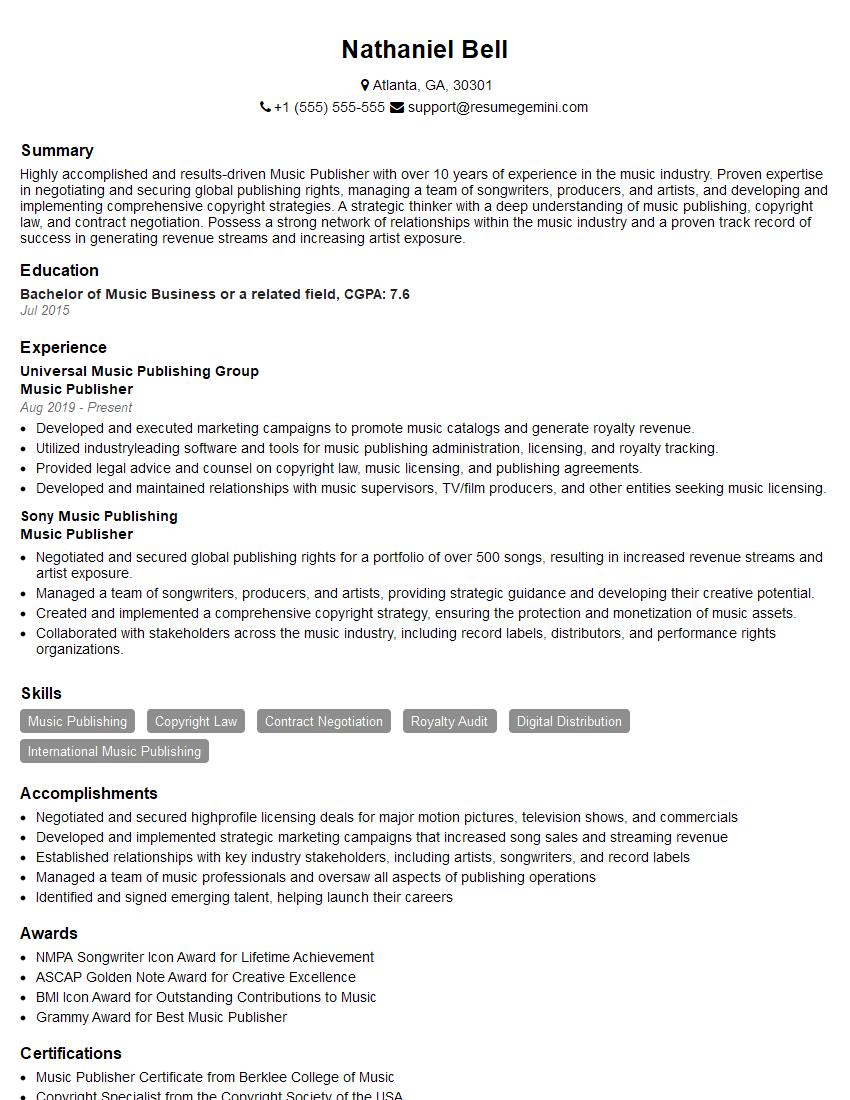
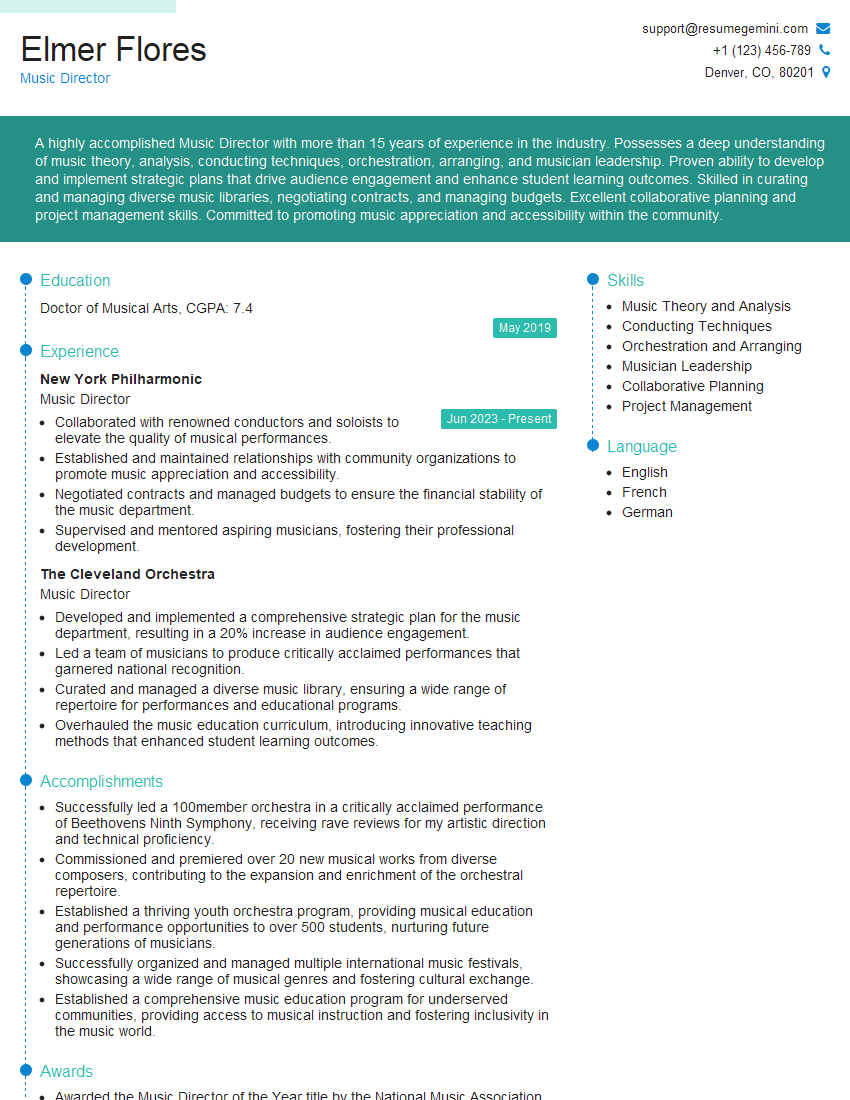
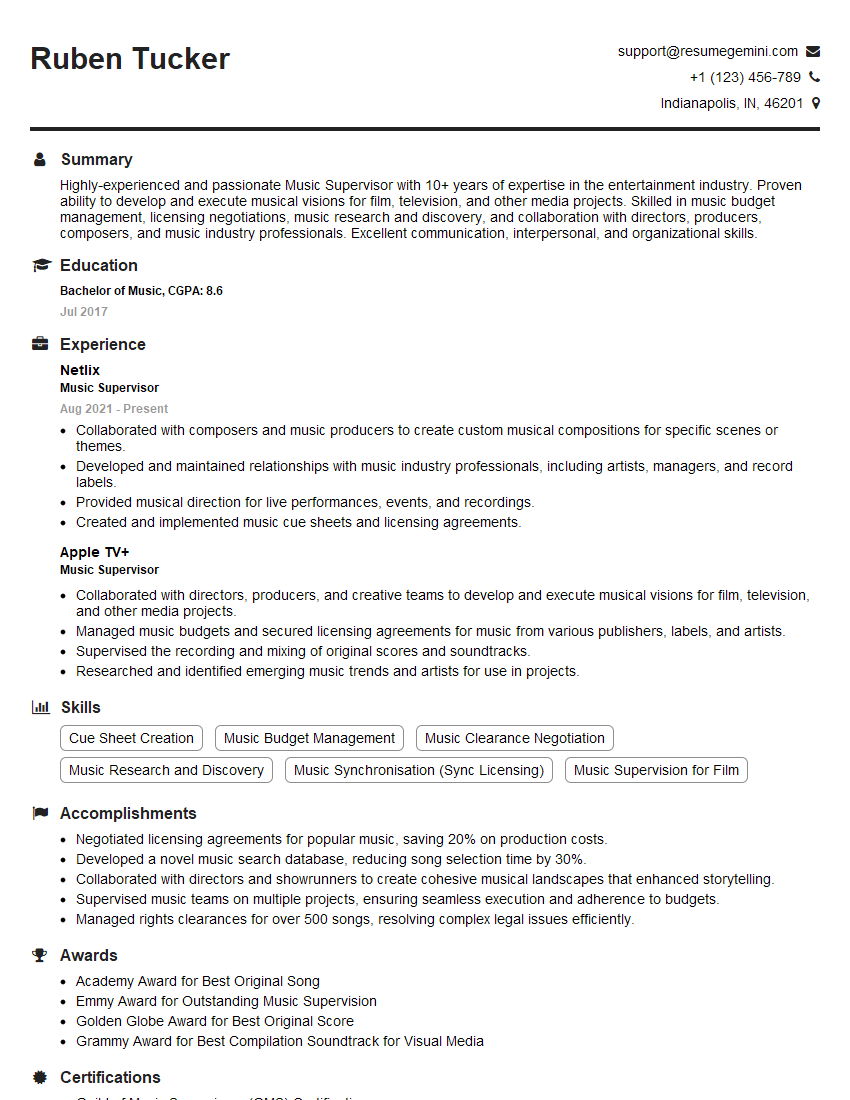
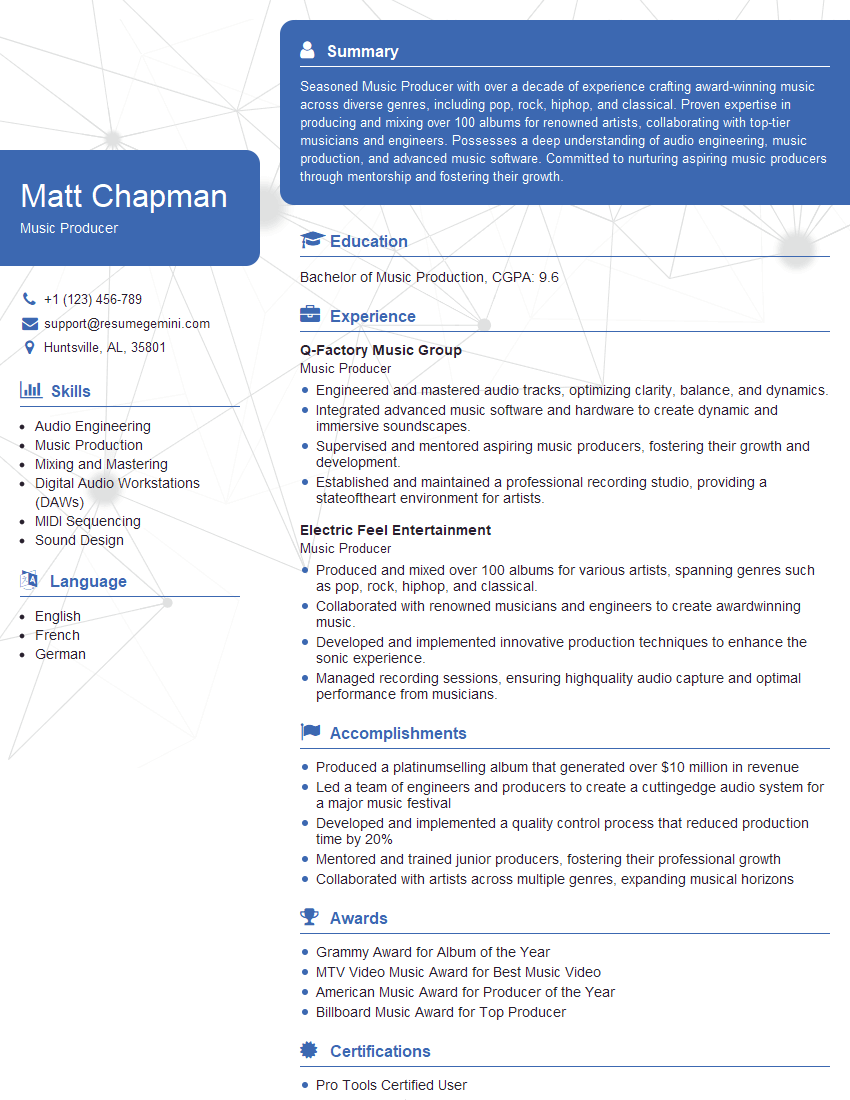
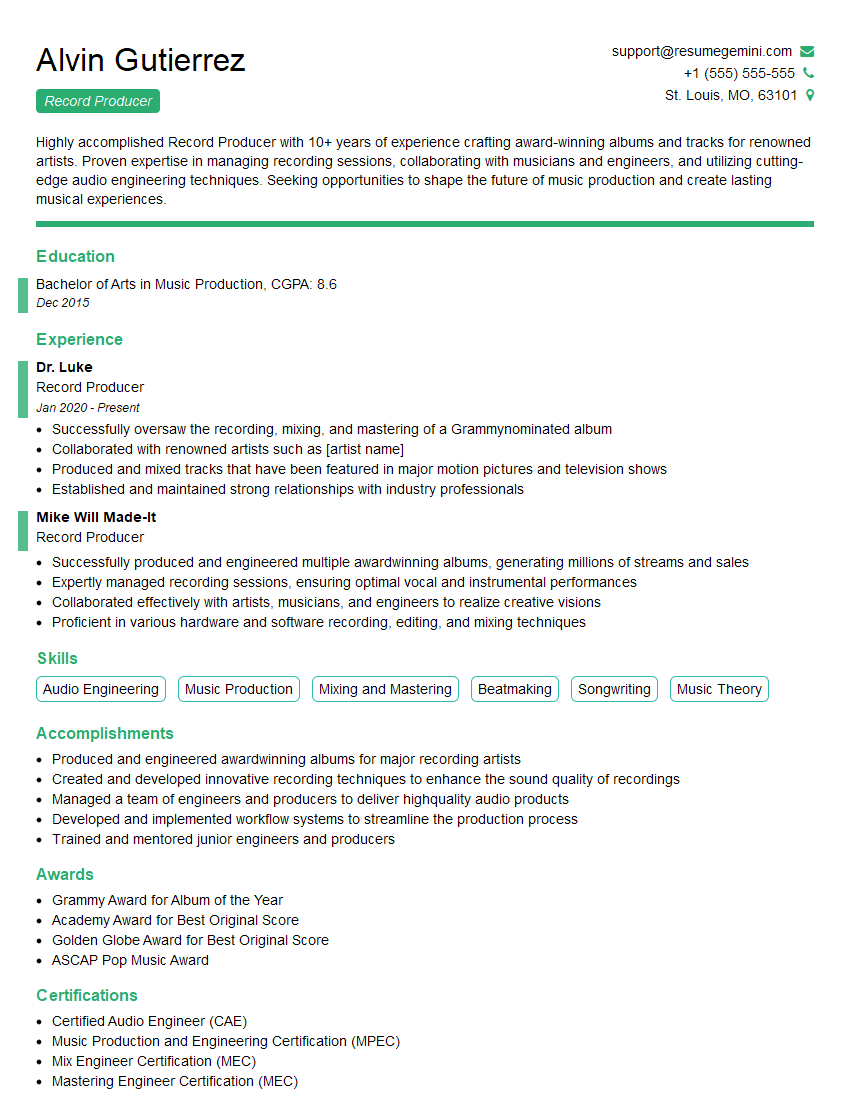
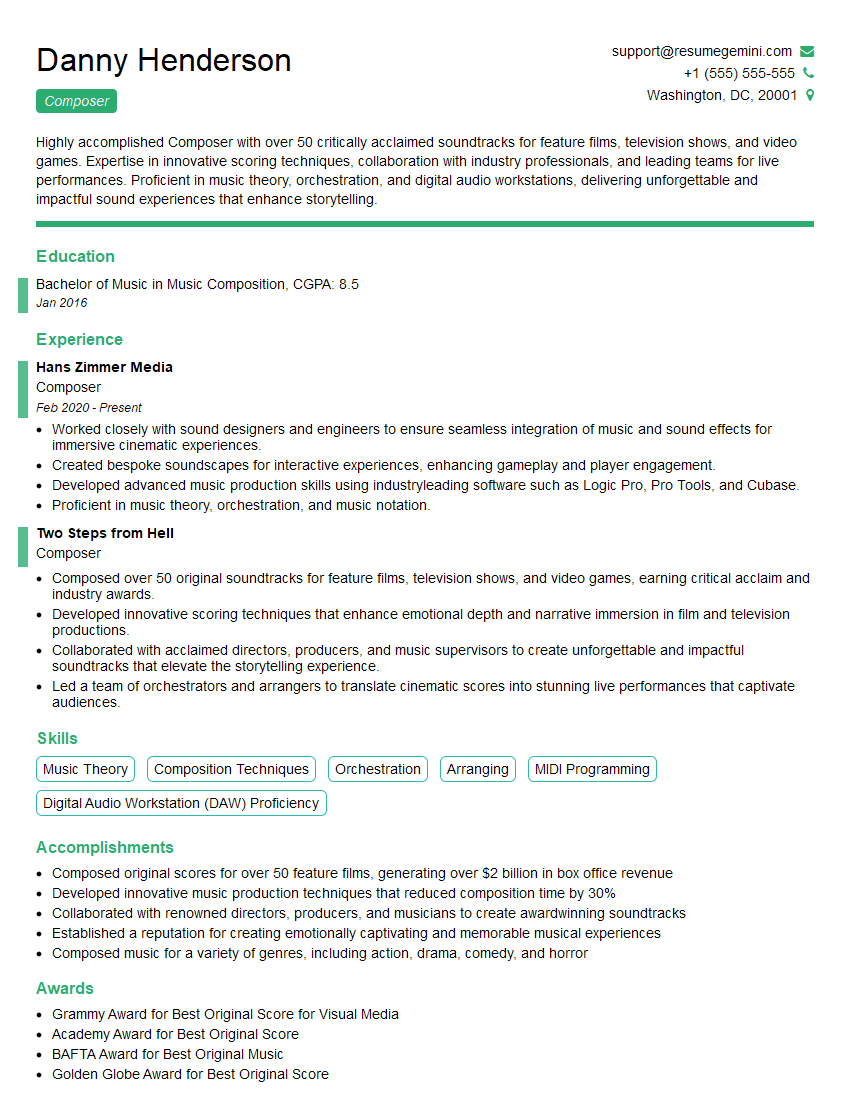
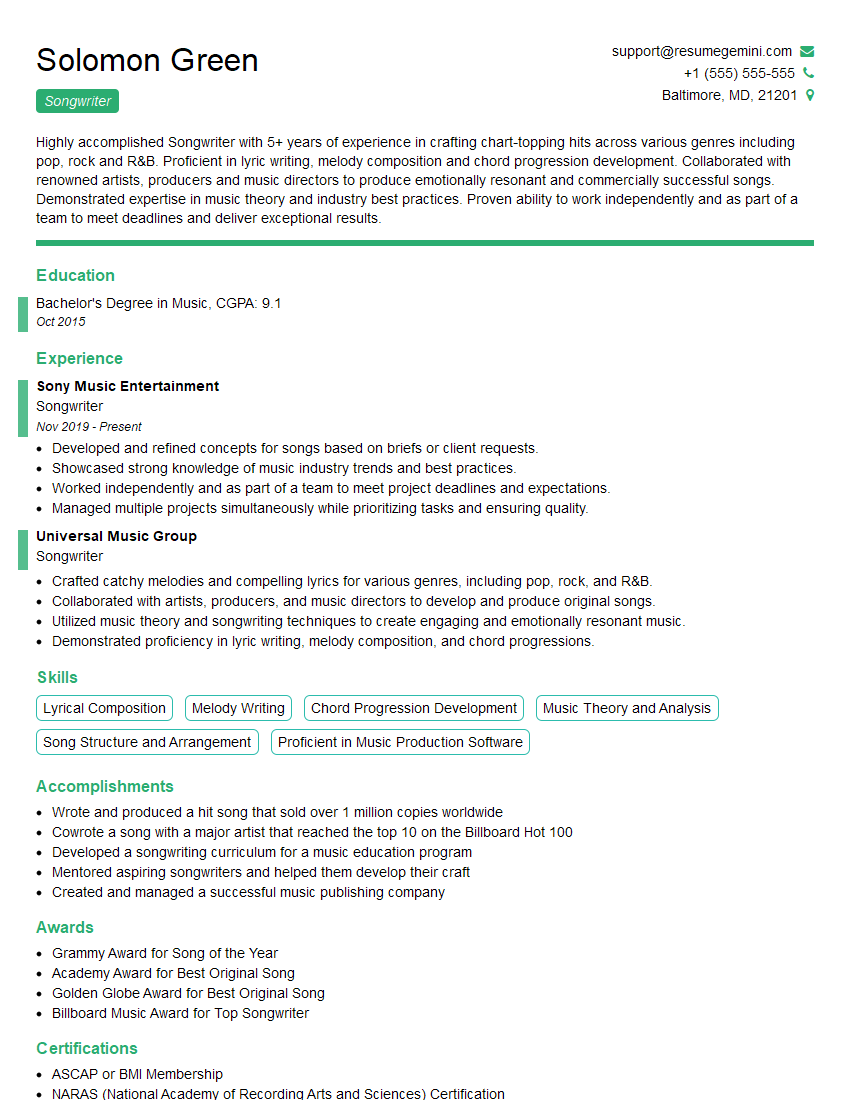
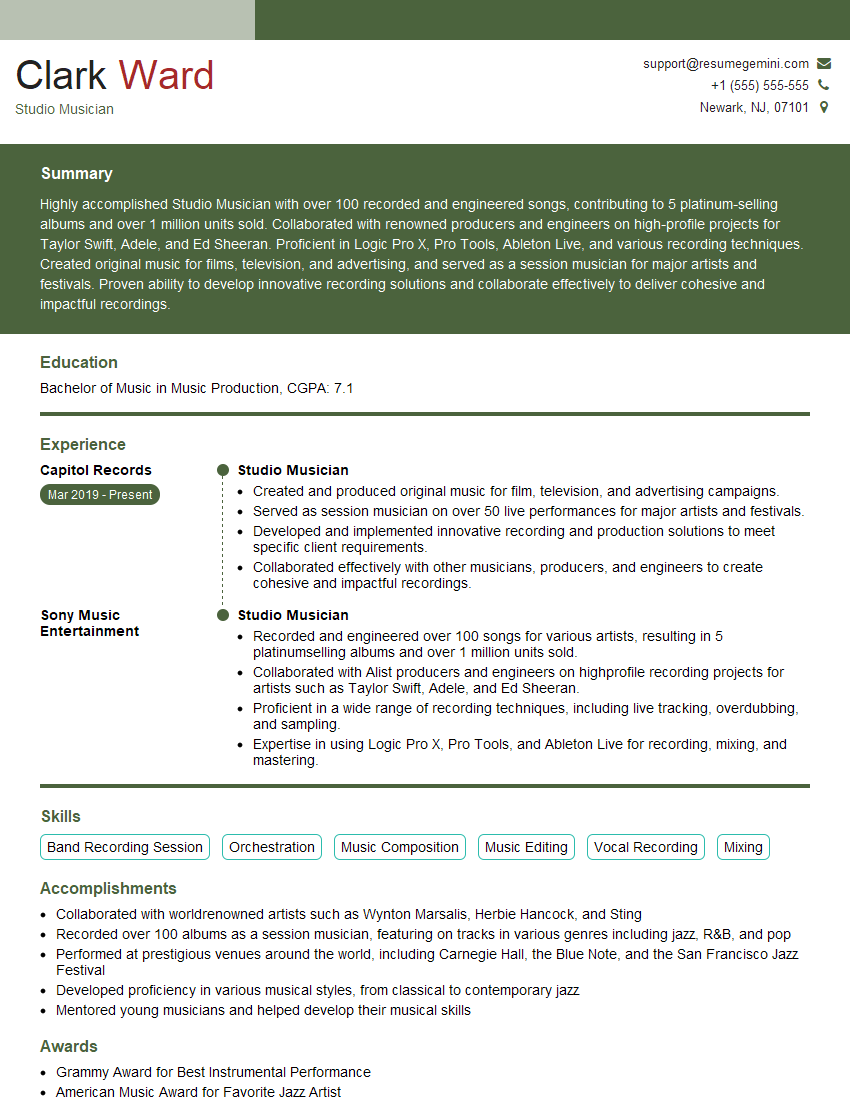
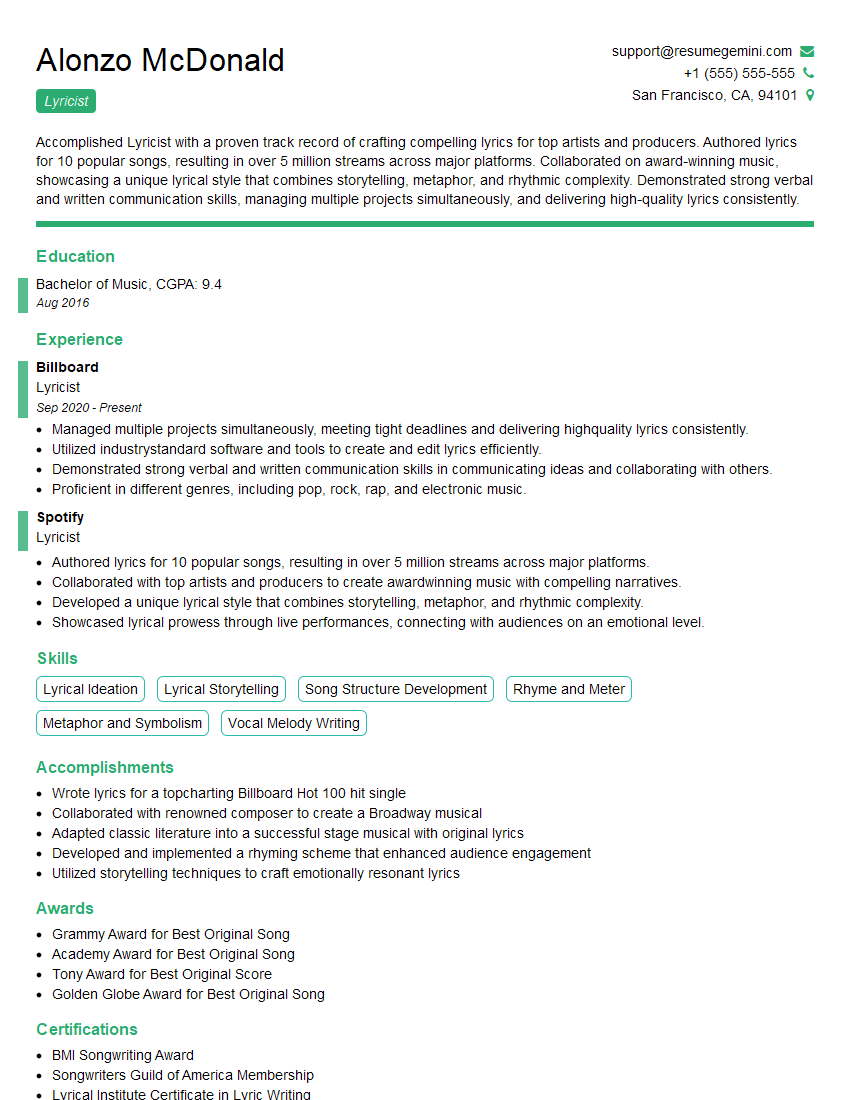
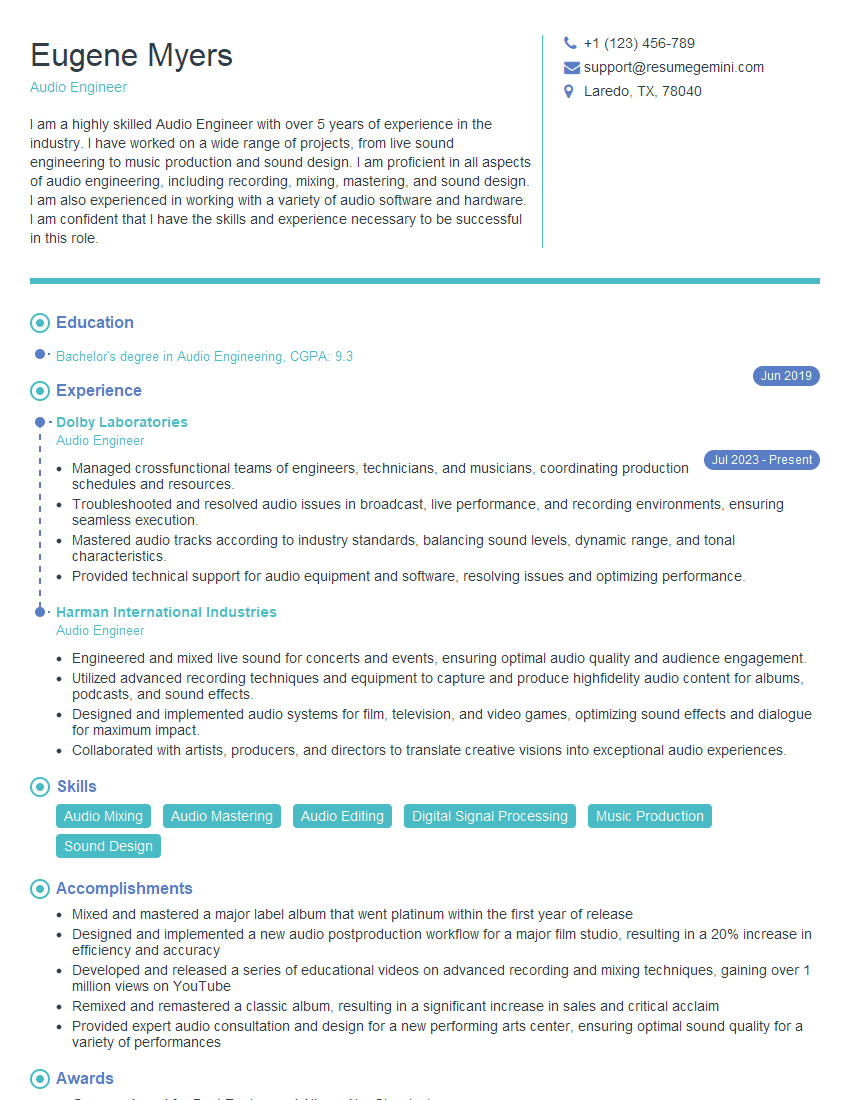
Mastering lyrical composition opens doors to exciting careers in songwriting, music production, and related fields. A strong understanding of these fundamental concepts is crucial for success. To further enhance your job prospects, create an ATS-friendly resume that effectively showcases your skills and experience. We highly recommend using ResumeGemini, a trusted resource for building professional resumes. ResumeGemini provides examples of resumes tailored to Lyrical Composition, helping you present your qualifications in the most compelling way.
Explore more articles
Users Rating of Our Blogs
Share Your Experience
We value your feedback! Please rate our content and share your thoughts (optional).
What Readers Say About Our Blog
Very informative content, great job.
good