Preparation is the key to success in any interview. In this post, we’ll explore crucial Machine Setting interview questions and equip you with strategies to craft impactful answers. Whether you’re a beginner or a pro, these tips will elevate your preparation.
Questions Asked in Machine Setting Interview
Q 1. Describe your experience with different types of machine setting processes.
My experience encompasses a wide range of machine setting processes, from traditional manual setups to advanced CNC machining. I’ve worked extensively with various machine types, including lathes, milling machines, grinders, and press brakes. Manual setups involved precise measurements and adjustments using tools like dial indicators and micrometers to achieve the desired tolerances. This required a deep understanding of mechanical principles and a keen eye for detail. For example, setting up a lathe for turning a specific diameter required careful calculation of tool offset and precise adjustment of the tailstock. With CNC machines, my experience includes programming, toolpath optimization, and setup verification using various CAM software packages. I’m proficient in G-code programming and the use of machine simulation software to avoid costly errors.
- Manual Machines: Lathes, Milling Machines, Grinders, Press Brakes
- CNC Machines: Milling Centers, Lathes, Turning Centers
Q 2. Explain the importance of precision and accuracy in machine setting.
Precision and accuracy are paramount in machine setting because they directly impact the quality, consistency, and functionality of the final product. Inaccurate setups lead to dimensional errors, surface imperfections, and potential machine damage. For instance, if a milling machine is not precisely aligned, the resulting part might be out of tolerance, requiring rework or even scrap. This not only wastes materials but also increases production time and costs. Precision is about minimizing errors during the setup process itself – ensuring the correct tools are used, and measurements are exact. Accuracy, on the other hand, relates to how closely the final product matches the design specifications. In a high-precision industry, even minor deviations can cause significant issues. Think of producing components for aerospace or medical applications; tolerances must be incredibly tight.
Q 3. How do you troubleshoot common machine malfunctions during setup?
Troubleshooting machine malfunctions during setup involves a systematic approach. I typically start by identifying the symptom – is the machine not powering on, are there unusual noises, or are the dimensions incorrect? Then, I systematically check the most likely causes. This might involve verifying power connections, checking for loose or damaged components, inspecting tooling for wear or damage, and reviewing the machine’s diagnostic messages. For example, if a CNC machine reports a tool breakage error, I would first visually inspect the tool, then check the tool length compensation settings and the spindle speed. If a manual machine is producing parts outside of tolerance, I’d check the machine’s alignment, the workpiece setup, and the tool’s sharpness. Documentation and detailed notes are essential throughout the process to track progress and identify recurring issues.
I use a systematic approach, often starting with simple checks (power, connections) and progressing to more complex diagnostics (control system checks, sensor calibration). This minimizes downtime and ensures efficiency.
Q 4. What safety procedures do you follow when setting up and operating machines?
Safety is my top priority. Before starting any machine setup, I always ensure that the machine is properly grounded, locked out, and tagged out (LOTO) to prevent accidental startup. I wear appropriate personal protective equipment (PPE), including safety glasses, hearing protection, and steel-toed shoes. I carefully review the machine’s safety manual and follow all specified procedures. Furthermore, I regularly inspect the machine for any potential hazards like loose parts or damaged wiring. During operation, I maintain a safe distance from moving parts and ensure that the work area is clean and organized. This prevents tripping hazards and facilitates efficient workflow. Finally, I always report any safety concerns or incidents immediately to my supervisor.
Q 5. Explain your experience with CNC machine programming and setup.
I have extensive experience with CNC machine programming and setup, using various CAM software such as Mastercam and Fusion 360. I’m proficient in G-code programming and post-processing. My experience includes developing efficient toolpaths, optimizing machining parameters for surface finish and cycle time, and setting up and verifying CNC programs on different machine platforms. For example, I’ve programmed complex 3D milling operations, including five-axis machining, utilizing techniques to minimize tool changes and improve machining efficiency. I regularly use machine simulation software to verify programs and prevent errors before they occur. This reduces scrap and downtime, ultimately improving productivity.
Q 6. How do you interpret engineering drawings and specifications for machine setup?
Interpreting engineering drawings and specifications is a crucial aspect of machine setting. I’m adept at reading blueprints, understanding tolerances, and identifying critical dimensions. I pay close attention to details like surface finish requirements, material specifications, and any special instructions. For example, a drawing might specify a surface roughness of Ra 0.8 µm, requiring me to select appropriate cutting tools and machining parameters to achieve that finish. I use various measurement tools such as calipers, micrometers, and dial indicators to verify dimensions during and after setup. Understanding GD&T (Geometric Dimensioning and Tolerancing) is critical for ensuring that the final part meets the specified requirements.
Q 7. Describe your experience with different types of tooling and fixtures.
My experience with tooling and fixtures includes a wide variety of cutting tools, such as end mills, drills, reamers, taps, and lathe tools. I understand the importance of selecting the right tool for the specific material and operation. For instance, high-speed steel (HSS) tools are suitable for certain materials, while carbide tools are preferred for others, especially harder materials. I also have extensive experience with various fixtures, including vises, chucks, and specialized workholding devices used for specific machining operations. Choosing the correct fixture is important for stability and accuracy. A poorly chosen fixture can lead to inaccurate parts or even damage to the workpiece or the machine. Regular inspection and maintenance of tooling and fixtures are crucial to prevent accidents and ensure consistent performance.
Q 8. How do you ensure the quality of parts produced after machine setup?
Ensuring the quality of parts after machine setup is paramount. It’s a multi-faceted process that begins even before the machine is powered on. My approach involves a rigorous system of checks and balances, focusing on preventative measures and proactive monitoring.
Pre-Setup Verification: Before even loading materials, I meticulously check the machine’s operational readiness, including tool condition, lubrication levels, and overall machine integrity. This includes verifying the accuracy of the tooling using precision measuring instruments like micrometers and dial indicators. For example, a dull cutting tool can lead to dimensional inaccuracies and surface imperfections.
Test Run and Sample Inspection: Once the machine is set up, I always conduct a test run using a small batch of material. This allows me to check the dimensional accuracy, surface finish, and overall quality of the produced parts. I use various inspection tools, like CMM (Coordinate Measuring Machine) for complex parts, or simpler tools like calipers and height gauges for simpler geometries. Any deviations from specifications are immediately investigated and corrected.
Statistical Process Control (SPC): I utilize SPC techniques to monitor the ongoing production process and to detect any variations in part quality. This involves regularly collecting and analyzing data, plotting control charts to identify trends, and taking corrective actions if necessary. This prevents small variations from escalating into major quality issues.
Continuous Improvement: Quality control is not a one-time event but a continuous cycle. I actively participate in root cause analysis of any quality problems, implement corrective actions, and use data analysis to fine-tune machine settings and processes for optimal performance. For instance, if we consistently observe burrs on a particular edge of the part, we can adjust the cutting parameters or tooling to rectify this.
Q 9. How do you manage and prioritize multiple machine setup tasks?
Managing multiple machine setup tasks requires effective prioritization and organization. I use a combination of techniques to ensure that tasks are completed efficiently and in the order of importance.
Prioritization Matrix: I utilize a prioritization matrix, considering factors such as due dates, urgency, complexity, and resource requirements. Tasks with critical deadlines and high impact are given top priority.
Scheduling and Planning: I carefully plan the sequence of setup tasks, considering machine dependencies and resource availability. This might involve scheduling certain setups for less busy periods or grouping similar tasks together to optimize workflow.
Kanban System (Visual Management): A visual management system, such as a Kanban board, helps in tracking the progress of multiple setups and identifying any potential bottlenecks. This provides a clear overview of the workflow and allows for timely intervention if necessary.
Communication and Collaboration: Open communication with other team members, such as production supervisors and machine operators, is vital to ensure that everyone is aware of the schedule and any potential disruptions. This ensures a smooth workflow and prevents delays.
For instance, I recently managed three concurrent setups – one involving a high-precision CNC machine for a critical component, a simpler milling machine task, and a lathe setup. By prioritizing the CNC task due to its tight deadline and intricacy, and effectively scheduling the other tasks around it, I ensured all three were completed on time without compromising quality.
Q 10. What is your experience with preventative maintenance on machines?
Preventative maintenance is crucial for maximizing machine uptime and preventing costly breakdowns. My experience includes a wide range of preventative maintenance tasks, from routine inspections to more complex procedures.
Regular Inspections: I perform regular visual inspections, checking for wear and tear on components, lubrication levels, and the overall condition of the machine. This includes examining belts, pulleys, gears, and other moving parts for any signs of damage.
Lubrication and Cleaning: Proper lubrication is essential for reducing friction and extending the lifespan of machine components. I adhere to manufacturer’s recommendations for lubrication schedules and types of lubricants. Regularly cleaning the machine removes debris and prevents build-up, which can cause malfunctions.
Scheduled Maintenance: I follow manufacturer-recommended schedules for more complex maintenance tasks, such as replacing worn-out parts, adjusting machine settings, and performing calibration checks. This ensures the machine operates within its specified tolerances and maintains its accuracy.
Record Keeping: I meticulously maintain detailed records of all preventative maintenance activities, including dates, tasks performed, and any findings. This data helps track machine performance, predict potential issues, and optimize maintenance schedules.
For example, during my previous role, I implemented a predictive maintenance program using vibration sensors on our CNC lathes. This allowed us to detect bearing wear early on, preventing catastrophic failures and minimizing downtime.
Q 11. How do you handle unexpected machine issues during production runs?
Unexpected machine issues during production runs are inevitable, but a systematic approach can minimize their impact. My strategy focuses on swift diagnosis, efficient troubleshooting, and proactive measures to prevent recurrence.
Immediate Assessment: Upon encountering an issue, I immediately assess the situation to determine the severity and potential causes. This often involves checking error codes, monitoring machine parameters, and assessing the physical state of the machine.
Troubleshooting: Based on my assessment, I systematically troubleshoot the problem, starting with the most likely causes. This could involve checking electrical connections, air pressure, coolant flow, or other relevant parameters.
Resource Utilization: I don’t hesitate to utilize available resources, including manufacturer documentation, online forums, or colleagues with specialized expertise, if I need further assistance.
Temporary Workarounds (if safe): In some cases, temporary workarounds may be necessary to minimize production downtime while awaiting permanent repairs. This might involve using a backup machine or adjusting processing parameters.
Root Cause Analysis: Once the issue is resolved, I conduct a root cause analysis to identify the underlying cause and implement preventative measures to avoid future occurrences. This may include improving maintenance procedures or modifying operating protocols.
For example, I once encountered a sudden power surge that caused a CNC machine to malfunction. After quickly isolating the problem and securing the area, I worked with the electrical team to fix the issue and implemented surge protectors to prevent future problems.
Q 12. Explain your proficiency with various measuring tools and techniques.
Proficiency with measuring tools and techniques is fundamental to my work. I am adept at using a wide range of instruments and techniques to ensure dimensional accuracy and quality control.
Precision Measuring Instruments: I am experienced with using various instruments, including micrometers, calipers, dial indicators, height gauges, and CMMs (Coordinate Measuring Machines). Each tool has its specific application and accuracy level, and I select the appropriate tool based on the requirements of the task and the complexity of the part.
Measurement Techniques: My understanding extends to various measurement techniques, such as direct measurement, comparison measurement, and indirect measurement using trigonometric principles. I understand the importance of proper measurement techniques to minimize errors and ensure reliable results.
Data Interpretation: I’m proficient in interpreting measurement data and using statistical methods to assess the accuracy and precision of measurements. This ensures that measurement results are reliable and can be used to make informed decisions about part quality.
Tolerance Analysis: I possess a strong understanding of engineering tolerances and can interpret and apply tolerances during the setup and inspection process. This is vital for ensuring that produced parts meet the specified requirements.
For example, when setting up a complex part on a CNC machine, I’d use a CMM to verify the accuracy of the setup, checking dimensions and angles against the CAD model to ensure tight tolerances are met.
Q 13. Describe your experience with different types of materials and their machining properties.
My experience encompasses a wide range of materials with diverse machining properties. Understanding these properties is critical for selecting appropriate machining parameters and tools to achieve optimal results.
Metals: I have extensive experience machining various metals, including steel (various grades), aluminum, brass, titanium, and stainless steel. I understand their differing machinability characteristics, such as hardness, toughness, and tendency to work-harden. For instance, high-speed steel tools are often necessary for machining harder materials like hardened steel.
Plastics: My experience includes machining various plastics, including ABS, acrylic, polycarbonate, and nylon. I understand the importance of using appropriate cutting speeds and feeds to avoid excessive heat buildup and material melting or deformation.
Composites: I’ve worked with composite materials like carbon fiber reinforced polymers (CFRP), requiring specialized tooling and machining techniques to prevent fiber damage and achieve a smooth surface finish.
Material Selection: I understand the importance of material selection based on the application requirements, taking into account factors like strength, weight, cost, and machinability. This ensures the selection of the most appropriate material for the intended use.
For example, when machining titanium, I would use specialized tooling and cutting fluids designed for that material’s unique properties to achieve the desired surface finish and prevent tool breakage.
Q 14. How do you optimize machine settings for efficiency and productivity?
Optimizing machine settings for efficiency and productivity is an ongoing process requiring a combination of experience, knowledge, and data-driven decision making.
Cutting Parameters: This involves careful selection of cutting speed (SFM), feed rate (IPM), and depth of cut. These parameters must be optimized based on the material being machined, the tool geometry, and the desired surface finish. Incorrect settings can lead to tool wear, poor surface finish, or even machine damage.
Tool Selection: Choosing the right cutting tool is critical for both efficiency and quality. Factors to consider include tool material, geometry, and coating. For example, a carbide tool would be preferred over a high-speed steel tool for machining harder materials.
Workholding: Secure workholding is essential to prevent workpiece movement during machining. This ensures accurate part dimensions and prevents damage to both the part and the machine. Using appropriate fixtures and clamps is vital for efficient and safe machining operations.
Data Analysis: Monitoring and analyzing machine data, including cutting forces, spindle power, and surface roughness, provides insights into process efficiency. This data allows for adjustments to machine settings to achieve optimal results and identify potential problems.
Continuous Improvement: Optimization is an iterative process. By continuously monitoring machine performance and refining settings based on data analysis, I continuously strive to improve efficiency and productivity.
For example, using data from the machine’s built-in monitoring system, I was able to increase the cutting speed by 15% for a particular operation on aluminum without compromising quality, resulting in a significant increase in productivity.
Q 15. How do you document your machine setup procedures and settings?
Documenting machine setup procedures and settings is crucial for reproducibility, training, and troubleshooting. My approach involves a multi-layered system combining written procedures, visual aids, and digital record-keeping.
Written Procedures: I create detailed, step-by-step instructions using a standardized format. This includes equipment specifics, parameters (like speeds, temperatures, pressures), sequence of actions, safety precautions, and expected outcomes. I use clear, concise language, avoiding jargon whenever possible. An example would be a procedure for setting up a CNC milling machine, detailing the tool selection, work-piece clamping, and zero-point setting process.
Visual Aids: Pictures, diagrams, and even short videos are invaluable for clarifying complex steps. A picture showing the correct placement of a sensor or a video demonstrating the proper tool change procedure can prevent errors and speed up training.
Digital Record-Keeping: I utilize digital databases or software specifically designed for documenting machine settings. This allows for easy searching, version control, and tracking of changes over time. Data logging from the machine itself (if available) is incorporated to provide objective evidence of the setup parameters.
This multi-pronged approach ensures that anyone can reliably replicate the machine setup and troubleshoot issues effectively, minimizing downtime and maximizing efficiency.
Career Expert Tips:
- Ace those interviews! Prepare effectively by reviewing the Top 50 Most Common Interview Questions on ResumeGemini.
- Navigate your job search with confidence! Explore a wide range of Career Tips on ResumeGemini. Learn about common challenges and recommendations to overcome them.
- Craft the perfect resume! Master the Art of Resume Writing with ResumeGemini’s guide. Showcase your unique qualifications and achievements effectively.
- Don’t miss out on holiday savings! Build your dream resume with ResumeGemini’s ATS optimized templates.
Q 16. What is your experience with statistical process control (SPC)?
Statistical Process Control (SPC) is integral to maintaining consistent product quality. My experience encompasses implementing and interpreting control charts, identifying trends, and making data-driven adjustments to machine settings.
Control Charts: I’m proficient in using various control charts like X-bar and R charts, p-charts, and c-charts, depending on the type of data being collected. I understand how to identify patterns indicating out-of-control processes, such as shifts, trends, or unusual variations. For instance, an X-bar and R chart tracking the diameter of a machined part helps monitor process stability and detect potential issues before they escalate.
Process Capability Analysis: I can perform capability studies (Cp and Cpk calculations) to assess the ability of a process to meet specified tolerances. This data guides decisions on machine adjustments or process improvements.
Data Analysis and Interpretation: I use statistical software to analyze data from control charts and identify root causes of variations. This allows for proactive adjustments to machine parameters and process improvements to reduce variability and increase efficiency.
I find SPC incredibly useful for identifying and resolving problems before they lead to significant quality issues or waste. It’s a powerful tool for continuous improvement.
Q 17. Describe your experience with machine calibration and verification.
Machine calibration and verification are critical for ensuring accuracy and reliability. My experience covers a range of techniques and equipment.
Calibration Procedures: I follow established calibration procedures, using certified standards and traceable measurement equipment. This involves adjusting the machine to meet predefined specifications and documenting the entire process. For example, I’ve calibrated CNC machine axes using laser interferometry to ensure precise positional accuracy.
Verification Methods: After calibration, I verify the machine’s performance using various methods, including test runs with calibrated parts and measurement tools. I meticulously document the results, comparing them to established tolerances. Deviation analysis helps identify areas needing further attention.
Calibration Records: I maintain comprehensive records of all calibrations, including dates, equipment used, results, and any corrective actions taken. This ensures traceability and compliance with industry standards.
Regular calibration and verification are essential for maintaining quality and preventing costly errors. It’s a proactive approach that ensures the machine continues to perform within its specified tolerances.
Q 18. How do you handle deviations from specified tolerances during machine setup?
When deviations from specified tolerances occur during machine setup, a systematic approach is crucial.
Identify the Root Cause: The first step is to meticulously investigate the source of the deviation. This may involve checking machine settings, tool condition, material properties, or even environmental factors. Tools like SPC charts can be incredibly helpful here.
Implement Corrective Actions: Based on the identified root cause, corrective actions are taken. This might involve adjusting machine parameters, replacing worn tools, or modifying the process. For example, if the deviation is due to tool wear, replacing the tool would be the obvious solution. If it’s due to a specific machine setting being off, adjusting that parameter would be needed.
Verify the Correction: After implementing corrective actions, the machine’s performance is verified using test runs and measurements. This ensures that the issue is resolved and the machine is producing parts within tolerances.
Document the Process: All steps, from identifying the deviation to implementing and verifying the correction, are thoroughly documented. This allows for future reference and contributes to continuous improvement efforts. It’s key to understand what caused the problem to prevent recurrence.
This systematic approach helps ensure that deviations are addressed promptly and effectively, minimizing waste and maximizing output.
Q 19. Explain your experience with different types of machine controls (e.g., PLC, HMI).
My experience encompasses various machine controls, including Programmable Logic Controllers (PLCs) and Human-Machine Interfaces (HMIs).
PLCs: I’m comfortable working with various PLC platforms, understanding ladder logic and programming languages like Structured Text. I can troubleshoot PLC programs, modify existing code, and create new programs as needed. For example, I’ve worked with Allen-Bradley PLCs to program automated assembly lines, adjusting control logic to optimize cycle times and reduce waste.
HMIs: I’m proficient in configuring and operating HMIs for various machine types. This includes creating user interfaces for operators, configuring alarm systems, and accessing machine data for monitoring and analysis. For instance, I have designed and implemented HMIs that provide real-time monitoring of critical process parameters, facilitating faster response to any anomalies.
Understanding PLCs and HMIs is fundamental to effective machine setup and operation. They provide the control and monitoring capabilities necessary for efficient and reliable manufacturing processes.
Q 20. How do you collaborate with other team members during machine setup and operation?
Collaboration is key to successful machine setup and operation. My approach to teamwork focuses on clear communication, shared responsibility, and mutual respect.
Pre-Setup Planning: Before any setup begins, I collaborate with other team members—maintenance technicians, operators, engineers—to review the specifications, discuss potential challenges, and assign responsibilities. This ensures everyone is on the same page.
Open Communication: I maintain open communication channels throughout the setup process. This includes regular updates, brainstorming sessions, and feedback loops. This ensures that any issues are identified and addressed promptly.
Shared Ownership: I believe in fostering a shared sense of ownership of the machine setup process. This encourages teamwork, collaboration, and a commitment to quality and efficiency.
Successful teamwork ensures a smooth and efficient setup process, minimizing errors and delays.
Q 21. Describe a time you had to troubleshoot a complex machine setup issue.
During the setup of a high-speed automated packaging machine, we experienced consistent jams in the final sealing stage. The machine was new, and the initial setup parameters seemed correct. After several days of troubleshooting, the usual methods—checking sensors, adjusting timing belts, and reviewing the PLC program—didn’t reveal the cause.
We decided to use a more systematic approach. We broke down the process into smaller steps, carefully recording the machine’s behavior at each stage using high-speed cameras. This revealed that a minute vibration in one of the conveyor belts was causing the packages to slightly misalign, leading to jams. The vibration, almost imperceptible to the naked eye, was traced to a faulty bearing in a seemingly unrelated part of the machine.
Replacing that bearing resolved the issue entirely. This experience highlighted the value of a detailed, methodical approach to troubleshooting, even when the root cause is not immediately obvious. Using high-speed cameras gave us critical insights that other methods couldn’t provide.
Q 22. How do you stay updated on the latest advancements in machine setting technology?
Staying current in the dynamic field of machine setting requires a multi-pronged approach. I actively participate in professional organizations like the Society of Manufacturing Engineers (SME) and attend industry conferences and workshops to learn about the latest innovations. This allows me to network with other experts and discover cutting-edge technologies firsthand. I also subscribe to relevant trade publications and journals, such as Manufacturing Engineering and Industry Week, and regularly read research papers published in academic databases like IEEE Xplore. Finally, online platforms like LinkedIn and specialized forums provide valuable insights into new trends and best practices. For example, recently I learned about a new type of automated lubrication system that significantly reduces downtime and maintenance costs through a webinar hosted by a leading machine tool manufacturer. This constant learning ensures I’m always equipped with the latest knowledge and techniques.
Q 23. What are your strengths and weaknesses in machine setting?
My strengths lie in my meticulous attention to detail and my problem-solving abilities. I’m highly proficient in various machine setting techniques, including precision alignment, calibration, and troubleshooting. My experience with a wide range of CNC machines, from lathes and mills to robotic systems, makes me adaptable and versatile. I’m also a strong communicator, able to explain technical concepts clearly to both technical and non-technical audiences. This is crucial for collaborative projects. An example of this is when I successfully diagnosed and resolved a complex production bottleneck by systematically checking each stage of the machine’s operation. My weakness, if I had to identify one, is occasionally getting overly focused on perfectionism, which can sometimes impact my speed of execution. However, I’m actively working on mitigating this by prioritizing tasks and focusing on efficient workflows.
Q 24. What are your salary expectations for this role?
My salary expectations are in line with the industry standard for a machine setting professional with my experience and skillset. I’m open to discussing this further once we’ve had a chance to explore the specifics of the role and its responsibilities. My primary focus is on finding a challenging and rewarding position where I can contribute meaningfully and grow professionally.
Q 25. Why are you interested in this specific machine setting position?
I’m particularly interested in this position because of [Company Name]’s reputation for innovation and its commitment to employee development. The opportunity to work with [Specific Machine/Technology mentioned in job description] is particularly exciting, as it aligns perfectly with my career goals. Furthermore, the collaborative work environment described in the job posting appeals to my team-oriented approach to problem-solving. I believe my skills and experience would be a valuable asset to your team, and I’m eager to contribute to your continued success.
Q 26. What are your long-term career goals related to machine setting?
My long-term career goals involve becoming a leading expert in advanced machine setting techniques, potentially specializing in areas like automation and robotics. I envision myself taking on leadership roles within a manufacturing company, mentoring younger technicians, and contributing to the development and implementation of innovative manufacturing processes. I’m also interested in pursuing certifications to enhance my expertise and demonstrate my commitment to continuous professional development. The ultimate goal is to significantly contribute to advancements in manufacturing efficiency and precision.
Q 27. Describe your experience working under pressure and meeting deadlines.
Working under pressure and meeting deadlines is a routine part of my job. I thrive in fast-paced environments. I use several strategies to manage pressure effectively: Prioritization, careful planning, and proactive communication. For instance, when faced with a tight deadline for setting up a new production line, I systematically broke down the task into smaller, manageable steps, creating a detailed schedule with clear milestones. I then proactively communicated any potential challenges to my team, allowing for collaborative problem-solving and ensuring we met the deadline. My ability to remain calm and focused under pressure, coupled with my organized approach, has consistently enabled me to deliver high-quality results within tight constraints.
Q 28. How do you ensure workplace safety while working with machines?
Workplace safety is my top priority. My approach to ensuring safety begins with meticulous adherence to all safety protocols and regulations. This includes wearing appropriate personal protective equipment (PPE), such as safety glasses, hearing protection, and steel-toed boots, and regularly inspecting machinery for any signs of damage or malfunction. I’m also trained in lockout/tagout procedures, ensuring that machines are properly de-energized before any maintenance or repair work is performed. Moreover, I actively participate in safety training programs and proactively identify potential hazards, reporting them to the appropriate personnel immediately. I believe a proactive and vigilant approach to safety is essential for maintaining a productive and injury-free work environment. For instance, during a recent project, I noticed a worn-out cable on a machine and immediately reported it, preventing a potential electrical hazard.
Key Topics to Learn for Machine Setting Interview
- Machine Setup and Calibration: Understanding the process of setting up different types of machines, calibrating tools and ensuring precision.
- Troubleshooting and Maintenance: Identifying and resolving common machine malfunctions, performing preventative maintenance, and understanding safety protocols.
- Process Optimization: Analyzing machine performance, identifying areas for improvement in efficiency and speed, and implementing changes to enhance output.
- Quality Control: Implementing quality checks throughout the process to ensure products meet specifications and identifying solutions to quality issues.
- Safety Procedures and Regulations: Understanding and adhering to all relevant safety regulations and procedures to maintain a safe work environment.
- Blueprint Reading and Interpretation: Accurately interpreting technical drawings and specifications to ensure correct machine setup and operation.
- Material Handling and Storage: Safe and efficient handling of materials used in the machine setting process and understanding proper storage techniques.
- Data Analysis and Reporting: Collecting and analyzing data related to machine performance, identifying trends, and creating reports for management.
- Working with different machine types: Demonstrating familiarity with various machine types (CNC, injection molding, etc.) and their unique setup requirements.
- Problem-solving and critical thinking: Applying analytical skills to diagnose problems, develop solutions and make effective decisions under pressure.
Next Steps
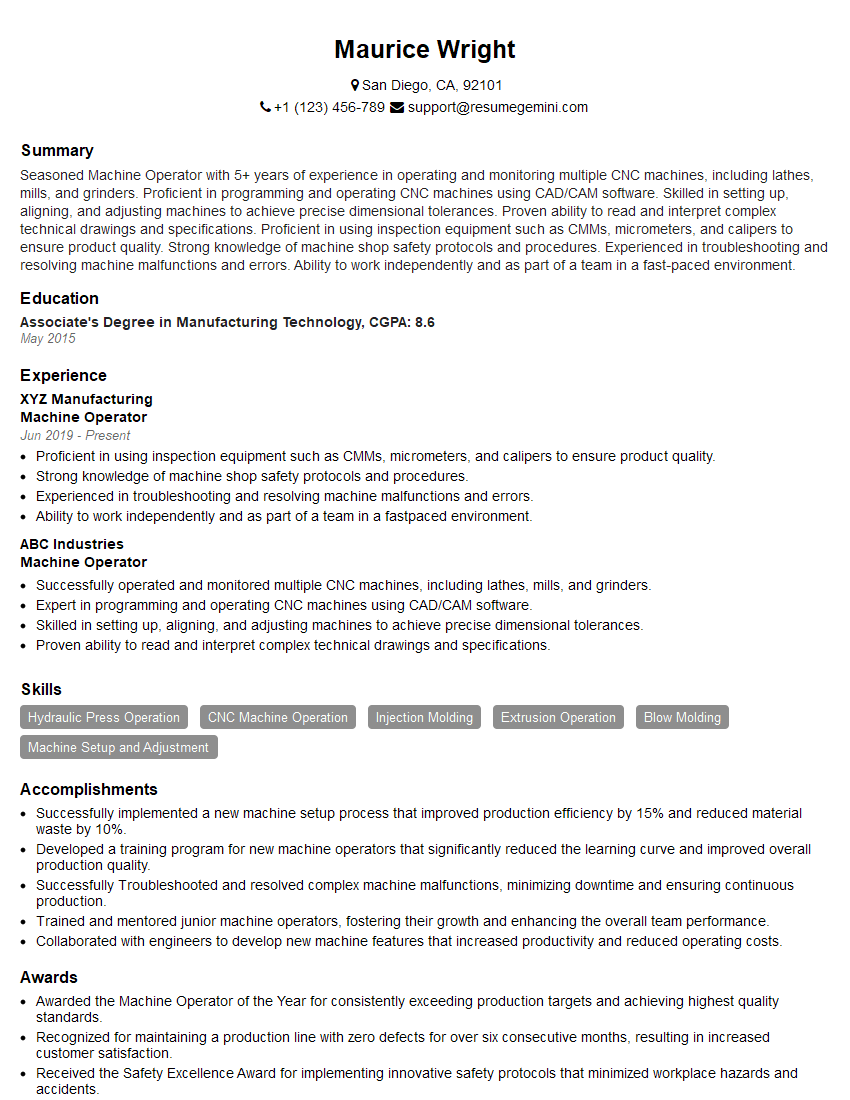
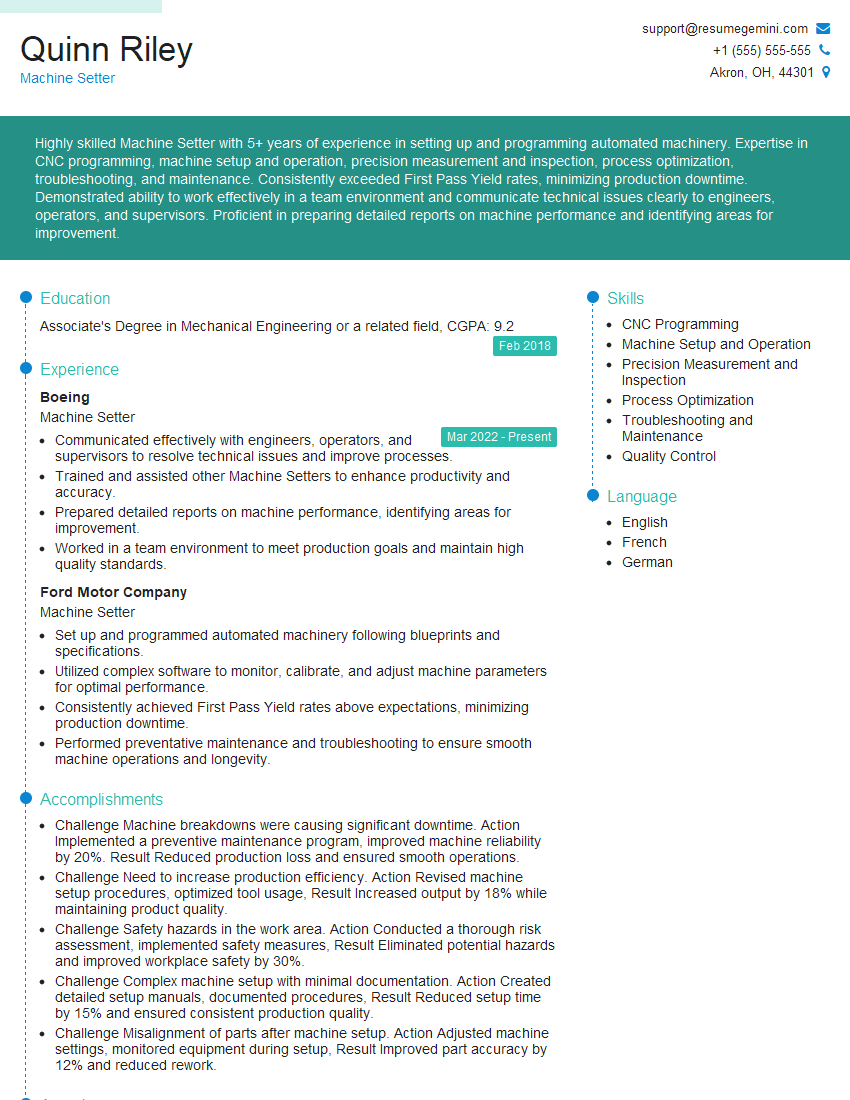
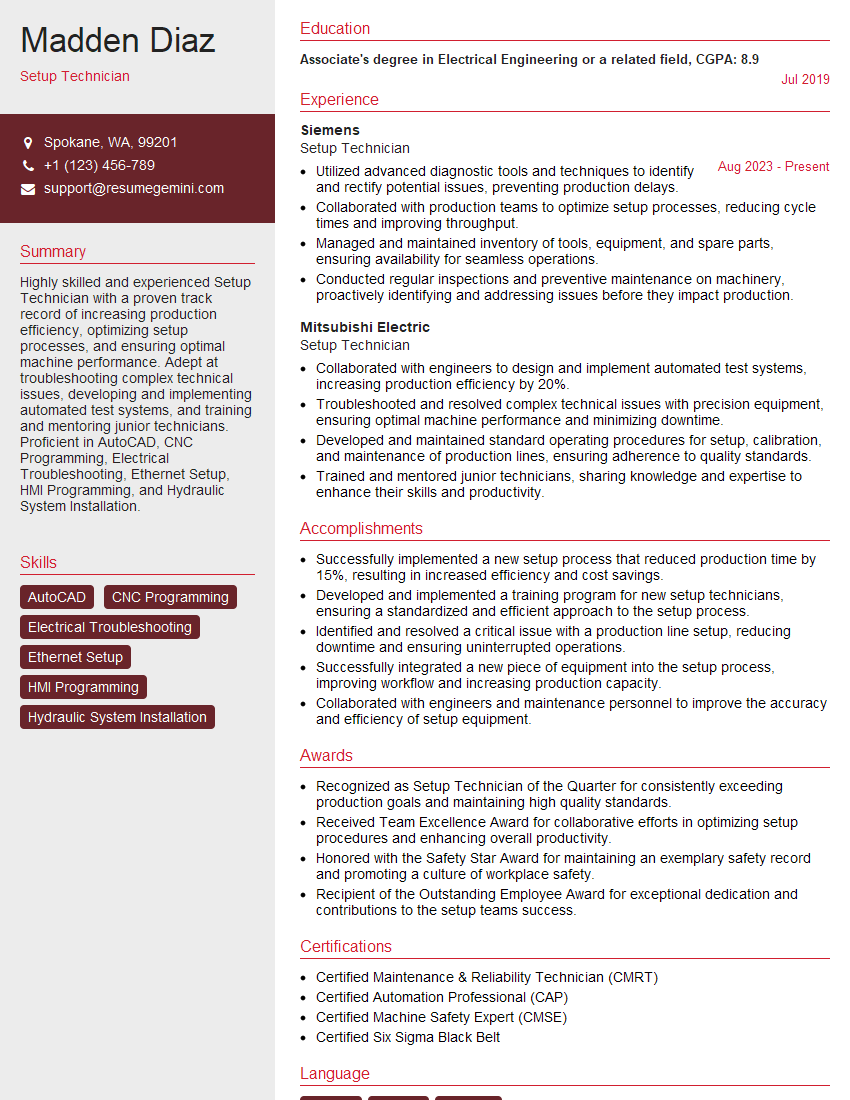
Mastering machine setting opens doors to exciting career opportunities with excellent growth potential in manufacturing and related industries. A strong foundation in these skills, coupled with a well-crafted resume, will significantly increase your chances of landing your dream job. To make your application stand out, create an ATS-friendly resume that highlights your technical expertise and achievements. We recommend using ResumeGemini, a trusted resource for building professional resumes. ResumeGemini provides examples of resumes tailored to the Machine Setting field, helping you showcase your skills and experience effectively.
Explore more articles
Users Rating of Our Blogs
Share Your Experience
We value your feedback! Please rate our content and share your thoughts (optional).
What Readers Say About Our Blog
Very informative content, great job.
good