Every successful interview starts with knowing what to expect. In this blog, we’ll take you through the top Marble Tile Setting interview questions, breaking them down with expert tips to help you deliver impactful answers. Step into your next interview fully prepared and ready to succeed.
Questions Asked in Marble Tile Setting Interview
Q 1. Describe your experience with different types of marble tile.
My experience encompasses a wide range of marble tiles, from classic Carrara and Calacatta to more exotic varieties like Emperador and Nero Marquina. Each type presents unique challenges and opportunities. Carrara, for instance, is known for its delicate veining and requires careful handling to avoid chipping. Emperador, with its rich, warm tones, can be more forgiving but still needs precision cutting. I’ve worked with various finishes too – polished, honed, and tumbled – each demanding a slightly different approach to installation and maintenance. For example, polished marble shows scratches more readily, requiring extra care during the setting process. Understanding the specific characteristics of each type of marble is crucial for a successful installation.
- Carrara Marble: Requires delicate handling due to its veining.
- Calacatta Marble: Known for its dramatic veining and luxurious appearance.
- Emperador Marble: A more durable option with a rich, warm tone.
- Nero Marquina Marble: A dramatic black marble with striking white veining.
Q 2. What methods do you use to ensure proper tile leveling and spacing?
Achieving perfectly level and evenly spaced tiles is paramount for a professional finish. I utilize a combination of methods to ensure accuracy. First, I always start with a perfectly level substrate – this is non-negotiable. Then, I use tile leveling systems, like wedges and clips, to maintain consistent height between tiles throughout the installation. These systems are particularly helpful with larger format marble tiles where minor discrepancies are easily magnified. For spacing, I employ calibrated spacers of consistent thickness, ensuring uniform grout lines. Regular checks with a level and straight edge throughout the process are crucial to catch any deviations early. Think of it like building a brick wall; each brick (tile) needs to be precisely placed to create a strong, aesthetically pleasing structure.
- Tile Leveling Systems: Maintain consistent height between tiles.
- Calibrated Spacers: Ensure uniform grout lines.
- Regular Level and Straight Edge Checks: Catch deviations early.
Q 3. Explain your process for cutting marble tiles to fit various shapes and sizes.
Cutting marble tiles requires precision and the right tools. I primarily use a wet saw with a diamond blade specifically designed for marble. This minimizes chipping and cracking. For intricate cuts or curved surfaces, I may use an angle grinder with a diamond blade, working slowly and carefully to avoid heat damage. Prior to cutting, I always mark the tile precisely to ensure accurate dimensions. For complex shapes, I often create templates from cardboard or other material to guide the cutting process. It’s like sculpting; each cut needs to be deliberate and accurate to achieve the desired result. Improper cutting can ruin an expensive tile, so patience and precision are key.
- Wet Saw with Diamond Blade: Primary tool for straight cuts.
- Angle Grinder with Diamond Blade: Used for intricate cuts and curves.
- Precise Marking and Templating: Ensuring accurate cuts.
Q 4. How do you prepare a surface for marble tile installation?
Surface preparation is the foundation of a successful marble tile installation. A perfectly level and clean substrate is essential. This involves removing any loose material, debris, or old adhesive. For uneven surfaces, I apply a self-leveling compound to create a smooth, even base. The substrate also needs to be primed appropriately, promoting adhesion between the tile and the substrate. The type of primer will depend on the substrate material (concrete, backer board, etc.). Think of it as preparing a canvas for a painting; without a clean, even surface, the final result will suffer.
- Remove Loose Material and Debris: Creates a clean surface for bonding.
- Apply Self-Leveling Compound (if necessary): Achieves a perfectly level base.
- Apply Appropriate Primer: Promotes adhesion between the tile and substrate.
Q 5. What types of adhesives and grouts are best suited for marble?
The choice of adhesive and grout is crucial for marble. For adhesives, I prefer modified thin-set mortars specifically formulated for marble and stone. These mortars offer excellent bonding strength and flexibility, accommodating minor substrate movement. For grout, I choose a high-quality epoxy grout for its durability, stain resistance, and water-tight seal. Epoxy grout is especially important in areas prone to moisture, such as showers or bathrooms. Cement-based grouts are generally not recommended for marble due to their greater susceptibility to staining and water damage. Using the right materials is key to longevity and preventing issues down the road.
- Modified Thin-Set Mortar: Provides excellent bonding strength and flexibility.
- Epoxy Grout: Durable, stain-resistant, and water-tight.
Q 6. Explain your approach to managing grout lines and achieving consistent width.
Maintaining consistent grout line width is essential for a professional look. I achieve this by using calibrated spacers consistently throughout the installation process. After grouting, I carefully remove excess grout before it sets using a damp sponge, ensuring the grout lines remain clean and uniform. For wider grout lines, I may use larger spacers or a different technique to ensure consistent filling. Think of it as a perfectly aligned row of soldiers; each soldier (tile) needs the same amount of space between them. Inconsistent grout lines immediately detract from the overall appearance.
- Calibrated Spacers: Maintaining consistent grout line width.
- Careful Grout Removal: Ensures clean, uniform grout lines.
Q 7. How do you handle challenging installations, such as curved surfaces or intricate designs?
Challenging installations, such as curved surfaces or intricate designs, require careful planning and execution. For curved surfaces, I often use flexible adhesives and cut tiles to precisely follow the curve, sometimes creating custom pieces. Intricate designs benefit from meticulous planning and templating. I may create full-scale mockups to ensure the design works before committing to the actual installation. These installations demand a high degree of skill and patience. It’s like working with a jigsaw puzzle; each piece must be carefully considered and placed to achieve the overall design.
- Flexible Adhesives: Accommodate curved surfaces.
- Custom Tile Cutting: Creating pieces that precisely follow the curve.
- Meticulous Planning and Templating: Ensuring accuracy for intricate designs.
- Full-Scale Mockups: Testing the design before installation.
Q 8. What safety precautions do you take when working with marble tiles?
Safety is paramount when working with marble tiles. Marble, while beautiful, can be brittle and sharp, posing several hazards. My safety protocols begin with proper personal protective equipment (PPE). This includes safety glasses to protect my eyes from flying debris during cutting, dust masks to prevent inhalation of silica dust (especially crucial with dry cutting methods), and work gloves to protect my hands from cuts and abrasions. I also ensure the work area is well-lit and free of clutter to prevent trips and falls. Furthermore, I always use appropriate tools for the job, ensuring they are in good working order and properly maintained. For example, using a wet saw significantly reduces dust compared to a dry saw. Finally, I follow all manufacturer’s instructions for any adhesives, sealants, or cleaning products used.
One time, I was working on a particularly intricate mosaic pattern. To prevent damaging the already-set tiles, I used a specialized diamond blade specifically designed for delicate work. Even with experience, a little extra caution goes a long way.
Q 9. Describe your experience with different types of tile saws and cutting tools.
My experience encompasses a wide range of tile saws and cutting tools. I’m proficient with both wet and dry saws, recognizing the trade-offs between dust generation and cutting speed. Wet saws, while generating some mess, are far less dusty and produce cleaner cuts. Dry saws are faster for certain applications but require diligent use of dust collection equipment and protective gear. I frequently use a variety of diamond blades, each specifically designed for different materials and tile thicknesses. For intricate cuts or curves, I use a tile nipper and a wet saw with a specialized blade. Handheld angle grinders with diamond cutting discs can be useful for certain jobs, but require careful control to avoid chipping or breakage. For scoring and snapping tiles, I often use a manual tile cutter for straight cuts on smaller tiles. I also possess expertise with specialized tools like a tile scribe for precise measurements and marking.
Choosing the right tool is essential. For example, cutting a thick porcelain tile requires a different blade and saw than cutting a thin marble mosaic piece. Experience allows me to select the optimal tool for the project at hand.
Q 10. How do you ensure proper ventilation and moisture control during installation?
Proper ventilation and moisture control are critical for successful marble tile installation and longevity. Poor ventilation can lead to the buildup of dust, which is not only hazardous to health but also can affect the adhesion of the thin-set mortar. For this reason, I always ensure adequate ventilation during cutting and installation, often using exhaust fans or opening windows. Moreover, moisture control is equally important, especially with marble which can be susceptible to staining and damage from excess moisture. I always allow sufficient drying time between steps, and I might use a dehumidifier in damp environments or use moisture-resistant membranes to protect the substrate from excess moisture.
In a recent basement project, I used a dehumidifier to prevent moisture problems and ensured proper ventilation with a large fan during tile cutting and setting. The job resulted in perfectly installed tiles with no issues stemming from moisture.
Q 11. What are the signs of improper tile installation, and how do you correct them?
Signs of improper tile installation include uneven grout lines, cracked or chipped tiles, hollow-sounding tiles (indicating poor adhesion), lippage (where tiles are uneven in height), and grout discoloration or cracking. These problems stem from various issues, such as improper substrate preparation, incorrect thin-set mortar application, incorrect spacing, or the use of unsuitable materials.
Correction methods vary depending on the problem. Uneven grout lines might require regrouting. Cracked tiles need replacement. Hollow-sounding tiles often require removal and reinstallation with proper adhesion. Lippage is harder to correct and may require removing several tiles and resetting them. Grout issues often stem from poor sealing or cleaning practices post installation.
I once encountered lippage on a large floor project. We carefully removed the affected tiles, checked the subfloor for levelness, and re-installed the tiles using shims to ensure even height. It was time-consuming but crucial for a high-quality finish.
Q 12. What is your experience with thin-set mortar application?
Thin-set mortar application is a crucial aspect of tile installation. The key is to ensure proper mixing according to manufacturer’s instructions, achieving the right consistency. Too thick, and it won’t spread evenly; too thin, and it won’t provide adequate support. I use a notched trowel to create consistent grooves in the mortar bed, ensuring proper coverage and adhesion. The notch size is chosen based on the tile size and type. I apply the mortar to the substrate, spreading it evenly and avoiding air pockets. For large format tiles, I might use a back-buttering technique to further improve adhesion.
Precise mortar application is crucial for preventing issues like hollow tiles or cracks down the line. Consistent practice and attention to detail are essential for success.
Q 13. How do you clean and maintain marble tiles after installation?
Cleaning and maintaining marble tiles after installation involves several steps. Immediately after grouting, I remove excess grout with a damp sponge, carefully avoiding scratching the tile surface. Once the grout has cured, I clean the tiles with a neutral pH cleaner specifically designed for marble. Harsh chemicals can damage the surface and dull the finish. Regular cleaning involves sweeping or vacuuming to remove loose dirt and debris. For tougher stains, I might use a specialized marble cleaner, but I always test it on an inconspicuous area first.
Regular, gentle cleaning prevents buildup and prolongs the life and beauty of the marble.
Q 14. What are your preferred methods for sealing marble tiles?
My preferred methods for sealing marble tiles involve using high-quality, penetrating sealers specifically formulated for natural stone. Penetrating sealers don’t form a surface film but instead soak into the stone, protecting it from within. Before sealing, I ensure the tiles are clean and completely dry. I apply the sealer according to the manufacturer’s instructions, usually with a brush or roller, working in small sections. After the sealer has cured (typically a few hours), I buff the surface to remove any excess residue. The frequency of resealing depends on the type of sealer, the amount of foot traffic, and the overall environment. Many penetrating sealers are designed to last for several years before needing reapplication.
Choosing the right sealer is essential. Some sealers offer better stain protection than others, and some are designed for specific types of marble. I carefully consider these factors when choosing a sealer for a project.
Q 15. Describe your experience with installing large format marble tiles.
Installing large format marble tiles requires meticulous planning and execution. These tiles, often exceeding 24×24 inches, are prone to issues like cracking and lippage (uneven tile heights) if not handled correctly. My experience involves using specialized tools and techniques to ensure a flawless installation. This starts with a perfectly level substrate – any imperfections will be magnified with larger tiles. I utilize a powerful laser level to ensure consistent elevation across the entire surface. I also employ a modified thin-set mortar application, often using a larger notched trowel to achieve consistent coverage and support the weight of the tile. Furthermore, I use extra support mechanisms like backer boards for added stability, especially on less-than-perfect subfloors. Finally, proper planning for cuts and waste is crucial to minimize material costs and time spent.
For example, on a recent high-end residential project, we installed 48×48 inch Calacatta marble tiles in a master bathroom. Using a laser level and a precise measuring system, we ensured consistent height throughout. Each tile was individually checked for flatness before installation. This methodical approach resulted in a stunning and flawless installation.
Career Expert Tips:
- Ace those interviews! Prepare effectively by reviewing the Top 50 Most Common Interview Questions on ResumeGemini.
- Navigate your job search with confidence! Explore a wide range of Career Tips on ResumeGemini. Learn about common challenges and recommendations to overcome them.
- Craft the perfect resume! Master the Art of Resume Writing with ResumeGemini’s guide. Showcase your unique qualifications and achievements effectively.
- Don’t miss out on holiday savings! Build your dream resume with ResumeGemini’s ATS optimized templates.
Q 16. How do you handle issues such as lippage or uneven surfaces?
Lippage and uneven surfaces are common challenges in tile installation, particularly with marble. Lippage refers to the visible difference in height between adjacent tiles. Uneven surfaces can lead to cracking and grout issues. To address lippage, I meticulously level each tile during installation, using shims as needed to correct any inconsistencies. This requires patience and attention to detail, constantly checking for levelness using a level and checking the height of the tile in relation to its neighbors. For uneven surfaces, I employ self-leveling compounds to create a perfectly flat substrate before tiling. This ensures that all tiles sit flush and prevents stress cracks, common occurrences in marble due to its inherent brittleness. This is often done in stages to allow for proper drying time, ensuring a long-lasting, even surface.
Think of it like building a brick wall – each brick must be level to create a smooth, stable structure. The same principle applies to tile installation. Neglecting to address lippage or uneven surfaces compromises the overall look and durability of the finished product.
Q 17. What are your troubleshooting skills for common marble tile installation problems?
Troubleshooting marble tile installation problems involves systematic investigation. Common issues include cracking (often due to stress from uneven surfaces or improper substrate preparation), grout haze (a film left behind by grout), and efflorescence (a white powdery deposit that shows up on the tile’s surface). Cracking usually requires removing and replacing the affected tiles, addressing the underlying cause (such as an uneven substrate) to prevent further issues. Grout haze can often be cleaned with a specialized grout cleaner, while efflorescence needs addressing at the substrate level, often requiring more significant intervention.
For example, if I encounter grout problems, I’ll first assess the type of grout used and the technique of its application, and then I would take appropriate measures like using a specific grout cleaner or sealing to mitigate future problems. If tiles are cracking, my troubleshooting would focus on substrate preparation (ensuring it is perfectly level and the appropriate material is used), the type of thin-set mortar employed, and the size and handling of the large-format tiles themselves.
Q 18. Describe your experience with different types of grout.
My experience encompasses various grout types, each with its own properties and applications. Epoxy grouts are exceptionally durable and water-resistant, ideal for high-traffic areas or wet environments like showers. Cement-based grouts are more common and cost-effective, offering a wide range of colors. Unsanded grout is suitable for narrow grout lines, while sanded grout is used for wider joints. The choice depends on the specific project requirements and aesthetic preferences. Knowing the properties of each grout type allows me to choose the best option to achieve both durability and the desired aesthetic appeal. This also involves understanding grout color consistency and proper cleaning procedures post-grouting to remove any haze or residue.
For instance, in a kitchen backsplash project, I might opt for a durable epoxy grout to withstand potential stains and moisture. In a shower, I would absolutely use an epoxy grout for its superior waterproofing properties. In situations with wider grout lines, a sanded grout may be best suited.
Q 19. What is your experience with waterproofing membranes in tile installations?
Waterproofing membranes are crucial in tile installations, particularly in wet areas like showers and bathrooms. They prevent water penetration, preventing damage to the substrate and the structure of the building. I have extensive experience with various membrane types, including liquid-applied membranes and sheet membranes. The selection depends on the project specifics and building codes. Proper installation of these membranes, including the use of overlapping seams and proper sealing, is vital for their effectiveness. I always perform a thorough inspection to ensure the membrane is properly applied before proceeding with the tile installation. Skipping this step can lead to costly water damage down the line.
Think of a waterproofing membrane as an insurance policy—protecting the structure from water damage. It’s an essential part of the installation and a crucial component in creating a long-lasting, damage free installation.
Q 20. How do you determine the appropriate amount of materials needed for a project?
Accurate material estimation is critical for project success and cost control. I start by meticulously measuring the area to be tiled, accounting for cuts and waste. I then add a contingency of 5-10% to account for unforeseen circumstances, such as cutting errors or damaged tiles. For large-format tiles, this contingency is even more important due to potential cracking and breakage. The tile supplier can help estimate the number of boxes needed based on the square footage of the project and the size of each box, accounting for the yield of the tiles.
For example, on a recent project, I meticulously measured the area and added a 10% contingency, considering the high breakage risk associated with the large-format tiles. This conservative approach minimized the possibility of running out of materials mid-project, preventing delays and cost overruns.
Q 21. Describe your experience with using a laser level for accurate tile installations.
A laser level is an invaluable tool for precise tile installations, ensuring perfectly level and plumb surfaces. I use it to establish a consistent reference point throughout the project, ensuring that all tiles are installed at the same height. This is particularly important for large-format tiles and for projects where even minor variations in height are unacceptable. The laser level significantly improves accuracy and efficiency, minimizing the need for constant manual level checks. This translates to a more aesthetically pleasing and durable final product.
Without a laser level, achieving a perfectly level installation is time-consuming and prone to errors. The laser level ensures consistency throughout, minimizing the need for manual checks and potential errors. Imagine trying to build a wall without a level – it’d be crooked and unstable! A laser level provides that same level of precision for tile installation.
Q 22. How do you manage your time and resources effectively on a tile setting project?
Effective time and resource management on a tile setting project is crucial for success. It’s a balancing act between speed, precision, and minimizing waste. My approach involves a multi-step process starting with a thorough project assessment. This includes carefully reviewing the blueprints, quantifying materials needed, and scheduling tasks realistically. I then create a detailed timeline, breaking down the project into manageable phases such as substrate preparation, tile layout, installation, and grouting. This phased approach allows for better resource allocation – I can order materials precisely when needed and manage my team’s time efficiently. I also prioritize preemptive problem-solving: anticipating potential delays (e.g., material delivery issues) and having contingency plans in place. For example, on a recent large-scale project, I identified a potential delay in receiving a specific type of marble. I proactively contacted alternative suppliers and had a backup plan in place, preventing any significant setbacks. Consistent monitoring of progress against the schedule and making necessary adjustments are vital. Finally, employing lean principles, focusing on eliminating waste and maximizing efficiency, is essential for a smooth and timely completion. This includes careful cutting of tiles to minimize waste and optimizing workflow to reduce unnecessary movement.
Q 23. What is your experience with working from blueprints and technical drawings?
I possess extensive experience interpreting and working from blueprints and technical drawings. My expertise encompasses understanding various drafting conventions, including scales, dimensions, and notations specific to tile layouts. I can readily identify crucial details such as tile sizes, placement, patterns, and any special considerations like transitions between different flooring materials. Before starting any project, I thoroughly review the drawings, identifying potential challenges or ambiguities. This includes checking for discrepancies between the drawings and the actual site conditions. For example, I once encountered a discrepancy between the blueprint and the actual wall dimensions on a project. By carefully measuring and documenting the deviation, I adapted the tile layout to ensure a flawless installation, avoiding costly mistakes. My ability to accurately interpret architectural plans guarantees a precise and aesthetically pleasing final product.
Q 24. Describe your experience working with different types of substrates (e.g., concrete, plywood).
My experience working with diverse substrates is extensive. I’m proficient in preparing and installing marble tiles on various surfaces, including concrete, plywood, backer board, and even existing tile. Each substrate requires a different approach. For instance, concrete requires thorough cleaning, priming, and possibly the application of a bonding agent to ensure optimal adhesion. Plywood necessitates careful consideration of moisture content to prevent warping and cracking. I’m adept at addressing challenges associated with uneven substrates, using appropriate leveling compounds to create a smooth, even surface. A project I recently completed involved installing marble tiles on an old, uneven concrete floor. To ensure a level surface, I first applied a self-leveling compound, which allowed for a perfect installation. My familiarity with these various methods translates to a durable and aesthetically pleasing finish regardless of the underlying substrate.
Q 25. How do you ensure the longevity and durability of a marble tile installation?
Ensuring the longevity and durability of a marble tile installation necessitates meticulous attention to detail at every stage of the process. This begins with substrate preparation – a properly leveled and prepared substrate is paramount. Using the correct type of thin-set mortar, appropriate for the substrate and tile type, is crucial for strong adhesion. Precise tile spacing and consistent grout lines contribute to the structural integrity of the installation. Furthermore, the choice of grout is critical; it should be compatible with the marble and resistant to moisture and staining. Proper cleaning and sealing after installation are also essential steps in maintaining the longevity of the installation. Sealing marble tiles protects them from staining and moisture damage. For high-traffic areas, I often recommend a higher-quality, more durable sealant. For example, in a recent project involving a kitchen backsplash, I used a specialized epoxy grout for superior stain resistance and water protection. Finally, regular maintenance, such as sweeping and occasional cleaning with a pH-neutral cleaner, contributes to the long-term lifespan of the tile installation.
Q 26. How do you maintain a clean and organized work area?
Maintaining a clean and organized workspace is not just a matter of aesthetics; it is a crucial aspect of efficiency and safety. My approach involves establishing a systematic organization strategy from the outset of a project. This includes clearly designating areas for different materials, tools, and waste. Regular cleanup throughout the workday prevents clutter and tripping hazards. I utilize protective coverings to safeguard the surrounding areas from dust and debris. Proper disposal of waste materials according to local regulations is essential. For larger projects, I implement a more structured system with clearly labeled containers for different types of waste. A well-organized workspace streamlines the workflow, reduces the likelihood of accidents, and contributes to a more efficient and productive work environment. It also projects professionalism to the clients.
Q 27. Describe your experience with different types of tile layout patterns.
I have extensive experience with a wide array of tile layout patterns, including running bond, herringbone, basketweave, diagonal, and more complex designs. My expertise encompasses understanding the mathematical aspects of these patterns, ensuring accurate measurements and consistent spacing for visually appealing results. I can adapt these patterns to different room shapes and sizes, maximizing the use of space while maintaining visual harmony. I understand the impact of different patterns on the overall perception of a space; for instance, a diagonal pattern can make a small room appear larger. I collaborate closely with clients to select the best pattern for their specific needs and aesthetic preferences. For example, I recently implemented a complex chevron pattern using a combination of different sized tiles, which required precise calculations and careful execution to ensure the pattern flowed seamlessly across the entire floor.
Q 28. What is your experience with using power tools such as wet saws and grinders?
I am highly proficient in the safe and effective operation of power tools such as wet saws and grinders, essential for precise tile cutting and shaping. Safety is my utmost priority, so I always utilize appropriate personal protective equipment (PPE), including safety glasses, hearing protection, and dust masks. I am familiar with the different types of blades and their applications, ensuring the optimal cut for various tile materials and thicknesses. Regular maintenance of these tools is crucial for safety and accuracy. I understand how to adjust the cutting depth and speed based on the type of tile and desired cut. For instance, I use a diamond blade wet saw for precise cuts on marble tiles to avoid chipping and ensure a clean, smooth edge. My experience allows me to perform these tasks efficiently and safely, contributing to a high-quality and professional finish.
Key Topics to Learn for Your Marble Tile Setting Interview
- Understanding Marble Properties: Learn about different types of marble, their strengths, weaknesses, and suitability for various applications. Consider porosity, hardness, and potential staining issues.
- Substrate Preparation: Master the techniques for preparing various surfaces for marble tile installation, including leveling, waterproofing, and applying appropriate adhesives.
- Tile Cutting and Shaping: Explore different methods for cutting and shaping marble tiles to fit complex layouts and challenging spaces. Discuss the use of wet saws and other specialized tools.
- Installation Techniques: Understand the intricacies of installing marble tiles, including thin-set mortar application, proper spacing, and grouting techniques. Discuss different laying patterns (e.g., running bond, herringbone).
- Grouting and Finishing: Learn about selecting the right grout for marble, applying it effectively, and achieving a professional finish. Understand methods for cleaning and sealing the finished installation.
- Troubleshooting and Problem Solving: Develop the ability to identify and address common problems during the installation process, such as lippage, uneven surfaces, and grout issues. Discuss preventative measures.
- Safety Procedures and Regulations: Familiarize yourself with relevant safety regulations and best practices for working with marble and related tools and materials.
- Tools and Equipment: Demonstrate knowledge of various tools used in marble tile setting, including their proper use and maintenance.
- Estimating and Project Management: Understand how to accurately estimate materials and labor costs for marble tile projects, including scheduling and project management basics.
Next Steps
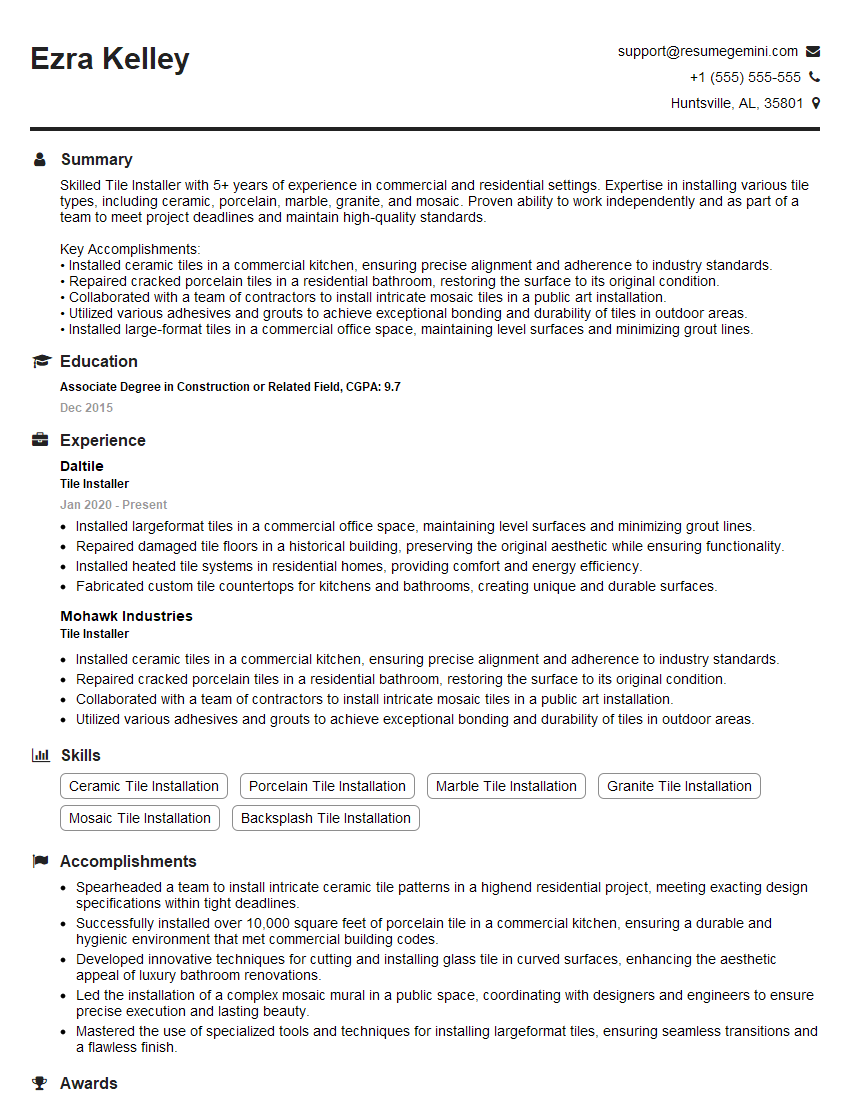
Mastering marble tile setting opens doors to a rewarding and potentially lucrative career. This specialized skill is in high demand, offering opportunities for growth and advancement within the construction and design industries. To significantly increase your chances of landing your dream job, creating an ATS-friendly resume is crucial. ResumeGemini can help you build a professional and impactful resume that highlights your skills and experience effectively. ResumeGemini offers examples of resumes tailored to the Marble Tile Setting profession, providing you with a head start in crafting a winning application.


Explore more articles
Users Rating of Our Blogs
Share Your Experience
We value your feedback! Please rate our content and share your thoughts (optional).
What Readers Say About Our Blog
Very informative content, great job.
good