Unlock your full potential by mastering the most common Mathematics and geometry interview questions. This blog offers a deep dive into the critical topics, ensuring you’re not only prepared to answer but to excel. With these insights, you’ll approach your interview with clarity and confidence.
Questions Asked in Mathematics and geometry Interview
Q 1. Explain the concept of Euclidean geometry.
Euclidean geometry is the study of flat spaces, the geometry we’re most familiar with from everyday life. It’s based on five postulates proposed by Euclid of Alexandria, and these postulates define the fundamental properties of points, lines, and planes. Think of it as the geometry you learned in high school, dealing with shapes like triangles, squares, and circles on a flat surface.
Key Postulates:
- A straight line segment can be drawn joining any two points.
- Any straight line segment can be extended indefinitely in a straight line.
- Given any straight line segment, a circle can be drawn having the segment as radius and one endpoint as center.
- All right angles are congruent.
- If two lines are drawn which intersect a third in such a way that the sum of the inner angles on one side is less than two right angles, then the two lines inevitably must intersect each other on that side if extended far enough.
Practical Application: Euclidean geometry is fundamental to architecture, engineering, and computer graphics. For example, architects use it to design buildings, ensuring that walls are straight and angles are accurate. Computer graphics rely heavily on Euclidean geometry to render 2D and 3D images.
Q 2. What is non-Euclidean geometry and give an example.
Non-Euclidean geometry challenges Euclid’s fifth postulate (the parallel postulate). It explores geometries where parallel lines might not always behave as we expect in Euclidean geometry. There are two main types: hyperbolic and elliptic.
Hyperbolic Geometry: Imagine a saddle. In hyperbolic geometry, the parallel postulate is replaced with a rule that states that given a line and a point not on that line, infinitely many lines can be drawn through the point that are parallel to the given line. The angles of a triangle in hyperbolic geometry add up to less than 180 degrees.
Elliptic Geometry: Consider the surface of a sphere. In elliptic geometry, there are no parallel lines; all lines intersect. The angles of a triangle in elliptic geometry add up to more than 180 degrees. A good real-world example is the surface of the Earth: geodesics (the shortest paths between two points) act like lines and great circles are analogous to straight lines in elliptic geometry.
Example: Consider drawing a triangle on a sphere. Its angles will always sum to more than 180 degrees, a characteristic of elliptic geometry.
Q 3. Define vector spaces and their properties.
A vector space is a collection of objects called vectors, which can be added together and multiplied by scalars (usually real numbers) in a way that satisfies certain axioms. These axioms ensure that vector addition and scalar multiplication behave in a consistent and predictable manner.
Properties:
- Closure under addition: The sum of any two vectors in the space is also in the space.
- Associativity of addition: (u + v) + w = u + (v + w) for all vectors u, v, and w.
- Commutativity of addition: u + v = v + u for all vectors u and v.
- Existence of a zero vector: There exists a vector 0 such that u + 0 = u for all vectors u.
- Existence of additive inverses: For every vector u, there exists a vector -u such that u + (-u) = 0.
- Closure under scalar multiplication: The product of a scalar and a vector is also in the space.
- Associativity of scalar multiplication: a(bv) = (ab)v for all scalars a and b, and vector v.
- Distributivity of scalar multiplication with respect to vector addition: a(u + v) = au + av for all scalars a and vectors u and v.
- Distributivity of scalar multiplication with respect to scalar addition: (a + b)v = av + bv for all scalars a and b, and vector v.
- Scalar multiplication identity: 1v = v for all vectors v.
Example: The set of all 2D vectors (x, y) forms a vector space, where addition is defined as (x1, y1) + (x2, y2) = (x1 + x2, y1 + y2), and scalar multiplication is defined as a(x, y) = (ax, ay).
Q 4. Explain the concept of linear transformation.
A linear transformation is a function between two vector spaces that preserves the operations of vector addition and scalar multiplication. In simpler terms, it’s a way of mapping vectors from one space to another while maintaining the linear structure. If you think of vectors as arrows, a linear transformation might stretch, rotate, or reflect them, but it won’t bend or distort them in a non-linear way.
Properties:
- Additivity: T(u + v) = T(u) + T(v) for all vectors u and v.
- Homogeneity: T(cv) = cT(v) for all scalars c and vectors v.
Example: A rotation in the plane is a linear transformation. It takes a vector, rotates it by a certain angle, and produces a new vector. This rotation preserves the linear structure; the sum of two rotated vectors is the rotation of their sum.
Practical Application: Linear transformations are crucial in computer graphics (for rotations, scaling, and projections), image processing (for filtering and transformations), and machine learning (for data preprocessing and dimensionality reduction).
Q 5. Describe different types of matrices and their applications.
Matrices are rectangular arrays of numbers. Different types of matrices have specific properties and applications.
Types of Matrices:
- Square Matrix: The number of rows equals the number of columns. Used extensively in linear algebra, representing linear transformations.
- Identity Matrix: A square matrix with 1s on the main diagonal and 0s elsewhere. It acts like the number 1 in multiplication (AI = A).
- Zero Matrix: A matrix with all entries equal to zero.
- Diagonal Matrix: A square matrix with non-zero entries only on the main diagonal. Often used in representing linear transformations that scale along axes.
- Symmetric Matrix: A square matrix that is equal to its transpose (A = AT). Frequently encountered in physics and engineering.
- Skew-Symmetric Matrix: A square matrix whose transpose is its negative (A = -AT). Used in representing rotations.
Applications:
- Linear Algebra: Solving systems of linear equations, representing linear transformations.
- Computer Graphics: Representing transformations (rotation, scaling, translation).
- Data Science: Representing data sets, performing dimensionality reduction.
- Quantum Mechanics: Representing quantum states and operators.
Q 6. How do you solve a system of linear equations?
Solving a system of linear equations involves finding the values of the variables that satisfy all equations simultaneously. Several methods exist:
Methods:
- Substitution: Solve one equation for one variable, and substitute the expression into the other equations. Repeat until you find the values of all variables.
- Elimination (Gaussian Elimination): Perform elementary row operations on the augmented matrix (matrix representation of the system) to transform it into row echelon form or reduced row echelon form. This makes it easier to find the solutions.
- Matrix Inversion: If the system is represented as AX = B, where A is a square matrix, X is the column vector of unknowns, and B is the column vector of constants, then if A is invertible, the solution is X = A-1B.
Example (Elimination):
Consider the system:
x + y = 5
2x - y = 1
Add the two equations to eliminate y: 3x = 6, so x = 2. Substitute x = 2 into the first equation: 2 + y = 5, so y = 3. The solution is x = 2, y = 3.
Q 7. Explain eigenvalues and eigenvectors.
Eigenvalues and eigenvectors are fundamental concepts in linear algebra. They provide crucial information about the behavior of linear transformations.
Eigenvectors: These are special vectors that, when a linear transformation is applied, only change in scale (they are multiplied by a scalar). They don’t change direction.
Eigenvalues: The scalar values by which the eigenvectors are scaled after applying the transformation. They represent how much the eigenvector is stretched or compressed.
Finding Eigenvalues and Eigenvectors: To find the eigenvalues (λ) and eigenvectors (v) of a matrix A, we solve the equation: Av = λv, or equivalently, (A - λI)v = 0, where I is the identity matrix. This leads to a characteristic equation, which is solved to find the eigenvalues. Then, each eigenvalue is substituted back into the equation (A - λI)v = 0 to find the corresponding eigenvector(s).
Practical Applications:
- Stability analysis: In dynamical systems, eigenvalues determine stability.
- Principal Component Analysis (PCA): Used in data analysis to reduce dimensionality.
- Quantum Mechanics: Eigenvalues represent measurable quantities.
Q 8. What are the different methods for solving quadratic equations?
Quadratic equations are equations of the form ax² + bx + c = 0, where a, b, and c are constants and a ≠ 0. There are several methods to solve them:
- Factoring: This involves rewriting the equation as a product of two linear expressions. For example,
x² + 5x + 6 = 0can be factored into(x + 2)(x + 3) = 0, giving solutions x = -2 and x = -3. This method is efficient when the equation factors easily. - Quadratic Formula: This formula,
x = (-b ± √(b² - 4ac)) / 2a, provides solutions for any quadratic equation. It’s a reliable method, even when factoring is difficult or impossible. For example, solving2x² + 3x - 2 = 0using the quadratic formula yields x = 1/2 and x = -2. - Completing the Square: This method involves manipulating the equation to create a perfect square trinomial. It’s useful for understanding the structure of quadratic equations and can be used to derive the quadratic formula. For instance, transforming
x² + 6x + 5 = 0involves completing the square to get(x + 3)² - 4 = 0, leading to the solutions x = -1 and x = -5. - Graphing: The solutions are the x-intercepts of the parabola represented by the quadratic equation. This method is visual and helps understand the nature of the roots (real or complex).
The choice of method depends on the specific equation and personal preference. In many engineering and physics problems, the quadratic formula provides a direct and reliable solution.
Q 9. Explain the concept of calculus (derivatives and integrals).
Calculus is a branch of mathematics dealing with continuous change. It has two major branches:
- Derivatives: A derivative measures the instantaneous rate of change of a function. Imagine driving a car; the speedometer shows your instantaneous speed, which is the derivative of your position with respect to time. Geometrically, the derivative at a point represents the slope of the tangent line to the function’s graph at that point. For example, the derivative of
f(x) = x²isf'(x) = 2x. - Integrals: An integral calculates the area under a curve. Think of calculating the total distance traveled given your speed over time. This is the integral of your speed function. Geometrically, the definite integral represents the area between the curve and the x-axis over a specified interval. The integral of
f(x) = x²isF(x) = (1/3)x³ + C(where C is the constant of integration).
Derivatives and integrals are fundamental in physics, engineering, economics, and many other fields. For example, in physics, derivatives are used to describe velocity and acceleration, while integrals are used to calculate work and energy.
Q 10. How do you calculate the area of a triangle?
The area of a triangle can be calculated using the formula:
Area = (1/2) * base * height
Where ‘base’ is the length of any side of the triangle, and ‘height’ is the perpendicular distance from that base to the opposite vertex. For example, a triangle with a base of 6 cm and a height of 4 cm has an area of (1/2) * 6 cm * 4 cm = 12 cm². For more complex triangles, trigonometry might be needed to find the height.
Q 11. How do you calculate the volume of a sphere?
The volume of a sphere is given by the formula:
Volume = (4/3) * π * r³
Where ‘r’ is the radius of the sphere and π (pi) is approximately 3.14159. So, a sphere with a radius of 5 cm would have a volume of (4/3) * π * (5 cm)³ ≈ 523.6 cm³. This formula is crucial in various fields such as architecture, engineering and even astronomy (calculating the volume of planets).
Q 12. Explain the Pythagorean theorem.
The Pythagorean theorem states that in a right-angled triangle, the square of the hypotenuse (the side opposite the right angle) is equal to the sum of the squares of the other two sides (called legs or cathetus).
Mathematically, it’s expressed as: a² + b² = c²
Where ‘a’ and ‘b’ are the lengths of the legs, and ‘c’ is the length of the hypotenuse. This theorem is fundamental in geometry and has numerous applications in fields like surveying, construction, and navigation. Imagine needing to measure the distance across a river; using the Pythagorean theorem with measurements along the river bank and the hypotenuse (the direct distance) allows you to find the distance across.
Q 13. What is the difference between a scalar and a vector?
The key difference between scalars and vectors lies in their properties:
- Scalar: A scalar quantity has only magnitude (size). Examples include temperature (25°C), mass (5 kg), and speed (10 m/s). It can be represented by a single number.
- Vector: A vector quantity has both magnitude and direction. Examples include displacement (5 meters east), velocity (10 m/s north), and force (10 N upward). It often requires multiple numbers to represent (e.g., x and y components in 2D space).
Consider the difference between saying ‘I walked 1 km’ (scalar – distance) and ‘I walked 1 km north’ (vector – displacement). The vector conveys more complete information. Vectors are essential in physics and engineering to represent forces, velocities, accelerations and other quantities that have both magnitude and direction.
Q 14. Explain the concept of a limit.
In calculus, a limit describes the behavior of a function as its input approaches a particular value. It’s not necessarily the value of the function *at* that point, but rather what the function is *approaching* as the input gets arbitrarily close. Formally, we write:
lim (x → a) f(x) = L
This means that as x gets closer and closer to ‘a’, the value of f(x) gets closer and closer to ‘L’. For example:
lim (x → 2) x² = 4
Even though f(2) = 4, the limit describes the approaching value of the function as x nears 2, not necessarily the value at x=2 (which might be undefined or different). Limits are fundamental to understanding continuity, derivatives, and integrals. They’re critical in analyzing the behavior of functions near points of discontinuity or where functions are not well defined.
Q 15. What is a derivative and what does it represent?
The derivative of a function measures its instantaneous rate of change. Imagine you’re driving a car; your speed at any given moment is the derivative of your position (distance traveled) with respect to time. More formally, the derivative of a function f(x) at a point x is the slope of the tangent line to the graph of f(x) at that point. It’s calculated using limits, often represented as f'(x) or df/dx.
For example, if f(x) = x², then its derivative f'(x) = 2x. This means that at x=3, the instantaneous rate of change is 6. In simpler terms, the function is increasing 6 times faster at x=3 than at x=1.
Derivatives are crucial in optimization problems (finding maximum or minimum values), physics (velocity and acceleration), and many other areas of science and engineering.
Career Expert Tips:
- Ace those interviews! Prepare effectively by reviewing the Top 50 Most Common Interview Questions on ResumeGemini.
- Navigate your job search with confidence! Explore a wide range of Career Tips on ResumeGemini. Learn about common challenges and recommendations to overcome them.
- Craft the perfect resume! Master the Art of Resume Writing with ResumeGemini’s guide. Showcase your unique qualifications and achievements effectively.
- Don’t miss out on holiday savings! Build your dream resume with ResumeGemini’s ATS optimized templates.
Q 16. What is an integral and what does it represent?
An integral is essentially the reverse of a derivative. It represents the accumulation of a quantity over an interval. Think of it like calculating the total distance traveled given your speed over time. The definite integral of a function f(x) from a to b, denoted as ∫ab f(x)dx, gives the area under the curve of f(x) between a and b.
For example, if f(x) = x, then the definite integral from 0 to 2, ∫02 xdx, is equal to 2. This represents the area of a triangle with base and height 2.
Integrals are fundamental in calculating areas, volumes, probabilities, and solving differential equations. In finance, for instance, integrals are used to compute the present value of future cash flows.
Q 17. Explain the concept of a Taylor series.
A Taylor series is a way to represent a function as an infinite sum of terms, each involving a derivative of the function at a single point. Imagine approximating a curve using an infinite number of increasingly smaller polynomials. This allows us to approximate the value of a function at any point near the point of expansion using only its derivatives at that point.
The formula for the Taylor series of a function f(x) around a point a is:
f(x) = f(a) + f'(a)(x-a)/1! + f''(a)(x-a)²/2! + f'''(a)(x-a)³/3! + ...The more terms you include, the better the approximation becomes. Taylor series are invaluable in numerical analysis, where complex functions can be approximated using simpler polynomials for computational efficiency. For example, they are used in computer graphics to render smooth curves and surfaces.
Q 18. How do you solve a differential equation?
Solving a differential equation means finding a function that satisfies the equation. A differential equation involves the function and its derivatives. There’s no single method, but techniques depend on the type of equation. Some common approaches include:
- Separation of variables: Useful when you can algebraically separate the variables and their derivatives.
- Integrating factors: Employed for first-order linear differential equations.
- Substitution methods: These involve substituting variables to simplify the equation.
- Laplace transforms: A powerful method for solving linear differential equations, especially those with discontinuous forcing functions.
- Numerical methods: Used when analytical solutions are difficult or impossible to find. Examples include Euler’s method and Runge-Kutta methods.
For example, a simple differential equation like dy/dx = x can be solved by direct integration: y = x²/2 + C (where C is the constant of integration).
Differential equations are vital in modeling dynamic systems across numerous fields, including physics (Newton’s laws), engineering (circuit analysis), and biology (population dynamics).
Q 19. Explain the concept of probability and statistics.
Probability quantifies the likelihood of an event occurring. It ranges from 0 (impossible) to 1 (certain). For example, the probability of flipping a fair coin and getting heads is 0.5. Statistics involves collecting, analyzing, interpreting, presenting, and organizing data to draw conclusions and make informed decisions. It uses probability to model and understand uncertainty in data.
Together, probability and statistics are essential for making sense of data. In a medical study, for example, statistics would help analyze the effectiveness of a new drug, while probability would help understand the chance of a patient responding positively.
Q 20. What is Bayes’ theorem and how is it used?
Bayes’ theorem is a fundamental concept in probability theory that describes how to update the probability of a hypothesis based on new evidence. It’s expressed as:
P(A|B) = [P(B|A) * P(A)] / P(B)Where:
- P(A|B) is the posterior probability of event A occurring given that event B has occurred.
- P(B|A) is the likelihood of event B occurring given that event A has occurred.
- P(A) is the prior probability of event A.
- P(B) is the prior probability of event B.
Bayes’ theorem is widely used in machine learning (e.g., spam filtering, medical diagnosis), risk assessment, and many other fields where we need to revise our beliefs based on new data.
Imagine a medical test for a disease. Bayes’ theorem helps determine the probability that someone actually has the disease given a positive test result, considering the test’s accuracy and the prevalence of the disease in the population.
Q 21. Explain hypothesis testing.
Hypothesis testing is a statistical method used to determine whether there is enough evidence to reject a null hypothesis. The null hypothesis is a statement of no effect or no difference. For instance, in a drug trial, the null hypothesis might be that the drug has no effect on the disease. We gather data and calculate a test statistic (e.g., t-statistic, z-statistic) to assess the evidence against the null hypothesis.
We compare the test statistic to a critical value, which is determined by a significance level (commonly 0.05). If the test statistic exceeds the critical value, we reject the null hypothesis. This does not necessarily prove the alternative hypothesis, but rather indicates that there’s sufficient evidence to suggest that the null hypothesis is unlikely.
Hypothesis testing involves setting up a null and alternative hypothesis, selecting a test statistic, determining the critical region, making a decision, and interpreting the results. It’s a cornerstone of scientific research, helping to establish causality and make evidence-based conclusions. Incorrect interpretations can lead to flawed conclusions, so a deep understanding of its principles and limitations is crucial.
Q 22. What are different types of distributions (normal, binomial, etc.)?
Probability distributions describe the likelihood of different outcomes in an experiment. Several types exist, each with unique characteristics and applications:
- Normal Distribution (Gaussian Distribution): This is the bell curve, symmetrical around the mean. Many natural phenomena, like height or IQ scores, approximately follow a normal distribution. Its key parameters are the mean (average) and standard deviation (spread). Knowing these allows us to calculate the probability of an observation falling within a specific range.
- Binomial Distribution: This describes the probability of getting a certain number of successes in a fixed number of independent Bernoulli trials (experiments with only two outcomes, like success/failure). For example, the probability of getting exactly 3 heads in 5 coin flips follows a binomial distribution. Its parameters are the number of trials (n) and the probability of success in a single trial (p).
- Poisson Distribution: This models the probability of a given number of events occurring in a fixed interval of time or space, if these events occur with a known average rate and independently of the time since the last event. Examples include the number of cars passing a certain point on a highway in an hour, or the number of typos on a page.
- Uniform Distribution: Every outcome within a given range has an equal probability. Imagine rolling a fair six-sided die – each number (1-6) has a 1/6 probability of appearing.
- Exponential Distribution: This describes the time between events in a Poisson process. For example, the time between customers arriving at a store.
Choosing the correct distribution is crucial for accurate statistical analysis. The nature of your data and the research question will guide this decision.
Q 23. How do you perform regression analysis?
Regression analysis is a statistical method used to model the relationship between a dependent variable (the outcome you’re interested in) and one or more independent variables (predictors). The goal is to find the best-fitting line or curve that describes this relationship.
Here’s a breakdown of performing regression analysis:
- Data Collection: Gather data on your dependent and independent variables.
- Data Exploration: Examine your data for outliers, patterns, and relationships using visualizations like scatter plots.
- Model Selection: Choose the appropriate regression model. Linear regression is used when the relationship is linear, while polynomial or other non-linear models are needed for more complex relationships.
- Model Fitting: Use statistical software (like R, Python with statsmodels or scikit-learn) to fit the chosen model to your data. This involves finding the parameters that minimize the difference between the observed values and the values predicted by the model (usually measured by minimizing the sum of squared errors).
- Model Evaluation: Assess the goodness of fit using metrics like R-squared (proportion of variance explained) and assess statistical significance of the model and individual predictors. Check for violations of assumptions (e.g., linearity, independence of errors, constant variance).
- Prediction and Interpretation: Use the fitted model to make predictions about the dependent variable based on new values of the independent variables. Interpret the coefficients of the model to understand the effect of each independent variable on the dependent variable.
Example: Predicting house prices (dependent variable) based on size (independent variable) using linear regression. The fitted model would give a formula to estimate the price based on the size.
Q 24. Explain the concept of correlation and causation.
Correlation and causation are often confused, but they are distinct concepts:
- Correlation: This refers to a statistical relationship between two or more variables. A correlation coefficient measures the strength and direction of this relationship (ranging from -1 to +1, where -1 indicates a perfect negative correlation, +1 a perfect positive correlation, and 0 no linear correlation). Correlation simply means that changes in one variable are associated with changes in another. It doesn’t necessarily imply that one variable *causes* the changes in the other.
- Causation: This means that one variable directly influences or causes changes in another variable. Establishing causation requires demonstrating a cause-and-effect relationship, often through controlled experiments or strong evidence ruling out alternative explanations.
Example: Ice cream sales and crime rates might be positively correlated (both increase in summer). However, this doesn’t mean that eating ice cream causes crime. A confounding variable (like hot weather) affects both.
Q 25. What is the difference between descriptive and inferential statistics?
Descriptive and inferential statistics serve different purposes in data analysis:
- Descriptive Statistics: These methods summarize and describe the main features of a dataset. They focus on organizing, presenting, and characterizing the data using measures like mean, median, mode, standard deviation, and creating visualizations (histograms, box plots, etc.). The goal is to understand the characteristics of the sample data.
- Inferential Statistics: These methods use sample data to make inferences or generalizations about a larger population. They involve techniques like hypothesis testing, confidence intervals, and regression analysis. The goal is to draw conclusions about the population based on the sample.
Example: Imagine surveying 100 students about their study habits. Descriptive statistics would summarize the average study time, the distribution of study times, etc., for *that sample*. Inferential statistics would allow us to estimate the average study time for the *entire student population* based on this sample, along with a measure of uncertainty (e.g., a confidence interval).
Q 26. Describe different types of geometrical transformations (translation, rotation, scaling).
Geometric transformations change the position, orientation, or size of geometric objects. Key types include:
- Translation: This involves moving an object from one position to another without changing its orientation or size. It’s defined by a translation vector that specifies the amount of movement in each direction (x, y, z in 3D).
- Rotation: This involves rotating an object around a specific point or axis. It’s defined by the angle of rotation and the axis of rotation. In 2D, it’s usually a rotation around a point; in 3D, it’s around an axis.
- Scaling: This involves enlarging or reducing the size of an object. It’s defined by a scaling factor for each dimension (x, y, z). A scaling factor of 2 would double the size in that dimension.
These transformations are fundamental in computer graphics, image processing, and robotics. They can be represented mathematically using matrices, making them easy to combine and apply sequentially.
Q 27. Explain the concept of a fractal.
A fractal is a geometric shape that exhibits self-similarity: its parts resemble the whole at different scales. This means that if you zoom in on a fractal, you’ll see similar patterns repeating themselves infinitely. Fractals are not smooth; they often have infinite length or area within a finite space.
Key characteristics:
- Self-similarity: Parts resemble the whole.
- Infinite detail: Zooming reveals increasingly finer structures.
- Non-integer dimension: Many fractals have fractional dimensions (e.g., 1.5), reflecting their complex structure.
Examples include the Mandelbrot set, the Koch snowflake, and the Sierpinski triangle. Fractals are found in nature (coastlines, trees, snowflakes) and have applications in computer graphics, data compression, and modelling complex systems.
Q 28. How do you calculate the surface area of a cylinder?
To calculate the surface area of a cylinder, you need its radius (r) and height (h).
The surface area consists of two circular bases and a lateral surface (the curved side):
- Area of one circular base: πr²
- Area of two circular bases: 2πr²
- Area of the lateral surface: The lateral surface can be imagined as a rectangle when unrolled. Its width is the height (h) of the cylinder and its length is the circumference of the base (2πr). Therefore, the area is 2πrh.
- Total surface area: The sum of the areas of the two bases and the lateral surface is 2πr² + 2πrh.
Therefore, the formula for the surface area (A) of a cylinder is:
A = 2πr² + 2πrh
Example: A cylinder with radius r = 3 cm and height h = 10 cm would have a surface area of:
A = 2π(3)² + 2π(3)(10) = 18π + 60π = 78π ≈ 245 cm²
Key Topics to Learn for Mathematics and Geometry Interview
- Linear Algebra: Understand vector spaces, linear transformations, eigenvalues, and eigenvectors. Practical applications include data analysis, computer graphics, and machine learning.
- Calculus: Master differentiation, integration, and their applications in optimization problems and modeling real-world phenomena. Explore both single and multivariable calculus.
- Differential Equations: Develop a strong understanding of solving ordinary and partial differential equations. These are crucial for modeling dynamic systems in various fields.
- Euclidean Geometry: Review fundamental theorems, postulates, and proofs related to shapes, angles, and lines. Understand concepts like congruence, similarity, and transformations.
- Analytic Geometry: Combine algebra and geometry to represent geometric objects using coordinate systems. This is essential for solving geometric problems algebraically.
- Probability and Statistics: Grasp key concepts like probability distributions, statistical inference, and hypothesis testing. These are vital for data analysis and interpretation.
- Discrete Mathematics: Familiarize yourself with graph theory, combinatorics, and logic. These are essential for algorithm design and computer science applications.
- Problem-Solving Strategies: Practice breaking down complex problems into smaller, manageable parts. Develop skills in deductive reasoning and logical thinking.
Next Steps
Mastering Mathematics and geometry opens doors to exciting and rewarding careers in diverse fields, from data science and finance to engineering and research. To maximize your job prospects, it’s crucial to present your skills effectively. Creating an ATS-friendly resume is paramount in today’s competitive job market. ResumeGemini can help you build a professional and impactful resume that highlights your expertise in Mathematics and geometry. We provide examples of resumes tailored specifically to these fields to give you a head start. Invest in crafting a strong resume – it’s your first impression and a critical step toward your dream career.

Financial Analyst Resume Sample

Data Scientist Resume Sample

Game Developer Resume Sample

Cartographer Resume Sample

Actuary Resume Sample
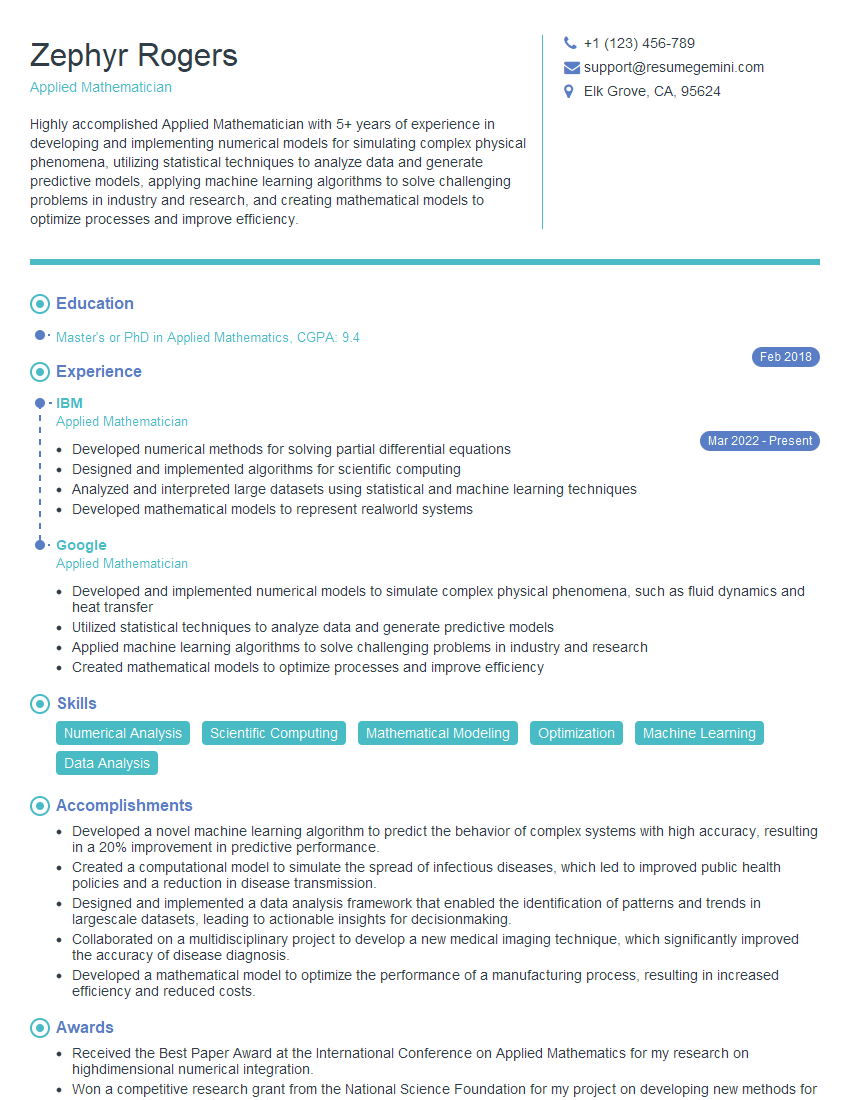
Applied Mathematician Resume Sample

Cryptographer Resume Sample
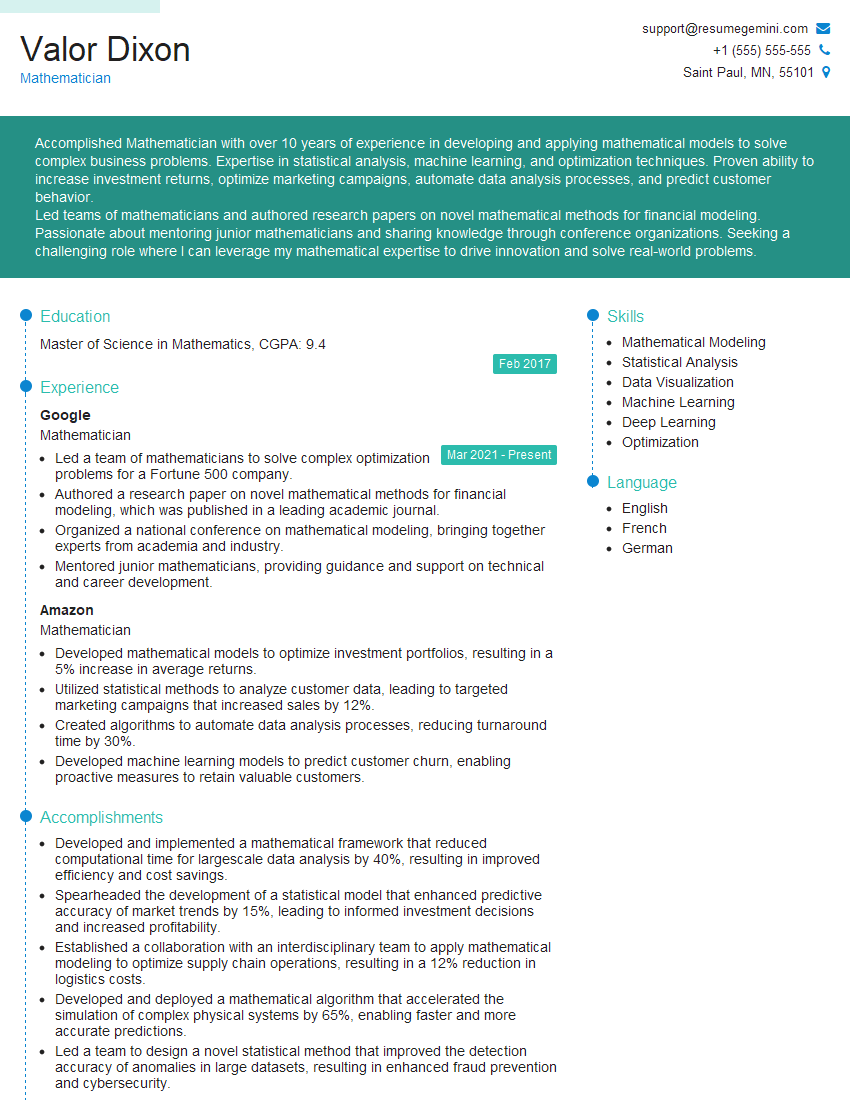
Mathematician Resume Sample

Operations Research Analyst Resume Sample

Statistician Resume Sample

Architect Resume Sample

Surveyor Resume Sample

Aerospace Engineer Resume Sample

Civil Engineer Resume Sample

Mechanical Engineer Resume Sample

Control Systems Engineer Resume Sample

Robotics Engineer Resume Sample
Explore more articles
Users Rating of Our Blogs
Share Your Experience
We value your feedback! Please rate our content and share your thoughts (optional).
What Readers Say About Our Blog
Very informative content, great job.
good