Cracking a skill-specific interview, like one for Media Network Design and Deployment, requires understanding the nuances of the role. In this blog, we present the questions you’re most likely to encounter, along with insights into how to answer them effectively. Let’s ensure you’re ready to make a strong impression.
Questions Asked in Media Network Design and Deployment Interview
Q 1. Explain the difference between unicast and multicast video delivery.
Unicast and multicast are two fundamental methods for delivering video content over a network. Think of it like sending invitations: unicast is sending a separate invitation to each guest individually, while multicast is sending a single invitation to a group.
Unicast: In unicast delivery, a separate stream of video data is sent from the server to each individual client. This is like a one-to-one communication. Every viewer gets their own dedicated stream. It’s simple to implement, but it becomes highly inefficient when serving a large number of viewers, consuming significant bandwidth and server resources. Imagine sending individual emails to thousands of people—it’s resource-intensive.
Multicast: In multicast delivery, a single stream of video data is sent to a group of clients simultaneously. This is like sending a group email or text message. Only one copy of the stream is transmitted, significantly reducing bandwidth consumption and server load, making it far more efficient for large-scale video distribution. The network intelligently replicates the stream to only the clients who have subscribed. Think of a live online concert—a single stream is sufficient for thousands of viewers.
Key Differences Summarized:
- Unicast: One-to-one communication, high bandwidth consumption, simple implementation.
- Multicast: One-to-many communication, low bandwidth consumption, efficient for large audiences, requires multicast-capable infrastructure.
Q 2. Describe your experience with QoS and its importance in media networks.
Quality of Service (QoS) is paramount in media networks. It’s the set of techniques and technologies that prioritize certain types of network traffic over others, ensuring that time-sensitive applications like video streaming receive the bandwidth and resources they need for optimal performance. Without QoS, your high-definition video stream might buffer incessantly while less important background network tasks hog the bandwidth.
My experience with QoS involves implementing various mechanisms, including:
- Differentiated Services (DiffServ): Assigning different priority levels to packets based on their application type. Video packets are marked as high priority, ensuring low latency and jitter.
- Integrated Services (IntServ): Providing guaranteed bandwidth and delay bounds for specific flows. This is suitable for applications requiring stringent QoS parameters, like live broadcasts.
- Traffic Shaping: Controlling the rate at which data is sent to prevent congestion and ensure fair allocation of bandwidth.
In a previous project, implementing DiffServ with appropriate packet marking and queuing policies on Cisco routers significantly improved the viewing experience for a large-scale online educational platform by minimizing latency and packet loss during peak viewing times. This involved careful analysis of network traffic patterns and identifying bottlenecks to optimize QoS parameters effectively.
Q 3. What are the key considerations for designing a scalable media network?
Designing a scalable media network requires careful consideration of several factors to ensure it can handle increasing bandwidth demands and user growth without compromising performance or reliability. Think of it like building a city—you need to plan for future expansion.
- Modular Design: Constructing the network in modules allows for easy expansion and upgrades without disrupting the entire system. This modularity is key to scalability.
- Distributed Architecture: Distributing servers and content across multiple geographical locations using a CDN (Content Delivery Network) reduces latency and allows for efficient handling of increased user base from various locations.
- Load Balancing: Distributing traffic evenly across multiple servers to prevent overloading any single server. This prevents single points of failure and ensures optimal performance even under peak load.
- Cloud-Based Solutions: Leveraging cloud-based infrastructure provides elasticity and allows for on-demand scaling to accommodate fluctuations in demand. You can easily scale up or down based on real-time needs.
- Redundancy and Failover Mechanisms: Implementing backup systems and failover mechanisms ensures continuous operation even in the event of hardware or network failures. This is crucial for mission-critical applications.
For example, I once designed a scalable media network for a large online gaming platform using a distributed architecture with load balancing and cloud-based infrastructure. This design allowed the platform to handle a sudden surge in users during a major gaming event without experiencing any significant performance degradation.
Q 4. How do you ensure network security in a media environment?
Network security in a media environment is critical to protect both content and viewers. It’s about safeguarding your valuable assets and user data. This involves a multi-layered approach:
- Firewalls: Implementing firewalls to control network access and block unauthorized traffic.
- Intrusion Detection/Prevention Systems (IDS/IPS): Monitoring network traffic for malicious activity and taking action to block or mitigate threats.
- Secure Protocols: Using secure protocols like HTTPS and SRT for content delivery and communication to encrypt data and prevent eavesdropping.
- Access Control: Restricting access to sensitive network resources based on user roles and permissions. Not everyone should have administrative access!
- Regular Security Audits and Penetration Testing: Performing regular security assessments to identify and address vulnerabilities.
- Content Protection: Using digital rights management (DRM) technologies to prevent unauthorized copying and distribution of content.
In a previous project, securing a live streaming platform for a major sporting event involved implementing a combination of firewalls, IDS/IPS, and DRM technologies. We employed regular penetration testing to proactively identify and address any potential vulnerabilities before they could be exploited.
Q 5. What are your preferred tools for network monitoring and troubleshooting?
My preferred tools for network monitoring and troubleshooting depend on the context, but some of my go-to options include:
- SolarWinds Network Performance Monitor: For comprehensive network monitoring and performance analysis, offering deep insights into network health and identifying bottlenecks.
- Wireshark: A powerful packet analyzer for detailed analysis of network traffic, allowing for identification of issues related to packet loss, latency, and other network anomalies. This is like having an X-ray of your network.
- PRTG Network Monitor: A user-friendly network monitoring tool offering a centralized dashboard for visualizing network performance and alerting on potential issues.
- Cisco Prime Infrastructure: For managing and monitoring Cisco networks, providing valuable insights into device health and performance.
- Nagios: A versatile network monitoring system that can be customized to monitor various aspects of the network, including servers, applications, and network devices.
The choice of tools often depends on the specific network architecture and the types of issues being investigated. For example, for a complex enterprise network, SolarWinds might be preferred for its comprehensive capabilities, while for troubleshooting a specific network segment, Wireshark’s packet analysis features would be indispensable.
Q 6. Explain your experience with various video codecs (H.264, H.265, VP9).
I have extensive experience with various video codecs, including H.264, H.265 (HEVC), and VP9. These codecs are the engines that compress and decompress video, balancing quality and file size.
- H.264: A widely adopted codec known for its good balance between compression efficiency and computational complexity. It’s been a workhorse for years, offering a solid compromise, but it’s less efficient than newer options.
- H.265 (HEVC): A more recent codec offering significantly better compression efficiency compared to H.264, allowing for higher quality video at the same bitrate or the same quality at a lower bitrate. This translates to significant bandwidth savings. However, it often requires more processing power for encoding and decoding.
- VP9: An open-source codec developed by Google, offering comparable performance to H.265 in terms of compression efficiency. It’s a strong contender, particularly where licensing fees for H.265 are a concern.
The choice of codec depends on factors like the desired video quality, available bandwidth, processing power of encoding/decoding devices, and licensing considerations. In a project involving a high-bandwidth, low-latency live streaming application, we chose H.265 to reduce bandwidth costs while maintaining high video quality.
Q 7. Describe your experience with CDN (Content Delivery Network) technologies.
Content Delivery Networks (CDNs) are crucial for delivering media content efficiently to a global audience. They are geographically distributed networks of servers that cache content closer to users, reducing latency and improving performance. Think of it like having mini-warehouses strategically located across the country to deliver goods faster to customers.
My experience with CDN technologies includes selecting, implementing, and managing CDNs from various providers, including:
- Akamai: A large and well-established CDN provider known for its extensive global reach and robust infrastructure.
- Amazon CloudFront: A popular CDN integrated with AWS, providing seamless integration with other AWS services.
- Cloudflare: A CDN provider offering a wide range of features, including security and performance optimization tools.
I have experience in configuring CDN settings, such as caching policies, origin servers, and security protocols, to optimize content delivery and improve user experience. For example, in a project involving a global video streaming service, I implemented a multi-CDN strategy, distributing content across multiple providers to ensure high availability and redundancy. This improved resilience and reduced delivery times significantly, optimizing the user experience.
Q 8. How do you handle latency issues in a media network?
Latency, or delay, is a critical enemy in media networks. Think of it like the echo on a phone call – it disrupts the flow and impacts the user experience. In media, even small delays can cause synchronization issues between audio and video, making content unwatchable. To handle latency, we employ several strategies.
Optimized Network Infrastructure: We use high-bandwidth, low-latency network technologies like 10 Gigabit Ethernet or even higher speeds where needed. This is the foundation. Think of it as building a superhighway instead of a dirt road for your data.
Content Delivery Networks (CDNs): CDNs strategically distribute content across multiple servers closer to end-users. This minimizes the distance data needs to travel, significantly reducing latency. It’s like setting up multiple warehouses instead of having all your stock in one central location.
QoS (Quality of Service): We prioritize media traffic over other types of network traffic using QoS mechanisms. This ensures that streaming video and audio get the resources they need, even during network congestion. Imagine a VIP lane on the highway, reserved for important media traffic.
Adaptive Bitrate Streaming (ABR): ABR protocols dynamically adjust the quality of the stream based on network conditions. If latency spikes, the stream automatically switches to a lower resolution to maintain playback. This is like shifting to a smaller gear in a car to navigate a steep hill.
Careful Network Design: This involves minimizing hops (the number of network devices data travels through), using efficient routing protocols, and optimizing network configurations for low latency. It’s like planning the shortest route on a map to avoid unnecessary travel.
Q 9. What are the different types of network topologies and when would you use each?
Network topologies define how devices are interconnected. The choice depends on factors like scalability, redundancy, and cost. Here are some common topologies:
Star Topology: All devices connect to a central hub (like a switch or router). Simple, easy to manage, but a single point of failure. Think of it like spokes on a wheel.
Mesh Topology: Devices connect to multiple other devices, offering high redundancy. More complex to manage but highly reliable. Imagine a web of interconnected nodes.
Bus Topology: All devices share a single cable. Simple but prone to bottlenecks and single points of failure. Think of it like a single highway for all traffic.
Ring Topology: Devices connect to two neighboring devices, forming a closed loop. Data flows in one direction. Relatively robust but failure of one device can disrupt the entire network.
Tree Topology: Combines aspects of star and bus topologies. Hierarchically organized, suitable for larger networks.
When to use which: Star topologies are ideal for smaller networks, while mesh topologies are preferred for larger, mission-critical applications requiring high redundancy, like broadcast studios. Bus topologies are rarely used in modern media networks due to their limitations.
Q 10. Explain your understanding of IP multicast and its application in media streaming.
IP multicast is a network technology that allows a single stream of data to be sent to multiple recipients simultaneously, saving bandwidth and resources. Instead of sending separate streams to each viewer, a single stream is replicated only at strategic network points, making it incredibly efficient for media streaming.
In media streaming, it’s used to deliver live broadcasts and video-on-demand content to a large audience efficiently. Imagine a live sporting event. Using unicast (sending individual streams to each viewer) would quickly overwhelm the network. Multicast, however, sends a single stream to strategically placed routers, which then distribute the stream to viewers in their local area, vastly improving efficiency and scalability.
However, it requires multicast-capable routers and network infrastructure, which might not always be available or cost-effective in every scenario. Therefore, other techniques like unicast or CDN solutions are frequently utilized as alternatives.
Q 11. Describe your experience with network virtualization technologies in a media context.
Network virtualization technologies, like Software-Defined Networking (SDN) and Network Function Virtualization (NFV), offer significant advantages in media networks. I have experience using these technologies to improve network flexibility, scalability, and efficiency.
SDN allows us to centralize network control, improving management and automation. This means we can dynamically allocate resources and adjust network configurations on the fly, ensuring optimal performance for media streams, even under heavy load. Imagine controlling your network like a symphony conductor, adjusting the flow of traffic smoothly.
NFV allows us to replace dedicated hardware network functions (like firewalls, load balancers) with virtualized software counterparts. This makes the network more agile, cost-effective, and scalable. It’s like renting computing power instead of buying expensive dedicated servers. I’ve used this in designing flexible and scalable encoding farms, which can handle a large number of simultaneous streaming sessions efficiently.
Q 12. How do you design a media network for high availability and redundancy?
Designing a high-availability, redundant media network requires careful planning and the implementation of several strategies. The goal is to ensure uninterrupted service even in the event of failures.
Redundant Paths: We create multiple paths for data to flow, so if one path fails, the traffic can be seamlessly switched to another. This is like having multiple routes to reach your destination – if one road is blocked, you can take another.
Redundant Equipment: Employing redundant servers, routers, and switches means that if one device fails, a backup is instantly available. Think of it as having a spare tire in your car.
Geographic Diversity: Distributing infrastructure across multiple geographic locations minimizes the impact of localized outages. Having data centers in different cities mitigates the risk of single-point failures.
Load Balancing: Distributing traffic across multiple servers prevents overload on any single device. This is like dividing the traffic across multiple lanes on a highway to avoid congestion.
Regular Monitoring and Maintenance: This helps detect and address issues before they escalate into major outages. It’s like regular servicing your car to prevent breakdowns.
Q 13. Explain your experience with video streaming protocols (RTMP, HLS, DASH).
I have extensive experience with various video streaming protocols, including RTMP, HLS, and DASH. Each has its strengths and weaknesses, making the choice dependent on the specific application.
RTMP (Real Time Messaging Protocol): A low-latency protocol, ideal for live streaming. However, it’s proprietary and primarily used with Adobe Flash Media Server, which is now largely deprecated. I’d use it only if legacy infrastructure needs to be supported.
HLS (HTTP Live Streaming): Apple’s protocol, using HTTP segments for adaptive bitrate streaming. Widely supported, robust, and good for broad compatibility. A great choice for delivering live or on-demand videos to a wide range of devices.
DASH (Dynamic Adaptive Streaming over HTTP): An open standard similar to HLS, offering better flexibility and control over stream adaptation. Excellent for handling various network conditions and device capabilities. Often the preferred choice for its flexibility and open nature.
The selection depends on factors like latency requirements, device compatibility, and scalability needs. For instance, low-latency live streaming favors RTMP (if legacy considerations allow), while broad device compatibility favors HLS or DASH.
Q 14. How do you troubleshoot network connectivity problems in a media environment?
Troubleshooting network connectivity problems in a media environment requires a systematic approach. I typically follow these steps:
Identify the Problem: What exactly is not working? Is it a specific stream, a particular device, or a widespread outage? Document all observations.
Isolate the Source: Is the problem on the client-side (viewer’s device/internet), the server-side (media server/CDN), or within the network infrastructure? Use tools like ping, traceroute, and network monitoring systems to help pinpoint the issue.
Check Basic Connectivity: Verify internet connectivity at the client and server ends. Check for DNS issues, firewall restrictions, and router configurations.
Examine Network Logs and Metrics: Look for error messages, dropped packets, high latency, or bandwidth bottlenecks. These logs provide crucial insights into the problem.
Test Different Components: Try accessing the stream from different locations or devices to isolate whether the problem is with the network infrastructure or the client devices.
Utilize Network Monitoring Tools: Sophisticated network monitoring tools provide real-time visibility into network performance, helping to pinpoint bottlenecks and identify problematic devices.
Escalate if Necessary: If the problem persists, involve the appropriate teams, such as internet service providers (ISPs) or CDN providers, to investigate further.
The key is to be methodical and to utilize the right tools to quickly diagnose and resolve the issue, minimizing disruption to service.
Q 15. What are the key performance indicators (KPIs) for a media network?
Key Performance Indicators (KPIs) for a media network are crucial for measuring its efficiency and effectiveness. They fall into several categories, focusing on aspects like viewer experience, infrastructure performance, and operational efficiency.
- Bandwidth Utilization: This measures how much of the available bandwidth is being used. High utilization is good, but excessively high utilization indicates potential bottlenecks and can negatively impact quality. We aim for optimal utilization, avoiding both underuse and overload.
- Latency: This is the delay between the request for media and its delivery. Low latency is crucial for a smooth viewing experience, especially for live streaming. High latency results in buffering and a poor user experience.
- Packet Loss: This refers to the percentage of data packets that are lost during transmission. Even a small percentage of packet loss can significantly degrade video and audio quality, leading to pixelation, glitches, and audio dropouts. We strive for near-zero packet loss.
- Bitrate: This reflects the data rate of the media stream. A higher bitrate generally results in better quality but requires more bandwidth. Finding the optimal bitrate that balances quality and bandwidth consumption is a key challenge.
- Concurrent Users/Streams: This KPI tracks the number of users simultaneously accessing the media network. It helps in capacity planning and ensuring the network can handle peak loads without performance degradation. We need to have a clear understanding of our peak demands to avoid network saturation.
- Content Delivery Time: This measures the time taken to deliver content to end-users. A fast delivery time contributes to user satisfaction and reduces churn. This is heavily influenced by caching strategies and CDN (Content Delivery Network) performance.
- Customer Satisfaction (CSAT): Measuring viewer satisfaction directly assesses the overall performance of the media network from the user’s perspective. Surveys, feedback forms, and social media monitoring are valuable tools to capture this data.
In my experience, regularly monitoring and analyzing these KPIs provides valuable insights into the health and performance of a media network, allowing for proactive optimization and troubleshooting.
Career Expert Tips:
- Ace those interviews! Prepare effectively by reviewing the Top 50 Most Common Interview Questions on ResumeGemini.
- Navigate your job search with confidence! Explore a wide range of Career Tips on ResumeGemini. Learn about common challenges and recommendations to overcome them.
- Craft the perfect resume! Master the Art of Resume Writing with ResumeGemini’s guide. Showcase your unique qualifications and achievements effectively.
- Don’t miss out on holiday savings! Build your dream resume with ResumeGemini’s ATS optimized templates.
Q 16. Describe your experience with cloud-based media processing and delivery.
I have extensive experience with cloud-based media processing and delivery, leveraging platforms like AWS Elemental Media Services, Azure Media Services, and Google Cloud Video Intelligence. My work has involved designing and deploying scalable and cost-effective solutions for various media workflows, from ingest and transcoding to packaging and delivery.
For example, I led a project migrating a large-scale video-on-demand (VOD) platform to AWS. This involved migrating our existing encoding infrastructure to AWS Elemental MediaConvert, optimizing our transcoding workflows for speed and cost efficiency, and integrating with Amazon S3 for storage and Amazon CloudFront for content delivery. The migration resulted in a 30% reduction in processing costs and a significant improvement in delivery speeds.
My experience also encompasses using cloud-based functions for content moderation, automated metadata generation, and advanced analytics. I’m proficient in utilizing serverless technologies to build responsive and scalable solutions. We used Lambda functions for real-time watermarking in one project, ensuring brand protection without introducing noticeable latency.
Q 17. Explain your understanding of network bandwidth management techniques.
Network bandwidth management is crucial for optimizing network performance and ensuring quality of service. Techniques vary depending on the specific needs of the media network, but some key strategies include:
- Traffic Shaping: This involves prioritizing certain types of traffic over others. For instance, we might give higher priority to real-time video streams over less critical background tasks. This uses techniques like QoS using DiffServ or MPLS.
- Quality of Service (QoS): This is a set of mechanisms that ensures a certain level of performance for specific types of network traffic. Implementing QoS can prioritize low-latency traffic for real-time applications, improving the overall viewer experience.
- Caching: Caching frequently accessed content closer to end-users significantly reduces the load on the network and improves delivery times. Content Delivery Networks (CDNs) are crucial for effective caching strategies.
- Bandwidth Throttling: This is a method to limit the amount of bandwidth consumed by individual users or applications. It’s useful for preventing individual users from monopolizing bandwidth and negatively impacting other users’ experiences.
- Content Delivery Networks (CDNs): CDNs distribute content across multiple servers globally, reducing latency and improving delivery speeds, especially for geographically dispersed audiences. They significantly reduce the load on the origin server.
Effective bandwidth management often involves a combination of these techniques, tailored to the specific requirements of the media network. For instance, in a live streaming environment, a high priority needs to be given to real-time video streams. For VOD, caching and CDNs are more critical.
Q 18. How do you ensure the quality of service (QoS) for different types of media traffic?
Ensuring Quality of Service (QoS) for different media traffic types requires a multi-layered approach. It’s not a one-size-fits-all solution and depends on the specific requirements of the network and its users. We need to prioritize traffic based on its sensitivity to latency and jitter.
- Prioritization: Using QoS mechanisms like DiffServ or MPLS, we assign different priorities to various traffic types. Real-time video and audio streams receive higher priority compared to less time-sensitive data like metadata or control signals. For instance, using Differentiated Services Code Point (DSCP) marking to prioritize live streams over downloads.
- Resource Allocation: We need to ensure sufficient bandwidth and processing resources are allocated to high-priority traffic. This may involve using dedicated network paths or servers for critical applications. This includes reserving bandwidth for critical streams during peak hours.
- Adaptive Bitrate Streaming (ABR): ABR dynamically adjusts the bitrate of the stream based on network conditions. This helps maintain a smooth viewing experience even in the presence of varying bandwidth availability. Adaptive streaming technologies like HLS and DASH are crucial here.
- Buffering: Appropriate buffering strategies at both the server and client sides can mitigate the impact of short-term network fluctuations. Sufficient buffering minimizes interruptions but shouldn’t be excessively large, increasing latency.
- Monitoring and Control: Continuous monitoring of QoS metrics, such as latency, jitter, and packet loss, is essential to identify and resolve any QoS issues proactively. Regular analysis of these metrics allows us to make informed decisions about network configuration and resource allocation.
In practice, this involves careful planning and configuration of network devices, such as routers and switches, to implement QoS policies. It also requires close collaboration with content providers and network engineers.
Q 19. What are your experiences with different types of media servers and their applications?
I have extensive experience with various media servers, each with specific applications:
- Origin Servers: These are the primary servers storing and serving the original media content. They handle requests for media assets and are often highly scalable and fault-tolerant. Examples include Wowza Streaming Engine, Nginx, and Apache.
- Streaming Servers: These servers specialize in delivering live and on-demand streams to multiple clients simultaneously. They utilize protocols like RTMP, HLS, and DASH to efficiently deliver media. Examples include Wowza Streaming Engine, Adobe Media Server, and Nimble Streamer.
- Media Storage Servers: These are high-capacity storage systems designed to handle large amounts of media assets. They often employ technologies like SAN or NAS for efficient data storage and retrieval. Object storage solutions like Amazon S3 or Azure Blob Storage are commonly used.
- Content Delivery Networks (CDN) Servers: CDNs are distributed networks of servers that cache media content closer to end-users. They reduce latency and improve delivery speeds, especially for geographically dispersed audiences. Akamai, Cloudflare, and Fastly are popular examples.
The choice of media server depends on the specific needs of the media network. For instance, live streaming requires streaming servers optimized for low latency and high concurrency. VOD applications may benefit more from scalable storage and efficient content delivery provided by a CDN.
Q 20. What experience do you have with video transcoding and its impact on network performance?
Video transcoding is the process of converting video from one format to another. It’s essential for delivering optimized media to various devices and network conditions. However, it has a significant impact on network performance due to the high computational demands.
The impact on network performance is primarily due to the increased bandwidth consumption during the transcoding process itself. The process is CPU-intensive, requiring significant processing power. Also, the output files produced are often much larger than the original source video, potentially leading to storage issues.
To mitigate these impacts, we must consider:
- Efficient Encoding Algorithms: Choosing the right encoding algorithms (like x264, x265, VP9) significantly affects the file size and quality. Modern algorithms offer high compression ratios while maintaining acceptable quality.
- Hardware Acceleration: Utilizing hardware acceleration, such as GPUs or specialized encoding hardware, significantly speeds up the transcoding process, reducing its impact on the network.
- Cloud-based Transcoding: Cloud platforms offer scalable and cost-effective transcoding solutions. This allows us to handle large volumes of video efficiently without investing in substantial on-premise infrastructure. Services like AWS Elemental MediaConvert and Azure Media Encoder offer this functionality.
- Pre-rendering and Caching: Pre-rendering and caching of transcoded videos reduce the need for on-demand transcoding, thus decreasing the real-time impact on network resources.
- Adaptive Bitrate Streaming: As mentioned earlier, using ABR helps to serve the best quality video based on the available bandwidth, thus minimizing the impact of less efficient transcoding.
Properly managing the transcoding process is key to maintaining a high-performance media network. Overlooking this can lead to significant bottlenecks and reduced quality of service.
Q 21. Describe your understanding of network security protocols and their implementation in media networks.
Network security protocols are paramount for protecting media networks from various threats. The implementation of these protocols is crucial to ensure the integrity and confidentiality of both content and user data. Different protocols cater to different aspects of security.
- HTTPS/TLS: This is essential for secure communication between clients and servers, protecting against eavesdropping and man-in-the-middle attacks. HTTPS ensures the confidentiality and integrity of the data transmitted between the client and server.
- Content Delivery Network (CDN) Security: CDNs offer various security features, including DDoS protection, access controls, and SSL/TLS encryption, mitigating threats at the edge of the network.
- Firewalls: Firewalls are critical for controlling network access and preventing unauthorized access to the media network. They filter network traffic based on predefined rules, blocking malicious activity.
- Intrusion Detection/Prevention Systems (IDS/IPS): These systems actively monitor network traffic for malicious activity and take action to prevent or mitigate attacks.
- Digital Rights Management (DRM): DRM systems protect copyrighted content by restricting access and preventing unauthorized copying and distribution. They encrypt the media content and require clients to have valid licenses to view it. Examples include Widevine and FairPlay.
- Access Control Lists (ACLs): ACLs define which users or devices are permitted to access specific resources on the network. They limit access to sensitive data or critical network components.
Implementing a robust security infrastructure requires a layered approach, combining multiple security protocols and technologies. Regular security audits, vulnerability assessments, and penetration testing are crucial for identifying and addressing potential weaknesses in the network’s security posture. We need to ensure that all security protocols are consistently implemented and updated to address emerging threats. Proper network segmentation also limits the impact of a breach.
Q 22. What is your approach to capacity planning for a growing media network?
Capacity planning for a growing media network is crucial for ensuring smooth operations and preventing performance bottlenecks. My approach involves a multi-step process:
- Forecasting Future Needs: I start by analyzing historical data on bandwidth consumption, user growth, and content delivery trends. This helps predict future demand accurately. I use statistical modeling and forecasting techniques to project traffic patterns for different scenarios (e.g., peak hours, special events).
- Defining Service Level Agreements (SLAs): Clear SLAs establish expected performance levels for different media services (e.g., latency for live streaming, buffering time for VOD). These SLAs guide capacity decisions.
- Technology Assessment: This involves evaluating current network infrastructure (bandwidth, servers, storage) and identifying potential upgrades or replacements. I consider technologies like Content Delivery Networks (CDNs) and cloud-based solutions to optimize content distribution.
- Scalability and Redundancy: The design needs to be scalable to accommodate future growth without major disruptions. Redundancy is crucial to maintain service availability in case of equipment failure or network outages. This often involves deploying redundant hardware and network paths.
- Monitoring and Adjustment: Continuous monitoring of network performance is essential. Real-time data allows for quick identification of capacity issues and timely adjustments. Regular reviews and capacity planning updates are necessary as the network evolves.
For example, in a recent project for a live streaming platform, I used historical data to project a 30% increase in concurrent viewers within the next year. Based on this, we upgraded our servers, implemented a CDN, and added network bandwidth to ensure consistent high-quality streaming during peak periods.
Q 23. How do you handle unexpected traffic spikes in a media network?
Handling unexpected traffic spikes requires a proactive and reactive approach. My strategy focuses on building a robust and flexible network infrastructure that can adapt to sudden surges in demand.
- Overprovisioning: Designing the network with extra capacity beyond the predicted average is a key strategy. This provides a buffer to absorb unexpected spikes.
- Traffic Shaping and Prioritization: Implementing Quality of Service (QoS) policies allows for prioritizing critical media traffic during peak periods. Less critical traffic can be temporarily throttled to protect the user experience of live streams or VOD.
- Automated Scaling: Cloud-based solutions often offer automated scaling features. This allows for dynamic adjustment of server capacity based on real-time demand, automatically adding resources when needed and scaling down when demand decreases.
- CDN Utilization: CDNs distribute content across multiple servers globally, reducing the load on the origin server and improving content delivery during traffic spikes.
- Caching Strategies: Effective caching mechanisms at different network layers can reduce server load and improve response times.
Imagine a sudden surge in viewers during a breaking news event. A well-designed network, leveraging QoS and automated scaling, can seamlessly absorb the extra traffic, ensuring viewers continue to receive high-quality streaming without interruptions.
Q 24. Explain your experience with various network monitoring tools and their capabilities.
I have extensive experience with various network monitoring tools, each offering unique capabilities. Some of the key tools I’ve utilized include:
- Nagios/Zabbix: These open-source tools provide comprehensive network monitoring, alerting on issues such as server outages, bandwidth bottlenecks, and high latency. I’ve used them to establish baseline performance metrics and set thresholds for alerts.
- SolarWinds: A powerful commercial tool providing detailed network performance analysis and visualization. Its dashboards and reporting capabilities aid in capacity planning and performance optimization.
- PRTG Network Monitor: Another commercial option, offering a user-friendly interface and strong alerting capabilities. It’s particularly useful for monitoring diverse network elements, from routers and switches to servers and applications.
- Wireshark: A powerful packet analyzer essential for deep-dive troubleshooting. It allows for capturing and analyzing network traffic to identify specific issues, such as packet loss or congestion.
The choice of tool often depends on the network’s size, complexity, and budget. I always choose the tool best suited to the specific needs of the project, and I integrate multiple tools for a holistic view of network health and performance.
Q 25. Describe your experience with designing and implementing a media network for a specific application (e.g., live streaming, video-on-demand).
I recently designed and implemented a media network for a live streaming application for a major sporting event. The key challenges included ensuring low latency, high availability, and scalability to handle a massive influx of viewers.
Design Considerations:
- Low-Latency Encoding and Distribution: We used low-latency encoding techniques (e.g., H.264/H.265 with low GOP sizes) and a CDN with strategically placed edge servers to minimize delay between the event and the viewer.
- Redundant Infrastructure: Multiple encoding servers, encoders, and streaming servers were used to ensure continuous service even if one component failed. Redundant network paths were also implemented.
- Scalable Architecture: The system was designed to scale dynamically based on viewer count, leveraging cloud-based infrastructure and auto-scaling capabilities.
- Adaptive Bitrate Streaming (ABR): ABR was used to allow for seamless adjustment of video quality based on network conditions and viewer bandwidth, ensuring a good viewing experience even on unreliable connections.
Implementation Steps:
- Network infrastructure setup, including routers, switches, and servers.
- Encoding server configuration and testing.
- CDN integration and content delivery optimization.
- Monitoring system setup and testing.
- Extensive testing under simulated load to ensure stability.
The result was a successful live streaming event with minimal disruptions, even during periods of peak viewership. This project demonstrated my expertise in optimizing network design for low latency and high scalability in live media applications.
Q 26. How do you ensure compliance with relevant industry standards and regulations in media network design and deployment?
Compliance with industry standards and regulations is paramount in media network design and deployment. I ensure compliance through the following steps:
- Understanding Applicable Regulations: I thoroughly research and understand all relevant regulations, including those related to data privacy (GDPR, CCPA), content licensing, and broadcasting standards (e.g., ATSC, DVB).
- Choosing Compliant Technologies: I select hardware, software, and protocols that adhere to the relevant standards and regulations. This ensures that the network is compliant from the outset.
- Implementing Security Measures: I implement robust security measures, such as encryption (HTTPS, TLS), access control lists (ACLs), and intrusion detection systems (IDS), to protect the network and comply with data security regulations.
- Regular Audits and Compliance Testing: Regular audits and compliance testing are performed to verify ongoing adherence to regulations. This involves reviewing logs, configurations, and security practices.
- Documentation and Reporting: Comprehensive documentation is kept to demonstrate compliance with regulations and standards. Detailed reports are generated to demonstrate adherence and track any necessary actions.
For instance, when working with European clients, I always ensure that the network architecture and data handling comply with the GDPR requirements, including the right of access, rectification, and erasure.
Q 27. What are your experiences with different types of storage solutions for media assets?
My experience encompasses a variety of storage solutions for media assets, each with its strengths and weaknesses:
- Network-Attached Storage (NAS): Cost-effective solution for smaller-scale deployments. Offers ease of access and management, but scalability can be a limitation.
- Storage Area Networks (SAN): High-performance storage solutions ideal for large-scale deployments. Offers high availability, scalability, and advanced features, but can be more complex and expensive.
- Cloud Storage (AWS S3, Azure Blob Storage, Google Cloud Storage): Highly scalable and cost-effective, particularly for large media archives. Offers features like data replication and durability, but requires careful consideration of data transfer costs and latency.
- Object Storage: Optimized for storing large unstructured data like media files. Offers scalability, durability, and cost-effectiveness. Examples include Ceph and OpenStack Swift.
- Hierarchical Storage Management (HSM): Automates the movement of data between different storage tiers based on access frequency. This can reduce storage costs by storing infrequently accessed data on cheaper storage.
The choice of storage solution depends heavily on factors like budget, scalability requirements, performance needs, and the type of media assets being stored. In one project, we used a hybrid approach, combining cloud storage for archiving and SAN for high-performance access to actively used media assets.
Q 28. How do you approach the integration of legacy systems into a modern media network?
Integrating legacy systems into a modern media network requires a careful and phased approach to minimize disruption and maximize efficiency.
- Assessment and Documentation: Thoroughly assess the legacy systems, documenting their functionality, limitations, and interoperability with modern technologies. This often involves reverse engineering and understanding the underlying protocols and data formats.
- Identify Integration Points: Determine the optimal points of integration between the legacy systems and the new network architecture. This might involve using APIs, message queues, or custom-built interfaces.
- Data Migration Strategy: Develop a robust data migration plan to move media assets and metadata from the legacy systems to the new storage infrastructure. This should include data cleansing, validation, and transformation as needed.
- Phased Rollout: Implementing a phased rollout reduces the risk of widespread disruption. Start with a small-scale pilot project to test the integration before deploying it across the entire network.
- Monitoring and Support: Establish robust monitoring and support mechanisms to identify and address any integration issues promptly. This might involve setting up dedicated support teams and monitoring dashboards.
For example, when integrating a legacy video editing system into a new cloud-based workflow, we used a custom API to connect the system to the cloud storage, enabling automated transfers of edited videos while minimizing disruption to existing workflows. We also implemented a monitoring system to alert us to any issues during the data transfer process.
Key Topics to Learn for Media Network Design and Deployment Interview
- Network Topologies: Understanding various network architectures (star, mesh, ring, bus, hybrid) and their implications for media delivery. Be prepared to discuss the advantages and disadvantages of each in different contexts.
- QoS (Quality of Service): Explain how QoS mechanisms ensure reliable and high-quality media streaming. Discuss techniques like prioritization, buffering, and bandwidth allocation.
- IP Networking Fundamentals: Demonstrate a solid understanding of IP addressing, subnetting, routing protocols (e.g., OSPF, BGP), and network security principles relevant to media networks.
- Media Protocols and Standards: Familiarity with protocols like RTP, RTCP, RTSP, and various video codecs (e.g., H.264, H.265) is crucial. Be ready to discuss their functionalities and trade-offs.
- Network Security in Media Delivery: Discuss security considerations for media networks, including firewalls, intrusion detection systems, and encryption techniques to protect against unauthorized access and data breaches.
- Network Monitoring and Troubleshooting: Explain your experience with network monitoring tools and techniques used to identify and resolve issues in media network deployments. Be prepared to discuss common problems and solutions.
- Cloud-Based Media Delivery: Understanding the role of cloud platforms (AWS, Azure, GCP) in media delivery, including content delivery networks (CDNs) and their impact on scalability and performance.
- Practical Application: Be ready to discuss real-world scenarios involving designing and deploying media networks for various applications (e.g., live streaming, video conferencing, IPTV).
- Problem-Solving: Practice approaching network design and deployment challenges systematically. Develop your ability to analyze problems, identify root causes, and propose effective solutions.
Next Steps
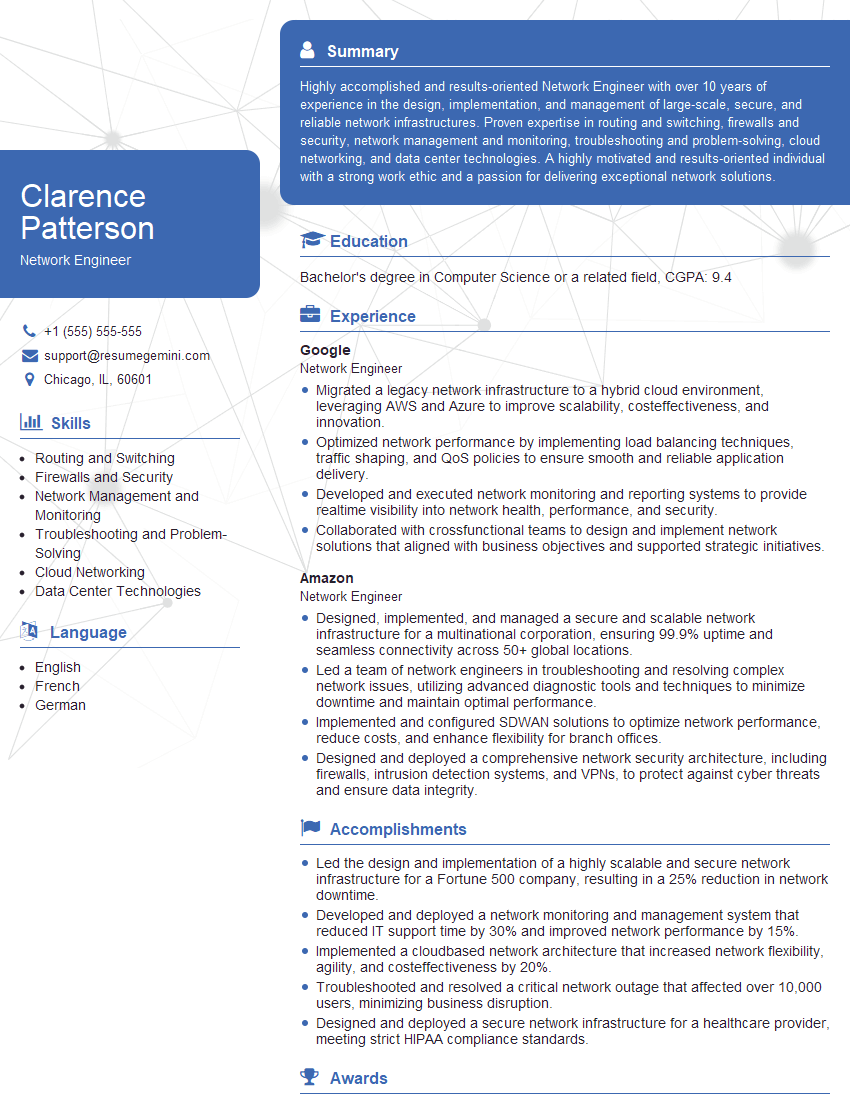
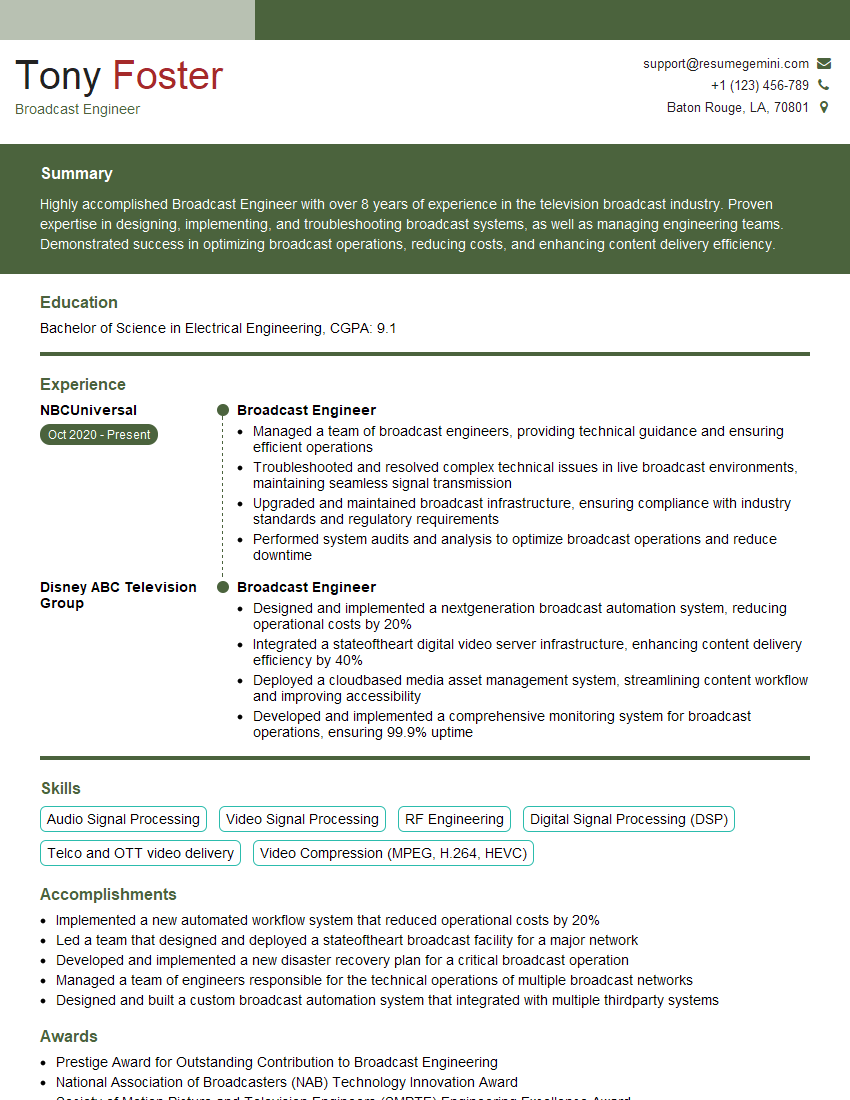
Mastering Media Network Design and Deployment opens doors to exciting career opportunities in a rapidly growing field. To maximize your chances of landing your dream job, creating a compelling and ATS-friendly resume is critical. ResumeGemini is a trusted resource that can help you build a professional resume that showcases your skills and experience effectively. ResumeGemini provides examples of resumes tailored to Media Network Design and Deployment to help you craft the perfect application. Take the next step in your career journey and invest in crafting a resume that truly reflects your capabilities.
Explore more articles
Users Rating of Our Blogs
Share Your Experience
We value your feedback! Please rate our content and share your thoughts (optional).
What Readers Say About Our Blog
Very informative content, great job.
good