Are you ready to stand out in your next interview? Understanding and preparing for Media Planning and Budgeting interview questions is a game-changer. In this blog, we’ve compiled key questions and expert advice to help you showcase your skills with confidence and precision. Let’s get started on your journey to acing the interview.
Questions Asked in Media Planning and Budgeting Interview
Q 1. Explain the difference between reach and frequency in media planning.
Reach and frequency are fundamental concepts in media planning that determine the effectiveness of an advertising campaign. Reach refers to the number of *unique* individuals exposed to your advertising message at least once during a specific period. Frequency, on the other hand, represents the average number of times each person within the target audience is exposed to your message during that same period.
Think of it like this: imagine you’re throwing a party. Reach is the number of unique guests who attend, while frequency is the average number of times each guest visits your party (if it’s a multi-day event, for example).
High reach is crucial for brand awareness and broad market penetration. A high frequency, however, is important for strengthening message recall and persuasion. The optimal balance between reach and frequency depends on your campaign objectives. For a new product launch aiming for maximum awareness, you might prioritize reach. For a product with established awareness that needs to drive immediate sales, you might prioritize frequency.
Q 2. How do you determine the optimal media mix for a given campaign?
Determining the optimal media mix is a strategic process that involves carefully analyzing your target audience, campaign goals, budget, and available media channels. It’s about finding the right combination of channels to maximize your impact. I typically follow a structured approach:
- Define Objectives: Clearly outline what you want to achieve (e.g., increase brand awareness, drive website traffic, generate leads). This will guide your media selection.
- Target Audience Analysis: Deeply understand your audience’s demographics, psychographics, media consumption habits, and online behavior. Where do they spend their time online and offline?
- Channel Selection: Based on your audience analysis, identify the most effective media channels (TV, radio, print, digital, social media, out-of-home, etc.). Consider their reach, targeting capabilities, and cost-effectiveness.
- Budget Allocation: Allocate your budget strategically across chosen channels, prioritizing those with the highest potential ROI based on audience overlap and campaign objectives.
- Testing and Optimization: Continuously monitor campaign performance, analyze data, and adjust the media mix as needed to improve efficiency and achieve optimal results. A/B testing different media combinations can provide valuable insights.
For instance, a B2B campaign might prioritize LinkedIn and industry publications, while a campaign targeting younger audiences might favor social media platforms like TikTok and Instagram.
Q 3. Describe your experience with media buying platforms (e.g., DV360, MediaMath).
I have extensive experience working with various media buying platforms, including DV360 and MediaMath. My experience encompasses campaign setup, trafficking, optimization, and reporting. On DV360, I’m proficient in utilizing its advanced targeting capabilities, such as audience segmentation based on demographics, interests, and behavioral data. I leverage its reporting dashboards to monitor key performance indicators (KPIs) and make data-driven decisions. With MediaMath, I’ve utilized its programmatic buying capabilities to create highly targeted campaigns across various digital channels, leveraging its sophisticated algorithms for real-time bidding and optimization.
I’m comfortable with the intricacies of these platforms, including managing budgets, setting up tracking pixels, and integrating with other marketing technologies. I’ve successfully managed large-scale campaigns with complex targeting requirements on both platforms, consistently delivering strong results for my clients.
Q 4. How do you measure the ROI of a media campaign?
Measuring ROI for a media campaign requires a clear understanding of your campaign objectives and the metrics that directly relate to them. It’s not simply about clicks or impressions; it’s about tying media spend to business outcomes. My approach involves:
- Defining Key Metrics: Establish clear, measurable goals (e.g., website conversions, leads generated, sales lift) and track the metrics directly tied to these objectives.
- Attribution Modeling: Employ appropriate attribution models (e.g., last-click, multi-touch) to accurately assign credit for conversions across different media channels.
- Data Analysis: Analyze data from various sources (website analytics, CRM, media platform reports) to understand the impact of your media spend on key performance indicators.
- Calculating ROI: Use a formula to calculate ROI, typically:
(Revenue Generated - Media Spend) / Media Spend. This will provide a percentage representing the return on your investment.
For example, if a campaign generated $100,000 in revenue with a $20,000 media spend, the ROI would be 400%.
Q 5. What are some key performance indicators (KPIs) you track in media planning?
The specific KPIs I track vary depending on the campaign goals, but some common ones include:
- Reach and Frequency: To understand audience exposure.
- Impressions and Click-Through Rate (CTR): To measure ad visibility and engagement.
- Website Traffic and Conversions: To gauge the effectiveness of driving users to the desired action.
- Cost Per Acquisition (CPA) and Cost Per Mille (CPM): To assess the cost-effectiveness of the campaign.
- Return on Ad Spend (ROAS): To measure the profitability of the campaign.
- Brand Lift: Using surveys or other methods to measure changes in brand awareness, perception, or consideration.
I use data visualization tools to monitor these KPIs in real-time, enabling quick adjustments to optimize performance during the campaign.
Q 6. How do you handle budget constraints in media planning?
Budget constraints are a common challenge in media planning. My approach involves a combination of strategies:
- Prioritization: Focusing on the most effective channels and tactics that deliver the highest ROI given the budget. This may involve sacrificing less effective channels.
- Efficient Targeting: Using precise targeting techniques to reach the most relevant audience segments, minimizing wasted ad spend.
- Programmatic Advertising: Leveraging programmatic buying to optimize ad spend in real-time, ensuring that your budget is used efficiently.
- Creative Optimization: Testing different ad creatives to identify high-performing versions and maximize campaign effectiveness.
- Negotiation: Negotiating favorable rates with media vendors to secure the best possible value for your budget.
- Phased Rollout: Consider a phased approach to test and optimize the campaign before committing the entire budget.
The key is to be strategic and data-driven, maximizing the impact of every dollar spent.
Q 7. What is your experience with programmatic advertising?
I have extensive experience with programmatic advertising, encompassing both planning and execution. I’m proficient in using various demand-side platforms (DSPs) to manage and optimize programmatic campaigns. This includes audience targeting, bid management, creative optimization, and performance reporting. I understand the nuances of real-time bidding (RTB), header bidding, and private marketplaces (PMPs), and I can leverage them to achieve the best results for my clients.
My experience also includes using programmatic advertising to reach specific audience segments based on various data points, including demographics, interests, behavior, and contextual information. I’m adept at using data-driven insights to inform campaign strategy and continuously improve campaign performance through A/B testing and optimization techniques.
Q 8. Explain your understanding of different media channels and their effectiveness.
Understanding media channels and their effectiveness is crucial for successful media planning. Each channel offers unique advantages and disadvantages, impacting reach, engagement, and cost. Let’s look at a few key players:
- Digital Channels (Search, Social Media, Programmatic): Offer highly targeted options based on demographics, behavior, and interests. Search advertising allows us to reach users actively looking for products or services. Social media platforms provide organic and paid opportunities to engage audiences within their preferred environments. Programmatic advertising utilizes automation to optimize ad placement across various websites and apps.
- Traditional Channels (Television, Radio, Print): While declining in some areas, these still hold significant reach, particularly within specific demographics. Television advertising provides broad reach and high impact, but targeting can be less precise. Radio offers localized reach and can be cost-effective for specific audiences. Print (magazines, newspapers) maintains a niche for high-quality visual engagement and targeted readership.
- Out-of-Home (OOH): Billboards, posters, transit advertising – these create brand awareness and reinforce messaging in physical spaces. They’re effective for geographically targeted campaigns.
Effectiveness is measured by factors like reach (audience size), frequency (number of exposures), engagement (interactions and clicks), and ultimately, return on investment (ROI). The optimal channel mix depends entirely on the campaign goals, target audience, and budget.
For example, a B2B SaaS company might prioritize digital channels like LinkedIn and search engine marketing, while a consumer goods company might focus on a mix of television, social media, and potentially OOH.
Q 9. Describe your process for developing a media plan.
Developing a media plan is a strategic process. My approach follows these key steps:
- Define Objectives and KPIs: What are we trying to achieve? Increased brand awareness? Lead generation? Sales? This step defines the Key Performance Indicators (KPIs) we’ll track for success (e.g., website traffic, conversions, brand mentions).
- Target Audience Research: Who are we trying to reach? Understanding demographics, psychographics, media consumption habits, and online behavior is critical. This informs channel selection and messaging.
- Media Strategy & Channel Selection: Based on the target audience and objectives, we select the most effective media channels. This involves analyzing reach, frequency, cost-effectiveness, and engagement potential.
- Budget Allocation: We distribute the budget across selected channels based on their effectiveness and reach. This often involves prioritizing high-impact channels and testing less-proven ones with smaller budgets.
- Content Development: Creating compelling ad creatives tailored to each channel is crucial. Messaging and visuals must resonate with the target audience and align with the campaign’s overarching goals.
- Implementation and Monitoring: Executing the plan involves scheduling ad placements, managing campaigns, and continuously monitoring performance against KPIs.
- Analysis and Optimization: Regular reporting and analysis track performance. We identify areas for improvement and optimize the campaign in real-time to maximize ROI. This might involve adjusting budget allocation, refining targeting parameters, or altering creative assets.
Q 10. How do you stay up-to-date with the latest trends in media planning?
Staying current in media planning requires continuous learning and engagement. I utilize several methods:
- Industry Publications and Blogs: Regularly reading industry publications (e.g., Ad Age, Marketing Week) and influential blogs keeps me informed about emerging trends and best practices.
- Conferences and Webinars: Attending industry conferences and webinars offers valuable insights from experts and allows for networking.
- Professional Organizations: Membership in professional organizations (e.g., IAB, 4A’s) provides access to resources, research, and networking opportunities.
- Data and Analytics Platforms: Monitoring data and analytics tools from platforms like Google Analytics, social media analytics dashboards, and ad platforms keeps me abreast of performance trends and audience behavior.
- Competitor Analysis: Regularly analyzing competitor campaigns provides insights into effective strategies and potential areas for innovation.
Q 11. What is your experience with media analytics and reporting tools?
I have extensive experience with various media analytics and reporting tools, including:
- Google Analytics: For website traffic analysis, user behavior tracking, and campaign performance measurement.
- Google Ads and other ad platform dashboards: To track campaign performance, including impressions, clicks, conversions, and ROI.
- Social media analytics platforms (e.g., Facebook Insights, Twitter Analytics): To monitor social media engagement, reach, and sentiment.
- Third-party analytics platforms (e.g., Adobe Analytics, Nielsen): For more comprehensive data analysis and audience insights.
My expertise extends to using these tools to create comprehensive reports, identify areas for improvement, and provide data-driven recommendations for optimization.
Q 12. How do you handle unforeseen challenges during a media campaign?
Handling unforeseen challenges during a media campaign requires adaptability and problem-solving skills. My approach involves:
- Rapid Assessment: Quickly identify the nature and scope of the challenge. Is it a technical issue? A change in market conditions? A competitor’s response?
- Data Analysis: Analyze the available data to understand the impact of the challenge on campaign performance.
- Contingency Planning: Having pre-defined contingency plans for potential risks helps mitigate the impact of unforeseen events.
- Collaboration and Communication: Work with the team and relevant stakeholders (clients, vendors) to develop solutions and communicate changes transparently.
- Adaptive Strategy: Adjust the media plan as necessary to address the challenge. This may involve shifting budget allocation, refining targeting, or changing creative messaging.
- Post-Mortem Analysis: After the challenge is resolved, conduct a post-mortem analysis to learn from the experience and improve future campaign planning.
For instance, if a major news event overshadows a campaign, we might adapt by adjusting messaging to be relevant to the current context or by shifting some budget to address emerging opportunities.
Q 13. Describe a time you had to make a difficult decision regarding media budget allocation.
In a recent campaign for a new skincare product, we faced a difficult decision regarding budget allocation. We initially allocated a significant portion to influencer marketing, believing it was crucial for reaching our target demographic (young adults). However, early performance data indicated a lower-than-expected ROI. We were seeing great engagement but limited conversions.
The difficult decision was to reallocate a portion of the influencer marketing budget to paid social media advertising with a more refined targeting strategy, focusing on specific interests and behaviors linked to purchasing skincare products. This required a difficult conversation with the client, explaining the data-driven rationale for the change. The shift proved successful; the paid social campaign delivered a much higher conversion rate, ultimately leading to a more positive ROI for the overall campaign.
Q 14. What is your experience with different targeting methods in media planning (e.g., demographic, behavioral, contextual)?
Targeting is essential for effective media planning, ensuring ads reach the right audience. I have experience with a range of targeting methods:
- Demographic Targeting: Targeting based on age, gender, income, location, education, etc. This is a foundational level of targeting, often used in conjunction with other methods.
- Behavioral Targeting: Targeting based on past online behavior, such as website visits, purchase history, and search queries. This allows for highly relevant ad delivery.
- Contextual Targeting: Placing ads on websites and apps relevant to the product or service. This ensures ads are shown within a context that aligns with the audience’s interests.
- Psychographic Targeting: Targeting based on personality traits, values, attitudes, and lifestyles. This requires deeper audience research and analysis but enables more resonant messaging.
- Lookalike Audiences: Creating audiences similar to existing customers or website visitors. This helps expand reach to potential customers with similar characteristics.
Effective targeting often combines multiple methods for optimal results. For instance, a campaign targeting millennial women interested in sustainable fashion might use a combination of demographic (age, gender), behavioral (website visits to eco-friendly fashion sites), and contextual (placing ads on relevant blogs and websites) targeting.
Q 15. How do you collaborate with other departments (e.g., creative, marketing) in the media planning process?
Collaboration is the cornerstone of successful media planning. I work closely with creative, marketing, and sales teams throughout the entire process. Early on, I meet with the marketing team to understand campaign objectives, target audiences, and key performance indicators (KPIs). This ensures the media plan aligns perfectly with overall marketing goals. For example, if the goal is brand awareness, we might focus on reach and frequency metrics. If it’s driving sales, we’ll prioritize conversions and ROI.
With the creative team, I share audience insights and media channel strategies so they can tailor creative assets for optimal impact. For example, if we’re targeting a younger demographic on TikTok, the creative will need a different style and tone compared to a campaign targeting older adults on Facebook. Finally, post-campaign analysis involves collaborating with the sales team to assess how media efforts directly influenced sales and conversions. This closed-loop feedback is critical for future planning.
Regular meetings, shared documents, and clear communication are key to this collaborative effort. Effective use of project management tools facilitates seamless workflow and information sharing.
Career Expert Tips:
- Ace those interviews! Prepare effectively by reviewing the Top 50 Most Common Interview Questions on ResumeGemini.
- Navigate your job search with confidence! Explore a wide range of Career Tips on ResumeGemini. Learn about common challenges and recommendations to overcome them.
- Craft the perfect resume! Master the Art of Resume Writing with ResumeGemini’s guide. Showcase your unique qualifications and achievements effectively.
- Don’t miss out on holiday savings! Build your dream resume with ResumeGemini’s ATS optimized templates.
Q 16. What is your understanding of the concept of ‘share of voice’?
Share of voice (SOV) measures a brand’s advertising presence relative to its competitors within a specific market. It’s expressed as a percentage, indicating the brand’s prominence in the overall advertising conversation. Imagine a crowded marketplace; SOV reflects how loud your brand’s voice is compared to the others. A high SOV doesn’t automatically guarantee success, but it suggests strong market presence and competitive activity.
Calculating SOV involves tracking advertising spend across various media channels – TV, radio, digital, print, etc. – and comparing it to the total advertising spend within that category. For instance, if Brand A spends $1 million on advertising in the beverage industry, and the total industry spend is $10 million, Brand A’s SOV is 10%.
Understanding SOV is crucial for strategic planning. A low SOV might indicate a need for increased investment, while an excessively high SOV might suggest overspending and potential for optimization.
Q 17. How do you evaluate the performance of different media agencies?
Evaluating media agencies requires a multi-faceted approach. I utilize a combination of quantitative and qualitative metrics. Key quantitative factors include campaign performance against KPIs (e.g., reach, engagement, conversions, ROI), cost efficiency, and media spend transparency. I meticulously review their reporting, looking for data integrity and actionable insights. For example, I’d examine the effectiveness of their targeting strategies by analyzing conversion rates from different channels.
Qualitative factors are equally important. These involve evaluating the agency’s strategic thinking, creative proposals, client communication, and overall team expertise. I assess their understanding of the target audience, their media recommendations’ rationale, and the efficiency of their operations. Client testimonials and case studies also provide valuable insights. Ultimately, the best agency demonstrates strategic thinking, delivers strong results, and maintains open communication.
Q 18. What is your experience with cross-channel attribution modeling?
Cross-channel attribution modeling is crucial for understanding how different marketing channels interact and contribute to conversions. It moves beyond simple last-click attribution by acknowledging that customers often interact with multiple channels before making a purchase. For example, a customer might see a Facebook ad, then visit the website through an email campaign, and finally purchase through Google Search.
I have experience using various attribution models, including multi-touch attribution (MTA) models like the Markov Chain model and data-driven attribution models that leverage machine learning to assign credit more accurately. These models help determine the relative value of each touchpoint within the customer journey, enabling optimization of marketing spend across channels. For example, if we discover that email marketing has a higher contribution to conversions than previously thought, we might allocate more budget there.
Q 19. Describe your experience with different bidding strategies in programmatic advertising (e.g., CPM, CPC, CPA).
Programmatic advertising uses various bidding strategies, each with its strengths and weaknesses. I’ve worked extensively with CPM (Cost Per Mille – cost per 1000 impressions), CPC (Cost Per Click), and CPA (Cost Per Acquisition) bidding strategies.
CPM is suitable for brand awareness campaigns aiming for broad reach. CPC focuses on driving traffic to a website, while CPA optimizes for conversions. Choosing the right strategy depends on campaign objectives. For example, if the goal is to maximize brand awareness, CPM bidding is appropriate; if it’s driving sales, CPA bidding is a better choice. I often use a combination of strategies and employ automated bidding platforms to optimize campaigns based on real-time data and machine learning algorithms.
Understanding the nuances of each bidding strategy and their appropriate application is crucial for maximizing ROI within the programmatic landscape.
Q 20. How do you incorporate consumer insights into the media planning process?
Consumer insights are the lifeblood of effective media planning. I leverage various methods to gather and analyze consumer data. This includes utilizing market research reports, analyzing social media trends, conducting surveys, and employing analytics tools to understand consumer behavior, preferences, and media consumption habits.
For example, understanding that my target audience is highly active on Instagram and prefers short-form video content would inform my media strategy to prioritize Instagram Reels and Stories. This ensures that my advertising message reaches the right people at the right time in the right place. I always strive to create a consumer-centric media plan.
Q 21. What is your experience with A/B testing in media planning?
A/B testing is a vital component of optimizing media campaigns. I use it to compare the performance of different creative assets, targeting strategies, or bidding strategies. A simple example might involve testing two different ad creatives for a Facebook campaign. By running both variations simultaneously, I can track key metrics like click-through rates and conversion rates to determine which version performs better.
The results of A/B tests provide data-driven insights that inform future campaign decisions. I might adjust targeting parameters based on what performs best, optimize the creative, or even switch to a more effective bidding strategy. It’s a continuous optimization process that improves campaign efficiency over time.
Q 22. Describe your experience with different types of media measurement (e.g., impressions, clicks, conversions).
Media measurement is crucial for evaluating the effectiveness of a media campaign. Different metrics provide insights into various stages of the customer journey. Impressions represent the total number of times an ad is displayed, offering a broad reach indicator. Clicks measure user engagement by tracking how many times an ad is clicked, indicating interest and potential conversions. Conversions track the desired actions users take after interacting with an ad, such as making a purchase or filling out a form. Each metric serves a unique purpose.
- Impressions: Imagine billboards along a highway; each passing car represents an impression, regardless of whether the driver actually notices the advertisement. High impressions suggest broad reach but don’t guarantee engagement.
- Clicks: If a significant number of those drivers turn into the store after seeing the billboard, we’re seeing a high click-through rate. This shows the ad is compelling enough to generate interest.
- Conversions: Finally, the actual number of drivers making a purchase represents the conversions. This is the ultimate measure of success; it translates ad exposure into tangible results.
In my experience, I’ve utilized various tools to track these metrics across multiple platforms, from traditional print and television to digital channels like Google Ads and social media. Analyzing these metrics allows for informed optimization and campaign adjustments based on performance data. For instance, a low click-through rate might indicate a need for ad creative improvements, while a low conversion rate could signify issues with the landing page experience.
Q 23. How do you manage the risks associated with media planning?
Managing risks in media planning is paramount. Unforeseen circumstances can significantly impact a campaign’s performance. My approach involves a multi-faceted strategy. First, I conduct thorough research and analysis to understand the target audience, competitive landscape, and media landscape. This helps identify potential pitfalls. Second, I build contingency plans. This means allocating a portion of the budget for unexpected events, such as negative press coverage or changes in algorithm.
- Market Fluctuations: For example, a sudden economic downturn could significantly affect advertising spend and consumer behavior. A contingency plan might involve flexible scheduling or a pivot to more cost-effective channels.
- Technological Disruptions: A platform’s algorithm update could drastically reduce an ad’s reach. Mitigation involves diversifying channels, tracking performance closely, and adapting strategies quickly.
- Competitive Landscape: A competitor launching a similar campaign could dilute the impact of our efforts. Contingency strategies might include adjusting messaging, targeting, or media mix to maintain a competitive edge.
Finally, I utilize robust monitoring and reporting processes. This includes regular tracking of key performance indicators (KPIs) and prompt adjustments based on real-time data. This proactive approach allows for rapid identification and mitigation of emerging risks, ensuring the campaign stays on track towards achieving its objectives.
Q 24. Explain your process for developing a media budget.
Developing a media budget is a structured process, not a guesstimate. It begins with clearly defining the marketing objectives and target audience. Once established, I determine the required media channels and associated costs. This process uses a combination of top-down and bottom-up approaches.
- Top-Down Approach: This starts with the overall marketing budget and allocates a percentage to media based on previous spending, industry benchmarks, or strategic priorities. For example, a company might allocate 50% of its marketing budget to media activities.
- Bottom-Up Approach: This starts by estimating the costs of individual media activities based on factors like pricing, reach, and frequency. The total of these costs provides a bottom-up budget. It’s often more precise for specific campaigns.
I then reconcile these approaches, factoring in factors like potential ROI (Return on Investment) for each channel, considering historical data and industry trends. This provides a realistic and achievable media budget. Regular review and adjustments are essential to keep the budget aligned with campaign performance and market dynamics. Budget allocation considers channel mix optimization, striving for a balance between cost-effectiveness and reach.
Q 25. How do you justify your media recommendations to clients or stakeholders?
Justifying media recommendations requires demonstrating a clear connection between media strategy and business goals. I present recommendations using data-driven insights and compelling narratives. This often involves visually appealing presentations with easily understood charts and graphs.
- Data-Driven Justification: I present data on target audience demographics and media consumption habits to demonstrate the strategic rationale behind channel selection. For example, if the target audience heavily uses Instagram, I’ll highlight that in the presentation with supporting data.
- ROI Projections: I show projected ROI for different media channels based on historical data and industry benchmarks. This clarifies how each channel is expected to contribute to the overall campaign goals.
- Comparative Analysis: I compare various media options and justify the chosen approach by highlighting its cost-effectiveness and potential to deliver the best results.
My presentations also include contingency plans to address potential risks. This demonstrates proactive thinking and a preparedness to adapt the strategy as needed. Finally, I encourage open discussion and actively address questions from clients or stakeholders, ensuring they fully understand the rationale behind the plan.
Q 26. What are your strengths and weaknesses in media planning and budgeting?
My strengths lie in my analytical skills, strategic thinking, and data-driven decision-making. I excel at developing comprehensive media plans that align with business objectives, leveraging data analytics to optimize performance and demonstrate ROI. I am proficient in various media planning and buying tools, and I stay updated on the latest industry trends and technological advancements.
One area I’m consistently working to improve is my presentation skills, specifically tailoring my communication style to different audiences. While I can present complex data clearly, I aim to enhance my ability to connect with diverse stakeholders on an emotional level, fostering stronger client relationships. This involves practice and receiving feedback.
Q 27. What are your salary expectations?
My salary expectations are in line with my experience and skills within the media planning and budgeting field, considering the specific responsibilities of the role and the company’s compensation structure. I am open to discussing a competitive salary range that reflects my value and contribution to your organization. I would be happy to provide a more specific range after learning more about the role and its requirements.
Key Topics to Learn for Media Planning and Budgeting Interview
- Media Landscape Analysis: Understanding the current media landscape, including traditional and digital channels, and their respective audiences. Practical application: Analyzing audience demographics and media consumption habits to inform channel selection.
- Target Audience Definition: Clearly defining the target audience for a campaign, including demographics, psychographics, and media consumption patterns. Practical application: Creating detailed buyer personas to guide media strategy.
- Media Objectives & Strategies: Defining clear, measurable, achievable, relevant, and time-bound (SMART) media objectives and developing strategies to achieve them. Practical application: Aligning media strategies with overall marketing goals and KPIs.
- Media Channel Selection & Optimization: Choosing the right mix of media channels based on target audience, budget, and campaign objectives. Practical application: Conducting cost-per-thousand (CPM) and return on investment (ROI) analysis for different channels.
- Budget Allocation & Management: Developing a realistic and effective media budget, allocating funds across different channels and activities, and tracking spending. Practical application: Utilizing budget forecasting tools and techniques to optimize spending.
- Campaign Measurement & Reporting: Tracking campaign performance using key metrics, analyzing results, and reporting findings to stakeholders. Practical application: Using analytics platforms to monitor campaign effectiveness and make data-driven optimizations.
- Emerging Media Trends: Staying current with emerging trends in media, technology, and consumer behavior. Practical application: Identifying opportunities to leverage new channels and technologies for increased reach and engagement.
Next Steps
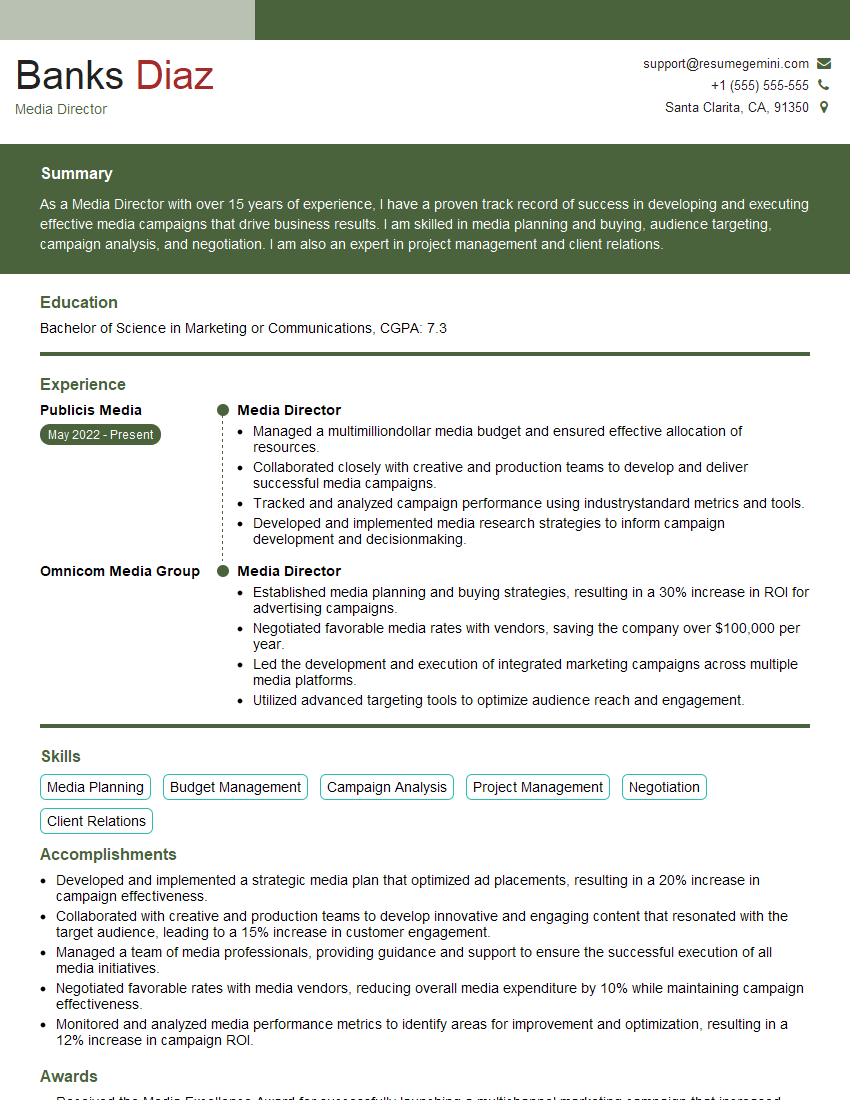
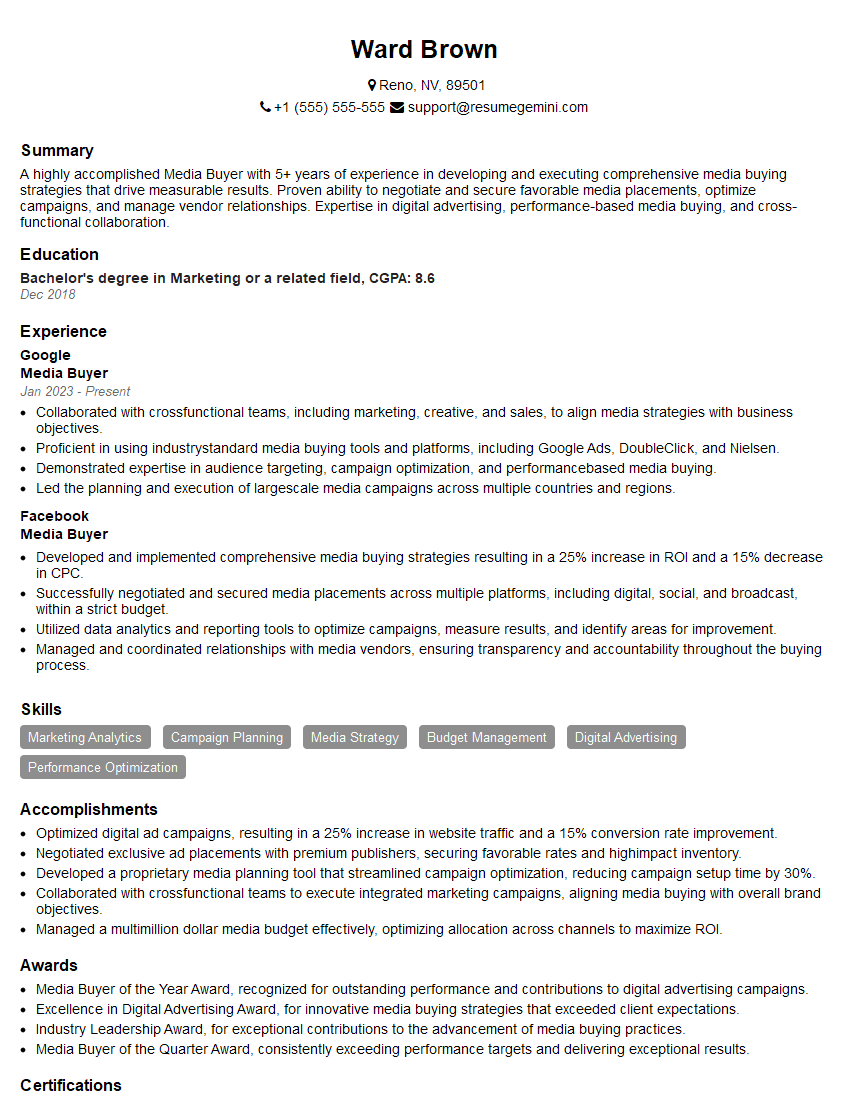
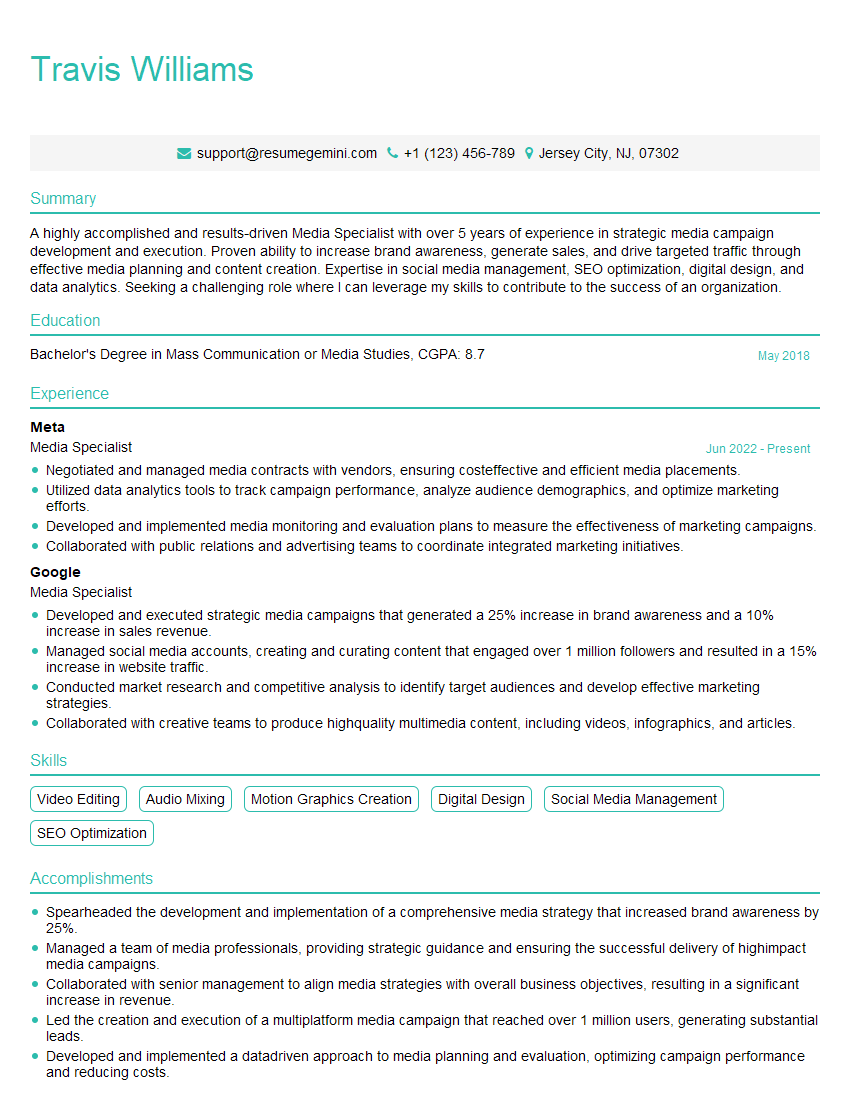
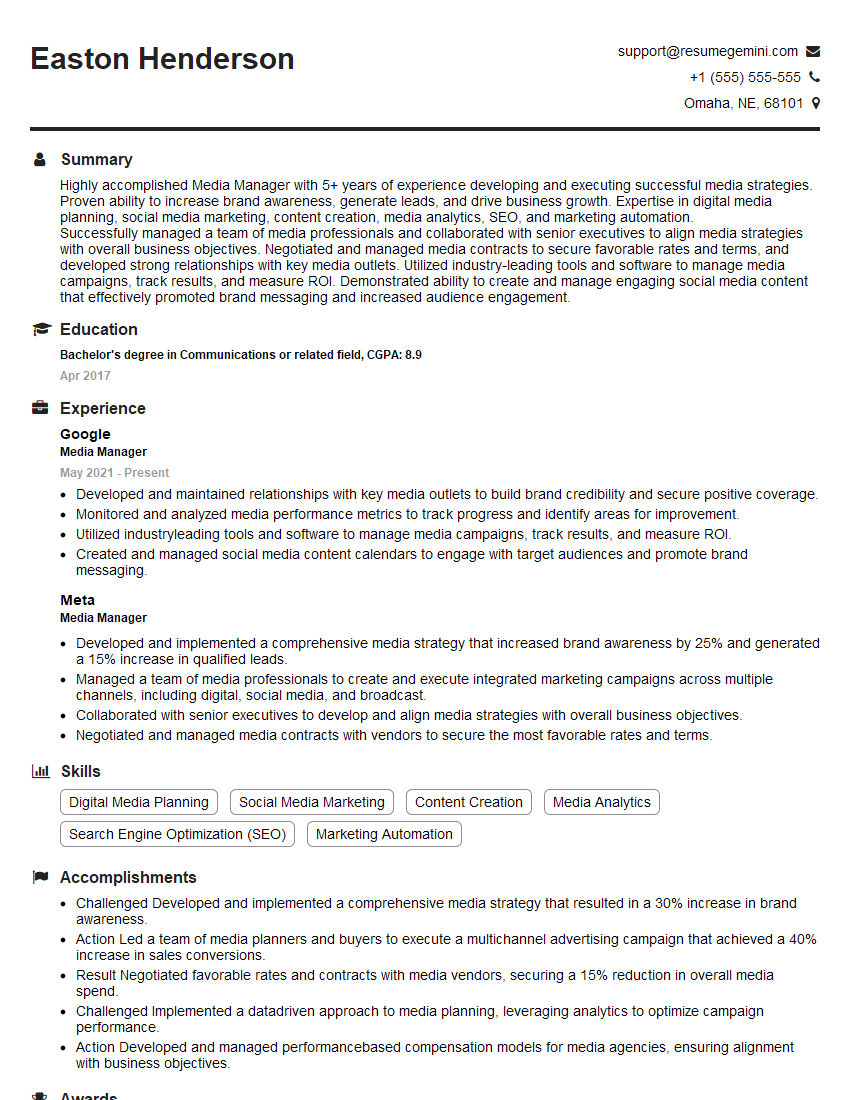
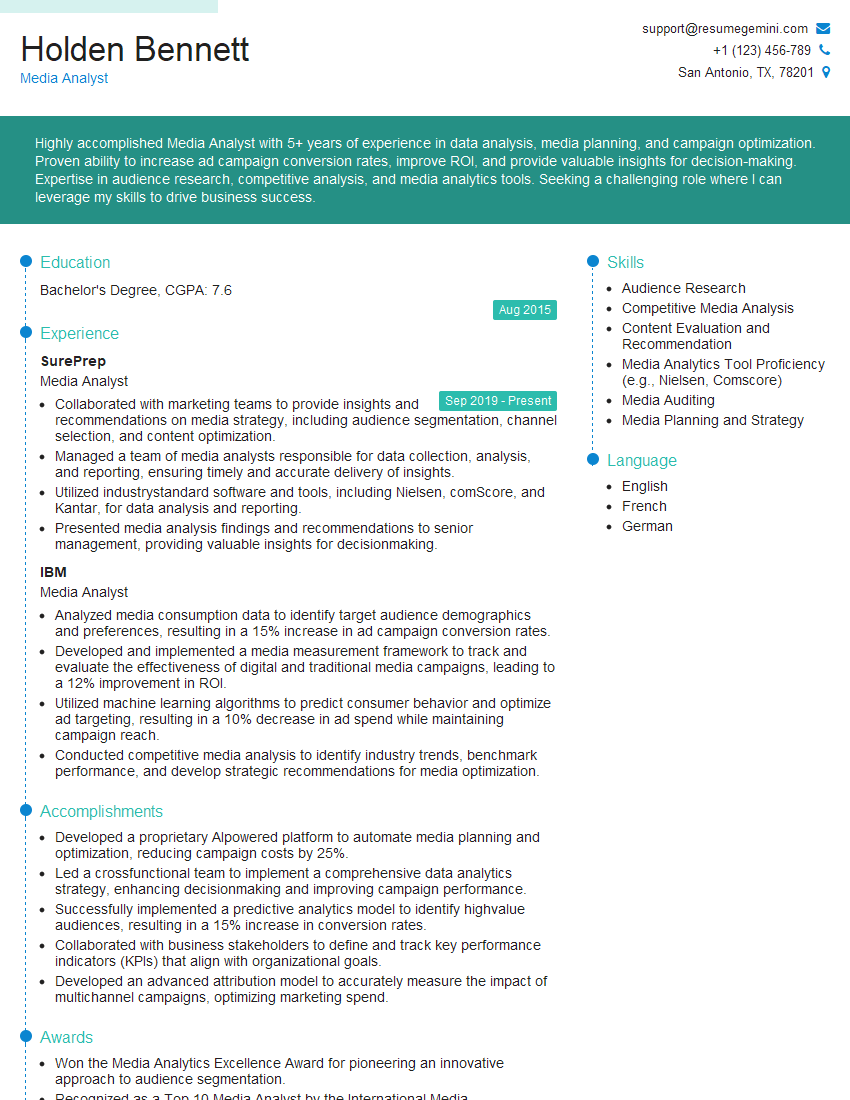
Mastering Media Planning and Budgeting is crucial for career advancement in marketing and advertising. A strong understanding of these concepts demonstrates valuable skills and opens doors to exciting opportunities. To maximize your job prospects, create a compelling and ATS-friendly resume that highlights your relevant experience and skills. ResumeGemini is a trusted resource to help you build a professional resume that stands out. We provide examples of resumes tailored to Media Planning and Budgeting roles to guide you in showcasing your expertise effectively. Take the next step towards your dream career today!

Explore more articles
Users Rating of Our Blogs
Share Your Experience
We value your feedback! Please rate our content and share your thoughts (optional).
What Readers Say About Our Blog
Very informative content, great job.
good