Cracking a skill-specific interview, like one for Melody Writing, requires understanding the nuances of the role. In this blog, we present the questions you’re most likely to encounter, along with insights into how to answer them effectively. Let’s ensure you’re ready to make a strong impression.
Questions Asked in Melody Writing Interview
Q 1. Explain your approach to developing a memorable melody.
Creating a memorable melody involves a blend of artistry and understanding fundamental musical principles. My approach begins with a strong concept – be it a specific emotion, a narrative arc, or even a single evocative image. From there, I experiment with different melodic ideas, constantly evaluating their memorability based on several key factors.
- Simplicity and clarity: Memorable melodies often have a simple, easily grasped structure. Think of the iconic opening of ‘Twinkle Twinkle Little Star’ – its simplicity is key to its memorability.
- Repetition and variation: Repeating core melodic phrases, but with slight variations, creates familiarity and intrigue. This keeps the listener engaged while reinforcing the melodic core.
- Strong rhythmic profile: A memorable melody typically has a clear and engaging rhythm. The rhythm itself can often be as important as the notes themselves in creating memorability.
- Use of leaps and steps: A balance between stepwise motion (notes close together) and leaps (larger intervals) can create both smoothness and dramatic impact. Too many leaps can feel disjointed, while too many steps might become monotonous.
I often use a process of trial and error, sketching out many ideas before honing in on the most promising ones. I might start with a simple motif (a short, recurring melodic idea) and then develop that motif into a longer melody. I also regularly test my melodies on others, seeking feedback on their memorability and overall impact.
Q 2. Describe your process for creating a melody that fits a specific mood or emotion.
Crafting a melody to match a specific mood or emotion requires a deep understanding of musical expression. Certain intervals, rhythms, and melodic contours are associated with particular feelings.
- Major vs. Minor: Major keys generally evoke happiness, joy, or optimism, while minor keys often express sadness, longing, or mystery.
- Melodic contour: Ascending melodies often feel triumphant or hopeful, while descending melodies might suggest sadness or resignation. A stepwise descending melody can even convey a sense of fragility.
- Rhythmic choices: Fast, upbeat rhythms often convey excitement or energy, while slower, more deliberate rhythms can evoke calmness or solemnity.
- Intervallic choices: Wide leaps can express surprise or excitement, whereas smaller intervals create a sense of intimacy or calmness.
For example, if I’m composing a piece meant to evoke feelings of peace and tranquility, I might use a slow tempo, a major key with a gentle, flowing melodic contour, and primarily stepwise motion. Conversely, a piece portraying dramatic tension might employ a minor key, rapid changes in tempo and dynamics, wider intervals and a more erratic melodic contour.
Q 3. How do you ensure your melodies are both catchy and original?
Balancing catchiness and originality is a constant challenge. Catchiness often relies on familiar patterns and structures, while originality requires breaking from convention. The key is finding a delicate balance.
- Borrowing and transforming: I might start with a familiar melodic pattern or progression, but then subtly alter it, perhaps changing the rhythm, the harmony, or the instrumentation. This creates something familiar yet new.
- Unexpected twists: Introducing an unexpected melodic leap, rhythmic shift, or harmonic change can add surprise and memorability while still maintaining a core sense of coherence.
- Extensive listening and research: Staying abreast of current musical trends while actively exploring diverse musical genres helps avoid unintentional plagiarism and provides inspiration for novel ideas. It also allows me to identify musical spaces where fresh approaches can thrive.
- Focus on unique phrasing: Even with common melodic building blocks, the way phrases are constructed and connected can dramatically affect originality. Emphasis on the phrase structure over just individual notes is crucial.
Ultimately, originality is not about avoiding all familiar elements but about using them in a fresh and inventive way.
Q 4. What are some common melodic patterns you utilize, and when are they most effective?
Many common melodic patterns are highly effective, depending on the desired effect. Here are a few examples:
- Arpeggios: Playing the notes of a chord one after another creates a pleasing, flowing sound, often used to create a sense of gentle movement or resolution.
C-E-G(C major arpeggio) is a simple example. - Scales: Ascending or descending scales (major, minor, etc.) can create a sense of momentum or resolution. A major scale ascending often feels uplifting.
- Sequences: Repeating a melodic fragment at a higher or lower pitch creates a sense of progression and anticipation. This is common in many genres.
- Motivic development: Taking a short melodic motif (a recurring musical idea) and developing it throughout the piece by altering its rhythm, harmony, or melody creates coherence and interest.
The effectiveness of a pattern depends heavily on context. A simple arpeggio might be perfect for a quiet, reflective moment, while a sequenced motif could be highly effective in building tension in a dramatic section. The choice always comes down to what best serves the overall emotional narrative.
Q 5. Discuss the importance of melodic contour in conveying narrative or emotion.
Melodic contour, the overall shape of a melody – its rises and falls – is crucial for conveying narrative and emotion. It acts like a visual representation of the feelings or story being told.
- Ascending contour: Often suggests hope, triumph, joy, or increasing intensity.
- Descending contour: Can represent sadness, loss, peace, or a decline in intensity.
- Wave-like contour: With alternating rises and falls, can mirror the ebb and flow of emotions or events.
- Stepwise motion: Creates a sense of intimacy, calmness or quiet contemplation.
- Leaps: Often suggest surprise, excitement, or a significant shift in emotion or narrative.
For instance, a melody depicting a character’s journey from despair to hope might start with a low, descending contour and gradually shift to an ascending contour with increasing leaps and a faster tempo as the character’s fortunes improve. The contour mirrors the emotional trajectory of the narrative. Consider how a simple upward arpeggio can convey a sense of reaching for something, expressing hope or yearning, while a descending stepwise melody could suggest a sense of falling or loss.
Q 6. How do you incorporate melodic variation to avoid monotony?
Melodic variation is essential for maintaining listener engagement and avoiding monotony. Repetition is important for memorability, but too much repetition becomes tiresome.
- Ornamentation: Adding grace notes, trills, or mordents to a melodic line can add interest without fundamentally changing the melody.
- Rhythmic variation: Changing the rhythmic values of the notes in a repeated phrase can create a new feel.
- Harmonic variation: Playing the same melody with different harmonies can create entirely new emotions and colors.
- Countermelody: Adding a secondary melody that complements the main melody can create texture and prevent monotony.
- Changes in instrumentation: If working with instruments, shifting the melody from one instrument to another can also add variety and interest.
For example, a simple eight-note phrase can be varied by changing its rhythm (dotted notes, syncopation), adding passing tones or neighboring tones, transposing it to a different key, or harmonizing it differently. The goal is to keep the core identity of the melody recognizable while introducing enough variety to keep the listener engaged.
Q 7. Explain your understanding of melodic intervals and their impact on the overall feel of a melody.
Melodic intervals, the distance between two notes, significantly impact the overall feel of a melody. The size and quality of the intervals determine the melodic character.
- Second (major/minor): Small intervals; major seconds feel slightly more tense than minor seconds. They’re common for creating stepwise motion.
- Third (major/minor): More significant intervals, major thirds often sound bright and consonant, minor thirds more melancholic.
- Fourth (perfect): A stable, often satisfying interval.
- Fifth (perfect): A very strong, consonant interval, often used for resolution or creating a sense of finality.
- Octave: Repeating the same note an octave higher or lower; creates a sense of unity or completeness.
- Leaps (larger intervals): Can create a sense of surprise, excitement, or dramatic impact. However, overuse can disrupt the flow.
For example, a melody primarily using major thirds might sound bright and optimistic, while one emphasizing minor seconds might feel more somber or pensive. A melody that frequently uses perfect fifths might sound powerful and resolute. The careful selection and combination of intervals are fundamental to shaping the overall emotional impact of the melody.
Q 8. How do you approach writing melodies for different instruments or vocal ranges?
Writing melodies for different instruments or vocal ranges requires understanding their unique timbral and pitch capabilities. A melody soaring effortlessly on a soprano voice might sound strained on a cello, and vice versa. My approach is to consider the instrument’s or voice’s natural tessitura – its comfortable range – as a starting point.
For instance, when composing for a cello, I’d prioritize a lower register and utilize larger intervals sparingly, focusing on creating a rich, resonant line. For a flute, I might favor a higher register, incorporating more agile leaps and ornamentation, taking advantage of its bright and airy tone. For vocals, I consider the specific voice type (soprano, alto, tenor, bass) and tailor the melody to its optimal range, avoiding extreme leaps that might challenge the singer’s technique or vocal health. I often experiment with different voicings and transpositions to find the best fit.
I also consider the instrument’s technical limitations. A melody requiring rapid scales might be unsuitable for a trombone but ideal for a clarinet. This careful consideration of each instrument’s strengths ensures that the melody not only sounds beautiful but also lies comfortably within the instrument’s capabilities.
Q 9. Describe your experience with different melodic forms (e.g., ABA, Rondo).
Melodic forms provide a structural backbone for melodies, guiding the development and creating a sense of anticipation and resolution. I’m extensively experienced with various forms. The ABA form, for instance, presents a theme (A), followed by a contrasting section (B), and a return to the original theme (A), offering a sense of familiarity and closure. I’ve used this in many pieces, particularly in simpler pop songs, where the ‘B’ section might offer a slightly more intense or emotional feel before returning to the catchy ‘A’ section.
The rondo form, on the other hand, uses a recurring main theme (A) interspersed with contrasting episodes (B, C, etc.), providing a more complex and varied structure. It’s particularly effective for conveying a sense of playfulness or narrative progression, and I’ve employed it in instrumental pieces where the return of the ‘A’ theme acts as a unifying element amidst diverse musical ideas. I also frequently incorporate elements of other forms, like ternary (three-part) forms and variations, tailoring the structure to best suit the emotional content and overall arc of the music. It is a powerful tool to manage listener expectations and emotional journeys.
Q 10. How do you ensure your melodies are harmonically sound?
Harmonically sound melodies are crucial for a piece’s overall coherence and appeal. I ensure this by grounding the melodic ideas in a strong harmonic foundation. This often involves using the notes of a chord progression as building blocks for my melodies, ensuring that the melodic notes align with the underlying harmony, creating a sense of consonance and resolution.
I use a combination of theoretical understanding and intuitive listening to achieve this. For instance, I frequently use stepwise motion within chords (moving from one note to another within the same chord) to create a smooth, consonant flow. When I introduce leaps or dissonances, I ensure that they are strategically placed and resolved effectively, often leading to a satisfying consonance. I will frequently sketch out chord progressions beforehand, serving as a roadmap for developing my melodic lines, ensuring a solid harmonic underpinning before I embark on composing the melody itself. This process prevents the dissonance from sounding jarring or unresolved.
Q 11. Discuss your familiarity with different melodic styles (e.g., classical, jazz, pop).
My familiarity with different melodic styles is broad, spanning classical, jazz, and pop music. Each style possesses a unique melodic language. Classical melodies, for example, often feature longer, more lyrical phrases, complex harmonic progressions, and a focus on structural integrity. I often incorporate techniques from classical counterpoint and form to create rich and sophisticated melodies.
Jazz melodies typically incorporate improvisation, blues scales, and syncopation – rhythmic displacement – creating a sense of spontaneity and rhythmic vitality. In my jazz compositions, I pay particular attention to rhythmic phrasing and the creation of memorable motifs that can then be developed through improvisation. Pop melodies generally prioritize memorability and accessibility, often using simpler harmonic progressions and repeating melodic fragments to create catchy hooks. My pop compositions focus on creating memorable melodies that can be easily sung along to, paying special attention to the phrasing and the overall structure.
Q 12. How do you use melodic phrasing to enhance musical expression?
Melodic phrasing is akin to punctuation in writing; it shapes the expressive character of a melody. The way I manipulate phrasing significantly influences a piece’s emotional impact. I use a variety of techniques to achieve this.
For instance, shorter phrases can convey a sense of urgency or excitement, while longer phrases can create a feeling of spaciousness and contemplation. I also utilize rests strategically to create pauses, building anticipation or allowing for moments of reflection. Furthermore, I control the rhythm and dynamics within a phrase to shape its expressive quality. A crescendo within a phrase can build intensity, while a diminuendo can create a sense of fading or introspection. The use of articulation (legato, staccato, etc.) also plays a critical role in creating diverse emotional color and textural interest. By meticulously crafting phrases, I can guide the listener’s emotional journey throughout the piece, highlighting specific moments and creating a holistic emotional arc.
Q 13. Describe your workflow for composing a melody from scratch.
My workflow when composing a melody from scratch generally starts with exploration. I often begin by experimenting with different chords or harmonic progressions, either on a piano or using a digital audio workstation (DAW).
Once I have a harmonic foundation, I start improvising melodic ideas, often recording and refining them as I go. I’ll try different rhythmic patterns, melodic contours, and intervals. I might start with a simple motif – a short melodic idea – and develop it through repetition, variation, and sequencing. I might also experiment with different melodic forms, trying out ABA structures, rondo forms, or free-flowing phrases to see what feels most natural. As the melody takes shape, I constantly evaluate its harmonic compatibility and its overall musical coherence. Through trial and error, refinement and analysis, I will shape the melody to fit its intended musical context and emotional expression. The final product is often the result of numerous iterations and revisions.
Q 14. How do you resolve melodic dissonance effectively?
Melodic dissonance, while sometimes jarring, can add dramatic tension and interest when handled effectively. Resolving dissonance is crucial for creating a sense of stability and satisfaction. My approach centers around leading the dissonant note to a consonant resolution.
A common technique involves using stepwise motion to a consonant note within the underlying harmony. For instance, a major seventh interval (a dissonant interval) can be effectively resolved by moving the upper note down a step to the root of the chord. Another approach is to use passing tones or neighboring tones to create a smooth transition from a dissonant to a consonant sound. I might also use suspension, where a dissonant note is held over from one chord to the next before resolving. It is vital that the resolution is clear and satisfying, preventing the listener from feeling a sense of unease or ambiguity. The careful management of dissonance is key to creating a dynamically interesting and emotionally engaging musical experience.
Q 15. Explain your process for revising and refining your melodies.
Revising and refining melodies is an iterative process, much like sculpting. I begin with a basic melodic idea, often a simple phrase. Then, I subject it to rigorous scrutiny, focusing on several key areas.
- Contour: Does the shape of the melody—its ascents and descents—create the desired emotional impact? I might adjust leaps or add passing tones to create a smoother or more dramatic effect. For instance, a rising contour often suggests hope, while a descending one can convey sadness.
- Rhythm: Is the rhythmic placement of notes compelling and supportive of the melody’s character? I experiment with different note values and rhythmic patterns to find the most effective and interesting rhythm. A syncopated rhythm can add a sense of surprise and energy.
- Intervals: Are the intervals (distances between notes) pleasing to the ear and consistent with the overall style? I might use a combination of consonant and dissonant intervals to create tension and release. Too many large leaps can sound jarring, while too many small intervals can be monotonous.
- Phrasing: Does the melody naturally break into phrases that feel complete and meaningful? I carefully shape phrases, often using cadences (musical resting points) to create a sense of closure. A well-phrased melody is easy to follow and remember.
This process involves repeated listening, making adjustments, and constantly asking myself, “Does this feel right?” I might even try playing the melody on different instruments to hear it in a new light. It’s a cycle of creation and refinement, constantly striving for elegance and effectiveness.
Career Expert Tips:
- Ace those interviews! Prepare effectively by reviewing the Top 50 Most Common Interview Questions on ResumeGemini.
- Navigate your job search with confidence! Explore a wide range of Career Tips on ResumeGemini. Learn about common challenges and recommendations to overcome them.
- Craft the perfect resume! Master the Art of Resume Writing with ResumeGemini’s guide. Showcase your unique qualifications and achievements effectively.
- Don’t miss out on holiday savings! Build your dream resume with ResumeGemini’s ATS optimized templates.
Q 16. How do you incorporate counter-melody effectively?
Counter-melody is a secondary melody that plays simultaneously with the main melody. Effective counter-melody enhances the overall texture and interest without overshadowing the primary melody. The key is to find a balance between independence and harmony.
- Harmonic Relationship: The counter-melody should complement the main melody harmonically. They can share common notes or move in complementary directions. A simple example is a counter-melody that moves in contrary motion (opposite direction) to the main melody.
- Rhythmic Contrast: Varying the rhythms between the main and counter-melody adds dynamism. If the main melody has a steady, even rhythm, the counter-melody could use syncopation or a more irregular pulse. This prevents monotony.
- Melodic Independence: While harmonically related, the counter-melody should have its own distinct character and melodic interest. It shouldn’t just mirror the main melody; instead, it should provide a contrasting voice.
- Texture: The combination of main melody and counter-melody should create a pleasing texture. Too many notes can sound cluttered; too few can feel thin. Finding the right balance is crucial.
Consider a simple example: If the main melody is a stepwise ascending line, the counter-melody could use arpeggios or descending figures to create contrast. The key is to experiment and listen carefully to achieve an effective balance.
Q 17. How do you use technology (e.g., DAWs, notation software) in your melody writing process?
Technology is invaluable in my melody-writing process. I use Digital Audio Workstations (DAWs) like Logic Pro X and Ableton Live, along with notation software like Sibelius. These tools help me in several ways:
- Rapid Prototyping: DAWs allow for quick experimentation. I can easily try out different instruments, tempos, and harmonies to find what works best. I can record ideas quickly and build upon them iteratively.
- Precision Editing: DAWs offer precise control over timing, pitch, and dynamics. I can fine-tune notes, adjust rhythms, and create subtle nuances that might be challenging to achieve solely with acoustic instruments.
- Arrangement & Collaboration: DAWs enable me to arrange the melody within a larger musical context. I can add harmonies, basslines, and other instrumental parts to see how the melody fits within the overall arrangement. This also facilitates collaboration by allowing easy sharing of projects.
- Notation & Score Creation: Notation software helps with creating professional-looking scores. This is vital for sharing with collaborators or for publication. It also aids in detailed analysis of melodic structure.
For instance, I might initially sketch out a melody using a MIDI keyboard within my DAW, then refine it by manipulating individual notes and rhythms. The ability to quickly adjust and experiment is a significant advantage.
Q 18. How do you handle creative blocks when writing melodies?
Creative blocks are a common challenge for any composer. My approach is multifaceted:
- Change of Scenery: A change of environment can spark new ideas. I might go for a walk, listen to different music, or work in a different room.
- Improvisation: Improvising on an instrument can unlock unexpected melodic ideas. I often record these improvisations to capture fleeting inspirations.
- Constraints: Sometimes, self-imposed constraints can be beneficial. I might try writing a melody within a specific mode, rhythm, or tonal range, to help focus my creativity.
- Collaboration: Discussing musical ideas with colleagues or other musicians can offer new perspectives and break through a creative rut.
- Analysis of Existing Music: Analyzing the melodic structure of my favorite pieces can be inspiring. I try to understand the techniques used and then apply them in my own compositions.
Remember, creative blocks are temporary. Persistence and a willingness to experiment are key to overcoming them. It’s often a matter of trying different approaches until something clicks.
Q 19. Describe your experience with collaborative melody writing.
Collaborative melody writing is a rewarding experience that often leads to innovative results. It requires good communication and a willingness to compromise. I’ve found that the most successful collaborations involve a balance of individual contributions and collective decision-making.
- Shared Goals: It’s crucial to establish clear goals and expectations at the outset. What is the style of music? What emotions should the melody evoke? What is the overall purpose of the piece?
- Open Communication: Open and honest communication is vital. We need to be able to share ideas freely, offer constructive criticism, and be open to compromise.
- Respectful Feedback: Giving and receiving feedback should be respectful and constructive. The goal is to improve the melody, not to criticize the individual.
- Experimentation: Collaborations offer a wonderful opportunity to experiment with different ideas and push creative boundaries. We might try combining seemingly unrelated melodic fragments to create something unique.
One memorable collaboration involved a jazz pianist and I. We were working on a piece requiring both a lyrical main melody and a strong improvisational counter-melody. By brainstorming separately initially and then merging our ideas, we produced something far richer than what either of us could have done individually.
Q 20. Explain your understanding of rhythmic relationships within a melody.
Rhythmic relationships within a melody are crucial to its character and impact. The interplay of long and short notes, accents, and rhythmic patterns creates a sense of movement, energy, and emotion.
- Meter and Time Signature: The melody’s rhythmic structure is defined by the meter (e.g., 4/4, 3/4) and time signature. Understanding this foundation is essential for creating a coherent and well-structured melody.
- Note Values: The durations of notes (whole, half, quarter, eighth, etc.) determine the rhythmic shape of the melody. A predominance of longer notes might create a feeling of solemnity, while shorter notes suggest energy or excitement.
- Syncopation: Placing accents on unexpected beats (syncopation) creates rhythmic interest and surprise. This can add energy and a sense of urgency to the melody.
- Rhythmic Motifs: Repeating rhythmic patterns (motifs) can create a sense of unity and coherence within the melody. Variations of a rhythmic motif can add interest without disrupting the overall feel.
For example, a simple melody with a strong, repetitive rhythmic pattern might feel predictable. By introducing syncopation or varying note lengths, we can create a more interesting and dynamic rhythmic landscape. The interplay between rhythmic patterns and melodic contours is vital to the overall effect of the melody.
Q 21. How do you use melody to tell a story or convey meaning?
Melody is a powerful tool for storytelling and conveying meaning in music. The shape, contour, and rhythm of a melody can directly evoke emotions and paint sonic pictures.
- Contour and Emotion: A rising melodic contour often suggests hope, joy, or triumph, while a descending contour might evoke sadness, despair, or resignation. Dramatic leaps can express surprise or excitement.
- Rhythm and Movement: A fast tempo and short note values can create a sense of urgency or excitement, while a slow tempo and long notes can create a feeling of peace or contemplation. Syncopation can add tension or unpredictability.
- Motifs and Repetition: Repeating melodic motifs can represent recurring ideas or characters in a musical narrative. Variations on a motif can show changes in a character’s emotional state or the progression of a story.
- Harmony and Dynamics: The harmony accompanying the melody and the use of dynamics (loudness and softness) can enhance the emotional impact. A major key often sounds brighter and happier, while a minor key can sound darker and more melancholic.
Consider a simple example: A melody that starts with a low, slow, descending phrase might convey sadness or loneliness, and then gradually rises to a high, triumphant climax could represent overcoming adversity. The melody itself acts as a visual representation of the story’s arc.
Q 22. Discuss the importance of melodic structure in a larger musical work.
Melodic structure is the backbone of any larger musical work, providing unity, coherence, and emotional impact. Think of it like the skeleton of a body – it gives shape and form to the music. Without a strong melodic structure, a piece can feel disjointed and lack direction. A well-crafted melody can guide the listener through the piece, creating anticipation, release, and a sense of satisfying resolution.
This structure often involves a clear presentation of a main theme (or several), development of that theme through variation and fragmentation, and ultimately, a return to, or a satisfying transformation of, the original theme. For instance, in a classical sonata form, the exposition presents the main themes, the development explores them in new contexts, and the recapitulation restates them with perhaps greater clarity or emotional weight.
- Form: The overall shape of the melody (e.g., A-B-A, rondo, sonata form) dictates how the melodic ideas are arranged and presented.
- Phrase Structure: Melodies are typically built from phrases, which are like musical sentences. The way these phrases are connected and balanced contributes significantly to the overall structure and listener experience.
- Motif Development: Short, memorable melodic fragments (motifs) are often repeated, varied, and developed throughout the piece, providing a sense of continuity and thematic unity.
A weak melodic structure can lead to a piece that sounds rambling and unfocused, while a strong structure creates a satisfying and memorable listening experience. Consider the instantly recognizable melodies of Beethoven’s symphonies or the thematic unity in a Bach fugue – these are prime examples of strong melodic structure at work.
Q 23. How do you balance originality with audience expectations when writing melodies?
Balancing originality with audience expectations is a constant challenge in melody writing. It’s about finding the sweet spot between surprising the listener and providing enough familiar elements to make the music accessible and enjoyable. Think of it like cooking – you want to create a dish that’s both innovative and delicious, satisfying both adventurous palates and those who prefer more familiar flavors.
One approach is to start with a familiar harmonic or rhythmic framework (a common chord progression, for example) that provides a sense of grounding, then introduce unexpected melodic contours, rhythms, or intervals to add originality. Conversely, you could begin with a completely novel melodic idea and gradually introduce familiar elements to ease the listener into the unconventional aspects.
It’s also helpful to analyze the music your target audience enjoys. Understanding what kinds of melodic shapes, rhythms, and harmonies they respond to can inform your creative process and help you gauge the level of originality you can effectively incorporate.
Ultimately, the goal is not to simply replicate existing styles, but to use them as a springboard for fresh, unique expression. For example, a composer might take a classic blues progression but infuse it with unexpected rhythmic complexity or unconventional melodic intervals to create something both familiar and novel.
Q 24. How would you approach composing a melody for a specific genre (e.g., video game soundtrack)?
Composing for a specific genre, like a video game soundtrack, requires a deeper understanding of the genre’s conventions and the overall aesthetic of the game. The melody must serve the narrative and gameplay effectively.
For example, composing a melody for a tense action sequence in a video game would necessitate a different approach compared to a calm, explorative section. In the former, the melody might feature a fast tempo, dissonant harmonies, and a driving rhythmic pulse to create a sense of urgency and suspense. Conversely, the explorative segment might employ a slower tempo, consonant harmonies, and a more lyrical melody to create a sense of peace and wonder.
Steps for composing a video game soundtrack melody:
- Understand the context: Analyze the scene or gameplay element the music will accompany. What emotion or atmosphere needs to be conveyed?
- Consider the instrumentation: The available instruments will influence the melodic possibilities. A simple melody might be more suitable for a game with limited instrumental capabilities.
- Experiment with melodic shapes and rhythms: Consider using rhythmic motifs that reflect the game’s action. For example, a repetitive, driving rhythm might suit a combat scenario, while a more varied rhythm might be appropriate for exploration.
- Develop the melody: Iterate on the initial idea, expanding it into a full phrase or section. Consider using variations and repetitions to create interest and maintain thematic unity.
- Test the melody in context: Integrate the melody into the game’s audio engine and playtest it to ensure it aligns with the overall gameplay experience.
Ultimately, the goal is to create a melody that enhances the gaming experience, seamlessly integrating into the game’s atmosphere and contributing to the narrative.
Q 25. How do you assess the effectiveness of your melodies?
Assessing the effectiveness of my melodies is an iterative process involving several steps. It’s not just about my personal opinion, but also about the impact it has on the listener.
- Self-evaluation: I start by critically listening to the melody, considering factors such as memorability, flow, emotional impact, and suitability for the intended context. Does it feel natural, or are there awkward leaps or rhythms?
- Feedback: I solicit feedback from trusted colleagues, musicians, and potentially even the target audience (through playtesting in the case of game soundtracks). Their reactions, both positive and negative, provide invaluable insight into the melody’s effectiveness.
- A/B testing: Sometimes I’ll create multiple versions of a melody and test them against each other to determine which resonates better. This allows for a more objective comparison.
- Analytical tools: Software can analyze the melodic contour, harmonic progression, and rhythmic complexity, providing quantitative data to support subjective assessments. While not a definitive measure of success, it can be helpful.
The effectiveness of a melody isn’t just about its technical proficiency, but also its ability to evoke the desired emotion and enhance the overall musical experience. A technically brilliant melody that fails to connect emotionally will ultimately fall short.
Q 26. Explain your understanding of melodic sequencing and its application.
Melodic sequencing involves arranging musical phrases in a specific order to create a larger melodic structure. It’s like constructing a narrative with musical sentences, each phrase building upon the previous one, creating a sense of momentum and direction.
In practice, melodic sequencing can involve repeating a phrase at a higher or lower pitch (sequential repetition), inverting a melodic contour, or creating a chain of related phrases that share common melodic fragments (motivic development). This approach can lead to a cohesive structure, where each part is a natural continuation of the previous one, enhancing the overall musical flow and expression.
A simple example would be taking a four-note melodic idea and repeating it at a higher pitch (transposition) after the first phrase, thus creating a sequence of related phrases. Another approach might involve creating variation through rhythmic alteration or changing the harmonies while keeping the fundamental melodic contour constant.
Effective melodic sequencing is crucial for establishing a sense of direction and maintaining listener interest in a musical work. A poorly sequenced melody might lack continuity and cohesion, making it sound disjointed and hard to follow, while a well-sequenced melody creates a smooth, logical flow of musical ideas.
Q 27. Describe your experience using different scales and modes in your melodies.
Scales and modes are fundamental building blocks in melody writing, significantly impacting the melodic character and mood. Each scale or mode possesses a unique sonic fingerprint, capable of evoking different emotions and creating distinct atmospheres.
I have extensive experience working with various scales, including major, minor (harmonic and melodic), pentatonic, and modal scales (e.g., Dorian, Phrygian, Lydian). For example, major scales often convey feelings of joy and optimism, whereas minor scales can evoke sadness or mystery. The pentatonic scale, with its simple structure, lends itself to folk and blues styles, while modal scales can create a more ancient or mystical atmosphere.
My approach to selecting a scale or mode begins with the emotional landscape I want to create. If I’m composing a piece with a melancholic mood, I might lean towards a minor scale or a mode like Dorian. If I want to express joy and exuberance, a major scale might be the perfect choice. Sometimes I explore less conventional scales to discover unique melodic possibilities, thereby enriching the emotional and stylistic diversity of my work.
The choice of scale or mode is intrinsically linked to the harmonic context, ensuring a coherent relationship between melody and harmony. The interaction between these two elements significantly influences the overall sonic texture and the overall artistic message.
Q 28. How do you incorporate leitmotifs or recurring melodic ideas into your work?
Leitmotifs, or recurring melodic ideas, are powerful tools for creating unity and thematic depth in a larger musical work. They act as musical signposts, connecting different sections of the piece and conveying specific emotions or representing particular characters or ideas (as famously used by Wagner).
I use leitmotifs to enhance both narrative coherence and emotional impact. For instance, a recurring melody might represent a specific character in a film score, appearing each time that character is on screen, thereby strengthening their narrative presence. Or, a motif associated with danger might be subtly introduced in the background, building suspense in anticipation of a key scene.
The process of incorporating leitmotifs often involves:
- Defining the theme: Clearly identifying the idea or emotion the leitmotif represents.
- Creating the motif: Composing a short, memorable melody that embodies that theme.
- Developing the motif: Varying the motif throughout the piece through changes in rhythm, harmony, instrumentation, and melodic contour. This prevents the melody from becoming repetitive while maintaining its identity.
- Strategic placement: Carefully choosing where to place the leitmotif to maximize its impact and narrative function.
Effective use of leitmotifs adds layers of meaning and complexity to the music, creating a richer and more rewarding listening experience. It’s a technique that can be used in almost any genre, from film scores and opera to video games and even pop music (though often less explicitly).
Key Topics to Learn for Melody Writing Interview
- Melodic Contour and Shape: Understanding how melodic lines ascend, descend, and create overall shape. Practical application: Analyzing existing melodies to identify their contour and how it contributes to the overall emotional impact.
- Intervallic Relationships: Mastering the use of intervals (distances between notes) to create melodic interest and coherence. Practical application: Composing short melodies using specific interval patterns to achieve a desired effect (e.g., stepwise motion for calmness, leaps for excitement).
- Rhythm and Meter: Understanding how rhythm interacts with melody to create a compelling musical phrase. Practical application: Experimenting with rhythmic variations within a given melodic contour.
- Scales and Modes: Proficiency in using different scales and modes to establish tonal centers and create melodic variety. Practical application: Improvising melodies within a specified scale or mode.
- Melody and Harmony Interaction: Understanding how melody interacts with and complements the underlying harmony. Practical application: Writing melodies that enhance or contrast with a given harmonic progression.
- Motivic Development: Learning to develop a short melodic idea (motive) into a longer, more complex melody. Practical application: Taking a simple 2-note motive and expanding it into a 16-bar melody.
- Melodic Analysis: Critically analyzing existing melodies to understand their structure, function, and effectiveness. Practical application: Analyzing famous melodies to identify their key features and compositional techniques.
Next Steps
Mastering melody writing is crucial for career advancement in music composition, arrangement, and related fields. A strong understanding of melodic principles significantly enhances your creative abilities and opens doors to a wide range of opportunities. To maximize your job prospects, it’s vital to create an ATS-friendly resume that effectively showcases your skills and experience. ResumeGemini is a trusted resource that can help you build a professional and impactful resume. We provide examples of resumes tailored to Melody Writing to guide you in crafting your own compelling application.
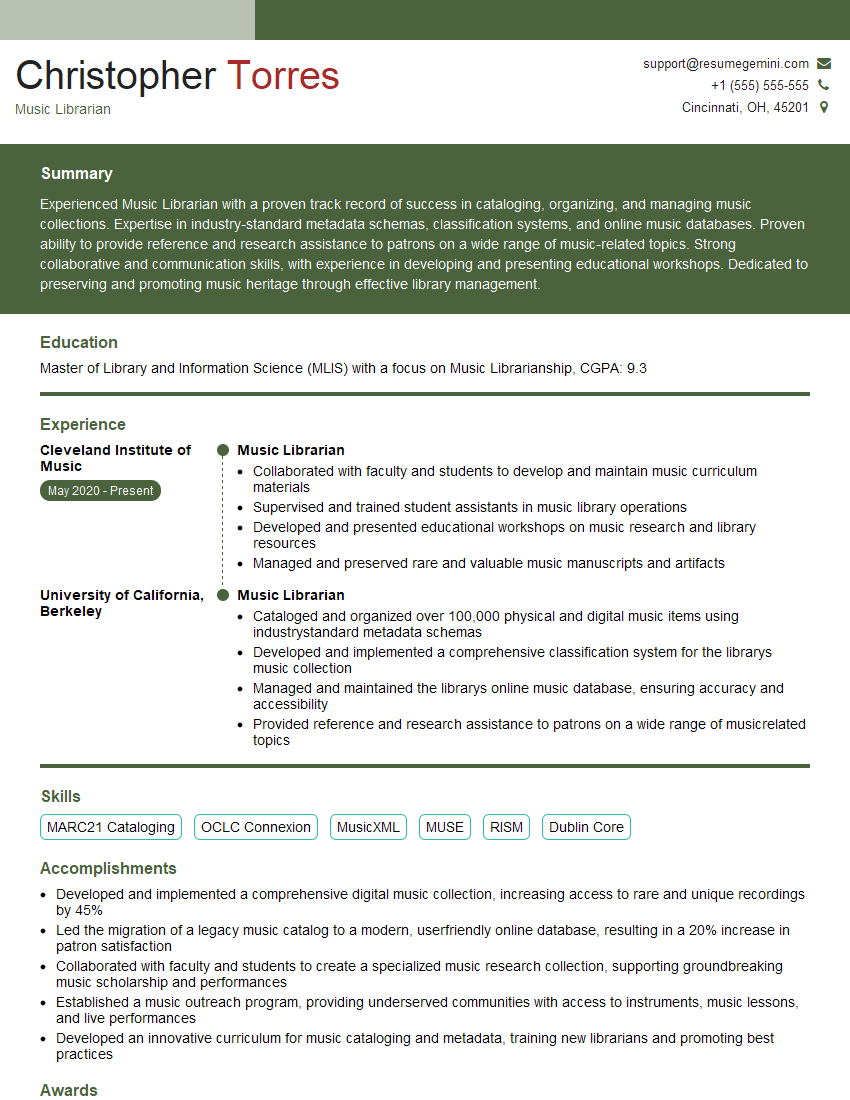
Music Librarian Resume Sample
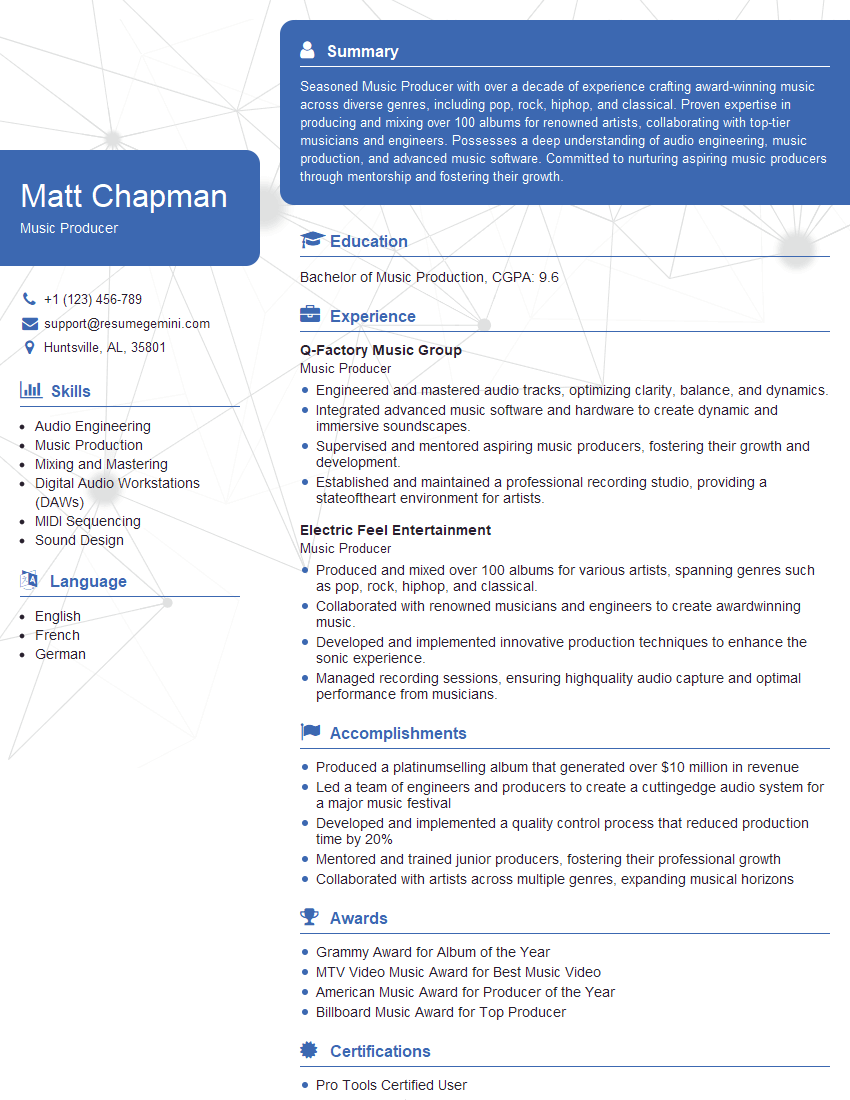
Music Producer Resume Sample
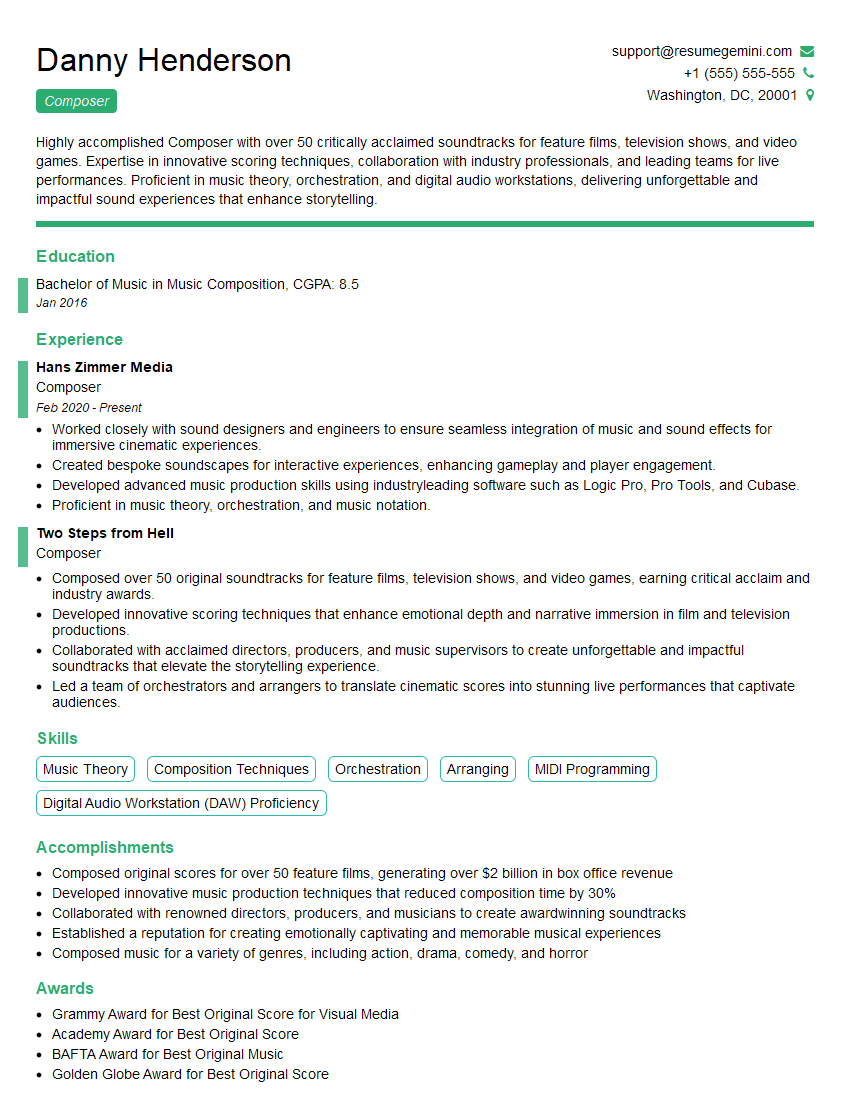
Composer Resume Sample
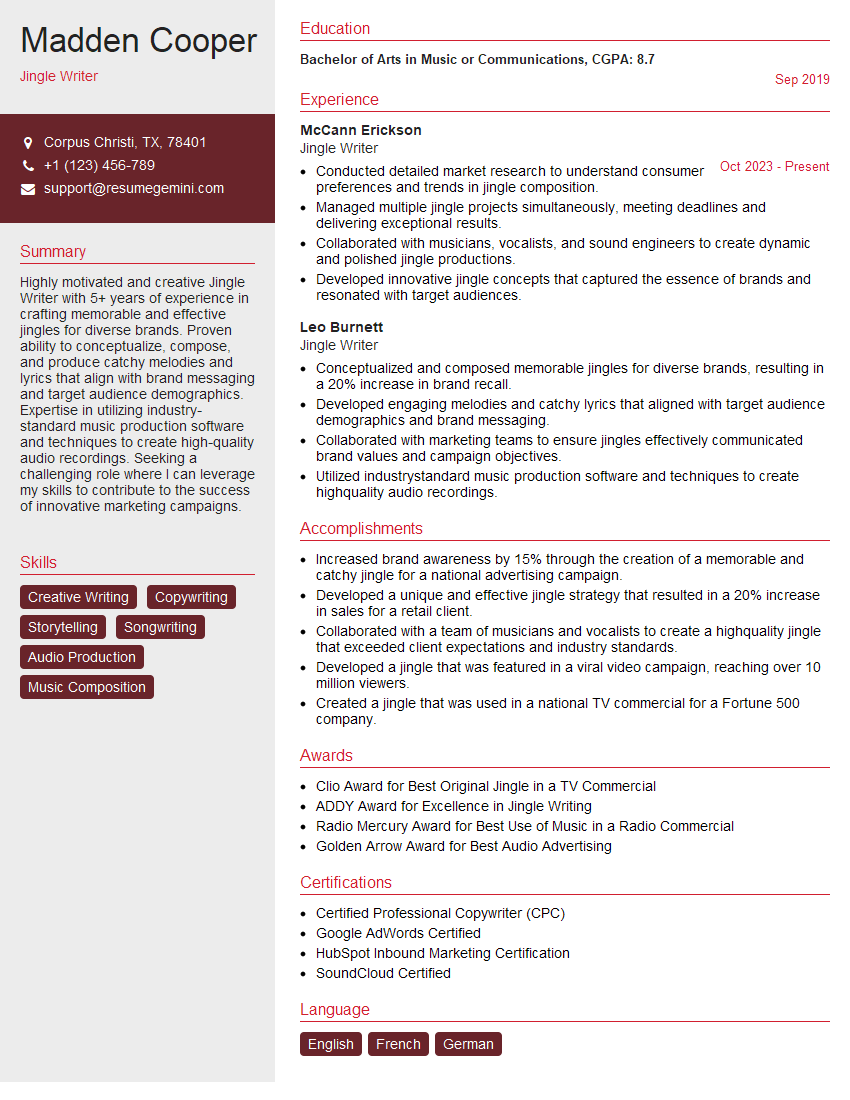
Jingle Writer Resume Sample
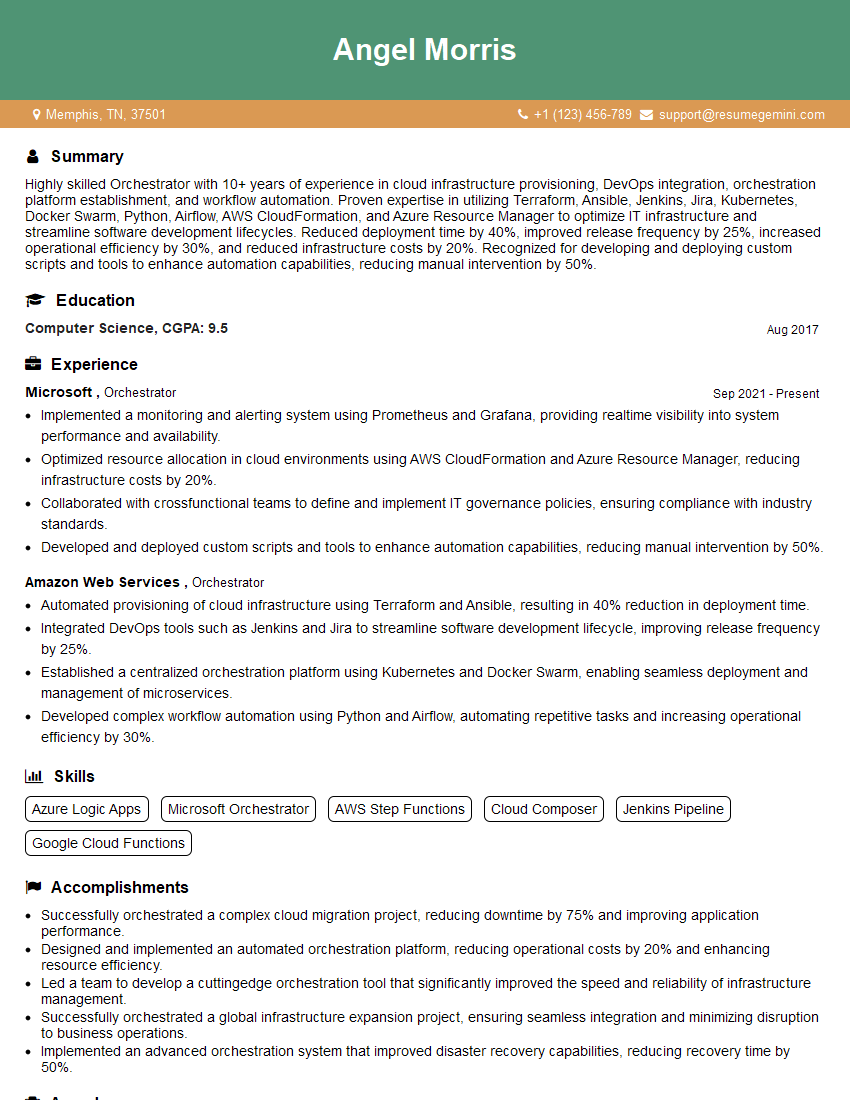
Orchestrator Resume Sample
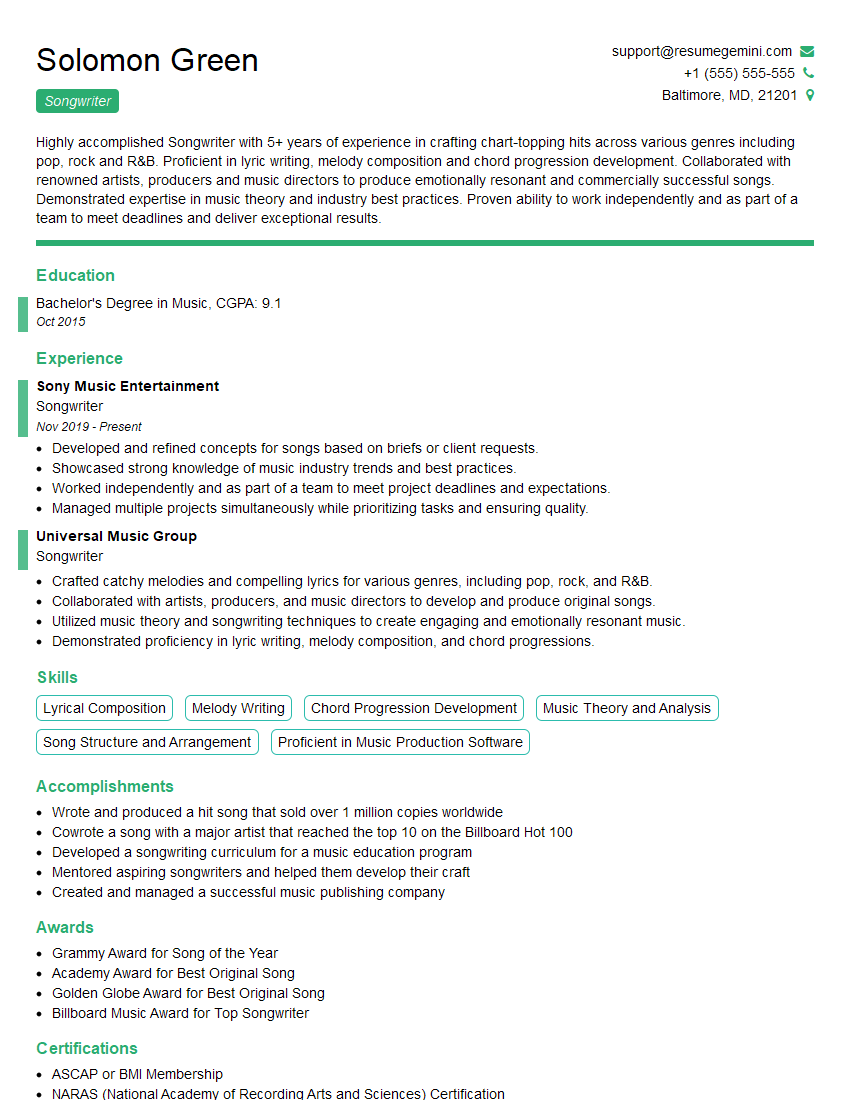
Songwriter Resume Sample
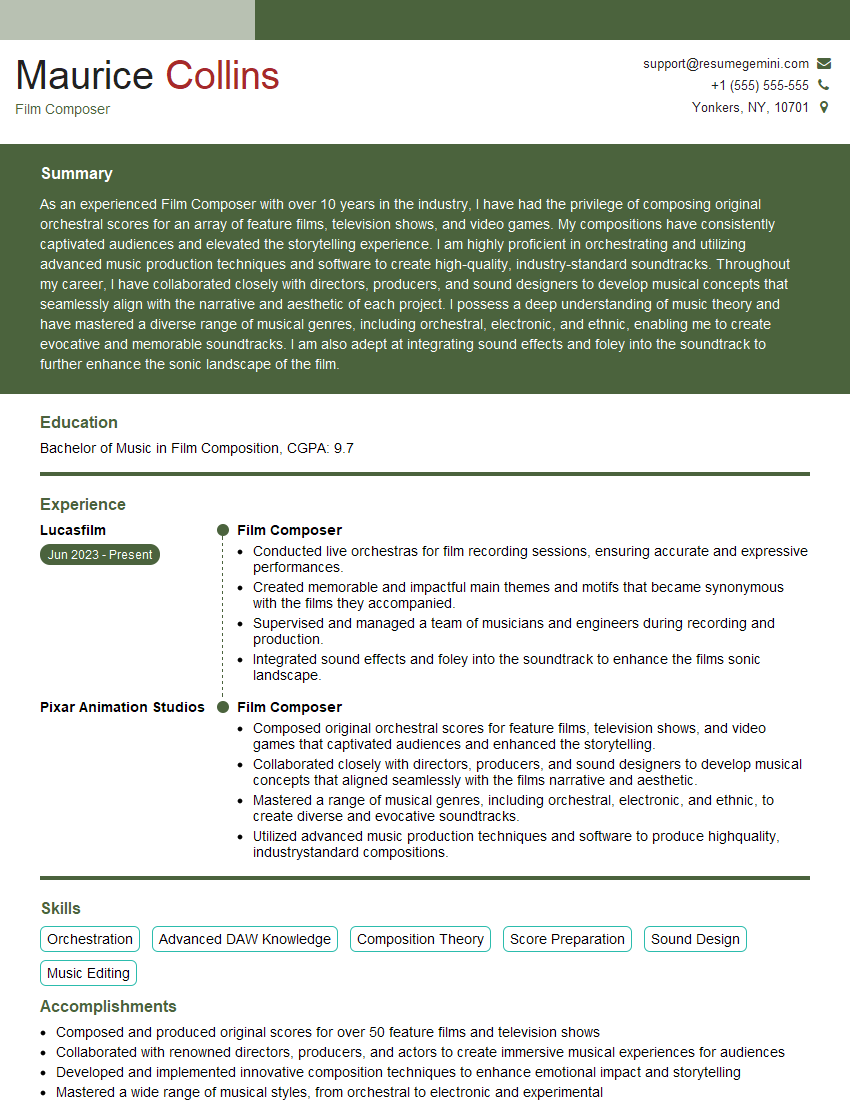
Film Composer Resume Sample
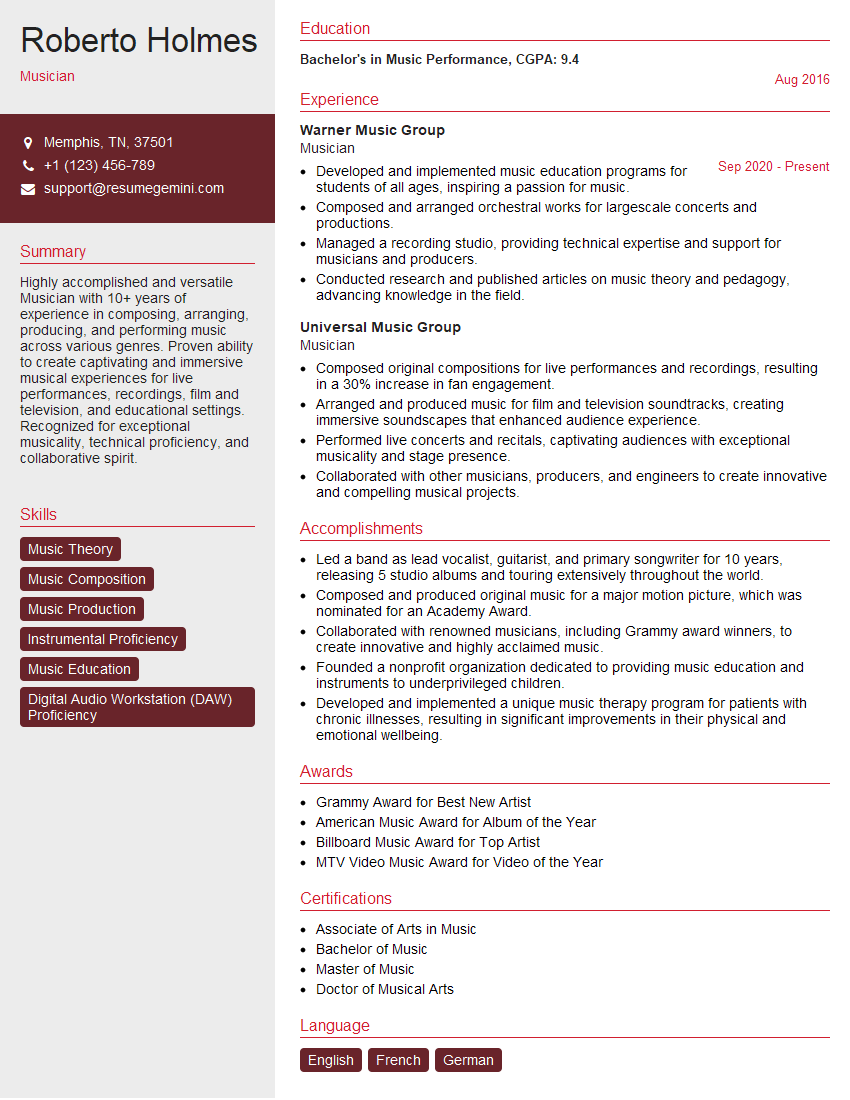
Musician Resume Sample
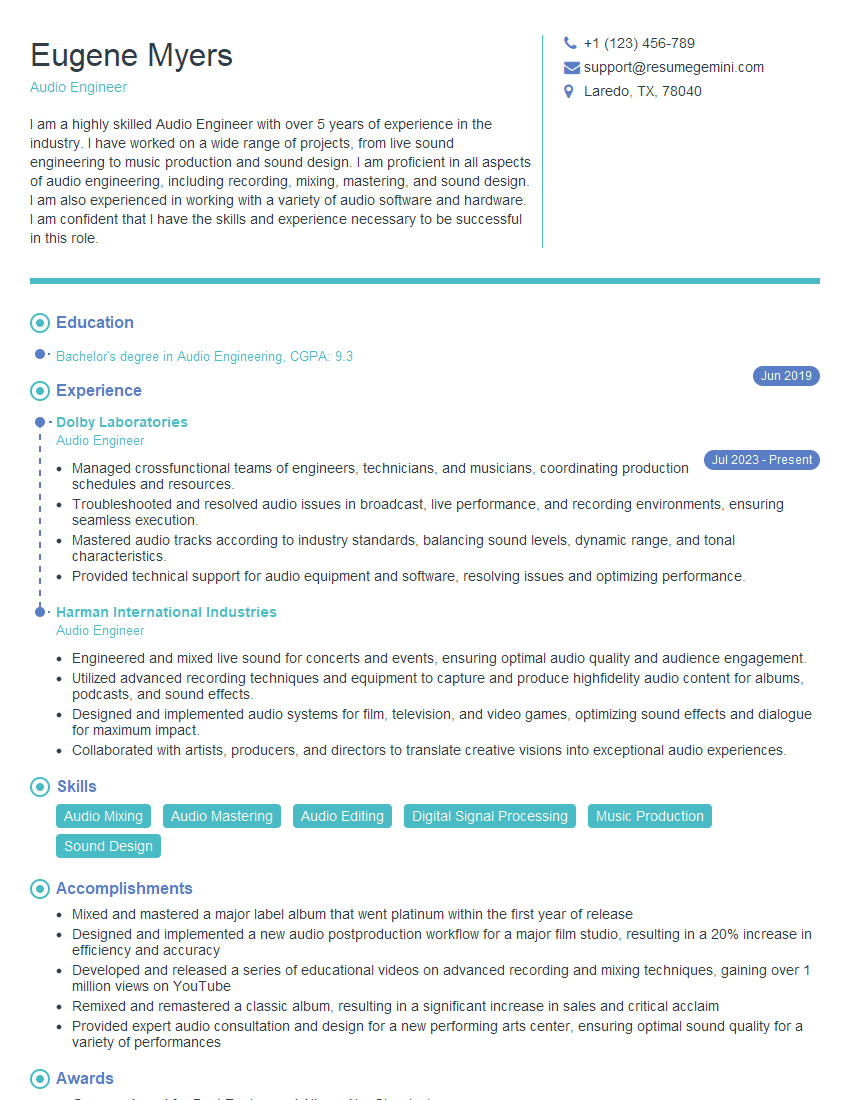
Audio Engineer Resume Sample
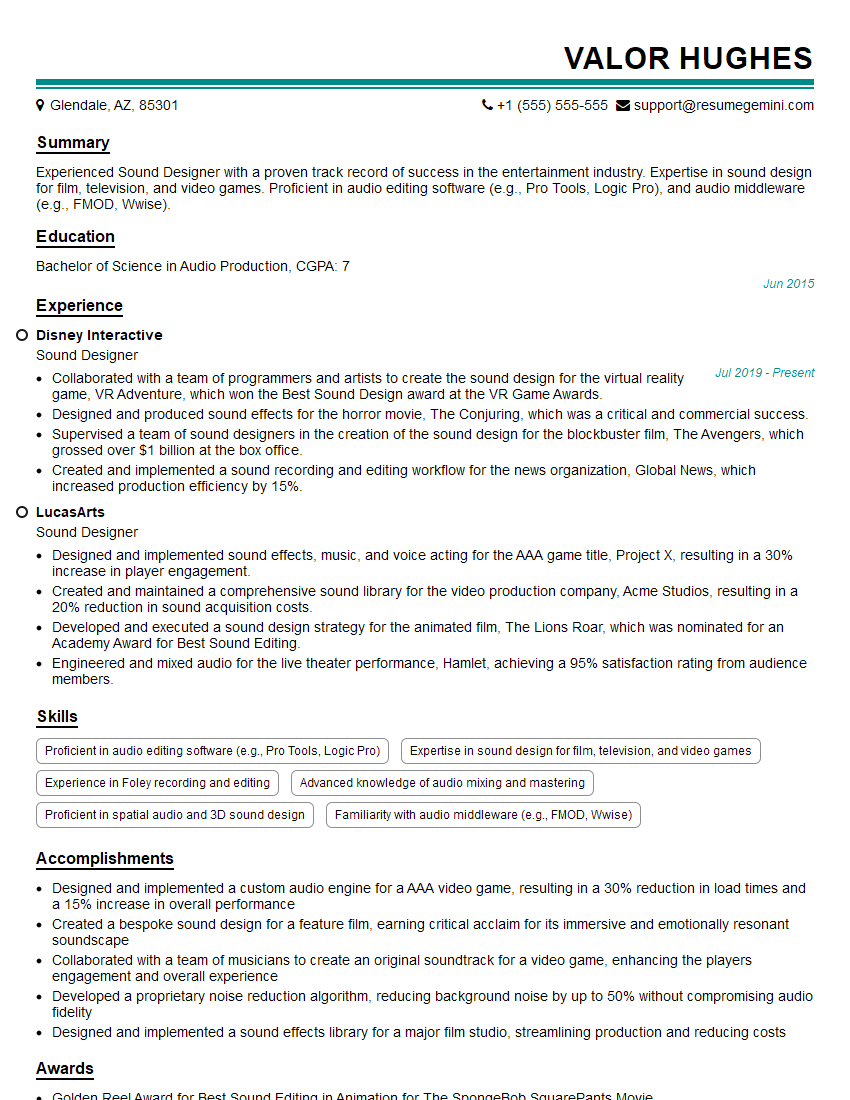
Sound Designer Resume Sample
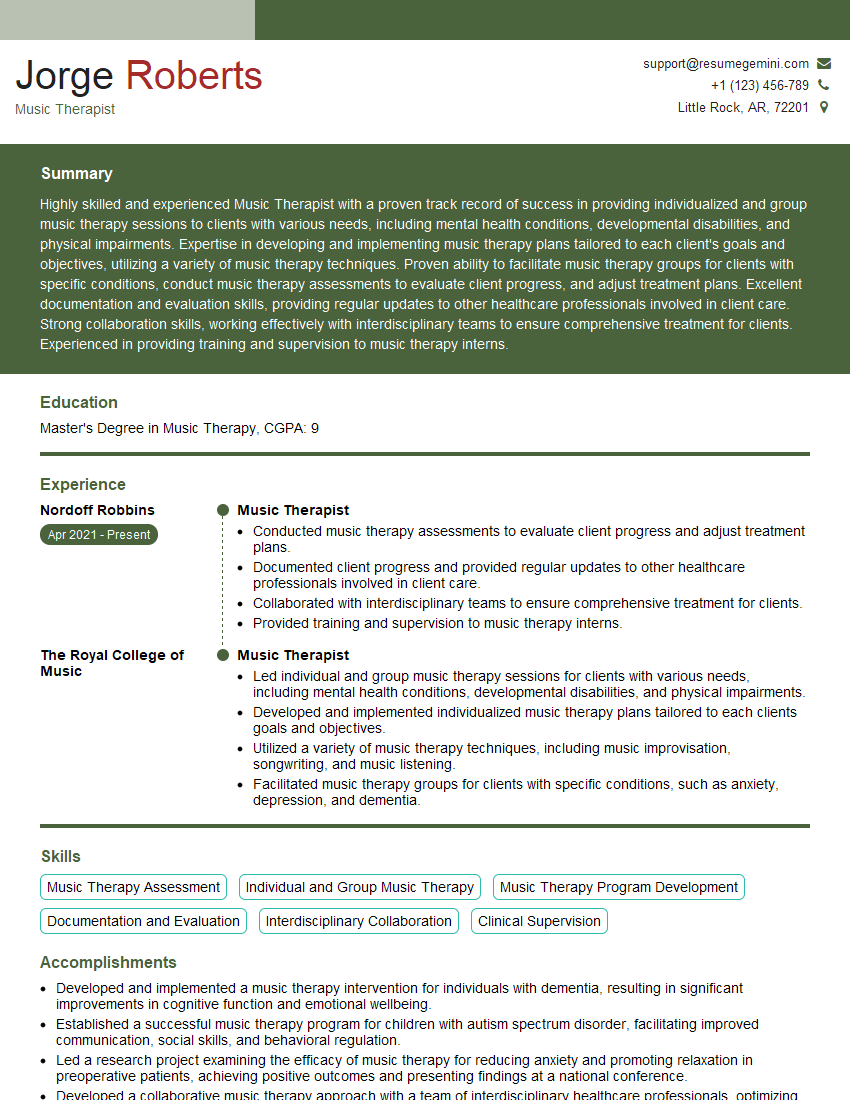
Music Therapist Resume Sample
Explore more articles
Users Rating of Our Blogs
Share Your Experience
We value your feedback! Please rate our content and share your thoughts (optional).
What Readers Say About Our Blog
Very informative content, great job.
good