Interviews are more than just a Q&A session—they’re a chance to prove your worth. This blog dives into essential Metalforming interview questions and expert tips to help you align your answers with what hiring managers are looking for. Start preparing to shine!
Questions Asked in Metalforming Interview
Q 1. Explain the difference between hot and cold forming processes.
The primary difference between hot and cold forming lies in the temperature at which the metal is deformed. In hot forming, the metal is heated to a temperature above its recrystallization temperature, making it significantly more ductile and easier to deform. This allows for complex shapes and larger deformations with less force. Think of it like trying to bend a piece of play-doh (hot) versus a metal ruler (cold). The play-doh is much more malleable. Cold forming, conversely, involves deforming the metal at room temperature or slightly elevated temperatures, below the recrystallization point. This leads to higher strength and better surface finish but requires more force and may result in more springback.
In short: Hot forming is easier, allows for more complex shapes, and leads to lower strength; cold forming is harder, produces stronger parts with better surface finish, but is more likely to lead to springback and requires more precise control.
- Hot Forming Examples: Forging, hot rolling
- Cold Forming Examples: Stamping, cold rolling, drawing
Q 2. Describe the various types of metalforming processes (e.g., forging, rolling, drawing).
Metal forming encompasses a wide array of processes, each tailored to specific material properties and desired part geometries. Here are some prominent examples:
- Forging: Metal is shaped by compressive forces using hammers, presses, or dies. Think of creating a coin or a complex shaped turbine blade. It results in high strength and good mechanical properties.
- Rolling: Metal is passed through a series of rollers to reduce thickness and increase length. This is how we get sheet metal. It’s excellent for mass production of consistent thickness.
- Drawing: Metal is pulled through a die to reduce its diameter or change its shape. Imagine creating wire or tubing. It’s precise and suitable for producing long, slender components.
- Extrusion: Metal is forced through a die to create continuous shapes, such as beams or tubes. It is common in the aluminum industry.
- Stamping/Pressing: Sheet metal is shaped using a die and punch, a process frequently used to make car body panels. High-speed production with good dimensional accuracy.
- Spinning: A rotating workpiece is shaped against a form, commonly used for making symmetrical parts like bowls or lampshades.
The choice of process depends heavily on the desired shape, material, production volume, and tolerance requirements.
Q 3. What are the common defects found in metal forming and their causes?
Metal forming defects can significantly impact part quality and functionality. Some common defects include:
- Cracking: This can occur due to excessive stress, low ductility of the material, or poor die design. It’s often a sign of exceeding the material’s yield strength.
- Wrinkling: This usually happens in sheet metal forming when the material buckles under compressive forces. This occurs when material is insufficiently constrained.
- Surface defects: Scratches, tears, or surface imperfections can result from poor lubrication, die wear, or improper handling. They affect surface finish and aesthetics.
- Dimensional inaccuracies: These arise from variations in material properties, die wear, or inaccurate machine settings. They affect the functionality of the part.
- Inclusion of foreign materials: Pieces of tooling, lubricants, or other foreign materials can become embedded in the formed part.
The causes of these defects often stem from issues with material selection, process parameters (temperature, speed, pressure), die design, lubrication, and equipment maintenance.
Q 4. How do you select the appropriate metalforming process for a given part design?
Selecting the right metal forming process involves careful consideration of several factors. It’s not simply picking the ‘best’ process but choosing the most suitable one for the specific design.
- Part geometry: Complex shapes might require forging, while simple shapes may be suitable for stamping.
- Material properties: Ductile materials are suitable for a wider range of processes, while brittle materials might limit your options.
- Production volume: High-volume production favors processes like rolling or stamping, while low-volume production may tolerate more labor-intensive methods like forging.
- Tolerances: Tight tolerances might require processes like precision forging or drawing. Less precision is acceptable in other processes.
- Cost: Each process carries distinct costs associated with tooling, machinery, and labor.
A step-by-step approach involves identifying the desired part shape and tolerances, considering material properties, and evaluating the suitability of different processes based on factors outlined above. This is often done by performing simulations and feasibility studies before settling on a final choice.
Q 5. Explain the concept of springback in metalforming and how it is mitigated.
Springback is the elastic recovery of a formed part after the forming forces are removed. Imagine bending a spring; it returns partially to its original shape after you release the pressure. This is exactly what happens in metal forming. It can lead to dimensional inaccuracies and necessitates careful design considerations.
Mitigating springback involves several strategies:
- Overbending: The part is intentionally formed beyond the desired final shape, accounting for the expected springback.
- Die design optimization: Designing dies with features that minimize bending moments and maximize support can reduce springback.
- Material selection: Materials with lower elastic modulus exhibit less springback.
- Process parameters adjustment: Adjusting variables such as the forming speed and temperature may influence the extent of springback.
- Computer simulations: Finite element analysis (FEA) can predict springback and guide process adjustments.
Springback is a significant challenge, and its effective mitigation is essential for producing parts to precise dimensions.
Q 6. Describe different types of dies used in metalforming.
Metal forming dies come in various types, each designed to accommodate different processes and part geometries. Here are a few examples:
- Forging dies: These dies are robust, typically made of high-strength tool steels, and used to shape metal through compressive forces. They may be open dies (simple shapes) or closed dies (complex shapes).
- Rolling dies: These are cylindrical rollers with precisely machined surfaces to control the thickness reduction of rolled metal. Their design needs to accommodate for wear and tear from large amounts of material.
- Drawing dies: These have a precisely shaped orifice through which metal is pulled, reducing its diameter or changing its cross-section. Their design is critical for maintaining consistent shape and surface finish.
- Stamping dies: These consist of punches and dies used to cut, bend, or form sheet metal. They are often highly complex designs that require significant engineering knowledge.
- Extrusion dies: These have precisely shaped openings through which metal is extruded to form a continuous profile. Often requires high-pressure hydraulic system to push the material.
The complexity and material of the die are crucial to the process’s success and precision.
Q 7. How do you determine the appropriate die material for a specific application?
Choosing the right die material is vital for die life, production efficiency, and the quality of the finished parts. The selection depends on several factors:
- Material of the workpiece: Harder workpieces necessitate harder die materials to prevent premature wear.
- Forming process: Forging dies require high strength and toughness, while drawing dies need excellent wear resistance and dimensional stability.
- Production volume: High-volume production justifies using more expensive, high-performance die materials to maximize die life.
- Operating conditions: High temperatures or corrosive environments require die materials with exceptional resistance to these conditions.
Common die materials include various tool steels, carbide, and ceramics, each offering a unique balance of properties. The selection is an optimization problem, balancing cost, performance, and required service life.
For example, a high-speed stamping operation might utilize a hardened tool steel for its cost-effectiveness and good wear resistance. Conversely, a forging die subjected to extreme temperatures might utilize a more expensive, heat-resistant alloy.
Q 8. Explain the role of lubrication in metalforming.
Lubrication in metal forming is crucial. Think of it like this: trying to slide a dry block of wood across a table versus a block lubricated with oil. The oil significantly reduces friction. Similarly, in metal forming, lubricants reduce friction between the workpiece (the metal being shaped) and the die, and also between the workpiece itself. This reduction in friction serves several vital purposes:
- Reduced Forming Force: Lower friction means less force is needed to shape the metal, leading to energy savings and reduced wear on the equipment.
- Improved Surface Finish: Less friction minimizes scratching and surface imperfections on the finished part, leading to a better aesthetic appeal and possibly improved functional properties.
- Enhanced Formability: By minimizing friction, lubricants allow for more complex shapes and deeper draws without tearing or cracking the material. This is especially important for materials with lower ductility.
- Extended Die Life: Reduced friction and wear on the die translate to a longer lifespan for the tooling, saving costs associated with die replacement and maintenance.
- Improved Safety: Lower friction can mean safer operations by minimizing the risk of workpiece sticking or seizing within the die.
The type of lubricant used depends heavily on the metal, the forming process, and the desired surface finish. Common lubricants include oils, greases, and various specialized chemical formulations.
Q 9. What are the advantages and disadvantages of using different die materials?
Die materials are selected based on factors like cost, wear resistance, thermal conductivity, and the specific forming process. Let’s consider some common die materials:
- Tool Steel: A workhorse in the industry, tool steel offers a good balance of hardness, toughness, and wear resistance. Different grades exist, each optimized for specific applications. For instance, high-speed tool steels are preferred for high-speed, high-temperature processes. However, they can be more expensive than other options.
- Cast Iron: A cost-effective option for lower-stress applications. Cast iron dies are easier to manufacture, but their wear resistance is lower than tool steels. They’re often used in low-volume production or for larger dies where the cost of tool steel would be prohibitive.
- Tungsten Carbide: Extremely hard and wear-resistant, making it ideal for high-volume production with abrasive materials or highly demanding forming operations. However, tungsten carbide is brittle and can be prone to chipping or cracking under impact loads. It’s significantly more expensive than tool steel or cast iron.
- Ceramics: Offer excellent wear resistance and high-temperature stability. They’re used in specialized applications such as forming very hard materials or in situations where extreme heat is generated during the process.
Advantages and Disadvantages Summary:
- Tool Steel: Good balance of properties, moderately priced; but can wear out over time.
- Cast Iron: Cost-effective, easy to manufacture; but lower wear resistance.
- Tungsten Carbide: Excellent wear resistance; but brittle and expensive.
- Ceramics: High-temperature stability, high wear resistance; but brittle and can be expensive.
The choice of die material is a crucial design consideration impacting cost, durability, and the overall success of the forming process. I often conduct extensive Finite Element Analysis (FEA) simulations to predict the stresses and strains on the die, ensuring the chosen material is suitable for the task.
Q 10. Describe your experience with different forming presses (e.g., hydraulic, mechanical).
Throughout my career, I’ve worked extensively with both hydraulic and mechanical presses. Each has its strengths and weaknesses:
- Hydraulic Presses: Offer precise control over the forming force and speed, making them suitable for complex shapes and delicate materials. The force application is relatively smooth, reducing the risk of damaging the workpiece. Hydraulic presses are particularly well-suited for larger, deep drawing operations where high tonnage is required. However, they can be slower than mechanical presses and require regular maintenance of hydraulic systems.
- Mechanical Presses: Characterized by their speed and simplicity. They’re often more cost-effective to operate and maintain than hydraulic presses, but the force application can be less precise. Mechanical presses are common in high-speed, high-volume production lines, particularly for simpler shapes like stamping operations. However, the speed can sometimes be detrimental to delicate materials and more complex geometries.
In my experience, choosing the right press depends on the specific application. A complex, intricate part requiring high precision might necessitate a hydraulic press, while a high-volume production run of a simple part might be ideal for a mechanical press. I’ve also worked with specialized presses like knuckle joint presses for forging applications and transfer presses for automated high-volume production.
Q 11. How do you ensure the dimensional accuracy of formed parts?
Dimensional accuracy is paramount in metal forming. Achieving this involves a multi-faceted approach:
- Precise Die Design: This is fundamental. The die must be designed and manufactured to exacting tolerances using CAD/CAM software and high-precision machining. FEA simulations play a crucial role in verifying the die design and predicting the final part dimensions.
- Material Selection and Control: Variations in the material’s properties can affect the final dimensions. Using consistent material batches with well-defined characteristics is crucial. I often incorporate material testing and quality control checks into the process to maintain consistency.
- Process Parameter Control: Maintaining consistent forming force, speed, and temperature are essential. This necessitates well-maintained equipment and precise control systems. Real-time monitoring and data logging are also critical.
- Die Maintenance: Regular inspection and maintenance of the dies are necessary to prevent wear and tear, which can lead to dimensional inaccuracies. Dies are often resharpened or replaced when wear exceeds acceptable limits.
- Post-Processing: In some cases, post-processing operations, such as trimming or machining, might be required to achieve the final desired dimensions. This is common when it’s more cost-effective than requiring extremely precise dies.
Regular dimensional inspection using tools like coordinate measuring machines (CMMs) throughout the production process helps ensure that formed parts meet the specified tolerances. The results of these inspections are crucial for feedback and process adjustments.
Q 12. How do you ensure the surface finish quality of formed parts?
Surface finish is influenced by many factors, all interconnected. Achieving high-quality surface finish requires attention to detail throughout the entire process:
- Die Surface Finish: The die’s surface finish directly impacts the workpiece. A smooth, polished die will produce a smoother surface on the formed part. Highly polished dies are often used in applications demanding superior surface quality.
- Lubrication: Appropriate lubrication minimizes friction, reducing scratching and other surface imperfections. The type and application method of the lubricant greatly affect the final surface finish.
- Material Properties: The material itself influences its inherent surface finish. Materials prone to surface defects during forming will need special attention to achieve a high quality finish.
- Forming Process Parameters: Factors like forming speed, force, and temperature all affect the surface finish. Excessive force can lead to surface defects, while insufficient force can result in an uneven finish.
- Post-Processing: Techniques like polishing, blasting, or other surface treatments can be used to improve the surface finish after the forming process.
My approach involves careful selection of die materials, optimization of lubrication, and close monitoring of the forming process parameters. Regular inspections during the production process, often with visual inspection, surface roughness measurements, and microscopy techniques, ensure that the surface finish meets the specified quality standards.
Q 13. Explain the concept of formability and how it’s assessed.
Formability refers to a material’s ability to undergo deformation without fracture or failure during forming operations. It’s like how much you can stretch a piece of clay before it breaks. Some materials are highly formable (like very soft clay), while others are less formable (like very stiff, dry clay). Formability is influenced by many factors, including the material’s:
- Ductility: The ability to deform plastically under tensile stress before fracturing.
- Yield Strength: The stress at which the material begins to deform plastically.
- Strain Hardening: The increase in strength during deformation.
- Anisotropy: The direction-dependent mechanical properties of the material.
Assessing Formability: Formability is assessed through various methods, including:
- Tensile Testing: A fundamental test providing information on ductility, yield strength, and strain hardening.
- Erichsen Cupping Test: A deep drawing test measuring the depth of a cup formed before failure.
- Nakazima Test: Measures formability by stretching a sheet metal specimen over a hemispherical punch.
- Limit Dome Height Test: Determines the maximum height of a dome that can be formed before failure. This test is frequently used for sheet metal applications.
- Finite Element Analysis (FEA): Sophisticated simulation tools predict formability by modeling the material behavior under various forming conditions.
In practice, I often use a combination of these methods to accurately assess the formability of a particular material for a specific forming process. This ensures the selection of suitable materials and processes for achieving the desired part geometry without failures.
Q 14. How do you calculate the required forming force for a specific part?
Calculating the required forming force is a complex task that often involves simplifying assumptions and approximations. There’s no single formula that applies to all cases, but there are several approaches:
- Empirical Formulas: These are based on experimental data for specific materials and forming processes. They offer a reasonable estimate, but their accuracy can vary depending on how well the specific conditions match the experimental data on which the formula was developed.
- Analytical Methods: These rely on simplifying the forming process and using theoretical models to estimate the force. The accuracy depends on the validity of the assumptions made in the model. These methods often involve calculating the required force to overcome the material’s yield strength, accounting for friction, and considering the geometry of the part.
- Finite Element Analysis (FEA): FEA is the most accurate method. It uses numerical techniques to simulate the entire forming process, taking into account the material’s behavior, the die geometry, and the applied boundary conditions. FEA provides a detailed stress and strain distribution, allowing for a precise prediction of the required forming force. The process involves creating a detailed model of the part and the die, defining material properties, and applying the boundary conditions that mimic the actual forming process.
Example (Simplified): For simple geometries like drawing a cylindrical cup, a simplified formula might be used: F = πDLσy (where F is the force, D is the diameter of the cup, L is the height, and σy is the material’s yield strength). However, this formula makes many simplifying assumptions and is only a rough estimate.
In my work, I generally rely on FEA to ensure accurate calculations. While more complex and computationally intensive, FEA provides a level of precision that’s essential for complex parts and minimizing the risk of die failure or workpiece defects.
Q 15. Explain your understanding of strain hardening and its effect on metalforming.
Strain hardening, also known as work hardening, is the increase in the strength and hardness of a metal as it undergoes plastic deformation. Imagine bending a paperclip repeatedly; it becomes progressively harder to bend. This is due to the dislocations within the metal’s crystal structure becoming entangled and hindering further movement. In metalforming, this effect is crucial because it increases the material’s resistance to further deformation.
This has both positive and negative consequences. The positive aspect is increased strength and hardness in the final product. The negative is that it necessitates greater force to continue the forming process, potentially leading to equipment damage or premature tool wear. For example, in deep drawing, excessive strain hardening can lead to cracking or tearing of the workpiece. To mitigate this, intermediate annealing steps may be necessary to relieve accumulated stresses and restore ductility.
Career Expert Tips:
- Ace those interviews! Prepare effectively by reviewing the Top 50 Most Common Interview Questions on ResumeGemini.
- Navigate your job search with confidence! Explore a wide range of Career Tips on ResumeGemini. Learn about common challenges and recommendations to overcome them.
- Craft the perfect resume! Master the Art of Resume Writing with ResumeGemini’s guide. Showcase your unique qualifications and achievements effectively.
- Don’t miss out on holiday savings! Build your dream resume with ResumeGemini’s ATS optimized templates.
Q 16. Describe your experience with Finite Element Analysis (FEA) in metalforming.
I’ve extensively used Finite Element Analysis (FEA) throughout my career in metalforming. FEA is invaluable for predicting the behavior of materials under stress, enabling us to optimize processes and designs before physical prototyping. I’ve used FEA software like Abaqus and ANSYS to simulate various metalforming processes, including forging, stamping, and extrusion. My experience encompasses modeling material properties, defining process parameters (like die geometry, friction coefficients, and applied loads), and analyzing the resulting stress, strain, and deformation fields.
For instance, in a recent project involving the deep drawing of a complex automotive part, FEA helped us identify potential thinning and wrinkling issues. By adjusting the blank holder force and die geometry in the simulation, we were able to eliminate these defects, saving significant time and resources during physical trial runs. The software provides visualizations that are incredibly useful to communicate the results to engineers and stakeholders who might not have a deep understanding of the FEA itself.
Q 17. How do you troubleshoot common problems encountered during the metalforming process?
Troubleshooting in metalforming requires a systematic approach. I typically follow a structured process that starts with carefully examining the defects. Common problems include cracks, wrinkles, tears, and dimensional inaccuracies.
- Visual Inspection: A thorough visual check of the finished part and the tooling often reveals the root cause. For example, a crack might point to insufficient lubrication or excessive strain.
- Material Analysis: The material’s properties (strength, ductility, etc.) are crucial. Testing the material’s properties might reveal inconsistencies that cause problems.
- Process Parameter Review: Examining the press speed, lubrication, temperature, and tooling design is key. Adjustments here often resolve issues. For example, if wrinkles are present, adjusting the blankholder force is usually the first step.
- Tooling Examination: Wear and tear, damage, or improper design of the tooling can be major culprits. This often requires collaboration with tooling engineers.
- Data Analysis: Collecting and analyzing data from previous runs – press tonnage, cycle times, etc. – can help identify trends or patterns that indicate underlying problems.
By combining these methods, I’ve successfully resolved various issues ranging from minor surface imperfections to major part failures.
Q 18. Explain your experience with process optimization techniques in metalforming.
Process optimization in metalforming is about maximizing efficiency and minimizing costs while maintaining quality. My experience includes applying techniques like Design of Experiments (DOE) and Taguchi methods to systematically investigate the influence of process parameters on the final product. For example, using DOE, I’ve optimized the deep drawing process of a particular automotive component by identifying the optimal combination of blankholder force, drawing speed, and lubrication. This resulted in a 15% reduction in scrap rate and a 10% increase in production speed.
Furthermore, I’m proficient in using simulation software (like FEA) to virtually test different process parameters, thereby saving time and resources by minimizing physical trials. I also use statistical process control (SPC) techniques to monitor the process and identify potential deviations from the optimal parameters before they lead to defects.
Q 19. Describe your experience with different types of tooling materials and their properties.
Tooling material selection is crucial in metalforming, as it directly impacts part quality, tool life, and production costs. I have experience working with a variety of materials, each with its strengths and weaknesses:
- Tool Steel: This is a widely used material due to its high hardness, wear resistance, and toughness. Different grades of tool steel (e.g., H13, D2) offer varying properties suited to specific forming processes and materials.
- Tungsten Carbide: Offers exceptional wear resistance and is ideal for high-volume production of parts from harder materials. However, it’s more brittle than tool steel.
- Ceramics: Used for applications requiring extreme wear resistance and high temperatures. They are very brittle and require careful handling.
- Powder Metallurgy Tooling: Provides customized properties tailored to specific needs, allowing for improved wear resistance, toughness, or thermal properties.
Choosing the right tooling material requires careful consideration of the material being formed, the forming process, and the desired tool life. For instance, forging tools often require higher toughness to withstand high impact forces, while stamping dies may prioritize wear resistance to endure numerous cycles.
Q 20. How do you determine the appropriate press tonnage for a given part?
Determining the appropriate press tonnage requires a combination of calculations, estimations, and experience. There’s no single formula, as it depends heavily on the material, part geometry, and the forming process.
A common approach involves using empirical formulas or established databases based on past experiences with similar parts. However, FEA simulations are increasingly used for accurate estimations. They allow engineers to model the forces involved during the forming process and accurately predict the required press tonnage. Furthermore, factors like friction, lubrication, and material properties greatly influence the calculated tonnage. I always add a safety factor to the calculated tonnage to ensure the press is adequately sized for the job and to prevent overloading or equipment damage.
For example, in the case of a simple cup drawing operation, the tonnage calculation might involve estimating the drawing force and the blank holding force. These forces are then added together, and a safety factor is applied. For more complex parts, an FEA simulation is essential for accurate tonnage estimation.
Q 21. Explain your experience with safety procedures in a metalforming environment.
Safety is paramount in a metalforming environment. My experience encompasses a comprehensive understanding and strict adherence to all relevant safety protocols. This includes:
- Lockout/Tagout Procedures: Ensuring that all power sources to machinery are locked out and tagged out before any maintenance or repair work is carried out.
- Personal Protective Equipment (PPE): Consistent and correct use of PPE, such as safety glasses, hearing protection, steel-toed boots, and gloves, is mandatory. I always enforce this within my team.
- Machine Guarding: Ensuring that all machinery is fitted with appropriate guards to prevent access to hazardous moving parts.
- Emergency Procedures: Thorough familiarity with emergency shut-off procedures and evacuation plans in case of accidents or equipment malfunctions.
- Regular Safety Audits and Training: Participating in regular safety audits and providing training to colleagues on safe work practices.
I believe that a strong safety culture is fundamental to a successful and productive metalforming operation. Proactive safety measures are far more effective and cost-efficient than reactive measures following incidents.
Q 22. Describe your experience with quality control measures in metalforming.
Quality control in metalforming is paramount to ensuring product consistency and meeting customer specifications. My experience encompasses a multi-faceted approach, beginning with incoming material inspection, verifying chemical composition, mechanical properties (tensile strength, yield strength, elongation), and surface finish against provided certifications and our internal standards. We utilize various techniques including tensile testing, hardness testing, and visual inspection.
During the process itself, we employ statistical process control (SPC) charts to monitor key parameters like press tonnage, ram speed, and die temperature. Out-of-control points trigger immediate investigations, potentially leading to die adjustments, material replacement, or process parameter changes.
Final inspection involves dimensional verification using CMM (Coordinate Measuring Machine) and other precision instruments, along with visual checks for surface imperfections like scratches, burrs, and cracks. We also conduct destructive and non-destructive testing such as leak testing or ultrasonic inspection depending on the part’s application. Data from all these stages are meticulously recorded and analyzed to identify trends and areas for improvement, feeding into continuous improvement initiatives.
For example, in one project involving the production of high-precision automotive parts, implementing a laser-based dimensional measurement system drastically reduced inspection time and improved accuracy, leading to a significant decrease in scrap rate.
Q 23. What is your experience with lean manufacturing principles in a metalforming setting?
Lean manufacturing principles are crucial for optimizing metalforming operations. My experience focuses on implementing 5S methodology (Sort, Set in Order, Shine, Standardize, Sustain) to create a more efficient and organized workspace. This includes optimizing tool storage, streamlining material flow, and eliminating waste within the production line.
Value stream mapping has been instrumental in identifying and eliminating non-value-added steps in our processes. We’ve successfully reduced lead times and improved overall equipment effectiveness (OEE) by analyzing the entire production process, from raw material arrival to finished product shipment, pinpointing bottlenecks and streamlining workflows.
Kaizen events, or continuous improvement workshops, have been regularly conducted to tackle specific issues or opportunities for enhancement. These collaborative efforts involving operators, engineers, and managers result in tangible improvements like reduced setup times, improved tool life, and increased production output. For instance, by implementing a quick die change system, we reduced setup time by 40%, directly increasing production capacity.
Furthermore, we utilize Kanban systems to manage inventory levels and ensure a smooth flow of materials throughout the production process. This avoids excessive stockpiles and reduces the risk of production disruptions.
Q 24. Explain your understanding of different material properties and their influence on formability.
Material properties significantly influence a metal’s formability—its ability to undergo plastic deformation without fracture. Key properties include:
- Yield Strength: The stress at which a material begins to deform plastically. Higher yield strength means greater resistance to deformation, potentially leading to cracking during forming.
- Tensile Strength: The maximum stress a material can withstand before fracture. Materials with higher tensile strength are generally stronger but can be more difficult to form.
- Elongation: The amount a material can stretch before breaking. Higher elongation indicates better ductility and formability.
- Strain Hardening (Work Hardening): The increase in material strength and stiffness as it undergoes plastic deformation. This can be beneficial in some cases, but excessive strain hardening can make further forming difficult.
- Anisotropy: The variation in material properties depending on the direction of loading. This can greatly impact formability as different directions might have different strengths and ductilities.
For example, low-carbon steel has good formability due to its relatively low yield strength and high elongation, making it suitable for deep drawing processes. In contrast, high-strength steels are harder to form but offer superior strength in the final product. Understanding these properties allows selecting the appropriate material and forming process for a given application and optimizing the process parameters to avoid defects like cracking or tearing.
Q 25. How do you interpret engineering drawings and specifications related to metalforming?
Interpreting engineering drawings and specifications is fundamental to successful metalforming. My experience involves carefully reviewing all aspects of the drawings, including:
- Dimensions and Tolerances: Accurately interpreting dimensions, tolerances (e.g., ±0.1mm), and surface finish specifications to ensure the final product meets the required standards.
- Material Specifications: Identifying the required material grade, chemical composition, and mechanical properties to select the right material and ensure consistency.
- Geometric Dimensioning and Tolerancing (GD&T): Understanding and applying GD&T symbols to accurately interpret the allowable variations in dimensions and form.
- Process Specifications: Identifying the required forming process (e.g., stamping, deep drawing, bending), tooling requirements, and process parameters.
- Notes and Annotations: Paying close attention to any special instructions, notes, or annotations on the drawings that may affect the manufacturing process.
I use software like AutoCAD and SolidWorks to review 2D and 3D models and ensure complete understanding before proceeding with tooling design and manufacturing. Any ambiguities or inconsistencies are immediately clarified with the design team to avoid errors and rework. For instance, in one project, a careful review of the GD&T specifications on a complex part prevented a costly error that could have resulted from misinterpreting the tolerance limits.
Q 26. Describe your experience with various types of forming simulations.
My experience with forming simulations involves using software packages like LS-DYNA, Abaqus, and AutoForm. These tools allow us to:
- Predict Formability: Simulate the forming process to assess the likelihood of defects such as wrinkling, tearing, and earing.
- Optimize Tool Design: Virtually test different die designs and process parameters to identify the optimal configuration before actual tooling is manufactured.
- Reduce Prototyping Costs: Minimize the need for expensive physical prototypes by identifying and rectifying potential problems in the virtual environment.
- Improve Process Efficiency: Optimize process parameters such as blank geometry, forming forces, and lubrication to improve efficiency and reduce cycle times.
For example, in a project involving the deep drawing of a complex automotive part, simulations helped us to optimize the blank geometry and die design to reduce wrinkling, leading to improved product quality and reduced material waste. The simulation results were validated through physical prototyping, confirming the accuracy of the predictions.
Q 27. How do you manage and resolve conflicts within a metalforming team?
Conflict resolution within a team is handled through a collaborative and respectful approach. My strategy focuses on:
- Open Communication: Encouraging open dialogue and active listening to understand the perspectives of all involved parties.
- Identifying the Root Cause: Working to understand the underlying cause of the conflict, rather than focusing solely on symptoms.
- Finding Common Ground: Seeking areas of agreement and working towards a mutually acceptable solution.
- Mediation and Facilitation: If necessary, acting as a mediator or facilitator to help team members reach a consensus.
- Documentation and Follow-up: Documenting the resolution process and ensuring follow-up actions are taken to prevent future conflicts.
In one instance, a disagreement arose between the engineering and production teams regarding the feasibility of a new process. By facilitating a meeting where both teams could openly express their concerns, we were able to identify the root cause of the conflict (lack of clear communication on process parameters) and develop a solution that met the needs of both sides.
Q 28. Describe your experience with implementing new metalforming technologies.
Implementing new metalforming technologies requires careful planning and execution. My experience includes:
- Needs Assessment: Identifying the specific needs and goals that the new technology aims to address.
- Technology Selection: Researching and evaluating different technologies based on factors such as cost, performance, and compatibility with existing infrastructure.
- Training and Development: Providing adequate training to operators and maintenance personnel to ensure safe and efficient operation of the new equipment.
- Integration with Existing Systems: Integrating the new technology seamlessly with existing production processes and systems.
- Process Optimization: Fine-tuning process parameters to optimize the performance of the new technology and achieve desired results.
For example, we successfully implemented a new high-speed press to increase production capacity. This involved a thorough assessment of our needs, rigorous selection of the press based on our specific requirements, comprehensive training for operators, and careful integration with our existing material handling systems. The result was a significant increase in productivity and improved product quality.
Key Topics to Learn for Your Metalforming Interview
- Metal Forming Processes: Understand the fundamental principles behind various metal forming processes such as rolling, forging, extrusion, drawing, and stamping. Be prepared to discuss their advantages, limitations, and applications.
- Material Selection: Demonstrate knowledge of selecting appropriate metal alloys for specific forming operations, considering factors like strength, ductility, and formability. Be ready to discuss the impact of material properties on the final product.
- Die Design and Tooling: Familiarize yourself with the design considerations for dies and tooling used in different metal forming processes. Understand the importance of material selection for tools and the influence of die geometry on the final product quality.
- Process Optimization: Discuss techniques for optimizing metal forming processes to improve efficiency, reduce defects, and enhance product quality. This might include understanding process parameters like temperature, pressure, and speed.
- Defect Analysis and Troubleshooting: Be prepared to discuss common defects encountered in metal forming and the methods used to identify and troubleshoot these issues. This includes understanding root cause analysis and preventative measures.
- Safety and Regulations: Demonstrate awareness of safety protocols and industry regulations related to metal forming operations. This includes understanding machine guarding, personal protective equipment (PPE), and relevant safety standards.
- Automation and Robotics: Familiarize yourself with the role of automation and robotics in modern metal forming processes. Understand the advantages of automation, including increased efficiency and improved product consistency.
- Quality Control and Testing: Discuss various quality control methods used in metal forming, such as dimensional inspection, metallurgical testing, and non-destructive testing (NDT). Understand the importance of quality assurance in maintaining product standards.
Next Steps
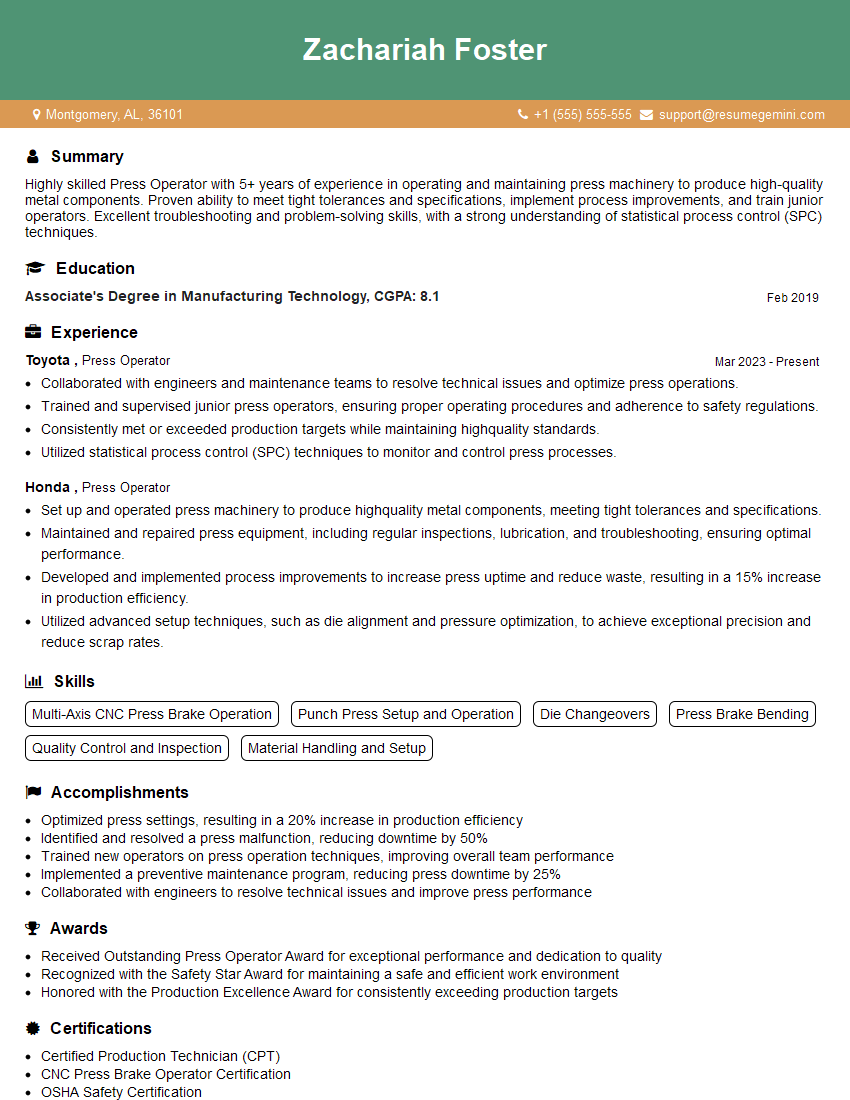
Mastering metal forming principles is crucial for a successful and rewarding career in this dynamic field. A strong understanding of these concepts will open doors to exciting opportunities and advancements. To maximize your chances of landing your dream job, create an ATS-friendly resume that showcases your skills and experience effectively. ResumeGemini is a trusted resource to help you build a professional and impactful resume that gets noticed. We provide examples of resumes tailored specifically to the metal forming industry to help you get started. Take the next step toward your career success today!
Explore more articles
Users Rating of Our Blogs
Share Your Experience
We value your feedback! Please rate our content and share your thoughts (optional).
What Readers Say About Our Blog
Very informative content, great job.
good