Feeling uncertain about what to expect in your upcoming interview? We’ve got you covered! This blog highlights the most important Microcontroller Architecture interview questions and provides actionable advice to help you stand out as the ideal candidate. Let’s pave the way for your success.
Questions Asked in Microcontroller Architecture Interview
Q 1. Explain the Harvard architecture and its advantages over the Von Neumann architecture in microcontrollers.
The Harvard architecture distinguishes between memory addresses for instructions and data, employing separate buses for each. Think of it like having separate lanes on a highway – one for instruction packets and another for data – allowing simultaneous fetching of both. In contrast, the Von Neumann architecture uses a single address space and bus for both instructions and data, leading to potential bottlenecks.
Advantages in Microcontrollers: The Harvard architecture’s key advantage in microcontrollers is increased performance. Because instruction and data fetches are parallel, processing speed is significantly enhanced, especially crucial for real-time applications. This is vital for tasks requiring quick responses, like controlling motors in robotics or managing data streams in sensor networks. For example, a microcontroller managing a drone’s flight controls needs to process sensor data and execute flight commands concurrently. The Harvard architecture’s parallel processing capability ensures smooth and responsive drone operation.
Consider this simple analogy: Imagine trying to build a house. With Von Neumann, you have one worker who must fetch both bricks (data) and blueprints (instructions) one at a time. With Harvard, you have two workers: one fetching bricks and the other blueprints simultaneously, leading to a much faster construction process.
Q 2. What are the different types of memory found in a microcontroller?
Microcontrollers typically employ several types of memory, each serving a specific purpose:
- Flash Memory: Non-volatile memory storing the program code. This means the program persists even after the power is turned off. It’s slower than RAM but crucial for permanent storage of the firmware.
- Random Access Memory (RAM): Volatile memory used for storing data that the microcontroller is actively processing. It’s much faster than flash memory but loses its contents when the power is removed. RAM is essential for variables, temporary data storage and stack operation.
- Read-Only Memory (ROM): Non-volatile memory that holds pre-programmed instructions and data. It’s often used for bootloaders or critical system routines.
- EEPROM (Electrically Erasable Programmable Read-Only Memory): Non-volatile memory that can be erased and reprogrammed in-circuit, allowing for flexible configuration changes. Useful for storing user preferences or calibration data.
The interplay between these memory types is vital for a microcontroller’s operation. The program code from flash is loaded into RAM for execution, while data is stored and manipulated within RAM. EEPROM provides a persistent storage mechanism for configuration settings.
Q 3. Describe the role of an interrupt in a microcontroller.
An interrupt is a signal that temporarily suspends the microcontroller’s normal program execution to handle a high-priority event. Think of it as a phone call interrupting your work – you pause what you’re doing to answer it, then return to your task afterward. It allows the microcontroller to respond quickly to external stimuli without constantly polling for them, saving processing power and improving responsiveness.
Role: Interrupts are triggered by external events (e.g., a button press, sensor reading) or internal events (e.g., a timer expiring). When an interrupt occurs, the microcontroller saves its current state (the context), jumps to a specific interrupt service routine (ISR) to handle the event, and then resumes its previous task. This process allows for efficient and timely handling of asynchronous events.
Example: Imagine a microcontroller controlling a washing machine. An interrupt might be triggered when the water level sensor detects the water reaching a certain level, causing the microcontroller to stop the water inflow.
Q 4. Explain the concept of interrupt priority and how it’s handled.
Interrupt priority determines which interrupt gets handled first when multiple interrupts occur simultaneously. It’s similar to a triage system in a hospital – the most critical patient is treated first. Microcontrollers often assign priority levels to different interrupts, typically ranging from high to low.
Handling: When multiple interrupts occur, the microcontroller prioritizes the interrupts based on their assigned priority levels. The highest-priority interrupt is serviced first, regardless of the order in which they arrived. If a higher-priority interrupt occurs while a lower-priority one is being handled, the lower-priority interrupt is interrupted, and the higher-priority one is serviced first. A priority system prevents lower-priority interrupts from delaying the response to critical events.
Example: In an automotive system, a brake sensor interrupt would have a higher priority than a radio button press. If both events occur at the same time, the brake interrupt is handled first, ensuring immediate braking response.
Q 5. How do you handle multiple interrupts simultaneously?
Handling simultaneous interrupts involves a combination of interrupt priority and efficient ISR design. The microcontroller’s interrupt controller manages the prioritization. When multiple interrupts occur simultaneously, the highest-priority interrupt is serviced first. Nested interrupts (one interrupt occurring during another) can be handled, but it’s crucial to ensure the ISRs are short and efficient to prevent excessive delays.
Strategies:
- Proper Priority Assignment: Carefully assign priorities based on the criticality of the events. High-priority events (e.g., critical errors) should have higher priority levels.
- Efficient ISR Design: Keep ISRs short and concise, focusing solely on the essential tasks related to the interrupt. Avoid lengthy computations or blocking operations within ISRs to minimize interrupt latency.
- Interrupt Masking: Temporarily disable lower-priority interrupts during the execution of a higher-priority interrupt to prevent unwanted nested interrupts. Properly managing interrupt masking is critical for preventing system instability.
Effective management of simultaneous interrupts ensures responsiveness and stability, preventing critical events from being delayed or missed.
Q 6. What is a Real-Time Operating System (RTOS) and why is it used in microcontrollers?
A Real-Time Operating System (RTOS) is a specialized operating system designed for real-time applications. Unlike general-purpose OSes like Windows or macOS, RTOSes prioritize deterministic behavior – meaning tasks are completed within predictable time constraints. They are essential for applications where timely response is critical, such as industrial control systems or medical devices.
Why use RTOS in Microcontrollers?
- Real-time performance: RTOSes ensure tasks are completed within predefined deadlines, ensuring system responsiveness.
- Task management: RTOSes handle multiple tasks concurrently, improving efficiency and allowing for parallel processing.
- Resource management: RTOSes manage shared resources (like memory or peripherals) efficiently, preventing conflicts and data corruption.
- Predictable behavior: The deterministic nature of RTOSes makes system behavior more predictable and reliable.
For instance, an RTOS might be used in a medical infusion pump to ensure precise drug delivery, or in a robotics application to guarantee smooth and coordinated movements. The RTOS ensures that all critical control functions execute within their allocated deadlines.
Q 7. Compare and contrast different RTOS scheduling algorithms (e.g., Round Robin, Priority-based).
Several scheduling algorithms are used in RTOSes, each with its strengths and weaknesses:
- Round Robin: This algorithm assigns a fixed time slice to each task in a circular manner. It’s simple to implement and guarantees fairness, but may not prioritize critical tasks. Imagine a group of people taking turns using a single computer – everyone gets a chance, but urgent tasks might not get prioritized.
- Priority-based: This algorithm assigns priorities to tasks, with higher-priority tasks being executed first. This ensures that critical tasks are completed promptly, even if it means some lower-priority tasks experience longer wait times. This is similar to a hospital triage system where emergency cases are prioritized over routine checkups.
- Rate Monotonic Scheduling (RMS): A priority-based algorithm where the tasks with the highest execution frequency are assigned the highest priority. This algorithm is particularly suitable for periodic tasks, ensuring timely execution of all tasks.
Comparison: Round Robin is simple but lacks responsiveness to urgency. Priority-based scheduling excels at handling critical tasks but may lead to starvation of lower-priority tasks. Rate Monotonic excels for periodic tasks but requires careful analysis of task periods and execution times. The choice of algorithm depends on the specific application’s requirements and the balance needed between fairness and responsiveness.
Q 8. Explain the concept of context switching in an RTOS.
Context switching in a Real-Time Operating System (RTOS) is the mechanism that allows the system to rapidly switch execution between different tasks or threads. Imagine a chef working in a kitchen: they might switch between preparing ingredients, cooking on the stove, and baking in the oven. Each of these activities is analogous to a task in an RTOS. Context switching ensures that the CPU efficiently handles multiple tasks without significant delays, creating the illusion of parallelism.
When a task’s time slice expires or it yields control, the RTOS saves the task’s current state (its context) – including the CPU registers, program counter, and stack pointer – to memory. This stored information allows the system to later restore the task to exactly where it left off. Then, the RTOS selects another ready task, loads its context into the CPU, and resumes execution. This process happens very quickly, minimizing perceived latency.
The efficiency of context switching is crucial for real-time systems where precise timing is critical. A slow context switch could lead to missed deadlines and system malfunctions. Factors like the number of registers, the memory access speed, and the efficiency of the RTOS scheduler significantly impact the speed of this process.
Q 9. What are the different types of memory management techniques used in microcontrollers?
Microcontrollers utilize various memory management techniques, each with its own trade-offs. The choice depends on the application’s requirements, microcontroller architecture, and available resources.
- Static Memory Allocation: Memory is allocated at compile time. Simple to implement, but inflexible and may lead to wasted memory if not planned meticulously. This is often used for fixed-size data structures or code segments.
- Dynamic Memory Allocation: Memory is allocated and deallocated during runtime using functions like
malloc()andfree(). Offers flexibility, but carries the risk of memory fragmentation and potential runtime errors if not handled carefully. This is beneficial for applications needing varying memory requirements throughout their operation. - Memory-Mapped I/O: Peripherals are accessed by reading from and writing to specific memory addresses. This simplifies hardware interaction but requires careful management to avoid unintended conflicts.
- Paged Memory: Memory is divided into pages, allowing efficient management of large amounts of memory. This technique is less common in simpler microcontrollers but is essential for larger, more complex systems.
- Segmented Memory: Memory is divided into segments, each with its own base address and length. Provides a structured way to organize memory, particularly useful in systems with different memory types (e.g., ROM, RAM).
For example, a simple embedded system controlling a motor might use primarily static memory allocation for its control algorithm, while a more complex system like an industrial PLC would likely use a combination of static and dynamic allocation, along with memory-mapped I/O for peripheral control.
Q 10. Explain the concept of memory mapping.
Memory mapping is a technique where memory addresses are assigned to both memory locations and peripheral devices. This creates a unified address space, allowing the processor to access peripherals as if they were memory locations. It simplifies programming, as interacting with a peripheral becomes as simple as reading or writing to a specific memory address.
For instance, imagine you want to control an LED connected to a microcontroller’s GPIO port. Instead of using specialized instructions to control the port, memory mapping allows you to write a value to a specific memory address, directly controlling the LED’s state. This simplifies software development and makes it more readable.
However, memory mapping requires careful consideration of address spaces to avoid conflicts between memory and peripherals. Incorrectly accessing a peripheral address can lead to unpredictable behavior or system crashes. The microcontroller’s datasheet provides the memory map, which outlines the assigned addresses for different memory regions and peripherals.
Q 11. How do you debug embedded systems?
Debugging embedded systems requires a multi-faceted approach combining different techniques and tools. It’s often more challenging than debugging software on a desktop computer because you lack the same level of visibility and control.
- Print statements/Logging: Adding print statements strategically throughout your code can provide valuable insights into the program’s execution flow and variable values. This is a simple and effective initial debugging step. However, this method can be intrusive to performance if overused.
- In-circuit Emulators (ICEs): ICEs offer the most intrusive, but often the most effective, debugging method. These devices replace the actual microcontroller on the circuit board, providing comprehensive control and visibility over program execution and memory.
- Hardware Debuggers (JTAG/SWD): JTAG and SWD interfaces provide a non-intrusive way to connect a debugger to the microcontroller. They enable breakpoint setting, single-stepping, and inspection of registers and memory.
- Logic Analyzers and Oscilloscopes: These tools help analyze hardware signals and timing issues. They are invaluable for identifying timing-related problems or verifying hardware functionality.
- Software Debuggers: Integrated Development Environments (IDEs) typically include powerful software debuggers that allow you to step through code, set breakpoints, and inspect variables.
A systematic approach, starting with simple techniques like print statements and progressively moving towards more advanced tools, is essential for effective debugging.
Q 12. Describe your experience with different debugging tools (e.g., JTAG, SWD).
I have extensive experience using JTAG and SWD debugging interfaces. Both are industry-standard protocols used for debugging embedded systems, but they differ in their implementation. JTAG (Joint Test Action Group) is a more established standard, characterized by its robustness and versatile capabilities. It uses a four-wire interface, supporting multiple operations including boundary scan testing.
SWD (Serial Wire Debug) is a newer protocol often preferred for its simplicity, using only two wires to communicate with the target microcontroller. It’s generally faster and consumes less power than JTAG. However, its features are typically a subset of JTAG’s capabilities. I’ve successfully utilized both in various projects; the selection often depends on the target microcontroller’s architecture and the specific debugging needs of the project.
For example, in a recent project involving a low-power sensor node, SWD was chosen for its reduced power consumption. In a more complex project with extensive hardware testing needs, JTAG’s robustness and versatility proved advantageous. My experience covers selecting and configuring these debuggers within various IDEs like Keil MDK, IAR Embedded Workbench, and Segger Embedded Studio.
Q 13. Explain how to use a logic analyzer or oscilloscope in embedded system development.
Logic analyzers and oscilloscopes are invaluable tools for embedded system development, especially when dealing with hardware-related issues. They allow observation of signals at the hardware level, providing a detailed view of timing and signal integrity.
Logic Analyzer: A logic analyzer captures the digital signals on multiple lines simultaneously. This is extremely useful for analyzing data bus activity, protocol communication (like I2C, SPI), or identifying glitches in digital signals. You’d use a logic analyzer to troubleshoot issues such as incorrect data transfer between peripherals or asynchronous communication errors. I’ve used them to debug issues like incorrect SPI clock phasing and data corruption.
Oscilloscope: An oscilloscope is typically used for analyzing analog and mixed-signal circuits. In embedded systems, it’s essential for verifying analog sensor readings, observing analog-to-digital converter (ADC) outputs, or analyzing the timing of PWM (Pulse Width Modulation) signals. For instance, I once used an oscilloscope to pinpoint a noise issue affecting an ADC reading that was causing faulty sensor data.
In many cases, both tools are used in tandem. For example, you might use a logic analyzer to track the digital signals associated with a motor control circuit and then use an oscilloscope to observe the actual analog motor voltage and current to verify proper operation.
Q 14. What is a watchdog timer and its purpose?
A watchdog timer is a hardware timer that is used to detect and recover from system malfunctions in embedded systems. Imagine it as a safety net preventing the system from freezing or becoming unresponsive. It’s a simple but incredibly useful mechanism for ensuring system reliability.
The watchdog timer is typically initialized with a timeout value. The microcontroller periodically ‘kicks’ the watchdog timer (resets its counter) within this timeout period. If the microcontroller fails to ‘kick’ the timer before it expires, the timer times out, resulting in a system reset. This reset prevents the system from remaining in a potentially harmful or unresponsive state.
Watchdog timers are critical in safety-critical applications where a system failure could have serious consequences. They can be crucial in industrial control systems, automotive electronics, and medical devices. They provide a basic form of fault tolerance, preventing catastrophic failures due to software glitches, hardware malfunctions, or unexpected external events.
Q 15. Explain the different power management modes in a microcontroller.
Microcontrollers offer various power management modes to optimize energy consumption based on the application’s needs. These modes typically range from full-power operation to deep sleep, each with trade-offs between power usage and responsiveness.
- Active Mode: The microcontroller runs at its full clock speed, consuming the most power but offering the highest performance. This is used for tasks requiring real-time processing.
- Idle Mode: The CPU is halted, but peripherals and clocks for critical functions might remain active. This consumes significantly less power than active mode, suitable for situations needing occasional processing.
- Sleep Mode: The CPU and most peripherals are powered down, with only a low-power wake-up source enabled. This dramatically reduces power consumption, ideal for applications needing minimal activity, such as sensor readings at long intervals. Wake-up typically involves an external interrupt or timer.
- Deep Sleep Mode (or Shutdown): The microcontroller’s internal voltage regulators are often disabled, resulting in the lowest power consumption. It requires a significant time to wake up, often through an external reset.
Example: In a battery-powered IoT sensor node, it would be crucial to use sleep or deep sleep modes for most of the time, waking up only periodically to collect and transmit sensor data. This significantly extends the battery life.
Career Expert Tips:
- Ace those interviews! Prepare effectively by reviewing the Top 50 Most Common Interview Questions on ResumeGemini.
- Navigate your job search with confidence! Explore a wide range of Career Tips on ResumeGemini. Learn about common challenges and recommendations to overcome them.
- Craft the perfect resume! Master the Art of Resume Writing with ResumeGemini’s guide. Showcase your unique qualifications and achievements effectively.
- Don’t miss out on holiday savings! Build your dream resume with ResumeGemini’s ATS optimized templates.
Q 16. How do you optimize code for memory and performance in a microcontroller?
Optimizing code for memory and performance in microcontrollers is critical due to their resource constraints. The strategies employed depend on the specific microcontroller and application, but some common techniques include:
- Data Structure Selection: Using efficient data structures like bit fields or arrays instead of complex structures minimizes memory usage.
- Code Optimization: Compilers offer various optimization levels. Using higher optimization levels (e.g., -O2 or -Os) can reduce code size and improve execution speed. In-line functions can also enhance performance but might increase code size. Careful use of pointers can improve efficiency, but requires careful management to avoid errors.
- Memory Allocation: Static allocation is preferable to dynamic allocation (
malloc(),free()) to avoid the overhead of runtime memory management. If dynamic allocation is necessary, ensure proper error handling. - Algorithmic Optimization: Choosing efficient algorithms is crucial. For example, a simple linear search might suffice for small data sets, but a binary search would be more efficient for larger sorted data.
- Register Usage: Utilizing microcontroller registers directly can drastically improve performance by reducing memory access time. Compilers can help with register allocation optimization.
Example: Consider a code snippet calculating a sum of numbers stored in an array:
int sum = 0; for (int i = 0; i < 100; i++) { sum += array[i]; }This can be optimized by utilizing a pointer for faster array access and potentially unrolling the loop for some architectures, depending on the compiler's optimization level.
Q 17. Describe your experience with different microcontroller architectures (e.g., ARM Cortex-M, AVR, PIC).
I have extensive experience with ARM Cortex-M, AVR, and PIC microcontroller architectures. Each has its strengths and weaknesses:
- ARM Cortex-M: Known for its high performance, low power consumption, and extensive instruction set. I've worked extensively with Cortex-M0+, M3, and M4 processors, leveraging their features like floating-point units (FPU) for computationally intensive tasks, and their advanced peripherals for complex I/O operations. For example, I designed a real-time control system using a Cortex-M4 based on a PID controller, relying on the FPU for fast calculations.
- AVR: These are well-suited for simpler applications, characterized by their relative ease of programming and low cost. I used AVRs in projects focusing on basic I/O control, sensor integration, and small-scale embedded applications. I have a history of developing embedded systems for motor control using 8-bit AVRs and successfully optimizing code for low power consumption.
- PIC: I have worked with PIC microcontrollers, particularly in projects requiring specific peripheral capabilities or legacy system integration where PICs were already established. Their architecture is distinct from ARM and AVR, requiring a different programming approach, but they offer a good balance between performance and cost in many instances.
My experience encompasses selecting the appropriate architecture based on the project requirements, from balancing cost and performance to optimizing for low power.
Q 18. Explain the concept of DMA (Direct Memory Access).
DMA (Direct Memory Access) is a hardware feature that allows data transfer between peripherals and memory without CPU intervention. This offloads the CPU, freeing it to perform other tasks.
Imagine a scenario where you need to transfer a large block of data from an ADC (analog-to-digital converter) to RAM. Without DMA, the CPU would have to read each data point from the ADC and write it to memory, a time-consuming process. With DMA, the ADC can directly transfer the data to memory, letting the CPU do something else during the transfer. The CPU only needs to configure the DMA controller (source address, destination address, number of bytes).
DMA is beneficial for high-speed data transfers, reducing CPU load and improving system responsiveness. This is commonly used in applications involving multimedia processing, networking, and high-speed data acquisition.
Q 19. How do you handle peripherals in a microcontroller?
Handling peripherals in a microcontroller involves configuring and interacting with hardware components such as ADC, DAC, timers, UART, SPI, I2C, etc. This typically involves several steps:
- Initialization: Setting up the peripheral's clock, mode of operation, interrupt settings, and other relevant parameters. This usually entails writing specific values to the peripheral's control registers.
- Configuration: Selecting the operating mode, data format, and other operational features based on the specific application needs.
- Data Transfer: Reading data from or writing data to the peripheral using appropriate methods (polling, interrupt, or DMA).
- Interrupt Handling (if applicable): Configuring and implementing interrupt service routines (ISRs) to respond to events generated by the peripheral. This is often more efficient than polling.
- Error Handling: Implementing error checking and handling mechanisms to ensure reliable operation.
Example: Configuring a UART to transmit data involves setting the baud rate, word length, parity, and stop bits in the UART's control registers. Data is then written to a transmit buffer. The UART's transmitter handles the data transmission without CPU intervention, provided interrupts or DMA are used.
Q 20. What is the difference between polling and interrupt-driven I/O?
Polling and interrupt-driven I/O are two different ways to handle peripheral communication. The choice depends on the application's requirements and the constraints of the microcontroller.
- Polling: The CPU repeatedly checks the status of a peripheral to see if it's ready for data transfer. This is simple to implement but consumes CPU time, especially if the peripheral is slow or infrequent. It's like constantly checking your mailbox—inefficient if you only get mail occasionally.
- Interrupt-driven I/O: The peripheral generates an interrupt signal when it's ready for data transfer. The CPU responds to the interrupt, processes the data, and then returns to its previous task. This is more efficient, as the CPU only works when needed. This is like getting a notification when you have mail—much more efficient.
Example: Receiving data from a slow sensor. Polling would involve the CPU constantly checking the sensor's data register, wasting CPU time. Interrupt-driven I/O would only engage the CPU when new sensor data is available, freeing the CPU for other tasks.
Q 21. Explain your experience with different communication protocols (e.g., I2C, SPI, UART).
I have hands-on experience with several communication protocols, each suited for different applications:
- I2C: A two-wire serial communication protocol used for connecting multiple devices on a single bus. It's commonly used for low-speed communication between microcontrollers and sensors. I've used I2C to interface with various sensors like accelerometers, gyroscopes, and temperature sensors. I understand the importance of proper pull-up resistors and the master-slave relationship in I2C communication.
- SPI: A full-duplex synchronous serial communication protocol offering high-speed data transfer. It's often used for communication with displays, memory chips, and other peripherals requiring faster communication. I've integrated SPI flash memory and displays in embedded projects leveraging its speed and efficiency.
- UART: A simple asynchronous serial communication protocol widely used for communication with computers, other microcontrollers, and peripherals requiring simple interfaces. I've used UART for debugging, data logging, and basic communication with external devices. I am familiar with different baud rates and configurations.
My experience extends to troubleshooting communication problems, including identifying and resolving issues related to clock synchronization, data integrity, and device addressing. I understand the importance of selecting the right protocol for a specific task, balancing speed, complexity, and cost.
Q 22. Describe your experience with low-power design techniques for microcontrollers.
Low-power design in microcontrollers is crucial for extending battery life in portable devices or reducing energy consumption in always-on systems. It involves optimizing various aspects of the microcontroller's operation.
- Clock Management: Dynamically switching between different clock speeds based on the processing needs. For instance, using a low-power crystal oscillator during idle periods and switching to a higher-frequency oscillator for computationally intensive tasks. This can be implemented through software control of clock registers or using power-saving modes.
- Sleep Modes: Utilizing the microcontroller's various sleep modes. These modes significantly reduce power consumption by shutting down parts of the system not actively needed. Wake-up mechanisms, such as interrupts from timers or peripherals, are crucial for resuming normal operation. For example, an IoT device might sleep for most of the time, waking up periodically to send data and check for commands.
- Peripheral Power Management: Enabling or disabling peripherals as needed. Peripherals like UARTs, SPI, I2C, and ADCs consume power even when idle. Turning them off when not in use can significantly contribute to power savings. Proper configuration of GPIOs to minimize leakage currents is essential.
- Code Optimization: Writing efficient code can minimize the processing time and hence reduce power consumption. This includes using efficient algorithms, minimizing memory accesses, and avoiding unnecessary operations. Optimizing interrupt service routines (ISRs) is particularly important, as they're often executed frequently.
- Voltage Scaling: Lowering the operating voltage of the microcontroller. This typically reduces power consumption quadratically (P ∝ V²), but may require careful consideration of the microcontroller's specifications to ensure stable operation at the lower voltage.
In a project involving a wearable health monitor, I implemented a combination of these techniques. We used a low-power microcontroller with multiple sleep modes, dynamically adjusting the clock frequency based on sensor readings, and enabling peripherals only when data acquisition was necessary. This extended the battery life from a few hours to several days.
Q 23. How do you ensure the safety and security of your embedded systems?
Ensuring the safety and security of embedded systems is paramount, especially in safety-critical applications like automotive systems or medical devices. My approach involves a multi-layered strategy:
- Secure Boot Process: Implementing a secure boot process to prevent malicious code from loading during startup. This often involves cryptographic verification of firmware images.
- Memory Protection: Employing memory protection units (MPUs) to isolate critical code and data from unauthorized access. This prevents buffer overflows and other memory-related attacks.
- Secure Communication: Using encryption and authentication protocols for all communication channels. This prevents eavesdropping and data tampering.
- Input Validation: Rigorously validating all inputs from external sources to prevent buffer overflows, format string vulnerabilities, and other injection attacks. Every input needs to be checked against its expected format and range.
- Regular Security Updates: Developing a robust update mechanism and regularly releasing security patches to address newly discovered vulnerabilities. This requires a secure mechanism for distributing updates and verifying their integrity.
- Static and Dynamic Analysis: Using static and dynamic analysis tools to identify potential vulnerabilities in the codebase before and after deployment. Static analysis helps find potential problems during development, while dynamic analysis provides insights into runtime behavior.
For example, in a project involving a smart lock, we implemented a secure boot process, used AES encryption for communication, and validated all inputs before processing. We also conducted thorough static and dynamic analysis to identify potential security weaknesses.
Q 24. Explain your experience with version control systems (e.g., Git) in embedded software development.
Version control is essential for managing the evolution of embedded software projects. I have extensive experience using Git, primarily for its branching and merging capabilities, enabling collaborative development and managing multiple versions of code simultaneously.
- Branching Strategy: I typically use a feature branching model, where each new feature or bug fix is developed in a separate branch. This allows for parallel development and prevents code conflicts. Feature branches are merged into the main branch (e.g., `main` or `master`) after thorough testing.
- Commit Messages: I write clear and concise commit messages that accurately reflect the changes made. This aids in understanding the project's history and tracing back to specific changes.
- Pull Requests (PRs): I use pull requests to review code changes before merging them into the main branch. This allows for peer review and ensures code quality.
- Code Reviews: I actively participate in code reviews, providing constructive feedback and ensuring adherence to coding standards.
- Conflict Resolution: I am proficient in resolving merge conflicts that occur when multiple developers modify the same code segments simultaneously. Git's conflict resolution tools are crucial for this.
In a previous project, using Git's branching strategy allowed multiple engineers to work on separate components concurrently, streamlining the development process and minimizing conflicts. The clear commit messages and pull requests proved invaluable for tracking down bugs and understanding changes across different versions.
Q 25. Describe your experience with unit testing and integration testing in embedded software.
Unit testing and integration testing are integral parts of my embedded software development process. They help ensure the correctness and reliability of the code.
- Unit Testing: I write unit tests to verify the functionality of individual modules or functions in isolation. This is often done using a unit testing framework like Unity or CppUTest. These tests ensure that each unit performs as expected before integrating it into the larger system. For example, a unit test might check the correctness of a specific sensor reading function.
- Integration Testing: Once unit tests pass, I conduct integration testing to verify the interactions between different modules or components. This involves testing the system as a whole or in smaller, integrated pieces. Mock objects or stubs are often used to simulate dependencies that haven't yet been fully implemented. For example, an integration test might check the communication between a sensor module and a data processing module.
- Test Driven Development (TDD): In some projects, I've utilized Test Driven Development (TDD), where tests are written before the code itself. This helps clarify requirements and ensures testability from the beginning.
- Code Coverage: I use code coverage tools to measure how much of the codebase is executed during testing. High code coverage is desirable, but not always sufficient to guarantee complete correctness.
In a project involving a motor control system, unit tests ensured each individual function (e.g., PID controller, PWM generation) functioned correctly, while integration tests confirmed the proper interaction between them and the motor itself.
Q 26. What is your experience with static code analysis tools?
Static code analysis tools are invaluable for identifying potential bugs and security vulnerabilities early in the development process. They examine the source code without actually executing it.
- Tools: I have experience using various static code analysis tools, such as cppcheck, Lint, and Coverity. Each tool has its strengths and weaknesses; some focus on coding standards, others on potential vulnerabilities.
- Benefits: Static analysis tools can detect issues like memory leaks, buffer overflows, and potential race conditions. They help improve code quality, reduce debugging time, and enhance security.
- False Positives: It is important to be aware that static analysis tools may sometimes generate false positives. It's crucial to carefully examine the reported issues and determine their validity.
- Integration into CI/CD: I frequently integrate static analysis tools into continuous integration and continuous delivery (CI/CD) pipelines to automate code analysis and prevent problematic code from being deployed.
In one project, integrating a static analysis tool into our CI/CD pipeline helped us catch a potential buffer overflow vulnerability early in development, preventing a major security issue in the deployed system.
Q 27. Explain your approach to solving a complex embedded system design problem.
My approach to solving complex embedded system design problems involves a structured and iterative process:
- Requirements Analysis: Clearly define the problem and gather all relevant requirements. This includes functional requirements (what the system should do) and non-functional requirements (constraints like power consumption, memory usage, real-time performance).
- System Architecture Design: Develop a high-level system architecture that outlines the major components and their interactions. This might involve using UML diagrams or other design notations.
- Component Design: Design and implement individual components, focusing on modularity and reusability. This often involves creating detailed design specifications and choosing appropriate hardware and software components.
- Testing and Verification: Thoroughly test each component and the integrated system to ensure correctness and meet the requirements. This includes unit testing, integration testing, and system testing.
- Optimization: Optimize the system for performance, power consumption, and memory usage. This might involve profiling the code, optimizing algorithms, or using more efficient hardware components.
- Iteration and Refinement: The process is iterative. Based on testing and feedback, the design and implementation may need refinement. This iterative approach helps to identify and resolve issues early in the development lifecycle.
Think of it like building a house; you wouldn't start laying bricks without a blueprint. Similarly, a well-defined architecture is crucial for tackling complexity in embedded systems.
Q 28. Describe a challenging technical problem you faced in embedded system development and how you overcame it.
One challenging problem I encountered involved real-time constraints in a motor control system. The system needed to accurately control the speed and position of a motor with very precise timing requirements. The initial implementation, while functionally correct, missed its timing deadlines occasionally, resulting in unstable motor control.
To overcome this, I employed several strategies:
- Real-Time Operating System (RTOS): We switched to a real-time operating system (RTOS) to manage tasks and resources efficiently. The RTOS provided features for task scheduling, interrupt handling, and resource management, allowing for deterministic timing behavior.
- Interrupt Optimization: We carefully optimized the interrupt service routines (ISRs) to minimize their execution time. This involved reducing unnecessary computations and utilizing efficient data structures.
- Code Profiling: We used profiling tools to identify performance bottlenecks in the code. This helped us pinpoint areas that needed further optimization.
- Hardware Acceleration: In some cases, we offloaded computationally intensive tasks to dedicated hardware peripherals, like DMA controllers, to reduce the processing load on the main CPU.
By carefully analyzing the performance bottlenecks, optimizing the code, and leveraging the RTOS's features, we managed to ensure that the motor control system met its real-time constraints, resulting in a stable and accurate control system. The solution demonstrated the importance of understanding the intricate timing requirements of real-time embedded systems.
Key Topics to Learn for Microcontroller Architecture Interview
- Central Processing Unit (CPU): Understand the instruction set architecture (ISA), pipelining, and different CPU architectures (e.g., Harvard, Von Neumann).
- Memory Organization: Explore different memory types (RAM, ROM, Flash), memory addressing modes, and memory management techniques. Practical application: Optimizing code size and execution speed by understanding memory limitations.
- Peripheral Devices: Learn about various peripherals (Timers, UART, SPI, I2C, ADC, DAC) and their interfaces. Practical application: Designing and implementing communication protocols between the microcontroller and external sensors or actuators.
- Interrupts and Interrupt Handling: Master interrupt mechanisms, priority levels, and efficient interrupt service routine (ISR) design. Practical application: Creating responsive and real-time systems.
- Power Management: Understand low-power modes and techniques for optimizing energy consumption in battery-powered applications. Practical application: Designing energy-efficient embedded systems.
- Real-Time Operating Systems (RTOS): Explore the basics of RTOS, task scheduling, and inter-process communication. Practical application: Managing concurrent tasks in complex embedded systems.
- Debugging and Troubleshooting: Develop proficiency in using debugging tools and techniques for identifying and resolving hardware and software issues. Practical application: Efficiently finding and fixing errors in embedded systems.
- Embedded Software Development: Gain a solid understanding of embedded C programming, including memory management and real-time considerations.
Next Steps
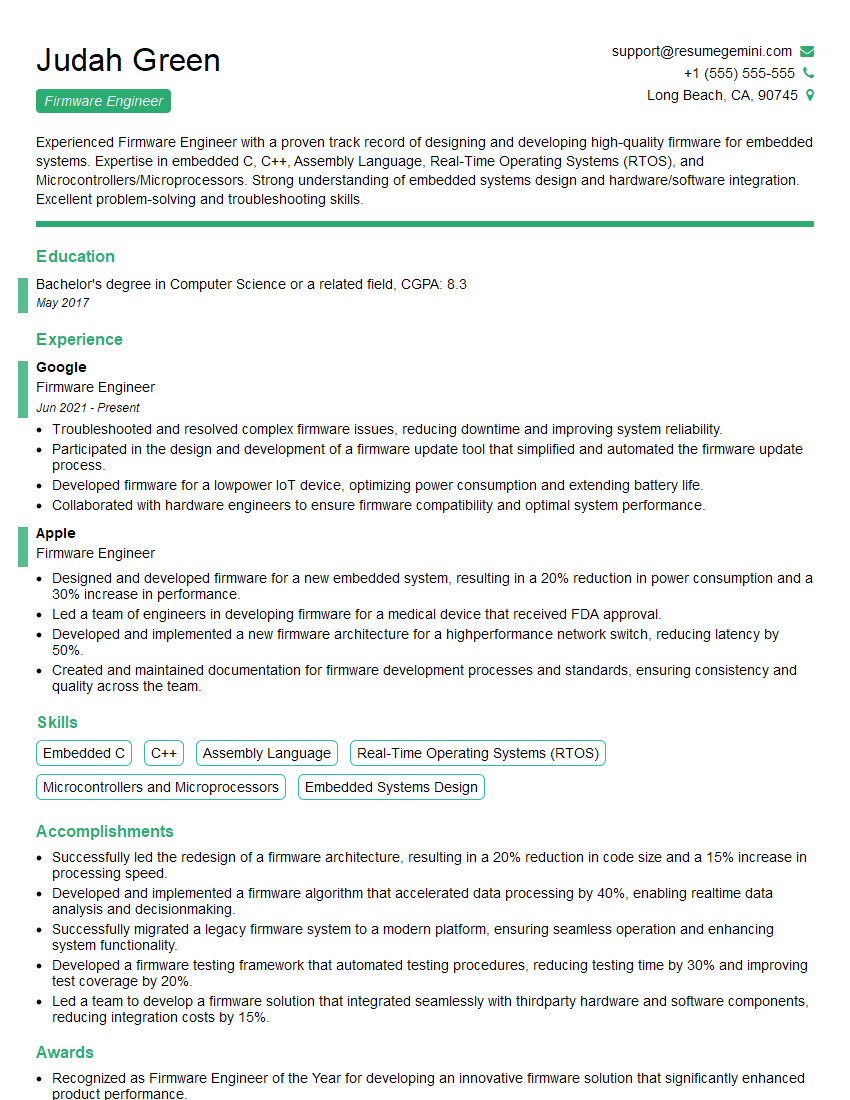
Mastering Microcontroller Architecture is crucial for a successful career in embedded systems, IoT, and robotics. It demonstrates a strong foundation in hardware and software interaction, opening doors to exciting and challenging roles. To maximize your job prospects, create a compelling and ATS-friendly resume that highlights your skills and experience. ResumeGemini is a valuable resource to help you build a professional resume that stands out. They offer examples of resumes tailored to Microcontroller Architecture to help you present your qualifications effectively.



Explore more articles
Users Rating of Our Blogs
Share Your Experience
We value your feedback! Please rate our content and share your thoughts (optional).
What Readers Say About Our Blog
Very informative content, great job.
good