Feeling uncertain about what to expect in your upcoming interview? We’ve got you covered! This blog highlights the most important Microelectronics Packaging interview questions and provides actionable advice to help you stand out as the ideal candidate. Let’s pave the way for your success.
Questions Asked in Microelectronics Packaging Interview
Q 1. Explain the different types of microelectronic packaging technologies.
Microelectronic packaging encompasses a wide range of techniques aimed at protecting and interconnecting integrated circuits (ICs) with the external world. The choice of packaging technology depends heavily on factors like performance requirements, cost, size, and reliability needs. Here are some key types:
- Wire bonding: A relatively simple and cost-effective method where tiny gold or aluminum wires connect the IC’s bond pads to the package leads. Think of it as tiny, delicate bridges connecting the chip to the outside world.
- Flip-chip packaging: The IC is flipped upside down and the solder bumps on the chip directly connect to the substrate. This offers improved performance due to shorter connection lengths and higher density.
- Surface Mount Technology (SMT): Components are mounted directly onto a printed circuit board (PCB) surface using solder paste. This is ubiquitous in consumer electronics, offering high density and automation-friendly assembly.
- Through-hole technology (THT): Leads of the component are inserted into holes drilled in the PCB and soldered on the underside. While less common now, it’s still used in some applications requiring robustness.
- System-in-Package (SiP): Multiple components, including ICs, passive components, and even sensors, are integrated into a single package. Think of it as a miniature system, all in one neat package.
- 3D packaging: This involves stacking multiple ICs or dies vertically to increase density and performance. It’s akin to building a multi-story building on a single footprint.
- Advanced Packaging: This category encompasses more recent and highly advanced technologies like 2.5D and 3D integration using techniques like through-silicon vias (TSVs) for higher performance and density in applications like high-performance computing.
Q 2. Describe the advantages and disadvantages of wire bonding and flip-chip packaging.
Wire Bonding:
- Advantages: Relatively simple and inexpensive, mature technology, well-established manufacturing processes.
- Disadvantages: Longer interconnect lengths leading to higher inductance and capacitance, susceptible to wire breakage due to repeated flexing or vibration, limited I/O density.
Flip-Chip Packaging:
- Advantages: Shorter interconnect lengths resulting in improved signal integrity and reduced parasitic effects, higher I/O density, better thermal management due to direct contact with the substrate.
- Disadvantages: More complex and expensive manufacturing process, higher risk of solder joint failures, requires precise alignment during assembly.
In essence, wire bonding is a good choice for cost-sensitive applications with lower performance requirements, while flip-chip is preferred when performance and density are paramount, even if it comes at a higher cost.
Q 3. What are the key considerations for selecting a suitable packaging material?
Selecting the right packaging material is crucial for the long-term reliability and performance of the microelectronic package. Key considerations include:
- Thermal conductivity: The material’s ability to dissipate heat generated by the IC is critical to prevent overheating and failure. Materials like copper, aluminum nitride, and diamond are excellent thermal conductors.
- Dielectric strength: The material must withstand high voltages without breakdown. This is crucial for high-voltage applications.
- Moisture resistance: Packaging materials must protect the IC from moisture, which can cause corrosion and degradation.
- Mechanical strength: The material should be able to withstand mechanical stress during handling, assembly, and operation.
- Chemical compatibility: The material must be compatible with other components in the package and not cause corrosion or degradation.
- Cost: The cost of the material must be balanced against its performance characteristics.
- Environmental impact: The environmental impact of the material throughout its lifecycle should be considered.
For example, choosing a high thermal conductivity substrate for a high-power IC is essential to ensure it operates within its specified thermal limits. Conversely, a low-cost plastic material might suffice for a low-power application where thermal management is less critical.
Q 4. How do you ensure the reliability of a microelectronic package?
Ensuring the reliability of a microelectronic package involves a multi-faceted approach that begins during the design phase and continues through manufacturing and testing. Key steps include:
- Robust design: Careful design considerations to minimize stress on the package and its components during assembly and operation.
- Material selection: Choosing materials that possess the required mechanical, thermal, and chemical properties.
- Process control: Maintaining tight control over the manufacturing process to ensure consistent quality and minimize defects.
- Testing and qualification: Rigorous testing to verify that the package meets the required reliability specifications. This often includes environmental stress testing (e.g., thermal cycling, humidity testing), accelerated life testing, and reliability physics analysis.
- Failure analysis: Investigating package failures to identify root causes and implement corrective actions.
A common reliability test is thermal cycling, where the package is repeatedly subjected to extreme temperature changes. This simulates real-world temperature variations that the package may experience in the field. Identifying and mitigating potential weak points, such as solder joint fatigue, is crucial for ensuring longevity.
Q 5. Explain the concept of thermal management in microelectronics packaging.
Thermal management in microelectronics packaging addresses the critical issue of heat dissipation from the IC. Excessive heat can lead to performance degradation, reliability issues, and even catastrophic failure. Effective thermal management involves:
- Heat sinks: Passive devices that increase the surface area for heat dissipation.
- Heat spreaders: Materials with high thermal conductivity that distribute heat evenly across the package.
- Thermal interface materials (TIMs): Materials like thermal grease or pads that improve the thermal contact between the IC and the heat sink or spreader.
- Active cooling: Techniques such as fans or liquid cooling that actively remove heat from the package. These are used for high-power applications.
- Package design: Careful design of the package to facilitate efficient heat dissipation, considering factors such as air flow and thermal vias.
Imagine a tightly packed city where heat generation is high. Effective thermal management is like the city’s infrastructure for removing that heat – heat sinks are like larger roads, spreaders are wider avenues, and TIMs ensure efficient connections.
Q 6. What are the common failure mechanisms in microelectronic packages?
Microelectronic packages can fail through various mechanisms. Some common failure modes include:
- Solder joint fatigue: Repeated thermal cycling can cause solder joints to crack, leading to open circuits or intermittent connections. This is a prevalent failure mechanism, especially in applications with wide temperature swings.
- Delamination: Separation of layers within the package, leading to compromised electrical connections and increased thermal resistance.
- Corrosion: Chemical reactions caused by moisture or other contaminants can corrode metal components, leading to failure.
- Die cracking: Mechanical stress or thermal shock can cause cracks in the semiconductor die itself.
- Wire bond failures: Wire bonds can break due to mechanical stress, fatigue, or corrosion.
- Encapsulant cracking: Cracks in the encapsulant can allow moisture or contaminants to enter the package, leading to degradation and failure.
Understanding these failure mechanisms is essential for developing reliable packages and implementing effective preventative measures. Proper design, material selection, and rigorous testing are key to minimizing the risk of these failures.
Q 7. Describe your experience with different types of encapsulants.
My experience with encapsulants spans various materials, each with its advantages and disadvantages. I’ve worked extensively with:
- Epoxy molding compounds (EMCs): Commonly used due to their low cost and ease of processing, they provide good protection against moisture and mechanical stress. However, their thermal conductivity can be relatively low, limiting their use in high-power applications.
- Silicone encapsulants: Offer excellent flexibility and thermal shock resistance, making them suitable for applications with extreme temperature variations. They can be more expensive than EMCs.
- Underfill materials: Used in flip-chip packaging to fill the gap between the chip and substrate, improving mechanical strength and thermal conductivity. This helps reduce stress on solder joints during thermal cycling.
- No-clean fluxes: These are used in surface mount technology and are designed to leave a minimal residue after soldering, simplifying the manufacturing process and minimizing the risk of corrosion.
The selection of encapsulant depends critically on the specific application requirements. For instance, in aerospace applications where extreme temperature cycles are common, a silicone encapsulant might be preferred for its superior thermal shock resistance over a standard EMC. In high-power applications, an encapsulant with higher thermal conductivity is necessary for optimal heat dissipation. My experience includes characterizing these materials, optimizing their application processes, and conducting failure analysis to understand their limitations and improve their performance.
Q 8. How do you design for manufacturability in microelectronics packaging?
Designing for manufacturability (DFM) in microelectronics packaging is crucial for cost-effectiveness and high yield. It involves proactively considering the entire manufacturing process from design inception to ensure smooth and efficient production. This includes optimizing the package design to minimize defects and maximize throughput.
- Material Selection: Choosing materials that are readily available, cost-effective, and compatible with the manufacturing processes. For instance, selecting a molding compound with good flow characteristics for efficient molding.
- Process Optimization: Designing the package to be easily assembled using standard industry equipment. This might involve optimizing the lead frame design for automated wire bonding or designing the package to be compatible with high-speed pick-and-place machines.
- Tolerance Analysis: Defining tight tolerances on critical dimensions to minimize variations during manufacturing. This helps prevent issues like misalignment or shorts.
- Testability: Incorporating test points and features that facilitate easy testing at various stages of the manufacturing process, minimizing the need for complex or destructive testing methodologies. For example, designing test pads for electrical testing or features accessible for optical inspection.
- Simulation and Modeling: Using simulation tools to predict manufacturing challenges and optimize the design before actual production. This allows us to identify and resolve potential issues proactively, reducing the number of iterations and costs.
For example, in designing a BGA package, DFM would involve selecting a solder mask material with good adhesion and minimal warpage, optimizing the solder ball size and placement for reliable reflow soldering, and incorporating test points for checking the integrity of the solder joints.
Q 9. Explain the role of underfill in flip-chip packaging.
Underfill is a crucial component in flip-chip packaging. It’s a low-viscosity epoxy resin that’s dispensed under the chip after it’s bonded to the substrate. Its primary role is to encapsulate the solder bumps and provide mechanical support, enhancing the package’s reliability and performance.
- Stress Reduction: Flip-chip packages experience significant thermal stress due to repeated temperature cycling. Underfill mitigates this stress by distributing it across a larger area, preventing cracking of the solder bumps and the chip itself. Think of it like a shock absorber for your package.
- Enhanced Electrical Performance: The underfill acts as a dielectric layer, improving the insulation between the solder bumps and reducing the risk of electrical shorts, especially critical in high-density packages.
- Improved Warpage Control: Underfill helps to flatten the package, reducing warpage which is crucial for proper mating with the next level of assembly.
Without underfill, the solder bumps are subjected to significant stress, leading to early failure due to fatigue and cracking. The choice of underfill material is critical; its viscosity, curing time, and coefficient of thermal expansion (CTE) must be carefully matched with the other components in the package.
Q 10. What are the key challenges in miniaturizing microelectronic packages?
Miniaturizing microelectronic packages presents several formidable challenges:
- Thermal Management: As packages shrink, the power density increases, leading to higher temperatures that can damage the components. Effective heat dissipation becomes increasingly critical, requiring innovative cooling solutions like micro-channels or advanced heat sinks.
- Solder Joint Reliability: Smaller solder joints have a higher susceptibility to failure due to increased stress and lower mechanical robustness. Advanced materials and assembly processes are needed to ensure reliability.
- Interconnect Density: Packing more connections into a smaller space requires sophisticated interconnect technologies like through-silicon vias (TSVs) or advanced packaging techniques. Designing for signal integrity and minimizing crosstalk becomes very challenging.
- Manufacturing Complexity: The miniaturization process requires highly precise and complex manufacturing processes, pushing the limits of existing equipment and techniques.
- Cost: The precision and advanced materials required for miniaturization can significantly increase manufacturing costs.
Overcoming these challenges requires innovative solutions such as the use of advanced materials (e.g., high-temperature solder, low-CTE substrates), novel packaging architectures (e.g., 3D packaging, system-in-package), and advanced manufacturing techniques (e.g., high-precision laser micromachining).
Q 11. How do you ensure the hermeticity of a microelectronic package?
Hermeticity, meaning the ability of a package to prevent the entry of moisture and other contaminants, is vital for the long-term reliability of sensitive microelectronics. This is especially important for applications in harsh environments or those with long operational lifespans.
- Material Selection: Using materials with low permeability to moisture and gases, such as ceramic or metal packages, is crucial. The sealing materials must also be carefully selected to ensure a strong, leak-proof seal.
- Seal Design: The design of the package seal is critical. Common methods include laser welding, soldering, or brazing, each requiring careful control of the process parameters to ensure a high-quality, hermetic seal. The design should also minimize the number of potential leak paths.
- Testing: Hermeticity testing is crucial to verify the quality of the seal. Methods include helium leak testing (highly sensitive), dye-penetrant testing, or vacuum-bake testing.
A failure in hermeticity can lead to corrosion, ionic migration, and other forms of degradation, ultimately resulting in premature failure of the device. Ensuring hermeticity requires a meticulous approach to material selection, process control, and testing.
Q 12. Describe your experience with automated optical inspection (AOI) in packaging.
Automated Optical Inspection (AOI) is an indispensable tool in microelectronics packaging for quality control. It employs high-resolution cameras and sophisticated image processing algorithms to automatically inspect packages for defects during the manufacturing process.
- Defect Detection: AOI can detect a wide range of defects, including solder bridging, missing components, cracks, misalignment, and foreign objects. This significantly reduces the reliance on manual inspection, which is time-consuming and prone to human error.
- Process Monitoring: AOI data can be used to monitor the manufacturing process and identify potential problems in real time. This enables proactive adjustments to the process parameters and prevents the production of defective units.
- Yield Improvement: By identifying and rejecting defective packages early in the process, AOI significantly improves overall manufacturing yield.
- Data Analysis: The data collected by AOI systems can be analyzed to understand the root causes of defects and implement corrective actions to improve the process.
In my experience, AOI systems have been instrumental in identifying subtle defects that would be easily missed by human inspectors, leading to significant improvements in product quality and yield. For example, we used AOI to detect minute cracks in the solder mask that could lead to moisture ingress and subsequent device failure.
Q 13. Explain the importance of solder joint reliability.
Solder joint reliability is paramount in microelectronics packaging. The solder joints are the critical electrical and mechanical connections between the components and the substrate, and their reliability directly impacts the lifespan and performance of the packaged device.
- Mechanical Stress: Solder joints are subjected to various stresses, including thermal cycling, vibration, and shock. These stresses can lead to fatigue and eventual failure if the joints are not designed and manufactured properly.
- Electrical Integrity: Reliability ensures the continued electrical conductivity of the solder joints. Intermittencies or failures can lead to malfunction or complete device failure.
- Corrosion: Exposure to moisture and other contaminants can cause corrosion of the solder joints, leading to degradation of their mechanical and electrical properties.
Ensuring solder joint reliability requires careful consideration of material selection (e.g., lead-free solders, underfill materials), joint design (e.g., appropriate joint geometry, appropriate solder ball size for chip size), and assembly process control (e.g., reflow profile optimization, proper cleaning after soldering). Techniques like finite element analysis (FEA) can be used to simulate stress on solder joints during different environmental conditions and refine designs to prevent failures.
Q 14. What are your experiences with different types of molding compounds?
I have experience with various molding compounds, each with its own strengths and weaknesses. The choice of molding compound depends heavily on the application requirements and the packaging technology used.
- Epoxy Molding Compounds (EMCs): These are the most common type, offering a good balance of properties like low viscosity for good flow, high thermal conductivity for heat dissipation, and good mechanical strength. Different types of EMCs exist, tailored for specific applications such as high-temperature operation or improved moisture resistance.
- Silicone Molding Compounds (SMCs): SMCs offer excellent flexibility and good thermal shock resistance, making them suitable for applications with significant temperature fluctuations. However, they typically have lower mechanical strength compared to EMCs.
- Polyimide Molding Compounds: Polyimide-based compounds provide high-temperature stability and good chemical resistance, but they often have higher viscosity and can be more challenging to process.
In my experience, selecting the right molding compound involves considering the CTE match with the die and substrate to minimize stress, the desired level of moisture protection, the required temperature range, and the processing characteristics (e.g., viscosity, curing time). Each project requires a careful evaluation to ensure the optimal choice for performance and manufacturability.
Q 15. Describe your experience with stress analysis in microelectronic packaging.
Stress analysis in microelectronic packaging is crucial for ensuring the reliability and longevity of the device. It involves predicting the mechanical stresses and strains experienced by the package components under various operating conditions, including thermal cycling, vibration, and shock. This is done using Finite Element Analysis (FEA) software, which creates a virtual model of the package to simulate these stresses.
My experience encompasses a wide range of stress analysis techniques, from simple analytical models for basic package configurations to complex 3D FEA simulations for advanced packages like System-in-Package (SiP) designs. For example, I’ve used FEA to optimize the leadframe design of a power amplifier package to minimize warpage during soldering, thereby preventing cracking of the die attach.
I’m proficient in using various FEA software packages like ANSYS and Abaqus, and am adept at interpreting the results to identify potential failure points and propose design modifications. A key part of this process involves selecting appropriate material models and boundary conditions to accurately represent the real-world scenario.
Furthermore, I’ve been involved in correlating FEA predictions with experimental results from physical testing, such as drop tests or thermal cycling tests, to validate our models and refine our analysis methodology. This iterative process ensures that our stress analysis accurately reflects the real-world performance of the package.
Career Expert Tips:
- Ace those interviews! Prepare effectively by reviewing the Top 50 Most Common Interview Questions on ResumeGemini.
- Navigate your job search with confidence! Explore a wide range of Career Tips on ResumeGemini. Learn about common challenges and recommendations to overcome them.
- Craft the perfect resume! Master the Art of Resume Writing with ResumeGemini’s guide. Showcase your unique qualifications and achievements effectively.
- Don’t miss out on holiday savings! Build your dream resume with ResumeGemini’s ATS optimized templates.
Q 16. How do you handle design for test (DFT) considerations in packaging?
Design for Test (DFT) in packaging is critical for ensuring the manufacturability and testability of the finished product. It involves incorporating specific test structures and access points into the package design to enable comprehensive testing at various stages of the manufacturing process.
My approach to DFT in packaging involves a collaborative effort with the design team, starting from the initial concept phase. We identify key test points, such as access to individual dies or specific signal traces within a SiP. This often involves adding dedicated test pads, integrated test circuits, or specialized probing structures.
For example, in a multi-chip module (MCM) design, we might incorporate dedicated routing layers for test signals, providing direct access to the individual chips for testing. This helps in isolating failures and identifying the root cause quickly. I also ensure compliance with industry standards for test interfaces to streamline testing in the manufacturing environment. For high-volume manufacturing, considerations regarding Automated Optical Inspection (AOI) and Automated Test Equipment (ATE) are paramount and must be integrated into the design from the beginning.
Q 17. Explain your understanding of package-level testing.
Package-level testing involves verifying the functionality and performance of the entire packaged device before it is integrated into a final system. This includes various tests assessing electrical performance, mechanical integrity, and environmental robustness.
Common package-level tests include:
- Electrical Tests: Measuring parameters like resistance, capacitance, voltage levels, and signal integrity to ensure the device functions correctly.
- Mechanical Tests: Evaluating the package’s ability to withstand mechanical stresses such as shock, vibration, and drop tests.
- Environmental Tests: Assessing the package’s performance in various environmental conditions, including temperature cycling, humidity, and altitude.
- Reliability Tests: These are accelerated tests that subject the packages to extreme conditions to assess their long-term reliability and predict their lifespan. Common tests include Highly Accelerated Life Tests (HALT) and Highly Accelerated Stress Screens (HAST).
My experience includes developing and implementing package-level test plans, selecting appropriate test equipment, and analyzing the results to identify any discrepancies or failures. The goal is to ensure that only reliable and high-quality packages reach the end user.
Q 18. Describe your experience with failure analysis techniques for microelectronic packages.
Failure analysis for microelectronic packages aims to identify the root cause of a package failure. This is a crucial step in improving product reliability and yield. The techniques employed depend on the nature of the failure and the level of detail required.
My experience covers a range of failure analysis methods, including:
- Visual Inspection: A simple yet effective method for identifying obvious defects such as cracks, delaminations, or foreign materials.
- Cross-Sectioning and Microscopy: Using various microscopy techniques (optical, SEM, TEM) to examine the internal structure of the package and identify failures at the micro and nano levels.
- X-ray Inspection: Identifying internal voids, delaminations, and other defects without physically damaging the package.
- Electrical Testing: Using specialized testing equipment to pinpoint the location and nature of electrical failures.
- Thermal Imaging: Identifying areas of excessive heat dissipation, often indicating a localized failure.
I’ve used these techniques to diagnose various failure modes, including die cracking, wire bond failures, delamination of the die attach, and solder joint failures. The analysis often involves meticulous documentation and reporting, ultimately providing crucial insights for design improvements and process optimization.
Q 19. How do you evaluate the cost-effectiveness of different packaging solutions?
Evaluating the cost-effectiveness of different packaging solutions involves a comprehensive analysis considering various factors throughout the product lifecycle.
My approach involves a structured cost breakdown, including:
- Material Costs: The cost of the various materials used in the package, such as substrates, die attach materials, molding compounds, and leadframes.
- Manufacturing Costs: Costs associated with the manufacturing process, including assembly, testing, and packaging.
- Testing and Quality Control Costs: Costs related to testing and quality control procedures.
- Long-term Reliability Costs: Potential costs associated with failures and recalls during the product’s lifetime. This often involves estimating the failure rate and associating costs with repairs or replacements.
- Design and Development Costs: Costs associated with the design and development of the packaging solution itself.
I use this data to perform a comparative analysis of different packaging options, considering trade-offs between cost and performance. For example, a more expensive package with higher reliability might ultimately be more cost-effective over its lifetime than a cheaper package with a higher failure rate.
Q 20. What are the key environmental considerations for microelectronic packages?
Environmental considerations are paramount in microelectronic packaging design, ensuring the device functions reliably under various conditions throughout its lifespan. Key environmental factors include:
- Temperature: Extreme temperatures can cause thermal stress, leading to cracking, delamination, and other failures. Package designs must accommodate thermal expansion mismatch between different materials.
- Humidity: High humidity can cause corrosion of metal components and lead to electrical failures. Moisture barriers and hermetic sealing techniques are often employed.
- Vibration and Shock: Mechanical stresses from vibration and shock can damage internal components. Robust package designs with appropriate damping and protective measures are crucial.
- Altitude: Changes in atmospheric pressure at high altitudes can impact package performance. Designs might need to account for this.
- Electrostatic Discharge (ESD): ESD events can damage delicate components. ESD protection measures are built into the package design.
Meeting relevant industry standards (e.g., JEDEC) for environmental testing is essential. I integrate these considerations into the design process using simulation tools and testing protocols to ensure that the packages meet stringent environmental requirements.
Q 21. Describe your experience with system-in-package (SiP) technologies.
System-in-Package (SiP) technology integrates multiple components, including passive and active devices, into a single package. This offers advantages such as miniaturization, reduced cost, and improved performance. My experience encompasses various aspects of SiP design and implementation.
I’ve worked on SiPs using different substrate technologies such as organic substrates (e.g., PCBs), ceramic substrates, and silicon interposers. The choice of substrate depends on the specific application requirements. For example, silicon interposers offer excellent thermal conductivity and electrical performance, making them suitable for high-power applications. Organic substrates, on the other hand, offer flexibility in design and cost-effectiveness.
Designing SiPs necessitates careful consideration of several key aspects including:
- Component Placement and Routing: Optimizing the placement of components and routing of interconnects to minimize signal interference and optimize performance.
- Thermal Management: Implementing effective thermal management strategies to dissipate heat generated by the integrated components.
- Signal Integrity: Ensuring signal integrity across the various components and interconnects.
- Power Delivery: Designing efficient power delivery networks to supply power to the integrated components.
I utilize advanced simulation tools and design methodologies to ensure the optimal performance and reliability of SiP designs.
Q 22. Explain the differences between through-silicon vias (TSVs) and traditional interconnects.
Through-silicon vias (TSVs) and traditional interconnects represent two distinct approaches to connecting different layers within an integrated circuit or a package. Traditional interconnects, like wire bonding or flip-chip technology, connect components on the surface of a substrate. Think of it like building a house with all the rooms on one floor – connections are relatively long and can limit performance at high frequencies. TSVs, however, drill directly *through* the silicon die, creating vertical interconnections. This is like building a multi-story building with direct connections between floors. It enables much shorter and denser interconnects.
- Traditional Interconnects: These use surface-level connections between chips or die, often using wire bonding (gold wires) or flip-chip technology (bumps directly connecting to the substrate). These methods are relatively inexpensive but have limitations in density and performance at high frequencies due to signal delay and inductance.
- TSVs: These are tiny vertical vias etched through the silicon wafer, creating high-density, short connections between different layers. This leads to significant improvements in signal speed, reduced power consumption, and increased integration density. The manufacturing process, however, is more complex and expensive.
In essence, TSVs enable 3D integration, leading to smaller, faster, and more power-efficient devices compared to the limitations imposed by planar, traditional interconnects.
Q 23. How do you manage the trade-offs between performance, cost, and reliability in packaging?
Balancing performance, cost, and reliability in microelectronic packaging is a constant challenge. It’s a delicate act of optimization, often involving making compromises depending on the specific application. For instance, a high-performance computing chip will prioritize performance even if it means a higher cost and perhaps a slightly lower long-term reliability. Conversely, a consumer electronic device might prioritize cost and reliability over peak performance.
Strategies for managing these trade-offs include:
- Material Selection: Choosing materials that offer a good balance of properties, such as high thermal conductivity for heat dissipation (improving reliability), low dielectric constant for high-frequency applications (improving performance), and cost-effectiveness.
- Packaging Design: Optimizing the packaging design to minimize the parasitic effects (inductance and capacitance) that impact performance. Advanced techniques like embedded passives can help in this regard.
- Process Optimization: Refining the manufacturing processes to minimize defects and improve yield. This directly impacts both reliability and cost.
- Simulation and Modeling: Using sophisticated simulation tools to predict performance and reliability before committing to costly fabrication processes. This allows for early optimization and identification of potential issues.
- Testing and Qualification: Implementing rigorous testing and qualification procedures to ensure that the package meets the desired performance and reliability specifications. This often involves thermal cycling, humidity testing, and mechanical stress tests.
In practice, this often involves iterative design cycles, where initial design choices are evaluated, and adjustments are made based on performance, cost, and reliability considerations. It’s a continuous process of refinement to find the optimal sweet spot.
Q 24. Describe your experience with 3D packaging technologies.
My experience with 3D packaging technologies spans several projects, focusing primarily on Through-Silicon Vias (TSVs) and wafer-level packaging (WLP). I’ve been involved in the design, simulation, and testing of various 3D stacked memory devices, as well as high-bandwidth memory (HBM) modules. For example, in one project, we developed a 3D package using TSVs to integrate a high-performance processor die with multiple memory dies. This required careful consideration of thermal management, since the increased density leads to higher power dissipation. We implemented micro-channels and high thermal conductivity materials to address this challenge. Another project involved developing a system-in-package (SiP) using WLP techniques, enabling a high level of integration in a compact footprint.
I’m also familiar with challenges associated with 3D packaging, such as:
- Thermal Management: The higher density of components in 3D packages necessitates advanced thermal management strategies.
- Signal Integrity: Ensuring high-speed signal integrity requires careful consideration of parasitic effects introduced by the vertical interconnections.
- Manufacturing Complexity: The manufacturing processes for 3D packaging are significantly more complex and challenging than traditional methods.
- Cost: 3D packaging generally has higher upfront costs due to the complexity of the manufacturing process.
Working with 3D packaging technologies has instilled in me a deep understanding of the intricate interplay between design, material selection, manufacturing processes, and performance characteristics.
Q 25. What are your experiences with substrate materials such as BT, ceramic, and PCB?
My experience with substrate materials like BT (Benzocyclobutene), ceramic, and PCBs is extensive. The choice of substrate material is crucial as it impacts several key aspects of package performance and reliability. Each material has its strengths and weaknesses:
- BT (Benzocyclobutene): BT is a popular choice for high-frequency applications because of its low dielectric constant, which minimizes signal loss and improves signal integrity. It’s also known for its good thermal conductivity and relatively low cost. However, its mechanical properties might be less robust compared to ceramic.
- Ceramic: Ceramic substrates, such as alumina or aluminum nitride (AlN), offer excellent thermal conductivity, making them ideal for high-power applications. They also possess superior mechanical strength and stability. However, they are usually more expensive and less flexible in terms of design than BT or PCBs.
- PCB (Printed Circuit Board): PCBs are the most cost-effective option, offering flexibility in design and ease of manufacturing. They are suitable for low-frequency applications and simpler packages but generally have lower thermal conductivity and dielectric constant than BT or ceramic substrates. Different PCB materials like FR4, Rogers, and others exist, each with specific electrical and thermal properties.
In my work, I’ve selected substrates based on the specific requirements of the application. For example, in high-speed communication systems, I’ve favored BT substrates. For high-power applications requiring excellent heat dissipation, ceramic has been the preferred choice. Cost-sensitive designs often utilized PCBs.
Q 26. Explain the importance of material compatibility in microelectronic packaging.
Material compatibility is paramount in microelectronic packaging. Incompatibility can lead to various issues, severely impacting the reliability and longevity of the device. These issues include:
- Interdiffusion: Materials with different chemical compositions may diffuse into each other at elevated temperatures, causing changes in their properties and potentially leading to device failure. This is especially relevant for solder joints and underfill materials.
- Stress and Strain: Differences in the coefficient of thermal expansion (CTE) between materials can induce stress during thermal cycling (temperature changes), potentially causing cracks or delamination.
- Corrosion: Exposure to moisture or other environmental factors can lead to corrosion at the interfaces between different materials, degrading performance and reliability.
- Chemical Reactions: Chemical reactions between materials can occur, resulting in the formation of unwanted compounds that negatively impact the device.
To mitigate these problems, careful material selection is critical. Detailed analysis of CTE mismatch, diffusion barriers, and compatibility testing are often performed to ensure that materials work well together over the expected lifetime and operating conditions of the device. For instance, selecting an underfill material with a CTE closely matching that of the die and substrate can reduce the stress induced during thermal cycles. Utilizing diffusion barriers between materials can also prevent interdiffusion problems.
Q 27. Describe your experience with designing for high-frequency applications.
Designing for high-frequency applications requires a meticulous approach that considers several key factors. High frequencies introduce unique challenges related to signal integrity, power distribution, and electromagnetic interference (EMI).
My experience includes designing packages that minimize signal loss and distortion at high frequencies. This involves careful consideration of:
- Substrate Selection: Choosing low-dielectric constant substrates like BT to reduce signal attenuation and dispersion.
- Layout Optimization: Careful routing of traces to minimize parasitic inductance and capacitance. This often requires advanced techniques such as controlled impedance routing and the use of electromagnetic simulation tools.
- Embedded Passives: Integrating passive components (resistors, capacitors, and inductors) directly into the substrate to reduce signal path length and improve performance.
- EMI Shielding: Employing shielding techniques to minimize electromagnetic interference.
- High-speed Interconnects: Utilizing advanced interconnect technologies like microstrip or stripline to maintain signal integrity.
One project I worked on involved designing a high-speed data converter package operating at over 10 GHz. We used sophisticated simulation techniques to optimize the trace layout and reduce signal reflections. The careful design ensured excellent performance while meeting stringent signal integrity requirements.
Q 28. How do you stay updated with the latest advancements in microelectronics packaging technology?
Keeping abreast of the latest advancements in microelectronics packaging technology requires a multi-faceted approach.
- Industry Conferences and Publications: Attending conferences like IMAPS and IEEE conferences focused on electronic components and technology, as well as regularly reading journals like the IEEE Transactions on Components, Packaging, and Manufacturing Technology, and other relevant publications.
- Professional Networks: Actively participating in professional organizations and attending workshops to network with other experts and learn about the newest technologies and trends.
- Online Resources: Utilizing online resources like research databases (IEEE Xplore, ScienceDirect), industry websites, and technical blogs to stay informed about recent innovations.
- Collaboration and Knowledge Sharing: Engaging in collaborative projects with leading companies and research institutions to gain hands-on experience and insights into cutting-edge techniques.
- Continuing Education: Participating in short courses and workshops to maintain a strong understanding of emerging packaging technologies and methodologies.
This continuous learning process allows me to stay at the forefront of this rapidly evolving field and adapt my expertise to address the ever-increasing demands of modern electronics.
Key Topics to Learn for Microelectronics Packaging Interview
- Packaging Materials and Processes: Understand the properties and selection criteria for various packaging materials (e.g., polymers, ceramics, metals) and the intricacies of different packaging processes (e.g., wire bonding, flip-chip, system-in-package).
- Thermal Management: Explore the principles of heat transfer and their application in microelectronics packaging. Learn how to analyze and solve thermal challenges in package design, considering factors like heat sinks and thermal interface materials.
- Mechanical Reliability: Grasp the concepts of stress, strain, and fatigue in microelectronics packages. Understand how to design for reliability, mitigating potential failures due to mechanical stress and environmental factors.
- Electrical Interconnects: Delve into the design and performance of electrical interconnects, including the impact of signal integrity and electromagnetic interference (EMI). Consider different interconnect technologies and their trade-offs.
- Packaging Design and Simulation: Familiarize yourself with CAD tools and simulation techniques used in microelectronics packaging design. Understand how to model and analyze package behavior under various conditions.
- Testing and Characterization: Learn about various testing methods used to assess the performance and reliability of microelectronics packages. Understand how to interpret test data and identify potential issues.
- Advanced Packaging Technologies: Explore emerging trends in microelectronics packaging, such as 3D integration, heterogeneous integration, and advanced interconnect technologies. Be prepared to discuss their advantages and challenges.
Next Steps
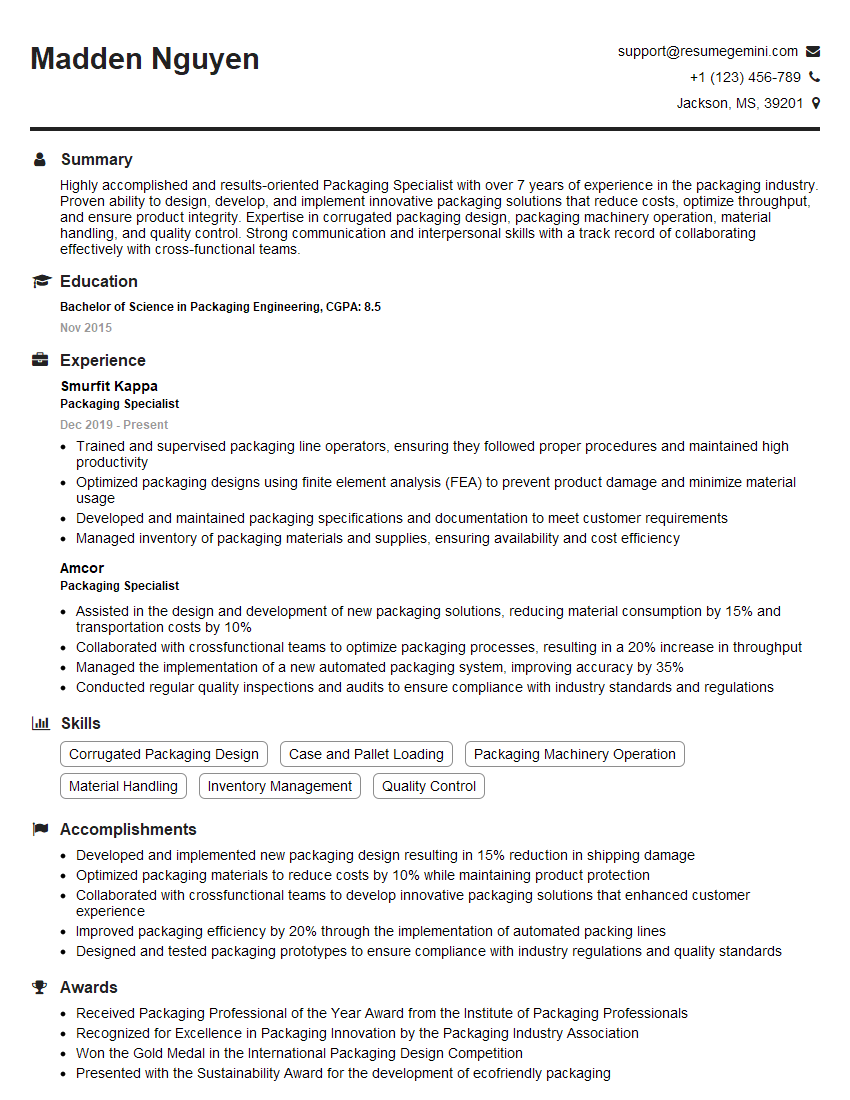
Mastering microelectronics packaging opens doors to exciting and impactful careers in a rapidly evolving industry. To maximize your job prospects, a strong and ATS-friendly resume is crucial. A well-crafted resume highlights your skills and experience effectively, making it easier for recruiters to identify you as a strong candidate. We strongly encourage you to use ResumeGemini, a trusted resource for building professional resumes. ResumeGemini offers valuable tools and templates, and you’ll find examples of resumes tailored specifically to Microelectronics Packaging to help you create a compelling application.

Explore more articles
Users Rating of Our Blogs
Share Your Experience
We value your feedback! Please rate our content and share your thoughts (optional).
What Readers Say About Our Blog
Very informative content, great job.
good