The right preparation can turn an interview into an opportunity to showcase your expertise. This guide to Microsystems Testing and Characterization interview questions is your ultimate resource, providing key insights and tips to help you ace your responses and stand out as a top candidate.
Questions Asked in Microsystems Testing and Characterization Interview
Q 1. Explain the difference between verification and validation in microsystems testing.
In microsystems testing, verification and validation are distinct but equally crucial processes ensuring the product meets its intended purpose. Think of it like baking a cake: verification checks if you followed the recipe correctly (did you use the right ingredients, the right steps?), while validation checks if the cake actually tastes good (does it meet the customer’s expectations?).
Verification confirms that the design and implementation adhere to the specifications. This involves various tests, such as simulations, code reviews, and unit tests, to ensure each component functions as designed. For example, verifying if a specific transistor switch operates within its defined voltage and current ranges.
Validation, on the other hand, determines if the completed microsystem meets the overall requirements and intended functionality. This usually involves system-level testing, integration tests, and often, real-world performance evaluations. Validating the cake means tasting it and checking if it meets the desired texture, sweetness, and overall taste.
In essence, verification is about building the system correctly, while validation is about building the correct system.
Q 2. Describe your experience with different test methodologies (e.g., black-box, white-box, gray-box).
My experience encompasses a wide range of test methodologies. I’ve extensively used black-box testing, where I treat the microsystem as a ‘black box’ – I know the inputs and outputs but not the internal workings. This allows for unbiased testing from the end-user perspective. For example, I’d test the overall functionality of a sensor by providing known stimuli and checking for the correct response, irrespective of its internal circuitry.
White-box testing, conversely, requires intimate knowledge of the internal structure and code. I’ve used this extensively to perform unit testing on individual components (e.g., testing individual modules within a microcontroller’s firmware) ensuring each part works correctly before integration. This helps pinpoint bugs at the source.
Gray-box testing lies somewhere in between. It uses partial knowledge of the internal structure – for example, knowing the general architecture but not the detailed implementation. This approach is helpful for integration testing, where I test the interaction of multiple components, understanding the overall system architecture while leaving some internal implementation details unspecified.
The choice of methodology depends on the testing phase, the available information, and the specific goals. Often, a combination of these techniques provides the most comprehensive testing.
Q 3. How do you approach debugging a failing test in a complex microsystem?
Debugging a failing test in a complex microsystem requires a systematic approach. My strategy typically involves:
- Reproducing the failure: First, I meticulously document the conditions under which the failure occurs to ensure repeatability. This often involves logging key variables and system states.
- Isolating the problem: I use a combination of techniques like binary search, reducing the complexity of the system gradually, to narrow down the source of the problem. This may involve disabling certain components or running simplified versions of the test.
- Using debugging tools: I utilize various debugging tools, including logic analyzers, oscilloscopes, and in-circuit emulators, to observe signals, memory contents, and execution flow. Debuggers embedded in the microcontroller firmware are also invaluable.
- Analyzing logs and data: I meticulously analyze logs and captured data from the test to identify patterns and anomalies that might hint at the root cause.
- Code review and static analysis: In case of software-related issues, code review and static analysis tools are employed to detect potential errors that might contribute to the failure.
Finally, once I have identified and rectified the problem, I thoroughly retest to ensure the fix resolves the original failure and doesn’t introduce new ones.
Q 4. What are common failure mechanisms in microsystems, and how do you test for them?
Microsystems are prone to various failure mechanisms, broadly categorized into:
- Physical failures: These include component failures (e.g., broken wires, shorted transistors), electromigration, thermal effects (overheating), and mechanical stress.
- Software failures: Bugs in the firmware, improper handling of interrupts, memory leaks, and race conditions can lead to system malfunctions.
- Environmental failures: Temperature extremes, humidity, radiation, and vibrations can impact performance and lead to failure.
Testing for these failures involves a multi-pronged approach:
- Environmental stress tests: Testing the system under extreme temperature, humidity, and vibration conditions to assess its robustness.
- Accelerated life testing (HALT): Intentionally stressing components beyond their normal operating conditions to accelerate failure and identify weaknesses.
- Reliability testing: Running the system continuously for an extended period to identify any latent defects.
- Fault injection: Simulating potential failures (e.g., injecting noise into signals) to observe the system’s response and identify potential vulnerabilities.
- Design for reliability (DfR): Incorporating reliability principles into the design phase helps prevent potential failures beforehand.
Q 5. Explain your experience with automated test equipment (ATE).
I possess extensive experience with Automated Test Equipment (ATE). My work has involved using ATE systems from various vendors for a wide array of applications. These systems automate the testing process, significantly improving efficiency and repeatability. I’m proficient in programming ATE systems using languages like LabVIEW and Python to create custom test routines. My experience includes:
- Developing and executing test programs: Creating complex test sequences to verify various aspects of the microsystem’s functionality.
- Integrating various test instruments: Connecting and controlling multiple instruments, such as digital multimeters, oscilloscopes, and signal generators, within a coordinated test sequence.
- Data acquisition and analysis: Acquiring large amounts of test data and developing algorithms for efficient analysis and reporting.
- Troubleshooting and maintenance: Identifying and resolving hardware and software issues within the ATE system.
For instance, I’ve used ATE to automatically test thousands of MEMS sensors, ensuring their sensitivity, linearity, and stability meet specifications. The ability to automate testing dramatically increased throughput and reduced human error.
Q 6. How do you ensure the repeatability and reliability of your test results?
Ensuring repeatability and reliability of test results is paramount. My approach focuses on several key areas:
- Standardized test procedures: Developing and strictly adhering to detailed, documented test procedures that outline every step of the process. This eliminates ambiguity and ensures consistency across tests.
- Calibrated equipment: Using regularly calibrated test equipment to guarantee accurate measurements. Calibration certificates are meticulously maintained.
- Environmental control: Controlling the environmental conditions (temperature, humidity, etc.) during testing to minimize variability in the results.
- Blind testing: In certain cases, blind testing – where the tester is unaware of the expected results – can eliminate bias and improve objectivity.
- Statistical analysis: Applying statistical methods to evaluate the variability of the data and to determine if the results are significant.
- Version control: Maintaining strict version control for both hardware and software involved in the testing process.
By implementing these measures, I ensure that the test results are reliable, repeatable, and can be confidently used to make informed decisions about the microsystem’s performance.
Q 7. Describe your experience with statistical process control (SPC) in a testing context.
Statistical Process Control (SPC) is integral to effective microsystems testing. It provides a powerful framework for monitoring and improving the consistency of the testing process itself. I’ve used SPC techniques extensively to track key process parameters and detect potential sources of variability in test results.
For example, I might use control charts (e.g., X-bar and R charts) to monitor the mean and variability of measurements like sensor sensitivity across a production batch. If the data points consistently fall outside the control limits, it signals potential problems in the testing process (e.g., equipment drift, environmental inconsistencies), or perhaps a shift in the manufacturing process causing non-conforming products.
Furthermore, I use capability analysis to determine if the testing process is capable of meeting the desired specifications. This involves evaluating the process’s variation compared to the acceptable tolerance. This data directly impacts decisions around process improvement, equipment upgrades, and the overall efficiency of the production line.
By leveraging SPC, I not only improve the reliability of individual test results, but also enhance the overall quality and consistency of the entire testing and manufacturing process. It’s a proactive approach to detecting and addressing potential issues before they become major problems.
Q 8. How do you handle unexpected test results or outliers?
Unexpected test results, or outliers, are a common occurrence in microsystems testing. They can stem from various sources, including measurement errors, environmental factors, or even actual defects in the device under test. My approach involves a systematic investigation, rather than simply dismissing the data point.
Repeatability Check: First, I’d repeat the test under identical conditions. If the outlier is not reproducible, it’s likely due to a random error (e.g., a brief power fluctuation). If it persists, further investigation is needed.
Data Analysis: I employ statistical methods like box plots and control charts to visually assess the data and identify any deviations from the expected distribution. This helps to determine if the outlier is statistically significant.
Root Cause Analysis: If the outlier is confirmed and significant, I meticulously examine the test setup, environment, and device characteristics. This might involve checking sensor calibration, environmental conditions (temperature, humidity), and the integrity of the test equipment itself. A thorough review of the test procedure to identify any potential systematic errors is also crucial. Log files and video recordings, if available, are invaluable resources during this stage.
Documentation and Reporting: Regardless of the outcome, I meticulously document the outlier, the investigation steps, and the conclusions reached. This ensures transparency and helps in future troubleshooting. If the outlier points to a genuine defect, it is reported as a failure, and the subsequent investigation drives corrective actions.
For example, in testing a microfluidic device, I once encountered an outlier in pressure readings. After repeating the test, the outlier persisted. Through thorough analysis, we discovered a microscopic air bubble trapped within the microchannel, causing the anomalous pressure reading. This highlights the importance of rigorous investigation, even for seemingly small variations.
Q 9. What are your preferred tools and techniques for data analysis in microsystems testing?
Data analysis in microsystems testing demands a multi-faceted approach leveraging both specialized software and statistical techniques. My preferred tools and techniques include:
MATLAB: This powerful environment excels in signal processing, statistical analysis, and data visualization. It allows for efficient manipulation of large datasets from various sensors and actuators, performing frequency analysis (FFT), filtering, and statistical tests.
Python with SciPy and Pandas: Python’s flexibility, coupled with libraries like SciPy (for scientific computing) and Pandas (for data manipulation), provides a robust platform for complex data analysis tasks, from simple descriptive statistics to sophisticated machine learning models for predictive maintenance.
LabVIEW: For real-time data acquisition and analysis directly from instruments, LabVIEW is indispensable. Its graphical programming environment simplifies the integration of hardware and software, enabling on-the-fly data processing and analysis.
Statistical Methods: Beyond software, the application of appropriate statistical methods is key. This includes hypothesis testing, regression analysis, ANOVA (Analysis of Variance), and time-series analysis. These techniques allow us to draw valid conclusions from the data, accounting for uncertainty and variability.
For instance, in characterizing a MEMS accelerometer, I used MATLAB to process the sensor’s output, performing spectral analysis to identify noise levels and resonance frequencies. This helped establish the device’s performance characteristics and identify potential sources of error.
Q 10. Describe your experience with different types of sensors and actuators used in microsystems.
My experience spans a wide range of sensors and actuators frequently used in microsystems. This includes:
MEMS Sensors: I’ve worked extensively with accelerometers, gyroscopes, pressure sensors, and microphones. These miniaturized devices are essential for various applications, from inertial measurement units (IMUs) in smartphones to environmental monitoring systems. Testing focuses on sensitivity, linearity, noise characteristics, and operating temperature range.
Optical Sensors: My experience also encompasses optical sensors such as photodiodes and phototransistors, vital for light detection applications in microsystems. Characterization includes responsivity, noise, and spectral response.
Chemical Sensors: I’ve worked with various chemical sensors, including electrochemical sensors and microcantilever-based sensors. These are used for detecting gases or specific molecules and their testing focuses on sensitivity, selectivity, and response time.
Microfluidic Actuators: I have experience with microfluidic systems, including pumps and valves. Testing these devices involves characterizing their flow rates, pressures, and controllability.
MEMS Actuators: This includes micro-mirrors, used for optical switching, and micro-motors for micro-robotics. Testing covers aspects like response time, accuracy, and power consumption.
A specific example involved testing a new type of MEMS pressure sensor for a biomedical application. We characterized its performance across a range of pressures and temperatures, ensuring its accuracy and stability met the stringent requirements for medical device certification.
Q 11. How do you manage test coverage in a large and complex microsystem?
Managing test coverage in complex microsystems requires a structured approach. A common strategy is to leverage a combination of techniques:
Requirement-Based Testing: Starting with a detailed specification of the system’s functionalities, we identify critical aspects requiring testing. This ensures that all essential features are covered.
Modular Testing: Breaking down the system into smaller, manageable modules allows for individual testing and integration testing, simplifying the process and improving fault isolation. Each module is thoroughly characterized and tested to ensure it meets its design specifications before integration.
Risk-Based Testing: Prioritizing tests based on their risk associated with failure. Components with higher failure probability or those with critical functions receive increased attention during the testing phase.
Code Coverage Analysis (for embedded systems): If the microsystem has significant software components, code coverage analysis tools measure the extent to which the code is executed during testing. This aids in identifying untested areas.
Test Automation: Automation of repetitive tests significantly enhances efficiency and reduces the chance of human error, enabling more comprehensive coverage.
Test Management Tools: Employing specialized test management software to track and manage tests, issues, and results contributes to better organization and overall test coverage visibility. These tools provide metrics such as test execution time and defect density.
For a large microsystem, I would employ a combination of these approaches, focusing on the highest-risk areas initially and iteratively increasing coverage. A test plan with clear objectives and a well-defined testing process is essential for effective management.
Q 12. Explain your understanding of design of experiments (DOE) and its application in testing.
Design of Experiments (DOE) is a powerful statistical methodology that allows for efficient and effective testing by systematically varying input parameters and observing their effects on the output. In microsystems testing, this translates to optimizing device performance and identifying critical design factors.
Types of DOE: Several types of DOE exist, such as full factorial designs, fractional factorial designs, and Taguchi methods. The choice depends on the number of factors and the desired level of detail.
Application in Testing: DOE helps determine which factors most significantly influence the microsystem’s performance. By carefully selecting input parameters and their levels, we can run a smaller set of tests than a full factorial approach, while still obtaining valuable information. For instance, if we are testing the sensitivity of a sensor, we might vary the input stimulus (light intensity, pressure, etc.), the temperature, and the bias voltage. DOE helps determine which of these factors has the greatest effect.
Data Analysis: After conducting the experiments, statistical analysis (ANOVA) is applied to determine the significance of each factor and identify optimal settings.
In a real-world application, I used a fractional factorial design to optimize the fabrication process of a MEMS gyroscope. By varying key parameters such as etch time and deposition thickness, we were able to identify the optimal process parameters that resulted in improved device sensitivity and reduced drift.
Q 13. How do you balance the need for thorough testing with project deadlines and resource constraints?
Balancing thorough testing with project deadlines and resource constraints is a common challenge. A crucial aspect is prioritizing what needs to be tested. This is managed by:
Risk Assessment: Identify the most critical aspects of the system and prioritize tests based on the severity of failure and its likelihood. This is often a collaborative process involving engineers and project management.
Test Prioritization: Focus on tests that provide the most valuable information, with higher risk areas targeted first. Smoke tests early on in the development cycle rapidly identify show-stopping issues.
Automation: Automate as many tests as possible to save time and resources. Automated tests also increase consistency and repeatability.
Test Case Optimization: Reduce the number of redundant test cases, focusing on achieving efficient test coverage. This often involves test case consolidation and design improvements.
Clear Communication and Reporting: Regular updates to project stakeholders on testing progress and potential risks are critical to ensure alignment and effective resource allocation.
Sometimes, compromises have to be made. This might involve focusing on critical functionality, accepting a slightly higher risk of undetected defects, or requesting additional resources where justified. This is a continuous negotiation and prioritization between testing thoroughness and project delivery.
Q 14. Describe your experience with failure analysis and root cause identification.
Failure analysis and root cause identification are crucial in microsystems testing. My experience involves a systematic investigation, starting with a thorough description of the failure mode.
Data Collection: Begin by collecting all relevant information such as test data, sensor readings, environmental conditions, and any available video or image data.
Visual Inspection: A detailed visual inspection of the failed device under a microscope (or other appropriate magnification) is often the first step. This can reveal physical damage, cracks, or other obvious defects.
Non-destructive Testing: Methods such as X-ray imaging, scanning electron microscopy (SEM), and focused ion beam (FIB) are used to investigate internal structures without causing further damage. These techniques can identify subsurface defects.
Destructive Testing: If necessary, destructive techniques such as cross-sectional analysis or layer-by-layer removal may be used to identify the source of failure.
Data Analysis: The data collected is carefully analyzed to identify patterns or correlations that provide clues about the root cause. This often involves comparing the failed device to working devices.
Documentation: All findings, methodologies, and conclusions are meticulously documented. This is essential for reporting to stakeholders and preventing future failures.
For instance, during the testing of a micro-mirror device, we experienced intermittent failures. Through careful failure analysis using SEM, we found tiny particles of debris causing short circuits. This led to design modifications that improved the device’s cleanliness and reliability.
Q 15. What are some common challenges you’ve encountered in microsystems testing, and how did you overcome them?
One of the biggest challenges in microsystems testing is the sheer complexity involved. We’re dealing with incredibly tiny devices, often with intricate interconnected components. A seemingly minor issue in one area can have cascading effects elsewhere. For example, I once worked on a MEMS accelerometer where a seemingly insignificant change in the bonding process caused a significant drift in the sensor’s output, only detectable under very specific environmental conditions.
To overcome this, I employ a multi-pronged approach. First, I utilize robust design of experiments (DOE) methodologies to systematically identify critical parameters. This helps pinpoint the root cause rather than chasing symptoms. Second, I leverage advanced characterization techniques like scanning electron microscopy (SEM) and focused ion beam (FIB) for detailed failure analysis. Finally, I advocate for rigorous verification and validation processes at each stage of development, incorporating simulations and modeling to predict behavior before committing to physical prototypes.
Another common challenge is dealing with the limitations of testing equipment. At the microscale, probing and manipulating devices requires specialized and often expensive equipment. To overcome this, we often develop custom test fixtures and adapt existing equipment to meet the specific needs of the device under test. For instance, we might use micro-manipulators coupled with high-precision probes to perform electrical measurements on tiny components.
Career Expert Tips:
- Ace those interviews! Prepare effectively by reviewing the Top 50 Most Common Interview Questions on ResumeGemini.
- Navigate your job search with confidence! Explore a wide range of Career Tips on ResumeGemini. Learn about common challenges and recommendations to overcome them.
- Craft the perfect resume! Master the Art of Resume Writing with ResumeGemini’s guide. Showcase your unique qualifications and achievements effectively.
- Don’t miss out on holiday savings! Build your dream resume with ResumeGemini’s ATS optimized templates.
Q 16. Explain your experience with different types of test environments (e.g., lab, field).
My experience spans both lab and field testing environments. Lab testing provides a controlled environment perfect for detailed characterization. We use specialized equipment like environmental chambers, vibration tables, and precision power supplies to stress the microsystems and systematically evaluate their performance under controlled parameters. For instance, we might test a microfluidic device’s flow rate across a range of temperatures and pressures.
Field testing, however, offers invaluable real-world data. It allows us to validate the performance of the microsystems under actual operating conditions and expose them to unforeseen circumstances. For example, we tested a miniature wireless sensor node for structural health monitoring deployed in a real-world bridge to evaluate its sensitivity and robustness under different environmental stresses. The contrast between the controlled lab data and the field data highlights the importance of both environments in creating robust and reliable microsystems.
Q 17. How do you ensure the integrity and security of test data?
Ensuring data integrity and security is paramount. We use a multi-layered approach. First, all test data is stored securely using version-controlled repositories and access-controlled databases. Second, data encryption ensures confidentiality, particularly important when dealing with sensitive sensor data or proprietary designs. Third, we implement checksums and other data integrity checks to detect any accidental or malicious data corruption during storage or transfer.
Furthermore, we maintain meticulous documentation of the test procedures, including detailed calibration reports of all equipment used. This ensures data traceability and allows for thorough investigation in case of anomalies. We also leverage digital signature techniques to verify the authenticity and integrity of test results, safeguarding against unauthorized modifications.
Q 18. What are your strategies for optimizing test efficiency and reducing test time?
Optimizing test efficiency is crucial. I employ several strategies, beginning with careful test planning. This involves defining clear objectives, selecting appropriate test methodologies, and prioritizing critical test cases. For example, using risk-based testing helps to focus efforts on the most critical functionalities.
Automation is key. We extensively utilize scripting languages like Python and LabVIEW to automate repetitive test procedures, reducing manual intervention and increasing throughput. This allows us to run hundreds of test iterations in a fraction of the time it would take manually. For example, we’ve developed automated scripts to control environmental chambers, acquire data from multiple sensors concurrently, and process results, producing comprehensive reports automatically.
Furthermore, adopting parallel testing, where multiple devices are tested concurrently, drastically reduces the overall test time. Lastly, employing statistical analysis of test data helps to identify trends and reduce the number of tests needed for complete characterization.
Q 19. Describe your experience with scripting languages for test automation (e.g., Python, LabVIEW).
I’m proficient in several scripting languages for test automation, primarily Python and LabVIEW. Python’s versatility and extensive libraries make it ideal for data analysis, report generation, and integration with other software tools. I’ve used Python to create custom scripts for automated data acquisition, statistical analysis, and visualization of test results. For instance, I used Python to develop a script that processed accelerometer data from 100 test runs, identifying outliers and generating a comprehensive performance summary.
LabVIEW, with its graphical programming environment, excels in instrument control and real-time data acquisition. I’ve used LabVIEW to interface with various test equipment, such as oscilloscopes, multimeters, and data acquisition systems. For example, I developed a LabVIEW program to control a temperature chamber, acquire data from a MEMS sensor, and plot the sensor’s response as a function of temperature. The choice of scripting language depends on the specific application and the available tools.
Q 20. Explain your understanding of different types of test equipment (e.g., oscilloscopes, multimeters, spectrum analyzers).
Understanding different types of test equipment is crucial. Oscilloscopes are essential for visualizing and analyzing time-varying signals, particularly important when evaluating the transient response of circuits and sensors. Multimeters measure various electrical parameters such as voltage, current, and resistance, providing essential information about circuit functionality.
Spectrum analyzers are vital for analyzing signals in the frequency domain, helping us assess signal integrity, identify noise sources, and characterize the frequency response of devices. Other crucial tools include network analyzers (for characterizing RF circuits), thermal cameras (for thermal management assessment), and environmental chambers (for evaluating the performance under various environmental conditions).
Proficiency with these instruments allows for effective diagnosis of issues and precise characterization of the microsystem’s performance.
Q 21. How do you collaborate with design engineers and other stakeholders during the testing process?
Collaboration is key. Throughout the testing process, I work closely with design engineers, providing feedback on the performance of their designs and identifying areas for improvement. Regular meetings and clear communication are essential to ensure a shared understanding of the test objectives, results, and implications. We utilize tools like shared documentation and project management software to maintain transparency and accountability.
When issues arise, I work collaboratively with the design team to diagnose the root cause. This often involves analyzing test data, conducting further investigations, and proposing solutions. A collaborative approach is crucial to delivering high-quality, reliable microsystems. For instance, during one project, my feedback on the sensitivity of a pressure sensor led the design team to optimize the sensor’s geometry, ultimately resulting in a significantly improved product.
Q 22. Describe your experience with developing test plans and test reports.
Developing effective test plans and reports is crucial for ensuring the quality and reliability of microsystems. A well-structured test plan outlines the scope, objectives, methodologies, and resources required for testing. It details the specific tests to be performed, the acceptance criteria, and the schedule. My approach involves a collaborative process, beginning with a thorough understanding of the microsystem’s specifications and intended applications. This often involves discussions with designers, engineers, and stakeholders to identify potential failure points and critical functionalities.
The test plan is then broken down into manageable test cases, each with clear steps, expected results, and pass/fail criteria. For example, testing a microfluidic device might include testing for pressure resistance, flow rate accuracy, and leak detection.
After testing is complete, the test report meticulously documents the results, including any deviations from expected behavior, observed failures, and the overall assessment of the microsystem’s performance. The report clearly communicates the findings, their implications, and any recommendations for improvement. I often use tables and graphs to present data effectively and provide concise summaries for easy understanding by a broad audience. My reports always include a detailed description of the testing environment and used equipment.
Q 23. How do you manage and track defects found during testing?
Defect management is a critical aspect of microsystems testing. I utilize a defect tracking system, often a dedicated software tool like Jira or Bugzilla, to record, track, and manage defects discovered during the testing process. Each defect is assigned a unique identifier, a detailed description of the problem, its severity (critical, major, minor), priority (urgent, high, medium, low), and the steps to reproduce it.
The system allows for assigning defects to specific engineers for resolution. It facilitates communication between testers, developers, and other stakeholders. I ensure that all defects are properly categorized and that their progress is closely monitored. Status updates, including the resolution steps and verification of fixes, are meticulously recorded. Regular reports are generated to provide a comprehensive overview of the defect status. Regular review meetings help prioritize issues and ensure timely resolutions.
Furthermore, I use root cause analysis techniques, such as the 5 Whys method, to identify the underlying causes of defects to prevent recurrence. This proactive approach contributes significantly to improving the overall quality and reliability of the microsystems being tested.
Q 24. What are your strategies for documenting test procedures and results?
Thorough documentation of test procedures and results is paramount in microsystems testing. My strategy relies on a combination of standardized templates and clear, concise writing. Test procedures are documented using step-by-step instructions that are easy to follow. This ensures reproducibility and consistency in testing across different teams and timeframes. I often include diagrams, flowcharts, and screenshots to further enhance understanding.
For instance, when testing a MEMS accelerometer, the test procedure would detail the setup of the testing equipment (e.g., vibration shaker, data acquisition system), the calibration process, and the specific tests performed (e.g., frequency response, sensitivity, linearity). The expected results for each test step are clearly stated.
Test results are documented comprehensively, with tables and graphs used to present data effectively. Any deviations from expected results are meticulously recorded along with explanations, supporting data (like oscilloscope waveforms), and images. Raw data is archived securely for future reference and traceability. All documentation follows a consistent format to ensure clarity, consistency and easy navigation for all involved parties, even those unfamiliar with the specific microsystem.
Q 25. Explain your understanding of yield improvement techniques in microsystems manufacturing.
Yield improvement in microsystems manufacturing focuses on maximizing the number of functional devices produced per wafer. It’s a critical aspect, impacting both cost and time to market. My experience encompasses several key techniques:
- Process Optimization: This involves fine-tuning various steps in the microfabrication process to minimize defects. For example, optimizing photolithography parameters to reduce mask misalignment or adjusting etching times to achieve the desired feature dimensions. Statistical process control (SPC) is crucial here, allowing for real-time monitoring and adjustments to maintain process stability.
- Defect Analysis: Identifying the root causes of failures is essential. Techniques such as optical microscopy, scanning electron microscopy (SEM), and focused ion beam (FIB) are used to characterize defects. This information is then used to implement corrective actions.
- Design for Manufacturability (DFM): Designing the microsystem with manufacturability in mind reduces the likelihood of defects. This may involve simplifying the design, selecting robust materials, or incorporating features that improve process robustness.
- Statistical Process Control (SPC): Continuous monitoring of key process parameters helps to identify and address variations early on. Control charts and other statistical tools are used to track process stability and identify out-of-control conditions.
Implementing these strategies in a systematic manner leads to a quantifiable increase in yield. For example, improving the etch process in a specific step by 1% could significantly impact the overall yield across thousands of devices.
Q 26. How do you ensure compliance with industry standards and regulations in your testing work?
Compliance with industry standards and regulations is non-negotiable in microsystems testing. I am well-versed in relevant standards, such as those defined by ISO, SEMI, and specific industry-specific guidelines. These standards cover various aspects, including testing methodologies, documentation, data management, and quality control.
My approach involves a thorough understanding of the applicable standards for each project. This includes reviewing the standards, adapting testing procedures to meet their requirements, and maintaining comprehensive documentation to demonstrate compliance. For example, if working on a medical microsystem, compliance with ISO 13485 (medical device quality management system) is critical.
Throughout the testing process, I meticulously document every step, ensuring traceability and providing auditable evidence of compliance. This includes calibration records for testing equipment, detailed test reports, and maintenance logs. Regular audits are welcomed to verify that procedures and practices align with the stipulated standards, demonstrating a commitment to producing reliable and safe microsystems.
Q 27. Describe your experience with different types of microfabrication processes and their impact on testing.
My experience encompasses various microfabrication processes, including photolithography, etching (wet and dry), thin-film deposition (e.g., sputtering, CVD), and bonding. Each process presents unique challenges and considerations for testing. For example, the resolution of photolithography directly impacts the dimensions of features on the microsystem and therefore influences the sensitivity and accuracy of the device. Any defects introduced during photolithography could lead to device malfunction, highlighting the importance of meticulous testing and process control.
Dry etching, while offering high precision, can introduce stress and damage to the material. This can affect the mechanical properties and performance of the microsystem, requiring specific tests to evaluate the integrity of the device. Similarly, the quality of thin-film deposition significantly impacts the device’s functionality. Therefore, tests are required to evaluate the film thickness, uniformity, and properties (e.g., resistivity, stress).
Understanding these processes and their potential impact on the microsystem’s functionality allows me to tailor testing strategies to identify potential problems and assess the overall quality and reliability. For example, during testing of micro-sensors fabricated using deep reactive ion etching (DRIE), I’d incorporate specific tests to detect micro-cracks or surface roughness that can negatively affect the devices’ performance.
Q 28. How would you approach testing a new, uncharacterized microsystem?
Testing a new, uncharacterized microsystem requires a structured and iterative approach. The process begins with a thorough understanding of the microsystem’s intended functionality and design. This includes reviewing schematics, understanding its intended operational parameters, and identifying potential failure mechanisms. Initial testing would focus on establishing the basic functionality of the device and identifying potential issues.
I’d start with simple tests to verify that the microsystem operates as expected under normal operating conditions. For example, if it’s a sensor, I’d check its response to known stimuli. If it’s an actuator, I’d test its movement range and force.
Based on the initial results, I would design more comprehensive tests to characterize its performance across various operating conditions and stress levels. This might involve exploring environmental effects like temperature and humidity, as well as studying long-term stability and reliability. Data analysis and statistical methods are used to evaluate performance metrics, identify trends, and compare results to design specifications. Each testing phase informs the next, guiding the development of more refined test strategies and leading to a deeper understanding of the microsystem’s behavior.
This iterative approach allows for early detection of critical defects and facilitates the establishment of robust acceptance criteria for future manufacturing and deployment, ensuring a smooth transition from prototype to production. Detailed documentation and characterization are crucial at each stage.
Key Topics to Learn for Microsystems Testing and Characterization Interview
- Device Physics and Modeling: Understanding the underlying physical principles governing the behavior of microsystems, including semiconductor physics, electromagnetism, and fluid dynamics. This forms the foundation for interpreting test results and developing effective characterization strategies.
- Testing Methodologies: Familiarize yourself with various testing techniques like electrical characterization (IV curves, capacitance-voltage measurements), optical characterization (spectroscopy, microscopy), and mechanical testing (stress-strain analysis). Understand the strengths and limitations of each method.
- Data Acquisition and Analysis: Mastering data acquisition techniques using various instruments (e.g., oscilloscopes, multimeters, etc.) is crucial. Develop proficiency in data analysis using statistical methods and software packages (e.g., MATLAB, Python) to extract meaningful insights from test results.
- Failure Analysis and Reliability: Learn how to identify and analyze failures in microsystems. This includes understanding reliability metrics (e.g., Mean Time To Failure – MTTF), failure modes, and mechanisms, and employing techniques for improving product reliability.
- Sensor Characterization: If your focus is on sensors, deepen your understanding of sensor types (e.g., pressure, temperature, accelerometers), their operational principles, and their performance metrics (e.g., sensitivity, resolution, accuracy).
- Microfabrication Processes: A basic understanding of microfabrication techniques (e.g., photolithography, etching, deposition) is helpful for comprehending the limitations and capabilities of the devices under test.
- Problem-Solving and Troubleshooting: Develop your ability to approach complex problems systematically, troubleshoot experimental issues, and design effective experiments to validate hypotheses.
Next Steps
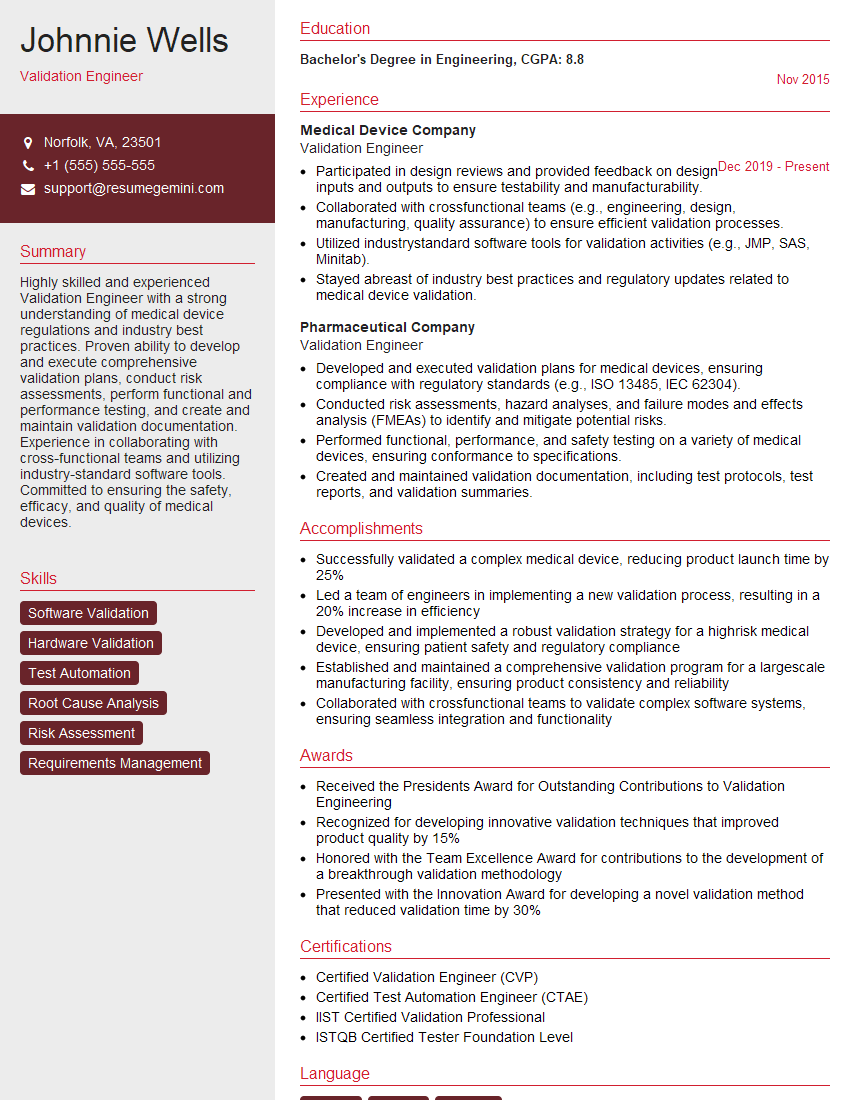
Mastering Microsystems Testing and Characterization opens doors to exciting and rewarding careers in research, development, and quality assurance within the semiconductor industry and beyond. A strong understanding of these concepts is highly sought after by leading companies. To maximize your job prospects, create a compelling and ATS-friendly resume that highlights your skills and experience. ResumeGemini is a trusted resource for building professional resumes, helping you showcase your qualifications effectively. Examples of resumes tailored to Microsystems Testing and Characterization are available to guide you. Invest the time to create a resume that truly reflects your expertise – it’s your key to unlocking your career potential.



Explore more articles
Users Rating of Our Blogs
Share Your Experience
We value your feedback! Please rate our content and share your thoughts (optional).
What Readers Say About Our Blog
Very informative content, great job.
good