Feeling uncertain about what to expect in your upcoming interview? We’ve got you covered! This blog highlights the most important Monumental Sculpture interview questions and provides actionable advice to help you stand out as the ideal candidate. Let’s pave the way for your success.
Questions Asked in Monumental Sculpture Interview
Q 1. Describe your experience with various sculpting materials (stone, bronze, etc.) and their unique challenges.
My experience spans a wide range of materials, each presenting unique challenges. Stone, for instance, demands a deep understanding of its geological properties. Different types – marble, granite, limestone – each carve differently, requiring adjustments in tooling and technique. The inherent fragility of some stones necessitates meticulous planning to avoid fracturing. Bronze, conversely, offers more malleability but presents challenges in the casting process itself, where precise temperature control and mold creation are paramount. I’ve worked extensively with both, finding that the creative process is enriched by understanding the material’s limitations and potential.
- Stone: I’ve worked with Carrara marble, renowned for its delicate veining, requiring careful consideration during the carving to highlight its beauty without compromising structural integrity. This often involves detailed planning and sketching to determine the best orientation and minimize waste. For instance, a recent project involving a large-scale relief necessitated a detailed mapping of the stone’s internal structure to avoid flaws and ensure the piece’s structural soundness.
- Bronze: The lost-wax casting process, in particular, is demanding. The slightest imperfection in the wax model will be replicated in the bronze. Achieving a fine level of detail while maintaining the structural integrity of the final piece is crucial, often involving multiple stages of reinforcement and refinement.
Q 2. Explain your process for creating a large-scale maquette.
Creating a large-scale maquette is a crucial step, serving as a blueprint for the final monumental sculpture. My process typically begins with extensive sketching and conceptualization, exploring various compositional possibilities. I then transition to a small-scale clay model, refining the form and composition. This is followed by a larger clay model, typically around 1:10 or 1:20 scale. This allows for further refinement of details, exploring textural elements and studying the interplay of light and shadow. Finally, this larger clay maquette is carefully documented through photography and digital modeling, providing a precise template for the fabrication of the full-scale sculpture.
For example, when working on a public art piece, I’d first create several small sketches, exploring different concepts, before moving on to a rough clay model to test the overall composition. I would continuously refine and adjust the model, based on both artistic intuition and structural considerations, which can sometimes involve incorporating internal support elements.
Q 3. How do you ensure structural integrity in a monumental sculpture?
Structural integrity is paramount in monumental sculpture. My approach is multi-faceted, involving careful consideration of material properties, design, and engineering principles. For example, in large-scale stone sculptures, I utilize engineering calculations to ensure the piece can withstand its own weight and environmental stresses (wind, seismic activity). This may involve creating internal supports or employing specific carving techniques to maximize strength. With bronze, the casting process itself needs precise engineering, including the design of the mold and the incorporation of internal reinforcement elements. Careful attention is paid to the thickness of the bronze, ensuring it’s robust enough for the sculpture’s size and intended location.
For instance, in a recent project featuring a tall, slender bronze figure, I employed sophisticated finite element analysis (FEA) software to assess its structural stability under various conditions. The resulting adjustments to the design involved strategically placed internal supports, preventing potential warping or cracking.
Q 4. Detail your experience with different casting methods (lost-wax, sand casting).
I have extensive experience with both lost-wax casting and sand casting, each appropriate for different circumstances and materials. Lost-wax casting is ideal for intricate details and fine finishes, often employed for bronze sculptures. The process involves creating a wax model, which is then encased in a ceramic mold. The wax is melted out, leaving a cavity which is filled with molten bronze. Sand casting, on the other hand, is a more robust technique, suitable for larger, simpler forms and potentially less expensive materials. It involves creating a sand mold around a pattern, which is then removed before pouring the molten metal.
- Lost-wax casting: This method allows for exceptional detail, but it’s time-consuming and costly. I use it when capturing delicate textures and features is essential.
- Sand casting: This is quicker and more cost-effective for larger projects where intricate detail is less important. It’s particularly useful for materials like aluminum, but can be adapted to bronze.
Q 5. Describe your approach to site-specific sculpture design.
Site-specific sculpture demands a deep understanding of the environment and its relationship with the artwork. My approach begins with a thorough site analysis, considering factors like scale, surrounding architecture, and natural elements (light, wind, views). The artwork should engage with its setting in a meaningful way, rather than simply occupying the space. I engage in extensive dialogue with stakeholders to understand their vision and the community’s needs, ensuring the sculpture is both aesthetically pleasing and functional. The resulting design responds organically to the site, enhancing its inherent qualities.
For example, a recent commission for a coastal park led me to design a sculpture that utilizes the natural flow of the wind to create dynamic movement and subtle sound. The material choice reflected the site’s maritime setting. The final product was not just a static object, but a dynamic experience reflecting the nature of its location.
Q 6. How do you manage and mitigate risks associated with large-scale projects?
Large-scale projects present inherent risks, from logistical challenges to unforeseen material issues. My risk mitigation strategy involves meticulous planning, detailed budgeting, and the formation of a strong, experienced team. We employ rigorous quality control at every stage of production and utilize specialized software for structural analysis and risk assessment. Open communication with stakeholders, including regular progress reports and contingency planning, is crucial in managing potential problems. Furthermore, insurance and legal considerations are carefully addressed from the outset.
For instance, on a project involving a massive stone sculpture, we meticulously mapped out transportation routes, considering weight, dimensions, and potential obstacles. This included creating detailed plans for handling and installation to minimize the risk of damage during transportation and placement.
Q 7. Explain your understanding of patina application and maintenance on bronze sculptures.
Patina is the surface coloration of bronze, significantly impacting its aesthetic appeal and longevity. My understanding of patina application and maintenance is extensive. Different patinas are achieved using various chemical treatments, each resulting in unique colors and textures. Proper maintenance involves regular cleaning and protection from environmental elements to prevent corrosion and discoloration. I typically advise clients on appropriate cleaning methods and protective coatings, emphasizing the importance of regular inspection to address any issues promptly. Ignoring this can lead to irreversible damage, significantly diminishing the lifespan of the sculpture.
For example, a dark brown, almost black, patina can be achieved using a liver of sulfur solution, while a more greenish-blue patina can be achieved with other chemical mixtures. The correct application method depends on the desired color and texture.
Q 8. Discuss your familiarity with relevant safety regulations and procedures for monumental sculpture fabrication.
Safety is paramount in monumental sculpture fabrication. My experience encompasses a thorough understanding and strict adherence to OSHA (Occupational Safety and Health Administration) guidelines, as well as site-specific safety plans. This includes, but is not limited to, proper use of Personal Protective Equipment (PPE) like respirators, safety glasses, and hearing protection; safe handling and operation of heavy machinery such as cranes, forklifts, and stone cutting equipment; and the implementation of fall protection measures, especially when working at heights. For example, during the fabrication of a large bronze sculpture, we meticulously planned the crane lifts, ensuring proper weight distribution and secure rigging to prevent accidents. We also conducted regular safety briefings to reinforce awareness and address any potential hazards.
Furthermore, I’m deeply familiar with Material Safety Data Sheets (MSDS) for all materials used, including stone dust management, and chemical handling procedures. This proactive approach minimizes risks and ensures a safe working environment for everyone involved in the project. We always prioritize preventative measures and maintain a comprehensive documentation system for all safety procedures and incident reports.
Q 9. How do you collaborate effectively with architects, engineers, and other professionals on a monumental sculpture project?
Collaboration is key to successful monumental sculpture projects. I believe in a highly communicative, integrated approach. From the initial design phase, I work closely with architects to ensure the sculpture complements the overall architectural design and structural considerations. This often involves reviewing architectural plans, discussing site conditions, and exploring the optimal location and scale for the artwork. Engineers are vital for determining structural integrity, particularly for large-scale pieces. We collaborate to address factors such as wind load, seismic activity, and foundation requirements, ensuring the sculpture’s long-term stability.
With other professionals, like fabricators, installers, and conservators, regular meetings, detailed drawings and specifications, and a shared online project management platform ensure everyone is on the same page. For example, on a recent project, we utilized BIM (Building Information Modeling) software to facilitate smooth collaboration across disciplines, allowing real-time updates and problem-solving. Open communication, active listening, and a respect for each team member’s expertise are critical for project success.
Q 10. What software and tools are you proficient in for 3D modeling and digital sculpting?
Proficiency in 3D modeling and digital sculpting is essential for my work. I’m highly skilled in industry-standard software such as ZBrush for digital sculpting, allowing for intricate detail and organic forms. For precise modeling and CAD (Computer-Aided Design) work, I utilize Rhino 3D, which offers excellent control over surface geometry. I also have experience with Blender, a versatile open-source option, and utilize programs like Keyshot for rendering and visualization. These tools are crucial for creating detailed designs, generating precise fabrication drawings, and communicating effectively with fabricators. For example, I used ZBrush to sculpt a highly detailed avian figure, then transferred the model to Rhino for precise adjustments to ensure structural integrity before fabricating it in bronze.
Q 11. Describe your experience with the transportation and installation of monumental sculptures.
Transportation and installation of monumental sculptures are complex logistical operations requiring meticulous planning and coordination. My experience includes overseeing the entire process, from creating detailed transport plans to on-site installation. This involves selecting appropriate rigging and transportation methods based on the sculpture’s size, weight, and material. For example, a delicate marble sculpture might require specialized cradles and climate-controlled transport, while a bronze sculpture may be moved using a crane. I collaborate closely with specialized riggers, transportation companies, and site engineers to ensure safe and damage-free transportation.
On-site installation requires precision and coordination. We often use cranes, forklifts, and other heavy machinery, all coordinated with detailed lifting plans and safety protocols. Precise leveling, anchoring, and finishing touches are critical for ensuring the sculpture is securely and aesthetically positioned. Each project requires a unique approach tailored to the sculpture and site specifics, prioritizing safety and minimizing risks throughout the process.
Q 12. Explain your understanding of different stone types and their suitability for outdoor sculptures.
Understanding stone types and their suitability for outdoor sculptures is vital. Different stones possess varying properties regarding durability, weather resistance, and aesthetic appeal. Granite, for instance, is exceptionally durable and weather-resistant, making it ideal for large-scale outdoor projects. Marble, while beautiful, is more susceptible to erosion and staining, requiring careful consideration of its placement and potential for protection. Limestone, another popular choice, is relatively soft and needs more maintenance to prevent weathering. I consider factors such as porosity, compressive strength, and susceptibility to freeze-thaw cycles when selecting a stone. The intended location’s climate heavily influences the choice—a highly porous stone in a humid climate, for example, might be prone to significant damage.
Furthermore, I assess the availability of different stone types, their cost-effectiveness, and their aesthetic compatibility with the overall design. For example, a coastal location might benefit from a harder, more erosion-resistant stone like granite, whereas a more sheltered location could accommodate a softer stone like limestone, allowing for more intricate detailing. The choice always balances aesthetic vision with practical considerations of longevity and maintenance.
Q 13. How do you address potential weathering and erosion issues in your designs?
Addressing weathering and erosion is crucial for the longevity of outdoor sculptures. My designs incorporate strategies to mitigate these risks. This starts with material selection, prioritizing stones with high weather resistance, as discussed previously. Beyond this, I design sculptures with minimal surface area exposed to the elements, utilizing overhangs or strategic placements to limit water penetration and direct sunlight exposure. I also specify finishes and treatments that provide additional protection against weathering, such as specialized sealants and protective coatings tailored to the chosen material. These coatings can significantly improve resistance to UV radiation, water absorption, and other environmental factors.
Furthermore, detailed documentation and maintenance plans are provided to clients to ensure the long-term preservation of the sculpture. These plans often include recommendations for regular cleaning and inspection, addressing any minor damage promptly to prevent further deterioration. For example, I might specify the use of a specific type of cleaning agent to avoid damaging the stone’s surface while effectively removing pollutants.
Q 14. What is your approach to budgeting and project management in large-scale sculpture projects?
Budgeting and project management are integral to large-scale sculpture projects. I employ a phased approach, starting with a detailed breakdown of all costs involved, including materials, fabrication, transportation, installation, and any unforeseen contingencies. I use project management software to track expenses, timelines, and deliverables, ensuring transparency and accountability. Regular meetings with the client are held to review progress, address any issues, and manage expectations. I also prioritize open communication to promptly address any budget deviations.
Risk assessment is a key aspect of my approach. Potential delays or cost overruns are identified and mitigation strategies are developed proactively. For example, including a contingency fund for unexpected material costs or labor price fluctuations. By meticulously planning and documenting every stage, I ensure the project remains on track, within budget, and meets the client’s expectations. A well-defined scope of work, clear communication, and proactive risk management are crucial for successful project delivery.
Q 15. How do you incorporate client feedback into the design process?
Client feedback is paramount in creating a monumental sculpture that truly resonates. I integrate feedback throughout the entire process, starting with initial concept sketches and continuing through to the final stages of installation. I find that a collaborative approach works best. This involves:
Initial Consultations: Thorough discussions to understand the client’s vision, budget, and desired impact of the sculpture. I use visual aids like mood boards and preliminary sketches to ensure we’re on the same page.
Iterative Design: I present multiple design options, incorporating client feedback after each iteration. This allows for adjustments and refinements, ensuring the final design meets their expectations.
Regular Updates: Throughout the fabrication process, I provide regular updates—photographs, videos, and progress reports—to keep the client informed and allow for timely adjustments if needed. This transparency fosters trust and prevents misunderstandings.
On-site Reviews: When feasible, I encourage clients to visit the studio or the installation site to review the progress in person. This allows for immediate feedback and a more tangible understanding of the scale and detail.
For example, I once worked on a public memorial where the client initially envisioned a very abstract design. Through a series of discussions and iterations, we arrived at a more representational design that still captured the intended emotion and fulfilled the client’s desire for something meaningful and accessible to the public.
Career Expert Tips:
- Ace those interviews! Prepare effectively by reviewing the Top 50 Most Common Interview Questions on ResumeGemini.
- Navigate your job search with confidence! Explore a wide range of Career Tips on ResumeGemini. Learn about common challenges and recommendations to overcome them.
- Craft the perfect resume! Master the Art of Resume Writing with ResumeGemini’s guide. Showcase your unique qualifications and achievements effectively.
- Don’t miss out on holiday savings! Build your dream resume with ResumeGemini’s ATS optimized templates.
Q 16. Describe your experience with the creation of detailed scale models.
Detailed scale models are crucial in monumental sculpture. They allow for comprehensive visualization, problem-solving, and client communication before committing to costly and time-consuming full-scale fabrication. My experience spans various materials and techniques:
Material Selection: The choice of material depends on the complexity and intended use of the model. I’ve worked with everything from foam core and wood for initial rough models to resin and clay for highly detailed prototypes. For very intricate details, I might even employ 3D printing.
Construction Techniques: I employ a variety of techniques depending on the chosen material. For example, clay models allow for fluid sculpting and organic forms, while foam core offers precision for geometric designs. I’m also proficient in using digital sculpting software to create highly accurate 3D models that can then be 3D printed.
Surface Detailing: Achieving accurate surface textures and details in the models is essential. I use various tools and techniques to replicate surface treatments that will eventually be used in the final sculpture, such as texturing tools for clay models or specialized painting techniques for foam core models. This meticulous attention to detail ensures the final product closely aligns with the design.
In one project, a complex bronze equestrian statue, the scale model allowed us to identify and resolve structural issues related to the horse’s pose and rider’s weight distribution before casting began. This saved significant time and resources.
Q 17. Explain your understanding of the preservation and conservation of monumental sculptures.
Preservation and conservation of monumental sculptures are critical for ensuring their longevity and continued appreciation. My understanding encompasses several key areas:
Material Properties: A deep understanding of the material’s properties—be it bronze, stone, or other materials—is fundamental. This knowledge informs the selection of appropriate conservation methods and materials.
Environmental Factors: Environmental factors like temperature fluctuations, humidity, pollution, and even bird droppings can significantly impact a sculpture’s condition. Protective coatings and regular cleaning are essential.
Damage Assessment: Accurate assessment of damage—cracks, corrosion, erosion, or biofouling—is crucial for developing a tailored conservation plan. This may involve non-destructive testing methods like X-ray fluorescence.
Treatment Techniques: Various techniques, from cleaning and consolidation to repair and restoration, are employed depending on the damage. This can include chemical cleaning, laser ablation, or careful patching with compatible materials.
Preventive Conservation: Proactive measures like regular inspections, environmental monitoring, and the application of protective coatings are vital in minimizing future damage.
For instance, when working on the restoration of a weathered sandstone sculpture, we used specialized cleaning solutions and consolidation techniques to stabilize the weakened stone while preserving its original patina. This requires a careful balance between intervention and preservation of the sculpture’s artistic integrity.
Q 18. How do you handle unforeseen challenges or changes during the fabrication process?
Unforeseen challenges are inherent in large-scale projects. My approach to handling them involves a combination of proactive planning, problem-solving skills, and effective communication:
Contingency Planning: I always build in contingencies into the project plan, accounting for potential delays or material shortages. This proactive approach helps to mitigate the impact of unexpected issues.
Problem-Solving: When unforeseen challenges arise, I employ a systematic problem-solving approach, involving careful analysis of the issue, exploration of potential solutions, and collaboration with engineers, fabricators, and other relevant specialists.
Open Communication: Open and transparent communication with the client and the project team is critical. Keeping everyone informed allows for timely decision-making and minimizes the impact of delays.
Adaptability: I’m always prepared to adapt my plans and approach as needed, finding creative solutions to overcome obstacles. Flexibility and resourcefulness are crucial in these situations.
For example, during the fabrication of a large bronze sculpture, we encountered a casting defect. By collaborating with the foundry and utilizing innovative repair techniques, we were able to rectify the issue without compromising the sculpture’s artistic integrity or significantly delaying the project.
Q 19. Describe your approach to quality control throughout the entire project lifecycle.
Quality control is an ongoing process integrated throughout the entire project lifecycle, from initial concept to final installation. My approach is multi-faceted:
Material Selection: I meticulously select high-quality materials that meet the project’s specific requirements and have proven durability. This is crucial for long-term preservation.
Fabrication Oversight: I maintain close oversight throughout the fabrication process, ensuring that each stage adheres to the highest standards of craftsmanship. This includes regular inspections and quality checks.
Documentation: Detailed documentation of every step of the process, including material specifications, fabrication techniques, and quality control checks, is maintained for accountability and future reference.
Independent Inspections: Where appropriate, I employ independent third-party inspections to ensure the work meets industry best practices and safety regulations.
Testing: Where necessary, I use non-destructive testing methods to ensure the integrity of the sculpture before installation, particularly with large and complex structures.
A detailed quality control plan is implemented from the beginning, which outlines procedures, checkpoints, and responsibilities to ensure that every aspect of the project meets the established standards of excellence.
Q 20. What are your preferred methods for creating textures and surface details in your sculptures?
Creating realistic and evocative textures and surface details is crucial for bringing a monumental sculpture to life. My preferred methods vary depending on the material and the desired effect:
Traditional Techniques: For stone sculptures, I often use traditional carving techniques, employing a variety of tools to achieve different textures, from smooth polished surfaces to rough, heavily textured finishes. For bronze, I work closely with the foundry to create molds with detailed textures using various techniques.
Modern Techniques: I incorporate modern techniques like 3D modeling and printing for creating highly detailed molds with intricate textures. These techniques are especially helpful for replicating complex organic forms.
Surface Treatments: Patination techniques for bronze, specialized paints and pigments for stone, and other surface treatments are used to enhance the texture and create the desired aesthetic effect. The goal is always to create a surface that is both visually appealing and durable.
For example, in a recent project involving a bronze figure, we used a combination of traditional casting techniques and digital sculpting to achieve highly realistic skin texture and folds in the clothing. The final patina gave the sculpture a lifelike appearance.
Q 21. How do you balance artistic vision with practical considerations like budget and feasibility?
Balancing artistic vision with practical considerations is essential for successful monumental sculpture projects. It requires careful planning and a willingness to adapt and compromise without sacrificing the core artistic vision.
Conceptualization: From the initial design phase, I consider the budget, feasibility, and material constraints. I explore design options that are both aesthetically compelling and practically achievable.
Material Selection: Material choices greatly influence the cost and feasibility of the project. I choose materials that effectively balance artistic vision, durability, and budget.
Fabrication Techniques: Careful consideration of the fabrication process allows for efficient and cost-effective production without compromising quality or artistic integrity. For instance, employing simpler construction methods where appropriate can save considerable resources.
Collaboration: I collaborate closely with engineers, fabricators, and other professionals to ensure that the design is structurally sound and within the budgetary limits. Open communication ensures everyone understands the constraints and works towards a common goal.
Value Engineering: Throughout the process, I actively participate in value engineering, finding ways to optimize the design and construction without compromising the artistic intent. This might involve finding cost-effective alternatives without sacrificing quality or aesthetic impact.
In one instance, we had to reduce the scale of a sculpture due to budgetary constraints. Through careful redesign and value engineering, we maintained the integrity of the artistic vision while remaining within the budget. The result was a smaller but equally impressive piece.
Q 22. Describe your experience with working from sketches, models, and digital designs.
My process begins with sketches, a crucial initial phase where I explore ideas, proportions, and composition. These are often quick, expressive renderings that help me visualize the overall form and feel of the sculpture. From these sketches, I then move to creating physical models, typically in clay or other malleable materials. This tactile process allows me to refine the form, experimenting with volume and texture in three dimensions. The model serves as a tangible representation for further refinement and helps me anticipate challenges in the final fabrication process. Finally, I incorporate digital design through 3D modeling software such as ZBrush or Blender. This allows for precise adjustments to the model, the creation of detailed elements, and the simulation of various materials and construction techniques before committing to the final execution. For example, on a recent project involving a large bronze equestrian statue, I used digital modeling to precisely adjust the musculature of the horse and to plan the complex internal armature needed for stability and support. The interplay between sketching, physical modeling, and digital design is iterative; I often move between these methods, refining the design at each stage.
Q 23. Explain your understanding of the historical context and evolution of monumental sculpture.
Monumental sculpture boasts a rich history, evolving significantly across different eras and cultures. Early examples, such as the colossal statues of ancient Egypt, were primarily associated with religious and political power. The Greeks perfected the idealized human form in monumental sculpture, exemplified by the sculptures of the Parthenon. The Roman Empire adopted and adapted Greek styles, creating monumental sculptures to celebrate military victories and imperial authority. The medieval period saw a shift towards religious imagery, with monumental sculptures adorning cathedrals and churches. The Renaissance witnessed a revival of classical forms, with artists like Donatello and Michelangelo pushing the boundaries of human representation. The modern era has seen experimentation with various materials, forms, and concepts, reflecting the changing cultural landscape. Think of Rodin’s *The Thinker*, a powerful expression of human introspection, or the abstract monumental sculptures of Henry Moore, which explore form and space in innovative ways. The evolution demonstrates a continuous interplay between artistic innovation, technological advancements (from bronze casting techniques to advanced digital fabrication), and socio-political contexts.
Q 24. What are some of the ethical considerations related to creating and installing monumental sculptures?
Ethical considerations in monumental sculpture are multifaceted. Firstly, the selection and representation of subjects are crucial. A sculpture commemorating a historical figure might need careful consideration of that figure’s legacy, avoiding the glorification of problematic individuals or events. Community engagement is also paramount. Meaningful consultation with the community ensures that the artwork resonates with and reflects the values and identity of the people it intends to serve. For example, I once worked on a project where the original design for a memorial was met with significant community opposition due to its perceived lack of inclusivity. We revised the design through extensive community consultations, leading to a final product that was better received. Material sourcing and environmental impact are equally important. Using sustainable materials and minimizing waste are vital for creating responsible and environmentally conscious art. The long-term preservation and maintenance of the sculpture should also be considered. A monument that is poorly maintained risks deterioration and loses its intended impact.
Q 25. Describe your experience working with different types of found objects or reclaimed materials.
I’ve been fortunate to work with a range of found objects and reclaimed materials in my sculptures, finding beauty in the unexpected. One project involved using repurposed steel beams from a demolished industrial building to create an abstract sculpture representing the area’s industrial past. The patina and texture of the steel contributed to the sculpture’s narrative. In another project, I incorporated reclaimed wood salvaged from old barns into a piece reflecting themes of history and resilience. Working with found objects allows for a unique engagement with material history, adding layers of meaning to the final artwork. The challenge often lies in adapting the inherent properties of these materials – their size, shape, and condition – into the artistic vision. Careful planning and skillful manipulation are key to successfully integrating these elements into a cohesive and aesthetically pleasing composition. The process is often collaborative, involving skilled fabricators and engineers who help me bring my vision to life.
Q 26. How do you ensure that your sculptures are accessible and inclusive to a wide range of audiences?
Accessibility and inclusivity are fundamental to my artistic practice. Designing sculptures for public spaces necessitates careful consideration of physical accessibility for people with disabilities. This includes ensuring sufficient space for wheelchair access and employing materials and techniques that are durable and safe. Furthermore, the design should consider diverse viewpoints and perspectives. The subject matter, symbolism, and aesthetics should be approachable and engaging for a wide range of cultural backgrounds and levels of art knowledge. Public art isn’t for a select few; it’s for everyone. I involve community members in the design process through workshops and discussions to gather insights and ensure the sculpture’s relevance and resonance within the community. Interactive elements or information panels can also enhance accessibility by offering additional context and engaging different learning styles.
Q 27. What are your future aspirations and career goals within the field of monumental sculpture?
My future aspirations involve expanding my exploration of sustainable materials and integrating technology more deeply into my creative process. I am eager to collaborate on larger-scale, internationally significant projects that challenge conventional notions of public art. I aim to use my work to foster dialogue and create opportunities for community engagement and collaborative creation. This includes exploring the use of augmented reality to enrich the audience experience and perhaps even incorporating elements of participatory art. Ultimately, I aspire to contribute to a growing body of work that promotes inclusivity, sustainability, and meaningful interaction between art and the public.
Q 28. Describe your experience with creating sculptures for public spaces and considering community engagement.
My experience in creating sculptures for public spaces has consistently highlighted the importance of community engagement. The ideal process begins with thorough research into the local context, history, and the community’s needs and aspirations. This research often involves attending community meetings, hosting workshops, and engaging with local stakeholders to gather insights and understand the community’s perspective on art and public spaces. Collaborating with community members throughout the design and fabrication process ensures that the final artwork genuinely reflects their values and desires. For example, a recent project in a diverse neighborhood involved incorporating elements suggested by residents, reflecting their cultural heritage and experiences. The community’s input not only enriched the aesthetic of the sculpture but also fostered a sense of ownership and pride in the final artwork. The success of a public sculpture hinges on its ability to serve as a point of connection and pride for the community, and that’s achieved through meaningful and ongoing engagement.
Key Topics to Learn for Monumental Sculpture Interview
- Material Selection and Properties: Understanding the strengths and weaknesses of various materials (stone, bronze, concrete, etc.) and their suitability for large-scale projects, including weathering and durability considerations.
- Scale and Proportion: Applying principles of scale and proportion to create impactful and harmonious monumental works. This includes understanding how a sculpture interacts with its environment and intended audience.
- Structural Integrity: Designing for stability and longevity. This involves knowledge of engineering principles and appropriate construction techniques to prevent collapse or damage.
- Casting Techniques (for Bronze): A thorough understanding of the lost-wax casting process and other relevant methods for creating large-scale bronze sculptures.
- Stone Carving Techniques: Familiarity with various stone carving techniques, including point, chisel, and mallet techniques, and their application in different stone types.
- Site-Specific Installation: Considering the unique challenges of transporting, installing, and maintaining monumental sculptures in diverse environments. This includes understanding site preparation and potential environmental factors.
- Conceptualization and Design Process: Articulating your creative process, from initial concept to final execution, including sketching, modeling, and problem-solving during the design phase.
- Budgeting and Project Management: Demonstrating an understanding of realistic project timelines, material costs, and labor requirements for large-scale projects.
- Historical Context and Influences: Showcasing knowledge of significant monumental sculptures throughout history and the various artistic movements that have shaped the field.
- Health and Safety Regulations: Demonstrating awareness of relevant safety protocols and regulations pertaining to working at heights, handling heavy materials, and operating machinery.
Next Steps
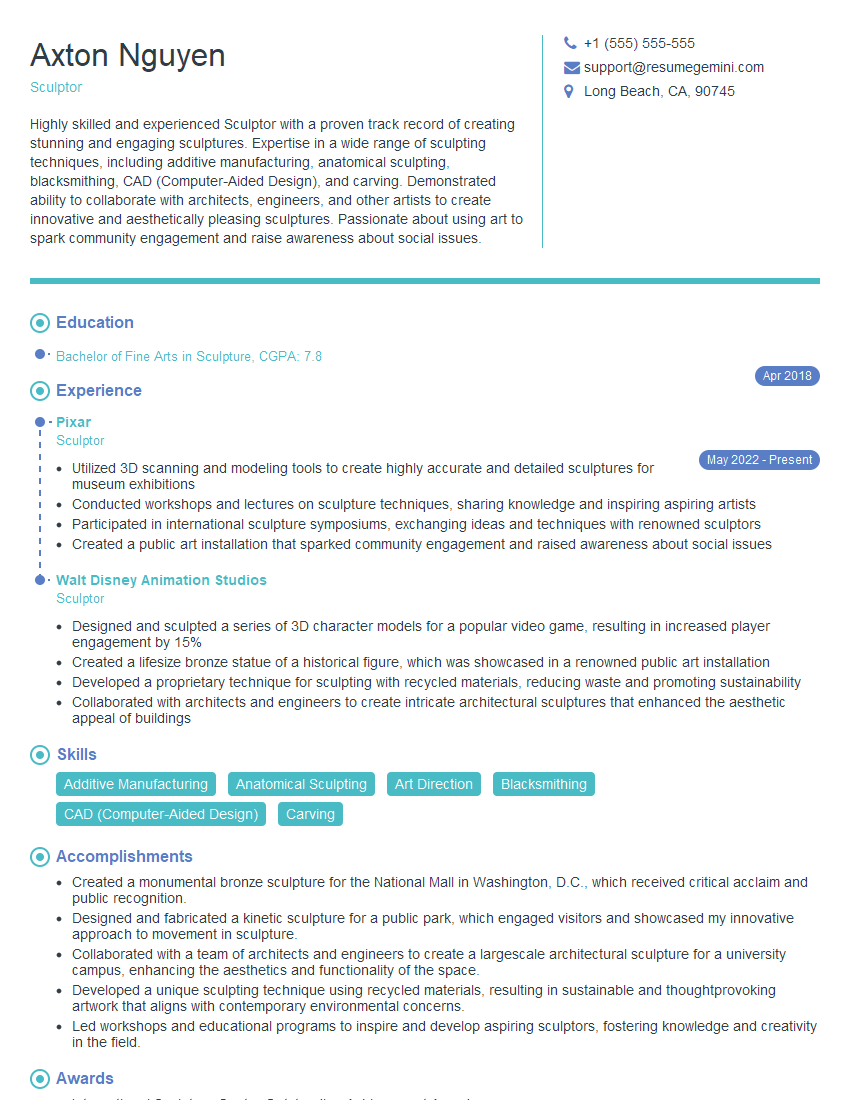
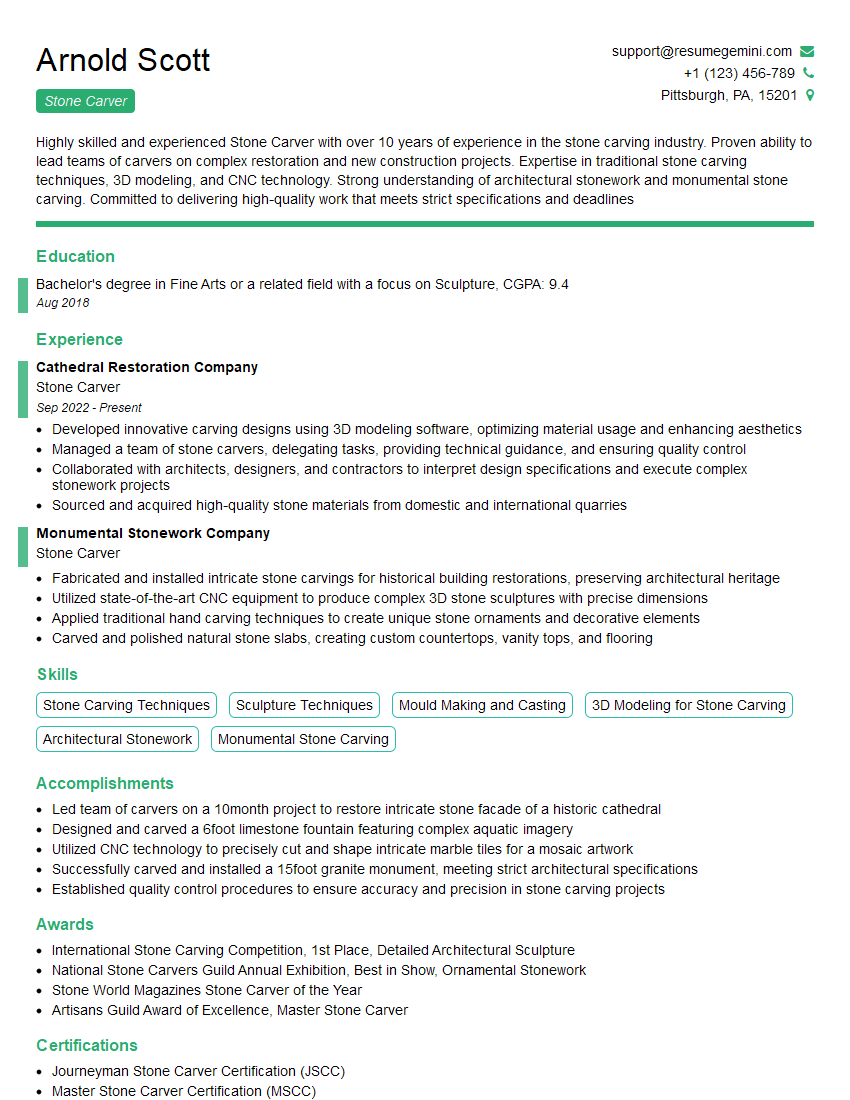
Mastering the art of monumental sculpture opens doors to exciting and impactful career opportunities, allowing you to leave a lasting mark on the world. To maximize your chances of landing your dream job, a strong and ATS-friendly resume is crucial. ResumeGemini is a trusted resource that can help you craft a professional and compelling resume that highlights your skills and experience effectively. Examples of resumes tailored specifically for Monumental Sculpture professionals are available to help guide you. Take the next step towards a successful career; build your best resume with ResumeGemini.
Explore more articles
Users Rating of Our Blogs
Share Your Experience
We value your feedback! Please rate our content and share your thoughts (optional).
What Readers Say About Our Blog
Very informative content, great job.
good