Are you ready to stand out in your next interview? Understanding and preparing for Motor Control System Design interview questions is a game-changer. In this blog, we’ve compiled key questions and expert advice to help you showcase your skills with confidence and precision. Let’s get started on your journey to acing the interview.
Questions Asked in Motor Control System Design Interview
Q 1. Explain the difference between open-loop and closed-loop motor control systems.
The core difference between open-loop and closed-loop motor control lies in feedback. Think of it like driving a car. Open-loop is like setting the cruise control and hoping you reach your destination – you’re sending a command (speed) but not constantly checking if you’re actually at that speed. Closed-loop, on the other hand, is like using a GPS and adjusting your speed based on your current location and the desired route. You’re constantly monitoring your position and correcting your course.
In open-loop control, the motor receives a control signal (voltage or current) without any feedback mechanism to verify the actual speed or position. This is simpler and cheaper, but accuracy and stability are poor. They’re suitable for applications where precise control isn’t critical, such as simple conveyor belts.
Closed-loop control, conversely, utilizes a feedback sensor (e.g., encoder, resolver, or hall effect sensor) to measure the motor’s actual speed or position. This feedback is compared to the desired setpoint, and any error is used to adjust the control signal to achieve the desired outcome. This system ensures accuracy and stability but is more complex and costly. Robotics, precise CNC machining, and servo-controlled systems are examples of applications that utilize closed-loop control.
Q 2. Describe various motor control techniques (e.g., V/f control, vector control, sensorless control).
Several motor control techniques exist, each with its strengths and weaknesses:
- V/f Control (Variable Frequency/Voltage): This is a widely used method for AC induction motors. It maintains a constant Volts/Hertz ratio to control the motor’s speed. It’s simple to implement, but torque performance at low speeds is limited. Think of it like adjusting the throttle of a car – you control speed primarily by changing the engine’s RPM (frequency) and fuel input (voltage).
- Vector Control (Field-Oriented Control): This sophisticated technique offers precise control of both the torque and flux components of the AC motor’s magnetic field. It’s essentially independently controlling the torque and magnetic flux to provide high-performance control. Imagine having separate controls for the car’s acceleration (torque) and steering (flux) – you can achieve very precise maneuvering.
- Sensorless Control: This eliminates the need for expensive and potentially unreliable feedback sensors. It estimates the rotor position or speed using advanced algorithms based on measured stator currents and voltages. It’s a cost-effective alternative to closed-loop control with sensors but can be more challenging to tune and may have slightly lower accuracy.
Q 3. What are the advantages and disadvantages of using different types of motors (e.g., AC induction, DC brushed, BLDC)?
Choosing the right motor depends heavily on the application’s requirements. Here’s a comparison:
- AC Induction Motors: Robust, simple, low maintenance, and relatively inexpensive. They are widely used in industrial applications but have lower efficiency at low speeds and may require more sophisticated control techniques for precise control.
- DC Brushed Motors: Simple construction and easy to control, but they have brushes that wear out, requiring periodic maintenance and limiting their lifespan. They’re often found in less demanding applications like toys and simple tools.
- BLDC (Brushless DC) Motors: High efficiency, long lifespan (no brushes), high torque-to-weight ratio, and precise control capabilities. They are more expensive than brushed DC motors but are preferred in applications requiring high performance and reliability, like electric vehicles, robotics, and aerospace.
Q 4. Explain the role of a PID controller in motor control.
A PID (Proportional-Integral-Derivative) controller is a feedback controller widely used in motor control systems to minimize the error between the desired setpoint and the actual motor position or speed. It’s the ‘autopilot’ that keeps the motor on track.
The three terms – Proportional, Integral, and Derivative – work together to address different aspects of the error:
- Proportional (P): Responds to the current error. A larger error leads to a larger corrective action. Think of it like adjusting the steering wheel proportionally to how far off course you are.
- Integral (I): Addresses accumulated error over time. It eliminates steady-state error, ensuring that the motor reaches the desired setpoint without any lingering offset. Like gradually correcting a slow drift off course.
- Derivative (D): Predicts future error based on the rate of change of the current error. It helps to reduce overshoot and oscillations, making the response smoother. It’s like gently easing off the steering as you approach the desired lane.
Q 5. How do you tune a PID controller for optimal performance?
PID controller tuning is crucial for optimal performance. The goal is to find the right balance between responsiveness, stability, and minimal overshoot. Several methods exist, including:
- Ziegler-Nichols Method: A simple and quick method based on the system’s ultimate gain and period. It provides initial tuning parameters that can be further refined.
- Trial and Error: A practical approach where you systematically adjust the P, I, and D gains, observing the system’s response to each change. This method often requires an understanding of the system’s dynamics.
- Automated Tuning: Sophisticated algorithms can automatically tune the PID controller based on system identification techniques, optimizing performance without manual intervention.
Regardless of the method, start with small changes to the gains and carefully observe the system’s response. It’s an iterative process requiring careful monitoring and adjustment to achieve the desired performance.
Q 6. Describe the process of selecting appropriate motor drivers for a specific application.
Selecting the right motor driver is critical. Consider the following:
- Motor Type: The driver must be compatible with the motor (AC induction, DC brushed, BLDC, stepper, etc.).
- Voltage and Current Requirements: The driver must supply sufficient voltage and current to meet the motor’s needs.
- Control Interface: The driver must have a control interface compatible with the control system (e.g., PWM, analog, digital).
- Power Dissipation: Choose a driver that can handle the power dissipation efficiently.
- Protection Features: Overcurrent, overvoltage, and thermal protection are essential for reliable operation.
- Cost and Size: Balancing performance and budget is key.
For example, a high-power industrial application may need a robust, high-current driver with advanced protection features, while a small consumer product might use a simpler, lower-power driver.
Q 7. Explain the concept of motor thermal management.
Motor thermal management is crucial for reliable and long-term operation. Excessive heat can degrade motor performance, shorten its lifespan, and even cause failure. The goal is to maintain the motor’s operating temperature within its safe limits.
Techniques for motor thermal management include:
- Heatsinks: Passive cooling using heatsinks to dissipate heat into the ambient air.
- Fans: Active cooling using fans to improve airflow and heat dissipation.
- Liquid Cooling: For high-power applications, liquid cooling can provide superior heat removal.
- Thermal Modeling and Simulation: Predicting the motor’s temperature profile during operation to optimize cooling strategies.
- Duty Cycling: Operating the motor at reduced duty cycles to reduce heat generation.
Ignoring thermal management can lead to premature motor failure and system instability. Implementing effective thermal management strategies is essential for ensuring the reliability and longevity of motor-driven systems.
Q 8. How do you handle motor faults and protect the system from damage?
Handling motor faults and protecting the system requires a multi-layered approach, combining hardware and software safeguards. Think of it like a car’s safety system – multiple redundancies to prevent accidents.
Overcurrent Protection: This is fundamental. A current sensor constantly monitors the motor current. If it exceeds a predetermined threshold, indicating a potential overload or short circuit, a circuit breaker or fuse quickly disconnects the power, preventing damage. This is like a car’s circuit breaker protecting the electrical system from overload.
Overvoltage and Undervoltage Protection: Similar to overcurrent protection, these features monitor the supply voltage. If the voltage drops too low (undervoltage), the motor might stall or draw excessive current. If it’s too high (overvoltage), components can be damaged. Protection circuitry shuts down the system under these conditions.
Thermal Protection: Motors generate heat. Excessive heat can lead to insulation breakdown and motor failure. Thermistors embedded in the motor windings monitor temperature. If a critical temperature is reached, the system is shut down.
Encoder Fault Detection: In closed-loop systems, encoders provide feedback on motor position and speed. If the encoder signal is lost or corrupted, it indicates a potential problem. The controller must detect this fault and take appropriate action, such as transitioning to a safe state or triggering an alarm.
Software Monitoring: The control algorithm itself can monitor parameters such as motor speed, torque, and current for inconsistencies indicative of faults. This could trigger a diagnostic routine or safe shutdown sequence.
These protection mechanisms work in concert. For example, if an overcurrent condition occurs, the system will not only cut the power but also log the event for later diagnostics, helping to pinpoint the root cause.
Q 9. What are the common communication protocols used in motor control systems (e.g., CAN, Modbus, Ethernet/IP)?
Motor control systems use various communication protocols depending on the application’s requirements for speed, reliability, and complexity. Consider these protocols as different languages that machines use to communicate.
CAN (Controller Area Network): A robust and widely used protocol in automotive, industrial automation, and robotics. It’s excellent for real-time control applications requiring high reliability and deterministic communication. It’s like a very reliable and fast messenger delivering urgent messages.
Modbus: A simpler, serial communication protocol primarily used in industrial settings. It’s known for its ease of implementation and widespread adoption. It’s like a more straightforward communication system that’s easy to set up and use but isn’t as fast.
Ethernet/IP: An industrial Ethernet-based protocol that offers high bandwidth and flexibility. It’s suitable for complex systems requiring high data throughput. It’s like a high-speed internet connection for your machines, allowing for greater control and data flow.
Profibus: Another industrial fieldbus protocol widely used in process automation. It’s capable of handling a large number of devices and is known for its robustness in harsh industrial environments.
The choice of protocol depends on factors such as the number of devices, communication speed, required data throughput, and the level of real-time requirements. For example, a high-speed robot arm might use CAN for its precise movement control while a simpler conveyor system might use Modbus for basic monitoring.
Q 10. Explain the importance of encoder feedback in closed-loop motor control.
Encoder feedback is crucial for closed-loop motor control, providing the controller with real-time information about the motor’s actual position and speed. Think of it as the eyes and ears of the motor controller. Without it, you’re effectively driving blind.
In a closed-loop system, the controller compares the desired (setpoint) position or speed with the actual position or speed obtained from the encoder. Any difference (error) is used to adjust the motor’s drive signal, ensuring that the motor accurately follows the desired trajectory. This is a constant feedback loop ensuring accuracy and responsiveness.
Benefits of Encoder Feedback:
Precise Position Control: Achieving accurate positioning is essential in many applications, such as robotics and precision machining.
High Accuracy: Minimizes errors and ensures repeatability.
Improved Transient Response: Reduces overshoot and settling time for faster and smoother motor control.
Fault Detection: Enables the detection of encoder faults, helping prevent motor damage.
Without encoder feedback, the system operates in open-loop mode, which is less accurate and susceptible to disturbances. Imagine trying to steer a car without looking at the road – you’ll likely end up off course!
Q 11. How do you design a motor control system for a specific application, considering factors like torque, speed, and precision?
Designing a motor control system for a specific application is an iterative process requiring careful consideration of various factors. It’s like designing a tailored suit – you need the right measurements and materials for a perfect fit.
Define Requirements: Start by clearly specifying the application’s requirements. What’s the required torque, speed, and precision? What are the environmental constraints (temperature, humidity)? What are the safety requirements?
Motor Selection: Choose a motor type (AC induction, DC brushed, brushless DC, stepper) that meets the torque, speed, and power requirements. Consider factors like cost, efficiency, and size.
Controller Selection: Select a controller with sufficient processing power and features to implement the desired control algorithm. Consider the required communication interfaces and safety features.
Control Algorithm Design: Select an appropriate control algorithm (PID, vector control, etc.) based on the application’s requirements for precision and response time. This requires tuning the control parameters to optimize performance.
Sensor Selection: Choose appropriate sensors (encoders, resolvers, current sensors) to provide feedback to the controller. This is crucial for closed-loop control.
Power Electronics Design: Design the power electronics to drive the motor efficiently and safely. This includes choosing the right power transistors, drivers, and protection circuits.
Testing and Validation: Thoroughly test the system to ensure it meets the specified requirements. This typically involves simulations and real-world testing.
For example, a robotic arm for delicate assembly would need a high-precision motor with accurate encoder feedback and a sophisticated control algorithm, while a conveyor belt might require a simpler motor control scheme with less stringent requirements for precision.
Q 12. What are the challenges in designing high-performance motor control systems?
Designing high-performance motor control systems presents several significant challenges:
High Bandwidth and Low Latency: High-performance applications demand fast control loops with minimal latency. This requires careful design of the hardware and software to minimize delays.
Noise and Disturbances: External noise sources and disturbances can affect the accuracy and stability of the control system. Robust control algorithms and filtering techniques are necessary.
Thermal Management: High-performance systems generate significant heat, requiring effective thermal management to prevent overheating and component failure.
Computational Complexity: Sophisticated control algorithms such as vector control can be computationally intensive, requiring powerful processors.
Real-Time Constraints: The system must meet strict timing deadlines to ensure proper functionality. This is crucial in applications where precise timing is critical.
System Integration: Integrating the motor control system with other subsystems (such as sensors, actuators, and a human-machine interface) can be challenging.
Overcoming these challenges requires a deep understanding of control theory, power electronics, embedded systems, and software engineering. It is often an iterative design process involving simulation, prototyping, and testing to optimize performance.
Q 13. Describe your experience with different motor control algorithms.
I have extensive experience with various motor control algorithms, each suitable for different applications and performance needs. Think of these algorithms as different tools in a toolbox, each designed for a specific job.
PID Control: A widely used and robust algorithm for controlling position, speed, and torque. It’s simple to implement but might struggle with complex dynamics.
Vector Control: A sophisticated technique offering precise control of both torque and flux in AC motors, achieving high performance and efficiency. It’s more complex to implement than PID control, requiring advanced mathematical modeling.
Field-Oriented Control (FOC): A sophisticated control technique widely used for permanent magnet synchronous motors (PMSM) and induction motors. It offers high dynamic response and efficiency but requires sophisticated mathematical transformations.
Sliding Mode Control (SMC): A robust control method that’s less sensitive to parameter variations and disturbances, making it suitable for harsh environments. However, it can introduce high-frequency chattering.
Model Predictive Control (MPC): An advanced technique that predicts the future behavior of the system to optimize control actions. It can handle constraints and nonlinearities but is computationally demanding.
My experience includes implementing and tuning these algorithms in various applications, including robotics, industrial automation, and automotive systems. For example, I once used vector control to design a high-performance motor drive for an electric vehicle, focusing on efficiency and responsiveness. In another project, I employed PID control for a simpler application requiring robustness and ease of implementation.
Q 14. Explain the role of power electronics in motor control systems.
Power electronics are the crucial link between the motor controller and the motor itself. They are the muscles that provide the power and control the flow of electrical energy to the motor, allowing precise control of speed and torque. Imagine them as the electrical system of a car that converts the energy from the battery to power the wheels.
Key Roles of Power Electronics in Motor Control Systems:
Conversion and Conditioning: Power electronics convert the DC input voltage (from a battery or power supply) into the appropriate AC voltage and frequency required by the motor.
Switching and Modulation: They use switching devices (like IGBTs or MOSFETs) to generate the required voltage and current waveforms for the motor, precisely controlling its speed and torque.
Protection: Power electronics incorporate various protection circuits to protect both the motor and the controller from overcurrent, overvoltage, and short circuits.
Regeneration: In some systems, they can regenerate energy during braking, feeding it back to the power supply, improving efficiency.
The design of the power electronics is critical to the overall performance and efficiency of the motor control system. For example, the choice of switching devices, the switching frequency, and the control strategy will significantly impact the system’s efficiency, power density, and cost. A poorly designed power electronics section can lead to reduced efficiency, increased heat generation, and even component failure.
Q 15. How do you ensure the safety of a motor control system?
Ensuring the safety of a motor control system is paramount. It involves a multi-layered approach focusing on preventing hazards and mitigating risks. This starts with a thorough risk assessment identifying potential dangers like electrical shock, mechanical injury, and uncontrolled motion.
- Safety Standards Compliance: Adhering to relevant safety standards like IEC 61800-5-1 (for variable speed drives) is crucial. This ensures the system meets established safety requirements.
- Emergency Stop Systems: Implementing robust emergency stop (ESTOP) circuits with multiple independent channels is vital. These must meet strict response time requirements, often within milliseconds.
- Protective Devices: Incorporating overcurrent protection, short-circuit protection, and ground fault detection devices prevents damage and hazards. These often include fuses, circuit breakers, and residual current devices (RCDs).
- Interlocking and Safety PLCs: Safety PLCs (Programmable Logic Controllers) manage safety functions independently from the main control system. Interlocking mechanisms prevent simultaneous operation of conflicting functions (e.g., preventing access to hazardous areas while the motor is running).
- Regular Inspections and Maintenance: Preventative maintenance and regular inspection of all safety devices are vital. This ensures the ongoing effectiveness of the safety systems.
For instance, in a robotic arm application, a comprehensive safety system might include ESTOP buttons at multiple locations, light curtains to detect personnel intrusion, and software limits to prevent the arm from exceeding its operational range. Each element contributes to a layered approach, ensuring safety even if one component fails.
Career Expert Tips:
- Ace those interviews! Prepare effectively by reviewing the Top 50 Most Common Interview Questions on ResumeGemini.
- Navigate your job search with confidence! Explore a wide range of Career Tips on ResumeGemini. Learn about common challenges and recommendations to overcome them.
- Craft the perfect resume! Master the Art of Resume Writing with ResumeGemini’s guide. Showcase your unique qualifications and achievements effectively.
- Don’t miss out on holiday savings! Build your dream resume with ResumeGemini’s ATS optimized templates.
Q 16. What is your experience with different motor control hardware platforms?
My experience spans various motor control hardware platforms, focusing on both embedded systems and industrial automation. I’ve worked extensively with:
- Microcontrollers (e.g., STM32, Texas Instruments TMS320F28x): These are essential for embedded motor control applications requiring real-time performance and precise control algorithms. I’ve used these in projects ranging from small-scale robotics to precise positioning systems.
- DSPs (Digital Signal Processors): DSPs are powerful for demanding motor control tasks involving complex signal processing like field-oriented control (FOC). I’ve utilized them in high-performance servo drives and industrial applications demanding high-speed, accurate control.
- PLCs (Programmable Logic Controllers): These are integral to larger industrial automation projects. My experience includes Allen-Bradley, Siemens, and Rockwell Automation PLCs, which were utilized to integrate motor control into complex manufacturing processes.
- Motor Drive Hardware: I’ve worked with a range of motor drives from different manufacturers, including VFDs (Variable Frequency Drives) and servo drives. Understanding the specific capabilities and communication protocols of each drive is critical for successful integration.
In a recent project involving a conveyor belt system, the control system employed an Allen-Bradley PLC for overall system management, while a dedicated VFD controlled the motor speed based on the PLC’s commands. This approach allowed for robust monitoring and control.
Q 17. Describe your experience with motor control software development (e.g., PLC programming, embedded C/C++)
My motor control software development expertise encompasses both PLC programming and embedded C/C++.
- PLC Programming: I am proficient in ladder logic, function block diagrams, and structured text programming languages common in industrial PLCs. I’ve used these to implement complex control algorithms, safety functions, and supervisory control interfaces.
- Embedded C/C++: For embedded systems, I’ve developed low-level motor control algorithms, including PID controllers, FOC algorithms, and sensor integration routines. My experience includes working with real-time operating systems (RTOS) to guarantee deterministic behavior.
For example, in a recent project involving a brushless DC motor, I used embedded C++ on an STM32 microcontroller to implement FOC, precisely controlling the motor’s speed and torque based on sensor feedback. The code included robust error handling, ensuring reliable operation even in adverse conditions. A snippet of the FOC code would involve intricate calculations to determine the appropriate PWM signals based on the motor’s position and desired torque.
// Example FOC code snippet (Simplified) float calc_PWM(float Iq, float Id) { // ...complex calculations based on Iq, Id, and motor parameters... return pwm_value; }Q 18. How do you troubleshoot motor control system issues?
Troubleshooting motor control system issues requires a systematic approach. I typically follow these steps:
- Gather Information: The first step is to collect information about the problem, including error messages, system logs, and operator observations.
- Isolate the Problem: Narrow down the potential sources of the problem by systematically checking different components: motor, drive, sensors, wiring, and software.
- Use Diagnostic Tools: Utilize diagnostic tools such as oscilloscopes, multimeters, and motor drive diagnostic software to measure voltages, currents, and other parameters.
- Inspect the Hardware: Visually inspect components for signs of damage, loose connections, or overheating.
- Check the Software: Examine the software code for errors or logical flaws. Simulation can be a valuable tool here.
- Test Solutions: Once a potential solution is identified, test it thoroughly before deploying it to the live system.
For example, if a motor isn’t starting, I would first check the power supply, then the motor itself (continuity, windings), the motor drive (fault codes, output voltages), and finally the control software (commands, parameters). The use of diagnostic tools helps eliminate possibilities quickly and efficiently.
Q 19. Explain your understanding of different types of motor drives (e.g., VFD, servo drive).
Motor drives are the brains behind motor control, converting electrical power into the appropriate form for the motor. Different types cater to various applications and performance requirements.
- Variable Frequency Drives (VFDs): VFDs control AC motors by varying the frequency and voltage of the supplied power. They are widely used in applications where variable speed control is needed (fans, pumps, conveyors).
- Servo Drives: Servo drives offer precise control of the motor’s speed, position, and torque. They use feedback sensors (encoders, resolvers) to monitor the motor’s actual position and make adjustments accordingly. They are commonly used in robotics, precision machining, and automation systems requiring high accuracy and responsiveness.
- Stepper Motor Drivers: These drives control stepper motors by energizing different windings in a precise sequence, resulting in stepwise rotation. They’re suitable for applications needing precise positional control with simpler control algorithms, though generally lower speed than servo systems.
The choice of drive depends on the specific application. For instance, a pump in a water treatment plant might only require basic speed control, suitable for a VFD. However, a robotic arm assembling intricate parts requires the high precision of a servo drive with feedback control.
Q 20. Describe your experience with motor control system simulation and modeling.
Simulation and modeling are essential for designing and testing motor control systems before physical implementation. This saves time, resources, and reduces risks.
- Software Tools: I have experience using simulation software such as MATLAB/Simulink, PSIM, and specialized motor control simulation packages. These allow for creating detailed models of motors, drives, and controllers.
- Model Complexity: The complexity of the model varies depending on the application. Simple models can focus on basic control behavior, while more sophisticated models incorporate detailed motor dynamics and environmental factors.
- Hardware-in-the-Loop (HIL) Simulation: For advanced validation, HIL simulation connects the control system software to a simulated motor model in real-time, allowing for rigorous testing before deployment.
In a recent project involving a complex multi-motor robotic system, I used MATLAB/Simulink to model the entire system dynamics, including motor models, control algorithms, and interactions between different motors. This allowed us to test different control strategies and optimize system performance before building the physical prototype.
Q 21. How do you handle noise and interference in motor control systems?
Noise and interference are significant challenges in motor control systems, potentially causing inaccurate measurements, erratic operation, and even system failure. Effective handling involves a multi-pronged approach.
- Shielding and Grounding: Proper shielding of cables and components minimizes electromagnetic interference (EMI). Establishing a robust grounding system is critical to prevent ground loops and common-mode noise.
- Signal Filtering: Using filters (e.g., RC filters, active filters) to remove unwanted noise from sensor signals and control signals is crucial. The filter design needs to consider the specific frequency characteristics of the noise and the desired signal bandwidth.
- Sensor Selection and Placement: Choosing sensors with good noise immunity and placing them strategically to minimize interference is essential. Careful consideration of sensor placement relative to potential noise sources is key.
- Robust Control Algorithms: Designing control algorithms that are less sensitive to noise is critical. This may involve incorporating techniques such as Kalman filtering or adaptive control.
- Differential Signaling: Using differential signaling for critical signals enhances noise rejection capabilities. The common-mode noise is rejected at the receiver end.
For example, in an industrial environment with significant EMI from nearby machinery, proper shielding of motor cables, use of differential signaling for encoder feedback, and incorporating Kalman filtering in the control algorithm significantly improved system robustness and reliability.
Q 22. What is your experience with real-time operating systems (RTOS) in motor control?
Real-Time Operating Systems (RTOS) are crucial for motor control because they guarantee deterministic timing, essential for precise control loops. My experience involves using RTOS like FreeRTOS and VxWorks in various projects. For instance, in a robotic arm project, I used FreeRTOS to manage multiple tasks concurrently – one for encoder reading, another for PID control, and a third for communication with a higher-level controller. The RTOS ensured that each task received its necessary processing time, preventing timing conflicts and ensuring smooth, responsive motor control. Without an RTOS, the system might experience jitter and instability, leading to inaccurate motor positioning or even instability.
Choosing the right RTOS depends on factors such as the complexity of the application, real-time constraints, memory limitations, and available hardware resources. For simpler applications, a lightweight RTOS like FreeRTOS might suffice, while more complex systems might require a more robust RTOS like VxWorks.
Q 23. Explain your knowledge of different motor control topologies (e.g., H-bridge, three-phase inverter).
Motor control topologies define the way power is switched to the motor windings. The simplest is the H-bridge, used for DC motors. It uses four switches (transistors or MOSFETs) to reverse the polarity of the voltage applied to the motor, enabling both forward and reverse control. Think of it as a simple on/off switch with the ability to change direction.
For AC motors (like induction or permanent magnet synchronous motors), a three-phase inverter is typically used. This is a more complex topology comprising six switches, which switch the AC voltage phases to create a rotating magnetic field in the stator, driving the motor. Imagine it as a more sophisticated control system allowing for variable speeds and torque. The precise switching patterns determine the motor’s speed and torque, often controlled using Pulse Width Modulation (PWM).
I have extensive experience designing and implementing both H-bridge and three-phase inverter topologies, including considerations for dead-time insertion to prevent shoot-through faults (simultaneous conduction of both high-side and low-side switches in the H-bridge).
Q 24. How do you ensure the efficiency of a motor control system?
Efficiency in a motor control system is paramount, impacting both energy consumption and system performance. We strive for efficiency on multiple levels:
- Minimizing Switching Losses: Careful selection of power semiconductors and optimized PWM strategies reduce losses due to switching. Techniques like space vector modulation (SVM) in three-phase inverters contribute significantly.
- Reducing Conduction Losses: Employing low-resistance components and ensuring proper heat dissipation minimizes conduction losses in the power electronics.
- Optimized Control Algorithms: Using advanced control algorithms like field-oriented control (FOC) or direct torque control (DTC) allows for precise control of the motor while minimizing energy waste. For example, FOC maximizes torque production for a given current, improving efficiency significantly.
- Efficient Thermal Management: Proper heatsinking and cooling mechanisms prevent overheating, which can lead to performance degradation and reduced lifespan.
In practice, we often use simulation tools to model and optimize the system for maximum efficiency before hardware implementation. This allows us to identify areas of improvement and fine-tune control parameters.
Q 25. What are your experiences with different types of encoders (e.g., incremental, absolute)?
Encoders are essential for feedback in closed-loop motor control. Incremental encoders provide relative position information – they count pulses as the motor shaft rotates, giving you the change in position but not the absolute position. Think of it like an odometer in a car, telling you how far you’ve traveled but not your exact location.
Absolute encoders, on the other hand, provide the absolute position of the motor shaft at any time. This is like a GPS – it gives you your precise location. They are often more expensive but offer greater accuracy and robustness against power loss. I’ve worked with both types extensively. For applications requiring high accuracy and robustness, such as robotics or precision machining, absolute encoders are preferred. Incremental encoders are more cost-effective for applications where absolute position is less critical.
Choosing between them involves careful consideration of the application’s requirements and budget constraints.
Q 26. Describe your familiarity with different motor control standards and certifications.
Familiarity with motor control standards and certifications is vital for safety and interoperability. I am aware of standards like IEC 61800-5-1 (for industrial drives), UL standards (for safety), and various automotive standards depending on the application. Certifications ensure the system meets specific safety, performance, and electromagnetic compatibility (EMC) requirements. This is critical for deploying systems in various industries, from industrial automation to automotive applications. For instance, in automotive applications, functional safety standards such as ISO 26262 are crucial and necessitate rigorous testing and validation procedures.
Q 27. Explain how you would implement a current limiting strategy in a motor control system.
Current limiting is a critical safety feature in motor control systems to prevent overcurrent conditions that can damage the motor, power electronics, or even cause a fire. The strategy typically involves monitoring the motor current using a current sensor (e.g., a shunt resistor or a current transformer).
Once the current exceeds a predefined threshold, the system implements a control action to limit the current. This could involve:
- Reducing the PWM duty cycle: This directly reduces the voltage applied to the motor, limiting the current.
- Switching to a lower speed profile: Adjusting the motor’s speed to reduce the demand for high currents.
- Tripping a circuit breaker: In severe overcurrent conditions, a circuit breaker can be activated to completely cut off the power supply.
The specific implementation depends on the control hardware and software. It often involves a rapid response mechanism within the control loop to prevent excessive current flow. In my experience, I’ve implemented sophisticated current limiting strategies using both hardware and software techniques to ensure a robust and reliable system.
Q 28. Describe your experience with testing and validation of motor control systems.
Testing and validation of motor control systems are crucial to ensure reliability, safety, and performance. My experience encompasses various testing methodologies:
- Hardware-in-the-Loop (HIL) Simulation: This simulates the real-world environment for the controller, allowing for extensive testing without the risks associated with direct testing on real hardware. This was particularly useful for testing emergency stop functionalities and fault tolerance mechanisms.
- Software-in-the-Loop (SIL) Simulation: This involves testing the control software independently, identifying software bugs early in the development cycle.
- Environmental Testing: Testing under varying temperature, humidity, and vibration conditions to ensure robustness. This often includes testing to specifications like those outlined in IEC 61800-5-2.
- Performance Testing: Evaluating parameters like speed accuracy, torque response, and efficiency.
- Safety Testing: Rigorous testing to verify the safety features, such as current limiting and over-temperature protection, are functioning correctly and conform to relevant safety standards.
Comprehensive documentation and traceability are essential throughout the testing process. This ensures that the system meets all specifications and is ready for deployment.
Key Topics to Learn for Motor Control System Design Interview
- Motor Drive Fundamentals: Understanding different motor types (DC, AC induction, brushless DC), their characteristics, and control strategies (e.g., V/f control, vector control).
- Power Electronics: Knowledge of power semiconductor devices (IGBTs, MOSFETs), their switching characteristics, and their role in motor drive circuits. Practical application: Analyzing and troubleshooting power electronic components in a motor drive system.
- Control Algorithms: Familiarity with PID control, state-space control, and other advanced control techniques used in motor control. Practical application: Designing and tuning a PID controller for precise speed regulation.
- Microcontroller/DSP Programming: Experience with embedded systems programming (e.g., C/C++) for implementing motor control algorithms. Practical application: Developing and debugging firmware for a real-time motor control application.
- Sensor Integration: Understanding the role and application of various sensors (encoders, resolvers, current sensors) in closed-loop motor control systems. Practical application: Selecting appropriate sensors based on system requirements and accuracy needs.
- Digital Signal Processing (DSP): Understanding the application of DSP techniques for signal filtering, noise reduction, and parameter estimation in motor control systems. Practical application: Implementing a digital filter to reduce noise in sensor measurements.
- System Modeling and Simulation: Ability to model motor control systems using tools like MATLAB/Simulink for design verification and analysis. Practical application: Simulating different control strategies and optimizing system performance.
- Troubleshooting and Diagnostics: Ability to diagnose and troubleshoot common problems in motor control systems, including hardware and software issues. Practical application: Using diagnostic tools and techniques to identify and resolve faults in a motor drive system.
Next Steps
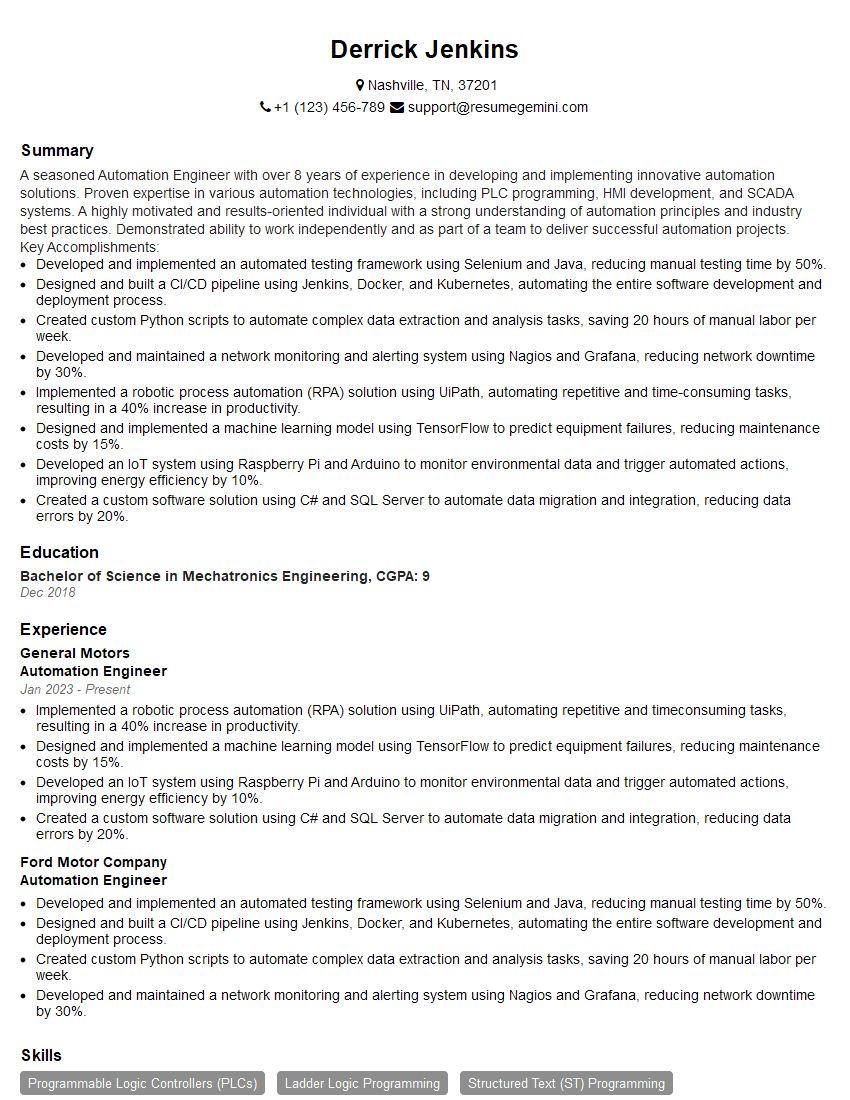
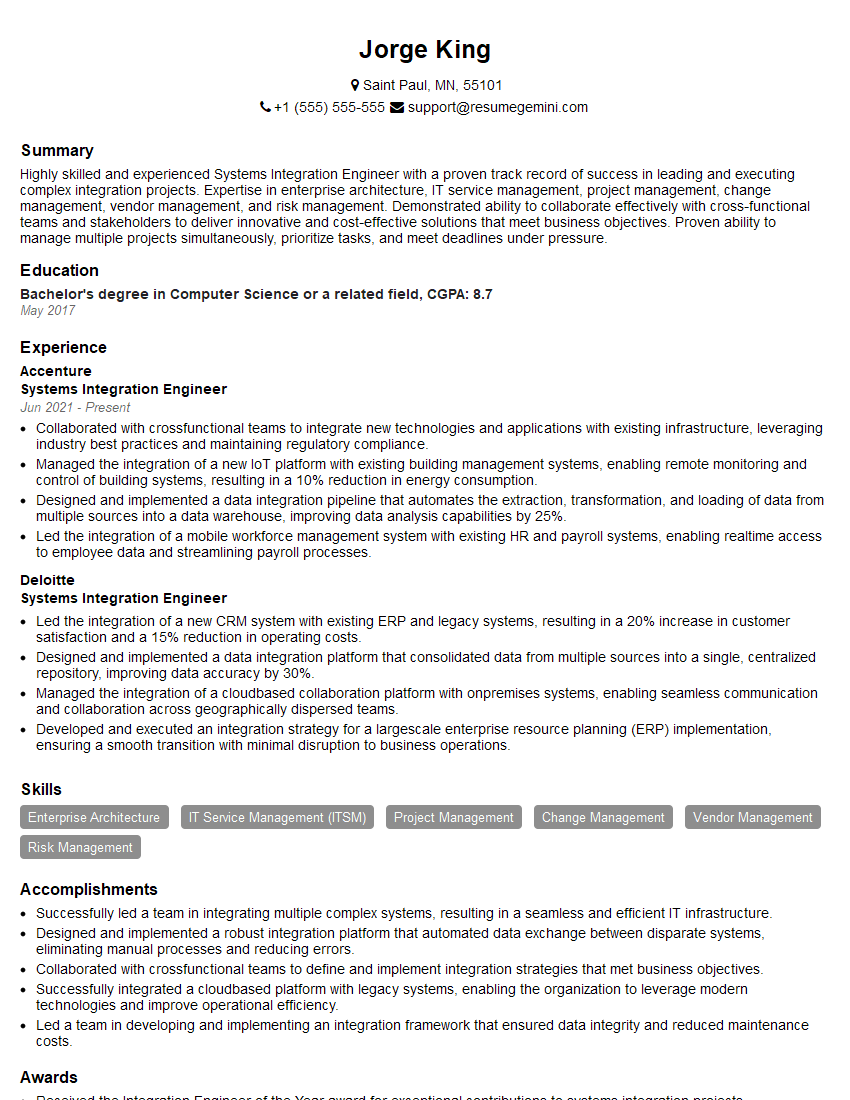
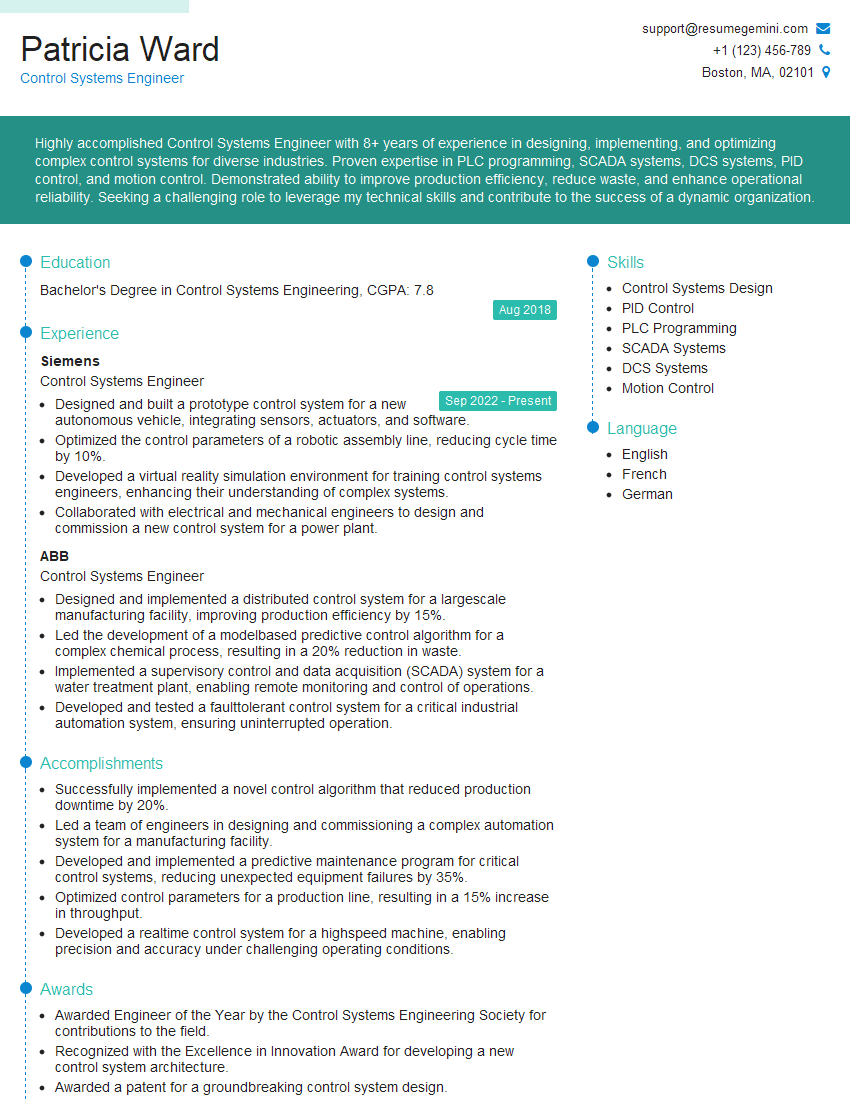
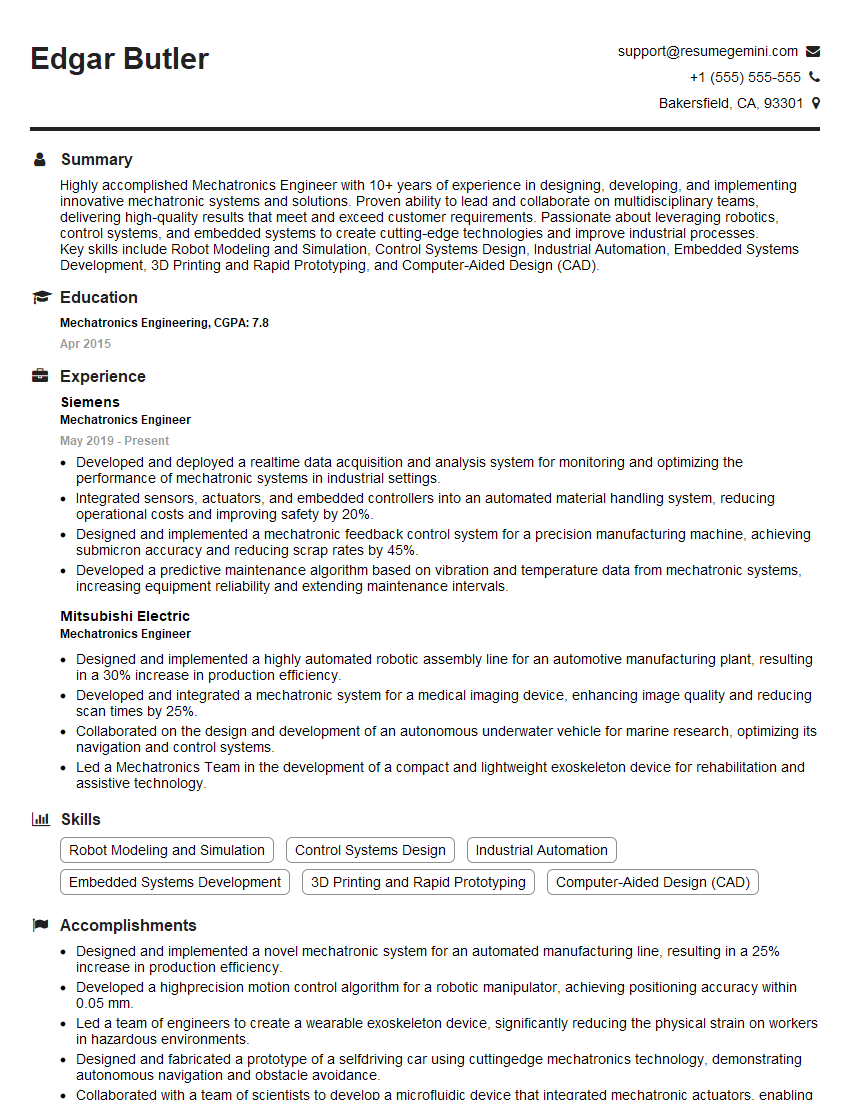
Mastering Motor Control System Design opens doors to exciting career opportunities in automation, robotics, and various industrial sectors. A strong understanding of these principles is highly valued by employers. To significantly boost your job prospects, create a resume that’s both ATS-friendly and showcases your unique skills and accomplishments. ResumeGemini is a trusted resource to help you build a professional and impactful resume. They provide examples of resumes tailored to Motor Control System Design, ensuring your application stands out from the competition. Invest time in crafting a compelling resume – it’s your first impression!

Explore more articles
Users Rating of Our Blogs
Share Your Experience
We value your feedback! Please rate our content and share your thoughts (optional).
What Readers Say About Our Blog
Very informative content, great job.
good