Every successful interview starts with knowing what to expect. In this blog, we’ll take you through the top Multicolor press operation interview questions, breaking them down with expert tips to help you deliver impactful answers. Step into your next interview fully prepared and ready to succeed.
Questions Asked in Multicolor press operation Interview
Q 1. Describe your experience with different types of multicolor presses (e.g., sheetfed, web offset).
My experience encompasses both sheetfed and web offset multicolor presses. Sheetfed presses, like Heidelberg Speedmaster or Komori Lithrone, are ideal for shorter runs and higher quality, allowing for intricate details and specialized substrates. I’ve extensively worked with various models, mastering their specific nuances in terms of makeready, ink settings, and overall press operation. Web offset presses, such as those from Goss or MAN Roland, are better suited for high-volume, continuous printing, often used for newspapers, magazines, and large-scale commercial jobs. My experience here includes optimizing web press speeds, managing large paper rolls, and ensuring consistent print quality across extensive runs. I’m familiar with the differences in their automation systems, including pre-press workflow integration, and how this impacts productivity and efficiency.
For example, on a sheetfed press, I’ve perfected techniques for achieving perfect color consistency across a 10,000-piece run of luxury business cards, requiring precise ink adjustments and careful monitoring. On a web press, I successfully managed a demanding 500,000-copy magazine print run, emphasizing maintaining consistent web tension and register throughout the entire process.
Q 2. Explain the process of color registration on a multicolor press.
Color registration is the precise alignment of multiple colors printed on the same sheet. Think of it like perfectly overlapping puzzle pieces. On a multicolor press, each printing unit applies a different color (cyan, magenta, yellow, black – CMYK, or spot colors). Improper registration leads to blurry images, misaligned colors, and generally poor print quality. The process involves several stages:
- Pre-press preparation: Ensuring accurate imposition and color separations in the design file is crucial. This forms the foundation for accurate registration.
- Makeready: This involves carefully aligning the printing plates on each unit using register marks printed on the sheet. Microscopic adjustments are made using sidelays, and lateral and longitudinal controls.
- Press setup: After makeready, test prints are run and adjustments are made using the press’s registration controls. This fine-tuning guarantees alignment across all units.
- Ongoing monitoring: Throughout the run, the operator continuously monitors the register to catch any drift or inconsistencies, making further adjustments as needed.
Think of it like building a layered cake: if each layer isn’t aligned perfectly, the final product will be uneven and messy. Proper registration ensures a sharp, visually appealing, and accurate final print.
Q 3. How do you identify and troubleshoot common multicolor press malfunctions?
Troubleshooting multicolor press malfunctions requires a systematic approach. I start by identifying the problem, whether it’s a color registration issue, a print quality defect (e.g., mottle, slur, or hickeys), or a mechanical failure. This usually involves examining the printed sheets, checking the press controls and monitoring systems, and sometimes even inspecting the ink, plates, and blankets.
- Print Quality Defects: Mottle (uneven ink distribution) often requires adjustments to ink viscosity or fountain roller pressure. Slur (fuzzy edges) can be caused by incorrect dampening or plate problems. Hickeys (small spots of debris) are typically addressed by cleaning the rollers and blankets.
- Mechanical Issues: A malfunctioning feeder might require adjustments to the paper guides or grippers. A misaligned printing unit needs precise adjustments to the registration controls. Paper jams necessitate troubleshooting the paper path.
- Color Issues: Inconsistencies in color often require adjusting the ink keys, altering the ink balance, or addressing problems with the ink itself.
For example, I once diagnosed a recurring paper jam on a web press by systematically checking each section of the paper path, eventually identifying a worn-down roller causing the issue. Similarly, I resolved a color registration problem by meticulously adjusting the lateral and longitudinal controls, and cleaning the blanket cylinder.
Q 4. What are the key factors affecting print quality on a multicolor press?
Print quality on a multicolor press is influenced by numerous factors. These can be broadly categorized into pre-press, press, and post-press aspects.
- Pre-press: The quality of the digital files, the accuracy of the color separations, the type of plates used, and the proofing process significantly influence the final print. Low-resolution images or improper color profiles will result in poor print quality.
- Press: The condition of the press itself, the quality of the inks and blankets, the accuracy of the registration, the paper stock used, the press settings (such as ink density, dampening, and pressure), and the operator’s skill all play vital roles.
- Post-press: Finishing processes like cutting, folding, and binding can impact the overall quality. Poor handling or storage can also damage the print.
For instance, using low-quality paper can lead to uneven ink absorption, resulting in poor color saturation and mottle. Similarly, incorrect dampening solution can cause slur and affect the dot gain.
Q 5. Describe your experience with color management systems (e.g., Pantone, G7).
I have extensive experience with color management systems, particularly Pantone and G7. Pantone provides a standardized system of spot colors, allowing for precise color matching across different printing processes. This is crucial for brands needing consistent color representation across various media. G7 is a grayscale calibration method focusing on achieving visual consistency across different printing devices, guaranteeing accurate color reproduction irrespective of the press used. I utilize both systems in tandem, using Pantone for specific brand colors and G7 for overall color accuracy and consistency across a job. My experience involves profiling presses, managing color profiles, and ensuring consistent color output.
For example, I utilized Pantone to ensure that the corporate logo colors were precisely reproduced in a client’s marketing brochure print job, matching their pre-approved Pantone color swatches. Simultaneously, I used G7 to optimize the overall CMYK color gamut, ensuring accurate and consistent color rendering throughout the print.
Q 6. How do you maintain consistent color accuracy throughout a long print run?
Maintaining consistent color accuracy throughout a long print run requires meticulous attention to detail and proactive measures. This involves:
- Regular color checks: Frequent color measurements using a spectrophotometer throughout the run, comparing readings against target values, and making adjustments as needed.
- Ink management: Ensuring sufficient ink supply and maintaining consistent ink viscosity, regularly stirring and replenishing as necessary. Ink temperature can also significantly impact consistency.
- Press maintenance: Regular cleaning and maintenance of the press components, including rollers, blankets, and dampening systems, to prevent build-up and degradation that might affect color consistency.
- Environmental control: Maintaining a stable temperature and humidity in the pressroom as variations can affect ink drying and absorption.
Think of it like baking a large batch of cookies: you need to monitor the oven temperature, ensure consistent ingredient amounts, and stir regularly to achieve a uniform product. Similarly, constant monitoring and adjustments are essential for maintaining color accuracy in long print runs.
Q 7. Explain the importance of proper makeready procedures.
Proper makeready procedures are paramount for achieving high-quality prints and efficient production. They ensure that the press is correctly set up for the job, minimizing waste and maximizing output.
- Plate mounting and alignment: Precisely mounting plates onto the printing units and aligning them using register marks is fundamental to achieving accurate color registration. Incorrectly mounted plates lead to misalignment and waste.
- Ink and dampening setup: Setting the correct ink density, dampening solution levels, and fountain roller pressures ensures proper ink transfer and prevents issues such as mottle and slur. Improper ink settings lead to poor color reproduction.
- Paper feed setup: Ensuring the paper feed system is correctly configured for the type of paper being used minimizes paper jams and feeding issues. The proper setup ensures smooth and consistent feeding.
- Test prints and adjustments: Conducting test prints before starting the full run allows for adjustments to be made and ensures that the desired quality is achieved before full production. This proactive approach helps avoid unnecessary waste and rework.
Imagine preparing for a major surgery: a surgeon wouldn’t begin without meticulously preparing the instruments and the operating room. Similarly, proper makeready ensures a successful and efficient print job.
Q 8. Describe your experience with different types of inks and coatings.
My experience encompasses a wide range of inks and coatings used in multicolor press operation. Understanding ink properties is crucial for achieving the desired color accuracy and print quality. I’m proficient with both conventional and UV inks, knowing the differences in their drying mechanisms, color gamuts, and application techniques. For example, UV inks offer instant drying, ideal for high-speed printing and coated stocks, but require specialized curing equipment. Conventional inks, on the other hand, require more time to dry, impacting press speed but often resulting in a wider color gamut and better print longevity on uncoated papers.
Regarding coatings, I have extensive experience with aqueous, UV, and varnish coatings. Aqueous coatings provide a matte or gloss finish, offering good protection and enhancing the printed image. UV coatings deliver a higher gloss and improved scuff resistance, often preferred for packaging applications. Varnishes, like UV varnishes, add a protective layer and can be used selectively for spot gloss effects, adding design flair.
Choosing the right ink and coating is a critical decision influenced by factors such as substrate (paper type), printing technique (offset, screen), desired finish, and budget constraints. I always consider these factors when recommending or choosing inks and coatings for a project to ensure optimal results.
Q 9. How do you manage paper waste and optimize press efficiency?
Minimizing paper waste and maximizing press efficiency are paramount in a multicolor press environment. This involves a multifaceted approach, starting with meticulous pre-press planning. Accurate job estimations and careful imposition (arranging pages for optimal printing) are crucial to reduce waste from misprints or misfeeds. We also use sophisticated software for efficient nesting to minimize material usage and cut down on trim waste.
On the press floor, we employ techniques like continuous monitoring of the paper feed system and timely adjustments to minimize jams and misalignments. Regular maintenance of the press ensures optimal performance and reduces downtime. We meticulously track waste and analyse causes of loss. This allows for better process control and improvements in material efficiency. Furthermore, we actively train press operators on best practices for paper handling and waste reduction. We regularly review our waste tracking data to identify areas for improvement and implement targeted solutions.
Implementing a robust quality control system is essential to detect and correct errors early, preventing large batches of waste. Finally, proper recycling and waste disposal practices contribute to a greener printing process, which is a growing priority in our industry. Through a combination of these strategies, we continually strive to achieve our waste reduction goals.
Q 10. What is your experience with pre-press procedures and their impact on press operation?
Pre-press procedures are foundational to a successful multicolor press run. I have significant experience in this area, understanding its direct impact on the press operation. This includes tasks such as color separation, image manipulation, trapping (preventing gaps between colors), and file preparation. Careful color management is key. Using appropriate color profiles and calibrating the pre-press systems ensures consistent color reproduction from the digital file to the printed product. I have worked with various pre-press software such as Adobe Creative Suite and Esko software.
Errors in the pre-press phase can cascade into significant problems on the press, leading to delays, wasted materials, and ultimately, costly corrections. For instance, an improperly trapped file can result in visible gaps between colors on the final print, requiring costly reprints. Similarly, incorrect color profiles can lead to significant color deviations, rendering the job unacceptable. My role involves careful review and approval of pre-press files to minimize the likelihood of such errors. I also collaborate closely with the pre-press team to address any concerns or inconsistencies before the job goes to press. This proactive approach significantly enhances the efficiency and quality of the entire printing process.
Q 11. How do you monitor and maintain press speeds and productivity?
Monitoring and maintaining press speeds and productivity involves a combination of technical expertise and operational strategies. We utilize the press’s built-in monitoring systems to track key performance indicators (KPIs) such as speed, waste, and makeready time. These metrics are constantly analyzed to identify bottlenecks and areas for improvement.
Maintaining optimal press speed requires regular preventative maintenance and careful attention to the press settings. Factors like paper type, ink viscosity, and the complexity of the job all influence the ideal press speed. We adjust the press settings accordingly, balancing speed with quality and minimizing waste. We use statistical process control (SPC) techniques to track and control variation in press performance and alert us to potential problems before they impact production. Operator training is equally critical; skilled operators understand how to detect anomalies and make timely adjustments to maintain high productivity.
Beyond the press itself, efficient workflow and material handling are also crucial. Minimizing downtime between jobs and ensuring a smooth flow of materials are key factors in maintaining high overall productivity. This involves careful planning, coordination, and communication between all team members involved in the printing process.
Q 12. Explain your understanding of different printing techniques (e.g., offset lithography).
My understanding of printing techniques, particularly offset lithography, is comprehensive. Offset lithography is a widely used printing method based on the principle of repelling oil and water. The image is transferred from a plate to a rubber blanket and then to the substrate (paper). This indirect printing process allows for high-quality, consistent results on large quantities. I’m well-versed in all aspects of the offset lithographic process, from platemaking to press operation and post-press finishing.
I understand the intricacies of color management, ink-water balance, and paper handling within the offset process. I also have experience with other techniques like screen printing and digital printing, though my main expertise is in offset lithography for its suitability to high-volume, quality printing. Each technique has its strengths and weaknesses, and choosing the right one depends on factors like the job’s quantity, budget, and required quality.
For example, I know that while offset offers excellent quality for large runs, digital printing is better suited for shorter runs and personalized materials. Screen printing excels in creating bold graphics and specialty effects. I can assess the specific requirements of a job and recommend the most appropriate printing technique to achieve the desired outcome.
Q 13. How do you ensure the safety and cleanliness of the press and surrounding area?
Safety and cleanliness are non-negotiable in a multicolor press environment. We adhere to strict safety protocols, starting with regular safety training for all personnel. This includes proper handling of chemicals, use of personal protective equipment (PPE), and emergency procedures. Regular maintenance checks on the press and safety equipment are vital. We have clearly defined safety procedures in place for tasks such as cleaning the press, changing inks, and handling paper rolls. These procedures are reviewed regularly and updated as needed.
Maintaining cleanliness is equally crucial for both operational efficiency and safety. Regular cleaning schedules are followed for the press, surrounding areas, and equipment. Spills are cleaned immediately to prevent accidents. We use appropriate cleaning agents and dispose of waste according to environmental regulations. A clean and organized workspace prevents accidents and contributes to a more efficient workflow. We encourage a culture of safety and cleanliness within the team. Regular inspections and audits ensure that safety procedures and cleanliness standards are maintained.
Q 14. How do you handle press breakdowns and emergencies?
Press breakdowns and emergencies are handled with a systematic approach. We have established emergency protocols for various scenarios, including ink spills, paper jams, and mechanical failures. These protocols are clearly defined and communicated to all personnel. Our first response is to address immediate safety concerns, ensuring the safety of personnel and preventing further damage.
We have a well-defined troubleshooting process. The press operator initiates the first level of troubleshooting using checklists and diagnostic tools. If the issue is not resolved, we escalate the problem to a qualified technician. We maintain a comprehensive inventory of spare parts to minimize downtime. We have also established relationships with maintenance providers for timely repairs. Regular preventative maintenance significantly reduces the frequency and severity of breakdowns. Post-incident analysis is conducted to identify the root cause of breakdowns and to implement corrective actions to prevent future occurrences. Accurate record keeping of maintenance and repairs is crucial for effective preventative maintenance scheduling and proactive issue resolution.
Q 15. Describe your experience with quality control procedures and inspection techniques.
Quality control in multicolor press operation is paramount. It’s a multi-stage process starting even before the press runs. My experience encompasses a rigorous system involving pre-press checks, in-press monitoring, and post-press inspection. Pre-press includes verifying the accuracy of digital proofs against the client’s specifications, checking for color consistency, and inspecting plates for any defects. During the press run, I constantly monitor color registration, ink density, and print quality, making adjustments as needed. This often involves using densitometers to measure ink density and color targets to ensure accurate color reproduction. Post-press involves a thorough visual inspection of the finished product, checking for any defects like smudging, misregistration, or imperfections in the substrate. I am proficient in using various inspection tools like magnifying glasses, colorimeters, and specialized software to detect minute flaws. For instance, in one project printing high-value gift cards, we used a specialized lightbox to detect minute variations in color saturation across the entire batch, avoiding potentially costly errors.
- Pre-press checks: Verification of proofs and plates.
- In-press monitoring: Continuous observation of color registration, ink density, and print quality.
- Post-press inspection: Thorough visual examination and use of inspection tools.
Career Expert Tips:
- Ace those interviews! Prepare effectively by reviewing the Top 50 Most Common Interview Questions on ResumeGemini.
- Navigate your job search with confidence! Explore a wide range of Career Tips on ResumeGemini. Learn about common challenges and recommendations to overcome them.
- Craft the perfect resume! Master the Art of Resume Writing with ResumeGemini’s guide. Showcase your unique qualifications and achievements effectively.
- Don’t miss out on holiday savings! Build your dream resume with ResumeGemini’s ATS optimized templates.
Q 16. How do you interpret and follow detailed printing specifications and instructions?
Interpreting printing specifications requires careful attention to detail. I’m adept at deciphering complex instructions that often involve intricate color profiles, paper specifications, and finishing requirements. I always start by thoroughly reviewing the job ticket which includes client specifications, artwork, and any special instructions. This includes details like the Pantone colors, the specific type and weight of paper, the desired finish (gloss, matte etc.), and the number of copies required. I then cross-reference these specifications with the press settings and adjust the machine accordingly. For example, a job requiring vibrant Pantone colors might necessitate specific ink formulations and precise adjustments to the ink keys, whereas a job printed on a delicate paper stock would need adjustments to the pressure and speed of the press to avoid damaging the substrate. I use color management software to ensure consistent color reproduction across different print runs. If I encounter any ambiguity, I always clarify with my team and the relevant stakeholders before proceeding.
Q 17. Explain your experience with different types of printing substrates (e.g., paper, card stock).
My experience spans a wide array of printing substrates. I am comfortable working with various paper types, from lightweight papers for brochures to heavy card stocks for business cards and packaging. Each substrate has unique characteristics that require adjustments to the press settings. For instance, thicker card stock demands higher pressure settings to ensure proper impression, while thinner paper requires careful adjustments to avoid paper jams or damage. I’ve worked with coated and uncoated papers, understanding that coated papers offer better ink adhesion and sharper images, but may be more susceptible to scratching. Uncoated papers provide a different feel and appearance, which might be more desirable depending on the marketing strategy. Working with specialty substrates, like metallic or textured papers, demands even greater precision and careful consideration of how the ink interacts with the unique surface properties. I always carefully examine the substrate before starting the run and conduct test prints to refine the settings and prevent unwanted issues.
Q 18. What is your understanding of press maintenance and preventative maintenance schedules?
Press maintenance is critical for optimal performance and print quality. I’m familiar with preventative maintenance schedules, including daily, weekly, and monthly tasks. Daily tasks usually involve cleaning rollers, checking ink levels, and monitoring the overall condition of the machine. Weekly tasks might include more detailed cleaning, checking for wear and tear on parts, and lubricating key components. Monthly maintenance includes more in-depth cleaning of the entire press, conducting thorough inspections of rollers and blankets, and potentially replacing worn parts. This preventative maintenance significantly reduces the likelihood of costly breakdowns and ensures consistent high-quality output. We follow a detailed checklist, and I document all maintenance activities meticulously for traceability. We also conduct regular performance checks to identify potential problems early on. For example, maintaining the dampening system correctly is crucial for consistent ink transfer. Any issues need to be addressed promptly to avoid problems like uneven ink distribution.
Q 19. How do you work effectively as part of a team in a fast-paced printing environment?
A multicolor press is a collaborative environment, and effective teamwork is essential. In my experience, this involves clear communication, shared responsibility, and mutual respect. We regularly discuss project requirements, challenges, and solutions. I value open communication where every member of the team feels comfortable voicing concerns or offering suggestions. For example, during a particularly high-volume job with tight deadlines, we worked in shifts, rotating responsibilities and supporting each other. We also regularly check in on each other’s progress, assisting where needed, ensuring everyone feels valued and supported. A team that works well together will deliver superior results, and this collaborative spirit keeps morale high, especially during busy periods.
Q 20. How do you adapt to changing priorities and deadlines in a printing production setting?
Adaptability is key in a fast-paced printing environment. I’ve learned to prioritize tasks based on urgency and impact. We use project management tools that allow us to track progress and identify potential bottlenecks. If deadlines change, I immediately re-evaluate the workflow and communicate adjustments to the team. I’m comfortable working under pressure and thrive in situations that demand quick thinking and problem-solving skills. For example, when an unexpected rush order came in, we adjusted the production schedule, prioritized the urgent job, and informed all relevant parties about the delay of other less urgent projects. This involved careful planning, clear communication, and effective prioritization to ensure that all deadlines, where possible, are met.
Q 21. Describe your experience with different types of plate mounting and cylinder preparation.
Plate mounting and cylinder preparation are critical steps in the printing process. My experience includes working with different types of plates, such as conventional and computer-to-plate (CTP) plates. I’m proficient in the process of mounting plates accurately onto the cylinders, ensuring proper registration and preventing issues like misregistration or blurring. This requires precision and attention to detail. Cylinder preparation includes cleaning and inspecting the cylinders to remove any debris or damage. Before mounting, I’ll carefully check the plates for any imperfections and make sure the plates and cylinders are clean and properly aligned. I have experience with different mounting techniques, including vacuum mounting and adhesive mounting. The specific technique depends on the type of plate and the press configuration. Proper cylinder preparation and plate mounting are vital to achieving consistent and high-quality prints. Improper mounting can lead to significant problems, including misalignment and wasted materials. Therefore, this is a step that requires meticulous attention to detail.
Q 22. How do you ensure accurate ink density and color consistency?
Maintaining accurate ink density and color consistency is paramount in multicolor printing. It’s like baking a cake – if one ingredient is off, the whole thing suffers. We achieve this through a multi-faceted approach.
Color Management System (CMS): We rely heavily on a robust CMS, which profiles the press, inks, and substrates to create accurate color transformations from the digital design to the printed output. This ensures that the colors on screen accurately translate to the printed product.
Ink Key Setting: Precise ink key settings are crucial. Each ink color (Cyan, Magenta, Yellow, Black – CMYK) has its own unique density setting. We use densitometers to measure the density of each color patch on a test print and adjust the ink keys until they meet the target values specified by the job’s color profile.
Regular Calibration and Maintenance: We regularly calibrate the press using standardized color targets, ensuring the printing units are consistently delivering the expected densities. This involves cleaning the rollers, replacing worn parts, and maintaining the proper ink viscosity.
Substrate Control: The type of paper or substrate significantly impacts ink absorption and color appearance. Consistency in substrate properties is vital. We carefully check the paper roll for any variations in thickness, texture, or moisture content.
Operator Skill and Experience: Experienced press operators know how to recognize slight variations and make subtle adjustments to maintain color consistency throughout the run. It’s a blend of art and science.
Q 23. What are the safety protocols you follow when operating a multicolor press?
Safety is our top priority. We adhere to strict protocols, including:
Lockout/Tagout (LOTO) Procedures: Before performing any maintenance or adjustments, we follow rigorous LOTO procedures to prevent accidental starts.
Personal Protective Equipment (PPE): We always wear appropriate PPE, including safety glasses, gloves, and hearing protection. The press operates at high speeds and high power levels which make this mandatory.
Regular Machine Inspections: We conduct daily inspections to identify potential hazards like worn parts or leaks. Early detection prevents accidents and costly downtime.
Emergency Shut-off Procedures: All operators are trained in emergency shutdown procedures and know where to locate the emergency stop buttons and fire extinguishers.
Cleanliness and Organization: A clean and organized workspace is safer. We regularly remove waste materials and maintain a tidy environment around the press to prevent slips, trips, or falls.
Training and Certification: All operators undergo comprehensive training and certification before operating the multicolor press. This includes safety training and refresher courses on a regular basis.
Q 24. How do you calculate the cost per impression for a printing job?
Calculating the cost per impression involves several factors. Think of it like this: you need to account for all the ingredients and the time it takes to bake a cake, then divide by the number of slices you get.
The formula is relatively straightforward:
Cost Per Impression = (Total Job Costs) / (Total Number of Impressions)
Total Job Costs include:
- Materials: Ink, paper, plates, blankets.
- Labor: Press operator time, pre-press, and post-press operations.
- Overhead: Rent, utilities, equipment maintenance, and depreciation.
Total Number of Impressions is the total number of printed sheets in the job.
Example: Let’s say a job costs $1000 in materials and labor, and the press prints 10,000 impressions. The cost per impression would be $0.10 ($1000/10000).
Accurate cost calculation requires detailed tracking of all expenses, and accurate job costing software can help automate and streamline this process.
Q 25. What software and systems are you familiar with in the context of press operation?
My experience encompasses a range of software and systems crucial for efficient press operation.
Prepress Software: I’m proficient with Adobe Creative Suite (Photoshop, Illustrator, InDesign) for checking and preparing digital files for printing. I also have experience with various RIP (Raster Image Processor) software for handling and processing digital files for the printing press.
Press Control Systems: I’m familiar with various press control systems, including those that integrate with color management systems. This includes software for adjusting ink keys, monitoring speeds, and controlling the various press functions.
Job Management Software: I’ve worked with various MIS (Management Information System) software packages for tracking job progress, managing costs, and scheduling press time efficiently. These systems greatly improve efficiency and allow for better project management.
Data Analysis Tools: I’m comfortable analyzing data from the press to identify trends and improve efficiency. This could involve analyzing production reports to identify bottlenecks or inefficiencies in the printing process.
Q 26. Explain your troubleshooting approach to common print defects (e.g., slur, mottle, ghosting).
Troubleshooting print defects requires a systematic approach. It’s like detective work, eliminating possibilities one by one.
Slur: This is a fuzzy or blurred image, often caused by incorrect ink-water balance or excessive pressure. I’d start by checking the ink viscosity and fountain solution levels and then adjust them appropriately. I’d also inspect the rollers and dampening system for any issues.
Mottle: Uneven ink distribution, resembling a mottled or speckled appearance, often points to problems with ink transfer. I would first check for problems with the rollers, the ductor roller, and the ink fountain. I would also check the impression cylinder and ensure even pressure across the print. Cleaning the rollers and checking their condition is also important.
Ghosting: A faint, repeated image that appears slightly offset, is often a sign of improper plate mounting or roller settings. The solution would involve verifying that the plates are correctly mounted and checking the blanket and impression cylinder for issues.
My troubleshooting involves careful observation, measuring ink density and pressure, and systematically testing adjustments until the defect is resolved. Detailed record keeping of the process and outcomes allows me to learn from past experiences.
Q 27. Describe your experience with perfecting presses and the unique challenges they present.
Perfecting presses print on both sides of the sheet simultaneously, demanding more precise registration and control than single-sided presses. It’s like juggling, but instead of balls, you are working with precisely aligned printing units. The challenges are significant:
Precise Registration: Maintaining perfect alignment between the front and back images requires meticulous setup and constant monitoring. Any misalignment results in unacceptable print quality.
Increased Complexity: Perfecting presses have more moving parts and require a higher level of technical understanding to maintain and troubleshoot.
Substrate Handling: The paper path is more complex, requiring careful handling to avoid paper jams and slippage, especially with heavier stocks.
Ink Drying: Because the sheet passes through the press twice, it’s essential to ensure the ink is sufficiently dry to avoid set-off (ink transferring to the back of the opposite sheet).
My experience includes working with various perfecting presses, and I’ve developed the skills and knowledge to overcome these challenges, resulting in consistent high-quality output. Careful setup, regular maintenance, and a keen eye for detail are key to successful perfecting printing.
Q 28. How do you stay updated on the latest technologies and best practices in multicolor press operation?
Staying updated is crucial in this rapidly evolving field. My methods include:
Industry Publications and Trade Shows: I regularly read industry publications and attend trade shows to learn about the latest technologies and best practices. Attending these events allows for direct engagement with equipment manufacturers, as well as with other industry professionals.
Manufacturer Training: I participate in training programs offered by press manufacturers to enhance my skills and knowledge of the latest equipment features and functionalities. This training can be hands-on, which enhances the learning process.
Online Resources and Webinars: I utilize online resources, webinars, and professional networks to stay informed about new developments and techniques.
Networking with Peers: I actively engage with colleagues and other professionals in the industry to share knowledge, discuss challenges, and learn from their experiences. This exchange of information and ideas can lead to rapid skill enhancement.
Continuous learning ensures I remain at the forefront of multicolor press operation, delivering optimal performance and maximizing quality and efficiency.
Key Topics to Learn for Multicolor Press Operation Interview
- Understanding the Multicolor Press Process: From pre-press to post-press, grasp the entire workflow, including platemaking, ink management, and quality control.
- Color Management and Calibration: Learn about color profiles, proofing methods, and the practical application of achieving consistent color across multiple print runs. Understanding colorimetric principles is crucial.
- Press Operation and Maintenance: Familiarize yourself with the mechanical aspects of multicolor presses, including different press types (e.g., sheetfed, web), their functionalities, and routine maintenance procedures. Troubleshooting common press issues is key.
- Ink and Substrate Knowledge: Demonstrate understanding of various inks (e.g., UV, water-based), their properties, and how they interact with different substrates (e.g., paper types, coated vs. uncoated). This includes understanding ink viscosity and its impact on print quality.
- Quality Control and Troubleshooting: Explain your approach to identifying and resolving print defects, such as color mismatches, banding, and registration issues. Highlight your problem-solving skills and attention to detail.
- Safety Procedures and Regulations: Demonstrate awareness of safety protocols and industry regulations related to operating heavy machinery and handling chemicals used in printing.
- Productivity and Efficiency: Discuss strategies for maximizing press efficiency, minimizing downtime, and meeting production deadlines. Understanding waste reduction techniques is beneficial.
Next Steps
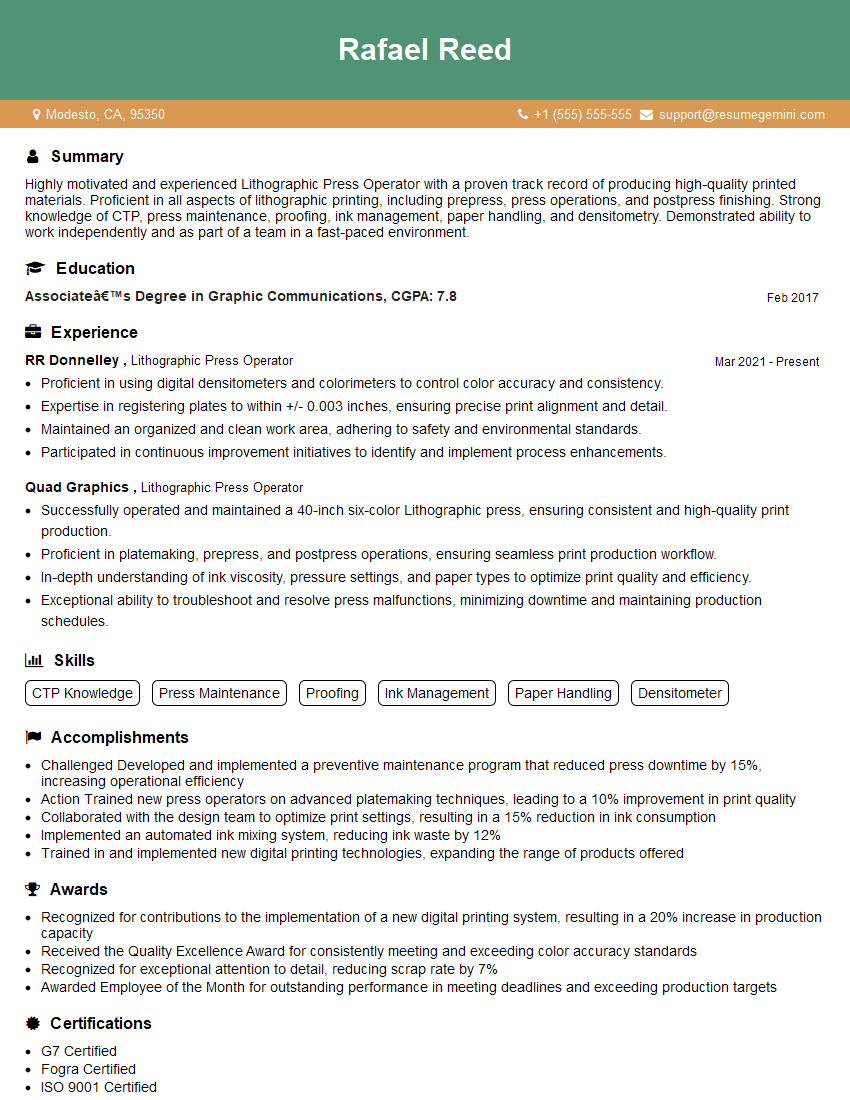
Mastering multicolor press operation opens doors to exciting career opportunities with significant earning potential and advancement possibilities within the printing industry. A strong resume is crucial for landing your dream job. Creating an ATS-friendly resume increases your chances of getting noticed by recruiters. We highly recommend using ResumeGemini to build a professional and impactful resume that highlights your skills and experience effectively. ResumeGemini provides examples of resumes tailored to the multicolor press operation field to guide you. Take the next step towards your successful career in printing today!
Explore more articles
Users Rating of Our Blogs
Share Your Experience
We value your feedback! Please rate our content and share your thoughts (optional).
What Readers Say About Our Blog
Very informative content, great job.
good