The right preparation can turn an interview into an opportunity to showcase your expertise. This guide to Multicolor Printing interview questions is your ultimate resource, providing key insights and tips to help you ace your responses and stand out as a top candidate.
Questions Asked in Multicolor Printing Interview
Q 1. Explain the difference between CMYK and RGB color models in printing.
The key difference between CMYK and RGB color models lies in their intended use: RGB is for screen display, while CMYK is for print. RGB (Red, Green, Blue) is an additive color model; it starts with black and adds color to create brighter shades. Think of a TV screen: mixing red, green, and blue light produces white. CMYK (Cyan, Magenta, Yellow, Key/Black) is a subtractive model; it starts with white and subtracts color to produce darker shades. In printing, we start with a white substrate (like paper) and apply inks to subtract from the white.
Imagine painting a white canvas: adding red, then blue, and then green results in a muddy brown. In RGB, the same combination creates almost white. That’s the fundamental difference. In print, achieving a pure bright white is easy; achieving a pure, deep black is challenging and often requires a separate black ink (the ‘K’ in CMYK) to improve density and sharpness.
Q 2. Describe the process of color separation in multicolor printing.
Color separation is the process of converting a full-color image into individual plates, one for each CMYK color. This is crucial because multicolor printing requires separate printing runs for each color. Traditionally, this was done using photographic methods, but now it’s largely digital. Software separates the image’s color channels, creating four separate images—one for cyan, one for magenta, one for yellow, and one for black. Each of these images is then used to create a printing plate (offset printing) or a digital file (digital printing), which dictates where the ink is deposited on the substrate. Precise registration (aligning the plates/images) during the printing process is critical for accurate color reproduction.
Think of it like creating a layered cake: each layer represents a CMYK color, and precise alignment ensures the layers combine harmoniously. Incorrect registration results in blurry, misaligned colors, ruining the final product.
Q 3. What are the common causes of color inconsistencies in multicolor printing?
Color inconsistencies in multicolor printing stem from several sources. Inaccurate color profiles are a major culprit. Variations in ink, paper, and printing press conditions also contribute significantly. For instance, humidity can affect ink drying time and color density. Ink inconsistency (variations in viscosity, color strength etc.) can lead to uneven color across the print. Calibration issues, such as improper press settings or misaligned color plates/images, are common problems. Even slight temperature changes in the printing environment can impact the outcome.
For example, if the cyan ink is slightly off in one batch, all the colors relying on cyan will be affected. Similarly, if the paper absorbs ink unevenly, it can affect the final color appearance across the sheet. Careful quality control measures, from ink consistency to environmental control, are essential to minimize these inconsistencies.
Q 4. How do you calibrate a printing press for accurate color reproduction?
Calibrating a printing press is a multi-step process that ensures consistent color reproduction. It starts with verifying the ink densities using a densitometer. This instrument measures the optical density of the ink on the substrate to ensure it meets the specifications of the color profile. Then, press settings are adjusted, including ink rollers and pressure, to fine-tune the output. Test prints are generated and compared to color targets, often using a spectrophotometer. This provides highly accurate measurements and a more precise comparison against the intended colors. The process involves iterative adjustments until the test prints match the color targets, achieving accurate color reproduction.
This calibration is often done using standardized color charts or color patches to act as reference points. The process may need repeating periodically due to environmental changes, and ink and equipment wear.
Q 5. Explain the role of color profiles in achieving consistent color across different printing devices.
Color profiles are digital descriptions of a device’s color characteristics. They translate colors between different devices and color spaces. For example, a color profile describes how a specific printer renders colors, accounting for its unique properties. By using appropriate color profiles, the printer can accurately interpret digital color information and produce an output close to the intended appearance. Consistent color across different printing devices is only achievable with accurate profiling and color management throughout the workflow, from design to printing.
Imagine sending a photograph to multiple printers – without color profiles, each printer may interpret and reproduce the image differently, due to variations in their ink sets and rendering processes. Color profiles act as a common language, ensuring consistency regardless of the device used.
Q 6. What are the different types of multicolor printing processes (e.g., offset, digital, screen)?
Multicolor printing encompasses several processes:
- Offset Lithography: This is the workhorse of high-volume commercial printing. It uses plates to transfer ink to a blanket cylinder, then to the substrate. It’s known for high-quality, consistent color, and cost-effectiveness for large runs.
- Digital Printing: This method uses digital data to print directly onto the substrate. This offers flexibility, short print runs, and personalized print-on-demand options, but it may have slightly lower color consistency than offset lithography for large print runs.
- Screen Printing: This method uses stencils to apply ink through a mesh onto the substrate. It is popular for textiles, signage, and specialized applications. Color accuracy can be achieved with care but generally doesn’t reach the consistency of offset or high-end digital methods.
Each process has strengths and weaknesses, making it suitable for different applications. Choosing the right process depends on factors like print volume, budget, substrate type, and desired color quality.
Q 7. Describe your experience with different printing substrates (paper, plastic, etc.).
My experience with various printing substrates is extensive. I’ve worked with a wide range of papers – from lightweight coated stocks for magazines to heavier, uncoated papers for brochures and books. I have also worked with various plastics, including PVC, PET, and polypropylene, for signage and product labeling. Different substrates have different ink absorption rates and surface textures that affect color reproduction. For example, coated papers generally produce more vibrant colors than uncoated papers because they offer less ink absorption. Plastics, in turn, often require specialized inks and processes to ensure proper adhesion and color consistency. Selecting the appropriate ink and printing process for each substrate is critical for achieving the desired color accuracy.
One memorable project involved printing high-quality images on a textured, metallic paper. The paper’s texture presented a challenge, creating an uneven ink distribution. We overcame this by carefully adjusting the printing press settings and using a specialized ink formulation designed for that type of surface. The final product was stunning, demonstrating the importance of understanding and accommodating substrate-specific properties.
Q 8. How do you troubleshoot common printing problems, such as banding, dot gain, or color shifts?
Troubleshooting printing problems like banding, dot gain, and color shifts requires a systematic approach. Let’s break down each issue:
- Banding: This typically manifests as horizontal streaks across the print. Causes include problems with the ink delivery system (clogged nozzles, ink viscosity issues), inconsistencies in the printing press rollers, or incorrect raster image processor (RIP) settings. Troubleshooting involves checking the ink system for clogs, cleaning the rollers, and adjusting RIP settings to optimize the print head’s movement and ink droplet placement. I’d also examine the substrate for irregularities.
Example: I once encountered banding on a large-format print job. After carefully checking the ink supply, we found a partially clogged nozzle on one of the cyan heads. Cleaning it resolved the issue immediately. - Dot Gain: This is an increase in the size of printed dots compared to the intended size, leading to darker and less crisp images. It’s often influenced by the type of paper, the ink itself, and printing pressure. Solutions involve adjusting the printing pressure, using a different substrate or ink specifically designed for less dot gain, and potentially recalibrating the printing press.
Example: When working with a glossy paper, we found significant dot gain resulting in muddy colors. Switching to a lower-gloss stock and reducing the printing pressure alleviated the problem. - Color Shifts: These are variations in color across a print run or between different print runs. This can stem from numerous sources, including variations in ink consistency, improper color profiles, inaccurate calibration of the printing press or monitor, and even changes in ambient lighting during printing. Systematic troubleshooting involves checking ink viscosity and consistency, validating color profiles against the client’s specifications, recalibrating the printing press using color test charts, and ensuring consistent environmental conditions.
Example: I once experienced a color shift in a Pantone-matched project. By carefully checking the PMS color formula against our ink mixing records, and re-calibrating our press using a color spectrophotometer, we ensured consistency.
Q 9. What are the key quality control measures you implement in multicolor printing?
Quality control in multicolor printing is paramount. My approach involves a multi-stage process:
- Pre-press Checks: Rigorous file review and proofing, including verifying color accuracy (often involving soft proofing with ICC profiles), checking resolution and image sharpness, and ensuring proper trapping and imposition.
- Press Setup and Calibration: Precise calibration of the printing press using color test charts and spectrophotometers before the print run begins to establish accurate color reproduction and consistent ink density.
- Regular Monitoring During Print Run: Continuous monitoring of the press, including checking ink levels, viscosity, and color consistency using colorimetric tools throughout the print run to identify and correct any deviations early on. Regular color checks are performed using densitometers and spectrophotometers. We employ color control strips to monitor color consistency throughout the run.
- Post-press Inspection: A thorough final inspection of the printed materials, checking for color accuracy, dot gain, banding, and other printing defects before delivery. This is often done with a lightbox to ensure evenness and catch subtle discrepancies.
- Documentation and Record Keeping: Meticulous record-keeping throughout the entire process to track all settings, calibrations, and quality control checks— crucial for identifying and correcting any future errors.
Q 10. How do you manage ink consistency and viscosity during a print run?
Maintaining consistent ink viscosity is vital for achieving high-quality multicolor prints. Several techniques are used:
- Regular Viscosity Checks: We use a viscosity cup or a more sophisticated viscometer to regularly monitor the ink viscosity throughout the print run. This helps detect variations early on.
- Ink Stirring and Agitation: Thorough stirring and agitation of the inks before and during the print run prevents pigment settling and ensures uniform ink consistency.
- Environmental Control: Maintaining a stable temperature and humidity in the printing environment significantly impacts ink viscosity. Fluctuations can lead to inconsistencies. For example, extreme heat may decrease ink viscosity.
- Ink Conditioning: Some inks benefit from specific conditioning procedures before use. This could include mild shaking or warming.
- Automated Ink Systems: Modern printing presses frequently utilize automated ink circulation and delivery systems that help maintain consistent ink viscosity and flow.
Example: In a recent large print job, we noticed a slight increase in viscosity of one color ink towards the end of the run due to temperature changes. By adjusting the temperature of the ink and continuing to stir the ink in the reservoir, we restored the uniformity of color across the entire print run.
Q 11. Explain your experience with different types of inks used in multicolor printing.
My experience encompasses a broad range of inks used in multicolor printing:
- Process Colors (CMYK): These are the four base colors (cyan, magenta, yellow, and black) used in most digital and offset printing processes. Understanding the nuances of each ink and how they interact is crucial for accurate color reproduction. Each ink is carefully adjusted to ensure optimal color mixing. For instance, the proper balance of CMYK is fundamental to maintaining neutral grays.
- Spot Colors (Pantone, etc.): I have extensive experience with Pantone Matching System (PMS) inks. These pre-mixed inks provide consistent color reproduction across different printing methods and substrates. Precise matching to PMS standards requires careful monitoring and control of ink mixing and application.
- Specialty Inks: I’ve worked with various specialty inks, including metallic, fluorescent, and UV inks, each possessing unique characteristics that demand specialized handling and printing techniques. These inks often require specialized presses or adjustments to the printing process.
- UV-curable Inks: These are used in some print applications, for example, those requiring high durability, quick drying and resistance to smudging. They are cured using UV light immediately after printing. Proper calibration and control of the UV curing process are essential to ensure color and image quality.
Q 12. Describe your experience with pre-press operations, including file preparation and proofing.
Pre-press operations are critical to the success of any print job. My experience includes:
- File Preparation: This involves ensuring the files are in the correct format (usually PDF/X-1a or PDF/X-4), with appropriate color spaces (CMYK typically for print) and resolutions. I thoroughly check for any errors or inconsistencies in the artwork, such as missing fonts, incorrect image embedding, low resolution images, and color profile issues.
- Color Management: I meticulously manage color using ICC profiles to ensure accurate color reproduction from the digital file to the printed output. This involves soft proofing the files to simulate the final printed output, ensuring color accuracy and consistency.
- Proofing: I am proficient in generating various types of proofs, including digital proofs (soft proofs), contract proofs (printed proofs providing an accurate representation of the final printed color and appearance), and press proofs (printed on the press to be used before a large print run). These proofs serve as crucial checkpoints for client approval and quality control.
- Imposition and Trapping: I’m experienced in creating imposition layouts to optimize the arrangement of pages for efficient printing, minimizing waste and ensuring correct page sequencing. I understand and implement trapping techniques to avoid gaps between colored elements.
Q 13. How do you ensure that print jobs meet client specifications regarding color accuracy and consistency?
Meeting client specifications for color accuracy and consistency is achieved through a combination of strategies:
- Color Communication: Clear and detailed communication with the client to understand their expectations and obtain precise color references (e.g., Pantone colors, specific color swatches).
- Color Standards: Using industry-standard color reference systems, such as Pantone, and adhering to their specifications for color matching. I verify color accuracy through multiple points in the process.
- Proof Approval: Obtaining client approval of proofs before proceeding with the print run to ensure that the final output accurately reflects their requirements.
- Colorimetric Measurement Tools: Employing densitometers and spectrophotometers for precise color measurement and calibration throughout the print process. This includes regular checks of color consistency and density.
- Calibration and Quality Control: Regular calibration of the printing press and equipment using color test charts helps maintain consistency. Thorough quality control checks throughout the process help detect and correct any deviations early on.
Q 14. How familiar are you with Pantone Matching System (PMS)?
I am very familiar with the Pantone Matching System (PMS). It is an essential tool in my workflow for ensuring accurate color reproduction across various printing methods and materials. My experience includes:
- PMS Color Matching: I accurately match Pantone colors using specialized inks, carefully adjusting ink concentrations for precise color reproduction. Using a spectrophotometer to measure the color allows for very precise matching.
- PMS Color Specification: I work efficiently with clients’ PMS color specifications, translating them into actionable instructions for ink mixing and press settings.
- PMS Color Libraries: I am proficient in using digital Pantone color libraries to ensure accurate color selection and consistency in design and print reproduction. The libraries allow for matching spot colors with relative ease.
- Limitations of PMS: I am aware of the limitations of the PMS system, particularly in achieving perfect color matches across different printing processes and substrates. I communicate these limitations to the client, setting realistic expectations about color matching.
Q 15. What software do you use for color management and pre-press work?
For color management and pre-press work, my workflow heavily relies on a suite of industry-standard software. At the core is Adobe Creative Suite, specifically Photoshop, Illustrator, and InDesign. Photoshop is crucial for image editing and color correction, ensuring the images are optimized for print. Illustrator is essential for vector-based artwork, allowing for precise control and scalability without loss of quality. InDesign is my go-to for page layout and overall document preparation.
Beyond the Creative Suite, I utilize Pantone Connect for consistent color selection and management across different projects, ensuring accurate Pantone Matching System (PMS) color reproduction. I also employ Gama Color for color proofing and profiling, allowing me to accurately predict how colors will appear on the final print. This software helps in creating ICC profiles to accurately represent the output of specific printing devices, reducing the risk of color variations.
Finally, I use dedicated RIP (Raster Image Processor) software, specific to the printing press being used, to handle the conversion of print-ready files into a format understood by the printing equipment.
Career Expert Tips:
- Ace those interviews! Prepare effectively by reviewing the Top 50 Most Common Interview Questions on ResumeGemini.
- Navigate your job search with confidence! Explore a wide range of Career Tips on ResumeGemini. Learn about common challenges and recommendations to overcome them.
- Craft the perfect resume! Master the Art of Resume Writing with ResumeGemini’s guide. Showcase your unique qualifications and achievements effectively.
- Don’t miss out on holiday savings! Build your dream resume with ResumeGemini’s ATS optimized templates.
Q 16. Describe your experience with different types of printing presses.
My experience encompasses a range of printing presses, from traditional offset lithography to modern digital printing technologies. I’ve worked extensively with four-color offset presses, mastering the complexities of ink management, registration, and color balancing across multiple printing units. This involves understanding the nuances of different inks and their interactions on various paper stocks. Imagine it like conducting an orchestra—each instrument (ink color) needs to play in perfect harmony to achieve the desired overall sound (color).
I’m also proficient with digital printing presses like high-volume inkjet printers and toner-based systems. These technologies offer flexibility and speed, especially beneficial for shorter runs and personalized print jobs. However, they require different color management approaches compared to offset, focusing on accurate color profiles and printer calibration. The key difference lies in the way the ink or toner is applied and how that interacts with the substrate (paper or other material).
Furthermore, I have experience with large-format printers, frequently used for posters, banners, and signage, which demand knowledge of different media and ink types. Each technology presents unique challenges and opportunities, requiring a nuanced understanding of their respective capabilities and limitations.
Q 17. What is your experience with managing print production schedules and deadlines?
Managing print production schedules and deadlines is a critical aspect of my role. My approach is based on a combination of meticulous planning, proactive communication, and efficient resource allocation. I start by carefully analyzing the scope of each project, identifying potential bottlenecks, and setting realistic timelines. This involves breaking down the project into smaller tasks, each assigned a specific deadline.
I utilize project management software, often incorporating Gantt charts to visualize the workflow and dependencies between tasks. This allows for clear identification of critical path activities and proactively addressing any potential delays. Regular communication with clients and the production team is crucial. Any unforeseen issues are addressed immediately through collaborative problem-solving and potential adjustments to the schedule, always keeping the client informed.
For example, once we had an unexpected paper shortage, we worked with our suppliers and rearranged our schedule, prioritizing urgent projects, and communicating the potential impact to clients well in advance, thereby mitigating potential dissatisfaction.
Q 18. How do you handle customer complaints regarding color accuracy?
Addressing customer complaints regarding color accuracy involves a systematic approach. First, I gather all relevant information, including the original design file, the printed output, and a detailed description of the discrepancy from the client. I then carefully examine the print to identify the source of the problem. This might be due to variations in monitor calibration, incorrect color profiles, or issues during the printing process itself.
Next, I carefully analyze the color differences using spectrophotometer readings to quantify the deviations. This objective data provides a foundation for further investigation. If the issue stems from a color profile mismatch, it can be easily corrected. If it’s due to a printing error (e.g., incorrect ink density or registration), adjustments in the press settings or reprinting may be required.
Open communication is key. I explain the findings to the client clearly and concisely, offering solutions and outlining next steps. A proactive and transparent approach builds trust, fostering a positive customer relationship, even when facing challenging situations.
Q 19. What are the safety procedures you follow while operating printing equipment?
Safety is paramount in a printing environment. My adherence to safety protocols starts with regular equipment inspections, ensuring all safety guards are in place and functioning correctly. I always wear appropriate personal protective equipment (PPE), including safety glasses, gloves, and hearing protection, when operating machinery.
I strictly follow procedures for handling chemicals and inks, including proper storage, disposal, and avoiding skin contact. This involves understanding the Safety Data Sheets (SDS) for all materials used in the printing process. In addition, I maintain a clean and organized workspace, minimizing trip hazards and potential sources of accidents.
Regular training on safe operating procedures and emergency protocols is crucial. I actively participate in these sessions and ensure that I’m up-to-date with all relevant safety regulations. A safe working environment protects not only myself but also my colleagues.
Q 20. Explain your understanding of different color spaces (e.g., Adobe RGB, sRGB).
Understanding color spaces is fundamental to accurate color reproduction in printing. Color spaces define the range of colors that can be represented in a digital or physical medium. sRGB (Standard Red Green Blue) is a widely used color space for web and screen displays. It has a relatively small gamut, meaning it can represent a limited range of colors. Think of it as a smaller paint palette.
Adobe RGB is a wider color gamut space, meaning it encompasses a larger range of colors than sRGB. It’s commonly used for photography and print design as it allows for a richer and more vibrant representation of colors. Imagine a larger, more diverse paint palette. The difference lies in the color profile’s ability to capture the vibrancy and saturation of colors. However, using Adobe RGB without proper color management for printing can lead to unexpected results since the printer may not be able to reproduce the full range of colors.
Understanding the differences between color spaces is crucial for consistent color representation across different media, ensuring the final print accurately reflects the intended design. Using appropriate color profiles throughout the design and print production process ensures color accuracy across different stages.
Q 21. How do you manage waste reduction and environmental impact in the printing process?
Waste reduction and environmental responsibility are crucial aspects of modern printing. We implement various strategies to minimize our environmental impact. This starts with utilizing eco-friendly inks and substrates, opting for inks made from recycled materials and paper certified by organizations like the Forest Stewardship Council (FSC).
We carefully manage our ink usage, employing techniques to minimize waste and optimize ink coverage. This involves proper press calibration and adjustments to minimize ink consumption without compromising print quality. We actively monitor and track ink usage to identify areas for improvement. Efficient workflow planning reduces the need for reprints, thereby reducing paper waste.
Furthermore, we have implemented a rigorous recycling program, separating different types of waste for proper disposal and recycling. We work with recycling partners to ensure that waste materials are processed responsibly. These measures collectively contribute to a sustainable printing practice that minimizes our environmental footprint.
Q 22. What is your experience with print finishing techniques (e.g., cutting, binding, laminating)?
Print finishing is crucial for creating a high-quality, professional final product. My experience encompasses a wide range of techniques, including cutting, binding, and laminating, each impacting the final presentation and durability.
Cutting: I’m proficient in various cutting methods, from simple guillotine cuts to more complex die-cutting for intricate shapes. Understanding the different blade types and their impact on paper stock is crucial for achieving precise, clean cuts, avoiding damage to the printed material. For example, I’ve worked with projects requiring intricate die-cuts for promotional cards and packaging, demanding precise alignment and sharp edges.
Binding: I have extensive experience with various binding methods, including saddle stitch (for booklets), perfect binding (for books and magazines), wire-O binding (for notebooks and calendars), and case binding (for high-end books). The choice of binding greatly influences the final look and feel, and I carefully select the most appropriate method based on the project’s specifications. For instance, I recently managed a project involving a high-volume, perfect-bound magazine requiring careful attention to spine thickness and adhesive application for a clean, professional finish.
Laminating: Laminating enhances durability and provides a professional finish. I’m experienced with both gloss and matte laminates, understanding the impact of different thicknesses and finishes on the printed material. Choosing the right laminate is critical – gloss laminates offer a vibrant look but can show fingerprints, while matte laminates provide a more subtle finish. A recent project involved laminating high-resolution photographic prints, requiring careful selection of a matte laminate to avoid glare and maintain the image quality.
Q 23. Explain your experience with evaluating print quality using various measurement tools.
Evaluating print quality is essential for ensuring consistent, high-quality output. I utilize a variety of measurement tools to assess different aspects of print quality, including color accuracy, density, and registration.
Densitometers: These tools measure the density of printed inks, enabling the assessment of color accuracy and consistency across the print run. For example, I use a densitometer to ensure the correct density of cyan, magenta, yellow, and black (CMYK) inks for consistent color reproduction.
Spectrophotometers: These provide more precise color measurements than densitometers, crucial for accurate color matching and maintaining color consistency across different print runs or printing devices. They can quantify color differences, allowing for adjustments to ensure precise color reproduction based on standardized color spaces like Pantone or sRGB.
Colorimeters: These are portable devices offering a quick color measurement, useful for on-press monitoring or quick checks. While less precise than spectrophotometers, they offer a valuable real-time assessment during printing to prevent major deviations.
Visual Inspection: While not a technical tool, visual inspection remains essential. I train my eye to identify subtle inconsistencies, ensuring the overall quality, alignment, and consistency of the print run. This also helps me quickly identify problems that instrumentation might miss.
Q 24. How do you identify and solve problems related to print registration?
Print registration refers to the precise alignment of multiple colors or images printed on the same sheet. Problems with registration can significantly impact print quality, making colors appear misaligned or blurry. Identifying and solving registration issues requires a systematic approach.
Identify the Source: Determine if the problem is originating from the press itself, the plates, or the printing process. This may involve checking plate alignment, ensuring the correct paper feed, and examining the press for mechanical issues.
Check the Print Plates: Misaligned or damaged plates are frequent culprits. Thorough inspection of the plates for damage, misregistration, or improper mounting is essential.
Adjust Press Settings: Minor registration issues might be addressed by adjusting the press’s settings, such as the gripper margins or the timing of the color units. Careful and incremental adjustments are key to avoid worsening the situation.
Clean the Press: Accumulation of ink or debris on the press components can cause misalignment. Regular cleaning and maintenance of the printing press are crucial for preventing registration problems.
Test Prints: Conducting test prints throughout the process enables timely identification and correction of any misalignment, ensuring the issue is resolved before a full production run.
A recent instance involved misregistration during a multi-color postcard print. Using a systematic approach, we isolated the issue to a slightly misaligned plate. After replacing the plate and recalibrating the press, perfect registration was restored.
Q 25. Describe your experience with different types of proofing methods (e.g., soft proof, hard proof).
Proofing is a crucial step in the printing process, ensuring that the final printed product accurately represents the client’s vision. I’m experienced with both soft and hard proofing methods.
Soft Proofing: This involves viewing a digital representation of the artwork on a calibrated monitor. Accuracy depends heavily on the monitor’s calibration and color profile matching the printing process. Soft proofing is quicker and cheaper, but it’s not a perfect representation of the final print.
Hard Proofing: This entails creating a physical print of the artwork using the intended printing method and materials. While more costly and time-consuming than soft proofing, it provides a much more accurate preview of the final printed product and allows for a more precise assessment of color accuracy and overall print quality. Different hard proof methods include inkjet proofs, laser proofs, and contract proofs which each have specific applications.
The choice between soft and hard proofing depends on the project’s complexity and the client’s requirements. For critical projects where color accuracy is paramount, I often recommend combining both methods to achieve the best results.
Q 26. How familiar are you with various printing standards and certifications?
Familiarity with printing standards and certifications is essential for ensuring consistent quality and meeting industry requirements. I’m knowledgeable about several key standards:
ISO 12647: This standard outlines the specifications for process printing, covering various aspects, from color management to ink densities, ensuring consistency across different printers and print providers.
Pantone Matching System (PMS): I’m proficient in using the Pantone system for consistent spot color reproduction. Understanding Pantone values is crucial for maintaining color accuracy across different print jobs and providers.
FOGRA: This is a set of standards for offset printing that dictates optimal settings for various printing processes. These standards ensure consistency and accuracy across all jobs.
Certifications: I have a working knowledge of various certifications, including those relating to environmental sustainability (e.g., FSC certification for responsibly sourced paper) and quality management systems (e.g., ISO 9001).
Understanding and applying these standards is key to delivering consistent, high-quality prints that meet industry best practices.
Q 27. Describe a time you had to solve a complex color matching problem. What steps did you take?
One challenging color matching problem involved a corporate brochure requiring a specific, complex teal color that was crucial for brand consistency. The initial print samples differed significantly from the client’s approved Pantone swatch.
Initial Assessment: I began by analyzing the differences between the print sample and the Pantone swatch using a spectrophotometer, quantifying the color deviation.
Investigate the Printing Process: We carefully examined the printing process, paying close attention to ink formulation, plate preparation, and press settings.
Adjust Ink Formulation: After analyzing the spectrophotometer data, we made minor adjustments to the ink formulation using color management software. The software helps refine CMYK values to better approximate the target Pantone color.
Iterative Process: We produced multiple test prints with incremental changes to ink formulation, measuring the color differences each time until a satisfactory match was achieved.
Client Review: The corrected print was presented to the client for approval. This iterative process ensured that the final print met the client’s expectations.
This experience highlighted the importance of meticulous color management techniques, including using precise measurement tools and iterative adjustments to achieve perfect color matches in complex situations. It also reinforced the critical role of client communication and collaboration to ensure their vision was accurately replicated in the printed material.
Key Topics to Learn for Your Multicolor Printing Interview
- Color Management Systems (CMS): Understanding different color spaces (CMYK, RGB, Pantone), color profiles, and how they impact print accuracy. Practical application: Troubleshooting color discrepancies between screen and print.
- Printing Processes: Familiarize yourself with various multicolor printing methods such as offset lithography, digital printing (inkjet, toner-based), screen printing, and flexography. Consider the pros and cons of each for different applications.
- Pre-press Preparation: Mastering file preparation for multicolor printing, including color separation, trapping, imposition, and proofing. Practical application: Identifying and resolving potential pre-press errors that could lead to print defects.
- Ink and Substrate Knowledge: Understand the properties of different inks (e.g., UV, water-based, solvent-based) and their interaction with various substrates (e.g., paper types, plastics, textiles). Problem-solving approach: Knowing how ink and substrate choices influence print quality and durability.
- Press Operation and Maintenance (if applicable): Depending on the role, basic understanding of press operation, color registration, and routine maintenance is crucial. This could involve familiarity with specific press types relevant to the position.
- Quality Control and Troubleshooting: Develop a strong understanding of quality control procedures and common print defects (e.g., banding, mottle, color shifts). Practical application: Diagnosing and resolving print issues to ensure high-quality output.
- Workflow and Production Management: Understanding the overall workflow from design to finished product, including scheduling, job costing, and communication with clients. Problem-solving approach: Optimizing workflow for efficiency and cost-effectiveness.
Next Steps
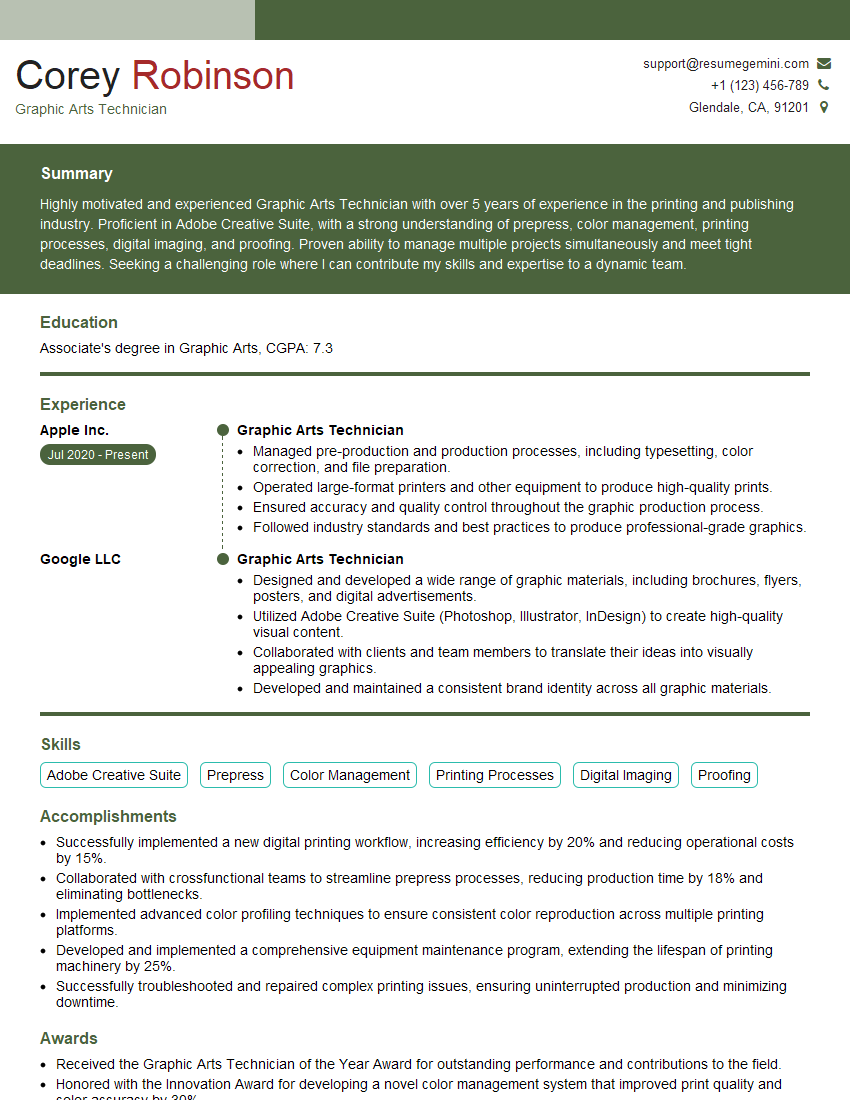
Mastering multicolor printing techniques opens doors to exciting career opportunities in a vibrant industry. To maximize your chances, a well-crafted, ATS-friendly resume is essential. ResumeGemini is a trusted resource that can help you create a professional resume that highlights your skills and experience effectively. We provide examples of resumes tailored to the Multicolor Printing industry to guide you in building a standout application.


Explore more articles
Users Rating of Our Blogs
Share Your Experience
We value your feedback! Please rate our content and share your thoughts (optional).
What Readers Say About Our Blog
Very informative content, great job.
good