Feeling uncertain about what to expect in your upcoming interview? We’ve got you covered! This blog highlights the most important Navigational Charting interview questions and provides actionable advice to help you stand out as the ideal candidate. Let’s pave the way for your success.
Questions Asked in Navigational Charting Interview
Q 1. Explain the difference between paper charts and Electronic Navigational Charts (ENCs).
Paper charts and Electronic Navigational Charts (ENCs) both serve the purpose of depicting nautical information for safe navigation, but differ significantly in format, update mechanisms, and functionality. Paper charts are traditional, printed maps representing water bodies and surrounding land areas. They require manual updates via Notices to Mariners and corrections. ENCs, on the other hand, are digital raster or vector representations of nautical charts. They offer dynamic capabilities such as automated route planning, collision avoidance system integration, and real-time updates via connections to the internet.
Think of it like comparing a physical map to a GPS navigation system. The paper chart is like the physical map – static and requiring manual interpretation. The ENC is like the GPS, dynamic, providing real-time information and advanced features.
Q 2. Describe the structure and components of an ENC.
An ENC is a structured database of navigational information. It’s not just a digitized image of a paper chart; it contains layers of data representing different features. Key components include:
- Vector data: This represents features like coastlines, buoys, and navigation channels as points, lines, and polygons. This allows for precise measurement and scaling.
- Raster data: Some ENCs may include raster data (images) for details like bathymetry (water depth) or aerial photography, providing a visual context.
- Attributes: Each feature has associated attributes such as depth, buoy type, light characteristics, or hazard warnings. This metadata enhances the information value.
- Metadata: This describes the chart’s content, scale, projection, and other important information about the data’s quality and accuracy.
The structure allows for selective display of information based on the vessel’s characteristics, such as draft or navigational capabilities, ensuring only relevant information is presented to the navigator.
Q 3. What is the role of S-57 in ENC production?
S-57 is the International Hydrographic Organization (IHO) standard for the encoding of digital navigational chart data. It defines the data structure, attributes, and codes used in creating ENCs. Think of it as the ‘language’ of ENCs. It ensures interoperability between different ENC producers and Electronic Chart Display and Information Systems (ECDIS). Without S-57, each ENC would be unique and incompatible with others, leading to chaos and safety risks.
Compliance with S-57 guarantees that ENCs from various sources will share a common structure, ensuring that ECDIS systems can correctly interpret and display data from multiple sources.
Q 4. Explain the concept of chart datums and their importance.
Chart datums are reference surfaces used to define the positions of features on a chart. They’re crucial because they establish the basis for all positional information. A horizontal datum (like WGS 84 or NAD 83) defines the location on the earth’s surface, while a vertical datum (like Mean High Water or Chart Datum) defines the height relative to a particular level. Incorrect or inconsistent datums can lead to significant navigational errors.
Imagine trying to meet someone using different street maps referencing different systems – you’d likely end up in different places. Similarly, if a vessel’s GPS uses one datum and the chart another, it could lead to inaccurate positioning and potentially dangerous situations.
Q 5. How are updates and corrections applied to ENCs?
ENC updates are delivered electronically through a system of broadcasts, often directly to the ECDIS via satellite communication or internet connection. These updates typically include corrections, additions, or deletions of navigational features. The system usually involves a service provider that releases update files based on official Notices to Mariners. ECDIS systems are designed to seamlessly integrate and apply these updates, alerting the navigator to any changes affecting the current navigational plan.
Regular updates are paramount for ensuring the accuracy and safety of navigation, as navigational hazards and changes in water depths may occur frequently. A navigator must verify and ensure their charts are up to date.
Q 6. What are the different types of chart projections and when are they used?
Various map projections are used in chart creation, each with advantages and disadvantages. The choice depends on the geographic area and intended use:
- Mercator Projection: Commonly used for navigation because it maintains rhumb lines (lines of constant bearing) as straight lines. However, it distorts areas greatly at higher latitudes.
- Lambert Conformal Conic Projection: Preserves shapes and angles and is suitable for areas extending along lines of latitude. Often used for coastal areas.
- Transverse Mercator Projection: Used for areas extending along lines of longitude, ideal for narrow, elongated regions. Useful for areas of a significant East-West extent, but still minimizes distortion in the north-south direction.
Choosing the right projection is crucial for minimizing distortion and ensuring accurate representation of distances, directions, and areas. It directly impacts navigation accuracy and safety.
Q 7. Describe the process of chart creation from hydrographic survey data.
Chart creation begins with hydrographic surveys, where specialized vessels gather data on water depths, bottom composition, and coastal features. This involves using sonar systems, GPS, and other advanced technologies to collect precise measurements. The raw data undergoes rigorous quality control and processing steps to ensure accuracy. This processed data is then compiled, alongside data from aerial surveys, terrestrial surveys, and other sources. This is used to create a digital model of the seafloor and coastline. Finally, cartographers use this data to design and produce the ENC according to IHO standards and S-57 encoding, and subject to quality assurance checks before publication.
This entire process is a meticulous and complex endeavor requiring highly skilled professionals and advanced technologies to ensure the accuracy, completeness, and reliability of the resulting navigational charts.
Q 8. What are the limitations of ENCs?
Electronic Navigational Charts (ENCs) are incredibly powerful tools, but they do have limitations. Think of them as highly sophisticated maps – they are not perfect representations of reality.
- Data limitations: ENCs rely on data provided by various sources, and this data may not always be completely up-to-date or perfectly accurate. For example, a newly constructed pier might not be immediately reflected on the chart.
- Scale and Resolution: The detail level of an ENC varies depending on its scale. A large-scale chart will show more detail than a small-scale chart, but even large-scale charts may not capture all the nuances of a complex navigational environment. Imagine trying to represent all the subtle variations in a rocky coastline on a single chart – some level of generalization is necessary.
- Dynamic information: ENCs primarily depict static features. Real-time information such as weather, currents, and traffic, needs to be integrated from other sources. Think of it like having a fantastic map, but needing a separate weather app to get current conditions.
- System dependencies: ENCs rely on the functioning of the ECDIS system. A malfunctioning system can render the ENC unusable, putting the vessel at risk. This underscores the importance of regular system maintenance and backups.
- User interpretation: Finally, the user’s understanding and interpretation of the ENC data are crucial. Incorrect settings, misinterpretations of symbols or a lack of sufficient training can lead to errors in navigation.
Q 9. Explain the functionality of an Electronic Chart Display and Information System (ECDIS).
An Electronic Chart Display and Information System (ECDIS) is more than just a digital chart. It’s an integrated system that combines navigational data with advanced functionalities to enhance safety and efficiency at sea. Think of it as a sophisticated navigational ‘cockpit’ consolidating various information sources.
Its core functionality includes:
- Chart Display: Displays ENCs, providing a clear, scalable view of the vessel’s position and surroundings.
- Positioning: Integrates data from various positioning systems (GPS, GLONASS, etc.) to show the vessel’s precise location on the chart.
- Route Planning: Allows for the creation, editing, and monitoring of voyage plans, considering factors like depth, width, and other navigational restrictions.
- Navigation Warnings: Displays navigational warnings (NAVTEX, GMDSS) and updates from other data sources.
- Alarm and Warning Functions: Provides alerts for potential hazards, such as shallow water, restricted areas, or proximity to other vessels.
- Data Integration: Connects to various sensors and systems onboard, such as radar, AIS, and gyrocompass, to provide a comprehensive navigational picture.
Q 10. How does an ECDIS handle route planning and monitoring?
ECDIS simplifies and enhances route planning and monitoring significantly. Let’s break it down:
Route Planning:
- Waypoints: Users can easily add waypoints along the desired route, defining specific locations and navigating between them.
- Route Optimization: The system can automatically suggest optimal routes based on various parameters like depth, width, and proximity to hazards. It’s like having a sophisticated route planner that considers all navigational constraints.
- Route Checks: ECDIS can automatically check the planned route against chart data, alerting the user to potential hazards or conflicts.
Route Monitoring:
- Real-time Tracking: The system continuously displays the vessel’s position relative to the planned route, providing clear visual feedback on progress and deviations.
- Deviation Alerts: ECDIS will alert the navigator of any significant deviations from the planned route.
- Arrival Time Estimates: Based on speed and route, ECDIS can provide estimated arrival times at various waypoints.
This combination of planning and monitoring capabilities significantly improves navigational safety and efficiency, helping crews stay on course and avoid dangerous situations.
Q 11. Describe the different types of navigational warnings and their sources.
Navigational warnings are crucial for safe navigation. They alert mariners about hazards that may not be reflected on charts or that have changed since the chart’s production. These warnings can be categorized by urgency and type:
- Urgent Warnings: These usually involve immediate dangers, such as sudden obstructions, navigational hazards, or severe weather conditions, requiring immediate action.
- Routine Warnings: These are less urgent but important, such as temporary changes to navigational aids, planned dredging activities, or new restrictions.
Sources of Navigational Warnings:
- NAVTEX (Navigational Telex): A broadcast system transmitting navigational warnings within a specific geographical area.
- GMDSS (Global Maritime Distress and Safety System): A global system for maritime safety communications, including navigational warnings.
- AIS (Automatic Identification System): Provides real-time information about other vessels, aiding in collision avoidance and contributing to situational awareness.
- VTS (Vessel Traffic Service): Local authorities managing vessel traffic in busy waterways often provide warnings relevant to their area of operation.
- Regional Authorities: Coastal states and hydrographic offices issue warnings related to their waters.
- Meteorological Services: Weather forecasts and warnings directly impact navigation and are crucial information.
Mariners must be vigilant in checking these sources regularly to stay informed about potential hazards.
Q 12. What are the safety implications of inaccurate or outdated charts?
Inaccurate or outdated charts pose serious safety risks. Think of it like driving with a map that has missing roads or incorrect directions – it’s a recipe for disaster.
- Grounding: Outdated charts may not reflect newly formed shoals or changes in water depth, leading to grounding incidents.
- Collisions: Incorrect positioning of aids to navigation or obstacles can result in collisions with other vessels or fixed structures.
- Running aground: Chart inaccuracies concerning depth or seabed composition may lead to a vessel running aground.
- Damage to vessel or environment: Incidents resulting from inaccurate charts can cause serious damage to the vessel and potential harm to the environment.
- Loss of life: In severe cases, inaccuracies can have catastrophic consequences, leading to serious injuries or even loss of life.
Regular chart updates and careful chart interpretation are crucial to mitigate these risks.
Q 13. Explain the concept of a Chart Correction Service.
A Chart Correction Service is a system designed to keep navigational charts up-to-date. It’s like a subscription service that ensures you always have the latest version of the map. This is critical because the maritime environment is dynamic – shorelines shift, new hazards emerge, and navigational aids change.
The service typically involves:
- Issuing corrections: Hydrographic offices and other authorities regularly issue corrections to existing charts, addressing changes, errors, or updates.
- Distribution mechanisms: These corrections may be distributed electronically (via internet or broadcast) or through traditional printed Notices to Mariners.
- Application of corrections: Mariners must diligently apply these corrections to their charts (either paper or electronic) to ensure they have the most accurate and up-to-date information.
- Data Updates: In the context of ENCs, chart correction is often automated through the ECDIS system, ensuring seamless updates.
A reliable chart correction service is a cornerstone of safe navigation.
Q 14. How do you verify the accuracy and integrity of chart data?
Verifying the accuracy and integrity of chart data is paramount. There’s a multi-layered approach to this crucial process:
- Source Verification: Ensure that the chart data originates from a reputable and trusted source, such as an official hydrographic office.
- Date of Issue: Always check the chart’s date of issue and ensure that it is up-to-date, incorporating all relevant corrections.
- Cross-referencing: Compare chart information with other sources, such as radar, AIS, and visual observations, to corroborate the data.
- Regular Updates: Actively subscribe to chart correction services and promptly apply all necessary corrections to the charts.
- ECDIS System Checks: For electronic charts, regularly check the ECDIS system for errors or malfunctions and verify that updates are applied correctly.
- Comparison with other charts: For both paper and electronic charts, comparing the information with charts from different sources can reveal inconsistencies or potential errors.
- Visual Verification: Whenever possible, visually verify information depicted on the chart through physical observation of landmarks or aids to navigation. This is especially important in unfamiliar waters.
This comprehensive verification process helps ensure that navigators have confidence in the data they rely upon for safe passage.
Q 15. What are the various layers of information displayed on an ENC?
Electronic Navigational Charts (ENCs) are not simply images; they’re complex databases containing multiple layers of information, each serving a specific navigational purpose. Think of it like a layered cake, where each layer reveals more detail.
- Bathymetry Layer: This is the foundational layer showing water depths, usually represented by contours or numbers. It’s crucial for safe navigation, especially in shallow waters.
- Topography Layer: This layer displays land features like mountains, hills, and buildings. It helps with orientation and understanding the coastal landscape.
- Culture Layer: This encompasses man-made features such as aids to navigation (ATONs like buoys and lighthouses), bridges, ports, and other structures. Understanding this layer is vital for safe passage through ports and channels.
- Navigation Layer: This layer contains information essential for route planning and navigation, including navigational warnings, recommended routes, and safety zones. It’s constantly updated to reflect changes in conditions.
- Safety Contours/Sounding Layer: This layer shows depth contours and individual soundings, highlighting potential hazards such as shallow areas or wrecks. These are critical for collision avoidance.
- Other layers: Depending on the ENC, there may be additional layers such as tidal data, current information, or even satellite imagery, enhancing situational awareness.
The ability to selectively display or hide these layers is a key feature of ENC software, allowing navigators to tailor their view to the specific needs of the situation. For instance, in open ocean, one might prioritize the bathymetry and navigation layers, while in a busy harbor, the culture and safety contour layers become paramount.
Career Expert Tips:
- Ace those interviews! Prepare effectively by reviewing the Top 50 Most Common Interview Questions on ResumeGemini.
- Navigate your job search with confidence! Explore a wide range of Career Tips on ResumeGemini. Learn about common challenges and recommendations to overcome them.
- Craft the perfect resume! Master the Art of Resume Writing with ResumeGemini’s guide. Showcase your unique qualifications and achievements effectively.
- Don’t miss out on holiday savings! Build your dream resume with ResumeGemini’s ATS optimized templates.
Q 16. Describe your experience with using specific charting software.
I have extensive experience using several charting software packages, including MaxSea TimeZero, Navionics Boating, and OpenCPN. My preference for MaxSea TimeZero stems from its robust capabilities for route planning, advanced features like tidal stream analysis and its seamless integration with various sensor data. I frequently used its 3D visualization capabilities during my time as a yacht captain, providing a more intuitive understanding of the surrounding environment.
With Navionics Boating, I’ve particularly valued its detailed chart coverage, especially in recreational boating areas, along with its user-friendly interface which is very efficient for quick reference during navigation. OpenCPN, being open-source, has allowed me to explore and customize different aspects of chart display and data integration, a valuable skill when working with diverse data sets.
My experience across these platforms allows me to quickly adapt to different software interfaces and effectively utilize the unique strengths of each system, improving overall navigational efficiency and situational awareness.
Q 17. How do you handle discrepancies between different chart sources?
Discrepancies between chart sources are not uncommon and require careful consideration. My approach involves a methodical process of verification and prioritization.
- Identify the Discrepancy: First, I pinpoint the exact nature of the difference – is it in depth, location of an obstruction, or something else?
- Source Evaluation: I evaluate the reliability and recency of each source. Is one source newer than the other? Does one source have a better reputation for accuracy in that specific area?
- Cross-Referencing: I look for supporting evidence from other sources, such as nautical publications, Notice to Mariners, or even local knowledge. For instance, if a difference in depth exists, I may investigate if recent dredging works have been carried out.
- Conservative Approach: When in doubt, I always err on the side of caution. I choose the most conservative option, for example, using the shallower depth reading if conflicting data exists.
- Documentation: I meticulously document the discrepancy and my decision-making process, including the sources consulted and the rationale behind my choice. This ensures transparency and aids in future reference and analysis.
Remember, safety is paramount in navigation. Thoroughly investigating inconsistencies and making informed decisions is essential to avoid potential hazards.
Q 18. What is your experience with vector and raster chart data?
Vector and raster data are two fundamentally different ways of representing chart information. Raster data is like a photograph – a grid of pixels representing the chart image. Vector data, on the other hand, is composed of points, lines, and polygons that define individual chart features. Think of it like a detailed drawing.
Raster charts are generally easier to view and simpler to display, but they lack the flexibility and scalability of vector charts. Modifying or zooming in on a raster chart often results in a loss of clarity. They are less efficient in terms of data storage.
Vector charts, the basis for ENCs, are far more flexible. They allow for greater detail at any scale, making them ideal for zooming and panning without loss of quality. Data can be easily updated and modified, and they are much more efficient in terms of data storage.
My experience encompasses both. I find vector data indispensable for professional navigation due to its adaptability and accuracy, but I recognize the role of raster charts in specific applications, particularly in areas with less frequent updates or where a quick visual overview is necessary.
Q 19. Explain your understanding of tidal calculations and their importance in navigation.
Tidal calculations are paramount in safe navigation, especially in shallow-water areas and estuaries. Tides significantly affect water depth, which directly impacts the safe passage of vessels.
My understanding encompasses the use of tidal prediction tables, harmonic constants, and specialized software to calculate predicted water levels at a specific location and time. These predictions are not simply about water level; they account for the complex interaction of astronomical forces (the moon and sun’s gravitational pull) and local geographical factors affecting the tidal pattern.
Importance: Inadequate tidal consideration can lead to grounding, damage to the vessel, or even loss of life. For example, a vessel attempting to enter a harbor at low tide, without accounting for the charted depth and tidal range, may run aground. Accurate tidal calculations are used in planning safe transit times, determining allowable drafts, and predicting current patterns.
Modern navigation systems frequently integrate tidal data automatically, but understanding the underlying principles remains vital for proper interpretation and ensuring navigational safety. Independent verification and cross-checking of tidal information from multiple sources are key to minimizing risk.
Q 20. How do you interpret depth soundings and other hydrographic information on a chart?
Interpreting depth soundings and hydrographic information on a chart is a critical skill for safe navigation. Depth soundings, typically represented by numbers, indicate the depth of water at a particular point. These soundings are critical for avoiding shallow water hazards.
Here’s how I interpret this information:
- Units: First, I always confirm the units used (e.g., meters, feet, fathoms). This is typically indicated in the chart legend. Inconsistent units could lead to serious errors.
- Datum: I understand the chart datum, which is the reference level for depth measurements (usually mean low water). Depth soundings are relative to this datum; variations in the tidal level must be factored in using tidal predictions.
- Sounding Density: The frequency of soundings gives an indication of the detail of the hydrographic survey. Areas with more frequent soundings are usually better surveyed, suggesting higher accuracy.
- Depths and Contour Lines: I look for both individual soundings and contour lines, which are lines connecting points of equal depth. These provide a clear picture of the seabed topography, identifying potential dangers like shoals or submerged obstructions.
- Qualifiers: I pay close attention to qualifiers or symbols associated with soundings. For example, a circle around a sounding might indicate uncertainty or that the sounding was obtained using a less reliable method.
By carefully analyzing depth soundings, contour lines, and their associated qualifiers, I create a mental picture of the underwater terrain and assess the safe route for the vessel, ensuring sufficient underwater clearance at all times. It’s not just about numbers; it’s about understanding the context.
Q 21. What are the standard symbols and abbreviations used on nautical charts?
Nautical charts utilize a standardized system of symbols and abbreviations to convey a vast amount of information concisely. Mastering these symbols is essential for effective chart interpretation. They are defined in chart legend.
Here are some examples:
- Aids to Navigation (ATONs): Different symbols represent various types of buoys (e.g., lateral marks indicating port and starboard, cardinal marks indicating compass directions), lighthouses, and other navigation aids.
- Depths and Soundings: Numbers represent water depths, often with qualifiers like ‘d’ for doubtful depth or ‘m’ for measured depth. Contour lines connect points of equal depth.
- Obstructions and Hazards: Various symbols depict rocks, wrecks, cable crossings, and other hazards to navigation.
- Topography: Symbols represent land features like mountains, forests, and buildings. Different hatchings or colors might represent different types of terrain.
- Navigation Information: Symbols represent restricted areas, traffic separation schemes, and other navigation-related information.
The International Hydrographic Organization (IHO) publishes standards for chart symbols, striving for global consistency. However, minor variations may exist between chart publishers. Therefore, careful consultation of the chart’s legend is crucial for proper interpretation. Regular practice and familiarity with these symbols are essential for any navigator. Learning to interpret these symbols is an ongoing process that improves with experience and further training.
Q 22. Explain your familiarity with various chart scales and their applications.
Navigational charts employ various scales to represent the Earth’s surface on a manageable size. The scale is the ratio between a distance on the chart and the corresponding distance on the Earth. Larger scales, like 1:50,000, show more detail over a smaller area (ideal for harbors), while smaller scales, like 1:500,000, cover larger areas with less detail (useful for coastal navigation).
- Large Scale Charts (e.g., 1:50,000): These charts are incredibly detailed, suitable for harbor approaches, intricate waterways, or areas requiring precise navigation. Think of navigating a busy port – you’d need to see every buoy, light, and shallow area clearly.
- Medium Scale Charts (e.g., 1:150,000): These provide a balance between detail and coverage, making them appropriate for coastal navigation and approaches to larger ports. They’re versatile and commonly used.
- Small Scale Charts (e.g., 1:1,000,000): These charts show extensive areas, ideal for planning long ocean voyages. Detail is less, focusing on major landmarks and depths. Think of a transatlantic crossing; you’d use these to plan your overall route.
Selecting the right scale is crucial. Using a small-scale chart for harbor entry would be impractical due to insufficient detail, leading to potential hazards. Conversely, using a large-scale chart for an ocean crossing would be cumbersome and unnecessary.
Q 23. Describe your experience with chart production and quality control procedures.
My experience encompasses the entire chart production lifecycle, from data acquisition and compilation to quality assurance and final product delivery. This includes working with various datasets, including bathymetric surveys, satellite imagery, and topographic data.
Quality control is paramount. It’s a multi-stage process that involves:
- Data Verification: Rigorous checks are performed to ensure the accuracy and consistency of source data.
- Chart Compilation: The data is integrated onto the chart using specialized software, ensuring symbology and presentation adhere to IHO standards.
- Internal Review: Experienced chart specialists review the draft chart for accuracy, completeness, and compliance with standards. This often involves comparing the chart to existing charts and datasets.
- External Review: Feedback from relevant maritime authorities and stakeholders is sought before publication to ensure that the chart meets navigational requirements.
- Proofreading & Final Checks: A meticulous check for errors before final publication, checking symbology, text accuracy, and the overall quality of presentation.
Through this process, I’ve ensured the highest level of accuracy and reliability in the charts, minimizing navigational risks.
Q 24. How do you identify and assess potential navigation hazards from a chart?
Identifying and assessing navigational hazards from a chart requires a systematic approach. It involves understanding the chart’s symbology, recognizing potential dangers, and considering environmental factors.
My process involves:
- Visual Inspection: Carefully examine the chart for any symbols indicating hazards, including:
- Rocks and shoals: Identified by various symbols, depending on their characteristics (e.g., submerged rocks, isolated dangers).
- Wreckage: Shown with specific symbols, often including details on the depth and extent of the wreck.
- Navigation aids: Buoys, lights, and beacons are vital for safe navigation; their positions and characteristics must be verified.
- Restricted areas: Areas where navigation may be limited, such as military zones or fishing grounds, clearly indicated on the chart.
- Depth contours: These indicate shallow areas, which are critical for assessing safe passage for a vessel.
- Cross-referencing information: Compare the chart information with other available data, such as Notices to Mariners or tide predictions, to get a more comprehensive understanding of the situation.
- Considering Environmental Factors: Account for factors like tides, currents, and weather conditions that can affect the navigational hazards.
For example, a seemingly safe depth might become hazardous during low tide, or strong currents might push a vessel into a dangerous area.
Q 25. Explain your understanding of the International Hydrographic Organization (IHO) standards.
The International Hydrographic Organization (IHO) sets the global standards for nautical charting. My understanding encompasses the IHO Standards for Hydrographic Surveying and Charting, including the specifications for chart content, symbology, accuracy, and quality control. I’m familiar with the various IHO publications and their implications for chart production and usage.
Key aspects of IHO standards that I’m proficient in include:
- Chart Symbology: The standardized symbols used on nautical charts to represent navigational features and hazards.
- Chart Projections: The mathematical methods used to represent the curved Earth’s surface on a flat chart.
- Accuracy Standards: The required level of precision for various data elements on the chart.
- Data Quality Control: Procedures to ensure the accuracy, completeness, and consistency of chart data.
Adherence to these standards is essential to ensure interoperability and safety across global navigation.
Q 26. How do you ensure compliance with relevant safety regulations regarding charting?
Compliance with safety regulations is a core component of my work. This involves understanding and applying relevant regulations, such as those published by the IHO and national maritime authorities. This ensures charts are accurate, safe, and meet the highest industry standards.
My approach to compliance includes:
- Regular updates: Charts must be updated regularly to reflect changes in navigational conditions, such as the construction of new facilities or the discovery of new hazards.
- Staying informed: Staying abreast of changes in IHO standards and national regulations through professional development courses and publications.
- Thorough data validation: Implementing rigorous quality control procedures to ensure the accuracy of chart data before publication.
- Using approved software: Utilizing certified software tools that meet IHO standards and regulatory requirements for chart production.
Failure to comply with these regulations can lead to serious navigational errors, putting lives and vessels at risk.
Q 27. Describe your experience working with GIS software in a marine context.
I have extensive experience using GIS software in a marine context, particularly for data management, analysis, and chart production. Software packages like ArcGIS and QGIS are invaluable tools for managing and analyzing bathymetric, topographic, and navigational data.
My skills include:
- Data Import and Management: Importing and managing various spatial datasets (e.g., shapefiles, raster data, point clouds) using GIS software.
- Spatial Analysis: Performing spatial analysis operations to identify navigational hazards and assess risks (e.g., buffer analysis, proximity analysis).
- Data Visualization: Creating maps and visualizations to communicate spatial information effectively.
- Chart Production: Using GIS software to assist in the production of nautical charts, integrating diverse data sources.
For instance, I’ve used GIS to analyze the impact of coastal erosion on navigable waterways, helping identify areas requiring immediate chart updates to enhance navigational safety.
Q 28. What are your strategies for staying updated on changes and developments in navigational charting?
Keeping up-to-date in navigational charting requires a multi-pronged approach. The field is constantly evolving due to technological advancements and changes in maritime operations.
My strategies include:
- Subscription to Notices to Mariners: Regularly reviewing Notices to Mariners from relevant authorities to stay informed about changes to navigational features.
- Professional Organizations: Actively participating in professional organizations like the IHO and attending conferences and workshops to learn about the latest developments.
- Industry Publications: Reading relevant industry journals and publications to stay informed about new technologies and best practices.
- Online Resources: Utilizing online resources and databases to access the latest data and updates.
- Continuous Learning: Undertaking relevant training courses to enhance skills and knowledge in new charting technologies and methodologies.
This commitment to continuous learning ensures my expertise remains current and relevant, allowing me to contribute to the safe and efficient operation of global maritime navigation.
Key Topics to Learn for Navigational Charting Interview
- Chart Types and Projections: Understand the different types of nautical charts (paper and electronic), their projections, and limitations. Be prepared to discuss the advantages and disadvantages of each.
- Chart Symbols and Abbreviations: Master the interpretation of chart symbols, abbreviations, and notations. Practice identifying and understanding various navigational aids, depths, and hazards depicted on charts.
- Position Fixing and Piloting: Demonstrate a strong grasp of various position fixing techniques (e.g., GPS, visual bearings, cross bearings) and their applications in different scenarios. Discuss safe piloting practices and collision avoidance.
- Navigation Calculations: Be comfortable performing calculations related to speed, distance, time, and course. Understand how to use nautical calculations to plan and execute voyages safely and efficiently.
- Electronic Chart Display and Information Systems (ECDIS): If applicable to the role, showcase your knowledge of ECDIS systems, their functionalities, and safety features. Discuss the advantages and challenges of using ECDIS compared to traditional paper charts.
- Chart Corrections and Updates: Explain the importance of maintaining updated charts and the procedures for applying corrections and notices to navigation (NOTAMs).
- Regulations and Best Practices: Demonstrate understanding of relevant international and national regulations concerning navigational charting and safety at sea.
- Troubleshooting and Problem-Solving: Be prepared to discuss how you would approach and solve real-world navigational challenges, such as unexpected weather conditions, equipment malfunctions, or navigational discrepancies.
Next Steps
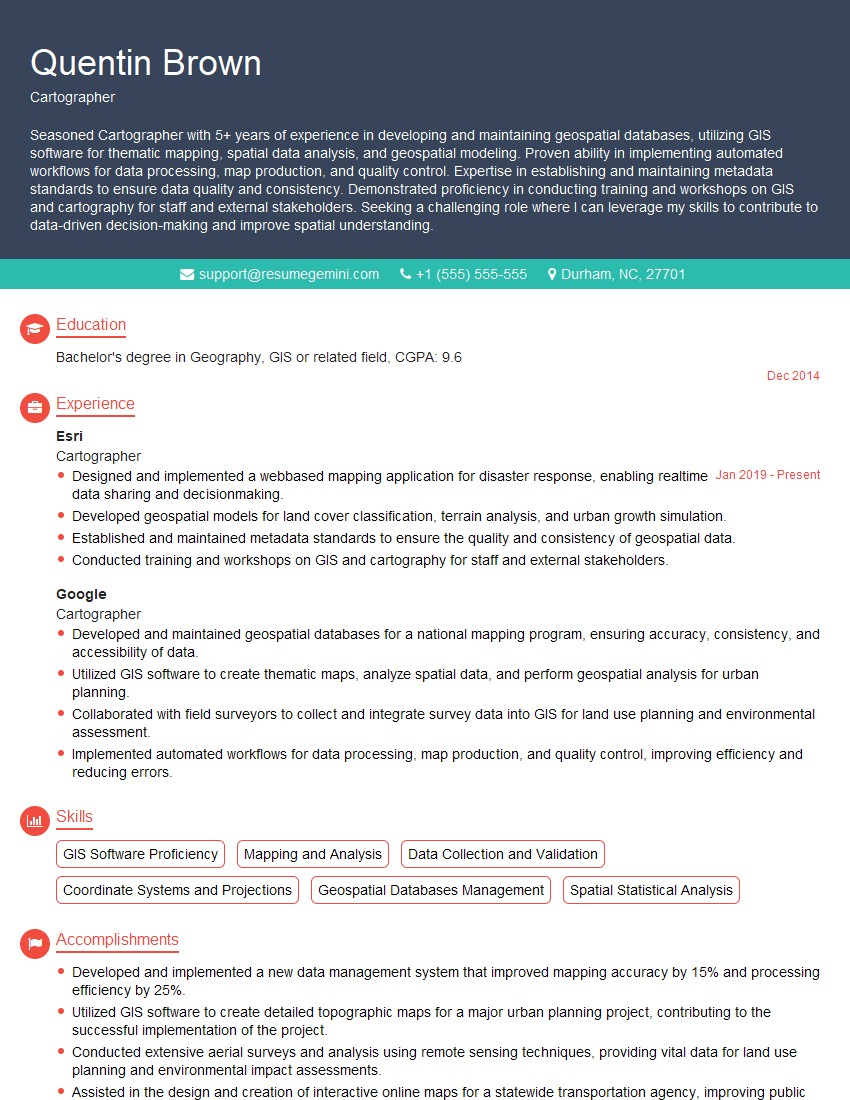
Mastering navigational charting is crucial for career advancement in the maritime industry, opening doors to rewarding roles with increased responsibility and compensation. An ATS-friendly resume is your key to unlocking these opportunities. To ensure your qualifications shine, leverage the power of ResumeGemini to create a professional and impactful resume that gets noticed. ResumeGemini provides you with the tools and resources to build a compelling narrative, highlighting your skills and experience effectively. Examples of resumes tailored to Navigational Charting are available to guide you.
Explore more articles
Users Rating of Our Blogs
Share Your Experience
We value your feedback! Please rate our content and share your thoughts (optional).
What Readers Say About Our Blog
Very informative content, great job.
good