Interviews are opportunities to demonstrate your expertise, and this guide is here to help you shine. Explore the essential NFPA 13 and 14 Knowledge interview questions that employers frequently ask, paired with strategies for crafting responses that set you apart from the competition.
Questions Asked in NFPA 13 and 14 Knowledge Interview
Q 1. Explain the differences between NFPA 13 and NFPA 14.
NFPA 13 and NFPA 14 are both crucial standards for fire protection, but they address different systems. NFPA 13, Standard for the Installation of Sprinkler Systems, focuses on the design, installation, and inspection of sprinkler systems themselves. Think of it as the blueprint and construction guide for your building’s fire suppression network. NFPA 14, Standard for the Installation of Standpipe and Hose Systems, deals with standpipe systems – those vertical pipes with hose connections allowing firefighters to fight fires from inside a building. It’s like the supplemental firefighting infrastructure that works alongside the sprinkler system. In essence, NFPA 13 is about automatically extinguishing fires, while NFPA 14 is about providing firefighters with the tools to tackle fires directly.
Q 2. Describe the various types of sprinkler systems covered by NFPA 13.
NFPA 13 covers a wide array of sprinkler system types, each designed for different occupancy types and hazard classifications. These include:
- Wet-pipe systems: These are the most common type, with water always present in the pipes. Think of them as always being ‘ready to go’.
- Dry-pipe systems: Used in unheated areas or where freezing is a concern, these systems have compressed air in the pipes, which is released when a sprinkler activates, allowing water to flow.
- Deluge systems: These systems have all the sprinkler heads open, and water is discharged when a fire alarm activates. This is typically used for high-hazard occupancies like paint storage.
- Preaction systems: A combination of dry-pipe and wet-pipe, these systems require both a fire alarm and a sprinkler head activation to release water. This minimizes accidental water discharge.
- Residential systems: These systems are specifically designed for residential applications and often utilize smaller piping and lower water pressures.
The choice of system depends on factors like the occupancy’s inherent fire risks, environmental conditions, and cost considerations.
Q 3. What are the requirements for water supply in NFPA 13?
Water supply is paramount for a sprinkler system’s effectiveness. NFPA 13 mandates sufficient water pressure and flow to ensure adequate water delivery to all sprinklers during a fire. This is determined through hydraulic calculations (discussed further in the next answer). The requirements consider:
- Water supply source: This could be a municipal water main, a fire pump, a gravity tank, or a combination.
- Pressure: Sufficient residual pressure must remain at the most remote sprinkler after the system’s flow is established.
- Flow: The system must provide enough water to control the fire effectively in the design fire scenario.
- Redundancy: Backup systems or sources are often required to maintain water supply in case of failure.
Imagine a scenario where a fire breaks out in a large warehouse. If the water supply is insufficient, the sprinklers might not deliver enough water to suppress the fire, leading to significant damage. NFPA 13’s water supply requirements are designed to prevent such situations.
Q 4. Explain the concept of hydraulic calculations in sprinkler system design.
Hydraulic calculations are the backbone of sprinkler system design. They’re a series of complex computations used to determine the adequacy of the water supply, pipe sizing, and sprinkler placement. These calculations ensure that enough water will reach each sprinkler head during a fire, delivering the required flow rate and pressure. This process considers:
- Sprinkler K-factor: Represents the flow rate of the sprinkler.
- Pipe friction loss: The pressure drop in the pipes due to the flow of water.
- Elevation changes: The impact of elevation differences on pressure.
- Sprinkler density: The number of sprinklers per unit area.
Software is frequently used to perform these calculations, considering various scenarios and ensuring compliance with NFPA 13. A properly performed hydraulic calculation is the key to ensuring the sprinkler system will operate as intended in a real fire situation.
Q 5. How do you determine the appropriate sprinkler spacing and density?
Sprinkler spacing and density are crucial for effective fire suppression. They’re directly influenced by the type of occupancy and the hazard classification. NFPA 13 provides tables and guidelines for determining appropriate spacing based on the sprinkler’s K-factor and the type of occupancy. For example, a high-hazard occupancy like a chemical plant will require closer spacing and higher density than a low-hazard occupancy like an office building. Density is expressed as the number of sprinklers per square foot (or meter). Proper spacing ensures complete coverage and prevents the spread of fire between sprinklers.
Imagine a warehouse with widely spaced sprinklers. If a fire starts between two sprinklers, the fire could grow significantly before the sprinklers effectively suppress it. Appropriate spacing and density are essential to control the fire’s spread and minimize damage.
Q 6. What are the requirements for fire department connections (FDC) according to NFPA 14?
NFPA 14 specifies requirements for fire department connections (FDCs) which are critical access points for firefighters to connect their hoses to a building’s water supply. Key requirements include:
- Location: FDCs must be readily accessible to firefighters, typically located near building entrances, often in a protected enclosure.
- Size and type: The size of the connection must be sufficient to supply the required flow rate.
- Signage: Clear and visible signage must indicate the location of the FDC.
- Protection: The FDC must be protected from damage and freezing.
- Testing: Regular testing is required to verify the FDC’s functionality.
Consider a situation where a major fire occurs in a high-rise building. If the FDC is poorly located, damaged, or improperly sized, firefighters might face delays in connecting their hoses, severely impacting their ability to combat the fire.
Q 7. Describe the different types of standpipe systems.
NFPA 14 details several types of standpipe systems, each designed for specific needs:
- Class I: Designed for use by fire department personnel only. These systems provide high-pressure water for large-caliber hoses.
- Class II: Intended for use by building occupants. These systems provide lower-pressure water for smaller-diameter hoses.
- Class III: Combines the features of Class I and Class II, providing both high- and low-pressure connections.
The choice depends on the building’s size, occupancy, and the anticipated needs of both firefighters and building occupants. A high-rise building would likely need a Class I or Class III system to ensure firefighters have the necessary pressure to reach higher floors, while a smaller building might suffice with a Class II system for building occupant use.
Q 8. What are the requirements for pressure testing and inspection of standpipe systems?
NFPA 13 and 14 outline rigorous pressure testing and inspection requirements for standpipe systems, crucial for ensuring their readiness in emergencies. The frequency and methods depend on the system’s type and location. For example, new systems undergo a thorough hydrostatic pressure test before being put into service. This involves pressurizing the system to a specified level (usually 150% of the system’s design pressure) to check for leaks or weaknesses.
Regular inspections, often annual, are also mandated. These inspections involve visual checks for corrosion, damage, obstructions, proper valve operation, and the overall integrity of the system components. Documentation of these inspections is critical. Any deficiencies identified must be promptly repaired and retested before returning the system to service. The specific requirements vary based on factors like system design, occupancy type, and local authority having jurisdiction (AHJ) requirements. Think of it like a thorough health check-up for your building’s fire protection ‘lifeline’.
For example, a high-rise building’s standpipe system will require more frequent and detailed inspections than a smaller, low-risk building. This is because the consequences of failure in a high-rise are significantly greater.
Q 9. Explain the importance of water flow alarms in fire protection systems.
Water flow alarms are the early warning system for your fire suppression network. Their importance lies in providing immediate notification when water is flowing unexpectedly in a sprinkler or standpipe system. This rapid alert is crucial for several reasons:
- Faster Response: The alarm signals the need for immediate action, alerting building occupants, fire departments, and building management of a potential fire.
- Pinpointing the Problem: It helps locate the exact location of the water flow, enabling fire fighters to quickly assess and address the situation. This reduces response time and potential damage.
- Preventing Unnecessary Water Damage: In case of a false alarm (e.g., accidental activation), the alarm allows for a quick investigation and prevents extensive water damage before it occurs.
Imagine a scenario without flow alarms – a fire starts, and the sprinkler system activates, but no one notices until significant damage has already occurred. The flow alarm acts as the critical link between the event and the response, minimizing damage and loss of life.
Q 10. What are the requirements for system maintenance and testing outlined in NFPA 13 and 14?
NFPA 13 and 14 mandate regular maintenance and testing to ensure the ongoing reliability of fire protection systems. These requirements are not merely suggestions but mandatory for ensuring the system is in optimal working condition at all times. Frequency and types of testing vary depending on the system type, its location, and the AHJ’s requirements.
Here are some key aspects of system maintenance and testing:
- Regular Inspections: These are typically annual visual inspections for any signs of corrosion, damage, or obstruction in system components.
- Hydrostatic Testing: This involves pressurizing the system with water to verify its structural integrity. Frequency depends on the system’s age and material, but it’s generally done at intervals specified in the standards.
- Operational Tests: This ensures the system operates correctly, such as checking the flow switch operation or alarm activation in sprinkler systems.
- Maintenance Records: All inspections, tests, and repairs must be meticulously documented for auditing purposes. This ensures accountability and that the system is always up-to-code.
Failure to perform these tests and maintain thorough documentation can lead to fines and even legal ramifications, especially in case of a fire.
Q 11. How do you interpret and apply the relevant tables and figures in NFPA 13 and 14?
The tables and figures in NFPA 13 and 14 are the heart of the standards, providing crucial data for system design and installation. They are not meant to be intimidating but rather a structured way of providing necessary information and calculations. Mastering their interpretation is essential for any fire protection professional.
For example, tables might specify the required water flow rate for a given occupancy type and area, while figures may illustrate the proper arrangement of sprinkler heads or the design criteria for various pipe sizes. To interpret these correctly, you’ll need to understand the variables involved – occupancy classification, floor area, building construction type, etc.
Let’s imagine designing a sprinkler system for a warehouse. You’ll consult the appropriate tables to determine the required water flow rate based on the warehouse’s square footage and the contents stored. The figures will then guide you in determining the required sprinkler head spacing, pipe sizing, and pump capacity to ensure sufficient water supply.
Proper interpretation requires careful attention to detail, ensuring correct identification of the relevant table or figure based on building characteristics and adherence to the specific instructions provided.
Q 12. Describe the different types of sprinkler heads and their applications.
Sprinkler heads are the critical interface between the piping system and the fire. They are designed to activate when exposed to sufficient heat, releasing water to extinguish or suppress the fire. Different types cater to specific needs:
- Standard Response Sprinkler Heads: These are the most common type, designed to activate at a specific temperature. They are used in general-purpose applications.
- Early Suppression Fast Response (ESFR) Sprinklers: These heads are designed to discharge water earlier and more rapidly than standard response heads. They are often used in high-rack storage warehouses where fire growth can be exceptionally rapid.
- Pendant Sprinklers: These hang down from the piping and are typically used in applications with high ceilings.
- Upright Sprinklers: These are mounted on top of the piping and are suitable for use with lower ceilings.
- Sidewall Sprinklers: These are mounted on the walls and are useful for protecting areas where pendant or upright heads are less suitable.
The selection of the appropriate sprinkler head type depends on several factors, including the occupancy type, hazard classification, ceiling height, and the presence of combustible materials. Each type has specific design considerations outlined in NFPA 13. A warehouse full of highly flammable materials would need ESFR heads, whilst an office building might utilize standard response heads.
Q 13. What are the requirements for fire protection system design in high-rise buildings?
Designing fire protection systems for high-rise buildings presents unique challenges due to the building’s height, occupancy, and potential for rapid fire spread. NFPA 13 and other related codes address these by mandating specific design features:
- Multiple Fire Pumps: High-rise buildings typically need multiple fire pumps to ensure sufficient water pressure and flow at all levels.
- Standpipe Systems: Standpipes provide access points for firefighters to connect hoses and fight fires from various locations. Their design must ensure adequate water pressure and flow throughout the building’s height.
- Sprinkler System Design: The sprinkler system requires careful design to account for water pressure losses due to height. This involves calculations to ensure sufficient water supply at the highest floors.
- Fire Department Connections (FDCs): These connections allow firefighters to access the building’s fire suppression systems externally. Their placement and access must be clearly marked and easily accessible.
- Smoke Control Systems: High-rise buildings usually require sophisticated smoke control systems to prevent smoke spread and provide safe evacuation routes.
Think of it like this: A high-rise building is a vertical city, and each floor needs its own independent fire protection considerations. The design needs to anticipate these challenges and account for potentially severe scenarios.
Q 14. How do you address challenges related to unusual building layouts or construction materials?
Unusual building layouts or construction materials demand creative and code-compliant solutions. Addressing these challenges requires a thorough understanding of NFPA standards and the ability to apply them flexibly while adhering to safety regulations. Here are some strategies:
- Consult NFPA 13 and 14: These standards offer guidance on design considerations for various unusual situations, including special construction materials or complex layouts.
- Engineering Analysis: For atypical situations, engineering calculations and simulations are often necessary to determine the appropriate system design. This can involve computational fluid dynamics (CFD) to model the behavior of fire and water flow within the unusual geometry.
- Special Inspections: The AHJ may require special inspections for unusual features to ensure adherence to code.
- Alternative Designs: In some cases, alternative designs using different sprinkler head types or system configurations might be necessary to accommodate the special requirements.
- Material Specific Design: Special considerations are needed for materials such as those with high flammability or unusual heat transfer properties. Calculations might be required to consider the fire’s behavior in such materials.
For instance, a building with a large atrium would require careful modeling of smoke movement to ensure the sprinkler system effectively protects the entire area. Similarly, buildings incorporating materials with unique fire performance characteristics (such as certain types of insulation) necessitate design adjustments to guarantee the required level of fire protection.
Q 15. What are the considerations for protecting hazardous materials storage areas?
Protecting hazardous materials storage areas requires a multi-faceted approach that goes beyond standard fire sprinkler systems. NFPA 13 and other relevant codes provide guidance, but the specific design depends heavily on the nature of the hazards. We must consider the properties of the stored materials – their flammability, reactivity, toxicity, and potential for explosion.
- Material Compatibility: Sprinkler system components must be compatible with the stored materials to prevent corrosion or chemical reactions. For example, stainless steel or special coatings might be necessary for corrosive substances.
- Increased Sprinkler Density: Higher sprinkler densities might be required for highly flammable materials to ensure adequate suppression. This often necessitates smaller spacing between sprinklers and potentially higher system pressures.
- Deluge Systems or Pre-action Systems: Standard sprinkler systems might be inadequate for some hazardous materials. Deluge systems, which discharge all sprinklers simultaneously upon activation, or pre-action systems, which require a secondary trigger after the initial alarm, might be necessary for rapid suppression of large fires or to prevent accidental discharge.
- Fire Containment: The building design itself needs to incorporate fire-resistant construction, firewalls, and potentially dedicated fire-rated storage areas to prevent fire spread. This often involves consulting with structural engineers and architects.
- Special Suppression Agents: In some cases, water might not be the most effective extinguishing agent. Foam systems, gaseous agents (like CO2 or inert gases), or specialized dry chemical systems may be required depending on the material’s characteristics.
- Emergency Response Planning: A robust emergency response plan, including procedures for evacuation and hazard mitigation, is paramount. This involves working closely with emergency response teams and training personnel on proper procedures.
For instance, a facility storing highly flammable solvents would need a significantly different design than one storing relatively inert materials. The design must carefully balance the level of protection needed with the cost and feasibility of implementation.
Career Expert Tips:
- Ace those interviews! Prepare effectively by reviewing the Top 50 Most Common Interview Questions on ResumeGemini.
- Navigate your job search with confidence! Explore a wide range of Career Tips on ResumeGemini. Learn about common challenges and recommendations to overcome them.
- Craft the perfect resume! Master the Art of Resume Writing with ResumeGemini’s guide. Showcase your unique qualifications and achievements effectively.
- Don’t miss out on holiday savings! Build your dream resume with ResumeGemini’s ATS optimized templates.
Q 16. Explain the process for obtaining required permits and inspections.
Obtaining necessary permits and inspections is a crucial step in ensuring compliance. This process typically involves submitting detailed plans and specifications to the local authority having jurisdiction (AHJ). The specific requirements vary by location, but the general process includes:
- Plan Review Submission: Submit detailed design drawings, calculations, and specifications for the fire protection system to the AHJ. These documents must demonstrate compliance with all applicable codes and standards, including NFPA 13 and 14, as well as local ordinances.
- Permit Issuance: Once the AHJ approves the plans, they issue a permit to proceed with installation. This permit verifies that the design meets the minimum requirements.
- Inspection During Installation: Throughout the installation process, the AHJ performs inspections to ensure that the system is being installed according to the approved plans. This may involve several inspections at different stages, like rough-in, piping, and final inspection. Any deviations must be promptly addressed and often require plan revisions and re-approval.
- Testing and Commissioning: Upon completion of installation, the system undergoes thorough testing and commissioning to verify that it functions correctly and meets performance standards. This involves testing individual components and the entire system, documenting all test results and providing them to the AHJ.
- Final Inspection and Permit Closing: A final inspection ensures that the system is fully functional, meets all code requirements, and has all the necessary documentation. The AHJ then closes the permit, certifying that the fire protection system is compliant.
I have extensive experience navigating this process in various jurisdictions, understanding the nuances of local regulations and ensuring a smooth and timely approval process.
Q 17. How do you ensure compliance with local and state fire codes in addition to NFPA 13 and 14?
Ensuring compliance with local and state fire codes in addition to NFPA 13 and 14 requires a diligent approach. The first step is to identify all applicable codes. NFPA codes provide national standards, but local authorities may adopt more stringent regulations or incorporate modifications.
- Code Research: Thoroughly research and obtain copies of all relevant local and state fire codes. This may involve checking with the AHJ, reviewing online resources, and consulting with code experts.
- Compliance Analysis: Carefully compare and contrast the NFPA standards with the local and state codes to identify any discrepancies or stricter requirements. It’s crucial to meet the most stringent requirements.
- Design Modifications: Modify the design to meet any stricter local or state requirements. This may involve changes to system components, layout, or performance criteria.
- Documentation: Maintain meticulous documentation throughout the entire process, including code references, design calculations, test results, and any deviations from the standards or the approved plans.
- Continuous Monitoring: Ensure ongoing compliance through regular inspections, maintenance, and testing of the fire protection system. Codes and regulations can change, so staying updated is essential.
For instance, a project in one municipality might mandate specific types of fire dampers or require more frequent testing than in another. My expertise lies in adapting the NFPA standards to meet the unique requirements of every jurisdiction.
Q 18. Describe your experience with fire protection system design software.
I have extensive experience using various fire protection system design software, including (mention specific software names here, e.g., Autosprink, HydraCAD, etc.). These software packages are invaluable for efficient and accurate design. My expertise encompasses:
- Hydraulic Calculations: I proficiently use the software to perform complex hydraulic calculations, ensuring adequate water flow and pressure throughout the system. This includes pipe sizing, pump selection, and sprinkler selection.
- System Modeling: I can create detailed 3D models of the fire protection systems, helping visualize the system layout, identify potential conflicts, and optimize design.
- Report Generation: The software allows me to generate comprehensive reports that include detailed design calculations, drawings, and schedules. These reports are crucial for submitting to the AHJ for review and approval.
- Code Compliance Checks: Many software packages incorporate built-in code compliance checks that help identify potential violations of NFPA standards and other relevant codes, ensuring that my designs meet regulatory requirements.
I leverage the software’s capabilities to reduce design time, minimize errors, and improve the overall efficiency of my design process. It’s not simply about using the software; it’s about understanding the underlying principles and using the software to effectively apply those principles.
Q 19. Explain your experience with different types of piping materials and their suitability.
Selecting appropriate piping materials is critical for the longevity and performance of the fire sprinkler system. The choice depends on several factors, including the system’s pressure, the environment, and the potential for corrosion.
- Black Iron Pipe (Steel): A common choice due to its strength and cost-effectiveness, but susceptible to corrosion, particularly in corrosive environments. Galvanizing can improve corrosion resistance, but it is crucial to specify this.
- Copper Pipe: Offers excellent corrosion resistance and a long lifespan. It’s often used in areas where corrosion is a concern, but it is more expensive than black iron.
- CPVC (Chlorinated Polyvinyl Chloride): A plastic pipe widely used for its corrosion resistance and ease of installation, particularly in smaller systems. It has limitations on temperature and pressure, however.
- Stainless Steel Pipe: Highly resistant to corrosion and suitable for aggressive environments. It’s more expensive but can be justified for applications where corrosion is a significant risk, such as in chemical plants or coastal areas.
My experience includes selecting the optimal piping material for various projects, balancing cost, durability, and the specific requirements of the environment. For instance, in a coastal facility, I would likely specify stainless steel or copper due to the high salt content in the air. In a standard office building, black iron with galvanizing might be a cost-effective option. The decision isn’t arbitrary; it’s based on a thorough assessment of the project’s needs.
Q 20. How do you handle discrepancies or conflicts between NFPA 13, 14, and local codes?
Handling discrepancies between NFPA 13, 14, and local codes necessitates a hierarchical approach. The most stringent requirement always prevails.
- Identify Conflicts: Carefully review all applicable codes to pinpoint any conflicts or differences in requirements.
- Prioritize: Determine which code takes precedence. Generally, local codes supersede NFPA standards. If there are conflicts between different local codes, the AHJ’s interpretation will be the final authority.
- Document Deviations: Clearly document any deviations from NFPA standards or other codes, explaining the reasoning behind the chosen approach and referencing the overriding code section that necessitates the deviation.
- Seek Clarification: If there are ambiguities or uncertainties about code interpretation, seek clarification from the AHJ before proceeding. This helps avoid costly revisions or delays later in the process.
- Engineer for Compliance: Design the system to satisfy the most stringent requirements, even if it means exceeding the minimum standards specified in NFPA 13 or 14. This proactive approach minimizes the risk of code violations and ensures safety.
For example, if a local code mandates a higher sprinkler density than NFPA 13 recommends for a specific occupancy type, I would design the system to meet the stricter local requirement. This approach ensures that the system adequately protects the building and its occupants, even if it means higher material costs.
Q 21. What are some common mistakes to avoid in fire sprinkler system design?
Several common mistakes can significantly impact fire sprinkler system design and effectiveness. Avoiding these is crucial to ensure proper protection:
- Inadequate Hydraulic Calculations: Inaccurate or insufficient hydraulic calculations can lead to inadequate water flow and pressure, compromising the system’s ability to extinguish a fire. Careful review and verification are vital.
- Incorrect Sprinkler Selection: Choosing the wrong type or density of sprinklers can result in insufficient water distribution, leading to inadequate fire suppression.
- Neglecting Code Requirements: Overlooking or misinterpreting specific code requirements can lead to non-compliant systems and potential safety hazards.
- Poor Pipe Sizing: Improper pipe sizing can restrict water flow and pressure, reducing the system’s effectiveness. Accurate sizing is essential to ensure adequate flow to all areas.
- Lack of System Testing: Failure to thoroughly test the system upon completion can leave hidden issues undetected, resulting in system malfunction during a real fire.
- Ignoring Environmental Factors: Overlooking environmental factors, such as corrosion or freezing temperatures, can lead to premature system failure or reduced performance.
- Insufficient Maintenance Planning: A well-designed system requires regular maintenance to ensure its long-term performance. Failure to plan for this can result in reduced effectiveness and unexpected system failures.
These are just a few examples. A thorough understanding of NFPA 13, 14, and local codes, combined with practical experience and attention to detail, are essential to avoid these mistakes and create safe, effective fire protection systems. Regular training and professional development remain key to staying abreast of best practices.
Q 22. Describe your experience with troubleshooting and repairing fire protection systems.
Troubleshooting and repairing fire protection systems requires a systematic approach combining technical knowledge with practical skills. My experience encompasses a wide range of issues, from simple component replacements to complex system failures. For instance, I once diagnosed a faulty fire pump by systematically checking the power supply, control panel, and pressure gauges. After isolating the issue to a malfunctioning pressure switch, I replaced it, restoring the system to full functionality. Another project involved tracing intermittent alarms in a sprinkler system. By carefully reviewing the system’s flow logs and performing a thorough inspection of the piping, I identified a small leak that was triggering the alarms. This involved using specialized equipment to pinpoint the location of the leak and then making the necessary repairs. My approach always prioritizes safety, adhering strictly to NFPA standards and lockout/tagout procedures. I’m proficient in interpreting system schematics, conducting pressure tests, and using diagnostic tools to identify the root cause of problems, leading to efficient and effective repairs.
Q 23. How do you stay current with changes and updates to NFPA 13 and 14?
Staying current with NFPA 13 (Standard for the Installation of Sprinkler Systems) and NFPA 14 (Standard for the Installation of Standpipes and Hose Systems) is crucial for maintaining competency in this field. I achieve this through several methods: actively attending NFPA-sponsored training courses and seminars, subscribing to relevant professional journals like Fire Protection Engineering, and actively participating in industry associations like the NFPA themselves. I also regularly review the latest editions and amendments of the NFPA codes and standards. Finally, I maintain a professional network with other fire protection engineers and technicians, allowing for knowledge sharing and updates on recent developments. This continuous professional development ensures that my work adheres to the most up-to-date safety regulations and best practices.
Q 24. What is your understanding of risk assessment in fire protection system design?
Risk assessment is fundamental to effective fire protection system design. It’s not just about meeting minimum code requirements, but about tailoring the system to the specific hazards of the building or facility. This involves identifying potential fire sources, evaluating the occupancy type, analyzing the building’s construction, and assessing the potential for occupant injuries and property damage. Factors such as building height, sprinkler system type, and the presence of hazardous materials all impact the risk assessment. For example, a high-rise building with flammable materials will require a far more sophisticated sprinkler system with higher water flow rates than a small, low-risk office building. The assessment considers both the likelihood of a fire and its potential severity, leading to a balanced approach to fire protection engineering. The goal is to design a system that provides appropriate levels of protection based on the identified risks, balancing cost-effectiveness with safety.
Q 25. Explain the concept of water flow switches and their role in fire alarm systems.
Water flow switches are essential components in fire alarm systems, serving as early warning devices. They are installed within sprinkler systems’ piping. When a sprinkler activates, a significant flow of water occurs, triggering the switch. This switch then sends a signal to the fire alarm control panel, initiating an alarm and potentially triggering other automatic systems, such as building evacuation systems. It’s crucial to differentiate them from pressure switches which only detect a pressure drop within the system. Water flow switches provide a positive confirmation of water flow, ensuring that the alarm is accurate and not caused by minor pressure fluctuations. This confirmation is crucial in triggering a timely response to an actual fire event.
Q 26. Describe your experience with the preparation of fire protection system submittals.
Preparing fire protection system submittals involves compiling detailed documentation for review and approval by the relevant authorities. This process requires meticulous attention to detail and a thorough understanding of the applicable codes and standards. My experience involves creating comprehensive documents containing system drawings, specifications, calculations (e.g., hydraulic calculations for sprinkler systems), equipment lists, and compliance certifications. These documents must clearly illustrate the design, demonstrate code compliance, and specify all necessary materials and components. A recent project involved submitting a detailed proposal for a new fire sprinkler system in a high-rise residential building. The submittal included detailed shop drawings, calculations confirming sufficient water supply and pressure, and all necessary certifications for the sprinkler heads, pipes, and other components. This meticulous preparation ensured the project’s swift approval and efficient execution.
Q 27. What is your understanding of the importance of documenting all phases of a fire protection project?
Thorough documentation is paramount for all phases of a fire protection project, ensuring accountability and facilitating future maintenance and repairs. This starts with the initial design phase, including risk assessments and system design calculations, and extends through construction, testing, and commissioning. Detailed records of inspections, testing procedures, and results are essential for compliance verification. Accurate “as-built” drawings, reflecting the final system configuration, are crucial for future maintenance and renovations. Comprehensive documentation safeguards against potential liabilities, provides a clear history of the system, and facilitates ongoing management and effective maintenance. Imagine a scenario where a system needs repair ten years later. Without proper documentation, troubleshooting becomes significantly more difficult and expensive.
Q 28. How familiar are you with the different types of fire alarm system notification appliances and their applications?
Fire alarm system notification appliances come in various types, each suited to specific applications. These include audible appliances like horns, bells, and speakers, often used to alert building occupants of a fire. Visual notification appliances such as strobe lights are essential for alerting individuals with hearing impairments. Voice communication systems can provide clear instructions and guidance during an evacuation. The choice of appliance depends on factors such as occupancy type, building size, and the needs of the building’s occupants. For instance, a hospital might require specialized notification appliances in patient rooms to ensure timely alerts to both patients and medical staff. A large industrial facility might use a combination of horns, strobes, and voice alarms to ensure wide coverage and clear communication. Understanding these different options and their applications is key to designing effective and accessible fire alarm systems.
Key Topics to Learn for NFPA 13 and 14 Knowledge Interview
Acing your NFPA 13 and 14 interview requires a deep understanding of both theoretical concepts and practical applications. Focus your preparation on these key areas:
- Water-Based Fire Suppression Systems (NFPA 13): Understand system design principles, including piping, components, and hydraulic calculations. Explore different sprinkler types and their applications, and be prepared to discuss system maintenance and testing procedures.
- Standpipe and Hose Systems (NFPA 14): Master the design and installation requirements for standpipe systems, including various system classifications and their suitability for different occupancies. Be familiar with hose connections, nozzle types, and water supply considerations.
- Code Interpretation and Application: Practice interpreting code requirements and applying them to real-world scenarios. This includes understanding the impact of different occupancy classifications and hazard classifications on system design.
- Inspection, Testing, and Maintenance (ITM): Thoroughly review the ITM procedures for both sprinkler and standpipe systems. Be ready to discuss common deficiencies and corrective actions.
- System Hydraulic Calculations: Develop a strong understanding of how to perform hydraulic calculations to ensure adequate water supply and pressure for fire suppression. Practice solving various scenarios.
- Fire Protection Engineering Principles: Connect your knowledge of NFPA 13 and 14 to broader fire protection engineering principles, demonstrating a holistic understanding of fire safety.
- Problem-Solving and Critical Thinking: Prepare to analyze case studies or hypothetical scenarios, demonstrating your ability to apply your knowledge to solve practical problems.
Next Steps
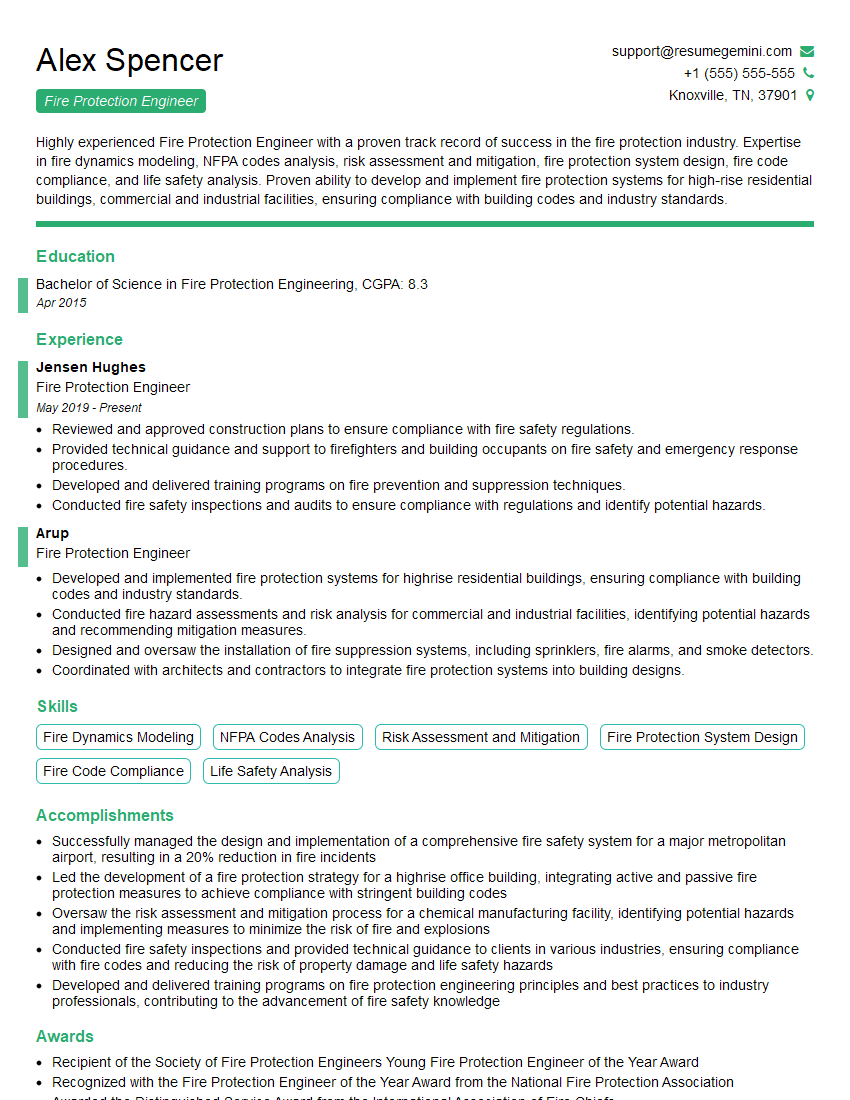
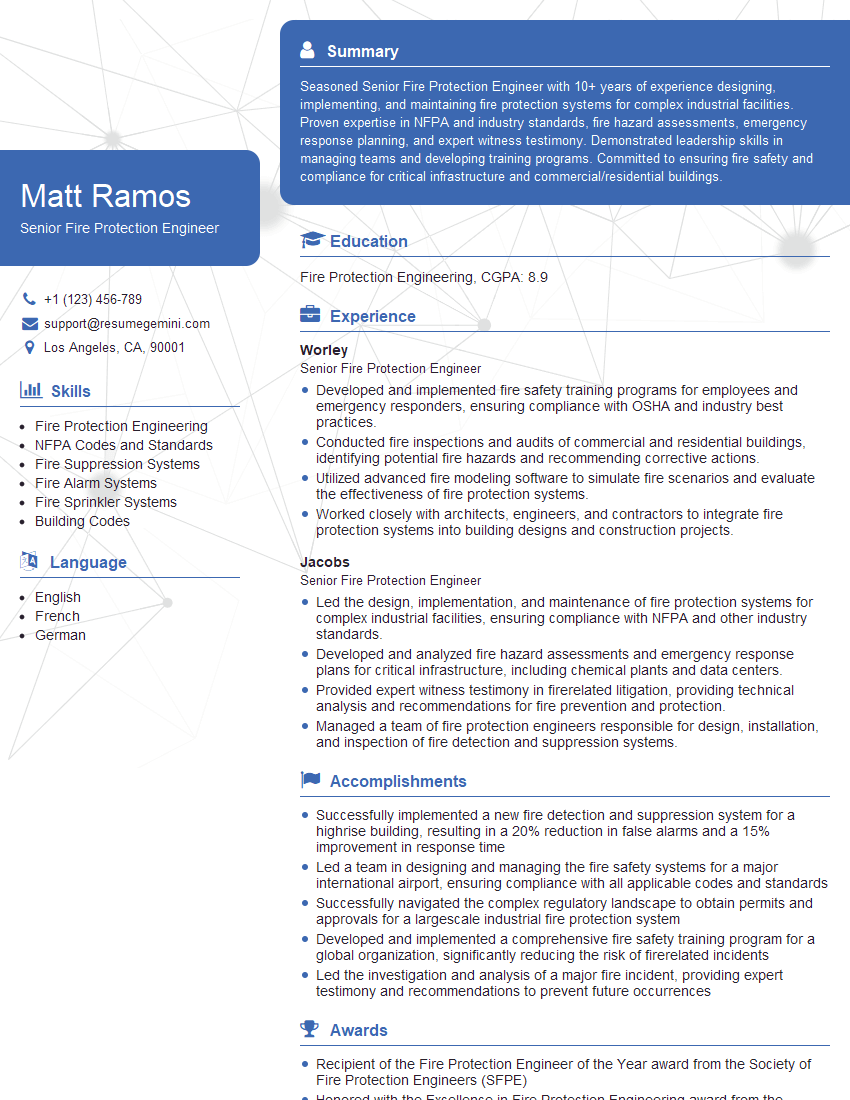
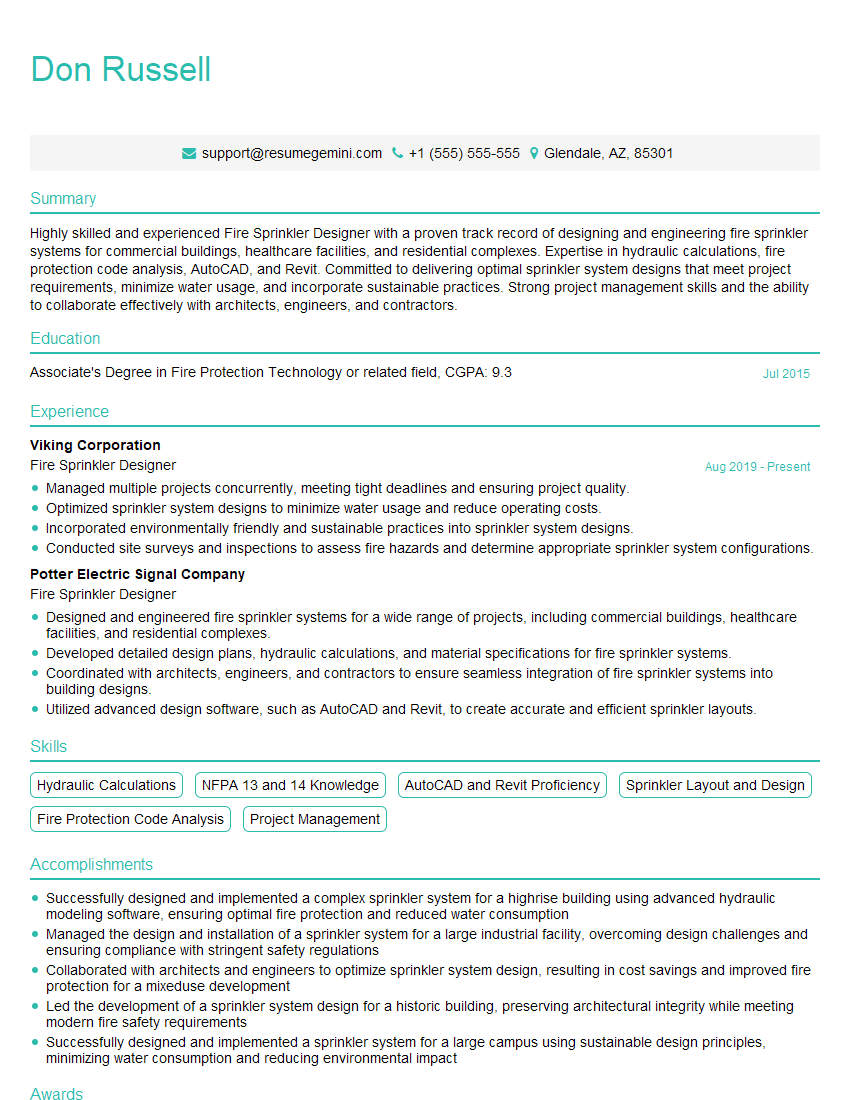
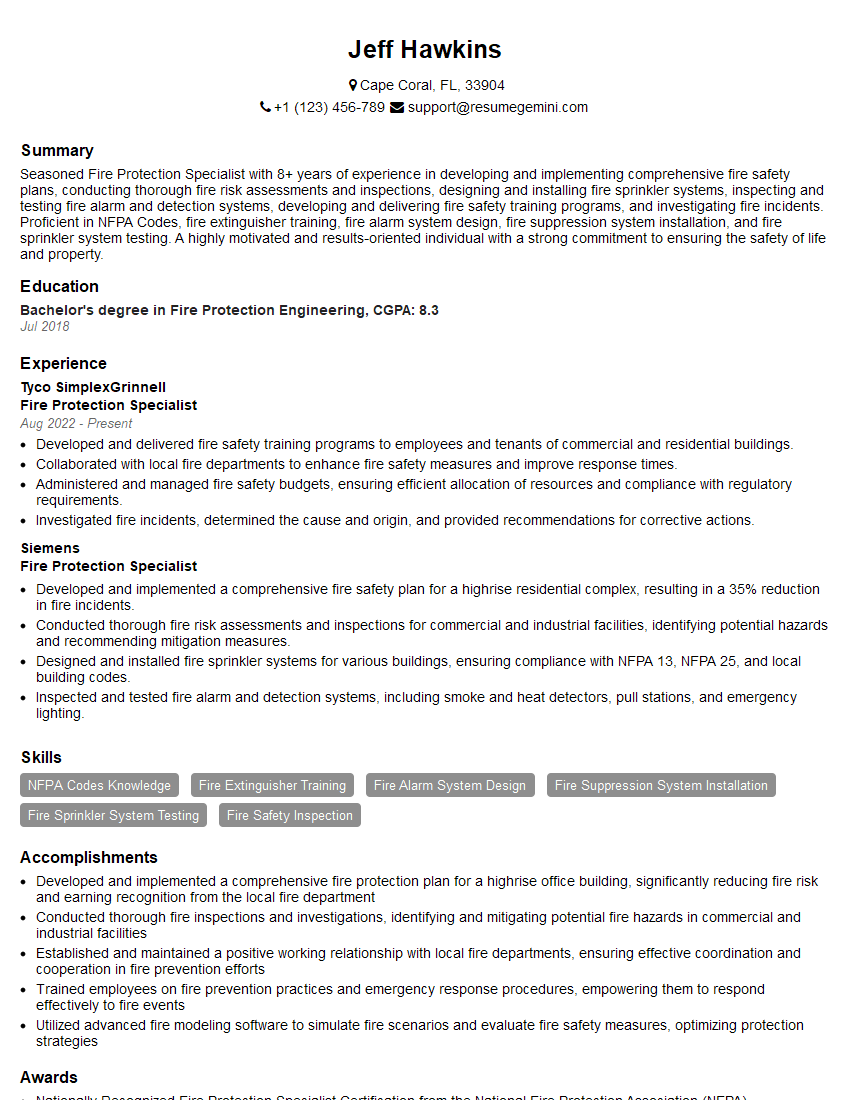
Mastering NFPA 13 and 14 knowledge is crucial for career advancement in the fire protection industry, opening doors to exciting opportunities and higher earning potential. To maximize your job prospects, it’s essential to present your skills effectively. An ATS-friendly resume is key to getting your application noticed. We highly recommend using ResumeGemini to build a professional resume that showcases your expertise. ResumeGemini provides examples tailored to NFPA 13 and 14 knowledge, helping you create a compelling document that highlights your qualifications and gets you noticed by potential employers.
Explore more articles
Users Rating of Our Blogs
Share Your Experience
We value your feedback! Please rate our content and share your thoughts (optional).
What Readers Say About Our Blog
Very informative content, great job.
good