Cracking a skill-specific interview, like one for Nuclear Codes and Standards, requires understanding the nuances of the role. In this blog, we present the questions you’re most likely to encounter, along with insights into how to answer them effectively. Let’s ensure you’re ready to make a strong impression.
Questions Asked in Nuclear Codes and Standards Interview
Q 1. Explain the significance of ASME Section III in nuclear power plant construction.
ASME Section III, “Rules for Construction of Nuclear Power Plant Components,” is the cornerstone of nuclear power plant safety. It dictates the design, fabrication, erection, testing, and inspection of components vital to the plant’s safe operation. Think of it as the ultimate rulebook for building a nuclear reactor, ensuring everything from pressure vessels to piping meets stringent quality and safety standards to prevent catastrophic failures.
The significance stems from its focus on preventing failures that could lead to radioactive releases. Section III goes beyond general engineering codes by addressing the unique challenges of nuclear environments, including high pressures, temperatures, and radiation exposure. It mandates rigorous quality control at every stage, from material selection to welding procedures. This detailed approach minimizes the risk of component failure, which is paramount in nuclear power where the consequences of failure are extraordinarily severe.
- Design by analysis: Section III emphasizes rigorous stress analysis to ensure components can withstand the operating conditions.
- Material specifications: It defines specific material properties required for nuclear applications, ensuring resistance to radiation and corrosion.
- Fabrication and welding: Detailed procedures ensure high-quality welds, which are critical to preventing leaks and structural failure.
- Non-destructive examination (NDE): Section III mandates thorough inspections to detect flaws before they become critical.
Q 2. Describe the role of the NRC (Nuclear Regulatory Commission) in enforcing nuclear codes and standards.
The Nuclear Regulatory Commission (NRC) is the independent US government agency responsible for licensing and regulating nuclear power plants to protect public health and safety. Regarding nuclear codes and standards, the NRC plays a crucial role in ensuring compliance. They don’t create the codes themselves (like ASME), but they enforce adherence to them.
The NRC achieves this through a multifaceted approach:
- Licensing: Before a nuclear power plant can operate, it must obtain a license from the NRC. This process rigorously reviews the design and construction, ensuring compliance with all relevant codes and standards, including ASME Section III.
- Inspections: The NRC conducts regular inspections of operating plants to verify continued compliance and identify potential safety issues. These inspections assess adherence to codes and standards, operator training, emergency preparedness, and more.
- Enforcement: The NRC has the authority to take enforcement actions against licensees who fail to comply with regulations and codes. This might include issuing citations, imposing fines, or even ordering plant shutdowns.
- Code review and approval: While the NRC doesn’t write the codes, they review and approve the use of specific codes and standards for nuclear applications, ensuring they meet their safety criteria.
In essence, the NRC acts as the independent overseer, ensuring the codes are correctly applied and that plant operators maintain a high level of safety.
Q 3. What are the key differences between ASME Section VIII and ASME Section IX?
ASME Section VIII and ASME Section IX are both crucial for pressure vessel construction, but they address different aspects:
- ASME Section VIII, “Rules for Construction of Pressure Vessels,” covers the design, fabrication, inspection, and testing of pressure vessels. It’s broadly applicable to many industries, with different divisions catering to different vessel types and design approaches. In nuclear applications, it often complements Section III, addressing pressure vessels not explicitly covered by Section III’s specialized nuclear requirements. Think of it as the general guide for pressure vessels, covering various designs and applications.
- ASME Section IX, “Welding and Brazing Qualifications,” focuses solely on welding and brazing procedures and qualifications. It’s critical for ensuring the quality of welds in pressure vessels and other components. In nuclear power, where weld integrity is paramount, Section IX plays a vital role in guaranteeing that the welding processes used meet rigorous standards. It’s the specialized section dealing specifically with weld quality and the people performing them.
The key difference lies in their scope: Section VIII covers the overall vessel construction, while Section IX focuses exclusively on the welding aspects – crucial within the larger context of Section VIII (and Section III) compliance for nuclear applications.
Q 4. How do you ensure compliance with the latest revisions of relevant nuclear codes and standards?
Maintaining compliance with the latest revisions of nuclear codes and standards requires a proactive and systematic approach. Simply put, it’s about staying on top of updates and adjusting practices accordingly.
My strategy involves:
- Subscription to code updates: I maintain subscriptions to ASME and other relevant organizations to receive timely notifications of code revisions and addenda.
- Regular code review: I regularly review the latest code versions to identify changes that affect our work processes, design specifications, or inspection procedures.
- Training and development: I ensure myself and my team receive regular training on the latest code revisions and best practices. This includes attending workshops, seminars, and online courses.
- Implementation of revisions: Once a revision is released and its impact is fully understood, we implement the necessary changes to our processes and documentation.
- Document control: We maintain a robust document control system to ensure all relevant documents, including codes and standards, are up-to-date and readily accessible.
- Audits and inspections: We conduct internal audits and inspections to verify compliance with the latest code versions.
Staying current with code changes is not just about compliance; it’s about continuous improvement of safety and operational efficiency.
Q 5. Explain the importance of quality assurance (QA) and quality control (QC) in nuclear projects.
Quality assurance (QA) and quality control (QC) are indispensable for the success of any nuclear project, but especially critical given the high safety standards required. They are distinct but complementary elements.
Quality Assurance (QA) is a management system that defines the processes, procedures, and documentation necessary to ensure the quality of the product or service. It’s about preventing defects rather than detecting them. Think of it as the overall strategy for quality.
Quality Control (QC) involves implementing the QA procedures and verifying that they are being followed correctly. It’s the hands-on, day-to-day checking for defects. It’s about ensuring that the strategy is being executed effectively.
In nuclear projects, QA and QC are vital because:
- Safety: They minimize the risk of defects that could compromise safety.
- Regulatory compliance: They are crucial for complying with NRC regulations and codes and standards like ASME Section III.
- Reliability: They ensure the long-term reliability and performance of nuclear components and systems.
- Cost savings: While QA and QC involve costs, they prevent far greater costs associated with rework, failures, and delays.
In essence, QA and QC work in tandem to create a robust system for ensuring the highest levels of quality and safety in nuclear projects.
Q 6. Describe your experience with conducting nuclear audits and inspections.
I have extensive experience conducting nuclear audits and inspections, both internal and external, spanning various stages of the nuclear lifecycle—from design review to operational assessments.
My approach typically involves:
- Planning: Carefully defining the scope, objectives, and methodology of the audit or inspection, taking into account relevant codes and standards (ASME Section III, etc.) and regulatory requirements.
- Data gathering: Reviewing design documents, fabrication records, inspection reports, test results, and operational data to assess compliance.
- On-site inspections: Conducting physical inspections of facilities, equipment, and systems to verify compliance and identify potential issues.
- Interviewing personnel: Speaking with personnel to understand procedures, practices, and training effectiveness.
- Reporting: Preparing a comprehensive report detailing findings, including non-conformances and recommendations for corrective actions.
- Follow-up: Verifying that corrective actions are implemented effectively.
For example, I once led an audit of a nuclear power plant’s welding program, verifying compliance with ASME Section IX. The audit identified a minor procedural deviation; however, through proactive corrective actions, the plant successfully addressed the issue, preventing any potential safety concern.
Q 7. What are the different types of nuclear licenses and permits?
The types of nuclear licenses and permits vary depending on the activity and the regulatory authority (in the US, primarily the NRC). However, some common categories include:
- Construction permits: Authorize the construction of a new nuclear power plant, subject to strict adherence to design and safety standards.
- Operating licenses: Permit the operation of a nuclear power plant after it has been constructed and successfully completed safety reviews and testing.
Material licenses: Authorizations for possessing, using, or transferring radioactive materials, depending on the material’s type and quantity. These could range from those needed for medical isotopes to those for industrial applications.
- Waste disposal permits: Authorizations for the disposal of radioactive waste, ensuring proper handling, storage, and disposal to protect the environment and public health.
- Export/Import licenses: Authorizations for the international trade of nuclear materials or technology, crucial for compliance with international non-proliferation treaties.
The specifics of each license or permit are detailed and stringent, reflecting the unique safety and security considerations involved in nuclear activities.
Q 8. Explain the concept of ALARA (As Low As Reasonably Achievable) in radiation protection.
ALARA, or As Low As Reasonably Achievable, is a fundamental principle in radiation protection. It emphasizes that radiation exposure should be minimized to the lowest level feasible, considering economic and social factors. It’s not about eliminating all radiation exposure, which is impossible in many contexts, but striving for continuous optimization.
Think of it like driving a car: you can’t eliminate all risk of an accident, but you can minimize it by following traffic laws, driving defensively, and maintaining your vehicle. Similarly, ALARA guides us to implement measures that reduce radiation exposure without causing undue hardship or expense.
In practice, ALARA involves a multi-step process: identifying radiation sources, assessing potential exposure pathways, implementing engineering controls (e.g., shielding, distance), administrative controls (e.g., work procedures, training), and personal protective equipment (PPE). The cost-effectiveness of each measure is carefully evaluated to ensure that the benefits outweigh the costs. A thorough cost-benefit analysis is often required.
Q 9. How do you handle discrepancies or inconsistencies between different nuclear codes and standards?
Discrepancies between nuclear codes and standards are a common challenge. Handling them requires a systematic approach. First, I thoroughly review each code or standard to understand their scope, context, and underlying rationale. Often, apparent inconsistencies arise from different interpretations or applications rather than fundamental conflicts.
Next, I consult relevant regulatory guidance and any available commentaries or interpretations. I look for precedence in previous applications. I also try to contact experts in the relevant field to discuss the discrepancies. If necessary, I will escalate the matter to the appropriate regulatory body for clarification or to request a ruling on the conflicting requirements. Documentation is crucial at every stage – it provides a record of the decision-making process and ensures consistency in future applications.
In some cases, a conservative approach is adopted, choosing the more stringent requirement to ensure safety. For instance, if one standard specifies a lower radiation level limit than another, I will invariably choose the lower limit.
Q 10. Describe your experience working with probabilistic risk assessment (PRA) methods.
I have extensive experience with probabilistic risk assessment (PRA) methods, including fault tree analysis (FTA), event tree analysis (ETA), and Monte Carlo simulation. PRA is a powerful tool used to systematically identify and quantify potential hazards in nuclear facilities. It provides a quantitative measure of risk, helping to prioritize safety improvements and optimize resource allocation.
For example, in a previous project, we used FTA to model the potential failure of a critical safety system in a nuclear power plant. This involved identifying all possible failure modes and their probabilities. By combining this with ETA, we modeled the consequences of different system failures under various initiating events. The results guided the development of enhanced safety measures, such as redundancy and improved maintenance procedures.
My experience also includes performing sensitivity analyses, exploring the uncertainty in input parameters and their influence on the overall risk estimate. This is important to ensure robustness and reliability of the PRA results.
Q 11. Explain the process of implementing a corrective action plan (CAP) in response to a non-compliance finding.
Implementing a Corrective Action Plan (CAP) after a non-compliance finding involves a structured, multi-step process. First, a thorough root cause analysis is conducted to determine the underlying causes of the non-compliance. This might involve interviews, document review, and process analysis to identify contributing factors.
Once the root causes are identified, specific corrective actions are defined to address each cause. The CAP must detail the corrective action, responsible parties, deadlines, and verification methods to confirm its effectiveness. It’s essential to include preventative measures to prevent recurrence of the non-compliance.
After the corrective actions are implemented, verification activities are performed to confirm that the problem has been resolved and the root causes effectively addressed. This is often achieved through audits or inspections. The CAP is then reviewed and closed when all actions are completed and verified.
A key aspect is clear and comprehensive documentation throughout the entire process. This ensures transparency, traceability, and accountability, which are crucial for continuous improvement and regulatory compliance.
Q 12. How familiar are you with the IAEA (International Atomic Energy Agency) safety standards?
I am very familiar with the IAEA safety standards. My work has extensively involved applying these standards to various projects and assessments. I have a strong understanding of the IAEA’s Safety Standards Series, including the safety fundamentals, specific safety requirements for various nuclear facilities, and the operational safety requirements for nuclear materials transport.
The IAEA safety standards provide a comprehensive framework for ensuring nuclear safety and security worldwide. My knowledge encompasses the principles underpinning these standards and their practical application in different contexts. I also understand the importance of adhering to these standards and the implications of non-compliance.
Q 13. What are the key safety features incorporated in nuclear reactor designs?
Nuclear reactor designs incorporate numerous safety features to mitigate the risks associated with nuclear fission. These features can be broadly categorized into:
- Passive safety systems: These systems rely on natural phenomena like gravity or convection to function, requiring minimal operator intervention. Examples include natural circulation cooling systems and gravity-driven safety injection systems.
- Active safety systems: These systems require power and operator action to operate. Examples include emergency core cooling systems (ECCS) and reactor shutdown systems.
- Containment structures: These robust structures are designed to contain radioactive materials in the event of an accident, preventing their release into the environment. They are designed to withstand extreme pressures and temperatures.
- Reactor control systems: These systems monitor and control the nuclear reaction to maintain safe and stable operation. They can automatically shut down the reactor if necessary.
- Redundancy and diversity: Multiple independent safety systems are incorporated to improve reliability. Diversity ensures that the systems operate using different principles, reducing the likelihood of simultaneous failure.
The specific safety features employed vary depending on the reactor type and design, but the overarching goal is to prevent accidents and mitigate their consequences, limiting potential harm to personnel and the environment.
Q 14. Describe the different types of nuclear waste and their management strategies.
Nuclear waste comes in various forms, each requiring different management strategies. The main categories include:
- Spent nuclear fuel: This highly radioactive material is the byproduct of nuclear fission in reactors. It is typically stored in spent fuel pools or dry storage casks for extended periods, awaiting long-term geological disposal.
- High-level radioactive waste (HLW): This waste includes highly radioactive liquid and solid materials from reprocessing spent fuel. It requires extensive shielding and long-term storage or disposal.
- Low-level radioactive waste (LLW): This category includes materials with low levels of radioactivity, such as contaminated tools and clothing. It can be managed through various methods such as shallow land burial or incineration.
- Intermediate-level radioactive waste (ILW): This waste exhibits intermediate levels of radioactivity and includes materials such as resins and filters from nuclear plants. It requires more extensive management than LLW but less than HLW.
Management strategies focus on minimizing waste generation, safe storage, and ultimately, disposal. For HLW, deep geological repositories are being developed in several countries to isolate the waste from the biosphere for thousands of years. LLW and ILW are often managed through near-surface disposal facilities, while spent fuel management involves either direct disposal or, in some countries, reprocessing to recover fissile materials.
Q 15. Explain your understanding of radiation shielding design and calculations.
Radiation shielding design is a critical aspect of nuclear safety, aiming to minimize personnel exposure to ionizing radiation. It involves calculating the amount and type of shielding material needed to reduce radiation levels to acceptable limits. This process relies heavily on understanding the type and energy of the radiation source (alpha, beta, gamma, neutron), and the attenuation properties of various shielding materials like lead, concrete, and water.
Calculations involve complex physics, often utilizing Monte Carlo simulations or deterministic methods. These methods account for factors like radiation scattering, absorption, and buildup factors. For example, a gamma ray source might require significantly more lead shielding than a beta emitter, due to the greater penetrating power of gamma rays. A simplified calculation might involve using attenuation coefficients to estimate the thickness needed to reduce the radiation intensity to a target level. More sophisticated approaches account for the geometry of the source and shielding, as well as the presence of multiple radiation sources.
In practice, we’d use specialized software to model the radiation transport. The design process involves iterative steps – initial calculations, refinement based on simulation results, and adjustments to ensure compliance with regulatory standards and safety limits.
Career Expert Tips:
- Ace those interviews! Prepare effectively by reviewing the Top 50 Most Common Interview Questions on ResumeGemini.
- Navigate your job search with confidence! Explore a wide range of Career Tips on ResumeGemini. Learn about common challenges and recommendations to overcome them.
- Craft the perfect resume! Master the Art of Resume Writing with ResumeGemini’s guide. Showcase your unique qualifications and achievements effectively.
- Don’t miss out on holiday savings! Build your dream resume with ResumeGemini’s ATS optimized templates.
Q 16. How do you handle emergency situations involving radiation exposure?
Emergency response to radiation exposure is paramount and requires swift, coordinated action. The first step is to ensure the safety of personnel – evacuation and isolation of the affected area are crucial. Immediate actions include assessing the level of exposure, providing appropriate medical care (decontamination, wound management), and monitoring for internal and external contamination. This involves using radiation detection instruments like Geiger counters and dose meters to measure radiation levels and individual exposure.
Documentation is absolutely essential. We meticulously record radiation levels, personnel exposure readings, decontamination procedures, and medical treatments. This detailed record is vital for retrospective analysis and informed decision-making, as well as fulfilling regulatory reporting requirements. Emergency response plans are regularly reviewed and tested to ensure preparedness and effective coordination among various teams involved, from radiation safety officers to emergency medical services.
For instance, in a scenario involving a spill of radioactive material, we’d establish a perimeter, initiate evacuation procedures, use specialized equipment for clean-up and decontamination, and ensure the affected individuals receive prompt medical attention and monitoring. A clear chain of command and communication protocol are critical to the efficiency and success of such response efforts.
Q 17. Explain the importance of documentation and record-keeping in nuclear projects.
Thorough documentation and record-keeping are fundamental in nuclear projects due to the high safety and regulatory requirements. It’s not just about compliance; it’s about safety, transparency, and accountability. A complete record allows for tracing every step of a project, from initial design to decommissioning. This comprehensive record ensures that all safety procedures are followed and allows for any issues or deviations to be identified and addressed promptly.
Records include design specifications, operational data, maintenance logs, safety audits, incident reports, and regulatory approvals. This information is crucial for future analysis, modifications, or inspections. In the event of an incident or accident, a detailed history aids in investigation and prevents recurrence. The regulatory bodies rely heavily on these records to verify compliance and assess the safety of the facility. Without meticulous records, it’s impossible to demonstrate adherence to safety regulations and maintain operational integrity.
For instance, a meticulously maintained log of radiation levels, personnel dosimeter readings, and equipment maintenance schedules might prove vital in uncovering the cause of a radiation leak. It provides the foundation for a thorough root cause analysis and supports the implementation of corrective actions to prevent similar events.
Q 18. What software or tools do you use to perform nuclear safety analysis?
Nuclear safety analysis relies on sophisticated software tools. These tools allow us to model complex radiation transport, thermal hydraulics, and structural behavior under various conditions. Some commonly used software packages include:
MCNP(Monte Carlo N-Particle Transport Code): A powerful code for simulating radiation transport in complex geometries.SERPENT: Another Monte Carlo code widely used for reactor physics calculations.RELAP5: A thermal-hydraulic code used to analyze reactor accidents and transients.ANSYS: A general-purpose finite element analysis software often employed for structural analysis of nuclear components.
The choice of software depends on the specific analysis being conducted. For example, MCNP would be used for shielding calculations, RELAP5 for assessing the consequences of a loss-of-coolant accident, and ANSYS for analyzing the structural integrity of a reactor vessel. These tools produce detailed results that help engineers make informed decisions regarding safety and design.
Q 19. How do you interpret and apply nuclear regulatory guidance documents?
Nuclear regulatory guidance documents provide the framework for safe operation and design of nuclear facilities. Interpreting and applying these documents requires a deep understanding of the regulatory requirements, technical standards, and safety principles involved. This includes familiarity with national and international standards, such as those published by the IAEA (International Atomic Energy Agency) and relevant national regulatory bodies.
We start by carefully reviewing the relevant sections of the guidance documents, ensuring a comprehensive understanding of the requirements. We then apply these requirements to our specific project or situation, adapting our design or procedures as necessary. This process often involves cross-referencing with other relevant standards and guidelines, comparing different interpretations to reach a conclusive and compliant approach.
For example, understanding the requirements of 10 CFR Part 50 (in the US context) for reactor licensing involves meticulous review and application to the specific reactor design and operational procedures. If a discrepancy arises between the regulatory requirements and the proposed design, we’d develop a justification and potentially submit it for review and approval by the regulatory body.
Q 20. Explain the process of obtaining necessary permits and approvals for nuclear projects.
Obtaining permits and approvals for nuclear projects is a complex, multi-stage process, heavily regulated and subject to rigorous scrutiny. It begins with conceptual design and feasibility studies, followed by a detailed design and safety analysis report (DSAR) submission. The DSAR encompasses all aspects of the project, including safety analysis, environmental impact assessment, and quality assurance plans.
The regulatory body reviews the DSAR meticulously, often involving several rounds of review and revisions. This might include public hearings and stakeholder consultations. Once the DSAR is accepted, various permits and approvals are progressively granted, such as construction permits, operating licenses, and waste disposal permits. Each permit involves specific conditions and requirements that must be met. The entire process is lengthy, demanding extensive documentation, and requires ongoing communication and cooperation with the regulatory authority. Non-compliance at any stage can lead to significant delays and project setbacks.
Think of it like building a skyscraper. You need permits for everything – foundation, construction, occupancy, etc. Nuclear projects are even more stringent; the regulatory oversight is exceptionally rigorous, given the potential impact of any failure.
Q 21. Describe your experience with nuclear fuel management and handling.
Nuclear fuel management and handling encompasses the entire lifecycle of nuclear fuel, from its enrichment and fabrication to its use in reactors and final disposal. It’s a highly specialized area demanding rigorous safety protocols and adherence to strict regulations. My experience includes working with various aspects of fuel cycle management – fuel assembly design, transportation, handling within the reactor, spent fuel storage, and eventual disposal. Safety is paramount; each stage has specific procedures to prevent criticality accidents, radiation exposure, and environmental contamination.
This involves using specialized equipment for handling fuel assemblies, which are extremely radioactive. We use remote handling systems, shielding, and criticality control measures to minimize risk. Spent fuel requires careful storage to prevent overheating and radiation release. Ultimately, the goal is to manage the fuel safely and efficiently throughout its lifecycle, complying with all relevant regulations and minimizing any potential environmental or health hazards. My experience includes reviewing fuel assembly designs for structural integrity, participating in spent fuel handling operations, and collaborating on the development of long-term waste management strategies.
For example, I’ve participated in the development of safety procedures for loading and unloading fuel assemblies in a reactor core. This involves intricate planning, precise execution, and the use of specialized tools and instrumentation to ensure safe and efficient operations.
Q 22. What are the key aspects of nuclear security and safeguards?
Nuclear security and safeguards are multifaceted systems designed to prevent the unauthorized use or diversion of nuclear materials. Security focuses on physical protection—think armed guards, fences, and sophisticated surveillance systems—to deter theft or sabotage. Safeguards, on the other hand, encompass the international legal and regulatory framework, along with verification measures, to ensure that nuclear materials are used only for peaceful purposes. This involves accounting for all materials, regular inspections, and robust reporting mechanisms. For instance, the International Atomic Energy Agency (IAEA) plays a crucial role in implementing safeguards agreements with member states, conducting inspections, and verifying declarations of nuclear materials.
Key aspects include:
- Physical Protection: This involves securing facilities, materials, and transportation routes against unauthorized access, theft, or sabotage.
- Material Control and Accounting (MCA): This is a systematic process of tracking nuclear materials throughout their lifecycle, from origin to disposal, ensuring that every gram is accounted for.
- State Systems of Accounting for and Control of Nuclear Materials (SSAC): These are national systems that ensure compliance with international safeguards agreements.
- International Cooperation: Sharing information and collaborating internationally is crucial to prevent illicit trafficking and enhance the effectiveness of safeguards.
A failure in any of these aspects could have catastrophic consequences, highlighting the need for robust and layered security measures.
Q 23. Explain the process of decommissioning a nuclear facility.
Decommissioning a nuclear facility is a complex and lengthy process aimed at safely dismantling and cleaning up a site after it’s ceased operation. It’s a multi-stage process that requires meticulous planning and execution to minimize risks and ensure environmental protection. Imagine it like carefully taking apart a highly intricate and radioactive clock.
The process typically involves:
- Planning and Assessment: This phase involves evaluating the facility’s condition, identifying hazardous materials, and developing a detailed decommissioning plan.
- Preparation: This includes establishing site access controls, worker training, and procuring specialized equipment.
- Decontamination and Decommissioning: This is the heart of the process where radioactive materials are removed or reduced to safe levels. This might involve dismantling equipment, removing contaminated soil, and treating wastewater.
- Waste Management: Radioactive waste generated during decommissioning requires safe and permanent disposal according to strict regulatory guidelines. This can range from low-level waste to high-level waste, each requiring different treatment and disposal methods.
- Site Restoration: The final step involves restoring the site to a safe and usable condition, ensuring it meets environmental standards.
The entire process can take decades and requires strict adherence to safety protocols and regulatory approvals, ensuring the protection of workers and the environment.
Q 24. Describe the principles of nuclear criticality safety.
Nuclear criticality safety is about preventing accidental nuclear chain reactions. Think of it like carefully managing a bonfire – you need the right amount of fuel and oxygen for it to burn safely, but too much can cause a dangerous blaze. Similarly, in nuclear processes, a criticality event can lead to a rapid release of energy, potentially causing significant damage and radiation exposure.
The core principles revolve around:
- Subcriticality: Maintaining the amount of fissile material below a critical mass, preventing a self-sustaining chain reaction. This is achieved through geometry control (e.g., spreading out the material), neutron absorption (using control rods or materials that absorb neutrons), and limiting the concentration of fissile materials.
- Redundancy and Diversity: Implementing multiple layers of safety systems to ensure that even if one fails, others can prevent criticality. This might include multiple control systems or independent safety mechanisms.
- Administrative Controls: Strict procedures, work instructions, and training programs for personnel handling nuclear materials are crucial to prevent criticality accidents.
- Emergency Preparedness: Having plans in place to respond to criticality accidents is essential, including emergency shutdown procedures and radiation protection measures.
These principles are applied rigorously during the design, operation, and decommissioning of nuclear facilities to minimize the risk of criticality accidents.
Q 25. How do you manage and mitigate risks associated with nuclear materials?
Managing and mitigating risks associated with nuclear materials requires a multi-layered approach involving physical protection, procedural controls, and robust regulatory oversight. It’s about creating a fortress of security around these potentially dangerous substances.
Key strategies include:
- Physical Protection Systems: These include barriers like fences, alarms, and surveillance systems to prevent unauthorized access or theft.
- Material Control and Accounting (MCA): Precise tracking of materials throughout their lifecycle helps identify any discrepancies or potential diversions.
- Personnel Security: Thorough background checks and ongoing security training for personnel handling nuclear materials are vital.
- Transportation Security: Secure transportation methods with GPS tracking, armed escorts, and robust packaging to prevent theft or accidents during transit.
- Emergency Response Planning: Developing and regularly practicing emergency response plans to deal with potential accidents or security breaches.
- Regulatory Compliance: Strict adherence to national and international regulations is crucial for safe handling and management of nuclear materials.
Regular audits, inspections, and independent reviews help ensure the effectiveness of these measures. A layered approach provides redundancy, increasing the overall security posture and minimizing the likelihood of incidents.
Q 26. Explain your experience with conducting failure mode and effects analysis (FMEA) for nuclear systems.
I have extensive experience conducting Failure Mode and Effects Analysis (FMEA) for nuclear systems. FMEA is a systematic approach to identify potential failures in a system, analyze their effects, and determine the severity and probability of those effects. Think of it as a proactive way to anticipate and address potential problems before they occur.
In my work, I’ve utilized FMEA to assess various nuclear systems, from reactor components to waste management processes. The process typically involves:
- Defining the system: Clearly specifying the system boundaries and components being analyzed.
- Identifying potential failure modes: Brainstorming all potential ways each component could fail, focusing on both hardware and human factors.
- Assessing severity, occurrence, and detection: Rating each failure mode based on the severity of its consequences, how likely it is to occur, and how likely it is to be detected.
- Calculating the risk priority number (RPN): Multiplying the severity, occurrence, and detection ratings to obtain an RPN, which prioritizes the most critical failure modes.
- Developing corrective actions: Identifying and implementing measures to mitigate the risk associated with high-RPN failure modes, such as design changes, procedural improvements, or enhanced training.
The output of an FMEA provides a prioritized list of potential risks, allowing for resource allocation and mitigation strategies to focus on the most critical issues, thereby enhancing the overall safety and reliability of nuclear systems.
Q 27. What are your strategies for staying current with evolving nuclear codes and standards?
Staying current with evolving nuclear codes and standards is crucial in this dynamic field. It’s like keeping your software updated – neglecting it could lead to outdated information and vulnerabilities. My approach combines several strategies:
- Professional Organizations: Active membership in organizations like the American Nuclear Society (ANS) and participation in their conferences and workshops provides access to the latest information and networking opportunities with leading experts.
- Regulatory Publications: Closely monitoring updates from regulatory bodies such as the Nuclear Regulatory Commission (NRC) in the US or equivalent organizations in other countries ensures adherence to the latest rules and requirements.
- Industry Journals and Publications: Reading peer-reviewed journals and industry publications keeps me abreast of cutting-edge research and advancements in the field.
- Continuing Education: Participating in continuing education courses and workshops on specific topics keeps my skills and knowledge up-to-date.
- Online Resources and Databases: Using online databases and resources to access relevant standards and guidelines ensures I have immediate access to the most up-to-date information.
This multi-pronged approach enables me to maintain a high level of competence and apply the latest standards and best practices in my work.
Q 28. Describe your experience with conducting root cause analysis (RCA) for nuclear incidents.
Conducting Root Cause Analysis (RCA) for nuclear incidents is a critical process for identifying the underlying reasons behind an event and preventing similar occurrences in the future. Think of it as performing a detailed autopsy to understand what went wrong.
My experience includes employing various RCA methodologies, including the widely used “5 Whys” technique and the more formal “Fishbone” or Ishikawa diagram. In a nuclear context, a thorough investigation often involves:
- Gathering Data: Collecting all relevant information from various sources, including incident reports, witness statements, equipment data, and regulatory documents.
- Identifying Contributing Factors: Systematically analyzing the data to pinpoint the factors that contributed to the incident.
- Determining the Root Cause: Identifying the underlying cause or causes that initiated the chain of events leading to the incident.
- Developing Corrective Actions: Proposing concrete measures to prevent recurrence, addressing both the immediate causes and the root causes.
- Implementing and Verifying Corrective Actions: Implementing corrective actions and verifying their effectiveness to ensure that similar incidents don’t happen again.
RCA is not just about assigning blame but about learning from mistakes to prevent future incidents and improve the overall safety and reliability of nuclear systems. The process requires a rigorous and objective approach, considering both human factors and technical issues.
Key Topics to Learn for Nuclear Codes and Standards Interview
- Regulatory Frameworks: Understand the underlying principles and key regulations governing nuclear safety, including international standards (e.g., IAEA) and national codes (e.g., ASME, ANSI).
- Design Codes and Standards: Become familiar with the application of relevant codes and standards in the design, construction, and operation of nuclear facilities. This includes understanding stress analysis, material selection, and quality assurance requirements.
- Radiation Protection: Master the principles of radiation protection, including ALARA principles, shielding design, and regulatory limits. Be prepared to discuss practical applications in various nuclear settings.
- Quality Assurance and Quality Control: Thoroughly understand the QA/QC processes crucial for ensuring the safety and reliability of nuclear facilities. This includes documentation, inspection, and audit procedures.
- Nuclear Materials and Fuel Cycles: Gain a solid understanding of nuclear materials, their properties, and their handling throughout the fuel cycle. This includes topics such as criticality safety and waste management.
- Accident Analysis and Mitigation: Familiarize yourself with the methodologies used in accident analysis and the strategies employed for accident prevention and mitigation. This may include probabilistic risk assessment (PRA).
- Nuclear Instrumentation and Control Systems: Understand the principles and applications of instrumentation and control systems used in nuclear facilities, including safety systems and their redundancy.
- Problem-Solving and Analytical Skills: Practice applying your knowledge to real-world scenarios. Develop your ability to analyze problems, identify potential hazards, and propose solutions that comply with codes and standards.
Next Steps
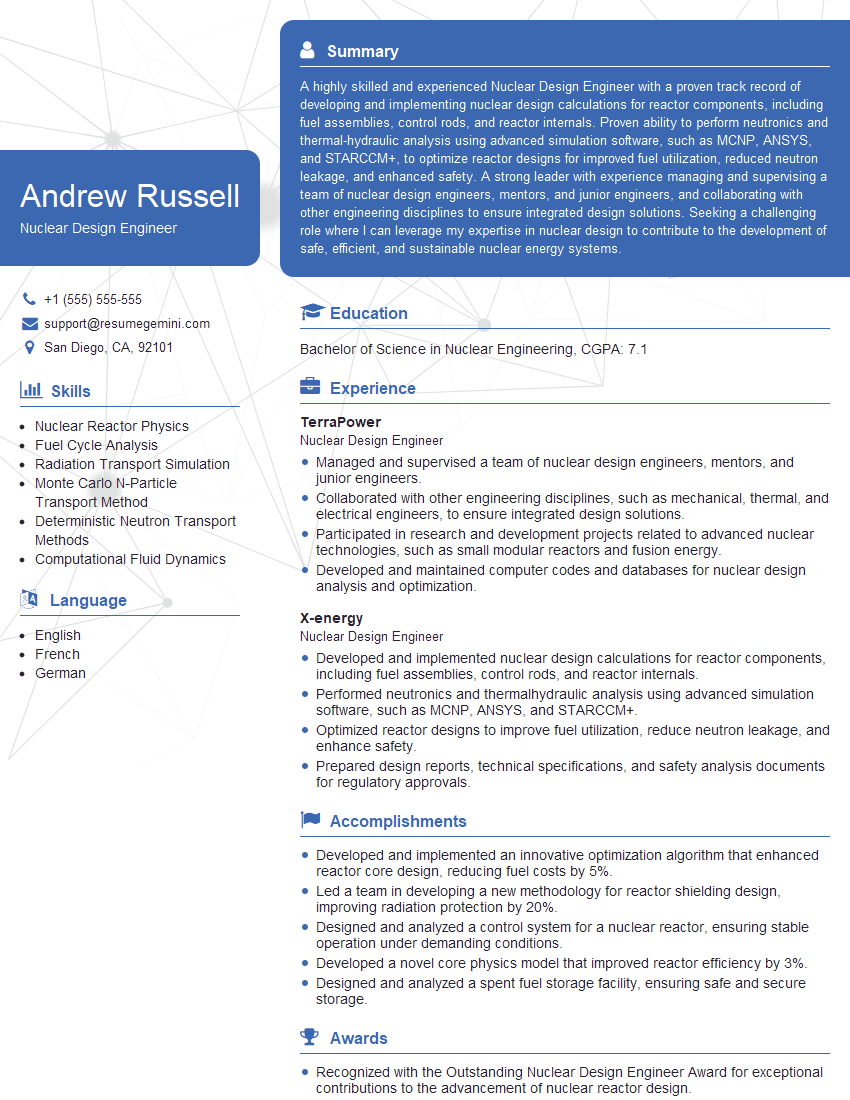
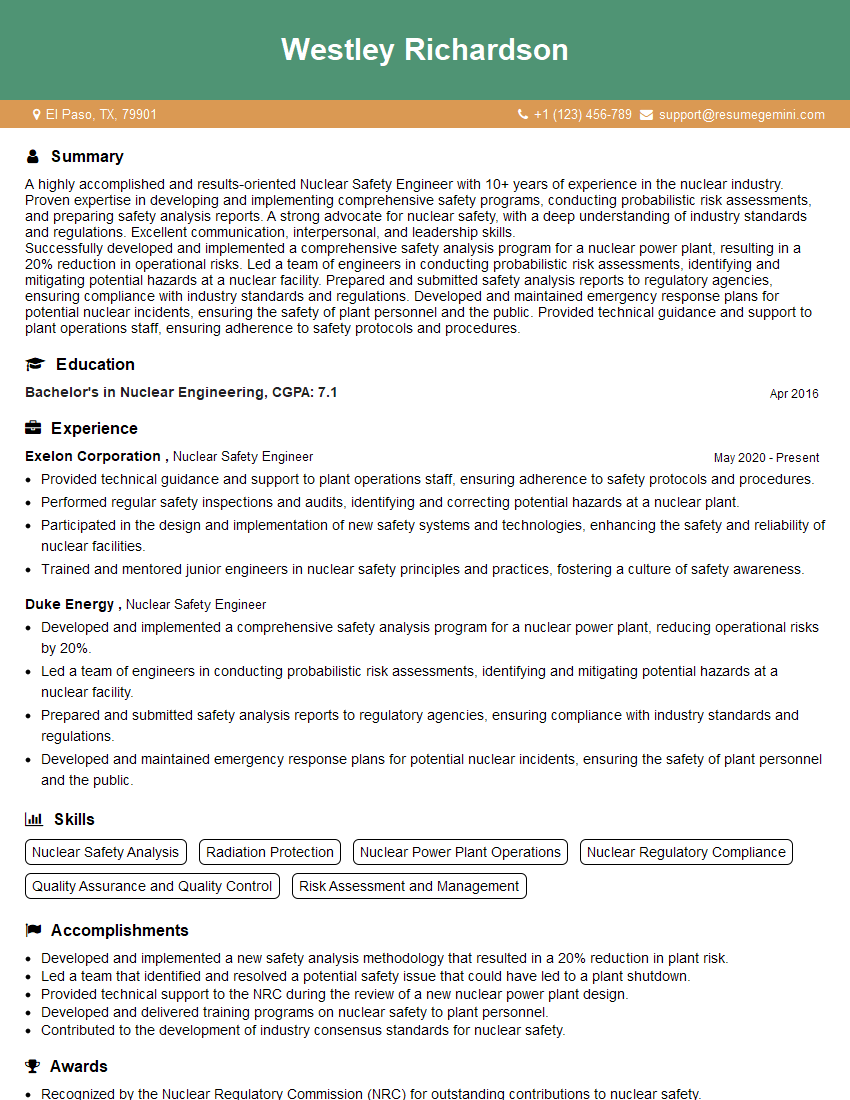
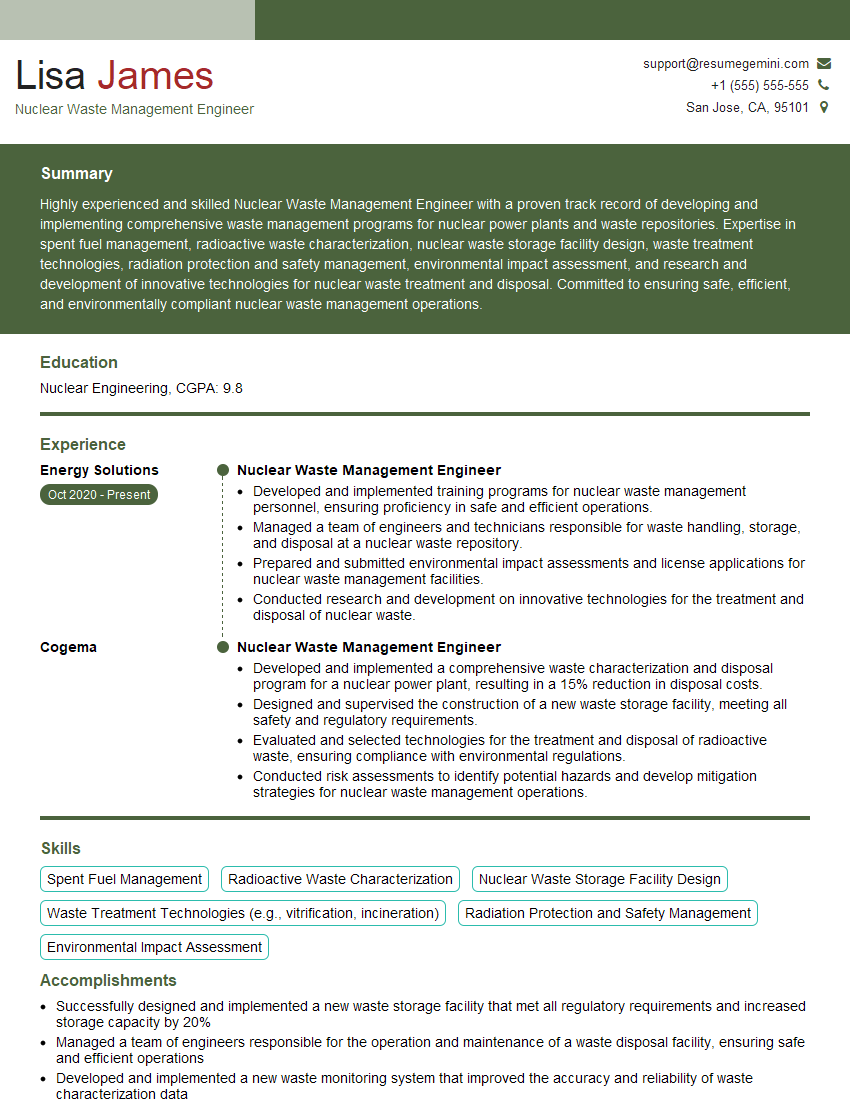
Mastering Nuclear Codes and Standards is crucial for career advancement in the nuclear industry. A strong understanding of these regulations demonstrates your commitment to safety and your technical expertise, opening doors to senior roles and specialized positions. To enhance your job prospects, create an ATS-friendly resume that effectively highlights your skills and experience. ResumeGemini is a trusted resource that can help you build a professional and impactful resume. We offer examples of resumes tailored specifically to the Nuclear Codes and Standards field to help you get started.
Explore more articles
Users Rating of Our Blogs
Share Your Experience
We value your feedback! Please rate our content and share your thoughts (optional).
What Readers Say About Our Blog
Very informative content, great job.
good