The right preparation can turn an interview into an opportunity to showcase your expertise. This guide to Nuclear Qualification interview questions is your ultimate resource, providing key insights and tips to help you ace your responses and stand out as a top candidate.
Questions Asked in Nuclear Qualification Interview
Q 1. Describe the process of qualifying a nuclear component for harsh environments.
Qualifying a nuclear component for harsh environments is a rigorous process ensuring it maintains functionality and safety under extreme conditions. It involves a comprehensive program defining the component’s intended service life and the environmental stresses it will endure within the nuclear power plant. This includes things like radiation, temperature extremes, humidity, and seismic activity.
The process typically begins with defining the component’s design basis. This defines the expected operating parameters and the environmental conditions the component must withstand. Next, we select appropriate qualification standards and testing methods based on the design basis and applicable regulations. We then develop a detailed test plan, outlining the specific tests to be conducted. This often includes accelerated aging tests to simulate the effects of long-term exposure to radiation and environmental stressors. Finally, post-test inspections and evaluations are performed to verify the component’s continued functionality and structural integrity. A comprehensive report documenting the entire process and its results is then prepared, demonstrating compliance with regulatory requirements and ensuring the component’s suitability for its intended application.
For example, a valve used in a reactor coolant system might need to undergo testing that simulates decades of radiation exposure, high temperatures and pressures, and potentially seismic events to ensure it remains leak-tight and operable throughout its intended service life.
Q 2. Explain the difference between qualification testing and verification testing.
Qualification testing and verification testing are distinct but related processes. Qualification testing demonstrates that a component meets its design requirements under specified environmental conditions before it’s used in a nuclear power plant. It’s a comprehensive program proving the component’s fitness for purpose. Verification testing, on the other hand, confirms that a specific component meets the requirements established by the qualification testing program. It is typically performed on the components to be installed.
Think of it like this: Qualification testing is like rigorously testing a new car model in various harsh conditions – extreme temperatures, off-road driving, etc. – to ensure its design is robust. Verification testing is like inspecting each car on the production line to confirm it meets the standards established during the testing of the car model.
Q 3. What are the key regulatory requirements for nuclear component qualification?
Key regulatory requirements for nuclear component qualification are stringent and vary depending on the country and the specific component’s role within the nuclear power plant. However, common threads include compliance with industry codes and standards like ASME, IEEE, and IEC. These standards define the specific testing requirements and acceptance criteria. Furthermore, regulatory bodies like the Nuclear Regulatory Commission (NRC) in the US or equivalent organizations in other countries establish regulations and oversight for the entire qualification process, demanding comprehensive documentation and stringent quality assurance procedures. The requirements are designed to ensure the safety and reliability of the nuclear facility.
For instance, regulatory requirements frequently dictate the types of tests to be performed, the duration of the tests, and the acceptance criteria for passing those tests. Failing to meet these regulatory requirements can lead to significant delays or even rejection of the component.
Q 4. How do you determine the appropriate qualification standards for a specific component?
Determining the appropriate qualification standards for a specific component is a critical step and relies heavily on the component’s function, location within the plant, and the environmental conditions it will face. The process starts with a thorough review of the component’s design specifications, operational parameters, and its location within the nuclear power plant. This information guides the selection of relevant industry standards and regulatory requirements. Industry codes and standards like IEEE Std 323, IEEE Std 344, and ASME Section III provide guidance and specific requirements for many components. Regulatory guidelines often specify required standards for components within specific safety classifications. Engineering judgment plays a crucial role in selecting and interpreting these standards, ensuring that the chosen standards adequately address all potential stressors the component might encounter.
For example, a component located inside the containment building will require qualification against different environmental conditions and higher radiation levels compared to a component outside the containment. The choice of standard will reflect this.
Q 5. What are the different types of qualification testing methods?
Nuclear component qualification utilizes a range of testing methods, tailored to the specific stressors the component will experience. These include:
- Environmental Stress Screening (ESS): A series of tests designed to identify early failures and weaknesses in the component.
- Accelerated Aging Tests: These tests simulate the effects of long-term exposure to harsh environmental conditions, such as high temperature, radiation, and humidity, in a significantly shorter timeframe. This helps predict the component’s performance over its lifespan.
- Seismic Qualification Testing: This rigorously tests the component’s ability to withstand earthquake-induced vibrations.
- Radiation Testing: Exposes the component to various levels of radiation to determine its resistance to radiation damage.
- Thermal Cycling Tests: Subject the component to repeated cycles of temperature extremes to evaluate its ability to withstand thermal shock.
- Vibration Testing: Tests the component’s resistance to vibrations of different frequencies and amplitudes.
The specific methods chosen depend on the component’s design, location within the plant, and the specific environmental conditions it will encounter.
Q 6. Explain the concept of environmental qualification and its importance in nuclear applications.
Environmental qualification is the process of demonstrating that a component will maintain its required functions throughout its intended lifespan under the expected environmental conditions of the nuclear power plant. This is absolutely crucial in nuclear applications because the failure of a single component could have severe safety and economic consequences. It involves a comprehensive evaluation of all environmental factors, including temperature, humidity, radiation, and seismic activity, and testing to ensure that the component can withstand these conditions without compromising performance or safety. The goal is to prevent premature failure and maintain operational reliability.
Imagine a safety-critical system like an emergency core cooling system. Failure during a severe accident could be catastrophic. Environmental qualification ensures that these systems operate reliably even under extreme conditions, providing critical safety.
Q 7. Describe your experience with seismic qualification testing.
My experience with seismic qualification testing encompasses several projects involving various components within nuclear power plants. This involves subjecting components to simulated earthquake motions using specialized testing equipment, such as shake tables. These tables replicate the ground motions expected during a seismic event, allowing us to assess the component’s structural integrity and functional performance under these extreme conditions. The process is guided by specific standards and regulations which dictate the severity and duration of the testing based on the component’s location and importance within the plant. I’ve worked on both qualification testing of new components and requalification testing of existing components following a design modification or regulatory updates.
One particular project involved qualifying a large control valve. We meticulously designed and executed a seismic test plan, ensuring accurate replication of the anticipated seismic forces. The data collected from the testing was then analyzed to verify that the valve could withstand these forces without compromising its sealing integrity or operational functionality. This involved sophisticated instrumentation and data acquisition systems to monitor the valve’s response during the test.
Q 8. How do you manage and document qualification test data?
Managing and documenting qualification test data is crucial for demonstrating compliance and ensuring the long-term reliability of nuclear components. This involves a robust system encompassing data acquisition, analysis, and archival. We employ a structured approach using a combination of electronic and paper-based records, adhering to industry best practices and regulatory requirements.
Data Acquisition: Data is collected using calibrated instruments and automated systems where possible. Raw data, including instrument readings, timestamps, and environmental conditions, is meticulously recorded. We leverage dedicated software for data acquisition and analysis, ensuring data integrity and traceability.
Data Analysis: Statistical methods are applied to analyze the data, determining whether components meet predefined acceptance criteria. Detailed reports are generated, including graphs, charts, and statistical summaries. Any deviations from expected results are thoroughly investigated.
Data Archival: Data is archived in a secure and accessible location, compliant with regulations like 10 CFR Part 21 (for US-based projects) or equivalent international standards. This often involves both physical and electronic storage, with version control mechanisms to track any changes.
Example: During a seismic qualification test, we’d meticulously record accelerometer readings at various points on the component throughout the test. This raw data is then processed to generate acceleration time histories, frequency response spectra, and ultimately a report demonstrating the component’s ability to withstand the specified seismic loads.
Q 9. How do you address discrepancies or failures during qualification testing?
Discrepancies or failures during qualification testing are thoroughly investigated using a structured root cause analysis. This process aims to understand the underlying cause of the failure and to implement corrective actions to prevent recurrence. We typically follow a systematic approach such as the 5 Whys or Fishbone diagrams.
Investigation: A team of experts reviews the test data, procedures, and equipment to identify potential causes. This might involve examining the component itself for damage, reviewing environmental monitoring data, and analyzing instrument calibration records.
Root Cause Analysis: Techniques such as the 5 Whys (repeatedly asking “Why?” to drill down to the root cause) or the Ishikawa diagram (Fishbone diagram) are employed to systematically identify the underlying reasons for the failure.
Corrective Actions: Once the root cause is identified, corrective actions are implemented. This might involve redesigning the component, improving manufacturing processes, modifying the test procedure, or recalibrating equipment. These actions are documented and verified.
Retesting: Retesting is often necessary to demonstrate that the corrective actions have effectively addressed the failure. This may involve retesting only the affected aspects or a full repetition of the original qualification tests.
Example: If a component fails a thermal cycling test due to a material weakness, we would investigate the material specification, manufacturing process, and potential weaknesses in the design. Corrective actions might include using a different, more robust material, tightening manufacturing tolerances, or redesigning the component to better manage thermal stresses. The component would then undergo retesting to ensure it meets the requirements.
Q 10. Explain the process of qualification by analysis.
Qualification by analysis is a method used to demonstrate the qualification of components without conducting extensive physical testing. It relies on engineering calculations, simulations, and established industry standards to predict the component’s performance under various conditions. This method is often used when physical testing is impractical, cost-prohibitive, or destructive.
Analytical Methods: This approach uses analytical methods like finite element analysis (FEA), computational fluid dynamics (CFD), or other relevant engineering calculations. These models predict the component’s behavior under various conditions, including aging and environmental stressors.
Justification: A detailed justification document is prepared, outlining the analytical methods used, the assumptions made, and the validation of the analytical models. This document demonstrates the confidence level in the analysis and shows that the methods used are appropriate for the specific component and application.
Code Compliance: The analysis must demonstrate compliance with relevant codes and standards, such as ASME Section III or equivalent international standards.
Verification and Validation: The analytical methods used must be verified and validated. Validation might involve comparing analytical predictions with the results of physical tests on similar components or sub-components, or by using well-established benchmarking data.
Example: Instead of physically testing a complex valve assembly under seismic loads, FEA could be used to model the valve’s response to seismic events. The results of this analysis, along with justification, would form the basis of the qualification.
Q 11. What is the role of aging degradation in nuclear component qualification?
Aging degradation is a critical factor in nuclear component qualification, as components are expected to function reliably over decades. This requires consideration of various degradation mechanisms that can affect component performance and safety. Accelerated aging tests are often used to simulate the effects of long-term exposure to environmental factors and operational stresses.
Degradation Mechanisms: Nuclear components can degrade due to various factors, including radiation damage, thermal aging, chemical attack, and mechanical stress. The specific degradation mechanisms depend on the component material and operating environment.
Accelerated Aging Tests: These tests subject components to intensified environmental conditions to simulate decades of aging in a shorter time frame. This might involve increased radiation doses, higher temperatures, or cyclic loading. The choice of acceleration factors requires careful justification and is based on established models and data.
Predictive Modeling: Models are used to extrapolate the results of accelerated aging tests to predict long-term performance. This requires understanding the kinetics of the degradation mechanisms and using appropriate acceleration factors.
Example: For an electrical cable, accelerated aging might involve exposure to high temperatures and radiation to simulate decades of operation in a nuclear power plant. Regular testing during the accelerated aging process allows us to track degradation, extrapolate its effects to the component’s lifetime, and ensure it remains within safety limits.
Q 12. How do you ensure the traceability of qualification activities?
Traceability in nuclear qualification is paramount for ensuring that all activities are documented, verifiable, and auditable. This is achieved through a comprehensive system that links all aspects of the qualification process, from initial design specifications to final qualification reports.
Unique Identifiers: Each component, test, and document is assigned a unique identifier. This allows tracking the component’s entire journey through the qualification process.
Document Control System: A formal document control system ensures that all documents are version-controlled, approved, and readily accessible. This includes test plans, procedures, data sheets, reports, and engineering drawings.
Electronic Data Management: Utilizing electronic data management systems allows for efficient tracking and retrieval of all data related to the qualification process. This includes raw data, analysis results, and reports.
Calibration Records: All instruments and equipment used for testing must be calibrated and traceable to national or international standards. Calibration records are maintained to demonstrate the accuracy of the measurement data.
Example: A unique serial number is assigned to each component undergoing qualification testing. This number is linked to all associated documents, test data, and inspection reports, creating a complete and auditable record of its qualification status.
Q 13. Explain the importance of independent verification and validation in nuclear qualification.
Independent verification and validation (IV&V) in nuclear qualification is essential for ensuring the quality, safety, and reliability of nuclear components. An independent team, separate from those responsible for the qualification activities, reviews and verifies the work performed to ensure its accuracy, completeness, and compliance with regulatory requirements.
Independent Review: The IV&V team independently reviews all aspects of the qualification process, including test plans, procedures, data analysis, and reports. This involves checking for errors, omissions, and inconsistencies.
Verification of Compliance: The team verifies that all activities comply with relevant codes, standards, and regulations. This includes reviewing the justification for deviations from established procedures or standards.
Validation of Methods: The IV&V team assesses the validity and appropriateness of the methods used for qualification. This might involve reviewing the rationale behind the selection of test methods and ensuring that they are appropriate for the specific component and application.
Auditing: The IV&V process often includes auditing to ensure that the quality system for qualification is effectively implemented and maintained. This may involve on-site inspections and document reviews.
Example: An independent team might review the analysis and results of a seismic qualification test. They would independently verify the accuracy of the calculations, assess the appropriateness of the analytical models, and confirm that the results meet the acceptance criteria, ensuring unbiased verification of compliance.
Q 14. What are the common failure modes in nuclear components?
Nuclear components are subjected to harsh operating environments and experience a variety of stress conditions. Common failure modes include:
Fatigue Failure: Repeated cyclic loading can lead to fatigue crack initiation and propagation, eventually causing component failure. This is particularly relevant for components operating under vibration or thermal cycling.
Stress Corrosion Cracking (SCC): The combined action of tensile stress and a corrosive environment can lead to SCC. This is a critical concern for many materials used in nuclear applications.
Creep Rupture: High-temperature operation can cause creep deformation, leading to eventual rupture. This is a major concern for components operating at elevated temperatures.
Radiation Damage: Exposure to radiation can embrittle materials, reducing their ductility and toughness and increasing the risk of brittle fracture. This is a significant concern for components located in the reactor core or near the radiation fields.
Thermal Shock: Rapid temperature changes can cause thermal stresses, leading to cracking or failure. This is a concern for components subjected to thermal transients.
Wear and Tear: Mechanical wear and tear can degrade the performance of components such as bearings, seals, and valves.
Understanding these failure modes is critical for designing and qualifying components that can reliably withstand the harsh conditions encountered in nuclear power plants. The qualification process addresses these potential failure modes through rigorous testing and analysis to ensure long-term reliability and safety.
Q 15. How do you ensure that qualified components maintain their performance over their lifetime?
Ensuring qualified components maintain performance throughout their lifespan involves a multifaceted approach focusing on robust design, rigorous testing, and diligent monitoring. It’s like building a house – you wouldn’t just build it; you’d ensure its foundation is strong, the materials are durable, and you’d regularly inspect it for any signs of wear and tear.
- Aging Management Programs: These programs predict and mitigate the effects of aging on components. This includes things like accelerated aging tests simulating decades of operation in a matter of weeks or months. For example, we might expose components to high temperatures, radiation, and humidity to assess their degradation over time.
- Preventive Maintenance: Regular inspections and maintenance are crucial. This can involve visual inspections, lubrication, and even component replacements before they fail, minimizing downtime and risk.
- Condition Monitoring: Employing sensors and data analytics to monitor the health of components in real-time. We can look at vibration levels, temperature readings, and other metrics to detect anomalies that might indicate impending failure. For example, a sudden increase in vibration in a pump could signal a bearing problem that needs attention before it leads to catastrophic failure.
- Robust Design and Material Selection: Choosing materials and designs that are inherently resistant to degradation from the expected operational environment is paramount. This includes selecting materials resistant to radiation embrittlement or corrosion.
All these strategies work together to form a holistic approach, providing layers of protection and ensuring the long-term reliability and safety of the components.
Career Expert Tips:
- Ace those interviews! Prepare effectively by reviewing the Top 50 Most Common Interview Questions on ResumeGemini.
- Navigate your job search with confidence! Explore a wide range of Career Tips on ResumeGemini. Learn about common challenges and recommendations to overcome them.
- Craft the perfect resume! Master the Art of Resume Writing with ResumeGemini’s guide. Showcase your unique qualifications and achievements effectively.
- Don’t miss out on holiday savings! Build your dream resume with ResumeGemini’s ATS optimized templates.
Q 16. What are your experiences with different qualification standards (e.g., IEEE, IEC)?
My experience spans various qualification standards, primarily IEEE and IEC standards, which are widely used in the nuclear industry. While they share the goal of ensuring safety and reliability, they differ in their approach and specifics.
- IEEE Standards: I’ve worked extensively with standards like IEEE Std 323-1974 (now superseded but influential) and its successors, which focus on qualifying safety-related equipment in nuclear power plants. These standards often emphasize detailed testing procedures and documentation.
- IEC Standards: I’ve also been involved in projects using IEC 61225 and related standards. These standards often have a broader scope, covering a wider range of industries but providing a robust framework for qualification adaptable to the nuclear context. The emphasis here is often on environmental testing and demonstrating compliance through rigorous testing.
Understanding the nuances between these standards and their application to different components is key. For example, the qualification of a circuit breaker would require a different approach compared to the qualification of a valve. The choice of standard also depends on regulatory requirements and project-specific needs. I’ve often found myself bridging the gap between standards, leveraging best practices from both to create a comprehensive qualification program.
Q 17. Describe your experience with software qualification in a nuclear context.
Software qualification in the nuclear industry is incredibly rigorous, demanding a high level of confidence in the software’s reliability and safety. Unlike commercial software, which might tolerate minor glitches, nuclear software errors can have catastrophic consequences.
My experience includes participation in the development and qualification of software used in safety systems, including:
- Verification and Validation: Rigorous testing, including unit testing, integration testing, and system testing, to ensure the software behaves as intended. Formal methods and model-checking can also play an important role. For instance, we used formal methods to verify the absence of deadlocks in a critical control loop.
- Software Safety Analysis: Employing techniques like Hazard Analysis and Critical Control Point (HACCP) to identify potential hazards and design mitigation strategies. Fault-tree analysis is commonly used to estimate the probability of software-induced failures.
- Independent Verification and Validation (IV&V): Engaging independent experts to review the software development process and the qualified software to ensure objectivity and compliance with safety standards.
A significant aspect of my role involved documenting every step of the software development lifecycle, ensuring complete traceability and facilitating audits. This level of meticulousness is essential to meeting the stringent requirements of nuclear regulators.
Q 18. How do you handle unexpected results during qualification testing?
Unexpected results during qualification testing are not uncommon, and handling them effectively is crucial. It requires a systematic and rigorous approach to ensure that the root cause is identified and addressed appropriately.
- Immediate Action: Secure the test setup to prevent further damage. This includes powering down equipment or isolating the failed component to prevent cascading failures. Thoroughly document all observations and measurements.
- Root Cause Analysis: This is paramount. A root cause analysis might involve reviewing the test procedure, the design of the component, and even the manufacturing process to identify potential contributing factors. Tools like Fishbone diagrams are helpful in structuring this process.
- Corrective Actions: Based on the root cause analysis, identify and implement necessary corrective actions. This may involve design modifications, changes to the testing procedure, or even rejection of the tested component. These actions need to be fully documented.
- Retesting: Once corrective actions are in place, comprehensive retesting is required to demonstrate the effectiveness of the changes. This may involve repeating the original test or conducting additional tests to address the identified weaknesses.
- Reporting: All findings, corrective actions, and retest results need to be documented in a detailed report for review by the relevant stakeholders and regulatory bodies.
The goal isn’t merely to fix the immediate problem, but to learn from the experience and improve the qualification process for future projects. Unexpected results often highlight areas for improvement in design, testing, or even manufacturing.
Q 19. Explain the significance of safety margins in nuclear component qualification.
Safety margins are critical in nuclear component qualification, providing an extra layer of protection against unexpected events or uncertainties. They’re a buffer against potential failures or deviations from expected performance.
Think of it like building a bridge with a significantly higher load-bearing capacity than anticipated traffic. The extra capacity accounts for unexpected loads like heavy snowfall or even a minor design flaw that might slightly reduce the bridge’s strength.
- Design Margins: These account for uncertainties in material properties, manufacturing tolerances, and potential degradation mechanisms. The design should exceed the anticipated operating conditions by a significant factor.
- Testing Margins: Qualification tests are often designed to stress components beyond their anticipated operating limits. This allows for identification of potential weaknesses under extreme conditions. For example, subjecting a valve to significantly higher pressure or temperature than its expected operating range can help unveil potential flaws.
- Operational Margins: Operational procedures and safety systems must include margins to manage unexpected events. This might involve having redundant systems or procedures that allow for safe shutdown even if a component malfunctions.
Safety margins are not arbitrary; they are based on engineering analyses and probabilistic risk assessments. The level of safety margin is often influenced by the safety significance of the component and the potential consequences of failure.
Q 20. Describe your understanding of the nuclear regulatory process.
The nuclear regulatory process is extremely stringent, aimed at ensuring the safe operation of nuclear facilities. This involves a multi-stage process with several key stakeholders:
- Licensing: Obtaining a license to operate a nuclear facility requires demonstrating compliance with rigorous safety standards and regulations. This involves extensive documentation, design reviews, and independent audits.
- Inspections and Audits: Regulatory bodies conduct regular inspections and audits to verify compliance with licensing conditions and safety standards. These inspections often involve review of operational procedures, maintenance records, and component qualification documentation.
- Reporting: Operators are required to regularly report operational data, maintenance activities, and any incidents or unusual events to the regulatory bodies. This enables continuous monitoring of safety performance.
- Enforcement: Regulatory bodies have the authority to enforce compliance with regulations, which may include imposing fines, issuing corrective action orders, or even suspending operations in case of significant safety concerns.
The process is designed to be transparent and accountable. It involves significant interaction between operators, regulatory bodies, and independent experts, ensuring a thorough review of safety aspects throughout the lifecycle of a nuclear facility.
Q 21. What are some common challenges faced during nuclear component qualification?
Nuclear component qualification presents several unique challenges, many stemming from the extreme operating conditions and the critical safety implications:
- Extreme Environments: Nuclear facilities expose components to high radiation levels, extreme temperatures, and corrosive environments. Simulating these conditions accurately during qualification testing can be challenging and expensive.
- Long Lifespans: Components in nuclear facilities are expected to operate reliably for decades. Predicting long-term degradation and ensuring performance over such extended periods necessitates sophisticated aging management strategies and accelerated testing techniques.
- Data Acquisition and Analysis: Collecting accurate and reliable data during qualification testing, especially under extreme environmental conditions, presents considerable challenges. Advanced instrumentation and rigorous data analysis techniques are crucial.
- Cost and Time Constraints: Nuclear qualification is inherently costly and time-consuming. Balancing the need for rigorous testing with project budgets and timelines requires careful planning and management.
Effectively addressing these challenges requires a multidisciplinary team with expertise in engineering, materials science, radiation effects, and regulatory compliance.
Q 22. How do you ensure the integrity of the qualification process?
Ensuring the integrity of the nuclear qualification process is paramount. It’s like building a skyscraper – you can’t compromise on the foundation. We achieve this through a multi-layered approach.
- Rigorous Test Plans: Detailed plans outlining the specific tests, environmental conditions (temperature, radiation, humidity, vibration), and acceptance criteria are meticulously developed and reviewed by multiple experts. This ensures all relevant aspects are considered.
- Traceability and Documentation: Every step, from initial design to final testing, is meticulously documented. This includes calibration records for equipment, detailed test procedures, raw data, and analysis reports. This complete audit trail allows for verification and validation at any point.
- Independent Verification and Validation (IV&V): An independent team reviews the qualification process and results. This adds an objective layer of assurance, ensuring no biases or errors have slipped through.
- Adherence to Standards and Regulations: We strictly adhere to relevant industry standards like IEEE, IEC, and regulatory guidelines from bodies like the NRC (Nuclear Regulatory Commission) or equivalent international organizations. These standards provide a framework for consistent and reliable qualification.
- Qualified Personnel: The entire process is managed and executed by highly trained and experienced personnel with specific expertise in nuclear qualification testing and methodology.
For example, in qualifying a safety-related valve, we would not only test its functionality under normal operating conditions but also simulate seismic events, loss-of-coolant accidents (LOCAs), and prolonged exposure to radiation to ensure it continues to function reliably even under extreme stress.
Q 23. Describe your experience with root cause analysis for qualification test failures.
Root cause analysis (RCA) after a qualification test failure is critical. It’s not just about fixing the immediate problem; it’s about preventing future failures. I’ve utilized various RCA methodologies, including the ‘5 Whys’ and Fault Tree Analysis (FTA).
For instance, during the qualification of a pressure sensor, we experienced a failure during the high-radiation test. Applying the ‘5 Whys’ revealed the following:
- Why did the sensor fail? Because the internal wiring insulation degraded.
- Why did the insulation degrade? Due to exposure to high-energy radiation.
- Why did the radiation affect the insulation? Because the chosen material wasn’t radiation-hardened.
- Why wasn’t a radiation-hardened material used? Due to an oversight in the material selection process.
- Why was there an oversight? Inadequate review of the material specifications during design.
This RCA identified a fundamental design flaw, leading to a change in material selection and a more robust design review process for future qualifications. FTA would have helped visualize the various potential failure modes and their contributing factors to provide a more comprehensive analysis.
Q 24. Explain your understanding of probabilistic risk assessment related to nuclear qualification.
Probabilistic risk assessment (PRA) plays a vital role in nuclear qualification. Unlike deterministic methods that focus on single failure points, PRA considers a range of potential failure scenarios and their likelihoods. It’s about quantifying the risk, not just identifying it.
In a nuclear power plant, PRA might be used to assess the probability of failure of a specific component, like a control rod drive mechanism, under various operating conditions. This involves identifying potential failure modes (e.g., mechanical failure, electrical failure), estimating their probabilities, and calculating the consequences of each failure. This allows for a more comprehensive understanding of risk and informed decision-making in selecting qualification requirements and mitigation strategies.
The output of a PRA, often expressed as a risk curve, helps prioritize resources towards the most critical components or systems. This ensures the qualification efforts are focused on areas with the highest potential impact on plant safety. Software tools like RELAP5 or other event tree and fault tree analysis software are commonly used for these kinds of analyses.
Q 25. How do you balance cost and risk in the qualification process?
Balancing cost and risk in nuclear qualification is a delicate act. Over-qualification can be expensive and unnecessary, while under-qualification can lead to catastrophic consequences. The key is to find the optimal balance. This involves a risk-informed approach.
We utilize a cost-benefit analysis considering factors like:
- Severity of potential consequences: A component with a high potential for causing a significant accident requires more rigorous qualification, regardless of cost.
- Probability of failure: Components with a high probability of failure justify more extensive testing and analysis to reduce the risk.
- Cost of failure: The potential cost associated with a failure (e.g., repair, downtime, potential environmental damage) is weighed against the cost of additional qualification testing.
For instance, we might opt for a less extensive qualification program for a low-risk component but invest heavily in qualifying critical safety systems. This targeted approach ensures that resources are allocated effectively to mitigate the most significant risks within budgetary constraints.
Q 26. What software tools are you familiar with for nuclear qualification?
My experience encompasses a range of software tools relevant to nuclear qualification. These tools assist in data acquisition, analysis, and reporting. Examples include:
- Data acquisition software: LabVIEW, DASYLab – for acquiring data from environmental test chambers and other equipment.
- Finite Element Analysis (FEA) software: ANSYS, ABAQUS – for simulating the structural integrity of components under stress.
- Reliability analysis software: Reliasoft, Weibull++ – for assessing component reliability and predicting failure rates.
- Radiation transport codes: MCNP, FLUKA – for simulating radiation effects on materials and components.
- Specialized qualification software: Various commercial software packages specifically designed for managing and reporting nuclear qualification tests.
Proficiency with these tools enables efficient data processing, accurate analysis, and the creation of comprehensive qualification reports.
Q 27. Describe your experience with qualification reports and documentation.
Qualification reports and documentation are the lifeblood of the process – they provide irrefutable evidence that components meet the required standards. My experience includes:
- Creating comprehensive reports: These reports document the entire qualification process, including test plans, procedures, raw data, analysis, and conclusions. They follow standardized formats to ensure clarity and consistency.
- Maintaining traceability: Each test result is linked back to the design specifications, test procedures, and equipment calibration records, creating a seamless audit trail.
- Ensuring regulatory compliance: Reports are prepared in accordance with applicable regulatory requirements and industry standards, ensuring they can withstand scrutiny.
- Utilizing document control systems: I’m experienced in using document control software to manage revisions, approvals, and distribution of documents, preventing version control issues.
A well-structured qualification report not only demonstrates the component’s fitness for purpose but also ensures legal compliance and provides valuable information for future maintenance and upgrades.
Q 28. How do you stay up-to-date with changes in nuclear qualification standards and regulations?
Staying current with evolving nuclear qualification standards and regulations is crucial. This is an ever-changing landscape.
- Professional Organizations: Active membership in professional organizations like the American Nuclear Society (ANS) or the Institute of Nuclear Materials Management (INMM) provides access to the latest industry developments and best practices. Conferences and workshops are invaluable.
- Regulatory Websites: Regularly reviewing the websites of regulatory bodies like the NRC (in the US) or equivalent international organizations ensures awareness of any updates or changes in regulations.
- Industry Publications: Keeping up-to-date with relevant journals, magazines, and technical papers allows access to cutting-edge research and industry trends.
- Training Courses: Participation in continuing education courses and workshops provides in-depth knowledge on new techniques and standards.
- Networking: Attending industry conferences and engaging with colleagues allows for the exchange of information and insights.
Staying informed not only enhances my professional capabilities but also ensures that our qualification programs remain compliant and effective.
Key Topics to Learn for Nuclear Qualification Interview
- Reactor Physics: Understanding nuclear chain reactions, criticality, and reactor control mechanisms. Practical application: Analyzing reactor power levels and safety parameters.
- Nuclear Fuel Cycle: Knowledge of uranium enrichment, fuel fabrication, spent fuel management, and waste disposal. Practical application: Evaluating the environmental impact of different fuel cycle stages.
- Radiation Protection and Shielding: Principles of radiation safety, shielding design, and ALARA (As Low As Reasonably Achievable) principles. Practical application: Calculating radiation doses and designing effective shielding for personnel and equipment.
- Nuclear Reactor Systems: Familiarity with different reactor types (PWR, BWR, CANDU, etc.), their components, and operational principles. Practical application: Troubleshooting reactor system malfunctions and ensuring safe operation.
- Nuclear Instrumentation and Control: Understanding the systems used for monitoring and controlling reactor parameters. Practical application: Interpreting data from reactor instrumentation and taking appropriate actions.
- Nuclear Safety and Regulations: Knowledge of relevant safety regulations and procedures. Practical application: Implementing safety protocols and ensuring compliance with regulatory requirements.
- Nuclear Decommissioning: Understanding the process of safely dismantling and disposing of nuclear facilities. Practical application: Planning and executing decommissioning projects.
- Problem-Solving and Analytical Skills: Demonstrating the ability to analyze complex problems, identify root causes, and develop effective solutions. Practical application: Handling unexpected events during reactor operation and maintaining safety.
Next Steps
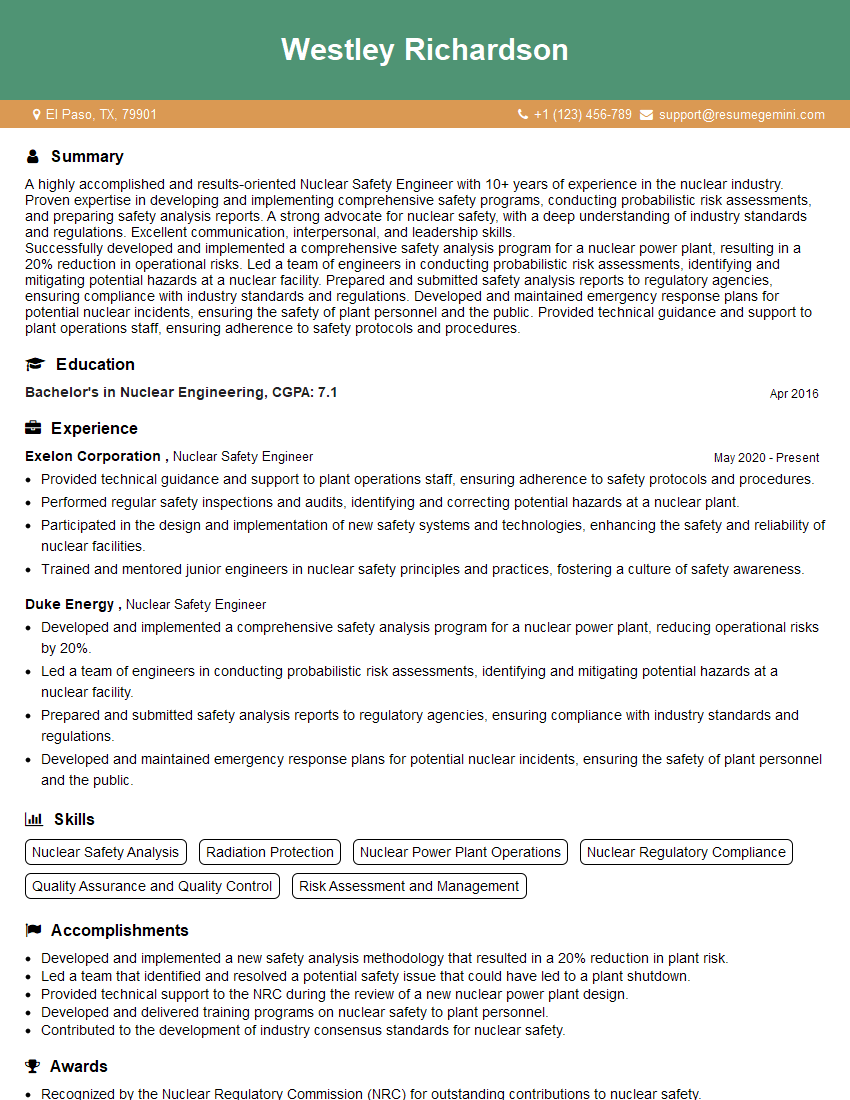
Mastering Nuclear Qualification opens doors to exciting and impactful careers in a vital industry. Your expertise in nuclear technology is highly sought after, offering excellent growth potential and the chance to contribute to a safer and more sustainable energy future. To maximize your job prospects, crafting a compelling and ATS-friendly resume is crucial. ResumeGemini is a trusted resource that can help you build a professional and effective resume tailored to the specific requirements of the Nuclear Qualification field. Examples of resumes specifically designed for Nuclear Qualification roles are available to guide you. Take the next step towards your dream career – create a resume that showcases your skills and experience effectively.
Explore more articles
Users Rating of Our Blogs
Share Your Experience
We value your feedback! Please rate our content and share your thoughts (optional).
What Readers Say About Our Blog
Very informative content, great job.
good